Proceedings of the Fourteenth Workshop on Innovative Use of NLP for Building Educational Applications, pages 127–133 127
The Unreasonable Effectiveness of Transformer Language Models in
Grammatical Error Correction
Dimitris Alikaniotis Vipul Raheja Grammarly
New York City, NY
Abstract
Recent work on Grammatical Error Correc-tion (GEC) has highlighted the importance of language modeling in that it is certainly pos-sible to achieve good performance by com-paring the probabilities of the proposed edits. At the same time, advancements in language modeling have managed to generate linguistic output, which is almost indistinguishable from that of human-generated text. In this paper, we up the ante by exploring the potential of more sophisticated language models in GEC and offer some key insights on their strengths and weaknesses. We show that, in line with recent results in other NLP tasks, Transformer architectures achieve consistently high perfor-mance and provide a competitive baseline for future machine learning models.
1 Introduction
Transformer models (Vaswani et al.,2017) trained on large-scale language modeling datasets have re-cently proved to be a very effective means of rep-resenting the meaning of a sentence, being put to effective use in fine-tuning both sentence-level tasks, such as the GLUE benchmark (Wang et al., 2018) and token-level tasks, such as Named Entity Recognition (Devlin et al., 2019). Recent work has also found them to produce linguistically valid representations (Goldberg,2019), as well as to dis-play excellent performance across multiple down-stream NLP tasks (e.g.,Houlsby et al. 2019).
In this work, we explore how such models per-form in the task of Grammatical Error Correc-tion (GEC). While there is a substantial amount of work on statistical (Rozovskaya and Roth, 2016; Junczys-Dowmunt and Grundkiewicz,2014; Yan-nakoudakis et al., 2017) and neural (Ji et al., 2017;Xie et al., 2016;Yuan and Briscoe, 2016; Chollampatt et al., 2016; Chollampatt and Ng, 2017; Sakaguchi et al., 2017; Chollampatt and
Ng,2018) machine translation methods for GEC, we follow the approach of Bryant and Briscoe (2018) and explore how such models would fare in this task when treated as simple language mod-els. More specifically,Bryant and Briscoe(2018) train a 5-gram language model on the One Bil-lion Word Benchmark (Chelba et al.,2013) dataset and find that it produces competitive baseline re-sults without any supervised training. In our work, we extend this work by substituting the n-gram model for several publicly available implemen-tations of state-of-the-art Transformer language models trained on large linguistic corpora and as-sess their performance on GEC without any super-vised training. We find that Transformer language models produce results on par with supervised ap-proaches providing a solid baseline system. This finding is of particular importance in GEC, where data collection and annotation requires substantial manual effort.
2 Related Work
The idea of using language models is quite funda-mental to the task of Grammatical Error Correc-tion, which has fed a substantial body of work over the years. More recently, with the availability of web-scale data powering the advances in language modeling, among most of the other advances in NLP, a plethora of language-modeling based ap-proaches have been proposed for the GEC task. Gamon et al. (2008); Matthieu Hermet and Sz-pakowicz(2008) andYi et al.(2008) were some of the early works to successfully leverage language models trained on large amounts of web-scale data into a GEC system, reinforcing the idea that sim-ple models and a lot of data trump more elabo-rate models based on annotated data (Halevy et al., 2009).
language-models have been proposed for the GEC task (Park and Levy,2011;Dahlmeier and Ng,2012a), either relying entirely on LMs or using them for fine-tuning their systems. Many of the top-ranked systems in the CoNLL-2013 and 2014 GEC shared tasks (Ng et al., 2013, 2014), were either based on language models or had them as integral parts of their systems (Kao et al., 2013; Yoshimoto et al., 2013; Xing et al., 2013; Lee and Lee, 2014; Junczys-Dowmunt and Grund-kiewicz,2014). LM-only approaches though took a backseat and were only sporadically used after the shared tasks, as Neural Machine Translation-based approaches took over, but LMs remained an integral part of the GEC systems (Junczys-Dowmunt and Grundkiewicz,2016;Ji et al.,2017; Xie et al., 2016;Junczys-Dowmunt et al., 2018; Chollampatt and Ng,2018). However,Bryant and Briscoe (2018) recently revived the idea, achiev-ing competitive performance with the state-of-the-art, demonstrating the effectiveness of the ap-proaches to the task without using any annotated data for training.
3 Methodology
In this work, we follow the setup from Bryant and Briscoe (2018) substituting the 5-gram lan-guage model for different lanlan-guage models based on the Transformer architecture. Specifically, we use Google’s BERT (Devlin et al.,2019) and Ope-nAI’s GPT (Radford et al.,2018) and GPT-2 (Rad-ford et al.,2019).1While all these are best thought of as language models in that they have been trained to predict an element in a sequence, they use slightly different objectives which does not make them directly comparable. Specifically, GPT and GPT-2 have been trained with a classic lan-guage modeling objective, whereby they predict the next word in a sequence, whereas BERT has been trained using a masked language modeling objective in which the network attempts to predict masked words in the sentence.
We extract the probability of a sentence from BERT, by iteratively masking every word in the sentence and then summing the log probabilities. While this approach is far from ideal, it has been shown (Wang and Cho,2019) that it approximates the log-likelihood of a sentence.
1https://github.com/huggingface/
pytorch-pretrained-BERT/
Test set Sent. Tokens Annot.
CoNLL-2014 1,312 30k 2
[image:2.595.319.513.64.115.2]FCE 2,715 47k 1
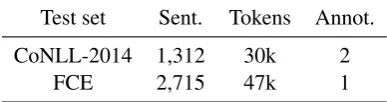
Table 1: Statistics for evaluation data
3.1 Confusion sets
Since our systems do not generate novel se-quences, we followBryant and Briscoe(2018) and use simple heuristics to generate a confusion set of sentences that our language models score. For prepositions and determiners, the confusion set in-cludes the set of all prepositions and determiners plus an empty stringto remove unnecessary ad-ditions. For morphological errors (e.g., past tense or pluralization), we use the Automatically Gener-ated Inflection Database (AGID) which contains different morphological forms for each word.2 However, we notice that due to the automatic gen-eration, AGID contains errors that might prop-agate into our scoring. The problem with in-troducing new errors and non-words is that they would be interpreted as unknown words (hence-forth[UNK]s) from the model’s perspective. An unknown word in some context might give higher probabilities to an erroneous sentence and cause the model not to select the correct alternative. To remedy this issue, we generate a vocabulary from all the training sets and make sure that any pro-posed words which do not exist in the vocabulary are replaced by[UNK]s. Note that there is no rea-son to re-use the vocabulary of the training sets as any large English wordlist would achieve a simi-lar effect. Finally, for spelling mistakes, we, again, followBryant and Briscoe(2018) and use CyHun-Spell3to generate alternatives for non-words.
3.2 Thresholding
Given that our confusion set is prone to errors (due to its automatic generation procedure) as well as the fact that we cannot target all potential errors (e.g., insertions), we bias our method to prefer the original sentence unless a much better the al-ternative is found. We quantify this margin by imposing a threshold above which we accept a candidate sentence as a better alternative. Con-cretely, let P(sc) be the probability of the can-didate sentence and P(so) the probability of the
2
http://wordlist.aspell.net/other/
ERRANT M2
Dataset System P R F0.5 P R F0.5
CoNLL-2014
Felice et al.(2014)† - - - 39.71 30.10 37.33
Yannakoudakis et al.(2017) - - - 58.79 30.63 49.66
Chollampatt and Ng(2017) - - - 62.74 32.96 53.14
Chollampatt and Ng(2018) - - - 65.49 33.14 54.79
Ge et al.(2018) - - - 74.12 36.30 61.34
Bryant and Briscoe(2018) 36.62 19.93 31.37 40.56 20.81 34.09
BERT 33.27 27.14 31.83 35.69 27.99 33.83
GPT-1 49.58 27.06 42.5 51.08 27.45 43.57
GPT-2 57.73 24.75 45.58 58.51 24.9 46.08
FCE
Yannakoudakis et al.(2017) - - - 65.03 32.45 54.15
Bryant and Briscoe(2018) 41.92 13.62 29.61 44.78 14.12 31.22
BERT 29.56 34.67 30.46 31.97 35.01 32.53
GPT-1 62.75 32.19 52.74 64.01 32.33 53.52
[image:3.595.72.520.64.257.2]GPT-2 61.91 33.47 52.92 62.64 33.74 53.48
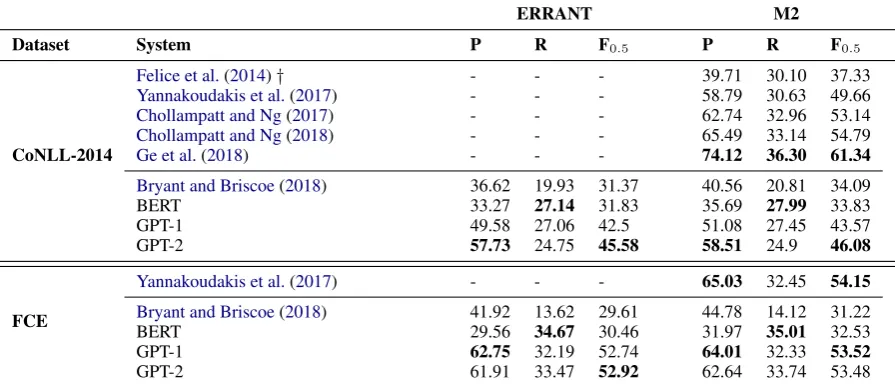
Table 2: Results of our Transformer-Language Model approach against similar approaches (Bryant and Briscoe,
2018) and state-of-the-art on Grammatical Error Correction. For each of the datasets, we use the corresponding test set, and we do not train our models on the corpora. As BERT, we report the best performing BERT model (12 layers, retaining uppercase characters). In the top part of each dataset, we report the scores of supervised methods and in the bottom the unsupervised ones.†denotes this system won the shared task competition.
original sentence, then we accept the candidate if
P(sc) > P(so) +τ, where τ is some threshold parameter which we fit on each development set. Note that, practically, this parameter controls the trade-off between precision and recall as higher
τ values would mean that there is less chance of changing the original sentence (i.e., higher preci-sion) and vice versa. We explore different values forτ ∈ {0,2,4,6,8}by, as above, fitting them on the corresponding development set.4
3.3 Search
Finally, we performgreedy searchto find the best alternative sentence by iterating over each sen-tence multiple times, once for every position for which our heuristics found alternatives. If an alter-native is selected for the target position, we update the original sentence and proceed to the next po-sition. This pseudo-log-likelihood approximation makes the problem of considering every permuta-tion more computapermuta-tionally tractable.
4 Experiments
We evaluate our method and report results on two standard publicly available datasets. Our evalua-tion is aimed to stay as true toBryant and Briscoe (2018) as possible to ensure an even compari-son. Concretely, we use the test dataset from
4Note that the probability of each sentence is in log space.
the CoNLL-2014 (Ng et al., 2014) shared task5 and the publicly available First Certificate in En-glish (FCE) (Yannakoudakis et al.,2011). Unfor-tunately, due to licensing issues, we were unable to obtain permission to use the JFLEG (Napoles et al., 2017) corpus for evaluation. Note that in our method, we do not make use of the training sets commonly used with these datasets. However, we use the development sets used by Bryant and Briscoe(2018) to tune the hyperparameterτ. The number of sentences and tokens for the datasets we used can be found in Table1.
Similar toBryant and Briscoe(2018), we report results on three metrics. We use the MaxMatch (M2) Precision, Recall and F0.5 (Dahlmeier and Ng, 2012b) and ERRANT Precision, Recall and F0.5(Bryant et al.,2017).
5 Results
Table2presents the results of our method compar-ing them against recent state-of-the-art supervised models and the simple n-gram language model used byBryant and Briscoe(2018). Table3shows some qualitative examples on how each model cor-rects two sentences pulled from the FCE along with the gold annotations. The reported results
5While we acknowledge the contemporaneous nature of
Source It will start by a speech from the Director of the conference, followed by a meal.
Gold It will startwitha speechbythe Director of the conference, followed by a meal.
BERT It will startwitha speechfromthe Director of the conference, followed by a meal.
GPT It will startbya speechfromthe Director of the conference, followed by a meal.
GPT-2 It will startwitha speechfromthe Director of the conference, followed by a meal.
Source They all knows where the conference is and when.
Gold They allknowwhere the conference is and when.
BERT They all know where theconferencingis and when.
GPT They allknowswhere the conference is and when.
GPT-2 They allknowwhere the conference is and when.
Table 3: Source sentences along with the gold edits and the proposed candidates from each of our models.
come from the best performing hyperparameterτ
on each dataset. For BERT, we also explored dif-ferent sizes (12 vs. 24 layers) and whether re-taining uppercase characters helps in performance. The best performing τ values were τ = 4 for CoNLL14 for all models; for the FCE dataset: BERT τ = 4, GPT τ = 8, and GPT-2 τ = 6. The best ‘version,’ of BERT was thelarge,cased (i.e., retaining the lower- /uppercase distinction).
A key result of Table2is that Transformer Lan-guage Models prove to be more than just a com-petitive baseline to legitimate Grammatical Er-ror Correction systems on their own. Across the board, Transformer Models are able to outperform the simple n-gram model and even approach the performance of supervised GEC systems.
6 Discussion
Looking at the performance of the two GPT mod-els more closely, we see that their performance is nearly identical with GPT-2 leading by a small margin in the CoNLL14 dataset. Given that the versions we used share the same number of layers (12), we attribute GPT-2’s slight advantage to the fact that it was trained on considerably more data. Another interesting result is that while BERT surpasses then-gram baseline overall, it achieves worse performance than the rest in terms of preci-sion and F0.5 score. Considering its overall suc-cess at modeling NLP tasks, one might expect BERT to achieve better performance here. How-ever, as mentioned above, BERT is not truly a language model in the sense that GPT and GPT-2 are but uses a quasi-language modeling objec-tive which could explain its degraded performance in this setting. Note that framing the task differ-ently (e.g., by masking the preposition in a
sen-tence and selecting the one with the highest proba-bility) might give the edge to BERT as it resembles the way it was trained.
It is also worth mentioning that despite tun-ingτ to each dataset, we do not explore different weights for different kinds of errors (e.g., penal-izing more spelling mistakes). Our key motivation was to corroborate and extend the results ofBryant and Briscoe(2018) to current state-of-the-art lan-guage models which have been trained in several languages and show that these models are tough baselines to beat for novel GEC systems.
While the results of the Transformer language models shown in Table 2 demonstrate that they are a tough baseline to beat, it is worth noting that the present approach is not without its limitations. We believe that our methodology should not be considered a panacea to GEC. For instance, being bound by the confusion sets, our system (1) cannot handle missing words (which make up about 20% of all errors), and (2) it is tuned to capture only a subset of the possible mistakes a writer can make (closed class words).
7 Conclusion
In this work, we advanced on the foundational idea that a simple language modeling-based approach to GEC with no annotated data can challenge the latest neural and machine translation approaches that rely on large quantities of annotated training data. To this end, we improve on previous work by leveraging state-of-the-art language modeling techniques and perform a thorough comparison of three state-of-the-art Transformer language mod-els which in turn have been trained on data of the order of hundreds of millions of words. We find that merely using pre-trained, and publicly avail-able neural language models improves the perfor-mance by a significant margin and comes within striking distance of the state-of-the-art methods.
This work reinforces the strength and robust-ness of language-model based methods for the task of grammatical error correction. While recent state-of-the-art GEC systems are pursuing NMT-based models with huge amounts (millions of sen-tences) of annotated training data, approaches like this which require no annotated training data pro-vide great value to researchers and developers interested in building competitive GEC systems (e.g., in other languages) with limited annotated data.
Acknowledgements
The authors would like to thank Joel Tetreault for his comments on earlier drafts as well as the anonymous reviewers for their helpful sugges-tions.
References
Christopher Bryant and Ted Briscoe. 2018. Language model based grammatical error correction without annotated training data. InProceedings of the Thir-teenth Workshop on Innovative Use of NLP for Building Educational Applications, pages 247–253, New Orleans, Louisiana. Association for Computa-tional Linguistics.
Christopher Bryant, Mariano Felice, and Ted Briscoe. 2017. Automatic annotation and evaluation of error types for grammatical error correction. In Proceed-ings of the 55th Annual Meeting of the Association for Computational Linguistics (Volume 1: Long Pa-pers), pages 793–805, Vancouver, Canada. Associa-tion for ComputaAssocia-tional Linguistics.
Ciprian Chelba, Tomas Mikolov, Mike Schuster, Qi Ge, Thorsten Brants, Phillipp Koehn, and Tony
Robin-son. 2013.One billion word benchmark for measur-ing progress in statistical language modelmeasur-ing. Tech-nical report, Google.
Shamil Chollampatt and Hwee Tou Ng. 2017. Con-necting the dots: Towards human-level grammatical error correction. InProceedings of the 12th Work-shop on Innovative Use of NLP for Building Edu-cational Applications, pages 327–333, Copenhagen, Denmark. Association for Computational Linguis-tics.
Shamil Chollampatt and Hwee Tou Ng. 2018. A multi-layer convolutional encoder-decoder neural network for grammatical error correction. InProceedings of the Thirty-Second AAAI Conference on Artificial In-telligence.
Shamil Chollampatt, Kaveh Taghipour, and Hwee Tou Ng. 2016. Neural network translation models for grammatical error correction. InProceedings of the 25th International Joint Conference on Artificial In-telligence, New York, USA.
Daniel Dahlmeier and Hwee Tou Ng. 2012a. A beam-search decoder for grammatical error correction. In
Proceedings of the 2012 Joint Conference on Empir-ical Methods in Natural Language Processing and Computational Natural Language Learning, pages 568–578, Jeju Island, Korea. Association for Com-putational Linguistics.
Daniel Dahlmeier and Hwee Tou Ng. 2012b. Better evaluation for grammatical error correction. In Pro-ceedings of the 2012 Conference of the North Amer-ican Chapter of the Association for Computational Linguistics: Human Language Technologies, pages 568–572, Montr´eal, Canada. Association for Com-putational Linguistics.
Jacob Devlin, Ming-Wei Chang, Kenton Lee, and Kristina Toutanova. 2019. BERT: Pre-training of deep bidirectional transformers for language under-standing. InProceedings of the 2019 Conference of the North American Chapter of the Association for Computational Linguistics: Human Language Technologies, Volume 1 (Long and Short Papers), pages 4171–4186, Minneapolis, Minnesota. Associ-ation for ComputAssoci-ational Linguistics.
Mariano Felice, Zheng Yuan, Øistein E. Andersen, He-len Yannakoudakis, and Ekaterina Kochmar. 2014.
Grammatical error correction using hybrid systems and type filtering. In Proceedings of the Eigh-teenth Conference on Computational Natural Lan-guage Learning: Shared Task, pages 15–24, Bal-timore, Maryland. Association for Computational Linguistics.
Tao Ge, Furu Wei, and Ming Zhou. 2018. Reaching human-level performance in automatic grammati-cal error correction: An empirigrammati-cal study. CoRR, abs/1807.01270.
Yoav Goldberg. 2019. Assessing bert’s syntactic abili-ties.CoRR, abs/1901.05287.
A. Halevy, P. Norvig, and F. Pereira. 2009. The un-reasonable effectiveness of data. IEEE Intelligent Systems, 24(2):8–12.
Neil Houlsby, Andrei Giurgiu, Stanislaw Jastrzebski, Bruna Morrone, Quentin De Laroussilhe, Andrea Gesmundo, Mona Attariyan, and Sylvain Gelly. 2019.Parameter-efficient transfer learning for NLP. InProceedings of the 36th International Conference on Machine Learning, volume 97 of Proceedings of Machine Learning Research, pages 2790–2799, Long Beach, California, USA. PMLR.
Jianshu Ji, Qinlong Wang, Kristina Toutanova, Yongen Gong, Steven Truong, and Jianfeng Gao. 2017. A nested attention neural hybrid model for grammati-cal error correction. InProceedings of the 55th An-nual Meeting of the Association for Computational Linguistics (Volume 1: Long Papers), pages 753– 762, Vancouver, Canada. Association for Computa-tional Linguistics.
Marcin Junczys-Dowmunt and Roman Grundkiewicz. 2014. The AMU system in the CoNLL-2014 shared task: Grammatical error correction by data-intensive and feature-rich statistical machine trans-lation. In Proceedings of the Eighteenth Confer-ence on Computational Natural Language Learn-ing: Shared Task, pages 25–33, Baltimore, Mary-land. Association for Computational Linguistics.
Marcin Junczys-Dowmunt and Roman Grundkiewicz. 2016. Phrase-based machine translation is state-of-the-art for automatic grammatical error correction. In Proceedings of the 2016 Conference on Empiri-cal Methods in Natural Language Processing, pages 1546–1556, Austin, Texas. Association for Compu-tational Linguistics.
Marcin Junczys-Dowmunt, Roman Grundkiewicz, Shubha Guha, and Kenneth Heafield. 2018. Ap-proaching neural grammatical error correction as a low-resource machine translation task. In Proceed-ings of the 2018 Conference of the North Ameri-can Chapter of the Association for Computational Linguistics: Human Language Technologies, Vol-ume 1 (Long Papers), pages 595–606, New Orleans, Louisiana. Association for Computational Linguis-tics.
Ting-hui Kao, Yu-wei Chang, Hsun-wen Chiu, Tzu-Hsi Yen, Joanne Boisson, Jian-cheng Wu, and Jason S. Chang. 2013. CoNLL-2013 shared task: Gram-matical error correction NTHU system description. In Proceedings of the Seventeenth Conference on Computational Natural Language Learning: Shared Task, pages 20–25, Sofia, Bulgaria. Association for Computational Linguistics.
Kyusong Lee and Gary Geunbae Lee. 2014.
POSTECH grammatical error correction system in the CoNLL-2014 shared task. In Proceedings of the Eighteenth Conference on Computational Natural Language Learning: Shared Task, pages 65–73, Baltimore, Maryland. Association for Computational Linguistics.
Alain Dsilets Matthieu Hermet and Stan Szpakow-icz. 2008. Using the web as a linguistic re-source to automatically correct lexico-syntactic er-rors. In Proceedings of the Sixth International Conference on Language Resources and Evaluation (LREC’08), Marrakech, Morocco. European Lan-guage Resources Association (ELRA).
Courtney Napoles, Keisuke Sakaguchi, and Joel Tetreault. 2017. Jfleg: A fluency corpus and bench-mark for grammatical error correction. In Proceed-ings of the 15th Conference of the European Chap-ter of the Association for Computational Linguistics: Volume 2, Short Papers, pages 229–234, Valencia, Spain. Association for Computational Linguistics.
Hwee Tou Ng, Siew Mei Wu, Ted Briscoe, Christian Hadiwinoto, Raymond Hendy Susanto, and Christo-pher Bryant. 2014. The CoNLL-2014 shared task on grammatical error correction. InProceedings of the Eighteenth Conference on Computational Nat-ural Language Learning: Shared Task, pages 1– 14, Baltimore, Maryland. Association for Compu-tational Linguistics.
Hwee Tou Ng, Siew Mei Wu, Yuanbin Wu, Christian Hadiwinoto, and Joel Tetreault. 2013. The CoNLL-2013 shared task on grammatical error correction. In Proceedings of the Seventeenth Conference on Computational Natural Language Learning: Shared Task, pages 1–12, Sofia, Bulgaria. Association for Computational Linguistics.
Y. Albert Park and Roger Levy. 2011. Automated whole sentence grammar correction using a noisy channel model. InProceedings of the 49th Annual Meeting of the Association for Computational Lin-guistics: Human Language Technologies - Volume 1, HLT ’11, pages 934–944, Stroudsburg, PA, USA. Association for Computational Linguistics.
Alec Radford, Karthik Narasimhan, Tim Salimans, and Ilya Sutskever. 2018. Improving language under-standing by generative pre-training.
Alec Radford, Jeff Wu, Rewon Child, David Luan, Dario Amodei, and Ilya Sutskever. 2019. Language models are unsupervised multitask learners.
Keisuke Sakaguchi, Matt Post, and Benjamin Van Durme. 2017. Grammatical error correction with neural reinforcement learning. InProceedings of the Eighth International Joint Conference on Natural Language Processing (Volume 2: Short Papers), pages 366–372, Taipei, Taiwan. Asian Federation of Natural Language Processing.
Ashish Vaswani, Noam Shazeer, Niki Parmar, Jakob Uszkoreit, Llion Jones, Aidan N Gomez, Ł ukasz Kaiser, and Illia Polosukhin. 2017. Attention is all you need. InAdvances in Neural Information Pro-cessing Systems 30, pages 5998–6008. Curran Asso-ciates, Inc.
Alex Wang and Kyunghyun Cho. 2019. BERT has a mouth, and it must speak: BERT as a markov ran-dom field language model. CoRR, abs/1902.04094.
Alex Wang, Amanpreet Singh, Julian Michael, Fe-lix Hill, Omer Levy, and Samuel Bowman. 2018.
GLUE: A multi-task benchmark and analysis plat-form for natural language understanding. In Pro-ceedings of the 2018 EMNLP Workshop Black-boxNLP: Analyzing and Interpreting Neural Net-works for NLP, pages 353–355, Brussels, Belgium. Association for Computational Linguistics.
Ziang Xie, Anand Avati, Naveen Arivazhagan, Dan Ju-rafsky, and Andrew Y. Ng. 2016. Neural language correction with character-based attention. CoRR, abs/1603.09727.
Junwen Xing, Longyue Wang, Derek F. Wong, Lidia S. Chao, and Xiaodong Zeng. 2013. UM-checker: A hybrid system for English grammatical error cor-rection. In Proceedings of the Seventeenth Con-ference on Computational Natural Language Learn-ing: Shared Task, pages 34–42, Sofia, Bulgaria. As-sociation for Computational Linguistics.
Helen Yannakoudakis, Ted Briscoe, and Ben Medlock. 2011. A new dataset and method for automatically grading ESOL texts. InProceedings of the 49th An-nual Meeting of the Association for Computational Linguistics: Human Language Technologies, pages 180–189, Portland, Oregon, USA. Association for Computational Linguistics.
Helen Yannakoudakis, Marek Rei, Øistein E. Ander-sen, and Zheng Yuan. 2017. Neural sequence-labelling models for grammatical error correction. In Proceedings of the 2017 Conference on Empiri-cal Methods in Natural Language Processing, pages 2795–2806, Copenhagen, Denmark. Association for Computational Linguistics.
Xing Yi, Jianfeng Gao, and William B. Dolan. 2008.
A web-based English proofing system for English as a second language users. In Proceedings of the Third International Joint Conference on Natural Language Processing: Volume-II.
Ippei Yoshimoto, Tomoya Kose, Kensuke Mitsuzawa, Keisuke Sakaguchi, Tomoya Mizumoto, Yuta
Hayashibe, Mamoru Komachi, and Yuji Matsumoto. 2013. NAIST at 2013 CoNLL grammatical error correction shared task. InProceedings of the Seven-teenth Conference on Computational Natural Lan-guage Learning: Shared Task, pages 26–33, Sofia, Bulgaria. Association for Computational Linguis-tics.
Zheng Yuan and Ted Briscoe. 2016. Grammatical er-ror correction using neural machine translation. In