Bidirectional Recurrent Convolutional Neural Network for Relation
Classification
Rui Cai, Xiaodong Zhang and Houfeng Wang∗
Key Laboratory of Computational Linguistics (Ministry of Education), School of EECS, Peking University, Beijing, 100871, China
Collaborative Innovation Center for Lanuage Ability, Xuzhou, Jiangsu, 221009, China {cairui, zxdcs, wanghf}@pku.edu.cn
Abstract
Relation classification is an important se-mantic processing task in the field of natu-ral language processing (NLP). In this pa-per, we present a novel model BRCNN to classify the relation of two entities in a sentence. Some state-of-the-art systems concentrate on modeling the shortest de-pendency path (SDP) between two entities leveraging convolutional or recurrent neu-ral networks. We further explore how to make full use of the dependency relations information in the SDP, by combining convolutional neural networks and two-channel recurrent neural networks with long short term memory (LSTM) units. We propose a bidirectional architecture to learn relation representations with di-rectional information along the SDP for-wards and backfor-wards at the same time, which benefits classifying the direction of relations. Experimental results show that our method outperforms the state-of-the-art approaches on the SemEval-2010 Task 8 dataset.
1 Introduction
Relation classification aims to classify the seman-tic relations between two entities in a sentence. For instance, in the sentence “The [burst]e1 has been caused by water hammer [pressure]e2”, en-tities burst and pressure are of relation Cause-Effect(e2, e1). Relation classification plays a key
role in robust knowledge extraction, and has be-come a hot research topic in recent years.
Nowadays, deep learning techniques have made significant improvement in relation classification,
∗
Corresponding author
compared with traditional relation classification approaches focusing on designing effective fea-tures (Rink and Harabagiu, 2010) or kernels (Ze-lenko et al., 2003; Bunescu and Mooney, 2005) Although traditional approaches are able to exploit the symbolic structures in sentences, they still suf-fer from the difficulty to generalize over the un-seen words. Some recent works learn features automatically based on neural networks (NN), employing continuous representations of words (word embeddings). The NN research for relation classification has centered around two main net-work architectures: convolutional neural netnet-works and recursive/recurrent neural networks. Convo-lutional neural network aims to generalize the lo-cal and consecutive context of the relation men-tions, while recurrent neural networks adaptively accumulate the context information in the whole sentence via memory units, thereby encoding the global and possibly unconsecutive patterns for re-lation classification. Socher et al. (2012) learned compositional vector representations of sentences with a recursive neural network. Kazuma et al. (2013) proposed a simple customizaition of recur-sive neural networks. Zeng et al. (2014) proposed a convolutional neural network with position em-beddings.
Recently, more attentions have been paid to modeling the shortest dependency path (SDP) of sentences. Liu et al. (2015) developed a dependency-based neural network, in which a con-volutional neural network has been used to capture features on the shortest path and a recursive neural network is designed to model subtrees. Xu et al. (2015b) applied long short term memory (LSTM) based recurrent neural networks (RNNs) along the shortest dependency path. However, SDP is a spe-cial structure in which every two neighbor words are separated by a dependency relations. Previous works treated dependency relations in the same
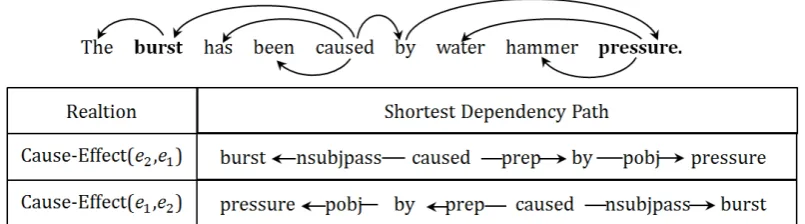
Figure 1: The shortest dependency path representation for an example sentence from SemEval-08.
way as words or some syntactic features like part-of-speech (POS) tags, because of the limitations of convolutional neural networks and recurrent neu-ral networks. Our first contribution is that we propose a recurrent convolutional neural network (RCNN) to encode the global pattern in SDP uti-lizing a two-channel LSTM based recurrent neural network and capture local features of every two neighbor words linked by a dependency relation utilizing a convolution layer.
We further observe that the relationship be-tween two entities are directed. For instance, Fig-ure 1 shows that the shortest path of the sentence “The [burst]e1 has been caused by water ham-mer [pressure]e2.” corresponds to relation Cause-Effect(e2,e1). The SDP of the sentence also
corre-sponds to relationCause-Effect(e2, e1), wheree1
refers to the entity at front end of SDP ande2refers
to the entity at back end of SDP, and the inverse SDP corresponds to relationCause-Effect(e1,e2).
Previous work (Xu et al., 2015b) simply trans-forms a (K+1)-relation task into a (2K+1) clas-sification task, where 1 is the Other relation and K is the number of directed relations. Besides, the recurrent neural network is a biased model, where later inputs are more dominant than earlier inputs. It could reduce the effectiveness when it is used to capture the semantics of a whole shortest depen-dency path, because key components could appear anywhere in a SDP rather than the end.
Our second contribution is that we propose a bidirectional recurrent convolutional neural net-works (BRCNN) to learn representations with bidirectional information along the SDP forwards and backwards at the same time, which also strengthen the ability to classifying directions of relationships between entities. Experimental re-sults show that the bidirectional mechanism sig-nificantly improves the performance.
We evaluate our method on the SemEval-2010 relation classification task, and achieve a state-of-the-artF1-score of 86.3%.
2 The Proposed Method
In this section, we describe our method in detail. Subsection 2.1 provides an overall picture of our BCRNN model. Subsection 2.2 presents the ra-tionale of using SDPs and some characteristics of SDP. Subsection 2.3 describes the two-channel re-current neural network, and bidirectional rere-current convolutional neural network is introduced in Sub-section 2.4. Finally, we present our training objec-tive in Subsection 2.5.
2.1 Framework
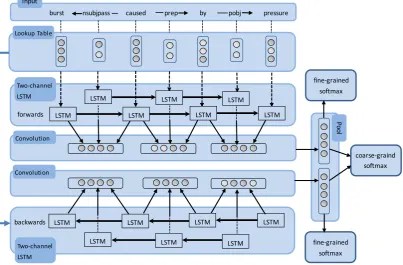
Our BCRNN model is used to learn representa-tions with bidirectional information along the SDP forwards and backwards at the same time. Figure 2 depicts the overall architecture of the BRCNN model.
Given a sentence and its dependency tree, we build our neural network on its SDP extracted from the tree. Along the SDP, two recurrent neural networks with long short term memory units are applied to learn hidden representations of words and dependency relations respectively. A convo-lution layer is applied to capture local features from hidden representations of every two neigh-bor words and the dependency relations between them. A max pooling layer thereafter gathers in-formation from local features of the SDP or the inverse SDP. We have a so f tmaxoutput layer af-ter pooling layer for classification in the unidirec-tional model RCNN.
two fine-grainedso f tmaxclassifiers of RCNNs do a (2K+1)-class classification respectively. The pooling layers of two RCNNs are concatenated and a coarse-grainedso f tmaxoutput layer is fol-lowed to do a (K+1)-class classification. The fi-nal (2K+1)-class distribution is the combination of two (2K+1)-class distributions provided by fine-grained classifiers respectively during the testing stage.
2.2 The Shortest Dependency Path
Ife1ande2are two entities mentioned in the same
sentence such that they are observed to be in a re-lationshipR, the shortest path betweene1 ande2
condenses most illuminating information for the relationship R(e1,e2). It is because (1) if entities
e1 and e2 are arguments of the same predicate,
the shortest path between them will pass through the predicate; (2) ife1 and e2 belong to different
predicate-argument structures that share a com-mon argument, the shortest path will pass through this argument.
Bunescu and Mooney (2005) first used short-est dependency paths between two entities to cap-ture the predicate-argument sequences, which pro-vided strong evidence for relation classification. Xu et al. (2015b) captured information from the sub-paths separated by the common ancestor node of two entities in the shortest paths. However, the shortest dependency path between two entities is usually short (∼4 on average) , and the common ancestor of some SDPs ise1ore2, which leads to
imbalance of two sub-paths.
We observe that, in the shortest dependency path, each two neighbor words wa and wb are
linked by a dependency relation rab. The
depen-dency relations between a governing word and its children make a difference in meaning. Besides, if we inverse the shortest dependency path, it corre-sponds to the same relationship with an opposite direction. For example , in Figure 1, the short-est path is composed of some sub-structure like “burst −−−−−−−−→nsub jpass caused”. Following the above intuition, we design a bidirectional recurrent con-volutional neural network, which can capture fea-tures from the local substrucfea-tures and inversely at the same time.
2.3 Two-Channel Recurrent Neural Network with Long Short Term Memory Units The recurrent neural network is suitable for mod-eling sequential data, as it keeps hidden state vec-torh, which changes with input data at each step accordingly. We make use of words and depen-dency relations along the SDP for relations classi-fication (Figure 2). We call themchannelsas these information sources do not interact during recur-rent propagation. Each word and dependency rela-tion in a given sentence is mapped to a real-valued vector by looking up in a embedding table. The embeddings of words are trained on a large cor-pus unsupervisedly and are thought to be able to capture their syntactic and semantic information, and the embeddings of dependency relations are initialized randomly.
The hidden stateht, for thet-th input is a
func-tion of its previous stateht−1 and the embedding
xtof current input. Traditional recurrent networks
have a basic interaction, that is, the input is lin-early transformed by a weight matrix and non-linearly squashed by an activation function. For-mally, we have
ht = f(Win·xt+Wrec·ht−1+bh) (1)
where Win and Wrec are weight matrices for the
input and recurrent connections, respectively. bh
is a bias term for the hidden state vector, and f a non-linear activation function.
It was difficult to train RNNs to capture long-term dependencies because the gradients tend to either vanish or explode. Therefore, some more sophisticated activation function with gating units were designed. Long short term memory units are proposed in Hochreiter and Schmidhuber (1997) to overcome this problem. The main idea is to in-troduce an adaptive gating mechanism, which de-cides the degree to which LSTM units keep the previous state and memorize the extracted features of the current data input. Many LSTM variants have been proposed. We adopt in our method a variant introduced by Zaremba and Sutskever (2014). Concretely, the LSTM-based recurrent neural network comprises four components: an in-put gateit, a forget gateft, an output gateot, and a
memory cellct.
First, we compute the values for it, the input
burst nsubjpass caused prep by pobj pressure
LSTM LSTM LSTM LSTM
LSTM LSTM LSTM
LSTM LSTM LSTM
LSTM LSTM LSTM LSTM
Input
Lookup Table
Po
ol
Two-channel
LSTM
Two-channel
LSTM Convolution
Convolution
fine-grained softmax
fine-grained softmax
coarse-graind softmax forwards
[image:4.595.101.505.73.338.2]backwards
Figure 2: The overall architecture of BRCNN. Two-Channel recurrent neural networks with LSTM units pick up information along the shortest dependency path, and inversely at the same time. Convolution layers are applied to extract local features from the dependency units.
the memory cells at time t:
it =σ(Wi·xt+Ui·ht−1+bi) (2)
gt =tanh(Wc·xt+Uc·ht−1+bc) (3)
Second, we compute the value for ft, the
activa-tions of the memory cells’ forget gates at time t:
ft=σ(Wf ·xt+Uf ·ht−1+bf) (4)
Given the value of the input gate activations it,
the forget gate activation ftand the candidate state
valuegt, we can computectthe memory cells’ new
state at timet:
ct =it⊗gt+ ft⊗ct−1 (5)
With the new state of the memory cells, we can compute the value of their output gates and, sub-sequently, their outputs:
ot=σ(Wo·xt+Uo·ht−1+bo) (6)
ht=ot⊗tanh(ct) (7)
In the above equations, σ denotes a sigmoid function;⊗denotes element-wise multiplication.
2.4 Bidirectional Recurrent Convolutional Neural Network
We observe that a governing wordwaand its
chil-dren wb are linked by a dependency relationrab,
which makes a difference in meaning. For exam-ple, “kills −−−−→nsub j it” is distinct from “kills −−−→dob j
it”. The shortest dependency path is composed of many substructures like “wa −−→rab wb”, which are
hereinafter referred to as “dependency unit”. Hid-den states of words and depenHid-dency relations in the SDP are obtained, utilizing two-channel recur-rent neural network. The hidden states ofwa, wb
andrab areha,hbandh0ab, and the hidden state of
the dependency unitdabis [ha⊕h0ab⊕hb], where ⊕ denotes concatenate operation. Local features Lab for the dependency unitdabcan be extracted,
utilizing a convolution layer upon the two-channel recurrent neural network . Formally, we have
Lab= f(Wcon·[ha⊕h0ab⊕hb]+bcon) (8)
where Wcon is the weight matrix for the
convo-lution layer and bcon is a bias term for the
local features of dependency units, which is de-fined as
G=maxD
d=1 Ld (9)
where the max function is an element-wise func-tion, and Dis the number of dependency units in the SDP.
The advantage of two-channel recurrent neural network is the ability to better capture the con-textual information, adaptively accumulating the context information the whole path via memory units. However, the recurrent neural network is a biased model, where later inputs are more dom-inant than earlier inputs. It could reduce the ef-fectiveness when it is used to capture features for relation classification, for the entities are located at both ends of SDP and key components could appear anywhere in a SDP rather than at the end. We tackle the problem with Bidirectional Convo-lutional Recurrent Neural Network.
On the basis of observation, we make a hypoth-esis that SDP is a symmetrical structure. For ex-ample, if there is a forward shortest path→−S which corresponds to relation Rx(e1,e2), the backward
shortest path ←S− can be obtained by inversing→−S, and←S− corresponds toRx(e2,e1), and both→−S and ←S−correspond to relationR
x.
As shown in Figure 2, two RCNNs pick up in-formation along→−S and←S−, obtaining global repre-sentations→−G and←G. A representation with bidi-− rectional information is obtained by concatenating
−
→G and←G−. A coarse-grainedso f tmaxclassifier is
used to predict a (K+1)-class distributiony. For-mally,
y=so f tmax(Wc·[←G−⊕→−G]+bc) (10)
WhereWc is the transformation matrix and bc is
the bias vector. Coarse-grained classifier makes use of representation with bidirectional informa-tion ignoring the direcinforma-tion of relainforma-tions, which learns the inherent correlation between the same directed relations with opposite directions, such as Rx(e1,e2) andRx(e2,e1).
Two fine-grained so f tmax classifiers are ap-plied to→−G and ←G− with linear transformation to give the (2K+1)-class distribution→−y and ←−y re-spectively. Formally,
−
→y = so f tmax(W
f ·→−G+bf) (11) ←−y = so f tmax(W
f ·←G−+bf) (12)
where Wf is the transformation matrix andbf is
the bias vector. Classifying→−S and←S−respecitvely at the same time can strengthen the model ability to judge the direction of relations.
2.5 Training Objective
The (K+1)-classso f tmaxclassifier is used to es-timate probability that→−S and ←S− are of relation R . The two (2K +1)-class so f tmax classifiers are used to estimate the probability that→−S and←S− are of relation→−R and←R−respectively. For a single data sample, the training objective is the penalized cross-entropy of three classifiers, given by
J =2XK+1 i=1
− →t
ilog→−yi+ 2XK+1
i=1 ←−t
ilog←−yi
+XK i=1
tilogyi+λ· ||θ||2
(13)
wheret∈RK+1,→−t and←−t ∈R2K+1, indicating the
one-hot represented ground truth. y,→−y and←−y are the estimated probabilities for each class described in section 2.4. θis the set of model parameters to be learned, andλis a regularization coefficient.
For decoding (predicting the relation of an un-seen sample), the bidirectional model provides the (2K+1)-class distribution→−y and ←−y . The final (2K+1)-class distributionytest becomes the
com-bination of→−y and←−y. Formally,
ytest =α· −→y +(1−α)·z(←−y) (14)
whereαis the fraction of the composition of dis-tributions, which is set to the value 0.65 according to the performance on validation dataset. During the implementation of BRCNN, elements in two class distributions at the same position are not cor-responding, e.g.Cause-Effect(e1,e2)in→−y should
correspond toCause-Effect(e2,e1) in←−y. We
ap-ply a functionzto transform←−y to a corresponding forward distribution like→−y.
3 Experiments
3.1 Dataset
Classifier Additional Information F1
SVM POS, WordNet, Prefixes and other morphological features, 82.2 (Rink and Harabagiu, 2010) dependency parse, Levin classed, PropBank, FanmeNet,NomLex-Plus, Googlen-gram, paraphrases, TextRunner
RNN Word embeddings 74.8
(Socher et al., 2011) +POS, NER, WordNet 77.6
MVRNN Word embeddings 79.1
(Socher et al., 2012) +POS, NER, WordNet 82.4
CNN Word embeddings 69.7
(Zeng et al., 2014) +word position embeddings, WordNet 82.7
FCM Word embeddings 80.6
(Yu et al., 2014) +dependency parsing, NER 83.0
CR-CNN Word embeddings 82.8
(dos Santos et al., 2015) +word position embeddings 84.1
SDP-LSTM Word embeddings 82.4
(Xu et al., 2015b) +POS+GR+WordNet embeddings 83.7
DepNN Word embeddings, WordNet 83.0
(Liu et al., 2015) Word embeddings, NER 83.6
depLCNN Word embeddings, WordNet, word around nominals 83.7 (Xu et al., 2015a) +negative sampling from NYT dataset 85.6
BRCNN Word embeddings 85.4
[image:6.595.93.508.60.369.2](Our Model) +POS, NER, WordNet embeddings 86.3
Table 1: Comparison of relation classification systems.
The dataset has (K+1)=10 distinguished rela-tions, as follows.
• Cause-Effect
• Component-Whole
• Content-Container
• Entity-Destination
• Entity-Origin
• Message-Topic
• Member-Collection
• Instrument-Agency
• Product-Agency
• Other
The former K=9 relations are directed, whereas the Other class is undirected, we have (2K+1)=19 different classes for 10 relations. All baseline systems and our model use the official macro-averagedF1-score to evaluate model performance.
This official measurement excludes the Other rela-tion.
3.2 Hyperparameter Settings
In our experiment, word embeddings were 200-dimensional as used in (Yu et al., 2014), trained on
Gigaword with word2vec (Mikolov et al., 2013). Embeddings of relation are 50-dimensional and initialized randomly. The hidden layers in each channel had the same number of units as their embeddings (200 or 50). The convolution layer was 200-dimensional. The above values were cho-sen according to the performance on the validation dataset.
As we can see in Figure 1, dependency relation r“−−−→prep ” in→−S becomesr−1 “←−−−prep” in←S−.
Exper-iment results show that, the performance of BR-CNN is improved ifrandr−1correspond to diff
er-ent relations embeddings rather than a same em-bedding. We notice that dependency relations con-tain much fewer symbols than the words concon-tained in the vocabulary, and we initialize the embed-dings of dependency relations randomly for they can be adequately tuned during supervised train-ing.
We add l2 penalty for weights with coefficient
10−5, and dropout of embeddings with rate 0.5.
3.3 Results
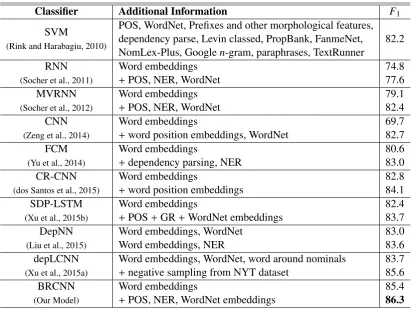
Table 1 compares our BRCNN model with other state-of-the-art methods. The first entry in the table presents the highest performance achieved by traditional feature-based methods. Rink and Harabagiu. (2010) fed a variety of handcrafted features to the SVM classifier and achieve anF1
-score of 82.2%.
Recent performance improvements on this dataset are mostly achieved with the help of neu-ral networks. Socher et al. (2012) built a recur-sive neural network on the constituency tree and achieved a comparable performance with Rink and Harabagiu. (2010). Further, they extended their recursive network with matrix-vector interaction and elevated the F1 to 82.4%. Xu et al. (2015b)
first introduced a type of gated recurrent neural network (LSTM) into this task and raised theF1
-score to 83.7%.
From the perspective of convolution, Zeng et al. (2014) constructed a CNN on the word se-quence; they also integrated word position em-beddings, which helped a lot on the CNN archi-tecture. dos Santos et al. (2015) proposed a similar CNN model, named CR-CNN, by replac-ing the common so f tmax cost function with a ranking-based cost function. By diminishing the impact of the Other class, they have achieved an F1-score of 84.1%. Along the line of CNNs, Xu
et al. (2015a) designed a simple negative pling method, which introduced additional sam-ples from other corpora like the NYT dataset. Do-ing so greatly improved the performance to a high F1-score of 85.6%. Liu et al. (2015) proposed a
convolutional neural network with a recursive neu-ral network designed to model the subtrees, and achieve anF1-score of 83.6%.
Without the use of neural networks, Yu et al. (2014) proposed a Feature-based Compositional Embedding Model (FCM), which combined un-lexicalized linguistic contexts and word embed-dings. They achieved anF1-score of 83.0%.
We make use of three types of information to improve the performance of BRCNN: POS tags, NER features and WordNet hypernyms. Our proposed BRCNN model yields an F1-score
of 86.3%, outperforming existing competing ap-proaches. Without using any human-designed features, our model still achieve an F1-score of
85.4%, while the best performance of state-of-the-art methods is 84.1% (dos Santos et al., 2015).
[image:7.595.351.482.117.191.2]3.4 Analysis
Table 2 compares our RCNN model with CNNs and RNNs.
Model F1
CNN 81.8
LSTM 76.6
Two-channel LSTM 81.5
RCNN 82.4
Table 2: Comparing RCNN with CNNs and RNNS.
For a fair comparison, hyperparameters are set according to the performance on validation dataset as BRCNN . CNN with embeddings of words, po-sitions and dependency relations as input achieves an F1-score of 81.8%. LSTM with word
em-beddings as input only achieves an F1-score of
76.6%, which proves that dependency relations in SDPs play an important role in relation clas-sification. Two-channel LSTM concatenates the pooling layers of words and dependency relations along the shortest dependency path, achieves an F1-score of 81.5% which is still lower than CNN.
RCNN captures features from dependency units by combining the advantages of CNN and RNN, and achieves anF1-score of 82.4%.
Model Input F1
RCNN →−S of all relations 82.4 Bi-RCNN →−Sand←S−of all relations 81.2
Bi-RCNN →→−−S and←S−of directed relations , 84.9 S of Other
BRCNN →→−−S and←S−of directed relations, 85.4 S of Other
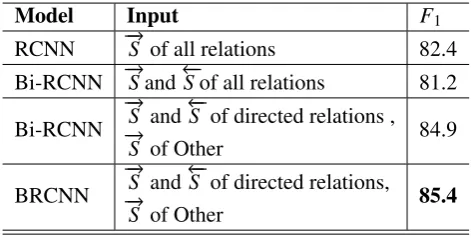
Table 3: Comparing different variants of our model.
[image:7.595.306.542.451.570.2]the Other class itself. However, the class Other is used to indicate that relation between two nom-inals dose not belong to any of the 9 directed classes. Therefore, the class Other is very noisy since it groups many different types of relations with different directions.
On the basis of the analysis above, we only in-verse the SDP of directed relations. A significant improvement is observed and Bi-RCNN achieves an F1-score of 84.9%. This proves bidirectional
representations provide more useful information to classify directed relations. We can see that our model still benefits from the coarse-grained classi-fication, which can help our model learn inherent correlation between directed relations with oppo-site directions. Compared with Bi-RCNN classi-fying→−S and←S−into 19 classes separately, BRCNN also conducts a 10 classes (9 directed relations and Other) classification and improves 0.5% in F1-score. Beyond the relation classification task,
we believe that our bidirectional method is gen-eral technique, which is not restricted in a specific dataset and has the potential to benefit other NLP tasks.
4 Related Work
Relation classification is an important topic in NLP. Traditional Methods for relation classifica-tion mainly fall into three classes: feature-based, kernel-based and neural network-based.
In feature-based approaches, different types of features are extracted and fed into a classi-fier. Generally, three types of features are often used. Lexical features concentrate on the enti-ties of interest, e.g., POS. Syntactic features in-clude chunking, parse trees, etc. Semantic fea-tures are exemplified by the concept hierarchy, tity class. Kambhatla (2004) used a maximum en-tropy model for feature combination. Rink and Harabagiu (2010) collected various features, in-cluding lexical, syntactic as well as semantic fea-tures.
In kernel based methods, similarity between two data samples is measured without explicit fea-ture representation. Bunescu and Mooney (2005) designed a kernel along the shortest dependency path between two entities by observing that the relation strongly relies on SDPs. Wang (2008) provided a systematic analysis of several kernels and showed that relation extraction can benefit from combining convolution kernel and syntactic
features. Plank and Moschitti (2013) combined structural information and semantic information in a tree kernel. One potential difficulty of kernel methods is that all data information is completely summarized by the kernel function, and thus de-signing an effective kernel becomes crucial.
Recently, deep neural networks are playing an important role in this task. Socher et al. (2012) in-troduced a recursive neural network model that as-signs a matrix-vector representation to every node in a parse tree, in order to learn compositional vec-tor representations for sentences of arbitrary syn-tactic type and length.
Convolutional neural works are widely used in relation classification. Zeng et al. (2014) proposed an approach for relation classification where sentence-level features are learned through a CNN, which has word embedding and position features as its input. In parallel, lexical features were extracted according to given nouns. dos San-tos et al. (2015) tackled the relation classification task using a convolutional neural network and pro-posed a new pairwise ranking loss function, which achieved the state-of-the-art result in SemEval-2010 Task 8.
Yu et al. (2014) proposed a Factor-based Com-positional Embedding Model (FCM) by deriving sentence-level and substructure embeddings from word embeddings, utilizing dependency trees and named entities. It achieved slightly higher accu-racy on the same dataset than Zeng et al. (2014), but only when syntactic information is used.
5 Conclusion
In this paper, we proposed a novel bidirectional neural network BRCNN, to improve the perfor-mance of relation classification. The BRCNN model, consisting of two RCNNs, learns features along SDP and inversely at the same time. In-formation of words and dependency relations are used utilizing a two-channel recurrent neural net-work with LSTM units. The features of depen-dency units in SDP are extracted by a convolution layer.
We demonstrate the effectiveness of our model by evaluating the model on SemEval-2010 rela-tion classificarela-tion task. RCNN achieves a better performance at learning features along the short-est dependency path, compared with some com-mon neural networks. A significant improvement is observed when BRCNN is used, outperforming state-of-the-art methods.
6 Acknowledgements
Our work is supported by National Natural Sci-ence Foundation of China (No.61370117 & No. 61433015) and Major National Social Science Fund of China (No. 12&ZD227).
References
Razvan C Bunescu and Raymond J Mooney. 2005. A shortest path dependency kernel for relation extrac-tion. In Proceedings of the conference on Human
Language, pages 724–731.
Cıcero Nogueira dos Santos, Bing Xiang, and Bowen Zhou. 2015. Classifying relations by ranking with convolutional neural networks. In In Proceedings of the 53rd Annual Meeting of the Association for Computational Linguistics and the 7th International Joint Conference, pages 626–634.
Kazuma Hashimoto, Makoto Miwa, Yoshimasa Tsu-ruoka, and Takashi Chikayama. 2013. Simple cus-tomization of recursive neural networks for semantic relation classification. In Proceedings of the 2013 Conference on Empirical Methods in Natural
Lan-guage Processing, pages 1372–1376.
Iris Hendrickx, Su Nam Kim, Zornitsa Kozareva, Preslav Nakov, Diarmuid ´O S´eaghdha, Sebastian Pad´o, Marco Pennacchiotti, Lorenza Romano, and Stan Szpakowicz. 2010. Semeval-2010 task 8: Multi-way classification of semantic relations between pairs of nominals. In Proceedings of the Workshop on Semantic Evaluations: Recent Achievements and Future Directions. Association for Computational Linguistics, pages pages 94–99.
Sepp Hochreiter and J¨urgen Schmidhuber. 1997. Long short-term memory. InNeural computation, pages 1735–1780.
Nanda Kambhatla. 2004. Combining lexical, syntac-tic, and semantic features with maximum entropy models for extracting relations. InProceedings of the ACL 2004 on Interactive poster and
demonstra-tion sessions, page 22. Association for
Computa-tional Linguistics.
Yang Liu, Furu Wei, Sujian Li, Heng Ji, Ming Zhou, and Houfeng Wang. 2015. A dependency-based neural network for relation classification. In Pro-ceedings of the 53rd Annual Meeting of the Associa-tion for ComputaAssocia-tional Joint Conference on Natural Language Processing and the 7th International Joint
Conference on Natural Language Processing, pages
285–290.
Tomas Mikolov, Ilya Sutskever, Kai Chen, Greg S Cor-rado, and JeffDean. 2013. Distributed representa-tions of words and phrases and their compositional-ity. InAdvances in Neural Information Processing
Systems, pages 3111–3119.
Barbara Plank and Alessandro Moschitti. 2013. Em-beddings semantic similarity in tree kernels for do-main adaption of relation extraction. InProceedings of the 51st Annual Meeting of the Association for
Computational Linguistics, pages 1498–1507.
Bryan Rink and Sanda Harabagiu. 2010. Utd: Clas-sifying semantic relations by combining lexical and semantic resources. InProceedings of the 5th
Inter-national Workshop on Semantic Evaluation, pages
256–259. Association for Computational Linguis-tics.
Richard Socher, Jeffrey Pennington, Eric H Huang, An-drew Y Ng, and Christopher D Manning. 2011. Semi-supervised recursive autoencoders for predict-ing sentiment distributions. In Proceedings of the Conference on Empirical Methods in Natural guage Processing and Computational Natural
Lan-guage Learning, pages 151–161.
Richard Socher, Brody Huval, Christopher D Manning, and Andrew Y Ng. 2012. Semantic compositional-ity through recursive matrix-vector spaces. In Pro-ceedings of the 2012 Joint Conference on Empiri-cal Methods in Natural Language Processing and
Computational Natural Language Learning, pages
1201–1211.
Mengqiu Wang. 2008. A re-examination of depen-dency path kernels for relation extraction. In Pro-ceedings of the Third International Joint Conference
on Natural Language Processing, pages 841–846.
Kun Xu, Yansong Feng, Songfang Huang, and Dongyan Zhao. 2015a. Semantic relation classifi-cation via convolutional neural networks with sim-ple negative sampling. InProceedings of the 2015 Conference on Empirical Methods in Natural
Yan Xu, Lili Mou, Ge Li, Yunchuan Chen, Hao Peng, and Zhi Jin. 2015b. Classifying relations via long short term memory networks along shortest depen-dency paths. InProceedings of Conference on
Em-pirical Methods in Natural Language Processing,,
pages 1785–1794.
Mo Yu, Matthew Gormley, and Mark Dredze. 2014. Factor-based compositional embedding models. In
NIPS Workshop on Learning Semantics, pages 95–
101.
Wojciech Zaremba and Ilya Sutskever. 2014. Learning to execute. arXiv preprint arXiv:1410.4615. Mathew D. Zeiler. 2012. An adaptive learning rate
method. InarXiv preprint at arXiv:1212.5701. Dmitry Zelenko, Chinatsu Aone, and Anthony
Richardella. 2003. Kernel methods for relation extraction. The Journal of Machine Learning Re-search, 3:1083–1106.