A Thesis Submitted for the Degree of PhD at the University of Warwick
Permanent WRAP URL:
http://wrap.warwick.ac.uk/110956/
Copyright and reuse:
This thesis is made available online and is protected by original copyright.
Please scroll down to view the document itself.
Please refer to the repository record for this item for information to help you to cite it.
Our policy information is available from the repository home page.
“THE USE OF SPREADSHEETS AS A TOOL FOR THE
DEVELOPMENT OF PROBLEM SOLVING SKILLS
IN THE MATHEMATICS CURRICULUM IN A
PRIMARY SCHOOL IN CYPRUS”
"Each problem that / solved became a rule which served afterwards to solve other problems. "
Rene Descartes (1596-1650), "Discours de la Methode"
TABLE OF CONTENTS
CHAPTER 1: BACKGROUND... 6
I. Aim... 7
II. Research Questions... 8
III. Methods... 8
CHAPTER 2: REVIEW OF THE LITERATURE... 9
I. Problem Solving...9
A. What is a problem?...10
B. Types o f problems...11
C. What makes a problem difficult to solve?...12
D. Problem solving steps and problem solving strategies...14
E. Assessment o f problem solving sk ills...22
F. Problem solving in the Cyprus Primary Education Curriculum...24
II. Information Technology...28
A. Computers in education...28
B. When to use computers in the classroom...29
C. Computer Assisted Instruction...30
D. Integrating Learning Systems...32
E. The role o f the teacher and the p u p il...34
F. Models o f implementation...35
G. The introduction o f computers in the Primary Education in C yprus...40
H. Spreadsheets... ...44
III. Research Ag e n d a... 46
CHAPTER 3: RESEARCH DESIGN AND METHODOLOGICAL APPROACHES... 49
I. Introduction - Justificationof Methods Chosen... 49
A. Developing a conceptual framework...52
B. Developing a set o f research questions fo r the case study...53
C. Developing a set o f sampling strategy...54
D. Selection o f data collection techniques...55
II. Instruments, Data Collectionand Date Analysis... 59
A. Research instruments...59
B. Analysis...61
III. Methodologicalissues: Limitationsofthe Research...62
A. Validity and Reliability...62
B. Research ethics...64
CHAPTER 4: RESEARCH FINDINGS... 67
I. Descriptionofthe Lessons... 68
A. Introductory Lessons...68
B First Lesson...70
II. Findingsfromthe Observations (Qualitative Data)... 72
III. Findingsfrom Pre-Test, Post-Testand Post Post-Test (Quantitative Data) ... 77
A. Differences on pupils' abilities in relation to control variables...77
B. Differences in Relation to Dependent Variables (Problem Solving)...80
C. Findings from the Pre-test and the Post-test...81
IV. Further Observations (Lessons 2 to 7 )...85
CHAPTER 5: DISCUSSION OF THE RESULTS... 88
I. Discussionof Findings... 90
A. Discussion o f qualitative data: Implications fo r the process o f teaching problem solving skills through the use o f IT...90
B Discussion o f quantitative data: Implications fo r the pupils' learning (final outcomes)...94
C. Discussion o f findings from the differential analysis...99
II. Limitationsofthe Study - Methodological Issuesand Further Research... 100
A. Introduction...¡05
B. Collaborative work...112
C. A change in teacher's role...113
D. Teaching and Learning with Spreadsheet Technology A synopsis...115
CHAPTER 6: REFERENCES... 120
CHAPTER 7: APPENDICES...125
I. APPENDIX A: Letters...126
II. APPENDIX B: A listwiththeproblemsthatwereusedduringthe Case Study...131
III. APPENDIX C: Pre-testand Post-test (in English) ... 133
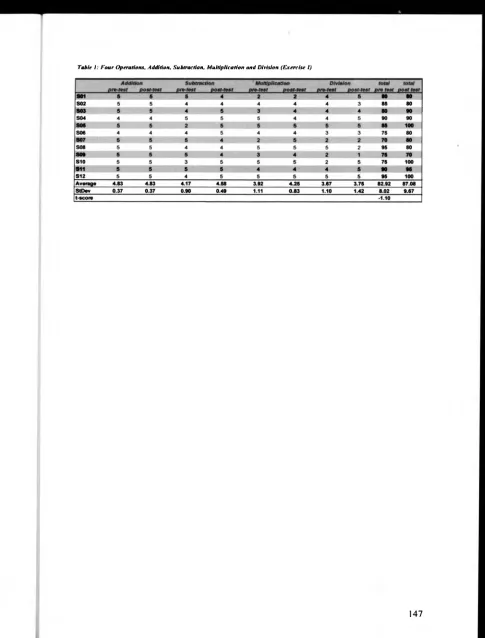
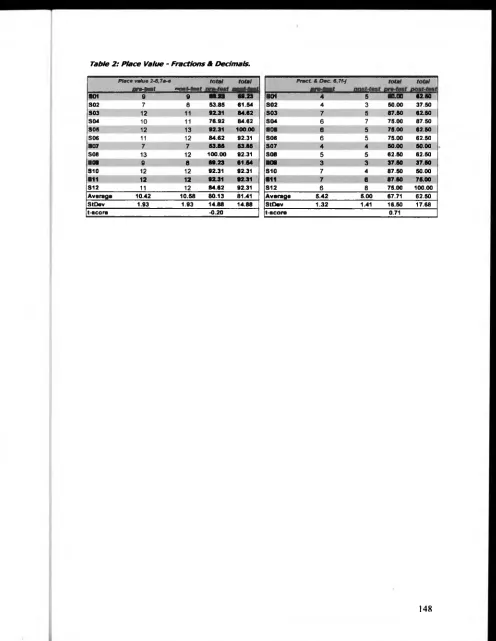
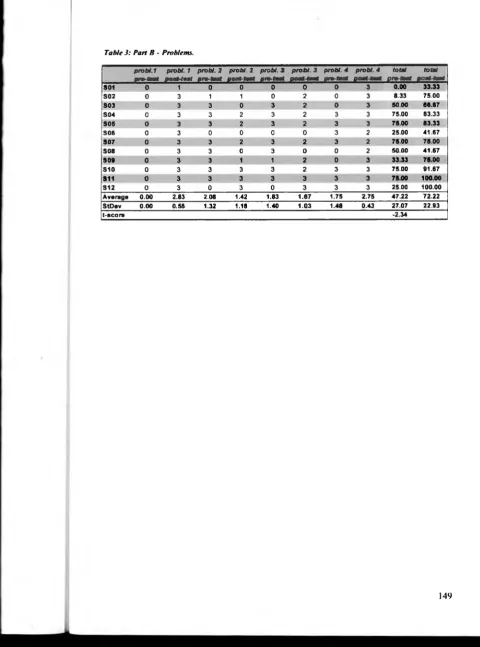
IV. APPENDIX D: Analysisoftests... 146
V. APPENDIX E: Data Collection Sheet & Data Collection Sheet Sample...150
VI. General Observations...152
VII. Relevancetoresearchquestions... 153
ACKNOWLEDGEMENTS
I should like to express my gratitude to all those people who have contributed towards the completion of this research. I wish to express my sincere thanks and appreciation to Jim Campbell, Professor in the Department o f Education at the University of Warwick for his attention, guidance, insight, and support during this research and the preparation o f this thesis. His critiques and suggestions were invaluable. My grateful thanks are also extended towards Dr. Leonidas Kyriakides who has been both a friend and an excellent guide and adviser and has provided me with his valuable suggestions and comments. His original ideas and comments were invaluable. His help was essential in bringing this thesis to completion. I am also much indebted to my Principal and my colleagues at school who cooperated in this study, and most especially to my pupils who were very enthusiastic to take part in my research. Many thanks are also extended towards the Parents' Association of my school who co-operated with me for the provision of hardware and software needed for my research. Finally, I should like to express my gratitude to my parents, my wife Evi and to my two children, Nataly and Kypros for their encouragement and patience during the preparation o f this thesis.
ABSTRACT
The purpose of this research project is to examine the use of spreadsheets for the development of problem solving skills in primary school pupils. This study is based on the notion that advanced skills o f comprehension, reasoning, composition, and experimentation are acquired not through the transmission of facts but through the learner's interaction with content. This constructivist view of learning calls for teaching basic skills within authentic contexts for modelling thought processes.
To gather the information 1 needed I worked for three months with a group of 12 pupils (six boys and six girls). A pre-test, a post-test and a post post-test one year later were used to gather quantitative data emerge from the research while I was taking part as a participant observer to record the qualitative data from the research.
The statistical analysis was carried out by SPSS-X. Percentages, means, standard deviations and medians were used to illustrate the variables. The Kolmogorov-Smimov test was used for the Inferential Statistical Analysis.
The main findings of my research that emerged from the tests the pupils undertake and from my observations during the lessons are:
Regarding progress in problem solving ability: Pupils have increased their abilities in problem solving after using a spreadsheet to solve a series o f problems. Regarding progress in problem solving ability after one year: Pupils did not increase or decrease their ability in problem solving as emerge from the post post-test. There were no problems of communication between the pupils during their work in the groups while collaborative work enabled pupils to apply facts and skills already acquired; encourage discussion and investigative activity to show that mathematics can be useful, meaningful and valuable. Teacher’ s work was more demanding with a major change in his role, from a knowledge dispenser to a facilitator.
CHAPTER 1: BACKGROUND
The purpose of this research project is to examine the use o f spreadsheets for the development of problem solving skills in primary school pupils. The significance of the research is twofold: first, the use of computers as a means o f cross-curricular teaching rather than as a curriculum subject is especially important in primary schools; second, problem solving is at the heart of the mathematics curriculum. The significance is societal as well as educational. The combination of problem solving and instructional technology in a co-operative - learning setting can be critical to the development o f a skilled twenty-first-century work force. Pupils should be prepared for a future in which the computer is used as an analytical tool rather than merely as a vehicle to test the accuracy o f programming skills or for solving simplistic problems using long and complicated numerical values (Sgroi, 1992). As mathematics education adapts to the needs o f a changing society, the use of technology becomes increasingly important. “Technology can play a valuable role in developing problem - solving capabilities in pupils by freeing them from tedious computations. Thus, higher level-thinking skills can be emphasised” (HoefTher et al., 1993, p. 52).
The computer is a rich and complex tool that is increasingly within the financial reach of schools. Like any educational tool, it comes with inherent advantages and disadvantages. It is more appropriate for some uses than others. It depends on the human qualities and aspirations for its effectiveness.
teachers themselves undertake research in their classrooms it is very beneficial because it is a way of improving practice, it enhances their teaching or their colleagues teaching and they become more autonomous in professional judgement. "Teachers are too often the servants o f heads, advisers, researchers, textbooks, curriculum developers, examination boards or the Department o f Education” (p. 4).
The introduction of computers in Primary Education is an innovation for the Cyprus Educational System, and within this content, as a software application, spreadsheets can be used in the teaching o f mathematics and in the developing of higher thinking skills like problem solving.
If effective learning can be shown from the use of spreadsheets, there may be new opportunities for the teaching o f mathematics. It will help teachers to clarify the concept of problem solving and support their teaching. The use of spreadsheets can be incorporated into the mathematics curriculum, with the creation of instructional methods and materials for using spreadsheets for problem solving. On the other hand, poor results will force us to review the use of computers in primary education. In addition, an evaluation of the effectiveness of the program will create more questions for further research.
I. Aim
II. Research Questions
The study will concentrate on a number of important factors associated with the following questions, amended from Newhouse and Oliver (1989):
1. Do spreadsheets as a Computer Assisted Instruction application improve
learning and teaching in problem solving activities?
2. In what ways do spreadsheets as a Computer Assisted Instruction application
influence pupils’ achievement in solving problems?
3. Are there variations in the effectiveness of Spreadsheets as a Computer Assisted
Instruction application among different types of pupils?
III. Methods
The case study will be conducted in my classroom with twelve pupils (age 10 to 11 years old). The project will rely heavily upon observations o f the pupils and personal notes. Analysis will be made of pupils’ achievement in problem solving before starting the project, at the end of the project both on problem solving and on using spreadsheets for problem solving.
CHAPTER 2: REVIEW OF THE LITERATURE
I. Problem Solving
Polya (1887-1985), the pioneer of problem solving techniques - the heuristic strategies - in an article presented in 1949 and reprinted in “The 1980 Yearbook” of the National Council o f Teachers o f Mathematics in the United States, states that
Intelligence is essentially the ability to solve problems: every day problems, personal problems, social problems, scientific problems, puzzles, all sorts of problems. The pupil develops his intelligence by using it, he learns to do problems by doing them (cited in Krulik, 1980, pp. 1-2).
Mathematics is hard. Problem solving is considered to be o f the most difficult mathematics topic to teach and learn. “Teachers have been concerned about their pupils’ inability to solve problems since problems first appeared in math textbooks” (Randall and Frank. 1982, p. 1). The development of problem solving ability must be the focus of mathematics instruction (Shufelt & Smart, 1983) and should direct the efforts of mathematics educators. “ Curricula in several countries are in the process of being modified to incorporate explicit consideration o f the nature of general problem solving strategies” (Lawson, 1990, p. 403). Gadanides (1988) suggests that in any model of mathematics teaching, problem solving is a major area o f emphasis together with facts and skills, and understanding.
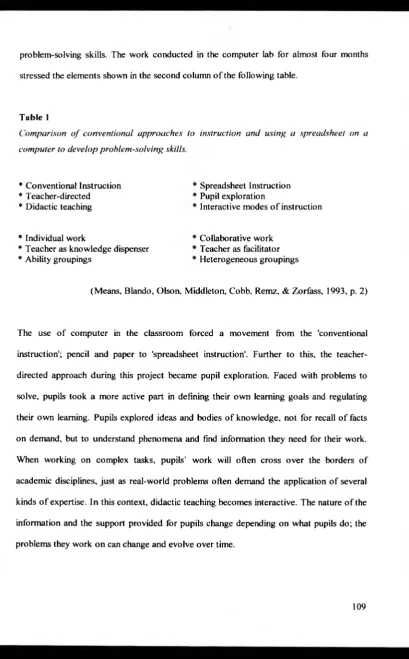
problem solving what is considered important are "the methods, procedures, strategies, and heuristics that pupils use in solving problems” (Branca, cited in Krulik, 1980, p. 4) and not the answer a pupil gives to a problem. A number of studies on how to develop methods of teaching problem solving and strategies for problem solving have been developed and are presented in the following paragraphs.
A. What is a problem?
In order to analyse problem solving we have to consider first what a problem is. Randall and Frank (1982), define the problem as a task for which:
The person confronting it wants or needs to find a solution.
The person has no readily available procedure for finding the solution. The person must make an attempt to find a solution (p. 5).
Also, a problem for Brannan and Schaaf (1983, p. 43)
... is a situation in which an individual or group accepts the challenge of performing a task for which there is no immediately obvious way to determine a solution. Frequently, the problem can be approached in many ways. Occasionally, the resulting investigations are non-productive. Sometimes they are so productive that they lead to many different solutions or suggest more problems than they solve.
Gadanides (1988, p. 22) argues that problem solving should be "incorporated and integrated in everyday classroom learning environments as much as possible”. Krulik (1981, p. 191) states that, what makes a problem differ from an exercise is that "a problem is not a problem at all if it can easily be solved by following a given model or by merely applying a series of basic rules that have previously been learned”.
B. Types of problems
There are three types of problems found in elementary school mathematics curriculum (LeBlanc et al„ 1980; Randall et al„ 1987; Randall and Frank, 1982):
1. Standard textbook problems: one-step problems or multiple-step problems. 2. Process problems.
3. Applied problems.
Standard textbook problems can be solved by direct application of an algorithm; the task is to choose which operation(s) or algorithms are appropriate for solving the problem. The purposes o f these problems are “improving the recall o f basic facts, strengthening skills with the fundamental operations algorithms, and reinforcing the relationship between the operations and their applications in real -world situations” (LeBlanc et. al, 1980, p. 105).
For example:
Joe went to the store to buy 3 cartons o f Coke. I f each carton contains 6 bottles, how many bottles o f Coke did Joe buy? (LeBlanc et al., 1980, p. IOS).
For example:
A backgammon club held a tournament fo r its 7 best members. I f every member played one game against each other member, how many games were played?
Applied problems require the pupil to collect data outside the problem statement. For example:
You and a friend decide to operate a sandwich stand in the school fair. You need to decide what to charge fo r each sandwich.
A teacher who is aware o f the various problem types is more able to make decisions concerning a good preparation of his or her mathematics lesson. In preparing the objectives of every unit, the inclusion o f a problem every day, choosing one from each group will be effective. Process problems require thinking processes like planning, guessing, estimating, and looking for patterns. A teacher can make his or her personal collection o f problems and present a problem every day, at the beginning or at the last ten minutes of the lesson calling this activity “Problem o f the day”. Drawings showing the four-step method, and signs with the names of strategies that have been used for solving these problems, together with the collection of problems presented to the pupils can make a good learning atmosphere in the classroom.
C. What makes a problem difficult to solve?
1. Complexity of the problem statement: The complexity of the syntax, the amount o f information, given the number of conditions and variables, and the mathematical content.
2. Methods of problem presentation and representation: The manner the problem is posed and the mental picture the solver forms.
3. Problem solver’ s familiarity with acceptable solution procedures: A pupil can more easily solve a problem if he or she has used that procedure before.
4. Misleading incorrect solutions or solution procedures: Of the way a problem is posed or o f nature of the problem, a misleading solution or procedure is suggested. For example:
Andreas and Maria, have together 20 colour pencils. Maria has 6 colour pencils more. How many pencils does Maria have and how many pencils does Andreas have?
5. Difficulty in locating reachable sub goals: Pupils do not know how to get started or what to do first.
6. Constraints arising from misconceptions or misunderstandings of information
given in a problem: Misconceptions and misunderstandings often change the meaning o f the problem by sometimes adding constraints?
7. Affective factors associated with the problem solver' s reaction to the problem:
Lack of interest and motivation, high stress or anxiety, lack of perseverance and desire to get an answer quickly.
Other factors that make Standard Textbook Problems difficult to be solved according to LeBlanc et al. (1980) are, the more the complex the algorithm, the more the difficult the problem and the number of steps required solving the problems. Some o f the difficulties that can arise while working on Process Problems are (LeBlanc et al., 1980):
2. The complexity of each condition.
3. The type o f strategy required solving the problem.
D. Problem solving steps and problem solving strategies
Problem solving of any kind, whether it involves mathematics, medicine, business or family life, is a learned and practised skill. By developing their problem solving skills, pupils will come to realise the potential usefulness of mathematics in their lives. Much of the work on problem solving steps is based on George Polya’ s (1957) work with some variations (Gadanides, 1988; Kersh & McDonald, 1991). Polya, in his famous book 'How to Solve it’, suggested the following four phases for solving a problem (In
Appendix E are cited the classic heuristics o f George Polya):
Understand the problem: See clearly what is required. Find out what the problem means.
Devise a plan: Check how the data are connected and how they are related to the unknown to make a plan. Choose the strategy or strategies that will help for solving the problem.
Carry out the plan: Pupils work through the problem until they find the answer to the question.
Look back: Review and examine the solution to see if it meets the conditions stated in the problem.
back. A good way to understand those four phases is to examine the role of the teacher and the role o f the pupil during each phase. Teachers play a critical role in helping pupils during problem solving. But, what are these specific actions, and behaviours? In general, a teacher’ s effort in mathematics must be the development of pupils’ abilities to solve problems.
Phase 1: Understanding the problem
Pupils should understand the problem and have the ‘desire’ (Polya, 1957; Randall & Frank, 1982) to approach the problem. They must understand the words and phrases used and what is happening in the problem; identify and determine necessary and unnecessary information. Pupils “may retell the story in their own words as a way o f better understanding the problem. Pupils should eventually be trained to ask themselves questions when they are confronted with a problem" (Randall & Frank, 1982, p. 37). Teachers, on the other hand have to choose the problem so as not to be very easy or very difficult. Polya (cited in Krulik, 1980) believes that a teacher “should set his pupils the right kind of problems: not too difficult and not too easy, natural and interesting challenging their curiosity, proportionate to their knowledge. He should also allow himself some time for presenting the problem appropriately” (p. 2). The problem must be stated verbally very clearly while the teacher asks questions to see whether his or her pupils understand the problem or help them to clarify it, like:
Phase 2: Devising a plan
The teacher directs pupils' "attention to related problems and previously used strategies where possible" (Randall & Frank, 1982, p. 37). Pupils suggest their strategies that they share with the rest o f the class.
Have you seen it before? Or have you seen the same problem in a slightly different form? Do you know a related problem ?
Do you know a theorem that could be useful?
Phase 3: Carrying out the plan
Pupils work through the problem on their own using the plan of phase two. If they have difficulties then, the teacher encourages them to go back, check if they truly understand the problem and re-check their plan using a different strategy.
Phase 4: Looking back
Pupils check the answer if it meets the conditions stated in the problem and that it answers the question. The teacher asks the pupils to share with the class the strategies they used to solve the problem so that they consolidate the knowledge gained from the solution and for developing pupils’ ability for solving problems (Polya, 1957; Randall & Frank, 1982).
Can you check the result? Can you check the argument ?
Pupils should be able to:
1. Develop the skills necessary to apply their mathematical understandings to recognise, identify, and formulate problems from given practical situations outside the domain of mathematics, as well as from relevant situations within the domain o f mathematics. (Look at the situation.)
2. Develop skills in using problem analysis strategies and modelling techniques. (Get to know the problem and decide what to do.)
3. Develop skills necessary to solve problems in all strands of the mathematics program. (Do it.)
4. Develop skills necessary to interpret or evaluate the solution in the original situation, or in an application to a new situation, of a generalisation. (Think about what is done.)
In Polya’ s four step method for problem solving, pupils have to decide in Phase 2, how to solve the problem. There is a number of problem solving strategies that pupils can use to solve a problem and reach the desired solution, as discussed in detail with examples from Hoogeboom and Goodnow (1987): 1. Act out or use objects 2. Make a picture or diagram 3. Use or make a table 4. Make an organised list 5. Guess and check 6. Work Backwards 7. Use or look for a pattern 8. Make it simpler 9. Use logical reasoning 10. Brainstorm.
Act out or use objects
Front of Shelf
From Hoogeboom and Goodnow
(1987, p. T*31)
Make a picture or diagram
Jim is looking fo r friends to play softball. His friends all live on his side o f the street. First he goes down the hill 4 houses to get to Lenny. Lenny lives in the first house on the block. Then Jim goes up the hill 6 houses to get to Raul. From here he goes down the hill 3 houses to fin d Terry. Next he goes up the hill 13 houses to get Renata. She lives in the last house on the block. How many houses are on J im ’s side o f the street in his block?
From Hoogeboom and Goodnow (1987, p. T*19)
Use or make a table
Ellen is 10 years old now and Cheryl is 15. A few years ago, when Cheryl was twice as old as Ellen, Cheryl taught Ellen how to swim. How old was Ellen when she learned to swim?
From Hoogeboom and Goodnow (1987, p. T*39)
Make an organised list
Name Telephone Number
Adams 22
Bears 26
Cricket 27
Dim_________28_______
Guess and check
Zoobee has two kinds o f flowers in his garden: Dandelions and tiger lilies. Zoobee planted only tiger lilies, but dandelions came up too. There are 51 flowers in Zoobee s garden, and there are more dandelions than tiger lilies. How many o f the flowers are tiger lilies and how many are dandelions?
From Hoogeboom and Goodnow (1987, p. T*83)
Use or look for a pattern
Mona is wearing her magic cape again. The first time she wore it, she found 5 pennies in a crack o f the sidewalk. The next time she wore it, she discovered 9 pennies under an old barrel. The third time she wore it, she found 13 pennies in some sand. The fourth time she wore it, she discovered 17 pennies under the bleaches in a ballpark. I f Mona keeps finding pennies this way, how many will she find when she next wears her cape the eighth time?
From Hoogeboom and Goodnow (1987, p. T*49)
Work Backwards
Someone broke a bag o f peanuts on Peep Street. Pigeons came from all over the city to feast on the peanuts. They ate lots o f the nuts on Monday. They ate 2 fewer nuts on Tuesday than on Monday. They came back again on Wednesday, Thursday, and Friday. Each day they ate 2 fewer peanuts than the day before. On What other telephone numbers can be made by the people in the Land o f Few?
Friday they cleaned up the last 4 peanuts. How many peanuts in all did the pigeons eat?
From Hoogeboom and Goodnow (1987, p. T*85)
Use logical reasoning
An old sneaker, a cup, a bottle, and a can fe ll o ff Drew's Dock and dropped to the bottom o f the water. Along came a fish, a snail, a crab, and a worm that were looking f o r homes. The worm slithered into the bottle. The crab crawled into the sneaker. The fish would not go near the can. What did each sea animal choose as its home?
From Hoogeboom and Goodnow (1987, p. T*77)
Make it simpler
Desmond wins points by tossing rings at a number board. There are four numbers on the board: I, 4, 5, and 7. Desmond gets to toss two rings on each round, and he never misses! He hits a number every time he tosses a ring. What are all the different ways Desmond could score points in each round? For example:
First Ring Second Ring
Round 1 1
Round 1 4
Brainstorm
Ursula showed us this design and asked, "Can you draw this shape without picking up your pencil, without crossing a line, and without retracing a line? ” How can you do it?
From Hoogeboom and Goodnow (1987, p. P* 12)
Of course a pupil has to know something, to use it! The question is what is the right way for a teacher to present the problem solving strategies; whether there should be unit lessons presenting each strategy with examples and exercises to work with or should they be presented in everyday instruction. Brannan and Schaaf (1983, p. 43) after considering a number of studies, suggest that ‘pupils become better problem solvers if they learn a variety of problem solving skills and have opportunities to apply the skills'.
E. Assessment of problem solving skills
The evaluation of a Standard textbook problem presents no problem. Since all that is asked is a simple answer, the only thing a teacher has to do is to check whether the pupil has the correct equation or gave the correct answer. But, the issue of assessment is different when a teacher has to evaluate Process Problems, when he or she has to evaluate not only the answer but also the process used to solve problem. During problem solving evaluation teachers are evaluating the skills involved in problem solving and the goals for teaching problem solving (Randall, Lester & O’ Daffer, 1987). However, before discussing evaluation techniques, the goals to assess should be considered. Randall et al. (1987, p. 7) identified seven goals for teaching problem solving:
1. To develop pupils ’ thinkingskills.
2. To develop pupils’ abilities to select and use problem solving strategies.
3. To develop helpful attitudes and beliefsabout problem solving. 4. To develop pupils’ abilities to use related knowledge.
5. To develop pupils’ abilities to monitor and evaluate their thinkingand progress while solving problems.
6. To develop pupils’ abilities to solve problems in co-operative learning situations.
7. To develop pupils’ abilities to fin d correct answersto a variety of types o f problems.
1. Thinking Skills
During problem solving a number of thinking skills are involved like:
Understand/ formulate the question in a problem. The problem solver has to understand what is being asked in the problem and the relations between the question and the data given in the problem.
Formulate sub-problems and select appropriate solution strategies to pursue. The problem solver must identify if there are multiple steps to be reached in the problem and select the appropriate strategy or strategies to be used
Correctly implement the solution strategy or strategies and solve sub-problems.
Give an answer in terms of the data in the problem. Give the answer using the correct units and/ or with a correct and complete answer.
Evaluate the reasonableness o f the answer. After rereading the problem the pupil has to determine if the answer is logical or not, looking on the conditions and variables.
2. Select and use problem-solving strategies
Some of the strategies that can be used are:
a) Guess, check, revise b) Make a table c) Draw a picture d) Look for a pattern e) Act out the problem 0 Make an organised list g) Use objects h) Write an equation i) Choose an operation(s) j) Use logical reasoning k) Solve a simpler problem 1) Work backward
3. Helpful attitudes and beliefs
Good attitudes and beliefs can help pupils’ performance.
4. Use related knowledge
5. Monitor and evaluate their thinking
Pupils should slow down periodically and reflect on what they are trying to do, what they have done, and what they still need to do.
6. Solve problems in co-operative learning situations
Accept the social skills developed in a co-operative learning situation, pupils learn also how to clarify their idea, evaluate someone else ideas.
7. Find correct answers
It is important after all for pupils to find the correct answer as motivation to go on with the next problem.
F. Problem solving in the Cyprus Primary Education Curriculum
Mathematics is one of the main subjects of the Cypriot National Curriculum, and both teachers and administrators emphasise its teaching and learning. The fact that the teaching of Mathematics covers 17 per cent of all school time, six teaching periods out o f thirty-five, is evidence o f this. Moreover, mathematical elements are incorporated in almost all other subjects such as Science and Geography. Problem solving is considered an integral part o f all mathematics learning and not an isolated part o f the mathematics program that will support the development of mathematical understanding.
The general scope o f mathematical teaching in the Cyprus Primary Education, ages 6 to 11 years old, as stated clearly in the mathematics curriculum is:
b) To help pupils capable to intimate and solve mathematical problems that are useful in everyday life and in sciences, as well as to appreciate the usefulness of Mathematics and enjoy the discipline thinking and harmony that exist in it (Ministry o f Education and Culture, 1994, p. 93).
According to the curriculum document, problem solving pervades all areas of the Mathematics syllabus (Ministry o f Education and Culture, 1994). Pupils should have frequent opportunities to formulate, grapple with, and solve complex problems that require a significant amount of effort. The 1994 Curriculum considers problem solving as the focus o f mathematical instruction. Pupils use their knowledge and skills during problem solving while they develop their creativity (Kyriakidou, et al„ 1995). Problem solving as a teaching instruction can help pupils to acquire mathematical concepts and make them able to communicate mathematically to describe everyday activities. The model, understand the problem - develop a plan - ca n y out the plan - go back and check the answer is proposed. Mathematical textbooks contain a variety o f problems that can be solved by using a number of problem solving strategies. These strategies are introduced through solving different types of problems. There is no systematically ordered teaching o f every strategy.
The General Aim o f mathematics (Ministry of Education and Culture, 1994, p. 94) states clearly that, “pupils should be able to use a variety o f strategies in the solving o f mathematical problems” (p. 95). As such, for ages 10 to 11 years old, it proposes (p. 107) the use of the following problem solving steps and strategies:
construct pattern using objects, colours and numbers draw a picture
select the appropriate operation (addition, subtraction, multiplication, division) use o f concrete objects fo r problem solving
use o f logical thinking guess and check
write the question, to an unfinished problem write the correct mathematical sentence
Problem solving should not be considered as a stand-alone unit in the mathematics curriculum but rather as a cross - curricular skill. The new mathematical textbooks (published in 1995 and 1996) consider problem solving as an aim and as a means for teaching mathematics. Although, problem solving has a prime value in mathematics, standard textbooks (edited in 1986) being used in the Cyprus Primary Education, grades 3rd to 6th require mainly an algorithmic approach for solving problems, having all the problems cited at the end of every chapter.
The assessment of the problem solving skills can be done by observing the pupils if they try to understand the problem and then try to solve the problem they can find similarities between problems
recognise the symbols and terms used in the problem
where is possible they can solve the problem with more than one way use o f certain problem solving strategies (Kyriakidou, et al., 1995, p. 17)
For example, the following problem is a very regular exercise when doing fractions in the 5th and 6th Grades that can be used to broaden pupils’ problem solving skills:
Andreas saved the L. o f the money he needs to buy a bicycle. What is the price o f 8
the bicycle, i f Andreas needs another £15?
This problem gives to the teacher the opportunity to use the following diagram to help pupils solve the problem by posing questions like,
Suppose this rectangular represents the value o f the bicycle, in how many pieces should I divide it to show the money Andreas has? (eight)
J____________ 1 ! 1 1 1 1 1
8 8 8 8 8 X X 8
What do the shaded parts represent? (The money he has) What is the value o f each shaded part? (1/8)
What is the value o f each un-shaded part? (1/8)
The rectangle represents the money he needs to buy the bicycle. The shaded parts the money he has. The rest 3/8 the money he needs, that is £15.
Solution: J_ is equal to £5 pounds so *. are equal to £40 pounds
8 8
have to apply the knowledge they have acquired in that chapter to solve them. These problems are ‘routine problems' (p. 100). By including ‘non-routine’ problems attention was given to strategies or heuristics. Polya's four-step method influence is evident and a number of researchers or pieces of research show that teaching problem solving strategies help pupils become better problem solvers.
II. Information Technology
When computers became available commercially, they were found only in educational institutes. They were used mainly in the engineering and the research departments of universities. Later, computer use in schools was in the field of computer programming. “The development of the microprocessor in 1974 and the subsequent creation of microcomputers was a turning point in the history of educational computing” (Newhouse & Oliver, 1989, p. 181).
A. Computers in education
Computing power is more available and affordable than ever before. Small business, education, and home: all over the world as well as teachers, parents and school systems moved to take advantage o f this new phenomenon. PCs are simple machines that teachers and their pupils can use in the classroom as a tool to promote pupil learning within the regular curriculum. The use o f computers as an instructional aid helped the popularity of computers in schools.
they are used for. Yet, they can help pupils learn about anything and everything around and beyond school subjects preparing them to use tools they will need in their adult lives, for lifelong learning.
B. When to use computers in the classroom
Some persistent computer stereotypes need to be set straight according to Dublin et al (1994, p. 37):
Computers are not ‘drill and practice” machines.
They do not serve much purpose if they are used just for “enrichment”.
They do not represent a new subject to teach, but rather a new tool to teach existing subjects.
Computers are problem -solving machines and need to be seen in schools as solutions to problems that naturally exist in the school environment. Some o f the potential sources of computer solvable problems in schools are:
The computer can be used to support learning activities that are difficult to perform in other ways.
The computer may serve a role to address the needs o f special groups of pupils, i.e. the handicapped, low ability, and those requiring extension activities.
The computer can be used in many ways as stimulation and motivation for a range o f other learning activities and situations.
Computers can provide a rich variety o f teaching strategies, accommodating to widely divergent learning styles, multiple intelligence, and special learning needs within classrooms.
responding to the needs of pupils who do better when they can visualise the concrete manifestations o f a mathematics operation or a pupil who needs more practice in the way to set up the solution to math word problems, or a pupil with a physical or learning disability who for example need shortcuts in keyboarding. Computers can provide pupils with learning disabilities or physical handicaps entry points to learning and communicating they have never before experienced in schools.
C. Computer Assisted Instruction
In Computer Assisted Instruction, computers are used for the solution of educational problems. They become part of an overall teaching strategy to enhance instruction and learning. There is an interaction of the learner with a direct instructional role. They are integrated into the curriculum and are not a separate curriculum themselves.
The two major characteristics of CAI are interaction and flexibility (Lockard, et al„ 1994). “Pupils interact directly and continually with the computer, responding to prompts and questions, receiving feedback to whatever they have done. The computer becomes a private tutor” (Lockard, et al„ 1994, p. 185) CAI have the flexibility to teach almost anything from “higher-order thought processes such as problem solving skills to the relatively simple cognitive learning usually associated with stimulus-response theory” (Lockard, et al„ 1994, p. 185). These two crucial elements o f CAI meet the diverse learning needs o f individual pupils.
Drill and Practice software does not teach any new concepts or ideas. It helps pupils “to review, remediate, rehearse, and practise. The software does not teach, but provides the opportunity to ensure understanding of concepts” (Erickson & Vonk, 1994, p. 67). Pupils remember and use information they have previously been taught. It provides pupils with problems to solve but it does not help to solve the problem. A principal criticism is that Drill and Practice software does not fully use the capabilities o f the computers and all that it provides could be accomplished just as easily with pen and paper. Critics also “claim that they are often boring, very narrow in their pedagogical approach, drill all pupils regardless o f their ability or level o f functioning, interfere with desired remembering, and often provide undesirable negative feedback” (Lockard, et al., 1994, p. 189). “Good D&P software provides immediate and effective feedback to the pupils ... and can reduce unnecessary redundancy” (Erickson & Vonk, 1994, p. 67).
Tutorial Software is designed to teach new concepts and ideas. They present new and unfamiliar material to the pupils. They present information to facilitate pupils’ learning. Two common uses o f tutorial software are for reinforcement and remediation. They are the most commonly used software in schools.
“Simulation software is designed to approximate real-world experiences in a safe, controlled environment... and help pupils develop mental model” (Erickson & Vonk, 1994, p. 76).
problem solving. Advocates of problem solving software assert that it contributes to enhancing pupils' skills. Critics o f this believe that “any skills developed will indeed transfer is open to question"’ (Lockard. et al., 1994, p. 201). Research findings suggest that outcomes o f CAI depend on many factors:
CAI has shown positive achievement gains, learning in shorter periods of time than traditional instruction, longer retention o f content learned, and a more positive attitude on the part o f the pupil toward the learning process. These results are encouraging and provide support for the use of CAI in our classrooms. Much research is still needed to learn how best to apply the computer to instruction (Lockard. et al., 1994. p. 201).
D. Integrating Learning Systems
Integrated learning systems (ILS) are networked CAI systems that manage individualised instruction o f curriculum material (mathematics, science, language arts, reading, and writing). ILSs differ from most stand-alone CAI in their use o f a network (i.e., computer terminals are connected to a central computer) and in their more extensive pupil record keeping capabilities. The systems are sold as packages, incorporating both the hardware and software for setting up a computer lab. ILSs are typically sold in sets o f workstations. There are numerous systems on the market. Major producers in U.S. include Jostens Learning Corporation, WICAT Systems, and CCC and in IJ.K. Success Maker and GlobalMath.
A new trend in integrated learning systems is represented by ClassWorks, developed by Computer Networking Specialists. ClassWorks offers the school access to whatever variety o f third-party software the teachers select, along with all the instructional management features associated with an ILS (Mageau, 1990).
ILS can be used for general reinforcement, to give extra practice to pupils in the lower ability range or to provide extension work for the more able. Another approach is where specific units are used to introduce a new topic. Here the pupils may be set tasks for revision or to give them the skills they need to embark on a particular topic; alternatively, teachers might use the ILS as a visual aid in their introduction o f a new theme (NCET,
1996, p. 33).
Many pupils with special needs can access ILS. Many programs have spoken instruction and explanations that make ILS accessible to pupils that have problems with written words. They can hear the instruction as often as they want, in an adjustable sound level. Also, regarding the devices a variety o f them are available for pupils with visual impairment.
session. Pupils like the privacy ILS affords them to make mistakes and correct them. 1LS is also a powerful tool for the professional development o f teachers. Moreover, teachers using ILS develop awareness of pupils’ learning process.
E. The role of the teacher and the pupil
“Teachers and pupils have a variety of roles to play in the classroom which have implications for computer use. Computer technology permits the teacher to become more a manager o f learning and permits pupils to become more involved in determining and evaluating their own learning” (Newhouse, et al., 1989, p. 81).
There is a new changed role that a teacher has to undertake. With teacher as a manager of learning there is a shift from the teacher-centred to the pupil-centred model. The teacher directs what and how the pupils learn whether this is by controlling the instruction or providing the learning situations. It involves, guidance, discipline, control at a distance, one-to-one interaction with pupils, managing equipment, setting the ground rules, presenting information, providing feedback and evaluation. “The teacher is a facilitator of co-operative learning by involving pupils in real problem solving situations” (Newhouse, et al., 1989, p. 80).
Raptis and Rapti (1997, p. 80) classified the teachers, researchers and those who are in the centres where decisions are taken concerning information technology into three categories:
favour of every technological evolution that they consider positive and beneficial for the progress of humanity.
2. Those who consider this innovation with scrutiny, they are against the use of computers for teaching and learning and are facing the new technology defensively with conservatism, overwhelming the influences on changing the way of our life, refusing even to try to become familiar to the system.
3. Finally, there those who support the implementation o f the new technology in the school class for economical, socio-political and pedagogical reasons. They are aware o f the danger o f the computer becoming an instrument that controls and emphasise the role of the teacher in between the pupil and the computer.
On the other hand, pupils listen to their teacher, completing work the teacher has assigned, working with other pupils in small groups, acting on the teachers’ instructions. Pupils need to develop skills in determining and assessing their own learning, in recording and evaluating their findings, have increased level of comprehension and concentration. They need to be able to interpret their findings and make decisions about directions for learning.
F. Models of implementation
models locate computers in the classroom; whole class model, one-to-one model and group work model. The fourth model locates computers in a computer lab.
The implementation o f computers in education depends on many factors; the teachers, the pupils, the school building, the availability o f funding (number o f computers). In each model there is a different emphasis on the interaction between pupils, computer system and the teacher.
Whole class model
The computer can be placed at the back of the classroom where groups o f two or three pupils can work, while the rest o f the class is doing another activity. This computer centre helps in co-operative activities, together with the other centres in the classroom like the science centre, the reading centre, the art centre, etc.
Alternatively, the computer might be placed in the front of the classroom and with the appropriate device and software to be connected with a TV monitor. Teachers will use it more as presentational tool maintaining total control over the interaction. The application used must be part o f the curriculum being addressed.
One-to-one model
The pupils then work through the software package at their own pace. This model is particularly applicable to the problems associated with providing pupils with extension or remedial material or even to catch up on some missed lessons. Teachers of course need to have access to a large amount of software appropriate for pupils and of course that it matches the content of the curriculum.
Group work model
This is when there are enough machines, three to five computers where pupils do group work using the computer and if there are pupils who do not have access to a computer, they are doing similar work in groups without the use of a computer. In this ‘pupils- centred' learning environment pupils are given a problem, a task or a set o f activities to attend. Pupils interacting with the computer do not necessarily work on the same software to give the chance to the other pupils to come and see their work to exchange ideas and thoughts.
Computer labs
Computer laboratories with rows of computer stations or set around the edge of the classroom have their advantages and disadvantages depending again on the needs o f the school unit.
hardware are covered with five or six computer stations, while in another case a much greater number would be needed to be bought to have three machines in every classroom. The laboratory separates the computers from the normal teaching programme of the teacher, with a consequent effect on the whole philosophy o f integrating computers into the classroom. For example computers can be easily seen as the focus o f lessons and not the material or content being developed. The laboratory can become the domain of computer expert teachers and inexperienced teachers are not encouraged to use the machines.
An important component in the whole procedure o f integrating computers into the classroom is the software and the hardware used. Both elements have their strengths and witnesses. The major categories of educational software are: drill and practice, tutorials, educational games, tool-based learning, simulations, problem-solving software, educational adventures (Dublin et al., 1994, p. 67).
The characteristics that make a software program good according to Dublin et al., (1994) and Newhouse and Oliver (1989) include the following:
It fits easily and directly into curriculum priorities rather than representing some new and different subject matter.
It has flexibility and versatility. It can get multiple uses at different skill levels. It can be used in small groups, as well as for ‘whole class lessons
It motivates pupils, encourages active learning, and promotes higher thinking skills
Easy to get started on
It fits the kinds o f instructional strategies the teacher prefers; strategies that support inquiry, co-operative learning, problem solving, etc.
Interactiveness, it provides feedback to the pupils to incorrect answers, offers pupils variables they can control.
There are many sources o f computer solvable problems in schools particularly concerning pupils learning and teacher preparation. The use of computers in the classroom should allow new learning experiences to be offered (Newhouse & Oliver,
1989, p. 9).
The use o f the computer as an instructional aid can provide a number of advantages to the pupils. Information Technology is able to accept responses from the pupil and give an immediate feedback. It is able to determine the amounts o f knowledge gained by a pupil and provides information on pupil’s progress.
IT provides a variety o f presentation and interaction modes that stimulate and maintain pupils' interest and motivation. It provides also the opportunity to increase knowledge and to develop higher order learning skills in an interaction fashion.
1. Users, e.g. the teachers and the pupils: the computer literacy o f teacher and pupils, developmental age of pupils, physical capabilities or disabilities of pupils. 2. The layout of the classroom.
3. Educational application.
There is some recent evidence that schools use computers primarily as individualised drill and practice machines and not as tools to support basic learning. Also, pupils from poorer communities and underachieving pupils often get less access to computers. And when they do get access, they are too often confined to drill and practice and tutorial activities (Becker cited in Dublin et al., 1994, pp. 28-29) However evaluation studies draw definitive conclusions about the ultimate potential of computers as a tool used wisely within the regular classroom. (Dublin et al., 1994, p. 28).
G. The introduction of computers in the Primary Education in Cyprus
The subject of Information Technology is itself a young subject in Cyprus schools. The first thoughts began in 1987. The Ministry of Education and the Pedagogical Institute that is responsible for the in-service education o f teachers exchanged views and ideas for incorporating computers in primary education. One of the first and main concerns was the training o f the teachers who would take part in the plan. The Department of Primary Education, “after reviewing the development o f information technology world-wide and the experiences gained by other countries, decided to develop a macro plan for the introduction of IT in the primary education” (Combos, 1994, p. 3).
The Introduction of Computers in Primary Education Plan was divided into five phases for the years 1993 to 1998. During the school year 1992/93 (May 93) computers were introduced in a small number of schools in Nicosia, the capital o f Cyprus, close to the Ministry of Education were educational policies and decisions are taken. By the end of the next year, 1993/94 there were eight schools all over the country working with computers. The Government with two computers and one printer equipped these eight schools. By the end of 1995 there were twenty-seven experimental schools (7.4 per cent of the schools) with an average of 7.2 computers in each school. In 1998/99 another five schools were added to the program. The selection o f the new schools was made to add schools from rural areas o f Lemesos (one school) and Lamaca (two schools). The schools added in Nicosia (one school) and Pafos (one school) were from urban areas. The schools were selected from the District Co-ordinators and approved by the Ministry of Education and Culture. Buildings, economical status of the parents' association, the willingness of the teachers, the pre existence of computers at the school, were some o f the factors taken into account when choosing the new schools.
Introducing computers to the classroom is a fundamental change in the teaching and learning processes. Computers are used as teaching and learning tools and that “changed the perception of the computer from a novelty to an integrated instructional device” (Erickson & Vonk 1994, p. 1)
In every school there is an IT co-ordinator. Teaching with the computers is more demanding than traditional teaching. The introduction o f computers in each school unit was left in the hands o f the school co-ordinator, like the placement of the machines into the classroom, the allocation of time for learning some Information Technology skills and when and how to use computer software programs. The local co-ordinator is working closely with the District Co-ordinator. They prepare teaching materials and work together as multipliers to introduce other teachers to use computers in their teaching.
Although the teaching o f Information Technology skills is not fundamental for the pupils, teachers on the other hand need to acquire computing knowledge. In service teachers working with software program is not enough. A Teacher has to know how to use a spreadsheet before trying to teach pupils to use a spreadsheet.
The teaching of some basic Information Technology skills and the use of Information Technology in Primary Education aims to help pupils in the following:
1. To develop their self -image and a positive attitude towards IT. 2. To understand the influence of IT in our everyday life.
4. To support learning in a variety o f contexts.
5. Understanding the implications o f IT for working life and society.
Some further instructions and objectives regarding these first steps in using computers in primary schools are can be found in the “New National Curriculum Order for Information Technology” (1996):
Pupils should be taught,
1. To use IT equipment and software to communicate and handle information, and to support their problem solving, recording and expressive work.
2. Use IT to explore and solve problems in the context o f work across a variety o f subjects.
3. To use IT tools and information sources that help them in their work; understand the limitations o f such tools and of the results they produce; and use the concepts associated with IT systems and software and the associated technical terms.
4. To investigate problems by modelling, measuring and controlling and by constructing IT procedures.
5. To discuss some of the social, economical, ethical and moral issues raised by IT.
Combos summarised the experience gained after using Information Technology for one year in a speech at the Philoxenia Hotel, in June 1994:
• There is a need for allocating some time into the curriculum for the development of Information Technology skills.
• Pupils are learning very easily to use the computer.
• Pupils’ interest is maintained and there is an increase of their self - image. • There is a co-operative learning setting.
• The activities of the software programs are close to the interests of the pupils and their learning levels.
• Three computers in a classroom is the ideal situation for pupils to get the most from the use of the computers.
• Computers enable individual pupils to progress and demonstrate achievement.
• Teachers can observe and record pupils’ needs and are able to provide individual assistant.
H. Spreadsheets
Spreadsheet is an application software program. Applications programs comprise packages that allow the user to perform tasks without doing the actual programming. By learning how to use a specific application program, the user benefits from the capabilities of microcomputers without devoting hours for doing programming lessons. Other applications software include a word processor (a writing tool), a database (an information handling tool), a graphic package (a painting and drawing tool) and communications program (to enable computers to share information through modems over distances).
Spreadsheets are large electronic papers where data are stored in rows and columns. A program’ s real strength is the power to use commands and formulas to manipulate these large amounts o f numbers or values contained in other cells. Changing a number in one o f those cells causes automatically the formula to recalculate cell entries controlled by formulae. Furthermore, using the data stored in the rows and columns of the spreadsheet the user can produce graphs and charts very easily.
In education, there are two kinds of uses for spreadsheets; for administrative purposes and learning purposes. “Teachers may use spreadsheets to calculate pupil grades, determine eligibility lists, maintain inventories, and a host of other activities. Pupils may use the software to solve a variety of mathematical problems, maintain club record information and analyse data” (Erickson, 1994, p. 109). For example, a record with pupils’ information, teachers’ records, pupils’ attendance, pupils’ activity funds and many more. The advantage in using the program for record keeping is the ease of changing data, adding data or deleting data. Besides storing various amounts of information, simple calculations can be performed on the data.
A pupil’s grade book can include for example two types o f calculations: the sum o f each pupil's marks for tests and average of scores on each test. Many more calculations based upon the data in the spreadsheet can be included, like total class averages.
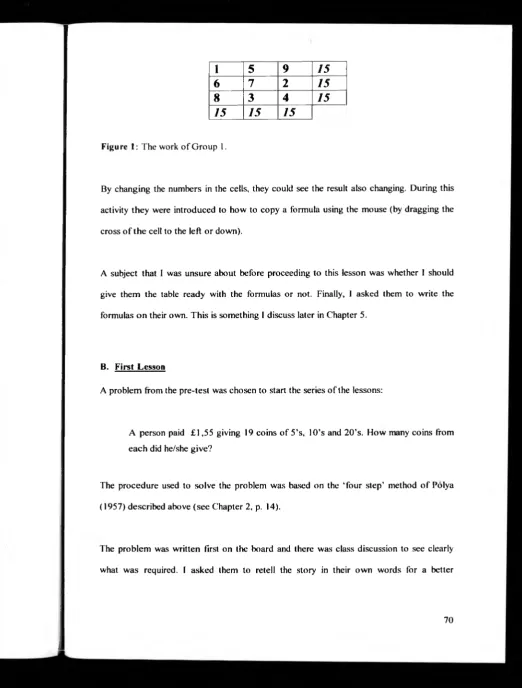
illustration there is a problem from Lockard (1994, p. 96) that can be solved using a spreadsheet:
trial & error
Each cell contains one o f the digits from 1 to 9, without repetition.
15 15 15
Place the digits so that all row sums and column sums equal 15.
III. Research Agenda
How can problem solving on a spreadsheet help students learn mathematics? The ability of a spreadsheet to execute mathematical algorithms permits pupils to quickly test and see the effects of varying parameters. It encourages guess-and-check experimentation both in arriving at solutions and in examining the effects when parameters change. Thus, it does not allow the formulation o f common errors found while pupils are working on a problem. Further, spreadsheets can be used to introduce pupils easily to problem solving activities with positive results. Together with appropriately designed processes problem can provide a context within which pupils can extend what they know and stimulate deep mathematical investigations.
The teacher plays an important role in the development o f problem solving skills by creating an environment in which pupils are encouraged to explore, take risks, share failures and successes, and questions one another in a co-operative setting environment.
Based on the four steps of George Polya’ s (1957), there have been many variations of the problem solving process. Some of the proposed strategies include, act out or use objects, make a picture or diagram, use or make a table, make an organised list, guess and check, use or look for a pattern, work backwards, use logical reasoning, make it simpler and brainstorm.
Should these strategies be taught explicitly as they will be working on the computer? Pupils while working on the spreadsheet to solve the problem will be using problem solving strategies and only then will become aware o f these strategies, as they arise in the classroom activities. It is only then that the teacher should encourage pupils to take note o f them and they will receive instructional attention if we want pupils to learn them. “Learning occurs not as pupils take in mathematical knowledge in ready-made pieces but as they build up mathematical meaning on the basis o f their experiences in the classroom” (Yackelet al., 1990, p. 34).
CHAPTER 3: RESEARCH DESIGN AND METHODOLOGICAL
APPROACHES
I. Introduction - Justification of Methods Chosen
After reviewing the literature about problem solving and its central place in pupils' learning as a fundamental element in the mathematics curriculum and the importance of using information technology as a tool I move now to the research methods chosen to identify if we can use a spreadsheet for the development of problem solving skills and to the methodological issues raised from this study.
There are three established research strategies; experiment, survey and case study (Robson, 1993; Cohen & Manion, 1994). Each one represents a different mode of enquiry suitable for particular purposes, with its unique characteristics:
Experiment: measuring the “effects o f manipulating one variable to another variable” (Robson, 1993, p. 40). Experiments can study “any kind o f behaviour but are limited by both practical and ethical considerations to ‘low impact' variables and research questions” (Robson, 1993, p. 167). Robson (1993) summarises that experiments need to satisfy “strict design requirements” (p. 168). The enquirer needs to know what he is or she is looking for with high specificity because of the “very small number o f variables”. There is no realism or generalisability.