Comittee
dr. Angelika Mader
dr. ir. Dennis Reidsma
ir. Hans Scholten
Till Schäfers MSc
User Experience in
Smart Environments
June 28 2016
Tobias Uebbing BSc
Written by
Design and Prototyping
Abstract
Home automation has been a popular interest and desire of the broad public for decades. Recently those visions slowly have started to become a reality with so called “Smart Home” devices. Nevertheless, the market adoption of these devices does not meet the sales expectations of the manufacturers. Market surveys have shown that missing interoperability, intelligence and un-pleasant User Experiences (UX) are potential causes. In-depth insights into the UX of such Smart Environments are scarce, since appropriate tools for the cre-ation of rapid prototypes are missing. Therefore, UX designer and researcher have to invest high efforts into the creation of merely stable prototypes. This repeatedly leads to shortened user evaluations with unsatisfying results.
Acknowledgements
My deepest gratitude goes to to all people that supported and accompanied me during the execution of this graduation project as well as my whole master studies.
I would like to thanks my supervisors Angelika Mader, Dennis Reidsma and Hans Scholten for the feedback and guidance throughout this project. I am in particular grateful for the excellent advice and academic as well as emotional support by my daily supervisor Angelika Mader. She was not only attend to keep me focused and motivated, but also that I take care of myself during times of intense research and conception. Without our weekly reflective talks I would not have reached the results laying now in front of you.
In the same manner I would like to thank my wonderful boyfriend who supported me at least as much and always made me feel like all the effort will lead to a valuable piece of work. Additionally, this document became visu-ally so appealing thanks to his noble graphical contribution. I also would like to thank my family for their steady support nevertheless which struggles oc-curred and for the sometimes undesired but needed distraction and relaxation.
Overall, I am thankful for my precious study years at the University of Twente that were enriched by my teachers, fellow students and friends. It would not have been the same without all of you.
Contents
1 Introduction 1
1.1 Intelligent Living Environments . . . 3
2 Background & Problem Motivation 6 2.1 Technical Background . . . 6
2.2 Applications on the Market . . . 15
2.3 User Experience Research . . . 18
2.4 Experience Prototyping . . . 20
2.5 Problem Statement . . . 26
2.6 Functional Experience Prototyping . . . 27
3 Desired UX 29 3.1 User Experience Dimensions . . . 31
3.2 UX outline for ILEs . . . 32
3.2.1 User’s Internal State . . . 33
3.2.2 Context of Use . . . 35
3.2.3 System Characteristics . . . 36
3.3 ILE Use Case Examples . . . 42
4 Design & Development Method 46 4.1 Current Methods . . . 46
4.2 An Optimized Method . . . 53
5 A Functional Experience Prototyping Toolkit 61 5.1 Specifications . . . 61
5.2 A Tool Framework . . . 65
5.3 Implementation . . . 72
6 Discussion & Conclusion 79
7 Future Work 81
Bibliography LXXXII
Acronyms LXXXVII
A List of Identifiers XCII
List of Figures
1.1 Search interests over time. . . 1
1.2 Examples of Intelligent Applications. . . 2
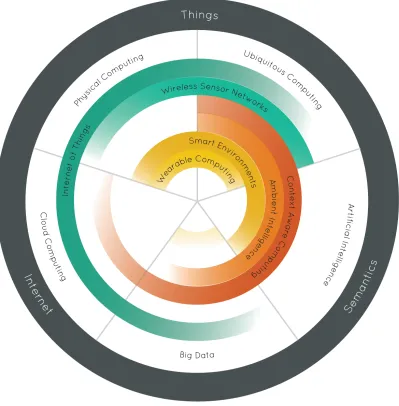
1.3 Allocation of fields associated with Smart Environment and inter-relations. . . 5
1.4 Intelligent Living Environments (ILEs) . . . 5
2.1 Identified IoT characteristics and derived technical challenges. . . 7
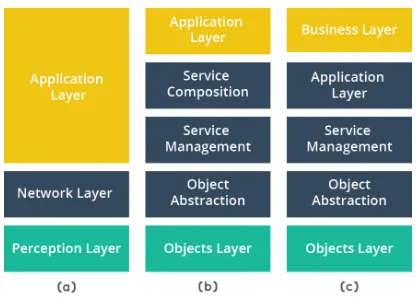
2.3 IoT architectures: (a) three-layer (b) service-oriented (c) five-layer 7 2.2 Technical elements of IoT as defined by Al-Fuqaha et al. [1] . . . . 8
2.4 Overview of standards relevant for IoT. . . 8
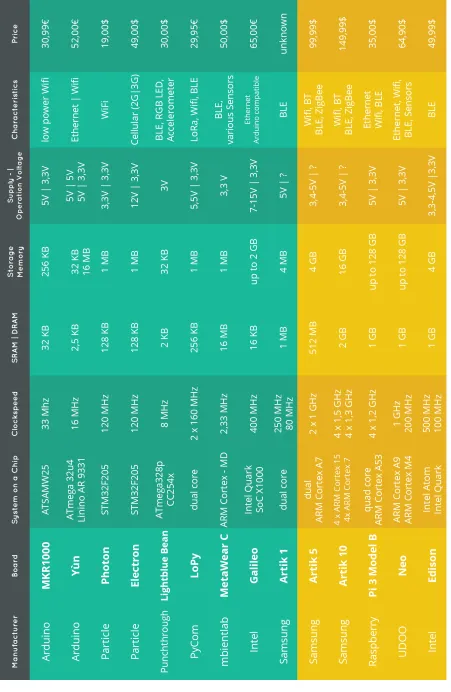
2.5 Overview of a selection of available development hardware. . . . 10
2.6 Overview of a selection of available development software. . . 12
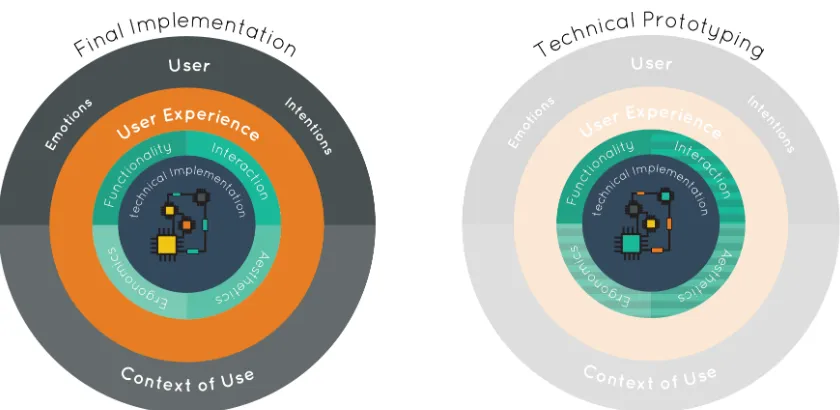
2.7 Illustration of Technical Prototyping . . . 13
2.8 Multiple IoT Application Domain Spectra. . . 14
2.9 Overview of collected application examples. . . 16
2.10 Continued: Overview of collected application examples. . . 17
2.11 Illustration of Experience Prototyping . . . 20
2.12 Overview of different types of prototyping activities. . . 28
3.1 The different scopes of User Experience (UX) design. . . 30
3.2 The three dimensions of UX. . . 32
3.3 General Intentions of Use for Intelligent Living Environments (ILE)s. 34 3.4 Overview of possible components of an ILE categorized into inputs, intelligence and outputs. . . 40
3.5 “Where did I leave ... my glasses?” . . . 42
3.6 Remembrall in the Harry Potter Movie. . . 43
3.7 Ario Smart Lighting system over a day. . . 43
4.1 The Agile Manifesto as defined by Beck et al. [7] . . . 47
4.2 One sprint in Scrum based on figure by Jongerius [29] . . . 48
4.3 Illustration of optimized design methods for ILEs incorporating functional Experience Prototyping (functional ExP). . . 52
4.4 Presence of expertise within the team. . . 53
4.5 Evolution of the prototype through out the design & development process including functional ExP, technical and final components. 55 5.1 Overview over all components of the functional ExP toolkit. . . 67
5.2 Hardware of the meSch kit. . . 73
5.3 Device pool overview in the front end of the meSchHub . . . 75
Chapter 1
Introduction
Figure 1.1: Search interests over time.
Source: Google Trends
The Internet of Things (IoT) is a term with continuously rising interest within research and industry since it was first coined in 1999 by Kevin Ashton [4]. The number of devices connected to the IoT is expected to reach 212 billion by the end of 2020 [17] and the annual global economic impact is estimated to be between $2.7 and $6.2 trillion by 2025 [43]. For this reason, leading Information Technology (IT) companies are making efforts to enter the IoT mar-ket. IBM, Google and Amazon are offering cloud services such as machine learning and IoT middleware for businesses. New hard- and software for IoT is constantly released for the development community by companies such as Samsung, Apple and others. Many of the big companies also offer end con-sumer products. Most popular application area in this market segment is the so called Smart Home. home automation has been a common interest for a while even before IoT was a well-known term as illustrated in figure 1.1. Current applications as for example smart thermostats and lighting systems can be either controlled via rules set by the user or manually from a remote location. But the adaption of these technologies by end consumers is still restrained and below expectations of manufacturers [12] [26].
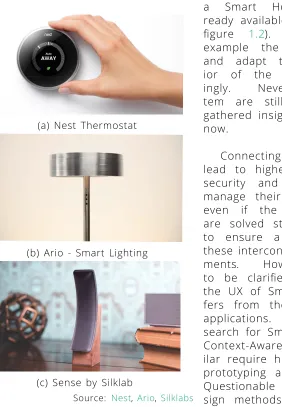
Learning Thermostat1, the Ario Smart Lighting2 system and Sense by Silklab3,
(a) Nest Thermostat
(b) Ario - Smart Lighting
(c) Sense by Silklab
[image:10.595.104.386.90.497.2]Source: Nest, Ario, Silklabs
Figure 1.2: Examples of Intelligent Ap-plications.
a Smart Home hub, are al-ready available on the market (see figure 1.2). They sense for example the presence of users and adapt their or the behav-ior of the environment accord-ingly. Nevertheless, those sys-tem are still isolated and keep gathered insights to themselves for now.
Connecting these systems shall lead to higher comfort, efficiency, security and empower users to manage their everyday life. But even if the technical challenges are solved still work is necessary to ensure a pleasant UX within these interconnected Smart Environ-ments. However, first it needs to be clarified whether and how the UX of Smart Environments dif-fers from the UX of stand-alone applications. UX design and re-search for Smart Environments and Context-Aware Applications and sim-ilar require high effort in terms of prototyping and user testing [55]. Questionable is to which extent de-sign methods for stand-alone ap-plications are suitable for UX de-sign within such Smart Environ-ments.
This work investigates how work of designers and researcher focusing on UX within Smart Environments can be facilitated. The focus will be sharp-ened to the area of ILEs on reasons explained within section 1.1. Chapter 2 provides a knowledge base in technical aspects, current applications on the market and UX research. Furthermore the chapter introduces the term Experi-ence Prototyping (ExP). Concluded is the chapter by summarizing the problem motivation and formulating a problem statement. Before the problem can be tackled chapter 3 defines the desired UX of ILEs. This generic outline includes three UX dimension aspects. Chapter 4 presents current common design & development methods and proposes a method that is optimized for the
appli-1https://nest.com/thermostat/meet-nest-thermostat/ 2http://www.arioliving.com/
cation of functional ExP. In chapter 5 we derive tool specifications from prior gathered knowledge and translate those to actual components of a software toolkit. Furthermore this chapter describes how an initial set of tool compo-nents is implemented. Finalized is the chapter by a proof of concept of the toolkit executed by the implementation of real world ILE use cases to validate the applicability of the tools. Afterwards, the findings and outcomes of this work are discussed and conclusions are drawn in chapter 6. Concluded is this work with a prospect on future efforts to continue the work on facilitating the design and prototyping of UX within ILEs and Smart Environments in chapter 7.
This work is a graduation project from the Master studies in Human Media Interaction at the University of Twente, Netherlands. It is carried out for the Products & Innovation department of the telecommunication provider Deutsche Telekom AG situated in Germany.
Final outcomes of this project are: 1. Generic outlines for the UX of ILEs.
2. A proposal for an improved design and development method for ILEs evaluated by experts.
3. Specification for a tool framework that supports this process and their translation to specific software components.
4. A collection of use cases inspired by previously defined UX outlines as well as current existing application in the market.
5. Implementation of an initial set of these tools and a proof of concept in form of an implementation of use cases using the toolkit.
1.1 Intelligent Living Environments
• Ubiquitious Computing (UbiComp) - embedding technology into everyday life
• Physcial Computing - connecting computing to the physical world by sensors and actuators
• Cloud Computing - granting access to cloud services for computing and communication in-between systems indirectly and asynchronously
• Big Data - managing, storing and handling the significant high amount of data that is expected to be produced
• Artificial Intelligence (AI) - extracting meaning from data and act on it intelligently
In the center of figure 1.3 the multidisciplinary fields were allocated in between their corresponding main fields. Most popular term right now is the Internet of Things (IoT). However, in our point of view IoT does not incorporate the ex-traction of semantic meaning and resulting intelligence. The terms that match our perception of the general phenomenon most are Smart Environments and AmI, where AmI forms more of an enabling base for Smart Environments.
For this reason, the focus of this work was laid on Smart Environments. Preparatory studies have shown that Smart Environments includes and in-tersects with many application domains such as smart cities, environmental monitoring, smart home, agriculture, markets and industry. It is evident that the UX of an application or service unfortunately depends highly on the user, his Intention of Use, Context of Use and application specific aspects [10,22,38]. The attempt to work on the UX of something as broad and general as Ubi-Comp or Smart Environment would potentially exceed the scope of this project. Consequentially, the focus is narrowed on an application domain that we call Intelligent Living Environments (ILEs). ILEs include all aspects that are incorpo-rated in a common everyday private live of a person. Therefore ILEs include terms such as Smart Home and Ambient Assisted Living (AAL) but also extents to private transportation and contact points with external services such as businesses. Figure 1.4 illustrates our point of view on the scope of ILEs.
At last in this introduction two minor remarks concerning the reading of this work. First, even though the terms (ILE, IoT, UbiComp, etc.) are so closely related we preserved the original word choice when citing work of predeces-sors. Treating them as different aspects of the same phenomenon potentially facilitates the reading process of this work. Second, a lot of different terms and aspects are defined and used throughout this work. For this reason, we introduced identifiers such as [EX.1] to uniquely mark them. A complete List of Identifiers is available in appendix A.
Figure 1.3: Allocation of fields associated with Smart Environment and interre-lations.
[image:13.595.87.513.591.689.2]Chapter 2
Background & Problem Motivation
This chapter forms a knowledge foundation for the further course. Addition-ally it provides the motivation for and specifies the problem tackled in this work in more detail. At first technical background knowledge relevant for the field concerning system characteristics, standards and hard- and software is given. Afterwards, existing applications in the market are briefly presented and examined with focus on matching the demands of the end consumers. Followed by a summary on the state of the art within User Experience (UX) research of Ubiquitious Computing (UbiComp) environments. The subsequent section introduces the method of Experience Prototyping and elaborates on supporting prototyping methods and their suitability for the design of Intelli-gent Living Environments (ILE)s. The first part of this chapter summarizes the results of our preparatory studies for this work on the subject of advances in applications and development for Internet of Things (IoT) and related fields.
2.1 Technical Background
Information Technology (IT) experienced significant advances in the last decade. Computing power steadily increased dramatically while the size of components and their cost decreased with the same factor. Shifting Mark Weiser’s [56] vision more and more into reality. The introduction of wireless technologies such RFID, NFC, WiFi and BLE made UbiComp systems such as Wireless Sensor Networks (WSN) and IoT possible. In the following information on the charac-teristics of IoT and related systems, important standards, hard- and software, and prototyping tools are explained.
System Characteristics
Miorandi et al. [44] defines the three main system-level characteristics within IoT so that ’anything’ communicates, ’anything’ is identified and ’anything’ in-teracts. From these main more specific characteristics can be derived. The 8 characteristics and resulting technical challenges as identified by predecessors [1, 41, 44, 50] are listed in figure 2.1. The characteristics and challenges can be projected on ILEs due to the close relations between Smart Environment and IoT. For more details please consult the preparatory study for this work.
Figure 2.1: Identified IoT characteristics and derived technical challenges.
the field. They discuss architecture, building blocks, common standards, chal-lenges and some application use-cases. The technical building blocks of IoT identified by them are shown in figure . When designing and developing IoT, the challenges identified previously such as scalability, heterogeneity and inter-operability should be taken into consideration [41].
Figure 2.3: IoT architectures: (a) three-layer (b) service-oriented (c) five-three-layer According to Al-Fuqaha et al. [1] a
flex-ible layered architecture is therefore a critical necessity to connect a theoret-ical infinite amount of heterogenous objects. However, “the ever increas-ing number of proposed architectures has not yet converged to a reference model” [1]. Figure2.3 illustrates three different generic approaches: a basic three-layer architecture [31, 59, 60], a service-oriented architecture (SoA) [1, 41, 44] and a five-layered architec-ture [31,59,60]. In the further course of this subsection the five-layered ar-chitecture will be used as reference
[image:15.595.300.508.511.661.2]Figure 2.2: Technical elements of IoT as defined by Al-Fuqaha et al. [1]
Standards
Figure 2.4: Overview of standards rele-Standardization is a key success
fac-tor for IoT to solve the challenge of heterogeneity [41, 57]. In the fol-lowing common standards for differ-ent compondiffer-ent and architectural lay-ers are briefly introduced.
For identification & communi-cation Infrastructure Protocols are needed to ensure interoperability within the Objects and Object Ab-straction Layer. Protocols for identifi-cation are divided into identifying enti-ties by an identifier such as EPC as im-plemented within RFID and address-ing them by IPv4 and IPv6. 6LoW-PAN provides a compressions mech-anism for IPv6 to make IPv6 address-ing possible on low power wireless networks. Most communication stan-dards are well-known such as WiFi, BLE, RFID and NFC. Other standards as e.g. LoRaWAN and LiFi are cur-rently emerging.
[image:16.595.302.507.356.711.2]com-municate to each other. Standards that are currently commonly used in IoT and similar systems are CoAP and MQTT. CoAP is based on REST on top of HTTP. UDP is the underlying transfer protocol and for identification URIs are used. CoAP incorporates mechanism that fix unreliability of message delivery within UDP. MQTT is built on top of TCP as transfer protocol. It implements a publish/subscribe pattern that allows one-to-one, one-to-many, and many-to-many relations. An MQTT implementation consists out of three components: publishers, subscribers, and one broker. Clients can be subscriber as well as publisher. A new emerging communication protocol is Weave but it is still in development and in invite-only Beta phase.
(Semantic) Interoperability “[T]here is a need for interoperation of underly-ing technologies” [1] due to the amount of different communication standards available and general heterogeneity present. The standard IEEE 1905.1 was introduced to converge technological heterogeneity. Other standardization ef-forts also support these endeavors. Unfortunately semantic interoperability has been mostly neglected. Though there are formal standards for the structure of information like JSON, EXI(XML), RDF and OWL there are no overarching agreements to make them applicable within IoT devices and services.
Figure 2.4 provides an extended overview of standards important for IoT and similar systems.
Hard- & Software
The hard- and software market for the development of IoT and similar appli-cation is fast emerging. In this section current new releases are presented.
Hardware -wise the two main segments are micro-controller boards and single-board computer. Most well-known micro-controller prototyping platform is Arduino1, respectively Genuino in Europe since 2015. For this reason, many other platforms are compatible with Arduino hardware and the associated Integrated Development Environment (IDE). Many new micro-controller boards have connectivity modules included such as for WiFi, BLE or LoRaWAN. Single-board computers became popular with introduction of the Raspberry Pi2. The low-budget computer was primarily meant to enable access to computation and the internet in education and developing countries. The newest version 3 Model B also includes a module for WiFi and BLE connectivity. Competitors such as the UDOO Neo3, aimed on IoT development, also already incorporates sensors on-board. Figure 2.5 provides an more extensive overview on current available hardware.
Fi
gu
re
2.
5:
O
ve
rv
ie
w
of
a
se
le
ct
io
n
of
av
ai
la
bl
e
de
ve
lo
pm
en
t
ha
rd
w
ar
[image:18.595.85.536.48.740.2]Software and Services for IoT development are available in various forms. This paragraph will shortly introduce relevant operating systems (OS)s, mid-dleware and cloud services. For single-board computers different operating systems are available. Two new OSs are Windows 10 IoT Core4 and Brillo5 by Google. Brillo claims to provide essential functionalities for IoT devices such as over-the-air updates. middleware compensates for asynchronism and ensures reliability of delivery within a system. It can either run within a local network or remotely on a server as cloud service. Example for middleware that can run on a local scope are Node-RED6, Eclipse SmartHome7 or the meSchup server developed during the meSch project [34]. Other middleware is offered in form of a cloud service like AWS IoT8 or IBM Watson IoT9. Other big IT companies that offer cloud services including computing, storage and machine learning capabilities are Google10 and Microsoft11. Figure 2.6provides an more extensive overview on current available software and services.
4?iiTb,ff/2p2HQT2`XKB+`QbQ7iX+QKf2M@mbfrBM/QrbfBQi 5?iiTb,ff/2p2HQT2`bX;QQ;H2X+QKf#`BHHQf
6?iiT,ffMQ/2`2/XQ`;f
7?iiT,ffrrrX2+HBTb2XQ`;fbK`i?QK2f 8?iiTb,ffrbXKxQMX+QKfBQif
9?iiT,ffrrrXB#KX+QKfBMi2`M2i@Q7@i?BM;bf 10?iiTb,ff+HQm/X;QQ;H2X+QKf
Figure
2.6:
Overview
of
a
selection
of
available
development
Technical Prototyping
Figure 2.7: Illustration of Technical Prototyping
We understand Technical Protoyping as following:
Technical Prototyping is the prototypical implementation of a system towards a technical realization and deployment of a concept. This activity can have different fidelity levels as aim from exploration and feasibility studies to final implementation.
Fi
gu
re
2.
8:
M
ul
tip
le
Io
T
Ap
pl
ic
at
io
n
D
om
ai
n
Sp
ec
tr
[image:22.595.112.472.79.762.2]2.2 Applications on the Market
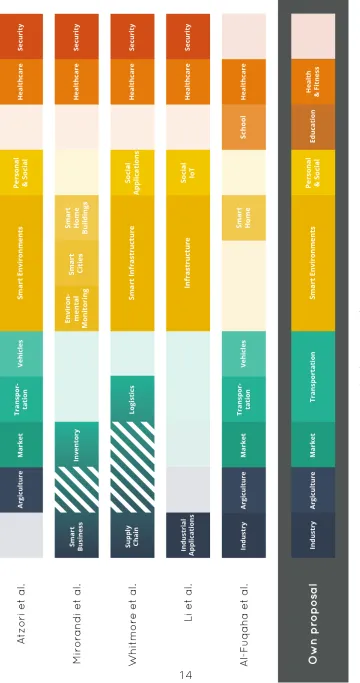
One result of the preparatory study was to define an updated application do-main spectrum based on similar spectra defined by predecessors (see figure 2.8) [1, 5, 41, 44, 57]. The proposed spectrum with 8 different domains is shown in the bottom of figure 2.8. The domains were defined with existing and potential future applications in mind.
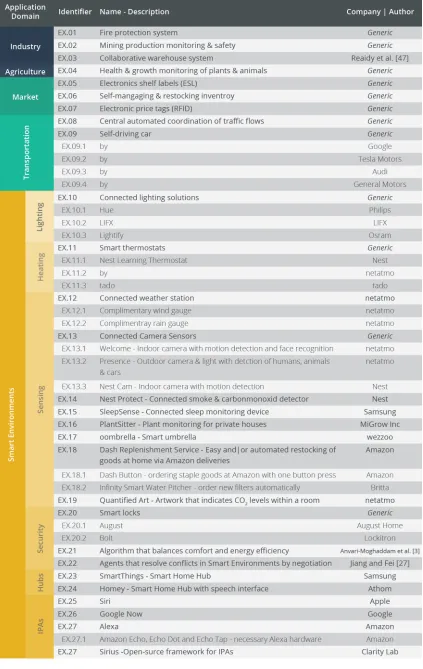
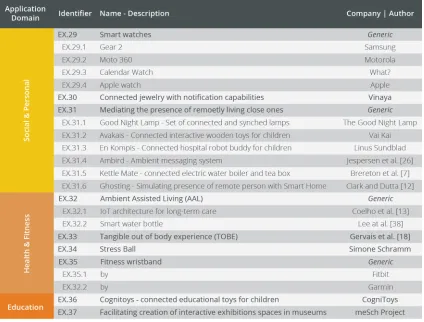
Second step was the collection of current application examples. Figure 2.9 shows an overview of the applications collected. As elaborated in section 1.1 this work concentrates on ILEs which mostly incorporate the domains of Smart Environments, Personal & Social, Education and Health & Fitness (see also figure 1.4). For this reason, most examples collected within the preparatory study fall under these domains.
Typical current end consumer products are retro-fit Smart Home solutions for controlling heating, lighting and the power supply of devices, and monitoring energy consumption. Smart Home hubs such as Smart Things (1sXkj) or Homey by Athom (1sXk9) are often a part of such ecosystems. They com-municate to devices using various communication standards, provide internet access to those and execute conditional rules which emulate the smart be-havior of the environment. More intelligent products like the Nest Thermostat
(1sXRRXR) that adapt to presence, preference and daily routine of the user by
themselves are available, too. Other products like the Cognitoys (1sXje) use cloud services to access speech recognition and synthesis capabilities as well as knowledge sources. Connected environments are also used to make museum exhibitions more interactive. The meSch project (1sXjd) funded by the Euro-pean Union is aiming to facilitate the use of such technologies within museums.
The critical aspects identified within this collection include missing interop-erability of products and the lack of (sensor) infrastructure in buildings and environments. Improvements within these aspects would potentially lead to higher consumer interest in IoT products. End consumer indicated in a survey that missing interoperability is a major critic point of Smart Home products [25]. For this survey Icontrol interviewed 1600 north american consumers in spring 2015 on the topic of Smart Home adoption. The results show that the current products are not meeting actual desires of end consumers.
In many current systems the user can either remote control functionalities via the internet and/or predefine rules and preferences that are triggered by specified sensor inputs or events. 60% of the participants of the survey indicated that they would rather prefer devices that use sensors, data and analytics to act on their own. Next best scenario from the consumer’s point of view is the interaction via voice-control or text messages (chat bots). Both of these characteristics are already available in some products. The before men-tioned Nest Learning Thermostat (1sXRRXR) and the Ario Smart Lighting system learn about their user and adapt accordingly. Amazon’s Alexa (1sXkd) and Siri
(1sXk8) make it possible to control devices using speech input. The problem
Figure 2.10: Continued: Overview of collected application examples.
other to create intelligent environments. Therefore (semantic) interoperability is key to enable the sharing and exchange of data.
The survey by iControl Networks [25] also identified another key success factor for the adoption of Smart Home systems. Surveyed consumers agreed that the UX and especially the ease-of use is more important than technical innova-tion. Väänänen-Vainio-Mattila et al. [55] agree that the consideration of the UX in the design and development process of intelligent environments from the very beginning is crucial for their success. As identified within our preparatory study it is nescessary for the future that systems recognize and understand their users and act appropriately on their own. However, it does need to be ensured that the user also feels comfortable being surrounded by systems that autonomously adapt their behavior and manipulate the environment.
2.3 User Experience Research
So as seen in the previous section IoT and related fields are maturing in terms of technology and started to enter the market [55]. Human Computer Interaction (HCI) and UX research has been a point of interest for many scholars within the field [54, 55]. “UX as a field seeks to offer a systematic approach to design and analysis of the user’s holistic experiences with the technology” [55]. Don Norman stated in 2000 that he created the term UX because he thought the term human interface and usability were to narrow and he wanted to cover all aspects of a person’s experience with a system [23]. Since the acceptance of a system “depends on how the user experiences them in real context”, well-executed UX Design has become a quality attribute and important success factor of any technology [55].
However, the concept of UX is still unclear and vague for many researcher and designers [15] and many different definitions exist12. The definitions by Alben [2] and Kuniavsky [35] match our understanding of UX closest:
“All the aspects of how people use an interactive product: the way it feels in their hands, how well they understand how it works, how they feel about it while they’re using it, how well it serves their purposes, and how well it fits into the entire context in which they are using it.”
- Alben [2]
“The user experience is the totality of end-users’ perceptions as they interact with a product or service. These perceptions include effectiveness (how good is the result?), efficiency (how fast or cheap is it?), emotional satisfaction (how good does it feel?), and the quality of the relationship with the entity that created the product or service (what expectations does it create for subsequent interactions?).” - Kuniavsky [35]
UXs are “based on instrumental (pragmatic) as well as non-instrumental (he-donic) system qualities” [22, 55]. Considering pragmatic system qualities such as usability is crucial [48] but UX goes beyond these aspects [55]. The terms usability and UX are often used interchangeably [15, 55]. But according to Hellweger and Wang [23] UX “should not be equaled to usability or user inter-face simply.” In the opinion of experts within the field usability alone can only achieve a limited level of UX [15]. We agree on this opinion and claim that usability is only one but essential part of UX. By understanding subjective and emotional experiences more meaningful and explicit targets for an application design can be facilitated [55].
Unfortunately most research in related fields is technology-oriented [1, 48] and literature related to HCI and UX has only a minor share [48,55]. Väänänen-Vainio-Mattila et al. [55] and Queirós et al. [48] executed an extensive system-atic literature review on UX research in UbiComp and Ambient Assisted Living (AAL).
Queirós et al. [48] analyzed 1048 articles in total. Only approximately 10%
(111) were related to direct user interaction and 29% were related to context-awareness within AAL. They found that “the [research] focus is still on the technology rather than on the person.” Many research projects concentrate on “how technology can be used in the AAL context instead of looking at the users’ needs and proposing ways to solve them” [48].
Väänänen-Vainio-Mattila et al. [55] collected initially 1016 article from various well-known databases. Only 75 (7%) papers were considered as relevant in the further course after applying filtering and selection criteria and content analy-sis. Field studies were the most often used approach for user studies among those papers. For evaluation purposes qualitative data gathering, more specific interviews, has been a prominent approach amongst the studies. Interesting findings of many studies about usage practices and design choice preferences enable insights into system use and needs for redesign purposes. Neverthe-less, such findings provide no insights into actual subjective experiences. Many qualitative studies apparently did not attempt to dive deep into experience aspects. Thus, systematic, in-depth analysis of subjective and emotional experi-ences is scarce within these works. “Only 4 of the 75 papers were at a level of description of the subjective user experiences that foster deep understanding of how the [UbiComp] systems are experienced” [55]. According to them UX studies “need to take a broad spectrum of human experiences into account” to provide guidance for design and experiments for UbiComp and similar systems due to the novel and versatile technology involved [55]. The trend of demon-strating complex and multitude UbiComp systems became evident such as the Georgia Tech Aware Home [32]. Many studies included aspects to take the technology out from laboratory conditions into the real-world. Unfortunately “it is evident that the development of prototype devices and applications was conducted very much from the technical viewpoint” [55]. For this reason, the “central outcome of the field studies was very much to verify that the technol-ogy concept actually worked in the real world settings, rather than that it was valid for the actual end users and targeted contexts of use” [55]. The cause for the limited amount of research with focus on subjective, details aspects of UX amongst UbiComp studies is potentially caused by the strong technological and engineering background from which the UbiComp field originated.
et al. [48] furthermore points out that different technologies emerged from different research groups, lacking necessary interoperability. They therefore ar-gue that efforts should be invested in the integration of existing technologies and interoperability.
The subsequent section introduces common methods for prototyping expe-riences for user studies and industrial design processes. Furthermore those methods will be elaborated towards their suitability for prototyping ILEs and similar systems.
[image:28.595.86.512.265.469.2]2.4 Experience Prototyping
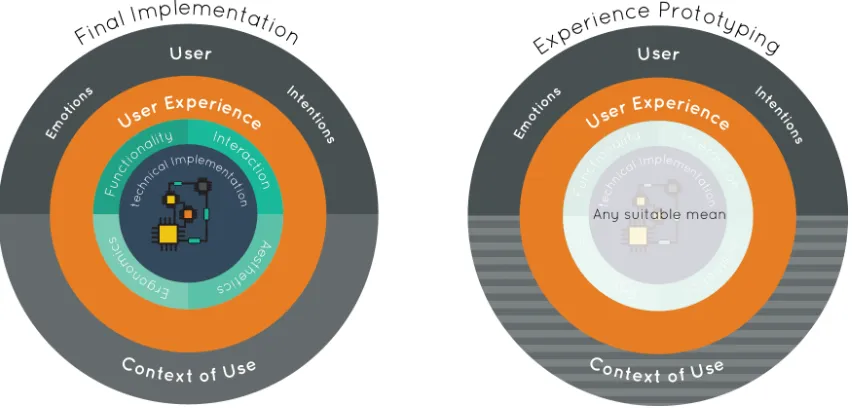
Figure 2.11: Illustration of Experience Prototyping
Prototyping is a key activity within the design of interactive systems and claims to be a key element of innovation in industry [10, 40, 42, 52]. Among others, Experience Prototyping (ExP) became a common practice since the term was first defined by Buchenau and Suri [10] from IDEO13 in 2000. According to them “[ExP] ... enables design team members, users and clients to gain first-hand appreciation of existing or future conditions through active engage-ment with prototypes.” They emphasize that an “Experience Prototype is any kind of representation, in any medium, that is designed to understand, explore or communicate what it might be like to engage with the product, space or system” in question (see figure 2.11). Prototypes in general allow “designers to demonstrate, evaluate or test an evolving design with minimal efforts” [54]. They can fulfill different functions [24], have different fidelity levels [33, 54], target different audiences and can be used as tool in participatory design [10]. Buchenau and Suri [10] considered preferably methods with active participation
to generate relevant subjective experiences instead of mediating a predefined one. They found that ExP contributes to a design process in three main ways: 1. Exploration and evaluation of ideas, generation of requirements and making design choices especially in an early design phase. Low-tech methods and basic materials are especially suitable.
2. Communicate ideas to different audiences such as fellow designers, tech-nical developers, clients or end users. The fidelity level should be chosen appropriately to the design and development stage.
3. Help to foster an understanding about the essential factors of an ex-isting application and it’s context. For achieving this more high fidelity prototypes are necessary.
As Buchenau and Suri [10] predicted, ExP established as a well-supported tradition within design practice over the last decade. The fidelity level of Experience Prototypes thus needs to raise to acquire more detailed and so-phisticated insights if e.g. the deployment of a product is approaching [10, 55]. Unfortunately efforts with respect to time, work force and expenses are high for the creation of high fidelity prototypes [53, 54]. For this reason, low-fidelity ExP methods are way more common in the fast iterative design processes in industry. In the following some of these methods will be presented and exploited with regard to their applicability within a design process of an ILE.
(1tSXR) Collages & (1tSXk) Visualizations - Collages [50] are tools for the creation of semi-realistic mockups that help non-experts imagine unfamiliar devices already in an early design stage. Those documents should situate the physical objects in context. Trade-offs are often necessary for an effective early concept communication. On the one hand, the documents need to convey the full complexity of the concept. On the other hand, they should function as initiator for concept discussion.
Product/Service Visualizations [50] should be a single page mockup of key forms, relationships, and interactions. The visualization can be rough and imperfect. It can consist of a montage of photographs of existing sites with rendering of the concepts. In case that images are insufficient annotations can be added to provide additional information and remarks. The visualization should be specific and concrete so that it conveys problems, possibilities and relationships. In this way it should foster a discussion.
These two low-fidelity methods are used in an initial stage to discuss ideas and concepts and to discover potential problems. They are certainly also suitable for the design and development of ILEs in an early stage. Since ILEs consist of many components potentially multiple visualization are needed to foster discussion to an appropriate extent.
due to its static nature. It can be created with pen and paper or on a white-board supported by special stencils or digitally. For digital creation standard graphics software such as Adobe Illustrator14, Sketch15 and OmniGraffle16, or specialized software such as Balsamiq17, Adobe XD18 and Mockflow19 can be used. It’s creation should be fast and results can be rough and low in fidelity.
Paper Prototyping [35, 53, 54] is the next evolutional prototyping level. It is commonly used for the same application types as wireframing. In difference to wireframing it allows additionally the evaluation of dynamic interaction aspects such as navigation and workflow, page layout and functionalities [53]. In a user test developers or researchers “play the role of ’computer’, manipulating the pieces of paper to simulate how the interface would behave” [53]. No explanations on how the interface is supposed to work is provided but only functionalities of the user interface are simulated [53]. In this way realistic interactions can be achieved [54]. All available materials such as paper, plas-tics or fabric can be used and crafted to a low-fidelity prototype [35]. It does not need straight lines or typed text, images or icons, color, and consistent sizing of components [53]. Therefore it is fine if it is rough or a bit messy [35,53]. The integration of existing graphics, screen shots, photos or previously generated wireframes is nevertheless desirable [35,53]. If the prototype incor-porates content, then it “[needs] to [be] appropriate, detailed and meaningful to the application to preserve the fantasy” [35]. Snyder [53] elaborated on this: “If your user are accountants and you’re testing a financial application, the number better make sense.” As a rule-of-thumb the creation of the prototype should not take up more than one day [35]. Benefits of paper prototyping are that changes are easy and quickly realizable and no technological efforts are necessary. For this reason, “application designers, usability specialists and even the users themselves can create prototypes individually” [54]. However, a paper prototype does not deliver insights into technical feasibility, response times, layouts that require scrolling and design choices like color and fonts. Paper Prototypes and Wirframes are certainly not sufficient to precisely cap-ture the interactivity of UbiComp environments [54] due to their visual nature. They are mainly used to prototype GUIs and other visual interfaces. However, Kuniavsky [35] points out that paper can also be used for scale models of scenery or objects. The two methods are certainly suitable for testing of ILE components such as the GUI a smartphone app.
(1tSX8) Physical Modeling 20 as used in Industrial and Product Design is very important for the IoT, Smart Environments and ILEs. Since ’things’ get connected functionalities and become avatars for digital data and representa-tions, ergonomics and aesthetics of them contribute to the general UX of ILEs. First mock-ups in full-scale or scaled-dimensions can be used for explorations
and early user feedback. Non-functional aesthetic models carved from e.g. sty-rofoam, wood or clay or 3D-printed from plastics can be used in user testings for more precise and detailed feedback on aesthetics and ergonomics. Scale-models of environments and objects within are useful to illustrate proportions and relations.
It is evident that Physical Modeling on its own is not suitable for ExP. Never-theless, we wanted to include it in this list based on the importance of the physicalness of objects in ILEs.
(1tSXe) GUI Prototyping is the final prototyping evolution from Wireframing
and Paper Prototyping. Software like Axure, Framer or Adobe XD offer the possibility to create high-fidelity prototypes that are semi-functional and offer a polished look. GUI prototypes enable the evaluation of layout, structure, content and the graphical and Interaction Design (IxD) in detail.
They are similar to they predecessors certainly not suitable to provide the experience of an ILE. However, due to their high fidelity they can potentially be used as one component of a high-fidelity prototype of an ILE.
(1tSXd) Written Scenarios & (1tSX3) Storyboards - Ascenario [35,54] “tells a short story about people, situations, and how products introduced into that situation change people’s experience” [35]. The goal is by describing the details of the five aspects people, time, space, objects and circumstances/context to create a detailed story of a specific UX [35]. One concept or product can be subject of multiple scenarios. It is even advisable to create at least one scenario of everyday usage and another describing the situation of an edge case [35]. Scenarios enable designers to understand the everyday practices of their users [54], share understanding amongst them and mediate concepts experiences to clients and end consumers [35].
Storyboards [35, 50, 54] are an evolution of scenarios and complement each other. They visualize scenarios in sequences and transitions by graphic commu-nication using images of people, objects, and environments but also diagrams, maps and symbols [50]. Equivalent to scenarios a concept “can have multiple storyboards describing possible experiences and interaction” [35]. They help imagine the various scales of a multi-scale interaction [35], its context and the cooperation of components [50]. Furthermore during the creation the designer needs to work through how the systems potentially fits together. The fidelity of graphics can additionally communicate the state of development of a com-ponent [50].
(1tSXN) Enactment of Scenarios with designers, developers and end con-sumers and potentially props make it possible to better envision dynamic relations and context of a concept. Furthermore it involves the actors actively so that they can experience the concept more subjectively.
However, due to the complexity and continuous changing context [54] within ILEs a lot of influencing factors are left to the actors’ imagination. Additionally the experience of an ILE can potentially only be enacted component-wise. This makes this method certainly suitable for early but not later stages in the development process of ILEs.
(1tSXRy) Rapid Video Prototyping [35,50] is not the creation of high-quality future visions as released on a regular released by Microsoft and other IT companies. This methods uses consumer-grade video hard- and software to create rapid video prototype using highly limited time, financial and workforce resources. These communicate and demonstrate concepts in action, and en-able the quick exploration of ideas while ignoring technical details. Earlier prototyping results such as paper prototypes, scale and physical models, or scenarios in form of enactment can be incorporated. The video can also be realized by stop-motion animation with e.g. LEGO.
Rapid video prototyping has the advantage over live enactment that the ex-perience can be enhanced by post editing and it can be used for mediating the idea to a bigger audience. However, since the audience is not active in-volved and the experience is predefined their feedback is potentially not as valuable since they did not have a subjective experience. Therefore it only seems suitable for UX design of ILEs to a limited extent or in early stages.
(1tSXRR) Wizard of Oz [50, 54][35, p. 228] is in general a test setup in which a person (the Wizard) observes the input of a system (e.g., user’s actions) and simulates the system’s responses in real time” [54]. This enables the simulation of complex and native interactions such as speech input or gesture control or the interaction with an intelligent system.
It is necessary to implement and test a second interface for the wizard. The effectiveness of the prototype depends on the wizard’s level of task under-standing and skill to control the interface [54]. Unfortunately “the complex and multimodality interactions make the high-fidelity implementations [of ILEs] very difficult and also make in situ testing challenging” since human perception is limited. But the Wizard of Oz technique can be used to simulate complex components in a high-fidelity Experience Prototype of an ILE that would require high efforts to be implemented.
prototype of a stand-alone product in an ILE furthermore the technical and semantic communication of components needs to be implemented. Incorpo-rating, even only a rule-based, intelligence increases the required efforts even more. Therefore, the creation of a complete functional prototype of an ILE for UX design and research purposes seems unadvisable with conventional tools for technical prototyping.
The previous elaboration on common ExP methods in industry and research as shown that they are not suitable for providing the UX of an ILE in its whole. Low-fidelity methods like collages, visualization, scenarios and its various deriva-tives are suitable for ideation and concept generation in an early stage. Other methods like wireframing, paper and GUI prototypes and physical modeling can be used to design and develop the individual UX of components within an ILE. High-fidelity component prototypes in form of sophisticated physical models, GUIs or functional components can potentially be used for the creation of a high-fidelity Experience Prototype of an ILE.
2.5 Problem Statement
This section describes in more detail the problems faced within this work and their origin.
As shown previously current products and services are not meeting the desire of end consumers (see chapter 2.2). They would prefer more intelligent cooperative systems that are more easy-to-use over current products [25]. This is caused on the one hand by missing efforts of the industry on semantic interoperability (see chapter 2.1). On the other hand UX design for ILEs is lagging behind the UX knowledge on stand-alone applications from our point of view. We see this confirmed by the findings of Väänänen-Vainio-Mattila et al. [55] (see chapter 2.3). Their literature overview illustrates that in-depth UX research for UbiComp systems is scarce. The origin of the field from a technical and engineering background is one reason. Another reason is that technical challenges during implementation of systems for user studies and their execution decrease the time span to gather and the quality of results [53, 55]. They find that long-term user studies in real context with real users are necessary to increase the validity of UX findings. Therefore the creation of suitable and stable Experience Prototypes is needed. We evaluated common prototyping methods in UX design towards their suitability (see chapter 2.4). Due to the heterogeneity, complexity and dynamics within ILEs, their context of use and new ways of interaction [54] none of the common prototyping methods are suitable to capture the experience of an ILE in its whole with reasonable efforts. Additionally Buchenau and Suri [10] claim that “solutions, and probably even imagination, are inspired and limited by the prototyping tools we have at our disposal.”
For this reason, this work attempts to ...
Following questions need to clarified to approach this problem statement:
• (ZXR) - What is the desired UX of ILEs?
– (ZXRXR) - What are the dimensions of UX?
– (ZXRXk) - To which extent can an UX outline for ILEs be defined?
• (ZXk) - What is a typical design and development process in UX research
and industry?
– (ZXkXR) - Does this process needs to be adapted when incorporating
functional ExP?
• (ZXj) - What are the specifications for a tool that supports a design and
development process that incorporates functional ExP?
– (ZXjXR) - How to map the identified specifications to functional tool
components?
2.6 Functional Experience Prototyping
We understand functional ExP as following:
Functional Experience Prototyping is the prototypical implementation of a User Experience (UX) that is equivalent to the UX of the intended final product. The prototype will most likely not contribute to the technical realization of the final product but is not restricted in this aspect.
Functional Experience Prototyping enables thus the fast and easy creation of high-fidelity Experience Prototypes of a concept. The resulting prototype provides similar UX and functionality in comparison with the intended final implementation. Nevertheless, the technical details, efficiency, scalability, etc. of the implementation are beside the point. Except if the UX of the proto-type would differ from the intended final implementation in such a way that findings of user studies carried out using the prototype would become invalid. Therefore, the technical implementation of the prototype will most likely not contribute to the final deployed implementation. However, we don’t want to limit the term functional Experience Prototyping (functional ExP) here, since innovations in development tools are steady and could lead to a fusion of functional ExP and Technical Protoyping to some extent.
Chapter 3
Desired UX
The desired UX of ILEs needs to be known so that it can be realized within a functional Experience Prototype. For this reason, this section aims to define an outline for desired UXs of ILEs.
First it needs to be clarified which dimensions are influencing UXs and therefore need to be included in a generic UX outline. Afterwards, the resulting UX outline of ILEs is presented by elaborating on the selected dimensions. However, before diving into UX dimensions and outlines two important aspects of designing UXs need to be mentioned. Next to the external factors it is important to define the type of UX that the designer is aiming for and the scope of the UX considered within the design. The next paragraphs will give more details about these two aspects.
Types of UX - The field of psychology defines three different types of moti-vation: utilitarian, hedonic and eudaimonic [47,51]. We borrow these terms to define three different non-exclusive types of UX:
• Utiliterian experiences aim for the pure fulfillment of the user need or Intention of Use without considering other dimensions such as the emotional state of the user or the Context of Use. This would correspond to a pure functional application that uses the most common and easy-to-implement way of interaction with the user e.g. keyboard and mouse or nowadays touch screens.
• Hedonic experiences aim for fun and enjoyment to improve well-being. Next to the fulfillment of the user need other aspects such as usability as well as aesthetics are considered in the design process. Making the experience not only intuitive by for example using body gestures but also enjoyable by e.g. funny ways of feedback.
• Eudaimonic experiences try to add to or support the meaningfulness of a system. Eudaimonic well-being concerns aspects such as self-acceptance, personal growth, purpose of life and more. An experience can support this by considering e.g. the emotional state and emotions of a user during the use of a system.
Figure 3.1: The different scopes of UX design.
aiming additional for a hedonic experience would most likely improve the fulfillment of the hedonic user need. In our opinion a hedonic or eudaimonic experience is always based on the fulfillment of the user need thus a utilitarian experience.
Scope of UX Design - It is important, especially with the background of ILEs, to define the scope of the UX that is intended to be designed in the very begin-ning. The following list provides more detail about different experience scopes.
• Brand Experience [38] includes the interaction with a whole company, all its products and services. A positive or negative brand image can influence the user experience. A image of a high valued brand can outweigh minor design flaws. A negative image can even prevent the whole experience to happen at all. In the same way as an experience with every service or product influences the brand experience. The brand experience forms the initial expectations towards a product.
to be insured that they form one monolithic Common Operating Picture (COP) [20].
• Service Experience [38] is the experience of one service that involves multiple components. All components contribute to the achievement of one objective. The experience within a service is distributed onto all components that come into contact with the user. An environment experiences could be assembled out of multiple service experiences. However, the interplay within a environment experience is potentially way more dynamic.
• Product Experience [38] is the experience with one specific artefact. A product experience can be part of service, brand, or environment experiences.
Figure 3.1 illustrates the relations between those different UX design scopes.
3.1 User Experience Dimensions
The term User Experience (UX) has been already introduce in section 2.3. This section elaborates on the dimensions that influence and built-up a UX from a more general perspective. The identified dimensions will be used to form an outline for desired UXs of ILEs in the further course of this chapter.
An “experience is a very dynamic, complex and subjective phenomenon” [10]. Experiences, even of simple artifacts, live in a complex dynamic context of people, places and objects [10]. According to Law et al. [38] experts in the field agree that “contextual factors are important influencers of UX.” Hassenzahl and Tractinsky [22] define three dimensions of UX:
1. user’s internal state (predispositions, expectations, needs, motivation, mood, etc.)
2. characteristics of the designed system (e.g. complexity, purpose, usability, functionality, etc.)
3. context within the interaction occurs (e.g. organizational/social setting, meaningfulness of the activity, voluntariness of use, etc.)
Hellweger and Wang [23] propose a conceptual UX framework based on this three dimensions that include following aspects: Product properties, context, usability, cognition, purpose, (user) need. Derived from the definitions of predecessors [22, 23, 38] we defined our own UX dimensions as shown in figure 3.2. In the following a short elaboration on the various aspects is given:
• User’s Internal State
– Intentions of Use summarize the user needs and motivations to use a specific application. The objective or user need that the intended application should fulfill is the most fundamental aspect of an UX [18].
• Context of Use includes temporal, social, physical, technological and task-specific aspects of the context that the system is used in.
• System Characteristics such as functionality, usability and complexity influence the perceived user experience of the system. The purpose of the system should meet the Intention of Use if a positive user experience is desired.
[image:40.595.87.509.289.494.2]In the subsequent section the gathered insights on UX from this section will be used to draw a generic outline for UXs of ILEs.
Figure 3.2: The three dimensions of UX.
3.2 UX outline for ILEs
This section defines an outline for UXs in ILEs by elaborating on appropriate dimensions of UX. The previous section introduced these dimensions. Due to the subjective nature of some of the aspects concerning the user dimension those can not be generalized and therefore not considered in this outline. However, the subsequent section provide details concerning UXs of ILEs with respect to the Intention and Context of Use, specific aspects of UX and IxD that originate from system characteristics as well as typical components that can be assembled to ILEs.
chapter the UX of an ILE is an environment experience. Such an experience is not just the sum of the individual UXs of the separate components. The environment experience incorporates additionally factors such the interplay of explicit and implicit interaction with assembled products and services. Figure 3.1 illustrates this constellation.
3.2.1 User's Internal State
It is evident that many aspects of the internal state of a user are highly subjec-tive and vary in between each individual. Aspects such as user’s expectations, emotions, moods, meaningfulness of an interaction and prior knowledge are therefore highly dynamic factors as an result of interplay between the user’s personality and the current Context of Use. Therefore, user evaluations, as this work attempts to enable, are necessary to consider theses aspects within a de-sign and development process of an application. Nevertheless, one part of the user’s internal state can be more generalized for ILEs as shown in the following.
The need that the user intents to satisfy by using an ILE application is the foundation of every UX. An unfulfilled user need has potentially such a negative influence on other UX dimensions, in our opinion, so that the intended designed UX is not experienceable. Subsequently, we attempt to summarize the Intentions of Use for ILEs. The overall goal of ILEs is an increase in life quality of its user in terms of comfort, health, environmental impact and more. Considering the collection of application example presented in section 2.2 and customer surveys [25] we derived more specific Intentions of Use as listed below. Figure 3.3 provides an overview of these as well.
• AXR - Efficiency of resources and activities of the user. ILEs can facilitate a more efficient use of resources such as energy (e.g. smart thermostats
(1sXRR)), water, food or shared goods (e.g. car-sharing). This leads to
higher cost efficiency as well. They can furthermore improve efficiency of time efforts and logistics within user activities to achieve e.g. a better work-life balance.
• AXk - Empowerment - ILEs can empower user to e.g. live on their own longer than without the system. They can improve safety by monitoring user activities, take care of chores that user can not execute anymore themselves caused by e.g. their age, and connect users to remote living relatives in every day life ((1sXjR)). This concept is also known as AAL. Other forms of empowerment are for example improved educational possibilities by e.g. interactive toys (e.g. Cognitoys (1sXje)).
Figure 3.3: General Intentions of Use for ILEs.
• AX9 - Security & Safety of users and their property can be enhanced by the advanced surveillance and monitoring capabilities of ILEs. For example user can be recognized and by this access can be granted without the need of a physical object like a key (Smart Locks (1sXky)). Continuous monitoring of user and infrastructures such as building can furthermore increase safety e.g. against accidents.
• AX8 - Maintenance - The continuous monitoring of infrastructures and devices can also simplify and improve maintenance. In comparison to fixed maintenance schedules systems to an ILE can indicate when main-tenance is really necessary. Smart devices can additionally also order replacement parts themselves (e.g. (1sXR3Xk)))
empowers user to live longer on their own. Intentions are of course highly dependent on the user e.g.: Some users may perceive daily cooking as a chore and would prefer if an ILE application would take over this task. Other users may perceive this task as delightful and would like to take care of it as long as and whenever possible themselves. This should be considered when designing and developing an ILE application.
3.2.2 Context of Use
As elaborated previously the Context of Use is a major factor for the user experience of ILEs. One general concept that needs to be considered in ILEs is that the user constantly carries his micro environment with him in form of e.g. personal devices. In optimal case this micro environment should inte-grate seamlessly with the surrounding macro environment. Furthermore it is important to consider all contextual dimensions as identified by predecessors [38]:
• *PXR - Temporal context can influence the way a system reacts to a user. Supporting the user after getting out of bed in the morning is most likely desired by the user. However, same supporting actions can be highly inappropriate when getting out of bed in the middle of the night or after nap in the afternoon.
• *PXk - Social context creates challenges for the behavior of a system. The behavior of a system like setting the preferred air temperature within a room should consider all persons present. It is still a matter how to solve such conflicts. Additionally, some behavior of a system that is desirable, when the user is on his own, is potentially not desirable when other people are around.
• *PXj - Physical context is a mayor factor that needs to be considered within ILEs. ILE applications should consider the physical context of its users as well as devices. This enables so called implicit interactions with an application. This term will be discussed in more detail in section 3.2.3.2.
• *PX9 - Technology infrastructure surrounding the user and other devices should be incorporated if worthwhile. For example the playback of a video should happen on the most appropriate screen available in the surrounding of the user instead of e.g. a smartphone display. Information from additional devices could be requested to increase confidence of e.g. the recognition of user identities or activities. The consideration of the technological context is the foundation that enables the integration of the micro and macro environment of the user.
stove previously. By recognizing that the user intents to prepare some tea the electric kettle could adjust the final water temperature according to the chosen sort of tea. In this way an improved result such as better taste cloud be achieved during the infusion of the tea.
Same as for the Intentions of Use the Context of Use is always a mix of all aspects. All factors are interrelated and can hardly be seen in an isolated manner.
3.2.3 System Characteristics
The third UX dimension that was derived and set within this work are the characteristics of the system in question. These are certainly dependent on the actual application and can hardly be generalized. However, we identified general characteristics of IoT systems within a preparatory study. These characteristics were previously presented in the technical background section 2.1. In the further course of this subsection first the impact of the system characteristics on the UX and IxD of ILEs will be discussed. Afterwards, the composition of ILEs will be analyzed with a set of abstract components for ILEs as a result.
3.2.3.1 User Experience Aspects
In course of this study it was already shown that the UX of stand-alone ap-plication (product/service experience) differs from the UX or ILEs (environment experience). In the following important UX aspects for ILEs are listed. These were partially derived from the system characteristics defined in chapter 2.1 and gathered from work of predecessors.
• (lsXR) - UX is distributed and dynamic - ILEs have dynamic N-to-N
relations (→ (*_Xj)). The interaction with one ILE application can happen
over multiple interfaces by one or multiple users, the functionality can be distributed and new components can dynamically be added to the system. Furthermore, the Context of Use can change dynamically → (*_X9). [50,
p. 7] [21, p. 112]
• (lsXk) - UX depends more on the Context of Use in comparison to UX
of stand-alone products. The Context of Use within ILEs is highly dynamic and diverse (→ (*_X9)). [50, p. 11] [35, p. 25] [54]
• (lsXj) - UX can be discontinued - Since ILEs are asynchronous, not all
devices are always online due to e.g. energy management→ (*_X8)(h*GX9).
Additionally, considering (lsXR), user can stop the interaction flow on one device and continue on another that offers the same functionalities →
(*_Xj). [50, p. 8] [21, p. 112]
• (lsX9) - Responses & feedback can be delayed or lost - ILEs can
• (lsX8) - UX can be unexpected and surprising - Taking (lsXR) into account it is evident that data can be manipulated and actions can be triggered over multiple interfaces either by another human, by rules or by intelligent agents. Rules can potentially have been set by another person or the user himself. The user may also forget about rules that he had set himself in the past.
• (lsXe) - UX can be shared amongst people - An ILE is most likely
a shared space in which multiple people live or at least are sometimes present. Therefore major parts of the UX of an ILE will be shared amongst those.
3.2.3.2 Interaction Design Aspects
The system characteristics and their influence on the UX have also an impact on how interaction should be designed for ILEs. Two different kinds of interactions are present within ILEs: Explicit and implicit interactions [54]. Subsequently, first a list of aspects that are important to consider when designing interaction within ILEs in general is presented. Afterwards, the terms explicit and implicit interaction will be explained in more detail and specific design aspects for those types of interaction will be pointed out.
Interaction within ILEs ...
• (At.XR) - ... should (at least partially) be available when
discon-nected. So that even if devices or services are shortly or completely disconnected part of the interaction still remains available → (lsXj).
• (At.Xk)- ... should be robust against discontinuity in interaction. An
ILE should be able to cope with situation where interaction is interrupted and potentially picked up on a later point in time → (lsXR)(lsX9)(*PXR).
• (At.Xj) - ... should be robust against other associated devices
being disconnected. Not all devices within an ILE are always online due to e.g. energy management → (lsXj). In such cases interaction flow
that require those devices need to be robust against this fact.
• (At.X9) - ... should be robust against conflicts between user
inter-ests. ILE are spaces that are most likely shared amongst multiple people. Therefore the interest of one user (e.g. preferred room temperature) can be in conflict with the interest of other users → (lsXe). An ILE needs
strategies how to cope with such conflicts preferably autonomously. De-pending on the type of interest averaging, merging or assigning priorities could resolve the conflict. Asking the users to resolve the conflict them-selves could also be an option in a social context where the users know each other.
• (At.X8) - ... should be always transparent for the user. The state
more feedback as in “sending request”, “request arrived”, “request exe-cuted” [50] → (lsXR). Additionally the user should have insights about all
implicit interaction happening by e.g. providing an overview about those.
Explicit Interaction are executed by the user with direct intention to manip-ulate the system. Explicit interaction are well-known to user nowadays in form of interactions with e.g. keyboard and mouse, touch screens or speech inter-faces. In the following some aspects that were derived from general system characteristics and UX aspects stated earlier are listed.
Explicit interaction within ILEs ...
• (At.X1tXR) - ... should consider the Context of Use. The interaction
should be adapted to the context of use → (lsXk). Controlling an ILE via
speech at home seems desirable to a user. But in public many people dislike using speech input, same is true for synthesized speech output. A graphical user interface (GUI) may in that context be more suitable. Con-tinuing this thought, the GUI should automatically adapt between in home and outside context, offering primarily the more important functionalities for the Context of Use.
• (At.X1tXk) - ... should be meaningful within the Context of Use. The
interaction type should be chosen considering the context. For example if the user is in a room and wants to lower the window blinds. Controlling them by point and speech control (→ “lower”) is a way more meaningful
interaction in this context than using a smart phone app to do the same. Furthermore, devices that evolved from traditional devices (e.g. smart thermostats) should offer similar functionalities and interaction possibili-ties as their traditional equivalents. For example some smart thermostats on the market lack direct interaction possibilities and need to be mainly controlled via a smart phone app.
• (At.X1tXj) - ... should be as modular as possible. It is a sensitive
matter how to divide and distribute the interaction considering (At.X1tXR)
& (At.X1tXk). This needs to be done in such a way that one module still offers a suitable amount of functionality by itself → (At.XR) (lsXR).
• (At.X1tX9) - should not be (physically) exhausting for the user.
Interaction types that require physical movement or holding of poses should be limited and not stress or exhaust the user except stimulating physical exercise is intended.
Implicit Interactions are executed by the user unconsciously through his every day behavior such as change in location or activity and are interpreted by a system to react in an appropriate way. Implicit interactions are used within context-aware applications or systems such as ILEs but also stand-alone appli-cations. Context-aware applications are still a minority but steadily gain more interest.