August 9, 2016
MASTER THESIS
ACHIEVING 128-BIT SECURITY
AGAINST QUANTUM ATTACKS IN
OPENVPN
Simon de Vries
Faculty of Electrical Engineering, Mathematics and Computer Science (EEMCS) Services, Cybersecurity and Safety (SCS)
Graduation committee: dr. A. Peter
dr. M.H. Everts
Achieving 128-bit Security against
Quantum Attacks in OpenVPN
Simon de Vries
Abstract—Niederreiter is a candidate post-quantum cryptosystem. Its large public key size currently discourages its use in practice. We demonstrate and evaluate how Niederreiter can be used for quantum-secure key exchanges by implementing it in OpenVPN. We contribute an analysis of how much Grover’s algorithm can speed up existing attacks on Niederreiter and McEliece and what code parameters can protect against these attacks. We provide parameters for 128-bit quantum security that result in almost 35% smaller keys than parameters currently available in literature.
Index Terms—OpenVPN, post-quantum cryptography, McEliece, Niederreiter, key exchange
✦
1
I
NTRODUCTIONO
PENVPN is a software application which can be usedto set up aVirtual Private Network (VPN) [1]. It allows connecting two private networks over a public untrusted network, creating a secure channel between the private networks. In order to provide this secure link, TLS is used for key exchange.
1.1 A new threat: quantum computers
The most used algorithms for key exchange in TLS are RSA, Diffie-Hellman and Elliptic Curve Diffie-Hellman. These algorithms respectively rely on the integer factorization problem, the Diffie-Hellman problem, and the elliptic curve Diffie-Hellman problem. No classical algorithms to solve these problems in polynomial time are known. However, these problems can be solved in polynomial time on a quantum computer, using Shor’s algorithm [2]. Almost all asymmetric cryptography in use today can be efficiently broken by quantum algorithms.
Symmetric cryptography, on the other hand, seems to be able to survive quantum computer attacks. The best quantum attacks on symmetric ciphers and hash functions currently known use Grover’s algorithm [2]. In order to find a 256-bit symmetric key from a number of plaintexts and ci-phertexts, or to find a pre-image for a 256-bit hash function, Grover’s algorithm needs approximately2128iterations. In practice there can additionally be significant overhead from quantum error correction [3], [4].
Although powerful quantum computers do not exist yet, it is expected to be only a matter of time before they can be used to break current key exchange algorithms [2]. In Febru-ary 2016, NIST published a draft report on Post-Quantum Cryptography which states that “many scientists now be-lieve it [building a large quantum computer] to be merely a significant engineering challenge”, although still substantial long-term efforts are needed to actually build one [5]. NIST is reluctant to provide concrete estimates of when scalable quantum computers will be available, although they do include an estimation from Matteo Mariantoni, a scientist who has been working on quantum computer research. He estimates that “it is likely that a quantum computer capable
of breaking RSA-2048 in a matter of hours could be built by 2030 for a budget of about a billion dollars” [5], [6]. Quantum computers have already successfully factorized small integers [7], [8]. Worryingly, an attacker can store intercepted key exchanges and ciphertexts today and de-crypt them when a large-scale quantum computer will be available. Depending on when (and if) powerful quantum computers will become available, this may make current asymmetric cryptography unsuitable for encryption of long-term secrets.
1.2 A new defense: post-quantum cryptography
A number of defenses against quantum computer attacks are known. A possible solution is to use quantum key distri-bution, which uses quantum communication to exchange a key between two parties and can be mathematically proven secure assuming some physical laws hold. A significant disadvantage of this solution is that it is incompatible with current networking hardware and therefore cannot be used across the Internet. Another solution is to use classical cryp-tosystems that are not known to be vulnerable to quantum computer attacks, for example by using only symmetric cryptography. However, this would significantly change the OpenVPN protocol and forward secrecy will be lost. A third and most promising solution is to replace vulnerable asymmetric cryptography in OpenVPN by cryptosystems that are still considered secure in a quantum-world. These cryptosystems are part ofpost-quantum cryptography.
1.3 Our contribution
We will implement the McEliece cryptosystem in Open-VPN, extending the existing key exchange by one secure against quantum attackers. We use McEliece because it is the oldest asymmetric post-quantum primitive and is one of the most trusted candidates for post-quantum cryptogra-phy. It was published in 1978 by Robert McEliece [9]. No efficient quantum attack on McEliece is known [10]. The best known attack uses Grover’s algorithm to speed up existing information-set decoding attacks [11]. McEliece’s main disadvantage is its large public key size, which is why it is currently not being used in practice. At time of writing, only very few implementations of McEliece are publicly available.
We provide two complementary measures to mitigate the challenge of McEliece’s large public keys. Firstly, we analyse how much Grover’s algorithm can speed up exist-ing attacks on McEliece and what parameters of McEliece can protect against these attacks. We provide parameters for 128-bit quantum security that result in almost 35% smaller keys compared to parameters currently suggested in literature. Secondly, we introduce a mechanism to minimize OpenVPN’s handshake time when using the large McEliece keys. We demonstrate and evaluate the usability of our solution in practice by benchmarking it against regular OpenVPN.
Our main contributions are new McEliece parameters that result in almost 35% smaller keys for 128-bit quantum security and an implementation of McEliece in OpenVPN which is publicly available and usable in practice. For easy verification and for further research, we make our source files and computations publicly available in the supplemen-tary material provided along with this paper.
1.4 Outline
This paper is organized as follows. Section 2 provides background information on the McEliece and Niederreiter cryptosystems. We give definitions of the key generation, encryption and decryption methods, review what codes are suitable for McEliece and give an overview of exist-ing attacks against McEliece. In Section 3, we analyse the impact of Grover’s algorithm on existing attacks against McEliece in order to optimize parameters for 128-bit quan-tum security. In Section 4, we explain how McEliece can be implemented in OpenVPN and how a key caching mechanism can be used to minimize OpenVPN handshake time. We discuss security guarantees and robustness of the key caching mechanism. In Section 5, we evaluate our solution by benchmarking the quantum-secure OpenVPN against regular OpenVPN. Finally, in Section 6 we provide conclusions and recommendations.
2
R
EVIEW OFM
CE
LIECE ANDN
IEDERREITERMcEliece is a post-quantum public-key cryptosystem pub-lished in 1978 by Robert McEliece [9]. The security of McEliece is based on the problem of decoding linear codes. If the code is indistinguishable from a random linear code, this is an NP-hard problem [12]. Even though this does not imply hardness for the average case or even for specific codes (many specific codes have been broken by structural
attacks), it still gives confidence that this cryptosystem will not be broken by generic attacks. McEliece is one of the oldest public-key cryptosystems and has fast encryption and decryption functions.
The Niederreiter cryptosystem is a variant of the McEliece cryptosystem published in 1986 [13]. From a secu-rity point of view, the Niederreiter variant is equivalent to the original McEliece cryptosystem [14]. It is called thedual variantof McEliece because it uses the parity check matrix instead of the generator matrix, and ciphertexts consist of syndromes as opposed to codewords to which an error vector has been added. The advantage of this variant is that the public key is slightly smaller. For a binary linear code of length n, rank k and minimum distance d, the public key matrix has dimensions(n−k)×ninstead ofk×nfor McEliece. For parameters suggested by the EU PQCRYPTO project [15] (n = 6960, k = 5413), this results in a public key of size 1.3 MiB for Niederreiter and of size 4.6 MiB for McEliece. Transforming a key into standard form, where the leftmost part of the public key equals the identity matrix, reduces the effective key size to k(n−k) or 1.0 MiB for the parameters mentioned above. Using Niederreiter for encryption and decryption is slightly slower than McEliece because messages have to be encoded into error vectors. We briefly describe the Niederreiter cryptosystem by giving a definition of theKeyGen,EncryptandDecryptprocedures:
Key generation
1) Given security parameters n, k, d, randomly select a linear code C of length n, rankk and minimum distance d. We will call such a code an [n, k, d]
code. An efficient decoding algorithm for C has to be known.
2) Generate an(n−k)×nparity check matrixH. 3) Choose a random(n−k)×(n−k)invertible binary
matrix S and a randomn×npermutation matrix
P. The public key consists of the productHpub = SHP, along with the number of correctable errors
t = ⌊d−1
2 ⌋. The private key consists of(S, P) and the decoding algorithm ofC.
Remark(ChoosingSandP). Instead of choosingSrandomly it can be selected such that SHP is in standard form. Also,P can be set to the identity matrix, because when the cryptosystem is based on a binary Goppa code selecting a random permutation matrix is equivalent to using a uni-formly random support vector. Permuting the elements of the support vector gives the same result as permuting the columns of the parity check matrix of a Goppa code.We will assume this choice ofSandPin the following.
Encryption
1) Given a public key Hpub = SHP and the number
of correctable errors t, and a message encoded as an error vector e ∈ Fn
2 of weight t, compute the syndrome ofe:
Decryption
1) Given a ciphertextcand a Niederreiter private key, undo the multiplication byS:
S−1c=HP eT.
2) Use the syndrome decoding algorithm to decode
HP eT toP eT.
3) Invert the permutation of the decoded error vector
P eT to obtain the original error vectorP−1P eT = eT.
4) Typically,ewill be decoded to the original message
m.
The Niederreiter cryptosystem is especially suitable for key exchange, since it is easy to generate a random error vector of a given weight (as opposed to encoding a mes-sage into an error vector of given weight). When using Niederreiter for key exchange, during encryption an error vector is randomly generated. By applying a key-derivation function, a shared secret can be established from the error vector. We will do so in our implementation in OpenVPN. This approach was introduced by Shoup in 2001 [16], proven secure for use with Niederreiter by Persichetti in 2012 [17] and previously used in McBits [18].
2.1 Codes suitable for McEliece
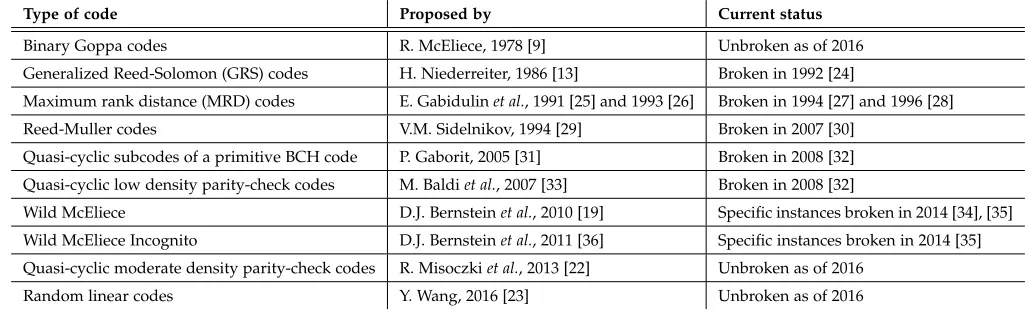
Robert McEliece originally proposed to use binary Goppa codes for the McEliece cryptosystem [9]. In an attempt to reduce McEliece’s key size, researchers have been looking for other linear codes. Although selecting a different code often significantly reduces the public key size, the resulting cryptosystem is often much easier to break as well. Table 1 lists various attempts of using different codes or subclasses of binary Goppa codes, showing the key size reduction and whether is was broken. Most of these codes were broken by structural decoding [19]. A lot of research has been done to breaking McEliece with binary Goppa codes yielding new attacks [20], [21]. This has resulted in a revision of secure parameters [21], but with these parameters the scheme is secure against all known attacks. There are two other unbroken proposals for codes that can be used with McEliece [22], [23]. However, these proposals are so recent that more research should be done to gain confidence in the cryptosystem’s security. We choose to use the original binary Goppa code because it is unbroken for almost 40 years.
2.2 Attacks on Niederreiter
The security of the Niederreiter cryptosystem depends on the following two security assumptions:1
1) The selected linear code is indistinguishable from a random linear code, and
2) Decoding a random linear code is hard.
As all attacks need to break at least one of these assump-tions, two types of attacks on Niederreiter can be distin-guished:structural(or general) attacks anddecodingattacks. Structural attacks aim to break the first assumption by
1. See [37], section 2.4, for a more precise definition of these assump-tions
discovering the original structure of the scrambled public key, in order to obtain the unscrambled private key. The feasibility of structural attacks mainly depends on the type of code used and the code parameters. On the other hand, decoding attacks aim to decode a codeword, using only the public key. If the first assumption holds, the feasibility of these attacks depends only on the length, rank and minimum distance of the code. The decoding problem is an NP-hard problem [12] and the best general decoding al-gorithms have their complexity exponential inn. Although the distinguishability problem for binary Goppa codes has not yet been reduced to a hard problem, the only efficient distinguisher known is a distinguisher for high-rate Goppa codes [38].
One of the main reasons Niederreiter is studied is because there are no efficient quantum computer attacks known [10]. The only known attack is a general attack using Grover’s algorithm to improve a classical information-set decoding (ISD) attack on McEliece [11]. This has yielded an attack with a complexity of c(1/2+o(1))n/logn, where c = 1/(1 − kn)
1−k
n. This attack, however, only uses
a ‘basic’ information-set decoding attack as described by McEliece [9] and originally introduced in 1962 by Prange [39]. A number of more advanced classical information-set decoding attacks exist and can be found in [21], [40], [41], [42], [43], [44], [45]. These attacks have resulted in a revision of McEliece’s parameters [21]. The best of these attacks has a classical complexity of20.0494n [43].
The advanced forms of information set decoding attacks decrease the number of iterations at the cost of increasing complexity per iteration. An overview of these attacks is given in Table 3. In the next sections, we will analyse the complexity of attacks when the iterative search step is replaced by Grover’s algorithm. Apart from speeding up existing attacks on McEliece using Grover’s algorithm, no quantum attacks against McEliece are currently known.
Grover’s algorithm is a quantum computer algorithm published in 1996 [46]. It was introduced as an algorithm for efficiently searching a database: given an unsorted list ofnitems, Grover’s algorithm can find the index of a given item in π4√n steps with high probability using log2(n) qubits. The best classical algorithm needs 12n steps on average. Although the description of Grover’s algorithm as a way of searching a database suggests all items need to be kept in memory, this is not the case. In fact, the algorithm only needs access to a black box function that outputs a value of 0 for the matching item and 1 for all other inputs. This leads to the following alternative description of Grover’s algorithm as a ‘quantum root-finding circuit’ (as stated in [11]). Given any black box functionf which is implemented in a quantum circuit:
f :{0,1}b→ {0,1} (1) Grover’s algorithm finds (with high probability) a b-bit string x such that f(x) = 0, or determines that such a string x does not exist. Note that in this case the search space is a set containingn = 2b bit strings. Even thoughf
TABLE 1
Overview of different codes used for McEliece.
Type of code Proposed by Current status
Binary Goppa codes R. McEliece, 1978 [9] Unbroken as of 2016
Generalized Reed-Solomon (GRS) codes H. Niederreiter, 1986 [13] Broken in 1992 [24]
Maximum rank distance (MRD) codes E. Gabidulinet al., 1991 [25] and 1993 [26] Broken in 1994 [27] and 1996 [28]
Reed-Muller codes V.M. Sidelnikov, 1994 [29] Broken in 2007 [30]
Quasi-cyclic subcodes of a primitive BCH code P. Gaborit, 2005 [31] Broken in 2008 [32]
Quasi-cyclic low density parity-check codes M. Baldiet al., 2007 [33] Broken in 2008 [32]
Wild McEliece D.J. Bernsteinet al., 2010 [19] Specific instances broken in 2014 [34], [35]
Wild McEliece Incognito D.J. Bernsteinet al., 2011 [36] Specific instances broken in 2014 [35]
Quasi-cyclic moderate density parity-check codes R. Misoczkiet al., 2013 [22] Unbroken as of 2016
Random linear codes Y. Wang, 2016 [23] Unbroken as of 2016
algorithm to an algorithm containing only NAND-gates (which is always possible because NAND is functionally complete), and then converting this circuit to a quantum circuit built from Toffoli gates, as described in [11]. For example,f can be implemented as a function that returns 0 if and only if the input is an AES-key for a certain plaintext-ciphertext combination [3], or a SHA-256 pre-image for a certain hash [4].
Grover’s algorithm has two limitations. One limitation is that although Grover’s algorithm can be parallelized, this does not result in a linear speedup. Givenmquantum computers searching in a set ofnitems, the time complexity is π4pn
m [47]. A straightforward way of achieving this
speedup is by splitting the search space ofnitems into m
sets of mn items, and having each quantum computer search in one of these sets. The other limitation is that Grover’s algorithm cannot be applied iteratively, meaning that the black box functionf cannot contain an instance of Grover’s algorithm.
If there are k matching items in a set ofn (as opposed to only one matching item), Grover can find an arbitrary matching item inπ4pn
k steps. This optimization can even be
used if the number of matching items is not known ahead of time [48].
Grover’s algorithm is optimal in at least three ways. Firstly, there does not exist a quantum algorithm that can solve the search problem faster than π4√n [49]. Secondly, when Grover’s algorithm is stopped after some number of oracle queries, the probability that it has found the correct result is maximal [47]. Thirdly, the time complexity of find-ing any solution when there are multiple matchfind-ing items is optimal [48].
For symmetric ciphers, an attack using Grover’s algo-rithm reduces the cipher’s security to at most half of the intended number of bits. For example, it takes about 2128 Grover iterations to find a 256-bit AES-key. This means that for 128-bit quantum security, setting the key size or hash output length to 256 bits is sufficient. Similarly, for code-based cryptosystems selecting system parameters (n, k, d) which provide 256-bit security against classical attacks is sufficient to provide 128-bit security against quantum at-tacks. However, Grover only reduces the number of itera-tions but does not reduce the cost per iteration. In order
to optimize parameters, we should therefore analyse the impact of Grover’s algorithm on attacks on McEliece more carefully. We will do so in the following section.
3
S
ELECTING PARAMETERS FORN
IEDERREITERAll information-set decoding algorithms listed in Table 3 are probabilistic: they consist of an algorithmAthat, with some probabilityp, decodes a codeword with errors (or finds a codeword of small weight). This algorithm is then iterated until the attack is successful, which is expected to happen after 1piterations. When adapting a classical information-set decoding algorithm to a quantum information-set decoding algorithm with Grover, we set the functionf(from Equation 1) to a function that returns 0 when the algorithmA was successful given the input x of f, and 1 otherwise. Now the attack will be successful with high probability after only
π
4 q
1
p iterations.
This transformation has a small cost: firstly, Grover’s algorithm supplies a string of qubits x of certain length to the functionf, whereas information-set decoding algo-rithms typically have input values of different forms (for example a vector of certain weight). The bitstringxneeds to be transformed to a suitable input forA. Also, sinceAneeds to be implemented as areversible quantum circuit[3], [11], it is no longer possible to skip an iteration if a submatrix from the parity check matrix is not invertible. To determine the the minimum number ofqubitoperations, for each decoding algorithm we need to determine the following quantities:
• pinv; the probability that a random binary matrix is
invertible. As the matrix size increases, this probabil-ity quickly converges topinv≈0.29.
• psuccess; the probability that one iteration of the
classical decoding algorithm is successful, given that the selected columns of the matrix are invertible.
• cdecode; the cost in qubit operations of decoding the
input qubits to the inputs of the classical algorithm.
• cinv; the cost in bit operations of inverting the
se-lected columns of the matrix.
• cit; the number of bit operations operations needed
If we are given these quantities, it can be seen that the minimum number of qubit operations, or binary workfactor
W F, for each quantum decoding algorithm can be com-puted as follows:
WF = π 4
s 1
pinv·psuccess
(cdecode+ cinv+ cit). (2)
The factor π 4 q 1
pinv·psuccess
gives the expected number of iterations each algorithm needs to decode a codeword. Each iteration consists of 1) decoding the iteration’s parameters from the input qubits, 2) inverting the selected columns, and 3) the cost to finish the iteration. Therefore the sum (cdecode+ cinv+ cit)gives the cost of each iteration. We will
explain how we obtain the value of psuccess, cdecode, cinv
andcitin the next subsection.
3.1 Non-asymptotic complexity of quantum attacks The probability psuccess and costcit are equal to the
clas-sical iteration success probability (given that the selected columns are invertible) and classical iteration cost, respec-tively. These are already known; for ‘basic ISD’, we extract them from [11], for Stern’s algorithm, we use the values mentioned in Stern’s paper [41], and for MMT and BJMM we obtain them from [50]. We assume the cost of Gaussian elimination of a matrix of dimensionk×nis12k3+(n−k)k2 qubit operations. This is equal to the classical cost given by Stern [41] and is consistent with the quantum cost Bernstein assumes [11]. We use this cost to computecinv.
The cost in qubit operations of decoding the input qubits, cdecode, is different for each algorithm. An operation which
is used multiple times is the transformation of a bitstring of length log2 nk
into a selection ofk out of nelements. To carry out this operation we use the algorithm from [51] with complexity O(n2logn) to decode an integer into a vector of length n and weight k. We assume the cost in qubit operations is equal to n2logn and denote the cost of this transformation ascselect(k, n) = n2log
2n. Now the precise decoding cost cdecode can be computed for each quantum
decoding algorithm in the following way:
• For ‘basic ISD’, the only parameter that needs to be decoded in each iteration of Grover’s algorithm is a selection ofkout ofncolumns. Therefore for basic ISD, cdecode= cselect(k, n).
• In each iteration of quantum Stern’s algorithm, the following three items need to be decoded from the input qubits: a selection of n −k out of n pivot columns, a partition of k integers into two sets X
andY, and a setJ containing a selection oflindices out ofn−koptions. Herel is a parameter of Stern which givennandkcan be optimized and set to a fixed value. This respectively costscselect(n−k, n), kandcselect(l, n−k)qubit operations, giving a total cost ofcdecode= cselect(n−k, n)+k+cselect(l, n−k).
• The input of the quantum MMT algorithm is a selec-tion of(n−k−l1)out ofncolumns and a selection of setsE1,2,3,4, containing (k+m/l14)/2vectors of weight 1
4mand lengthk+l1. SetsE1,2have disjoint supports, as do setsE3,4. The variablesmand l1 are parame-ters which are set to a fixed value. The selection of
columns costscselect(n−k−l1, n)qubit operations. For decoding a string of qubits into sets E1,2 with disjoint supports, we first decode the support ofE1, requiringcselect(k+l1
2 , k +l1) qubit operations. The support of E2 consists of the positions not selected for the support ofE2, so the sets indeed have disjoint supports. Next, for both sets, we select (k+l1)/2
m/4
vectors of weight 14mand length(k+l1)/2instead ofk+l1, because only the vector positions selected in the support may be used. In fact, we have only one possibility here, by selectingallvectors of the afore-mentioned length and weight. This means for this se-lection of vectors no decoding is needed. However, in order for these vectors to be usable to the algorithm, we do need to decode each of the2 (k+l1)/2
m/4
vectors of weight14mand length(k+l1)/2. The cost of this is
(k+l1)/2
m/4
(cselect(m/4,(k+l1)/2))qubit operations. Combining these costs, we obtain a decoding cost of:
cdecode= cselect(n−k−l1, n) +2
cselect
k+l1 2 , k+l1
+ 2
k+l1
2 m 4 ! cselect m 4,
k+l1 2
!
• The quantum BJMM algorithm has a selection of (n − k − l) out of n columns, and 8 sets E1···8 each containing (kp+l)/2
2/2
vectors of weight 12p2 and length k+l as input. The variables l and p2 are fixed algorithm parameters. SetsE2i−1andE2i have
disjoint supports. Using the same reasoning as for the decoding of quantum MMT’s inputs, it can be seen that the decoding cost of quantum BJMM is given by:
cdecode= cselect(n−k−l, n)
+4
cselect
k+l
2 , k+l
+ 2
k+l
2 p2 2 ! cselect p2 2,
k+l
2 !
The exact formulas forpsuccess,cdecode,cinvandcitfor each
algorithm are listed in Appendix A.
3.2 Optimizing parameters for 128-bit quantum secu-rity
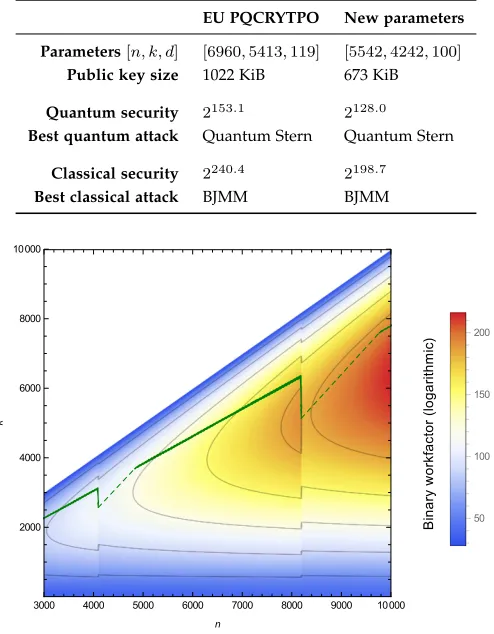
two transitions visible in this graph, near n = 4096 and
n= 8192. These transitions occur because the code needs to use a larger field near these values: for binary Goppa codes we need to switch from GF(212) to GF(213)and GF(214) whennbecomes greater than 4096 and 8192, respectively.
From the optimal code parameters from Figure 1 we can compute the Niederreiter public key size for a given security threshold. Figure 2 shows the public key size in kilobytes for a given security in bits against both a classical and quantum computer attacker. For example, when a key provides 128 bits of classical (or quantum) security, the best attack needs at least2128 binary operations on a classical (or quantum) computer. In these graphs again some bumps are visible: the key size suddenly increases from approximately 400 KB up to approximately 460 KB. This is caused by a transition from GF(212) to GF(213). The ‘PQCRYPTO recommenda-tion’ graph displays the public key size if Grover can speed up classical attacks exactly by taking the square root. This assumption is made for the initial recommendations of the EU PQCRYPTO project [15]. We have shown that although Grover can significantly reduce the attack cost, this worst-case assumption is overly conservative. A more careful analysis of the cost of quantum information-set decoding yields keys that are almost 35% smaller compared to the size of parameters under this assumption. For comparison, in Table 2 we show the parameters as suggested by the EU PQCRYPTO project and compare them with new parame-ters which also aim to provide 128-bit security against quan-tum computer attackers. Interestingly, the EU PQCRYPTO parameters have a security of approximately 240 bits against a classical attacker instead of the expected 256 bits. This can be explained by the fact that the parameters suggested by the EU PQCRYPTO initial recommendation are taken from a paper published in 2008 [21]. Only the BJMM attack, which was published in 2012 [43], can break this algorithm in less than2256bit operations.
We point out that our new security estimates are still based on conservative assumptions. Firstly, in practice, qubits suffer decoherence and quantum error correction is needed to overcome this. This can add significant overhead, as has been demonstrated by [4]. They estimate the cost of performing a pre-image on SHA-256 at 2162 logical-qubit-cycles using a surface code, even though Grover needs only
π
42128 iterations. Secondly, the advanced information-set decoding algorithms make use of lookup tables. We do not know if this can be efficiently implemented in a quantum algorithm. For example when using Grover to break AES, the authors choose to explicitly calculate the AESSubBytes
step, because it was considered more ‘resource friendly’ than using a lookup table [3]. Thirdly, we did not analyse the number of required qubits and quantum gates but just as-sumed that it is feasible to build a quantum computer large enough to run the algorithms. Especially for algorithms such as BJMM, which may require a substantial amount of memory, this may be problematic in practice. Finally, the quantum attacks only allow for limited parallelization. With Grover, running the algorithm on n quantum computers only makes the algorithm run √n times faster. For these reasons we consider our quantum security estimates as a lower bound on the actual security.
[image:8.612.315.562.85.402.2]For codes of our interest, with 3000 ≤ n ≤
TABLE 2
Comparison of Niederreiter parameters for 128-bit security against quantum computers. The PQCRYPTO parameters can be found in [15].
EU PQCRYTPO New parameters Parameters[n, k, d] [6960,5413,119] [5542,4242,100]
Public key size 1022 KiB 673 KiB
Quantum security 2153.1
2128.0
Best quantum attack Quantum Stern Quantum Stern
Classical security 2240.4
2198.7
Best classical attack BJMM BJMM
3000 4000 5000 6000 7000 8000 9000 10000 2000
4000 6000 8000 10000
n
k
B
in
a
ry
w
o
rk
fa
c
to
r
(
lo
g
a
ri
th
m
ic
)
50 100 150 200
Fig. 1. Binary workfactor for breaking a linear code of lengthnand rankk with the best quantum information-set decoding attack. The parameters of the smallest code for a certain complexity are given by the green line.
10000, the quantum Stern algorithm is the fastest quan-tum information-set decoding algorithm. Basic quanquan-tum information-set decoding is more expensive because it needs more iterations, while the quantum MMT and quantum BJMM algorithms need fewer iterations but have a high cost per iteration and decoding qubits into suitable inputs for the algorithm takes more operations. It is, however, possi-ble that decoding qubits into suitapossi-ble algorithm inputs is actually less expensive than we assume. For example, some algorithm parameters that should be random can actually be set to a fixed value. This will reduce the probability of success per iteration because iterations are no longer independent from each other (see for example [21], section 5), but will decrease decoding cost. It is currently unclear what the smallest possible decoding cost is when this is taken into account. If we assume an absolute lower bound on decoding cost,cdecode= 0for all algorithms, the code we
suggest in Table 2 actually has a security of 127.94 bits.
3.3 Asymptotic complexity of quantum attacks
Since complexities of information-set decoding algorithms are all exponential, their asymptotic running times are of-ten compared in exponential factors of the code length n
64 96 128 160 192 0
512 1024 1536 2048
Bits of security
P
u
b
lic
ke
y
si
ze
(
K
B
)
Classical Quantum PQCRYPTO recommendation
Fig. 2. Security vs. McEliece public key size.
suppressed, i.e. each of the algorithms has anα such that the complexity is inO˜(2αn)[43]. We derive this complexity
from the non-asymptotic workfactor of each algorithm as determined in Section 3.1. We use a variant of Stirling’s approximation to approximate binomials:
log2
n k
!
≈nH
k
n
, (3)
where H(p) is the binary entropy function H(p) =
−plog2(p)−(1−p) log2(1−p). The complexity of decod-ing an [n, k, d] linear code does not just depend on the length of the code, but also on the rank k and minimum distance d. For computing the asymptotic complexity, the Gilbert-Varshamov bound is used to compute the maximum possible minimum distance (and therefore maximum error-correcting capacity, for which decoding is most difficult) for a code of length nand rank k. We note that both random codes and binary Goppa codes asymptotically meet this bound [52]. Each attack (except Basic ISD) has a number of parameters that need to be optimized in order to achieve the lowest complexity. By optimizing these parameters for several values of k we can find the value ofk for which decoding is most difficult. This gives the asymptotic worst-case complexity of decoding as a function ofn. The asymp-totic complexities for FS and Ball collision are adapted from [44] and [45], respectively.
A more elaborate description on how asymptotic plexities of information-set decoding algorithms are com-puted can be found in [43], section 1. We usebounded distance decodingas opposed tofull decoding, because in Niederreiter the number of errors is limited by⌊d−21⌋.
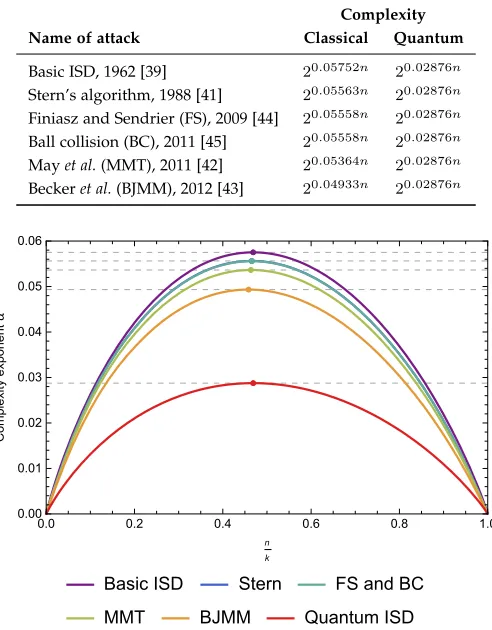
[image:9.612.56.293.47.208.2]The asymptotic complexities of a number of information-set decoding attacks are listed in Table 3. The classical complexities are well-known (see for instance [43]). The quantum complexities are computed in the same way as the classical complexities, but with the original number of iterationsnreplaced byπ4√nand with a higher cost per iter-ation. Surprisingly, all quantum attacks asymptotically have exactly the same complexity as the most basic information-set decoding attack. It turns out the optimal parameters for the other attacks, for which the attacks have the lowest cost, are all zero. This effectively reduces the more advanced
TABLE 3
Overview of information-set decoding attacks and their asymptotic complexities.
Complexity Name of attack Classical Quantum
Basic ISD, 1962 [39] 20.05752n 20.02876n
Stern’s algorithm, 1988 [41] 20.05563n
20.02876n
Finiasz and Sendrier (FS), 2009 [44] 20.05558n 20.02876n
Ball collision (BC), 2011 [45] 20.05558n
20.02876n
Mayet al.(MMT), 2011 [42] 20.05364n 20.02876n
Beckeret al.(BJMM), 2012 [43] 20.04933n
20.02876n
0.0 0.2 0.4 0.6 0.8 1.0
0.00 0.01 0.02 0.03 0.04 0.05 0.06
n k
Complexit
y
exponent
α
Basic ISD Stern FS and BC
[image:9.612.315.561.83.398.2]MMT BJMM Quantum ISD
Fig. 3. Asymptotic running time for different code ratesn/kand different information-set decoding attacks. Since the complexity of Finiasz and Sendrier and Ball collision differ less than 0.1% from the complexity of Stern’s algorithm, these graphs are overlapping.
attacks to the most basic attack. This can be explained by the fact that the advanced attacks reduce the number of iterations at the cost of complicating each iteration. Grover, on the other hand, only reduces the number of iterations and does not reduce the cost of each iteration. Also, note that the complexity of basic quantum ISD is exactly half of the complexity of basic classical ISD. This is because the cost per iteration for this algorithm is only polynomial, and therefore the asymptotic complexity is completely determined by the number of iterations. In Figure 3, the factor α in the exponent of the asymptotic running times is shown as a function of the code rate nk. The complexities in Table 3 correspond to the maximum value of the complexities in this graph.
4
I
NTEGRATINGN
IEDERREITER INTOO
PENVPN
4.1 OpenVPN architecture
8
OpenVPN client
OpenVPN server Multiplexed channels
over UDP or TCP Control channel
Data channel
Symmetrically encrypted Authenticated by HMAC
[image:10.612.48.302.46.134.2]TLS 1.2 with 2048-bits RSA and DHE Optional: tls-auth HMAC
Fig. 4. OpenVPN protocol from a security perspective
As outlined in Figure 4, a connection between an Open-VPN client and OpenOpen-VPN server consists of two channels: acontrol channeland adata channel.
Control channel – OpenVPN uses the control channel for authentication of both the server and the client and to negotiate keys for the data channel. A TLS session is set up to authenticate both parties and provide a secure channel to exchange keys for the data channel. OpenVPN supports a wide range of TLS ciphers and security mechanisms. It is currently recommended to use a Diffie-Hellman key exchange to provide perfect forward secrecy [53]. The Diffie-Hellman shares are signed with an RSA key. The keys for the data channel are generated using the TLS PRF mechanism, which is based on HMAC.
Data channel– The actual data packets which are sent or received through the OpenVPN tunnel are transmitted over the data channel. Two keys are used for encryption of data; one for each direction. Two other keys are used for authentication of packets in both directions.
These two channels are multiplexed and transmitted over a single UDP or TCP stream. Since UDP is an unreliable transport protocol but TLS requires a reliable transport pro-tocol, an intermediate reliability layer is used for the control channel. Optionally, the control channel can be protected by the tls-auth directive, which specifies a pre-shared key by which all incoming packets on the control channel shall be authenticated (using an HMAC). This feature is not essential for security but it makes it more difficult to exploit software vulnerabilities in OpenVPN or the TLS implementation. This is because unauthenticated packets are discarded instead of being processed by the TLS library. The reason for having a special data channel instead of just using the TLS control channel for data as well is motivated by performance. Since OpenVPN can tunnel TCP packets, and TCP includes a reliability layer, tunneling TCP over the TLS connection will stack two reliability layers. The tunneled TLS connection will never experience any packet loss and will not be able to set its window sizes to correct values. After a timeout happens, packets will be retransmitted even though this is not necessary. To elimi-nate this performance problem, data is transmitted over an unreliable channel using UDP. A combination of UDP and TCP might have allowed for better performance, but was probably considered unnecessary given the small size of a regular handshake.
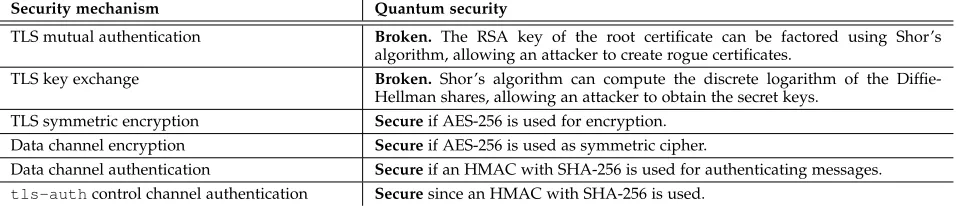
Table 4 shows an overview of the security of each Open-VPN security mechanism assuming quantum algorithms are usable in practice. Two components are broken in a quantum world: the RSA-based mutual authentication and
(1) Send regular key
exchange
(2) Send regular key
exchange Send client_random
(4) Generate ciphertext
(5) Check cookie Send H(pks),E(pks, )rc
(3) Check cookie
Send server_random
Client has cookie
Client Server
(6) Inform server Client
does not have cookie
(7) Generate public key Server does not
know cookie
Send "no cookie known"
(8) Generate ciphertext
Send new public ke
y pk′s
(9) Receive ciphertext Send E(pk′s, )rc
Server knows cookie
(11) Generate
cookie (10) Derive session keys
Send cookie pks,cookie (12) Store
cookie Start
Preview https://www.draw.io/
[image:10.612.315.560.48.310.2]1 of 1 07/27/2016 03:31 PM
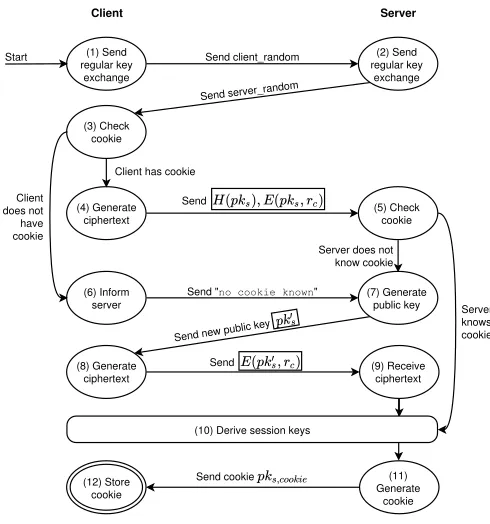
Fig. 5. State diagram of the new key exchange protocol. In this diagram, H is a cryptographically secure hash function and E(pks, rc) is an encryption of messagercby public keypks. Messages inside a box shall be signed by the sender if the protocol is not executed within an authenticated channel.
Diffie-Hellman key exchange. Both of these components are part of TLS. The fact that mutual authentication is insecure in a quantum world will only be a problem once quantum computers are actually available and can be used to forge signatures. However, since an attacker without a quantum computer can already store key exchanges in order to break them when a quantum computer becomes usable, the key exchange problem is much more urgent. For our research, we will therefore focus on creating secure post-quantum key exchange functionality in OpenVPN.
4.2 Extending OpenVPN
From the description above, the most sensible way for extending the OpenVPN protocol with a post-quantum key exchange is to change the control channel protocol. There are multiple options to accomplish this:
1) Implementing an entirely new key method, ‘key method 3’.
2) Changing the current TLS key exchange such that it uses a Niederreiter key exchange instead of (elliptic curve) Diffie-Hellman.
3) Performing a Niederreiter key exchange once the TLS control channel is set up.
TABLE 4
Summary of OpenVPN security in a post-quantum world. We consider a mechanism secure if it is not known to be broken by a quantum computer in less than2128
qubit operations.
Security mechanism Quantum security
TLS mutual authentication Broken. The RSA key of the root certificate can be factored using Shor’s
algorithm, allowing an attacker to create rogue certificates.
TLS key exchange Broken. Shor’s algorithm can compute the discrete logarithm of the
Diffie-Hellman shares, allowing an attacker to obtain the secret keys.
TLS symmetric encryption Secureif AES-256 is used for encryption.
Data channel encryption Secureif AES-256 is used as symmetric cipher.
Data channel authentication Secureif an HMAC with SHA-256 is used for authenticating messages.
tls-authcontrol channel authentication Securesince an HMAC with SHA-256 is used.
keys. Although the TLS handshake protocol specifies a max-imum message length of 16 MiB (224bytes), the TLS records that contain handshake messages actually have a maximum length of 64 KiB (216 bytes) [54]. TLS extension messages are also limited to 64 KiB. We note that there exist recent proposals for post-quantum key exchanges in TLS [55], [56], but these are using cryptosystems with smaller public keys. A disadvantage of the third option regarding performance is that actually two key exchanges are done: a Diffie-Hellman key exchange to set up the TLS connection and then a Niederreiter key exchange. With respect to security, this is in fact an advantage, because an attacker will need to break both key exchanges. In the unlikely event that the Niederreiter cryptosystem is broken, this will not affect se-curity against non-quantum adversaries. Also, a new control channel is set up automatically after a predefined number of seconds or transmitted packets to ensure forward secrecy. By building upon the control channel we can achieve post-quantum forward secrecy. Because this option allows most flexibility to define a custom protocol we choose this method to implement the new key exchange.
As explained in Section 2, Niederreiter can easily be adapted into a key exchange protocol between Alice and Bob in the following way: Alice constructs a Niederreiter keypair and sends the public key to Bob. Bob constructs a random error vector, encrypts it and sends the ciphertext to Alice. After decryption, Alice and Bob both have the same secret error vector. By supplying the error vector as input to a key derivation function a shared key is obtained. This is the basis of our key exchange protocol. In principle, this protocol is vulnerable to adaptive chosen-ciphertext attacks. If a protocol run for a non-decodable ciphertext is distinguishable from a protocol run for a decodable ci-phertext an attacker can iteratively decode a syndrome by testing whether the syndrome is still decodable when the syndrome of a single error is added. If the ciphertext is still decodable, the new error actually nullified an existing error and the attacker learns that the original ciphertext contains an error at the same position. Persichetti [17] suggests to solve this by continuing the protocol even if a ciphertext is not decodable. The key should then be derived from the unscrambled ciphertext. However, we use an alternative solution by signing ciphertexts so an attacker cannot adapt them. Since our protocol is run over TLS, all messages are signed already anyway. This also protects against other man-in-the-middle attacks, such as attacks replacing public
keys by forged ones.
4.3 Caching Niederreiter keys
With this approach, one challenge still remains. Since a large Niederreiter public key has to be transferred before the handshake can be finished, setting up a VPN connection takes a lot of time. To solve this problem for most practical situations, we have implemented a cache for the public key. Once the handshake is finished the server will generate a new public key and send it to the client. The client will store the public key and use it for the next key exchange. We call this cached public key a cookie. If during the next key ex-change the server still has knowledge of the corresponding private key, there is no need to send a large public key before the handshake can be finished. In Figure 5, the new key exchange protocol is described in more detail. This protocol is executed over the control channel after the TLS connection has been set up. First, in State (1) and (2), the regular key exchange is done. If both the client and server already have a cached key (which is very likely if they connected with each other before), the client immediately uses the cached public key to encrypt a random error vector in State (4). This drastically speeds up the handshake. If either the server or the client does not have knowledge of a previous key, a new keypair will be generated by the server in State (7). It will take some time to transfer the large public key, but this is unavoidable and should only be necessary when the client and server connect for the first time or when they lose possession of their cached key. In State (10), the shared secret is established. The data channel can then be used and the key exchange is finished. Finally, the server generates a new keypair and sends the new public key to the client. This new keypair will be cached by the server and client so it can be used for the next key exchange. In a way this is similar to the TLS Cached Information Extension, which has been published in July 2016 [57].
Thirdly, clients often have more download bandwidth than upload bandwidth. When the server generates the keypair the public key has to be transferred from the server to the client, which is often faster than the other way around.
4.4 Cookie mechanism robustness and security The protocol automatically recovers from lost cookies by generating a new keypair on the server. When the cookie storage for theclientis compromised by an attacker the key exchange is still secure: in case the attacker obtains read access, the attacker can only read public keys. If the attacker obtains write access, the attacker can store new public keys, but the server will not know these keys and therefore reject ciphertexts encrypted by these keys. Because ciphertexts are signed, an attacker cannot perform a man-in-the-middle attack even when he has write access to the client cookie storage. An attacker who obtains either read or write access to server cookie storage will be able to break the security of the key exchange. If the cookie cache is shared among multiple servers, an attacker might conceivably be able to remove cookies or restore cookies that have already been used. Apart from being able to collect multiple ciphertexts for a single public key because cookies can be made valid multiple times, this does not affect the key exchange secu-rity.
If either the server or the client has a compromised or predictable random number generator, the shared secret can be learned by an eavesdropper. This is because either the private key or the random error vector will be known by the attacker. We are not aware of a way to circumvent this and believe this is acceptable. A single predictable random number generator compromises the Diffie-Hellman and RSA key exchange methods in TLS as well.
Although the presence of a cached private key on the server arguably makes the forward secrecy no longer ‘per-fect’, because potentially more than a single session can be decrypted, the impact of an event in which an attacker grabs hold of all secrets on the server is still very limited. At most two sessions can be decrypted, namely the current session and the next session. To limit the consequences of a security breach, cookies are valid for a limited time. They may be used only for a predefined number of times or be valid within a certain time interval. The latter may be useful for unstable connections with frequent reconnects. Because we combine the Niederreiter key exchange with a regular Diffie-Hellman key exchange, perfect forward secrecy is preserved against non-quantum adversaries.
4.5 Storage
The decoding procedure needs knowledge of the inverse of the scrambling matrix S, the Goppa polynomial and the support vector. Since the scrambling matrix can be computed from the Goppa polynomial and support vector, a space-time trade-off is possible. The following options for storing private keys exist:
1) Store only a seed for a CSPRNG. Storage size: 32 bytes (256 bits). It takes approximately 0.6 seconds to load a private key.
2) Store only the Goppa polynomial and support vec-tor. Storage size:18m(t+n)bytes, or about 11 KiB for
our parameters. It takes approximately 0.4 seconds to load a private key.
3) StoreS−1as well. Storage size: 1
8m(t+n+mt 2), or about 215 KiB for our parameters. The private key is immediately available for use.
Because the best way to store private keys depends on how much storage space is available and the number of clients, we implement the last two options and allow the server administrator to make a choice.
4.6 Implementational details and optimizations
We implement Patterson’s algorithm for decoding binary Goppa codes [58]. Patterson’s algorithm is a specialized algorithm which can correct up to ⌊d−1
2 ⌋ errors in code-words of binary Goppa codes. In our implementation, we have applied the following optimizations. We use lookup tables for multiplications, inversions and square roots in GF(2m). These operations only cost a single table lookup, but may make the implementation vulnerable to cache-timing attacks. Additions in GF(2m) are simply done by
xor-instructions. In the key generation procedure, we use the algorithm from Shoup [59] for quickly constructing a random Goppa polynomial, given a precomputed irre-ducible polynomial of the same degree. Only about 29% of Goppa code parity check matrices can be transformed to standard form. Instead of trying again with a new code when this transformation fails, we swap columns in the parity check matrix and support vector such that the trans-formation will be successful. In the decoding algorithm, we use an optimization previously applied by Risse [60] to quickly compute the square root of a polynomial modulo the Goppa polynomial with only a single multiplication. We use Horner’s method to evaluate the error polynomial. There exist faster methods for finding all roots of the error polynomial, such as the method using additive FFT’s which is used by McBits [18].
5
P
ERFORMANCE IN PRACTICE5.1 Benchmark setup
We evaluate the performance of OpenVPN with Niederre-iter key exchange under different network conditions. We connect two virtual machines in a virtual network and run an OpenVPN server on one machine and an OpenVPN client on the other machine. The host machine has an Intel Core i5-3230M CPU. During the benchmarks, the CPU is only the bottleneck for experiments with (nearly) ideal net-work conditions. When packet drops or additional latency are introduced, the network becomes the bottleneck. We use the Linux kernel Queuing Disciplines Traffic Control, that can be managed by the tc qdisc command, to control networking characteristics. We evaluate OpenVPN’s perfor-mance for packet losses between 0 and 2% for the classical OpenVPN client and the OpenVPN client with Niederreiter key exchange, with and without the cookie mechanism. The results are displayed in Figure 6.
0.0% 0.5% 1.0% 1.5% 2.0% 0
5 10 15 20 25 30
Post-quantum OpenVPN (without cookie) Classical OpenVPN Post-Quantum OpenVPN (with cookie)
TCP handshake (RTT 0ms) TCP handshake (RTT 50ms) TCP handshake (RTT 100ms) TCP handshake (RTT 150ms)
Packet loss (%)
H
a
n
d
s
h
a
k
e
t
im
e
(
s
)
0 250 500 750 1000
[image:13.612.55.294.62.238.2]≈
Fig. 6. The time of a full handshake for different packet loss rates. Each data point represents the average of at least 100 runs, except the ‘Post-quantum OpenVPN no cookie’ graph, which is averaged over 20 runs. The TCP graph shows how post-quantum OpenVPN would perform for various round-trip times when TCP would be used as reliability layer.
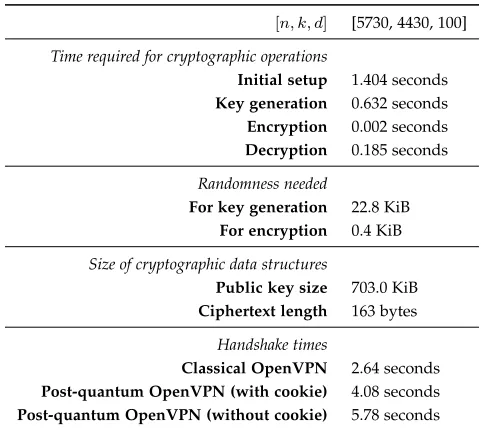
of constructing and precomputing operations in theGF(213) finite field. This is only needed once. For key generation, transforming the matrix into standard form takes most time: approximately 0.2 seconds. For decoding, the most expen-sive operation is evaluating the error polynomial, which takes approximately 0.1 seconds. The rows under ‘random-ness needed’ show the number of (pseudo)random bytes needed to generate a key and generation of a shared secret. This is not necessarily the same as the required amount of entropy, since using 256 bits of entropy is sufficient if a CSPRNG is used. The handshake time is the time needed for a complete handshake, measured as the time interval between starting the client and server and the moment the OpenVPN tunnel is set up under ideal network conditions.
5.2 Analysis
From Figure 6, we can conclude that the handshake time for post-quantum OpenVPN without a cookie explodes when network conditions degrade. This is caused by the transfer of the public key of almost 700 KiB and by OpenVPN’s reliability layer for the control channel, which is very ineffi-cient. The reliability layer has a very small window size of 8 packets, and only detects a packet loss when a timeout of 2 seconds occurs. Effectively this means every time a packet loss happens, the handshake time is increased by 2 seconds. A better reliability layer can significantly improve Open-VPN’s performance for networks with high packet loss. For comparison, we also show the OpenVPN handshake time for the case where TCP would be used as reliability layer for the control channel in Figure 6. We have not actually implemented this, but simulated this scenario by sending exactly the same packets over a TCP connection (taking into account that each party can only respond when certain pack-ets have been received) and added the cost of cryptographic operations. We did so for various round-trip times, ranging from 0 to 150 ms. As we can see from Figure 6, replacing
TABLE 5
Niederreiter in practice: amount of time and randomness required for cryptographic operations, key and ciphertext sizes and actual
handshake times.
[n, k, d] [5730, 4430, 100]
Time required for cryptographic operations
Initial setup 1.404 seconds
Key generation 0.632 seconds
Encryption 0.002 seconds
Decryption 0.185 seconds Randomness needed
For key generation 22.8 KiB
For encryption 0.4 KiB Size of cryptographic data structures
Public key size 703.0 KiB
Ciphertext length 163 bytes
Handshake times
Classical OpenVPN 2.64 seconds
Post-quantum OpenVPN (with cookie) 4.08 seconds
Post-quantum OpenVPN (without cookie) 5.78 seconds
OpenVPN’s reliability layer by TCP drastically reduces the handshake time when no cookie exists. Unfortunately, even though OpenVPN supports running the entire OpenVPN protocol over TCP, its internal reliability layer will then still be used.
On the other hand, the cookie-mechanism, which ex-changes a shared secret using a public key previously sent, works quite well. It is only about 1.6 seconds slower than classical OpenVPN. This is due to the time initial setup, encryption and decryption takes. The cost of initial setup only applies to the server, and only once for all clients, so in practice the difference in handshake time between classical OpenVPN and OpenVPN with a cookie is much lower. Because a ciphertext is only 163 bytes and only few other additional messages are needed for the post-quantum handshake, the impact of packet loss is very comparable with classical OpenVPN. However, when the handshake is finished, it is still needed to transfer a large public key for the next key exchange. This may still prevent this solution from being suitable for devices that need to do frequent quantum-secure key exchanges with very limited bandwidth or a low data cap. We also note that the current implementation of OpenVPN lacks support for multithread-ing. Therefore, the data channel cannot be used during key generation and public key transfer. Because Niederreiter keys are completely independent from clients and specific connections, it is possible to optimize key generation by generating keys beforehand in a separate thread for all clients and maintaining a ‘pool’ of Niederreiter keypairs on the server.
6
C
ONCLUSIONS AND RECOMMENDATIONS [image:13.612.317.558.90.305.2]an open source product and a way to cope with the large public keys in practice. We have shown that although the complexities of quantum information-set decoding attacks are asymptotically exactly the same, non-asymptotically the binary workfactor is different for each algorithm and the quantum information set decoding variant of Stern’s algo-rithm is the most efficient quantum decoding algoalgo-rithm cur-rently known. We demonstrated and evaluated the usability of McEliece in practice. We conclude that in ideal network conditions McEliece can be used in practical applications to establish a shared secret key. In networks with high packet loss, OpenVPN’s inefficient reliability mechanism is unsuitable for sending large public keys.
We recommend to replace OpenVPN’s reliability layer by a more efficient one, such as TCP. We also recommend to estimate the number of logical qubit cycles and gate opera-tions more precisely, taking overhead from quantum error correction and transforming the circuit into a reversible circuit into account.
A
PPENDIXA
N
ON-
ASYMPTOTIC COST OF QUANTUMINFORMATION
-
SET DECODING ALGORITHMSIn this appendix, we list the exact cost of several quantum information-set decoding algorithms. For algorithms that have additional parameters, these parameters are optimized to minimize the cost of the algorithm. The final workfactor can be computed using Equation 2 on page 5. The cost of transforming a bitstring of lengthlog2
n k
into a vector of lengthnand weightkis defined ascselect(k, n) =n2log
2n. For a description on how to derive these formulas, see Section 3.1.
A.1 Quantum information-set decoding
The basic information-set decoding algorithm does not have any parameters which can be optimized. The only param-eter that needs to be decoded in each iteration of Grover’s algorithm is the selection ofkout ofncolumns.
psuccess= n−d
k
n k
, cinv= 1 2k
3+ (n
−k)k2,
cdecode= cselect(k, n), cit=k.
A.2 Quantum Stern’s algorithm
Stern’s algorithm has two parameters: l and m. In each iteration of Grover’s algorithm, the following three items need to be decoded from the input qubits: the selection of
n−kout ofnpivot columns, a partition ofkintegers into two sets X and Y, and a setJ containing a selection of l
indices out ofn−koptions.
psuccess= d
2m n−d
k−2m 2m
m
n−k−d+2m l
4m n k
n−k l
,
cdecode= cselect(n−k, n) +k+ cselect(l, n−k),
cit= 2lm k
2
m
!
+ 2m(n−k)
k
2
m
!2 2−l,
cinv=
1 2(n−k)
3+k(n−k)2.
A.3 Quantum MMT’s algorithm
MMT’s algorithm has four parameters: m, l1, l2 and |A|. The input of this algorithm is a selection of (n−k−l1) out ofncolumns and a selection of setsE1,2,3,4, containing
(k+l1)/2
m/4
vectors of weight 14mand lengthk+l1. SetsE1,2 have disjoint supports, as do setsE3,4.
psuccess = 1−
1−ε2l1
|E|
,
cinv=
1
2(n−k−l)
3+ (k+l)(n−k−l)2, cdecode= cselect(n−k−l1, n)
+2
cselect
k+l1 2 , k+l1
+ 2
k+l1
2 m 4 ! cselect m 4,
k+l1 2
!
cit=|A|(n−k)
4L0+ 2L202−l
2+ 2L4
02−l1−l
2
,
ε=
n−k−l1
d−m
min 2n−k, n d
, L0= k+l1
2
m
4 !
,
|E|=|A|L402−l1−l
2 .
A.4 Quantum BJMM’s algorithm
The BJMM algorithm has six parameters:m,l,r1,r2,e1and
e2. The inputs that need to be decoded for each iteration of Grover’s algorithm are a selection of (n−k−l)out of n
columns, and 8 setsE1···8 each containing (kp+2/l)2/2vectors of weight 12p2 and length k+l. Sets E2i−1 and E2i have
disjoint supports.
psuccess= 1−
1−ε2lS0,
cinv=
1
2(n−k−l)
3+ (k+l)(n
−k−l)2,
cit= (n−k)(8S3+ 4C3+ 2C2+ 2C1), cdecode= cselect(n−k−l, n)
+4
cselect
k+l
2 , k+l
+ 2
k+l
2 p2 2 ! cselect p 2 2 ,
k+l
2 !
ε=
n−k−l d−m
min 2n−k, n d
, m1=
m
2 +e1, m2=
m1 2 +e2,
µ1=
m1
e1
k+l−m1
m1−e1
k+l m1
, µ2=
m2
e2
k+l−m2
m2−e2
k+l m2
,
S0= min µ1C1,2−l
k+l m
!!
,
S1= min µ2C2,2−r1−r2
k+l m1
!!
,
S2=C3= 2−r2S23, S3=
k+l
2
m2
2 !
,