‘The differences between value propositions
following G-D and S-D logic: A multiple case study’
Author: Nicolas Rittmeyer
University of Twente P.O. Box 217, 7500AE Enschede
The Netherlands
Value propositions help companies to communicate their core strategy with stakeholders
and shareholders, outlining the approach through which the company aims to attain
strategic advantage against its competition. Although the concept of value proposition is
a central premise to the S-D logic, there is nevertheless limited agreement and ambiguity
surrounding its conceptualization. By analyzing and comparing companies’ value
proposition following G-D and S-D logic, this paper aims to contribute to reducing the
ambiguity in the literature. The findings of this study suggest that the main differences
between value propositions following G-D and S-D logic resides in a company’s intent
and effort to communicate with its customers and key stakeholders.
Supervisors: Dr. R. P. A. Loohuis
Prof. Dr. Ir. P.C. De Weerd-Nederhof
Keywords
Service Dominant Logic, Goods-Dominant Logic, Value Proposition, Differences, Similarities, Multiple Case Study
Permission to make digital or hard copies of all or part of this work for personal or classroom use is granted without fee provided that copies are not made or distributed for profit or commercial advantage and that copies bear this notice and the full citation on the first page. To copy otherwise, or republish, to post on servers or to redistribute to lists, requires prior specific permission and/or a fee.
8th IBA Bachelor Thesis Conference, December 16th, 2016, Enschede, The Netherlands.
1.
INTRODUCTION
Without changing our patterns of thought, we will not be able to solve the problems we created with our current pattern of thoughts – Albert Einstein
With their widely-acclaimed paper ‘Evolving to a new dominant logic in marketing’ first published in 2004, Lusch and Vargo combined the efforts of various research streams (e.g. service science and relationship marketing) to introduce the so-called ‘service dominant logic’ (henceforth S-D logic). S-D Logic challenged the hitherto dominant ‘goods-dominant logic (henceforth G-D logic) which inherited its focuses on tangible units of outputs (goods) and the exchange of goods embedded with value amid the production process from neoclassical economics.
S-D logic initially introduced a set of eight foundational premises subsequently extended to eleven -that build the foundation for the S-D logic, aimed at transcending the underlying assumptions related to G-D logic (Vargo et al., 2004, 2016). According to S-D logic, a central assumption is that ‘actors cannot deliver value but can participate in the creation and offering of value propositions’ (Vargo & Lusch, 2016). Chandler et al. (2015) define a value proposition as “an invitation from actors to one another to engage in service” (p.6). Although the concept of a value proposition is central to S-D logic, there still seems to be limited agreement and ambiguity surrounding its conceptualization (Ballantyne et al., 2011; Frow et al., 2014; Skålén et al., 2014). Value propositions have been analyzed in a variety of contexts such as stakeholder networks (Frow et al., 2011) and ecosystems (Frow et al., 2014; Vargo & Lusch, 2016). Although the concept of a value proposition has been widely used among scholars and marketing practitioners, a study about 200 companies by Payne et al. (2014) showed that while 65% used the concept, fewer than 10% of organizations had a formal process in place supporting the development and communication of their value proposition. Webster (2002) further emphasizes the importance of value proposition by stating that “the value proposition should be the firm’s single most important organizing principle” (p.61).
Frow and Payne (2011) state that there is an apparent lack of scholarly articles on value propositions in general and particularly a lack of specifics on value proposition in practice. Hence, this study aims to bridge the gap in the scientific literature by providing empirical evidence that highlights the difference between value propositions according to G-D and S-D logic in practice. Besides, Kowalkowski (2011) emphasizes that “S-D Logic should uncover opportunities for value creation constrained by the traditional ‘goods-dominant’ mindset” (p.4). This paper will provide managerial implications concerning how a company can uncover these uncovered opportunities by employing a value proposition according to S-D logic. Therefore, this paper aims to answer the following research question:
How do companies' value propositions employing G-D or S-D logic vary in practice?
To answer the research question, a multiple case study will be conducted to analyze the value proposition of both respective companies employing a value proposition according to G-D logic as well as S-D logic. Underlying assumptions are compared to provide managerial
implications on how companies can adapt their value proposition to uncover further opportunities for (co-)creation.
This paper first shortly introduces both G-D as well as S-D logic to outline their conceptual roots. Subsequently, the concept of a value proposition following G-D and S-D logic, is described, before the next section depicts the difference between value propositions following G-D and S-D logic. Thereafter, the methodology part deals with the theoretical framework, which is subsequently used to analyze ten companies. Next, the results of the case study are presented and the research question will be answered. Finally, managerial implications, recommendations for further research as well as the limitations of this study are outlined.
2.
THEORY
2.1 S-D logic
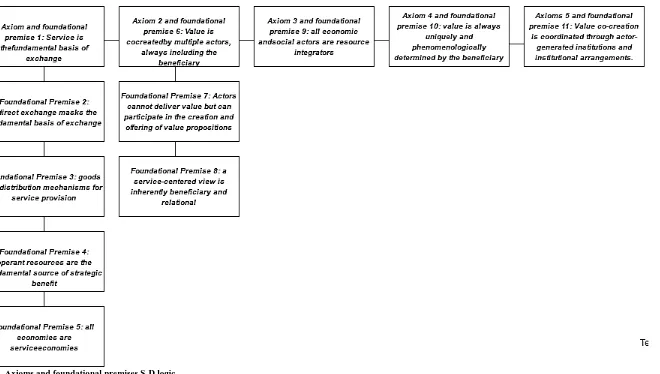
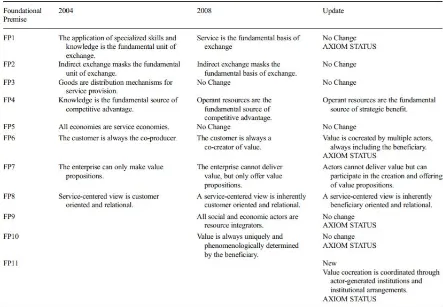
In response to Lusch and Vargo’s initial publication in 2004, various research streams helped to continuously adapt, extend, and further consolidate S-D logic over the last decade. S-D Logic consists of five axioms from which the remaining six foundational premises can be derived. An overview over the foundational premises can be found in Table 1. Lusch and Vargo (2014) argue that “S-D logic is a more abstract, simpler (but broader), more general, and transcending framework for understanding human exchange and exchange systems in general” (p.101). S-D logic transcends the traditional G-D logic, which is closely linked to neoclassical economics. According to G-D logic, the primary purpose of firms and economic exchange is to produce and distribute goods, mainly in the form of tangibles (Vargo et al., 2004). Economic exchange on a basic level is dealing with tangible units of output (goods), which are installed with value amid the assembling procedure (Lusch & Vargo, 2004).
On the contrary, Axiom and foundational premise one emphasizes that actors ultimately exchange their skills and knowledge (operant resources) as opposed to the output of the application of their skills and knowledge. Lusch and Vargo (2004) subsequently conclude that “value was considered the comparative appreciation of reciprocal skills or services that are exchanged to obtain utility; value meant “value in use” (p.7).
According to the second foundational premise, the notion that actors exchange their physical and cognitive skills directly is largely a historical artifact (Lusch & Vargo, 2004). An indirect exchange of services, simplified through the usage of money, has emerged instead (Lusch & Vargo, 2014). Organizations can mask the fundamental nature of service-to-service exchange because there can be many service transactions within the company, which are not apparent from the outside (Lusch & Vargo, 2004). Organizations are therefore substitutes for direct service-to-service exchange (Lusch & Vargo, 2014).
According to foundational premise four, operant resources are needed to solve the problems of tomorrow (Lusch & Vargo, 2014). Lusch and Vargo (2014) define operand and operant resources as following: “operand resources are resources on which an operation or act is performed to produce an effect, and they compare operand resources with operant resources, which are employed to perform on operand resources (and other operant resources). Operant resources are resources that produce effects” (p.2).
Therefore, a sustainable competitive advantage derives through the application of operant resources for the benefit of another actor or oneself (Lusch & Vargo, 2004).
Furthermore, foundational premise five argues that economies can be more accurately described as an exchange mechanism for large scale specializations, whereas each specialization is characterized by the development and refinement of some particular capability. Arguably, there is an increasing tendency to split up tasks into micro-processes, which subsequently can be done by multiple actors; each specialized in a different process, resulting in an overall increase of service exchange (Lusch & Vargo, 2004, 2008, 2014). As this drastic increase in micro specializations or service(s) became more apparent to the public, it was postulated that there is a rise of a service economy, however, ignoring the fact that service and operant resources have always represented the essence of economic exchange (Lusch & Vargo, 2004, 2014).
Axiom two and foundational premise six suggests that value is not embedded in goods, as depicted in the G-D logic; rather, value occurs when the good is utilized as opposed to when it is being exchanged (value-in-use vs. value-in-exchange). The assertion that customers are always the co-creator of value helps to resolve the discrepancy surrounding the assumption that firms are the producer of value and customers the recipient thereof (Lusch &Vargo, 2011). Lusch and Vargo (2014) emphasize that the production and distribution merely represent an intermediary process within the value creation process. To utilize a product, the customer first needs to understand how he/she can adapt the product to his/her unique needs. Therefore, the beneficiary of the product is continuing the value-creation process. Stated alternatively, value derives from the use and integration of resources (Lusch & Vargo, 2014).
Foundational premise seven argues that the enterprise cannot deliver value, but can only offer value propositions. Value propositions are frequently seen as an appeal to collaborate with a company for the benefit of both parties (Lusch & Vargo, 2014). A value proposition is considered as an actor's attempt to invite another actor to collaborate together on an offering that yields a positive reciprocal relationship (Lusch & Vargo, 2014; Ballantyne and Varey, 2006; Kowalkowski et al., 2012). Foundational premise eight deals with the marketing concepts of customer orientation and relationship marketing, which became mainstream narratives within the marketing domain to initially overcome the limiting assumption associated with the G-D logic, which states that the customer is an external entity within the value creation process. However, S-D logic recognizes the relational nature of value creation, as described in the second axiom. Value is created over time through the relational intertwining of resources and competencies. Through continuous communication actors realize what
the other party values. Therefore, relationships among actors are inherently beneficiary oriented.
Axiom three and foundational premise nine states that actors co-create value through the exchange of service rights. However, this perspective only portrays the interaction taking place on a micro level. Actors are not separated entities from their environment, as depicted in structuration theory; they are both at the effect as well as the creator of their surroundings (Lusch & Vargo, 2014). Axiom three states all economic and social actors are resource integrator, taking a more macro level perspective. Lusch & Vargo (2014) argue that the service-to-service provision exchange is only a fraction of the conditions needed to co-create value. As Lusch & Vargo (2014, p.77) emphasize: "It is not simply acquiring services (resources) from suppliers but rather integrating these services (resources) with internal resources and public resources to create a market offering that reflects a compelling value proposition." Resource integration can also be considered as the process of innovation (Lusch & Vargo, 2014; Skalen et al., 2015). Since all social and economic actors are resource integrators, the integration of resources results in new resources creation, which subsequently will be used by different actors to repeat the cycle.
Axiom four and foundational premise ten argues that Value is always uniquely and phenomenologically determined by the beneficiary because every service-for-service exchange takes place in a unique context (Lusch & Vargo, 2014). The obtained value is evaluated based on the beneficiaries’ goals, objectives and ability to integrate it with other available resources at the time and is, therefore, unique to the beneficiary (Lusch & Vargo, 2014). Value is defined as a phenomenon that is “…idiosyncratic, experiential, contextual and meaning-laden” (Lusch & Vargo, 2008, p.7).
Finally, the fifth axiom and eleventh foundational premise deals with the role institutions and institutional arrangements play in the value co-creation process. Institutions are “humanly devised rules, norms, and beliefs that enable and constrain action and make social life predictable and meaningful” (Vargo and Lusch, 2016, p.11). Institutions and institutional arrangements - defined as an upper tier set of interrelated institutions - represent the coordinating mechanisms of social context (Chandler and Vargo 2011) that help actors to overcome cognitive and time restriction to continuously engage in service-to-service exchange and value co-creation among service ecosystems (Varg & Lusch, 2016).
Lusch & Vargo (2014, p.161) introduced the concept of a service ecosystem, defining it as “a relatively self-contained, self-adjusting system of resource integrating actors that are connected by shared institutional logics and mutual value creation through service exchange.” Within service ecosystems all actors are constantly engaged in many processes (Lusch & Vargo, 2014). Processes mostly do not begin or finish with a single actor’s action; they rather set into motion the continuous configuration and integration of resources that ultimately enables the value co-creation process (Lusch and Vargo, 2014).
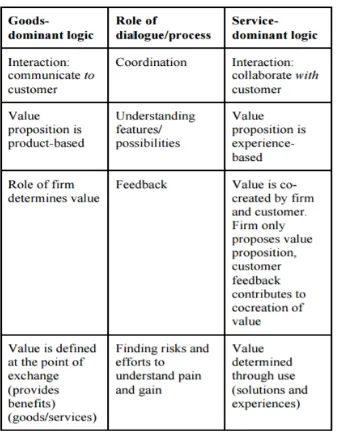
Table 2. Key differences between G-D and S-D Logic Source: London, Pogue & Spinuzzi (2015, p.6)
2.2 Value Proposition
Value propositions play a major role in business strategy (Payne and Frow, 2014). Value propositions help companies communicate their core strategy with stakeholders and shareholders, outlining the approach through which the company aims to attain strategic advantage against its competition (Payne and Frow, 2014).
In the 1980s and 1990s, economic scholars started to conceptualize value propositions in terms of value delivery (e.g. Bowever and Garda, 1985). The aim of the value proposition was to communicate the unique points of differences that made one’s offering superior to those of competitors and outline how the company can deliver this to their customers (e.g. Lanning, 1998; Lanning and Michaels, 1988). Recently, with the introduction of S-D logic, scholars started to elaborate the role of the value proposition in the value co-creation process between supplier and customer (e.g. Prahalad and Ramaswamy, 2004). Frow et al. (2014) argue that the former conceptualization focused on the delivery of value offerings, whereas the latter concentrates on the relational notion of value creation. Instead of emphasizing the dyadic, supplier-consumer nature of a value proposition, value propositions are now started to be seen through a broader view that includes multiple stakeholders or ‘actors’ within a service ecosystem (Frow et al., 2014). In this ecosystem, value propositions are utilized to provide social and economic actors opportunities for value co-creation (Vargo and Lusch, 2011). Actors exchange and integrate resources with each other and thereby co-create value with the help of shared institutional arrangements (Lusch & Vargo, 2015).
2.2.1
Value proposition according to G-D
Logic
The concept of a value proposition first briefly appeared in the managerial literature in 1985 through the collaborative effort of Bower and Garda. Initially, a value proposition was considered as a value offering delivered to customers (Bower and Garda, 1985). More precisely, the value proposition was understood as a unidirectional
marketing offer or promise that was communicated by one part to another in the hope of being accepted by the other party (Bower and Garda, 1985). It contained the expected benefits that the customer will experience in relation to the anticipated costs that the offering entails (Bower and Garda, 1985). Lanning (1998) elaborated on Bower and Garda’s (1985) narrative by emphasizing that value propositions represent a value offering created by the supplier for the customer, by suggesting that a company aims to develop a value proposition for its customers that is superior to that of the competition. This customer-oriented approach challenged the accepted supplier-oriented narrative of the time (Ballantyne et al., 2008).
Lanning’s (1998) approach shifted the focus away from a supplier-oriented narrative to a customer-oriented one. The customer-oriented conceptualization still adhered to the G-D logic notion because it assumes a unidirectional supplier-customer communication approach while it implies that customer value is embedded in the production and distribution phase of a good (Vargo & Lusch, 2008). After the initial publication of Bower and Garda (1985), it took another three years until the concept was further elaborated in an internal McKinsey staff paper (Lannings and Michaels, 1988). Initially, the concept of value proposition was defined as “a clear, simple statement of the benefits, both tangible and intangible, that the company will provide, along with the approximate price it will charge each customer” (Lannings and Michaels, 1988). Lannings and Michaels’ (1988) approach towards value proposition was reflected in the creation of their so-called ‘value delivery system,’ which is divided into three steps: (1) choose the value; (2) provide the value; and (3) communicate the value. The ‘value delivery system’ emphasized that businesses need to adopt a customer value-oriented approach to achieve competitive success (Ballantyne et al., 2008). Later, Anderson et al. (2006) developed a different approach, suggesting that organizations usually distinguish between one of the three heuristics to develop their value proposition: “all benefits,” stating all benefits that an organization can offer to its customer; “favorable points of difference,” identifying favorable points of difference compared to its closest competitors; and “resonate focus,” stating those one or two essential differences that are highly valued by the customer (Anderson et al., 2006). The concept of value proposition became increasingly acknowledged following the work of Treacy and Wiersema (1995), who discussed value proposition in terms of value disciplines. The authors distinguish between three different disciplines, i.e. operational excellence, customer intimacy and product leadership. The authors argue that the market success of a company is strongly influenced by the generic value proposition or disciplinary options that a company pursues (Treacy and Wiersema, 1995). Taking a different angle, Day (2006) applied the resource base view to further elaborate on the concept, incorporating a more relational approach towards customers, by outlining a different set of three generic value propositions and disciplines, i.e. price value, performance value, and relational value. These two approaches follow the intent for a company to deliver value to its customers by utilizing a seemingly customer-oriented approach; however, its generic nature deflects attention away from more individual customer-based strategies that are at the heart of S-D logic (Ballantyne et al., 2010).
surrounding the concept of value proposition focused on the customer as the focal point of the value proposition (Ballantyne et al., 2008). Put simply, a customer value proposition represents the idea that a company tries to anticipate or discover customer needs through direct interaction with its customers and subsequently offer a solution to that need (Ballantyne et al., 2008). However, different scholars highlighted the vital role the value propositions play in communicating the strategic direction of a company with its stakeholders other than the customer, e.g. in an attempt to recruit new employees or enhance relationships with key internal and external stakeholders such as suppliers, employees or shareholders (Ballantyne,2008, Payne et al., 2005). These attempts are implicitly supplier-led because it is the focal company’s responsibility to understand context-specific requirements and subsequently pivot its value proposition to address these (Ballantyne et al., 2008, 2011).
To summarize, despite the lack of consensus surrounding the topic of value propositions in the G-D logic-guided literature, common denominators among different streams of thought can be identified. The G-D logic- guided research argues that value propositions are inherently supplier-led initiates to internal and external stakeholders, which try to communicate the superiority of one’s marketing offering by showcasing the unique, valuable differences of one’s offering compared to those of the competition (Anderson et al., 2006). Following a G-D-centric logic, the concept of a value proposition is heavily supplier-centric as the supplying company is seen as the entity responsible for the identification, production, and delivery of costumer value (Skalen et al., 2014). The value potential offered within the value proposition is delivered from the firm to the customer. (Ballantyne et al., 2011). Value propositions are supplier-led initiatives without the involvement of the customer (Ballantyne et al., 2011). Furthermore, some scholars (Bower & Garda, 1985; Lanning, 1998) argued that the concept of a value proposition follows a customer-centric approach. However, the fact that customer value is delivered in the form of a good that is embedded with value (value-in-exchange) contradicts the notion of a truly customer-centric approach, as depicted in S-D logic (Lusch & Vargo, 2004).
2.2.2
Value proposition according to S-D
Logic
Although the concept of the value proposition is a central premise to the S-D logic, there is limited agreement and ambiguity surrounding its conceptualization (Frow et al., 2014). In a business setting, the value proposition should recognize particular advantages and sacrifices for all performing actors, besides how value is realized (Payne and Frow, 2014a). Lusch and Vargo (2004, 2008) argue that, the firm must be in direct interaction with its customer to realize a value proposition.
Flint and Menzer (2006) argue that the beneficial elements of value propositions exist to provide opportunities for co-production as well as knowledge exchange among two parties. (Kowalkowski, 2011). Superior value propositions namely, those offering that provide more value or a better solution compared to their completion will most likely be accepted by the beneficiary, which subsequently initiates the materialization process in the form of a market offering (Payne and Frow, 2014; Kowalkowski, 2015). Following Lusch and Vargo’s (2004) notion on value propositions, Ballantyne et al. (2006) agree on the tentative state of
value propositions, arguing that value-in-use is the execution of value propositions that is in accordance with the needs of both the buyer and seller. Subsequently, the process of value co-creation can take place by aligning firm and customer processes (Skalen et al., 2014).
The reciprocal nature of value proposition
Most research surrounding the concept of value proposition is based on the dyadic notion of an interaction between a buyer and supplier (Skalen et al., 2014; Kowalkowski 2016).Just recently, scholars have realized the need to transition from a supplier-dominant to an initiator-participant perspective to account for the interchangeable nature of an actor being able to be both the initiator and participant (Truong et al., 2012; Vargo & Lusch, 2011; Kowalkowski, 2011). Value propositions form through the collaborative effort of multiple resource integrating actors exchanging knowledge (Ballantyne & Varey, 2006).Furthermore, scholars have started to emphasize the importance of the mutual dependence and reciprocal nature of value propositions, yet these conceptualizations still mainly follow the dyadic notion inherent in G-D logic (Ballantyne and Varey, 2006; Payne and Frow 2014, Skalen et al., 2014). Ballantyne et al. (2006) define a value proposition as “reciprocal promises of value, operating to and from suppliers and customers seeking an equitable exchange. Thus, value propositions are always two-way, quid pro quo.” (p.344-345, italics in original). Ballantyne and Varey (2008) argue that “there can be no satisfactory relationship development unless exchange participants reciprocally determine their sense of what is of value, and begin this process with the development of reciprocal value propositions” (p.48).
co-creative practice of value proposition cannot be examined by merely investigating firms and customers; rather, actors are embedded in a “constellation of resource integrating actors” (p.1566) that all draw upon different scripts and activities, leading to the conclusion that firms should be understood as multiple resource-integrating actors as opposed to a one-dimensional resource integrator (Kowalkowski, 2012). This approach stands in clear distinction to the prior notion of unidirectional value proposition by the supplier, which outlines the unique benefits for the consumer in exchange for monetary compensation (Glaser, 2006)
In recent years, one can observe a major transition emerging within the value proposition literature, away from a narrow, dyadic, customer-supplier perspective towards one that views value propositions through a wider angle, incorporating multiple stakeholder or actors who are part of an all-encompassing service ecosystem (Frow et al., 2014). Truong et al. (2012) were eager to investigate how reciprocal value propositions are developed in practice at the network level (Truong et al., 2012). Truong et al.’s (2012) findings indicate that value propositions help actors to identify opportunities of co-creation while simultaneously “providing a platform to create stability within network relationships” (p.205). More specifically, the results indicate how dialog and knowledge brokerage can both enable and constrain the development of reciprocal value propositions (Truong et al., 2012).
The role of value proposition in networks
Value propositions are used to connect actors within a service system (Kowalkowski, 2015). Maglio and Spohrer (2008) define service systems as “value-co-creation configurations of people, technology, value propositions connecting internal and external service systems, and shared information (e.g. language, laws, measures, and methods)” (p.18). Lusch and Vargo (2004, 2008) suggest that the customer represents the focal point of value creation within a value network. Frow et al. (2014) define a value network as “a set of activities linked together to deliver a value proposition for the end consumer” (p.332).Within the value network, the customer can directly interact with a network of firms or consumers to fulfill his/her needs (Frow et al., 2014). The consumer is thereby actively involved in the process of production and delivery of service (Frow et al., 2014). Following Lusch and Vargo’s (2004, 2008) suggestion, Frow et al. (2014) define a market as “a place where dialogue among the consumer and the firm, consumer communities and networks of firms can take place” (p.332), which enables the continuous process of co-creation of value. Frow et al. (2014) further elaborate on the notion of value networks by emphasizing that there is, in fact, a network of value networks which Layton et al. (2011) calls ‘marketing systems’ influenced by social structures and norms. Building on this value network approach to a value proposition, Vargo and Lusch (2011) introduced the concept of ‘service ecosystems’ to account for the adaptable nature of the system. Ecosystems differ from stakeholder systems in the sense that the former include actors who are generally not considered to be part of the stakeholder system such as competitors or activist groups (Frow et al., 2014). Frow et al. (2014) identified five key premises related to the role that value propositions play in a service ecosystem:
• “Value propositions are a co-created and reciprocal mechanism through which actors offer and attract resources.
• Value propositions in ecosystems arise from the value potential inherent in actor’s resources.
• Value propositions influence the composition of networks, specifically determining with whom actors choose to engage, shaping the nature of market interactions.
• Value propositions may change over time and shape new resource integration within the service ecosystem. • Value propositions act as balance/aligning mechanism in the service ecosystem” (p.344-345).
The role of resource integration in the formation of a value proposition
A different aspect that differentiates value propositions according to S-D logic from those of G-D logic is the concept of resource integration (Skalen et al., 2014). Resource integration refers to the integration of knowledge and competencies. As mentioned earlier, S-D logic distinguishes between operant and operand resources. As two or multiple actors exchange their service offering, both the supplying actor as well as the consuming actor integrate the purchased offering (service or good) into their service system to co-create value (e.g., Vargo and Lusch, 2008). Skalen et al. (2014) note that operant resources facilitate the development of value propositions. Through the integration of resources, actors within the service ecosystem can adapt their value proposition in accordance with the obtained resource(s) (Vargo & Lusch, 2008). Skalen et al. (2014, p.139) conclude that “S-D logic treats value propositions as value creation promises created either by the firm independently or together with customers and other actors through resource integration based on knowledge and competencies.”
To summarize, even though the concept of a value proposition is central to S-D logic, there still seems to be limited agreement and ambiguity surrounding its conceptualization (e.g. Frow et al., 2014; Skalen et al., 2014). Nevertheless, the literature surrounding the concept of value proposition at least seems largely agrees on the following assumptions. First and foremost, value propositions are connecting forces that enable actors to identify opportunities for value co-creation within an ecosystem (Vargo & Lusch, 2010). Opportunities for value co-creation arise through an actor’s ability to offer and attract resources, which subsequently can be integrated into one’s service system and thereby co-create value (Vargo & Lusch, 2008). Successful resource integration among two actors has a cumulative effect on the overall ecosystem structure. Therefore, value propositions cannot be static to remain viable; rather, need to adapt in accordance with the requirements and needs of the ecosystem (Frow et al., 2014). Finally, value propositions serve as a stabilizing and aligning force within the ecosystem by ensuring that the experienced value-in-context is congruent with the value proposition (Truong et al., 2012; Frow and Payne, 2011).
2.3 Differences and similarities between value
propositions following G-D and S-D logic
differences and similarities between the two logics are outlined in the following.
One of the most striking differences between the logics is the initiating actor responsible for the creation and communication of the value proposition. Within G-D logic, the supplier is a crafter of the value proposition. A generic pre-packaged offering is targeted at the customer, outlining the expected costs and benefits that the offering entails. In accordance with this supplier-led approach, the supplier is the creator of value, which is subsequently used or ‘destroyed’ by the customer. By contrast, S-D logic, assumes that the value propositions can be individual as well as reciprocally created by both actors. Following FP7 “actors cannot deliver value but can participate in the creation and offering of value propositions,” whereby the supplying actor is unable to create value independently and subsequently offer it to a target actor because following FP6, “value is cocreated by multiple actors, always including the beneficiary.” Moreover, G-D logic assumes that suppliers can recognize and predict customer value as a result traditional marketing efforts such as consumer research. Subsequently, a generic value proposition is designed to fulfill these needs. Under S-D logic, value propositions outline how a service can meet the customer’s unique needs through the collaborative practice of co-creating value (Ballantyne et al., 2011). Because the customer is actively involved in the creation of a reciprocal value proposition and the following value co-creation practice, the customer is considered to be an active player as opposed to a passive entity. Here, a shift from a transactional to a sustained relational exchange view in the marketing literature is observable (Frow and Payne, 2011).
Furthermore, the value proposition according to S-D logic takes a broader, more encompassing view compared to G-D logic. Even though G-D logic partly emphasizes the notion that value propositions should also be targeted at other stakeholders, it ignores the role that value propositions play at the macro level.
However, the fact that value propositions according to both S-D and G-D logic can operate at a meso level reflects one of the rare commonalities among the two logics. Nevertheless, the stakeholder view advocated by G-D logic follows the supplier-led notion and thus differentiates itself from the stakeholder view advocated by S-D logic. Finally, Lannings and Michaels (1988) supported a customer-oriented approach when developing value proposals and delivering value. Upon first consideration, this notion can be assumed to be compatible with FP8, which states that “a service-centered view is inherently customer oriented and relational”; however, the fact that customer value is added during the internal production process contradicts the notion of a truly customer-centric approach (Lusch & Vargo, 2004).
3.
METHODOLGY
Case study design is a widely-accepted and commonly used method of research within various fields of research, i.e. economics and political science (Thomas, 2011). Thomas (2011) defines a case study as an analysis “of persons, events, decisions, periods, projects, policies, institutions, or other systems that studied holistically by one or more methods. The case that is the subject of the inquiry will be an instance of a class of phenomena that provides an analytical frame – an object – within which the study is conducted and which the case illuminates and
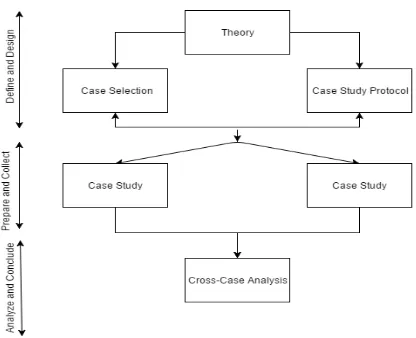
[image:7.595.319.527.369.538.2]explicates”(p.513). As the subject for the study two key cases or “deviant” cases (Lijphart, 1971, p.692) are introduced that reflect the exemplary knowledge of these cases, which are subsequently compared against one another (Thomas, 2011). This approach is also known under the synonym of a cross-case analysis (Schwandt, 2001). The object is intended to provide the theoretical framework to analyze the cases and will be introduced in further depth later on. Based on the explanatory nature of this study, a multiple parallel case study was chosen as the appropriate design. The research design follows an evaluative approach with the aim of illustrating and describing the theory in practice. Cross-case analysis or a comparative case method can be used to examine one or more cases to investigate the nature of a certain concept or theory (Schwandt, 2001). Furthermore, by comparing two cases, it is possible to better highlight the contrasting features of social phenomena (Bryman and Bell, 2015). As indicated in Table 4, the first step is to introduce the review the current literature, before the case selection method is introduced. The case study protocol builds the foundation for the analysis. Individual case reports will be filed to report on the findings of the different case studies. Based on these individual case study reports, a cross-case analysis, elaborating on the most remarkable facts and figures will be presented, paying particular attention to the specific characteristic that distinguishes value propositions according to G-D and S-D logic.
Table 4. Research framework
3.1 E-Research
organizations mostly present the organization’s perspective, meaning that the provided information may be biased. However, since the intent of this analysis is to analyze a company’s communication efforts with the public and the analyzed web site is the official communication domain with the public, both representativeness and authenticity can be assumed.
3.2 Case selection
For this multiple case study, a total of ten companies of diverse size that operate in separate industries are chosen to illustrate the differences between value propositions following G-D and S-D logic. Subsequently, the cases of Volkswagen passenger car as well as McDonald’s are presented in more depth. The value proposition of both companies serve well as the two key cases for this study as their value propositions display the key characteristics of value propositions following G-D and S-D logic.
3.3 Case study protocol
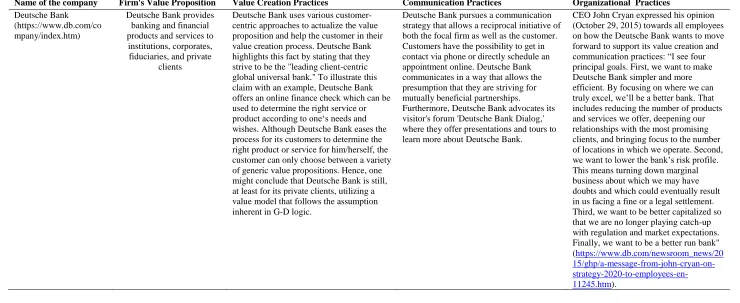
As depicted above, value proposition according to S-D and G-D logic substantially differ. Accordingly, the aim of this study is to clarify how these conceptual differences manifest in practice will. By reviewing the current literature surrounding the concept of value proposition, three variables have been identified: (a) value creation practices, (b) communication practices and (c) organizational practices. The proposed framework is geared towards supporting the researcher to gather significant information that can be utilized to answer the research question and shed further light on how companies use G-D and respectively S-D informed logic to propose their value proposition and subsequently (co)create value. The three variables are the result of the previous literature review and are considered prime characteristics when determining the underlying logic behind a value proposition.
Value-creation practices analyze the process through which the company is trying to fulfill its value proposition. More precisely, this variable considers how the company supports the customer in the value-creation process. In addition to that, it will be interesting to see how value is created according to the focal firm, as well as who is involved in the value creation process. Accordingly, the following questions are posed to shed light on that process: (1) What is the company’s value proposition? (2) How does the company facilitate the realization process as promised in the value proposition whereby the customer is able to experience the promised value?
The next variable is communication practices. This variable investigates the communicative practices between the focal company and its customer and stakeholder. Here, it is interesting to observe how the company engages in a dialog with its customers regarding the way in which it composes its value proposition and how the company communicates the methods through which it aims to support the value-creation process of its customers. The following question will aim to shed light on the issue: How is the focal company engaging in a dialog with its customers and stakeholders?
The variable organizational practices is aimed at supporting both value-creation practices as well as communication practices. Organizational practices take a closer look at the organization and managerial practices
in place that support the communication and value-creation practices. These organizational practices can include practices such as knowledge sharing among internal and external stakeholders or initiatives to train employees. The following question is formulated to investigate it: What organizational practices are in place that support both the value creation as well the communication effort of the focal firm?
3.4 Case study
3.4.1
Volkswagen passenger car
Volkswagen passenger car is a prime example of how an actor can adopt the S-D logic mindset to innovate and develop innovative ideas with its customers. By analyzing Volkswagen’s homepage (www.vw.com), one can immediately recognize that Volkswagen does not offer a generic value proposition to its customer, but rather on that the customer can co-create their own car. One can clearly identify that Volkswagen’s value proposition is aiming to actively involve its customer in the creation of the value proposition. For example, customers have the possibility to choose a model that is offered by Volkswagen and subsequently change and adapt the interior and exterior of that model - such as the seat color - according to one’s wishes. Various advertised slogans such as “Jetta. It says you’ve arrived. Ahead of schedule.” and “Don’t pass up a chance for peace of mind.” indicate that the time of value realization is not when the car is purchased, but rather when the car is used. Volkswagen advertisements suggest that the installed technique acts as a service appliance that enables the driver to receive value in the form of time savings and reduced stress. Moreover, Volkswagen involves a wide variety of stakeholders to reciprocally develop value propositions that reflect the interests of all relevant actors. Stakeholder surveys, as well as dialog forums are common communication practices to incorporate employees, suppliers and local authorities’ opinions, which Volkswagen considers to subsequently adapt, enhance or innovate their value proposition in accordance with the need of all actors involved. In addition a variety of instruments to communicate with Volkswagen are used, i.e. public debates, working groups, open days or customer workshops.
Furthermore, potential buyers have the possibility to plug in their smartphone into one of Volkswagen’s cars to have the luxury of using their applications during the ride. By enabling users to integrate their smartphone into the car, Volkswagen has successfully integrated its resources with those of the user to ultimately enable a superior service offering for both parties. In addition to providing a superior value offering to their customers, Volkswagen can collect certain meta-data about the driver’s usage of his/her smartphone to subsequently adapt its service offering, which can be used to continually adjust their value proposition to meet continuously changing customer needs.
building cars not only for, but also with people.” To further emphasize that Volkswagen is interested in a constant exchange of ideas and knowledge with its customers, the company is actively engaged in various social media platforms (e.g. Facebook, Twitter). To summarize, Volkswagen does not view its customers as passive entities, nor does its offer the same generic offering to all customers or expect to be the sole creator of value. Volkswagen understands that to thrive in the business world nowadays, a wide variety of actors within the service network need be engaged, activated and invited to actively participate in reciprocally generating a viable value proposition that yields reciprocal promises of value for the actors involved. Volkswagen showcases how a modern, internationally- operating company can facilitate an environment that fosters continuous dialog between various stakeholders and allows the customer to actively influence the experiences according to one's wishes and needs.
3.4.2
McDonald’s
McDonald’s is an American fast food chain with restaurants operating in more than 119 countries around the globe. McDonald’s is well known for its standardized business model, which allows the company to offer the almost same offering all around the world, or - as McDonald’s website phrases it - “The Simpler The Better.” McDonald’s offers a variety of different dishes such as burgers, fries and wraps. To ease the decision- making for the customer, McDonald’s offers a variety of menus between which customers can choose. Customers have the possibility to customize their offering to a degree, for example, by choosing a random mix of dishes and drinks that are not predefined by McDonald's. Nevertheless, the customer cannot customize the separate dishes such as by creating their own burger. Overall, one can argue that McDonald’s value proposition follows that of the G-D logic since McDonald's offers a generic value proposition to the market with little direct involvement of the customer. McDonald’s argues that it is pursuing a customer-oriented approach, stating that “at McDonald’s, we’re making changes based on what we’re hearing from all of you” (https://www.mcdonalds.com/us/en-us/about-our-food/our-food-philosophy.html). However, based on the implicit assumption that McDonald’s is the creator of value that is subsequently used or ‘eaten’ by the customer, McDonald’s cannot be considered as a company following a truly customer-centric approach. Although McDonald’s is working in accordance with G-D logic on a micro scale, its communication with external and internal stakeholders at the meso and macro level mostly follows the S-D institutional logic. According to its website (www.aboutmcdonalds.com), McDonald’s is fostering an environment in which the importance of their employees as a key asset is recognized. Opportunities for continuous training and education are provided to its employees. Besides, McDonald’s states that its vision is to “create positive impacts for our communities, society and the planet,” which reflects the company’s intention behind the impact that it wants to have on a global, macro level. Moreover, McDonald’s adapts its value proposition according to national and cultural food preferences, arguably
In conclusion, McDonald’s is arguably utilizing a value proposition following G-D logic on a micro scale while their activities at a meso and macro level are following a more S-D-centric approach.
4.
DISCUSSION AND CONCLUSION
4.1 Discussion
The analysis of ten companies revealed various patterns among companies that together allow one to draw conclusions from. Based on the presented case studies, one realizes that S-D logic has arrived in the main stream narrative and is not only a phenomenon observable in various research streams. Most international-active companies have realized the signs of our time that to strive and generate a sustainable strategic advantage they have to adapt broader, more flexible, cooperative mindset based on reciprocal value creation. Companies appear to shift their focus more towards perceiving value in terms of value-in-use, providing the necessary resources and knowledge to help customers reach a desired end state. Examples of this phenomena are for example observable in BlackRock`s ‘Alladin’ platform and Gusto’s service offering. On the contrary, value creation practices following G-D logic are based on the assumption that value is internally produced and subsequently exchanged. Therefore, the proposed value proposition is of generic nature, outlining the potential costs and benefits. The client has only limited possibility to influence and shape the value offering. Nevertheless, most analyzed companies in this study appear to follow value creation practices associated with S-D logic.
In addition, vast networks of actors are established - as it is the case with LegalShields - to subsequently offer a service offering that combines the capabilities and resources of multiple actors to subsequently offer a value proposition that is arguably able to create a superior value proposition for its customers. Through the integration of resources and certain service practices, innovation can take place, leading to value proposition with a high degree of density (Skalen et al., 2014, Norman, 2001). A high degree of ‘density’ in this context refers to “the best combination of resources is mobilized for a particular situation – for example for a customer at a given time, in a given place – independent of location, to create the optimum value/cost result” (p.27).
Based on the analysis, one can observe that companies employ communication practices that foster the reciprocal exchange of information. A number of different service offerings are targeted at providing possibilities for value co-creation before or after the actual purchase. In accordance with Ballantyne et al. (2011), communication is viewed as a process -extending from pre to post-sale- as opposed to a fixed event. For this purpose, a number of companies developed platforms or apps that contain the necessary knowledge to allow self-service for its customers. Forums are a practical tool for firms to engage in a reciprocal knowledge exchange with its customers and other beneficiaries. Moreover, companies communicate with its key stakeholders through a diverse range of communication channels. This development points towards a general trend that is observable among internationally operating companies, i.e. a shift towards relationship building and continuous knowledge with the member of their ecosystem. Furthermore, the case studies revealed that companies appear to increasingly recognize the importance of operant resources such as their employees. Most analyzed companies offer a range of development programs for its customers to reach that goal.
supplier-led initiative. Customers are considered as passive entities that are targeted by the supplying company. On the other hand, Volkswagen passenger car provides a good example on how a company can reciprocally determine a value proposition that subsequently enables the integration of different resources to provide a unique experience for its customer. Rather than selling a product, Volkswagen passenger car understands that the customer is looking for an experience in the form of comfort or time savings. Continuous communication and knowledge exchange allow the company to gather relevant information about the needs and wishes of its customers, while simultaneously fostering relationship building.
4.2 Conclusion
In conclusion, after reviewing the current literature as well as analyzing ten cases and illustrating two key cases, one can observe major distinctions between the value proposition of firms following G-D and S-D logic. Companies following the G-D logic largely offer the same generic offerings to their customers. The customer has no real possibility to shape or has a say in the creation of the value proposition. Communication is unidirectional from the supplying company to the customer. Furthermore, since value is created internally, companies tend to put a greater focus on developing internal capabilities as opposed to focusing on co-creating value with its customers and stakeholders. By contrast, companies employing a S-D logic offering highly value the input of their customers. Ongoing communication among the focal firm and its customers and key stakeholders is used to ensure that the value proposition offered yields a positive, reciprocal outcome for all actors. Platforms and apps are widely utilized tools by companies to connect numerous users and experts within a field to facilitate knowledge renewal and self-service for its customers and the focal firm. Nonetheless, Atikson and Coffey (2004) remind the reader that “we cannot learn through written records alone how an organization
actually operates day by day” (p.58).
4.3 Managerial Implications
Foundational premise four states that operant resources are the fundamental source of strategic benefit. As depicted above, operant resources refer to knowledge and skills (Lusch & Vargo, 2004). Therefore, S-D logic emphasizes the importance of continuously developing one’s knowledge and competencies using various communicational and organizational practices. The reciprocal development of value propositions can facilitate the continuous development of knowledge and competencies, which subsequently leads to strategic benefits. Firms have to realize that to generate this ongoing exchange and development of knowledge and competencies, customers and other stakeholders have to be viewed as an active participant in the value creation process. Adding to this notion, Ballantyne et al. (2011) state that companies and scholars greatly underestimate the value potential inherent in considering customers as an active player, as the mere fact that customers are actively involved the value creation process contains value in itself. Therefore, the focal firm has to facilitate an environment that fosters open-ended communication with its environment. A shift in mindset among management and employees are critical for that. Only then, firms are capable of uncovering opportunities for
value creation, which are constrained by the traditional G-D logic (Kowalkowski, 2011). Lastly, in line with Ballantyne et al. (2011), firms need to view communication as a continuous process, unrestricted by time constraints, as opposed to a unidirectional approach led by the focal firm.
5.
LIMITATIONS AND FURTHER
RESEARCH
5.1 Limitations of this study
The aim of this research was to illustrate the concepts of value proposition according to G-D and S-D logic based on examples observed in practice. However, based on the limited available resources and access, it was not possible to obtain a more in-depth look into the workings of the ten analyzed companies. Case studies often rely on a multitude of research methods to strengthen its validity and reliability. Furthermore, the collected data is merely the result of direct observation of the attainable information via the internet; therefore biases surrounding their interpretations are likely to arise. The boundaries between practices following G-D and S-D logic are sometimes blurry and it thus leaves room for misinterpretation and potential errors. Finally, due to the lack of insider information, it is an almost impossible task to identify a company that is still merely following G-D logic, given its apparent deficiencies.
5.2 Practical relevance
The knowledge obtained through this paper can be utilized by strategic decision makers to determine whether their current value proposition is still relying on traditional views associated with G-D logic or in which areas there remains room for improvement. Furthermore, real life examples are presented that companies can use as inspiration to subsequently alter certain company policies or ways of thinking and doing things.
5.3 Theoretical relevance
The theoretical relevance of this study resides in the fact that it has further elaborated on the concept of a value proposition within the context of S-D Logic, providing real-life examples to illustrate the often abstract ideas illustrated in existing literature.
5.4 Recommendations for further research
6.
BIBLIOGRAPHY
Anderson, J. C., Narus, J. A., & Van Rossum, W. (2006). Customer value propositions in business markets. Harvard Business Review, 84(3), 90.
Atkinson, Paul, and Amanda Coffey. "Analysing documentary realities." Qualitative research (2004): 56-75.
Ballantyne, D., Frow, P., Varey, R. J., & Payne, A. (2011). Value propositions as communication practice: Taking a wider view. Industrial Marketing Management, 40(2), 202-210. doi:10.1016/j.indmarman.2010.06.032
Ballantyne, D., & Varey, R. J. (2006). Introducing a dialogical orientation to the service-dominant logic of marketing. The service-dominant logic of marketing: Dialog, debate, and directions, 224-235.
Ballantyne, D., Varey, R. J., Frow, P., & Payne, A. (2008). Service-dominant logic and value propositions: Re-examining our mental models. Paper presented at the Otago Forum.
Ballantyne, D., Williams, J., & Aitken, R. (2011). Introduction to service-dominant logic: From propositions to practice. Industrial Marketing
Management, 40(2), 179-180.
doi:http://dx.doi.org/10.1016/j.indmarman.2010.06.025
Bower, M., & Garda, R. A. (1985). The role of marketing in management. McKinsey Quarterly, 3(1).
Bryman, A., & Bell, E. (2015). Business research methods: Oxford University Press, USA.
Chandler, J., & Vargo, S. L. (2011). Contextualization: Network intersections, value-in-context, and the co-creation of markets. Marketing theory, 11(1), 35-49.
Chandler, J. D., & Lusch, R. F. (2015). Service Systems: A Broadened Framework and Research Agenda on Value Propositions, Engagement, and Service Experience. Journal of Service Research, 18(1), 6-22. doi:10.1177/1094670514537709
Flint, D. J., & Mentzer, J. T. (2006). Striving for integrated value chain management given a service-dominant. The Service-Dominant Logic of Marketing: Dialog, Debate, and Directions Armonk, NY: ME Sharpe, 139-149.
Frow, P., McColl-Kennedy, J. R., Hilton, T., Davidson, A., Payne, A., & Brozovic, D. (2014). Value propositions: A service ecosystems perspective.
Marketing theory, 14(3), 327-351.
doi:10.1177/1470593114534346
Frow, P., & Payne, A. (2011). A stakeholder perspective of the value proposition concept. European Journal of Marketing, 45(1/2), 223-240.
Kotler, P. (1994). Analysis, planning, implementation and control: Prentice Hall International.
Kowalkowski, C. (2011). Dynamics of value propositions: Insights from service-dominant logic.
European Journal of Marketing, 45(1), 277-294. doi:10.1108/03090561111095702
Kowalkowski, C., Kindström, D., & Carlborg, P. (2015). Triadic value propositions: When it takes more than two for tango.
Kowalkowski, C., Persson Ridell, O., Röndell, J. G., & Sörhammar, D. (2012). The co-creative practice of forming a value proposition. Journal of Marketing
Management, 28(13-14), 1553-1570.
doi:10.1080/0267257x.2012.736875
Lanning, M. J. (1998). Delivering profitable value: A revolutionary framework to accelerate growth, generate wealth, and rediscover the heart of business: Da Capo Press.
Lanning, M. J., & Michaels, E. G. (1988). A business is a value delivery system. McKinsey staff paper, 41(July).
Layton, R. A. (2011). Towards a theory of marketing systems. European Journal of Marketing, 45(1/2), 259-276.
Lijphart, A. (1971). Comparative politics and the comparative method. American Political Science Review, 65(03), 682-693.
London, N., Pogue, G., & Spinuzzi, C. (2015). Understanding the value proposition as a co-created claim. Paper presented at the 2015 IEEE International Professional Communication Conference (IPCC).
Lusch, R. F., & Vargo, S. L. (2006). Service-dominant logic: reactions, reflections and refinements. Marketing theory, 6(3), 281-288.
Lusch, R. F., & Vargo, S. L. (2014). Service-dominant logic: Premises, perspectives, possibilities: Cambridge University Press.
Lusch, R. F., Vargo, S. L., & Wessels, G. (2008). Toward a conceptual foundation for service science: Contributions from service-dominant logic. IBM Systems Journal, 47(1), 5-14. doi:10.1147/sj.471.0005
Lusch, R. F., & Webster, F. E. (2011). A stakeholder-unifying, cocreation philosophy for marketing. Journal of Macromarketing, 31(2), 129-134.
Maglio, P. P., & Spohrer, J. (2008). Fundamentals of service science. Journal of the Academy of Marketing Science, 36(1), 18-20.
Normann, R. (2001). Rethinking business: Chichester: Wiley.
Payne, A., Ballantyne, D., & Christopher, M. (2005). A stakeholder approach to relationship marketing strategy: The development and use of the “six markets” model. European Journal of Marketing, 39(7/8), 855-871.
Prahalad, C. K., & Ramaswamy, V. (2004). Co‐creation experiences: The next practice in value creation. Journal of interactive marketing, 18(3), 5-14.
Schwandt, T. A. (2001). Dictionary of qualitative research: Thousand Oaks, CA: Sage.
Scott, J. (1990). A matter of record: Cambridge: Polity Press.
Staff, A. (2012, May/June). Volkswagen's People's Car Project in China offers three concepts, including a hovering EV LICENSE. Retrieved December/January,
2016, from
http://www.autoblog.com/2012/05/06/volkswagens- peoples-car-project-in-china-has-produced-three-co/#slide-endcap
Skålén, P., Gummerus, J., von Koskull, C., & Magnusson, P. R. (2014). Exploring value propositions and service innovation: a service-dominant logic study. Journal of the Academy of Marketing Science, 43(2), 137-158. doi:10.1007/s11747-013-0365-2
Thomas, G. (2011). A typology for the case study in social science following a review of definition, discourse, and structure. Qualitative inquiry, 17(6), 511-521.
Treacy, M., & Wiersema, F. (1995). How market leaders keep their edge. Fortune, 131(2), 52-57.
Truong, Y., Simmons, G., & Palmer, M. (2012). Reciprocal value propositions in practice: Constraints in digital markets. Industrial Marketing Management, 41(1), 197-206.
Vargo, & Lusch. (2004). Evolving to a New Dominant Logic for Marketing. Journal of Marketing, 68(1), 1-17.
Vargo, & Lusch. (2016). Institutions and axioms: an extension and update of service-dominant logic. Journal of the Academy of Marketing Science, 44(1), 5-23. doi:10.1007/s11747-015-0456-3
Vargo, S. L., & Lusch, R. F. (2008). From goods to service(s): Divergences and convergences of logics. Industrial Marketing Management, 37(3), 254-259. doi:10.1016/j.indmarman.2007.07.004
Appendix A
[image:13.842.85.745.138.512.2]Appendix B
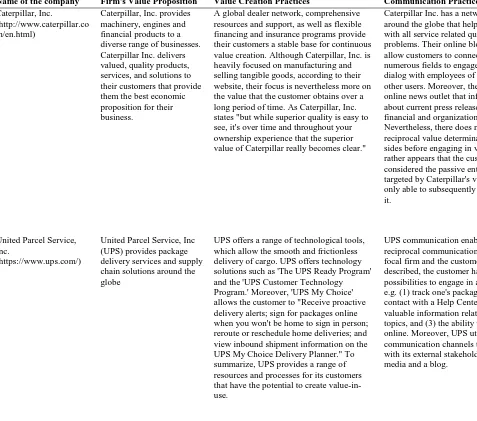
Name of the company Firm's Value Proposition Value Creation Practices Communication Practices Organizational Practices BlackRock, Inc.
(https://www.blackrock.c om/)
Supporting clients with a range of consulting, analytical, capital markets and strategic advisory services
As part of BlackRock Solutions, BlackRock offers the 'Alladin' System, which is a platform that comprises the information of thousands of i.a. Risk Analyzer and investment portfolios that enable the user to make better investment decisions based on the obtained information. 'Alladin' system is a prime example of how a network of actors and information can be merged to help the customer in their value creation process.
BlackRock practices a mainly
unidirectional communication practice with its clients and stakeholders. BlackRock has two blogs that enhance the communication with its external stakeholders. Nevertheless, as far as one was able to tell, the reader was a rather passive entity within the domain, unable to contribute to a discussion or topic. Furthermore, according to their website, there is no reciprocal
determination of value prior to creation of the value proposition.
BlackRock fosters an environment of continuous knowledge exchange among its divisions, customers, and external stakeholders. Hence, platforms such as 'Alladin' are established to enable a constant sharing of knowledge. Furthermore, BlackRock utilizes the expertise of 135 investment teams in 35 countries to realize the value proposition's promise successfully.
Nike, Inc.
(https://www.nike.com)
Nike offers its customers a variety of sport equipment, including athletic footwear and apparel. Nike's aim is to bring inspiration and innovation to every athlete in the world.
Besides offering a broad range of athletic footwear and apparel, Nike is also
providing tools that are designed to enhance athletic performance.
'Nike+ Run Club App' is one of these tools and is intended to connect the user with thousands of other runners from numerous experts to obtain valuable information, track one's goals and share one's accomplishments with others. Also, customers have the possibility of customizing their shoe in accordance with their wishes and needs. Nike provides the platform and technology, but the customer is ultimately responsible for creating the shoe.
Nike's offers its customers the possibility to be both the passive as well as active entity. Nike's value proposition invites its customers to reciprocally shape the value proposition according to his/her wishes. Furthermore, social media such as Facebook or Twitter is used to handle after sale complains, suggestions or any other related issue.
Nike employs a variety of organizational practices that are designed to fulfill the promises given in their value proposition. First, Nike offers numerous development offerings, programs and resources to support their work workforce. To drive innovation forward on a macro scale, Nike is actively engaged in seizing opportunities that present themselves with the usage of open-sourcing and