http://www.scirp.org/journal/ajibm ISSN Online: 2164-5175
ISSN Print: 2164-5167
DOI: 10.4236/ajibm.2017.75050 May 27, 2017
Development and Application of an
Inter-Organizational PPP Knowledge Transfer
Effectiveness Model for Knowledge Sourced in
Public Sector Organizations
Geoffrey Aerts
*, Elvira Haezendonck
Faculty of Economic and Social Sciences and Solvay Business School, Vrije Universiteit Brussel, Brussels, Belgium
Abstract
The research aim is to develop and apply the conceptual inter-organizational knowledge transfer effectiveness (IOKTE) model to the inter-organizational transfer of Public-Private Partnership (PPP) related knowledge between public sector organizations in Flanders. The model assumes a relationship between an individual’s ability to make PPP-related decisions and the extent to which knowledge is sought after, applied and shared in an inter-organi- sational manner within the public sector. The inter-organizational transfer of knowledge studied in this article is specific to PPP in Flanders and studied for public sector actors active at diverse policy levels. The aim is to uncover the extent to which the current system of inter-organizational knowledge transfer fits the user’s satisfaction, expressed as the extent to which the use of the system improves the perceived decision-making on PPPs. The results indicate that searching for, sharing and using PPP-related knowledge sourced in public sector organizations improve the perceived decision-making ability. The re- search establishes that the current public sector PPP knowledge transfer system is perceived as being effective, yet for the assessment of its efficiency, insufficient data is found. Issues that stand to be improved are the frag- mentation of the knowledge assets and the access across policy levels.
Keywords
Knowledge Transfer, Public-Private Partnerships, Public Sector, Knowledge Management, Project Management, Public Procurement, Information Asymmetries
How to cite this paper: Aerts, G. and Haezendonck, E. (2017) Development and Application of an Inter-Organizational PPP Knowledge Transfer Effectiveness Model for Knowledge Sourced in Public Sector Organizations. American Journal of Indus-trial and Business Management, 7, 671-710. https://doi.org/10.4236/ajibm.2017.75050
Received: March 15, 2017 Accepted: May 24, 2017 Published: May 27, 2017
Copyright © 2017 by authors and Scientific Research Publishing Inc. This work is licensed under the Creative Commons Attribution International License (CC BY 4.0).
672
1. Introduction
Several authors have expressed the importance of knowledge transfer and man-agement for modern day public organizations [1] [2] [3] [4] [5].
Others have stated that knowledge is a critical resource and determinant of Public-Private Partnership (PPP) success [6]. This has implications for public organizations involved in PPP projects, as this increases the necessity to re-sourcefully combine new, innovative and existing insights to develop dynamic competencies in support of organizational goals, e.g. the successful initiation, implementation and monitoring of PPP projects [7] [8].
Such a requirement for the development of knowledge assets is reinforced by the fact that public sector organizations (PSO) are confronted with demands to become more efficient and effective, i.e. increasing financial cutbacks, a rising demand for services and quality and a push towards performance-related man-agement [8] Since PSO often have to achieve conflicting goals imposed upon them by numerous stakeholders simultaneously, this imposes challenges on the sustainable development of knowledge assets, which are often seen as second- rate resources. PSO furthermore partake in complex global and local networks of political, societal and economic interdependencies, enabled in part by the ex-panding capabilities of information and communication technologies [9]. As a result, this creates the ability to share and search for knowledge and information pertaining to a particular topic across projects, organizations and national boundaries [9]. However, ample access to information and expertise can create situations where knowledge is ubiquitous and thereby leads to a situation of overload rather than parsimony [10]. It is therefore essential that public sector organizations manage their knowledge, given that their knowledge base [11] may serve as a beacon in the vast sea of (PPP-related) knowledge and information.
As a crucial element of PPP projects’ success, public sector knowledge man-agement has yet to gain the interest of mainstream strategic manman-agement litera-ture [1]. Especially in relation to the process of public sector organizations’ PPP knowledge management and the extent to which the inter-organizational PPP- related knowledge transfer processes influence the perceived knowledge man-agement’s effectiveness, extensive academic work has been scarce. The study of this managerial phenomenon is however important, even if transferring know-ledge and storing knowknow-ledge are not a new nor original undertaking.
673 PPP projects often involve several of these actors, especially in those projects developed on Flemish territory [12] [15] [16]. PPP projects additionally consist out of several sequential stages, each with specificities and objectives [17]. Add-ing to this complexity is the implications of faulty project implementation, due to a lack of skill and/or expertise. This, whilst public sector organizations face highly transient and ever-evolving surroundings [7], in turn evoking the need for the development of coping-mechanisms and instilling resilience and adapti- vity into the core of the organization [18], fostering dynamic project engineering and management skills.
Transferring PPP related knowledge between stakeholders, and therefore, be-tween public stakeholders is challenging due to this complexity, yet according to Carillo et al. (2006) stand to nurture innovation and increase the public sector’s ability to foster successful PPP projects [17]. This is since PPP-related know-ledge sharing stands to remain relevant over long periods of time, may aid in overcoming divergent public sector goals and therefore stands to increase the public sector’s capacity to successfully initiate, develop, implement and monitor PPP projects [17] [19].
Current evolutions in IT have also lowered boundaries imposed upon inter- organizational knowledge transfer (KT), even in the public sector. Caution is however warranted, since even when inter-organizational transfers are sup-ported by IT systems, this does not necessarily guarantee a free circulation of knowledge through organizations or between organizations [20]. Hence, the availability of technological innovations alone does not necessarily improve knowledge transfer be it organizational or inter-organizational. For the latest IT technologies to improve KT, it is important that it is adapted to the management of organizational knowledge in relation to the specific needs expressed by par-ticipants in the field.
Therefore, from a knowledge management perspective, this paper aims to study the perceived effectiveness of inter-organizational PPP knowledge trans-fers that occur in the public sector in Flanders. The research hereto explains the research design, consisting of an inter-organizational knowledge transfer effec-tiveness (IOKTE) model and its application to the PPP knowledge transfer in Flanders between public sector organizations. Next to this research method, i.e. a quantitative survey-based analysis of perceived knowledge transfer effectiveness (based on descriptive statistics and a partial least squares structural equation model) the results of the study are discussed and the implications of the analysis are presented. The paper concludes with a recapitulation of the main findings and their academic implications. Finally, it also offers suggestions for future re-search.
2. Inter-Organizational Knowledge Transfer Effectiveness
(IOKTE): Conceptual Model and Operationalization
674
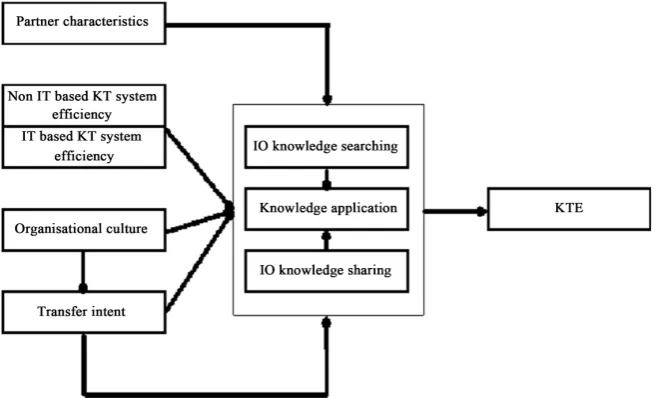
knowledge transfer, several variables are to be measured to test relevant hypo-theses. An overview of the literature that was consulted can be found in annex 4. The constructs used in support of the KTE model are based on a variety of re-sources, ranging from the IS success model proposed by DeLone and McLean (1992), to models developed recently by Wu and Wang (2006), Kulkarni, Ravin-dran and Freeze (2007), Pérez-Nordtvedt et al. (2008) and critical factors pro-posed by authors like Alzami and Zairi (2003), Duan, Nie and Coakes (2010), Khamesh and Jolly (2006), and Jennex, Smolnik and Croasdell (2007) [21]-[28]. The operationalization of the variables and their relation to the hypotheses is brought forwards in the following paragraphs. The operationalization of in-fluential factors at the inter-organizational level is similar to the one found at the individual or organisation level. The latter is the result of the fact that knowledge transfer at any level is based on person-to-person endeavours, possibly mediated by communication technology. As a consequence, the transfer process can be studied at these different levels, based on insights that apply from the lowest tot highest organizational levels [29]. Figure 1 provides an overview of the model.
2.1. Endogenous Variables: Knowledge Transfer Effectiveness,
Inter-Organizational Knowledge Searching, Sharing and
transferred Knowledge Application
In the knowledge transfer model proposed in this paper, inter-organizational transfer effectiveness is expressed as the perceived increased ability to make de-cisions pertaining to public-private partnership involvement. Crucial in this as-sessment of effectiveness is the application of knowledge towards a particular end [20] [30]. Performing inter-organizational knowledge transfers (IOKT), i.e.
[image:4.595.210.539.517.716.2]sharing and searching for knowledge in an inter-organizational fashion, signals the use of a process. Whilst the application of shared or found knowledge is es-sential for this knowledge to be able to influence decision-making and problem solving, which signals the effectiveness of the inter-organizational knowledge
675 transfer in terms of transfer outcome [31] [32]. This in turn determines the added value (expressed as perceived improved decision-making ability) that arises from performing a knowledge transfer [9] [21] [22] [23] [24] [26] [33] [34]. System use is expressed as searching for, the sharing of and the application of knowledge sourced in an inter-organizational manner in and between public sector organizations.
Towards the application of the IOKTE model under the conditions specified for the transfer of PPP knowledge in Flanders, an operationalization of the en-dogenous variables was established in several parts. First respondents were asked whether they search for PPP-related knowledge at other public sector organiza-tions active on the same territory. Afterwards the same approach was used to as-sess whether respondents shared PPP-related knowledge in an inter-organisa- tional manner in the public sector. Respondents were also asked if they used the knowledge that they shared and searched for. Finally, questions that gauge if respondents felt that they could follow-up on current developments and innova-tions in PPP due to IOKT and whether they felt that their PPP-related skills and decision making improved because of the inter-organizational knowledge trans-fer were included to assess the perceived effectiveness of the knowledge transtrans-fer.
As the perception of the effectiveness of inter-organizationally sourced know-ledge can only follow the knowknow-ledge that has been sourced and applied, this means that the model assumes that searching, sharing and effectively applying inter-organizationally transferred knowledge will affect the perceived benefit towards decision-making in PPP. A relation between the use of the transfer sys-tem (i.e. searching, sharing and applying knowledge) and the perception of its effectiveness is assumed to be positive. Hence the more the IOKT system is used; the more this will lead to improved decision-making ability, indicating the fit-ness of the knowledge transfer system.
H1: The inter-organizational transfer of PPP related knowledge positively impacts the perception of decision-making ability concerning PPP projects that take place on Flemish territory.
H2: Searching for and the sharing of PPP knowledge in an inter-organiza- tional manner in the public sector in Flanders will positively impact the applica-tion of PPP knowledge.
2.2. Exogenous Variables and Hypotheses
2.2.1. Organizational Culture676
and income, as well as the orientation of the overall culture within the organiza-tion, in its focus on organizational learning and knowledge management, all signal an organizational culture that promotes knowledge transfer [23].
Organizational culture and the extent to which this culture is directed towards the inter-organizational transfer of knowledge was operationalized as the extent to which the respondents’ organization facilitates KT through higher manage-ment, through the provision of resources towards the transfer of knowledge and the extent to which knowledge transfer is a priority for the organization.
Inter-organizational knowledge transfer in the public sector stands to be posi-tively influenced when the organizations that are part of the system are culturally oriented towards knowledge sharing. The model assumes that a knowledge oriented public organization will positively influence a user’s intent to transfer knowledge and the perceived effectiveness of the knowledge transfer. This is the case in both the process of transferring, as well as in its outcome. Furthermore, the assumption is made that an organizational culture that is oriented towards knowledge transfer, will positively impact the individual’s knowledge transfer intent.
H3: An organizational culture that is oriented towards knowledge manage-ment and transfer positively impacts the process of inter-organizational PPP knowledge sharing, searching, and application done by its members.
H4: An organizational culture that is oriented towards knowledge manage-ment and transfer positively impacts the inter-organizational knowledge transfer intent of the organization’s members.
2.2.2. Knowledge Transfer System Efficiency: Assessing the Quality of the Transfer System
The assessment of the knowledge transfer system’s efficiency consists out of two parts. Knowledge transfer in an inter-organizational fashion is not solely done through IT or IS based approaches only. A lot of knowledge is shared and trans-ferred in formal or informal meetings, or with a particular intent that is not nec-essarily directly linked to information technology. In Nonaka’s terms for in-stance, knowledge transfer instruments that are often cited for the socialization of new workers are: employee rotation, cooperative cross-organization projects, apprenticeships and monitoring programs, learning by observation and learning by doing [18] [38]. Hence the assessment of the efficiency of the transfer system should consist out of an IT-based part and a non-IT-based part, in order to grasp the full extent of the knowledge transfer mechanism that is used to support inter-organizational knowledge transfer. As the system is more efficient in pro-viding access to information, and in transferring knowledge from one organiza-tion to another, this will impact the effectiveness of the transfer, through both enabling the ability to search for as well as share and apply knowledge that was sourced in an inter-organizational manner [28].
ques-677 tions. Hence before respondents could assess the efficiency of the IT based knowledge transfer system and/or the non-IT based knowledge transfer system, respondents had to indicate which knowledge transfer mechanisms they used. This condition was added as the results towards the assessment of the systems’ efficiency may have been distorted when respondents answered questions con-cerning an IT based KT system, when they weren’t even aware of its existence. Hence the conditional set-up was implemented to uphold the quality of the an-swers and enable a thorough assessment of the current knowledge transfer me-chanisms. Questions included in the survey towards the assessment of the sys-tems’ perceived efficiency gauged its stability, fluency, and ease of use, structure, accessibility, user-friendliness, cost, content quality and quality of the provided IT-support.
H5a: The perceived efficiency of the IT based knowledge transfer support sys-tem positively affects the inter-organizational PPP knowledge transfer activities,
i.e. knowledge sharing, searching and application of/for knowledge.
H5b: The perceived efficiency of the non-IT based knowledge transfer support system positively affects the inter-organizational PPP knowledge transfer activi-ties, i.e. knowledge sharing, searching and application of/for knowledge.
2.2.3. Partner Characteristics
Literature on both alliance formation and inter-organizational knowledge trans-fer, as well as knowledge governance suggests that organizations that keep close, trust based relations and develop a reciprocal connection on the basis of their reputation in certain fields, tend to transfer inter-organizational knowledge more effectively [18] [24] [26] [28] [30] [34] [39]. The same is true for organiza-tions that are similar in terms of organizational culture and structure, or those that provide open access to the relevant knowledge that they possess. As such, the inclusion of partner characteristics in the inter-organizational knowledge transfer effectiveness model allows for the assessment of the preferences of indi-viduals active in a sector concerning the organizations with which knowledge is shared. In turn this also indicates knowledge transfer intent or motivation, which is impacted as the partner characteristics may trigger reluctance, or in-creased motivation towards the transferal of knowledge [24] [28] [34].
Operationalized towards the assessment of perceived inter-organizational knowledge transfer effectiveness for PPP related matters in Flanders, questions on partner characteristics and their effect on IOKT included whether IOKT happened due to the close relations between public entities, the trust that existed between public organizations, and the impact the public organizations’ PPP rep-utation had on IOKT. Since Flanders is a relatively small geographical region and given that most of the national and regional level institutions involved with PPP are in Brussels, the physical distance between organizations was not consi-dered.
678
2.2.4. Knowledge Transfer Intent
Next to the organizational culture of organizations active within a certain sector, the intrinsic motivation of knowledge workers also impacts the transfer of knowledge in an inter-organizational manner. This has to do with elements that are separate from the incentives and organizational support structures that are in place and that may influence individuals in effectively transferring knowledge. Hence, positive attitudes towards the transferring of knowledge within the sys-tem or sector stand to positively affect the knowledge transfer activities that take place within a system [40].
Towards the operationalization of knowledge transfer intent, questions were included in the survey that gauge the respondent’s curiosity in terms of PPP de-velopments, their openness towards new ideas and their reluctance towards sharing PPP-related knowledge.
H7: Positive attitudes towards the sharing of knowledge in the public sector concerning PPP knowledge positively affect the inter-organizational knowledge transfer activities that take place, i.e. knowledge sharing, searching for know-ledge and the application of transferred knowknow-ledge.
3. Research Method
For the analysis of perceived public sector inter-organizational knowledge transfer effectiveness, concerning PPP knowledge transfer within the Flemish territory, a quantitative research approach was used. This approach, based on a self-completion method, involved gathering numerical data using structured questionnaires, to collect primary data from individuals, i.e. survey-based re-search [40].
The survey used in support of the research was constructed in close coopera-tion with the Vlaams Kenniscentrum in PPS (Flemish Expertise centre in PPP). Several top-tier Flemish PPP experts evaluated the final version of the survey. A threefold linguistic quality assessment of the survey was made before uploading it, making it into an online survey tool. A 7-point Likert scale was included for each question. Answer categories ranged from totally disagree to totally agree or an equivalent 7-point scale. By means of an online survey management tool, namely Lime Survey v.2.00+1, made available by the Vrije Universiteit Brussel, respondents were asked to participate in the research. Hence respondents re-ceived an invitation via email, in which a URL-link to the survey was provided. The survey was made available online from the 10th of March 2015 until the 30th of April 2015. During this period two reminders were sent, to increase the response rate.
Next to having the option to fill-out the survey online, the survey could also be downloaded, filled-out, and returned to the research team in hard copy. None
679 of the respondents opted to do so. Hence the participation that was received from people in the sample, confirms the usability of the approach. The latter is also confirmed in literature, as the use of web-hosted Internet surveys, in the field of strategic management has increased substantially in the last decade [40].
3.1. Sampling and Population
The objective of the study is to analyze the perceived effectiveness of inter-orga- nizational PPP knowledge transfer in the public sector that takes place on Fle-mish territory. Hence, the total population of people could be defined as anyone who is or will be actively involved with PPP at the public-sector side in the near future. For the Flemish territory, this means that the potential actors involved with PPP can be located at different policy levels. The main three levels are the national or federal level, the regional or Flemish level and the local or communal level. Other levels exist; yet usually have a limited stake in the initiation, imple-mentation, management and development of large-scale PPP projects on Fle-mish territory. Our sampling unit is the individual and his/her perception of the knowledge transfer system’s effectiveness.
Based on the membership listings of the Vlaams Kenniscentrum PPS, com-bined with the contacts gathered at the Chair in Public-private partnerships, lo-cated at the Vrije Universiteit Brussel, a list with potential respondents was composed. These people were either identified as an active or passive attendee or participant identified by the Flemish expertise centre, or as a public-sector offi-cial with an interest in PPP in Flanders which had shown interest in the work performed by the VUB Chair in PPP. Other potential respondents were gathered through desktop research and by a thorough revision of lists of attendees at PPP related events that took place in Flanders in the period from 2012-2014. From such lists, people still active at the public-sector side were selected and added to the list.
In doing so a dual sampling method was applied, i.e. referral sampling com-bined with convenience sampling [40]. At first a referral from the Vlaams Ken-niscentrum PPS served as to form the basis of our set of respondents. The exper-tise centre in PPP identified a total of 150 respondents. Through additional re-search and the combination of several resources the rere-search team was eventual-ly able to identify 400 potential candidates for participation in the survey. Cross-validation with PPP experts in Flanders did however reveal that this is an overestimation of the total population. Approximations on the actual number of people active at the public-sector side in PPP on Flemish territory are signifi-cantly lower than the 400 people identified through the research. Nonetheless, this is not problematic as the identified set of respondents includes people that might become active in PPP, as well as people that are already active in PPP.
680
3.2. Use of Partial Least Squares Structural Equation Modelling
(PLS-SEM)
Structural equation modelling (SEM) is among the most useful advanced statis-tical analysis techniques of multivariate analysis that combine aspects of factor analysis and regression, enabling the research to simultaneously examine retionships among measured variables and latent variables, as well as between la-tent variables. While there are many approaches to conducting SEM, the most widely applied method is certainly covariance-based SEM (CB-SEM) [41]. This has led to a situation wherein not all researchers are aware of the variance-based partial least squares SEM (PLS-SEM) approach, which is an alternative tech-nique for SEM, and which has become a key research method. Hair et al. (2014) summarize the studies on PLS-SEM as published in top journals in marketing and strategic management disciplines [41]. Their analysis shows that the use of PLS-SEM has increased exponentially since 1980 and knows accelerated applica-tion from 2010 onwards. This is largely due to the recogniapplica-tion that PLS-SEM’s distinctive methodological features make it a viable alternative to the more pop-ular CB-SEM approach [41].
The advantages of PLS-SEM that are commonly identified in the literature are amongst others, its ability to run analyses even when sample sizes are small, when data is non-normally distributed, or when complex models with many in-dicators and model relationships are estimated. In addition, PLS-SEM can easily handle reflective and formative measurement models, as well as single-item con-structs, with no identification problems. PLS-SEM is therefore a highly versatile research method, with a high efficiency in parameter estimation, which is mani-fested in the method’s greater statistical power, than that of CB-SEM. However, PLS-SEM is not less stringent than CB-SEM, rather it is a complimentary ap-proach to SEM [41]2.
Restrictions, Conditions and Consequences
681 when compared to CB-SEM, PLS-SEM has higher levels of statistical power in situations with complex model structures or smaller sample sizes. As a rule of thumb, authors have established that the sample size should be equal to the larg-er of 1) 10 times the largest numblarg-er of formative indicators used to measure a single construct, or 2) 10 times the largest number of structural paths directed at a particular construct in the structural model. Such computations do however only hold value, when the sample size is considered against the background of the model and data characteristics [41].
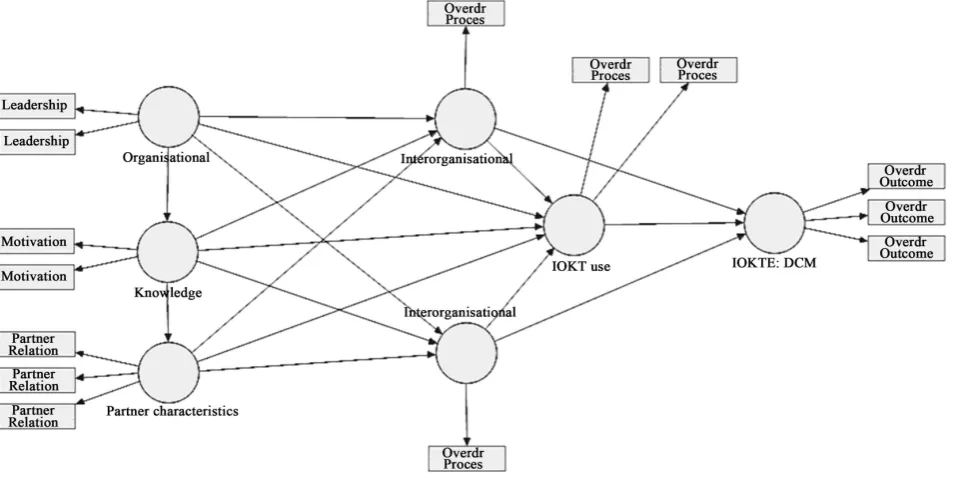
[image:11.595.62.539.476.715.2]Considering the data distribution and measurement scales, for the PLS-SEM approach, missing values should be dealt with before the analysis can be per-formed. For reasonable limits, i.e. less than 5% missing values per indicator, missing value treatment options such as mean replacement, expectation-max- imisation and nearest neighbour generally result in only slightly different PLS- SEM estimations [41]. When the amount of missing data on a questionnaire ex-ceeds 15%, the observation is typically removed from the data file [41]. Moreo-ver, if a high proportion of responses are missing for a single construct, then the entire observation may have to be removed. This implies that out of 130 com-pleted and partially comcom-pleted surveys, the research was able to include 49 ob-servations in the final PLS-SEM model. Similar to the reduction in obob-servations, the number of indicators used in the final PLS-SEM model is also reduced. Indi-cators that were included in the survey for the evaluation of IT based trans-fer-system efficiency and non-IT based transtrans-fer-system efficiency, did not yield sufficient data to be included in the model. The model, which was constructed in SmartPLS v2.0, is shown in Figure 2. For this model, the reduced data set was imported into SmartPLS, which in turn allowed for estimates to be calculated for the model. The results of which are discussed in the following paragraphs. Given
682
the fact that the PLS SEM model used to test the hypothesis in the IOKTE model has one construct to which 5 structural paths lead, this means that the necessary minimum sample requirements are not met. Due to the strict application of the SmartPLS modelling requirements (max. 15% missing values per observation), only 49 observations made it into the sample. Given that this is the smallest possible deviation from the required sample size and the fact that PLS-SEM works well under conditions of small samples, a choice was made to run the model nonetheless, even given this very small deviation from the sample re-quirements.
4. Results
For the presentation of the findings, the preference is given to address the de-scriptive statistics first, as these add more depth to the findings, before address-ing the application of the hypothesis testaddress-ing for the IOKTE model.
4.1. Descriptive Statistics
4.1.1. Sample CompositionTo be able to differentiate the respondents in the sample, several questions were added to the survey that gauges the socio-economic characteristics of the res-pondents. These are identification questions such as the policy level at which a respondent is active, the public organization one works for or the level one has within this organization.
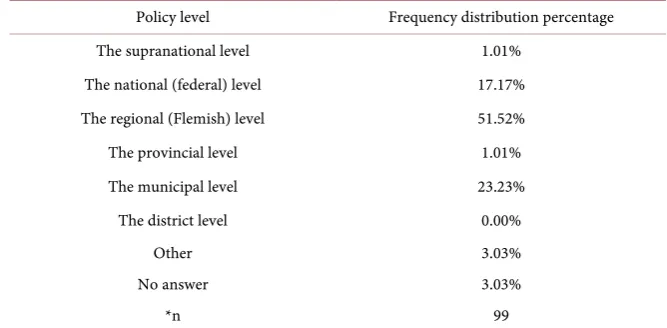
[image:12.595.205.539.553.717.2]Concerning the distribution of respondents across policy levels, the results in Table 1 indicate that almost half of the sample is active at the Flemish regional level. This however, is to be expected as the regional level has been granted sub-stantial say in most public domains and state affairs. State reform in Belgium has seen a substantial redistribution of state power, in which the regional entities have gained the most direct say in many policy fields. As a result, for PPP, which is found at many of these policy levels, the regional policy level is the central or key player. Nonetheless, given that the data-collection is aimed at the inclusion
Table 1. Descriptive statistics: sample composition, policy level representation.
Policy level Frequency distribution percentage
The supranational level 1.01%
The national (federal) level 17.17%
The regional (Flemish) level 51.52%
The provincial level 1.01%
The municipal level 23.23%
The district level 0.00%
Other 3.03%
No answer 3.03%
*n 99
683 of all policy levels active on Flemish territory, a substantial part of the sample consists out of respondents active at the federal and municipal levels. This is as to be expected, since these two levels, next to the regional policy level, have the most vested interest in the initiation, implementation and monitoring of PPP projects that take place on Flemish soil.
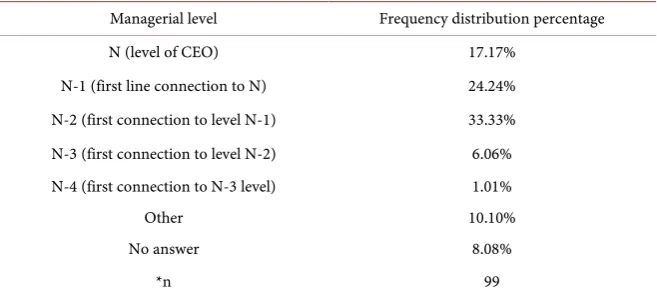
Pertaining to the level at which respondents are active within their respective public organizations, the results in Table 2 indicate that there is a clear repre-sentation in the sample of the higher-levels of management in the public organ-izations that are represented in the sample. The majority of respondents is either active at the level of CEO, N-1, or N-2 level. This is an important finding, as the managerial activity, i.e. managing and transferring PPP knowledge is dependent on the involvement of top-level leadership and should happen at the highest or-ganization levels.
4.1.2. Control Variables: PPP and TPP Experience
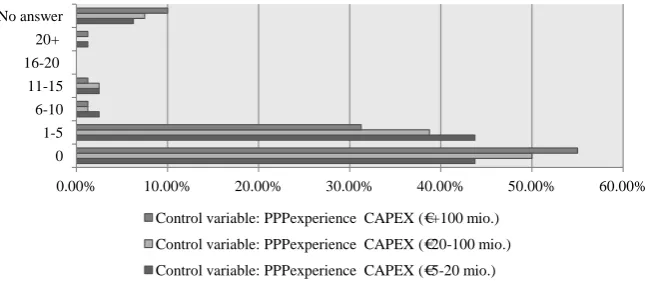
[image:13.595.211.538.365.533.2]Several questions were added to the survey, which aim at uncovering the expe-rience-level of respondents with the PPP and traditional public procurement methods (TPP) used on Flemish territory. Figure 3 offers a visual comparative representation of respondents’ experience levels.
Figure 3. Descriptive statistics: TPP & PPP experience comparison.
Table 2. Descriptive statistics: sample composition, managerial level.
Managerial level Frequency distribution percentage
N (level of CEO) 17.17%
N-1 (first line connection to N) 24.24% N-2 (first connection to level N-1) 33.33% N-3 (first connection to level N-2) 6.06% N-4 (first connection to N-3 level) 1.01%
Other 10.10%
No answer 8.08%
*n 99
13.75%
36.25% 37.50% 10.00%
0.00% 0.00%
2.50%
13.51% 15.32%
20.72% 22.52% 10.81%
7.21% 9.91%
0 years 1-5 years 5-10 years 10-15 years 15-20 years 20+ years No answer
TPP experience
[image:13.595.210.539.585.734.2]684
Figure 3 indicates that the experience respondents have in number of years is different in the sample for the TPP and PPP type of public procurement. This however does not come as a surprise, given that PPP in Flanders was first intro-duced in the policy domain in 2003. Hence the fact that respondents indicate to have less years of experience with PPP than with TPP is to be expected, given that TPP approaches have existed far longer within this region.
In terms of the types and number of PPP projects respondents have been in-volved in, Figure 4 indicates that this exposure has been rather narrow. Hence exposure to PPP does not often exceed 1 - 5 projects that have a capital expend-iture (CAPEX) of between €5 - 100 million. However, chances are that the same people involved in smaller projects, have also been involved in the somewhat larger projects. There is however no information available to check the overlap between categories. What does stand out is that only a very small fraction of respondents indicates to have been involved in a higher number of projects. This would indicate that certain individuals active within one or more public sector organizations in Flanders exhibit a concentration of practical knowledge in PPPs.
4.1.3. Endogenous Variables
1) Inter-organizational knowledge transfer effectiveness: decision-making ca-pability:
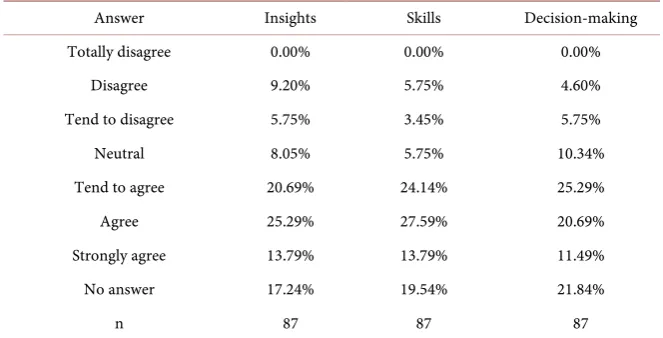
[image:14.595.212.535.551.693.2]For the construct perceived knowledge transfer effectiveness, the survey in-cluded several indicators in the survey. Certain of these indicators are aimed at uncovering the extent to which PPP IOKT in Flanders contributes to the deci-sion-making capability or capacity of individuals and organizations active in public sector organizations involved with PPP. The results, shown in Table 3 in-dicate that the largest portion of respondents agrees with the statement that IOKT aids decision-making (DCM) and confirm that this is also the case in real- life. Respondents indicate that this transfer is beneficial, aids in developing PPP- related skills, whilst improving the PPP decision-making capacity at the pub-lic-sector side in Flanders.
Figure 4. Descriptive statistics: PPP experience, project size and exposure differentiation. *Number of responses retrieved is 80 for each of the three CAPEX categories. **Experi- ence is expressed in number of projects that respondents have been part of.
0.00% 10.00% 20.00% 30.00% 40.00% 50.00% 60.00%
0 1-5 6-10 11-15 16-20 20+ No answer
Control variable: PPPexperience CAPEX (€+100 mio.)
Control variable: PPPexperience CAPEX (€20-100 mio.)
685 Table 3. Descriptive statistics: Improvement of PPP-related decision-making.
Answer Insights Skills Decision-making
Totally disagree 0.00% 0.00% 0.00%
Disagree 9.20% 5.75% 4.60%
Tend to disagree 5.75% 3.45% 5.75%
Neutral 8.05% 5.75% 10.34%
Tend to agree 20.69% 24.14% 25.29%
Agree 25.29% 27.59% 20.69%
Strongly agree 13.79% 13.79% 11.49%
No answer 17.24% 19.54% 21.84%
n 87 87 87
*DCM stands for decision-making capacity; **n is the number of responses retrieved through the data col-lection.
2) The application of sourced PPP knowledge, searching for and sharing of PPP knowledge:
Table 4 indicates that overall, respondents tend to agree, to fully agree with the statement that they apply PPP knowledge that they sourced at different pub-lic sector organizations to perform their PPP related tasks. This is a crucial in-sight, as the use of the transferred knowledge in real life indicates that it is im-portant to further follow-up on what the importance of this type of knowledge is compared to other non-public sources of PPP knowledge. This allows for further investigations into the importance of the knowledge to be made.
4.1.4. Exogenous Variables
For the first exogenous variable, i.e. the organizational culture in which the re-search participants are active, the findings shown in Table 5 indicate that the largest part of respondents indicates that for their respective organizations PPP related knowledge management is to some extent seen as a necessity and that the overall conception of knowledge management within their organization is that knowledge management is crucial to the success of projects.
The results shown in Table 5 further indicate that the respondents included in the sample are willing to transfer their PPP related knowledge and are inquisitive towards what is happening in the PPP market or context that they are part of. Given the sample size this insight allows us to conclude that PPP related know-ledge is sought after on a continued basis by a substantial part of the sample. It also indicates that a substantial part of the respondents are willing to share their experiences with and knowledge on PPP, therefore granting access to their in-sights and potentially aiding the advancement of inin-sights made by other public sector stakeholders.
686
Table 4. Descriptive statistics: inter-organizational PPP knowledge transfer in Flanders.
Answer
Use of IOKT Activity 1 Activity 2 Current IOKT
use 1 Current IOKT use 2 Knowledge sharing for knowledge Searching
Totally disagree (A1) 4.60% 4.60% 6.90% 8.05%
Disagree (A2) 5.75% 6.90% 10.34% 8.05%
Tend to disagree (A3) 11.49% 8.05% 8.05% 8.05%
Neutral (A4) 8.05% 10.34% 5.75% 4.60%
Tend to agree (A5) 13.79% 14.94% 14.94% 16.09%
Agree (A6) 22.99% 18.39% 20.69% 25.29%
Strongly agree (A7) 14.94% 17.24% 18.39% 14.94%
No answer 18.39% 19.54% 14.94% 14.94%
N 87 87 87 87
Table 5. Descriptive statistics: Exogenous variables.
Exogenous variable 1 Exogenous Variable 2 Exogenous variable 3 Organizational culture Transfer intent Relational distance
Answer PPP KM is necessity
KM is crucial for success
Inquisitive towards PPP
matters
Willing to share PPP knowledge
IO
trust Reputation Relational distance
Totally disagree 4.11% 2.74% 0.00% 0.00% 2.78% 4.17% 2.78% Disagree 8.22% 4.11% 0.00% 0.00% 8.33% 6.94% 6.94% Tend to disagree 12.33% 8.22% 2.82% 2.82% 4.17% 4.17% 5.56% Neutral 15.07% 13.70% 9.86% 7.04% 16.67% 16.67% 11.11% Tend to agree 17.81% 19.18% 21.13% 16.90% 16.67% 26.39% 25.00% Agree 10.96% 20.55% 26.76% 45.07% 26.39% 16.67% 22.22% Strongly agree 13.70% 17.81% 29.58% 18.31% 2.78% 4.17% 5.56%
No answer 17.81% 13.70% 9.86% 9.86% 22.22% 20.83% 20.83%
n 73 73 71 71 72 72 72
*n is the number of responses retrieved through the data collection.
[image:16.595.210.539.320.554.2]687
4.2. Additional Descriptive Insights
4.2.1. Knowledge Quality and Knowledge Resource Composition
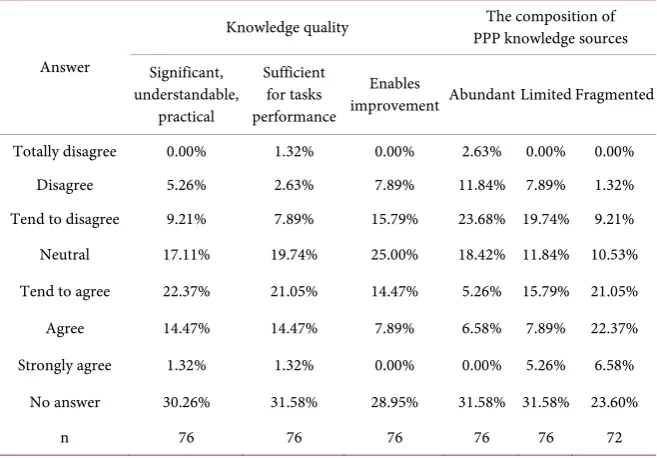
Table 6 provides a summary of the results that were gained for the assessment of the quality of the knowledge that is currently transferred between public sector organizations in relation to PPP knowledge in Flanders. These results indicate that the knowledge is to some extent significant, understandable and practical,
i.e. holds value for the performance of PPP related tasks, with sufficient quality to perform these tasks. Yet, in comparison to the agreement that was found in the discussion of the constructs that were used in the IOKTE model, less con-gruence or similarity is found in these responses. The latter is also found in the results pertaining to the ability of the currently transferred knowledge to im-prove task performance. The opinions that were voiced through the collection of the data are divided on the matter.
[image:17.595.210.539.494.723.2]Table 6 also summarizes findings related to the composition of the PPP knowledge sources that are found and shared between public sector organiza-tions in Flanders. These findings indicate that respondents do not find that there is an over-abundance of information and PPP knowledge. This is crucial as too much knowledge, may generate a knowledge overload, making it harder to come to decisions and solve problems, thereby obscuring the useful from the less use-ful knowledge and or insights. For the question related to whether the know-ledge that is available at the moment on PPP in Flanders is too limited, answers are more divided. What does however stand out is that respondents tend to agree with the statement that the knowledge that resides at the public-sector side is too fragmented, making it harder to fully grasp the PPP knowledge that is available and come to an improved understanding of the experiences that have been gained within the public sector related to PPP.
Table 6. Descriptive statistics: PPP knowledge quality and source composition.
Answer
Knowledge quality PPP knowledge sources The composition of
Significant, understandable,
practical
Sufficient for tasks performance
Enables
improvement Abundant Limited Fragmented
Totally disagree 0.00% 1.32% 0.00% 2.63% 0.00% 0.00% Disagree 5.26% 2.63% 7.89% 11.84% 7.89% 1.32% Tend to disagree 9.21% 7.89% 15.79% 23.68% 19.74% 9.21% Neutral 17.11% 19.74% 25.00% 18.42% 11.84% 10.53% Tend to agree 22.37% 21.05% 14.47% 5.26% 15.79% 21.05% Agree 14.47% 14.47% 7.89% 6.58% 7.89% 22.37% Strongly agree 1.32% 1.32% 0.00% 0.00% 5.26% 6.58% No answer 30.26% 31.58% 28.95% 31.58% 31.58% 23.60%
n 76 76 76 76 76 72
688
4.2.2. Transfer Mechanism Use
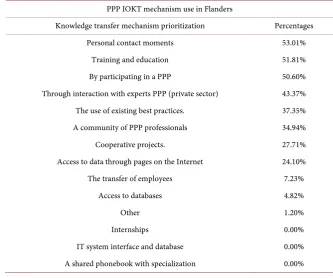
The knowledge transfer mechanisms that are used the most for transferring PPP knowledge between public sector organizations in Flanders respondents indicate that this is primarily based on interpersonal contacts, as can be seen in Table 7. These interpersonal transfers can be structured such as in training and educa-tion, but can also be more sporadic or ad-hoc during brief or extended contact moments, and can happen not only with public sector actors, but can also in-clude private sector interactions. The same rather inter-personal approach un-derpins “participation in a PPP” as a transfer mechanism, as one is immersed into the complexity and reality of PPP projects, thereby gaining insights on the go. A community of PPP practitioners (CoP) also serves as a vehicle towards the dissemination of PPP knowledge within the public sector in Flanders. The pro-nounced absence of internships directed towards PPP knowledge transfer, IT systems and PPP databases, and PPP specialization catalogues or registries are however striking.
4.2.3. Transferred Types of Knowledge
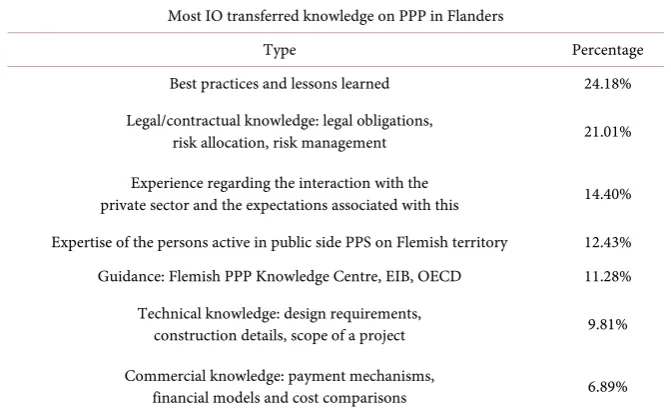
[image:18.595.204.538.464.742.2]With regards to the type of knowledge that is transferred the most amongst pub-lic sector actors, the results shown in Table 8 indicate that best practices and lessons learned and legal and contractual knowledge are the most transferred knowledge types. Both elements are codified forms of knowledge that are easily transferrable once created. Best practices and lessons learned often consist out of written documents or presentations, which can be sent to PPP practitioners via e-mail or through some other outlet. Legal documents also must be in writing and are therefore also more easily transferrable. However, the latter would indi-
Table 7. Descriptive statistics: PPP KT mechanism use.
PPP IOKT mechanism use in Flanders
Knowledge transfer mechanism prioritization Percentages
Personal contact moments 53.01%
Training and education 51.81%
By participating in a PPP 50.60%
Through interaction with experts PPP (private sector) 43.37% The use of existing best practices. 37.35% A community of PPP professionals 34.94%
Cooperative projects. 27.71%
Access to data through pages on the Internet 24.10%
The transfer of employees 7.23%
Access to databases 4.82%
Other 1.20%
Internships 0.00%
689 Table 8. Descriptive statistics: PPP knowledge types, most often transferred.
Most IO transferred knowledge on PPP in Flanders
Type Percentage
Best practices and lessons learned 24.18% Legal/contractual knowledge: legal obligations,
risk allocation, risk management 21.01%
Experience regarding the interaction with the
private sector and the expectations associated with this 14.40% Expertise of the persons active in public side PPS on Flemish territory 12.43% Guidance: Flemish PPP Knowledge Centre, EIB, OECD 11.28%
Technical knowledge: design requirements,
construction details, scope of a project 9.81%
Commercial knowledge: payment mechanisms,
financial models and cost comparisons 6.89%
cate that these contracts are not confidential and therefore accessible to others. The least transferred knowledge is either commercial knowledge on payment mechanisms, financial models and cost comparisons, or technical knowledge on design requirements, construction details or project scopes. A great deal of con-sultancy work is outsourced to the private sector on these topics, which may therefore explain the lesser need for transferring this type of information. How-ever, these are crucial elements for PPP projects, in direct relation to the long-term investments that are often made in these projects. This does not ex-plain why legal documents would be transferred, as a lot of consultancy work is also outsourced towards this end. Hence further research needs to consider why these types of knowledge are transferred substantially less than their best prac-tice and legal documentation counter parts.
4.2.4. Potential Improvements to the Current Knowledge Transfer Mechanisms
690
Table 9. Descriptive statistics: PPP knowledge transfer improvements for IOKT in Flanders.
Potential improvements to the IOKT system
Answer based IOKT Need IT system
Need central K coordination
centre
Need for cheaper IOKT process
Need for cross-policy
level access
Need improvement documentation
Need CoP’
Totally disagree 1.43% 2.86% 2.86% 0.00% 0.00% 2.86%
Disagree 8.57% 4.29% 2.86% 4.29% 1.43% 2.86%
Tend to disagree 4.29% 1.43% 2.86% 4.29% 2.86% 7.14% Neutral 8.57% 17.14% 31.43% 11.43% 5.71% 15.71% Tend to agree 21.43% 18.57% 8.57% 14.29% 21.43% 14.29% Agree 25.71% 21.43% 11.43% 31.43% 35.71% 24.29% Strongly agree 2.86% 10.00% 8.57% 8.57% 8.57% 8.57%
No answer 27.14% 24.29% 31.43% 25.71% 24.29% 24.29%
n 70 70 70 70 70 70
Cop: Community of practitioners
*n is the number of responses retrieved through the data collection.
4.3. PLS Path Model Analysis
4.3.1. Measurement ModelsAssessing the reflective measurement models included in the PLS-SEM in terms of their reliability and validity, following Hair et al. (2014) starts by looking at the internal consistency reliability [41]. This measure traditionally relies on the Cronbach’s alpha criterion for internal consistency, yet assumes that all indica-tors are equally reliable or that all indicaindica-tors have equal outer loadings on the construct [41]. As PLS-SEM prioritizes the indicators according to their indi-vidual reliability, and because the Cronbach’s alpha criterion is sensitive to the number of items in the scale, this results in a general tendency for the Cron-bach’s alpha criterion to underestimate the internal consistency reliability. Therefore, in PLS-SEM a different measure of internal consistency reliability is used, i.e. composite reliability [41]. This type of reliability considers the different outer loadings of the indicator variables and is generally interpreted in the same way as Cronbach’s alpha (Hair et al. 2014). As the composite reliability for the reflective measurement models included in the IOKTE model are all well above the 0.70 threshold, as can be seen in Table 10, it is safe to say that the internal consistency of the reflective measurement models is obtained.
[image:20.595.209.540.103.328.2]691 Table 10. Reflective measurement model assessment: validity and reliability.
Reflective measurement model assessment
Latent variable Indicators
Indicator reliability
(+0.708) Internal consistency reliability (+0.60) Convergent validity Discriminant validity
Loadings Composite reliability Cronbach’s Alpha AVE AVEROOT > CORR
Organizational ulture
Leadership
[SQ002] 0.906
0.898 0.773 0.815 Y
Leadership
[SQ004] 0.899
Transfer intent
Motivation
[SQ001] 0.813
0.838 0.619 0.722 Y
Motivation
[SQ003] 0.885
Inter-organizational trust
Partner Relation
[SQ001] 0.887
0.938 0.902 0.835 Y
Partner Relation
[SQ002] 0.934
Partner Relation
[SQ003] 0.920
IOKT knowledge use
Overdr Proces
EFFECT [SQ007] 0.968
0.967 0.931 0.935 Y
Overdr Proces
EFFECT [SQ008] 0.967
Decision-making improvement
Overdr Outcome
EFFEC [SQ002] 0.891
0.942 0.908 0.844 Y
Overdr Outcome
EFFEC [SQ005] 0.914 Overdr Outcome
EFFEC [SQ008] 0.950
seen in Table 10, the AVE values for the reflective measurement models are all well above the 0.50 threshold. The communality of the indicators is also reflected in the fact that all outer loadings have values of 0.708 and more.
Discriminant validity finally, which is the extent to which a construct is truly distinct from other constructs by empirical standards, can be assessed by appli-cation of the Fornell-Larcker criterion, which compares the root of the AVE values with the latent variable correlations. As such, the square root of each con-struct’s AVE should be greater than its highest correlation with any construct [41]. This is the case for all reflectively measured constructs included in the IOKTE model3.
692
each endogenous latent variable on its corresponding predecessor constructs. This means that just as in regular multiple regressions the path coefficients might be biased if the estimation involves significant levels of collinearity be-tween the predictor constructs [41]. Overall goodness of fit statistics are however not applicable in the PLS-SEM context. Instead of applying measures of good-ness of fit, the structural model in PLS-SEM is assessed based on heuristic crite-ria that are determined by the model’s predictive capabilities4. The key criteria for assessing the structural model in PLS-SEM are the significance of the path coefficients, the level of the R2 values, the f2 effect size, the predictive relevance Q2 and the q2 effect size [41].
4.3.2. Structural Model: Assessment of the Model’s Validity and Significance
1) Collinearity in the structural model
Following Hair et al., (2014), in order to assess the collinearity of the predictor variables a measurement of VIF is used in order to examine each set of predictor constructs separately for each subpart of the structural model. To do so the pre-dictor variables are used as the independent variables in a linear regression and tested against a random dependent variable. Extracting the latent variable scores from the structural model and using these as the input for the linear regression in IBM SPSS statistics package v.22 [41] allows for this assessment to be made. The results of this analysis are shown in Table 11. The table shows that neither the crucial tolerance limit (lower than 0.20) is exceeded by any of the constructs, nor do the VIF values exceed the crucial value of 5. Hence collinearity amongst the predictor constructs is not an issue in the structural model.
2) Significance of path coefficients
After running the PLS algorithm, estimates are obtained for the structural model relationships, i.e. the path coefficients, which represent the hypothesized relationships among the constructs, see Figure 5. Hair et al. (2014) state that es-timated path coefficients close to an absolute value of 1 represent a strong rela-tionship, either positive or negative. Significance of the path coefficients is how-ever established through a bootstrap procedure in which the standard error for each construct is calculated, hence allowing for the calculation of the empirical t-values [41]. For an exploratory study such as this one, we assume a significance level of 10%, as our objective is to explore the perceived fitness of this particular knowledge transfer activity, and not to develop extensive generalization on the operationalization of the IOKTE model as presented here. The results of the PLS-SEM algorithm and bootstrapping procedure for the PPP-IOKTE model’s significance tests can be found in Table 12 and Table 13. These results indicate that several of the hypothesized relationships between the constructs included in the model show strong (positive) relationships.
693 Figure 5. Structural PPP-IOKTE path model.
Table 11. Structural path model: collinearity assessment. Structural model collinearity assessment
Model part 1 Tolerance Collinearity statistics VIF
Partner characteristics 0.849 1.177
Organizational knowledge transfer culture 0.669 1.495
Knowledge transfer intent 0.62 1.613
a dependent variable: IOKT use
Model part 2 Collinearity statistics Tolerance VIF Inter-organizational knowledge searching 0.887 1.127
Inter-organizational knowledge sharing 0.887 1.127 a dependent variable: IOKT use
Model part 3 Collinearity statistics Tolerance VIF Inter-organizational knowledge searching 0.565 1.769
Inter-organizational knowledge sharing 0.872 1.147
IOKT use 0.631 1.585
a dependent variable: IOKTEDCM
Control model Collinearity statistics Tolerance VIF
Age 0.845 1.183
PPP experience 0.845 1.184
Policy level 0.996 1.004
694
Table 12. Significance testing: structural path model coefficients.5
Significance testing: structural model path coefficients
Hypotheses Original sample statistics T Significance levels p value
Confidence
interval (90%) (M) (STDEV) (STERR) LB UB
Age -> IOKTE: DCM −0.2664 2.1255 ** 0.039 −0.473 −0.060 −0.2593 0.1253 0.1253 IOKT use -> IOKTE: DCM 0.6707 3.897 *** 0.000 0.387 0.955 0.6375 0.1721 0.1721 IO knowledge searching -> IOKT use 0.7379 4.9001 *** 0.000 0.489 0.986 0.7349 0.1506 0.1506 Policy level -> IOKT use 0.2166 1.818 * 0.075 0.020 0.413 0.2117 0.1191 0.1191 OK transfer culture -> IO knowledge searching 0.2385 1.9884 ** 0.052 0.041 0.436 0.2527 0.1199 0.1199 Partner characteristics -> IO knowledge searching 0.5476 3.3425 *** 0.002 0.277 0.818 0.5489 0.1638 0.1638 Knowledge transfer intent -> IO knowledge sharing 0.286 1.7256 * 0.091 0.012 0.560 0.2806 0.1658 0.1658 OK transfer culture -> IO knowledge sharing 0.4542 2.9771 *** 0.005 0.202 0.706 0.4687 0.1526 0.1526 OK transfer culture -> Knowledge transfer intent 0.5715 4.8722 *** 0.000 0.378 0.765 0.5659 0.1173 0.1173
*Significant at 90% confidence; **Significant at 95% confidence; ***Significant at 99% confidence.
Table 13. Significance testing: total effects.6
Significance testing: total effects
Hypotheses Original sample statistics T Significance levels p value
Confidence
interval (90%) (M) (STDEV) (STERR)
LB UB
IO knowledge searching -> IOKTE: DCM 0.472 2.324 ** 0.024 0.137 2.325 0.468 0.203 0.203 OK transfer culture -> IOKTE: DCM 0.294 1.879 * 0.066 0.036 2.100 0.279 0.156 0.156
*Significant at 90% confidence; **Significant at 95% confidence; ***Significant at 99% confidence.
This is the case for the relationship between inter-organizational knowledge transfer use (IOKT use) and inter-organizational knowledge transfer effective-ness (IOKTE: DCM); inter-organizational knowledge searching (IO knowledge searching) and inter-organizational knowledge transfer use; partner characteris-tics and inter-organizational knowledge searching; organizational knowledge transfer culture (IO transfer culture) and inter-organizational knowledge shar-ing, and finally organizational knowledge transfer culture and knowledge trans-fer intent. Significant, yet weaker relationships exist between age and perceived inter-organizational knowledge transfer effectiveness, and organizational know-ledge transfer culture and inter-organizational knowknow-ledge searching. The weak-est significant effects are found for policy level and inter-organizational ledge transfer use and knowledge transfer intent and inter-organizational ledge sharing. The total effects analysis shows that inter-organizational know-ledge searching significantly impacts perceived inter-organizational knowknow-ledge transfer effectiveness, and that organizational knowledge transfer culture also has a weaker significant effect on perceived inter-organizational knowledge 5To improve the flow of the document, only the significant relationships are shown. For a full list or
the total assessment of the significance testing, details can be found in Annex 2.
[image:24.595.60.537.336.423.2]695 transfer effectiveness.
3) Determining the coefficient of determination, construct effect size and pre-dictive relevance of constructs
[image:25.595.210.537.268.735.2]The R2 values, which indicate predictive accuracy, the path coefficients that indicate the strength and direction of the relationship between constructs, as well as the Q2 values and effect sizes that indicate predictive relevance of con-structs are shown in Table 14. Large effects are found for the effect of knowledge use on decision-making ability improvement, knowledge searching on know-ledge use, and organizational culture on knowknow-ledge sharing and inter-organisa- tional trust on knowledge searching.
Table 14. Coefficients of determination, construct effect size and predictive relevance of constructs.
Determination, effect size and predictive relevance of the IOKTE constructs
IOKTE model included R2 excluded f 2 R2 Effect size included Q2 excluded q2 Q2 Effect size adjusted R
IOKTE DCM
IO searching 0.469 0.469 0.000 None 0.386 0.385 0.002 None 0.434 IO sharing 0.469 0.428 0.077 Small 0.386 0.350 0.058 Small 0.434 IOK use 0.469 0.230 0.450 Large 0.386 0.186 0.326 Large 0.434 IOKT Use
IO searching 0.432 0.224 0.366 Large 0.433 0.245 0.332 Large 0.366 Organizational
culture 0.432 0.387 0.079 Small 0.433 0.330 0.181 Medium 0.366 Transfer intent 0.432 0.411 0.037 Small 0.433 0.354 0.140 Small 0.366 IO trust 0.432 0.429 0.005 None 0.433 0.421 0.022 Small 0.366 IO sharing 0.432 0.415 0.030 Small 0.433 0.404 0.051 Small 0.366 IO searching
Organizational
culture 0.504 0.466 0.077 Small 0.484 0.407 0.150 Small 0.471 Transfer intent 0.504 0.503 0.002 None 0.484 0.427 0.110 Small 0.471 IO trust 0.504 0.218 0.577 Large 0.484 0.223 0.505 Large 0.471 IO sharing
Organizational
culture 0.509 0.347 0.330 Large 0.504 0.351 0.308 Large 0.476 Transfer intent 0.509 0.446 0.128 Small 0.504 0.445 0.120 Small 0.476 IO trust 0.509 0.509 0.000 None 0.504 0.231 0.551 Large 0.476
Control model included R2 excluded f 2 R2 Effect size included Q2 excluded q2 Q2 Effect size adjusted R
IOKTE DCM
Policy level 0.535 0.531 0.009 None 0.448 0.378 0.126 Small 0.469 Age 0.535 0.479 0.120 Small 0.448 0.326 0.220 Medium 0.469 PPP experience 0.535 0.510 0.054 Small 0.448 0.363 0.154 Medium 0.469
IOKT use
696
4) Discussion of the results
These findings indicate that the extent to which respondents feel that the pub-lic sector inter-organizational PPP knowledge transfer improves PPP-related de-cision-making is to a large extent explained by the usage of knowledge that was sourced in such an inter-organizational manner. These findings are not surpris-ing, yet important, as the improvement of the PPP knowledge in the public sec-tor can therefore be seen as a priority, which in turn can improve problem solv-ing capacity and ability to foster support for individual decision-maksolv-ing processes. This also indicates that there is a clear need for ample access to in-formation and knowledge on PPPs in the public sector, allowing public organi-zations to disseminate and search for this particular knowledge.
The extent to which public sector inter-organizational PPP knowledge trans-fers improve the PPP-related decision making also shows a relation with the act of searching for PPP related information in an inter-organizational fashion. However, the effect that is indicated in the total effects table is fully mediated by the mediating variable knowledge use or, put differently, the actual application of inter-organizationally sourced knowledge in the public sector. This is con-firmed through an application of the Sobel test, which delivers a z score of 2, 65,884 at a 95% confidence level. The path coefficient for the construct searching for PPP related knowledge in an inter-organizational fashion also increases and becomes significant when the construct knowledge use is removed from the model. Hence confirming the full mediation that is present between inter-orga- nizational knowledge searching and the perceived effectiveness of the knowledge transfer towards decision-making ability or capacity. The total effects therefore indicate that searching for PPP related knowledge in an inter-organizational manner within the public sector, does impact the effectiveness that is expe-rienced in transferring PPP related knowledge between organizations. Hence, once again, reaffirming the importance for access to and structure in the shared knowledge and for the provision of tools and processes may support these searches, as this stand to impact the actual effectiveness of the knowledge trans-fer.
697 added through inter-organizational PPP related knowledge transfer. Further re-search shall have to investigate which elements may explain this difference.
The absence of data for the constructs perceived IOKT system (non-IT based or IT based) efficiency limits this study from gaining further insight into these factors as explanatory elements in the extent to which PPP related knowledge is used and aids in improving PPP-related decision making in the public sector in Flanders. Since no data was available to test the related hypotheses, the research cannot but state that an efficient IT-based KT system for the transfer of PPP knowledge is not present7, hence making it impossible to assess its perceived ef-ficiency and its effect on the perceived effectiveness of the transfer system. The same goes for the perceived efficiency of the non-IT based knowledge transfer system, as here again insufficient data was retrieved to make a final assessment.
Related to the explanation of the extent to which inter-organizationally sourced knowledge is applied, the main explanatory factors are: searching for PPP-related knowledge in an inter-organizational manner and to some extent the policy level control variable.
The fact that searching for knowledge has a significant effect on the applica-tion of the inter-organizaapplica-tionally sourced knowledge is a rather simplistic rela-tion, yet is also important, as one cannot apply PPP knowledge without search-ing for the knowledge first. The fact is however that the relation is positive, which would indicate that searching for PPP knowledge across the boundaries of public organizations also leads to the application of the knowledge that is sourced. By extension this necessitates further understanding of the drivers of this searching activity. The fact that the policy level also shows significant effects towards the application of inter-organizationally sourced PPP knowledge, would indicate that lower policy levels are more inclined to use PPP knowledge that was sourced at the public sector in an inter-organizational manner. Likely ex-planations for this finding are to be found in terms of access to information and PPP related knowledge. Where organizations located at the lower policy levels may be more willing to share knowledge amongst each other, or should share more knowledge amongst each other due to restricted access to private sector or other knowledge sources. Further research shall however have to delve deeper into the relation between policy level and the use of inter-organizationally trans-ferred PPP knowledge in the public sector in Flanders.
698
people in public sector organizations involved in PPPs that take place on Fle-mish territory tend to look for PPP-related knowledge at public sector organiza-tions with which trust-based relaorganiza-tions exist, or based on the reputation that these organizations have in terms of PPP (which is an extension or expression of trust)
i.e. reputation-based trust. This is not that remarkable, since PPP as a concept is complex and not all public-sector organizations have the capacity to handle the complexity associated with the topic, nor do they feel a need to expand resources towards such an endeavour. Furthermore, not all public organizations have an interest in PPP-related matters, offering those who may only need momentary access to PPP-related matter the ability to be opportunistic in their knowledge sourcing activities. The idea that reputation is an important factor in the expla-nation of knowledge transfer as a searching activity also relates to the fact that not all public organizations active within the public sector have made previous investments towards the accumulation of PPP knowledge, hence making PPP knowledge an asset that is connected specifically to certain organizations within the public sector in Flanders.
The second explanatory construct used to explain searching for PPP-related knowledge in an inter-organizational manner is the knowledge transfer culture that is present in the organization one is active in. As a result, the research con-cludes that an organizational culture based on a belief system and values that are directed towards the inter-organizational transfer of knowledge positively influ-ence the act of searching for PPP related knowledge in an inter-organizational manner. The latter is also confirmed in the fact that a knowledge transfer en-couraging organizational culture significantly impacts knowledge transfer intent of the individual’s motivation to share PPP-related knowledge in an inter-orga- nizational manner on PPP in the public sector in Flanders.
The sharing of PPP-related knowledge between public organizations finally, is positively impacted by both the individuals’ inter-organizational knowledge transfer intent, i.e. the individual’s willingness to share PPP-related knowledge and the organizational culture within which an individual is active. Indeed, those individuals that are eager to share their knowledge and who are also curious about the goings-on and new developments that take place in the world of PPP stand to share more of their knowledge than their less inquisitive counter-parts. The same is true for individuals who are active within organizations where the management of PPP-related knowledge is experienced as a necessity or more general in organizations where knowledge management is perceived as an abso-lute necessity towards the successful realization of projects. The latter reaffirms the notion of bounded rationality and its importance for the effectiveness of PPP-related inter-organizational knowledge transfer, by exemplifying that people with particular views and particular backgrounds will partake in particu-lar activities, whilst those with other views will not do so.
699 the research can confidently (95%) state that the relations, or hypotheses in-cluded in the model that do not show significant effects, will also not do so at the population level.
5. Conclusions
Knowledge management has been identified as a crucial managerial endeavour for public sector organizations. Knowledge has also been identified as a crucial factor in the successful realization of PPP projects. Excessive or insufficient knowledge assets stand to limit public sector capacity and restrict the develop-ment of adaptive problem-solving and decision-making. Consequently, there is need to address how knowledge assets are developed in and between public sec-tor organizations involved with PPP.
A descriptive analysis of the data sourced in support of the analysis presented in this paper indicates that even though experience levels might not be extremely high, the respondents do indicate that the sharing of PPP knowledge amongst public sector entities involved in PPP in Flanders aids their decision-making. It also confirms a large part of the respondents use the knowledge that they source from other public entities on this topic. The latter is also the result of transfer ac-tivities such as knowledge sharing and searching for knowledge, which the data inspection confirms, happens as a large part of the respondents included in the sample indicate to perform these two activities. Towards the quality of the knowledge that is currently transferred, the results show that there still is room for improvement, especially towards reducing the fragmentation of PPP know-ledge within the public sector. This is connected to the fact that not much struc-tured and codification enhancing knowledge transfer mechanisms are currently employed in the public sector in Flanders when looking at PPP specific know-ledge. Suggested improvements are increased centralized coordination of the knowledge, increased cross-policy level access to the PPP knowledge and im-proved PPP documentation that is more adapted to the end user’s needs.
This paper furthermore empirically tests the model developed for the assess-ment of the perceived public sector inter-organizational knowledge transfer ef-fectiveness and applies it to the knowledge transfer in the public sector on PPP knowledge that exists on Flemish territory. The sample that served to estimate the effects of the variables included in the model was therefore derived from people that, on a range of policy levels and in different types of public sector or-ganizations, are or will be active in PPP in Flanders.