Checking of XRF Observations with Matrix Terms
Involved in Sample Analysis
Meenakshi Bansal, Kanan Deep, Raj Mittal
Nuclear Science Laboratories, Physics Department, Punjabi University, Patiala, India Email: [email protected]
Received January 2, 2013; revised February 4, 2013; accepted February 11, 2013
Copyright © 2013 Meenakshi Bansal et al. This is an open access article distributed under the Creative Commons Attribution Li-cense, which permits unrestricted use, distribution, and reproduction in any medium, provided the original work is properly cited.
ABSTRACT
In X-Ray Fluorescence (XRF) studies of samples, the relative absorption terms for an analyte in a sample with respect to its standard (the analyte itself or its compound) have been empirically related to analyte amount as well as to next enhanced element amount in the sample. The terms along with these empirical relations have been used to cross check the XRF observations for the analysis work. One such an attempt has been made in the present work for bulk measure- ments on rice saplings and a disparity in observations has been caught.
Keywords: XRF Observations; Matrix Terms; Sample Analysis
1. Introduction
X-ray fluorescence has been a powerful analytical tool since the beginning of its application to elemental analy- sis. The working principle of XRF analysis is the meas- urement of energy and intensity of the X-rays emitted from the sample. The energies of the emitted X-rays are the characteristic of elements present in the sample and thus provide the knowledge about the composition of sample, hence form the basis of qualitative analysis. Whereas the measurement of the intensities of the X-rays provides information about the concentration of the ele- ments present, thereby forms the basis of quantitative analysis. In XRF analysis of samples, the presence of substrate matrix effects (absorption and enhancement) disturbs the proportionality between the elemental char- acteristic X-ray intensity and its amount [1-4]. For the correction and compensation of these effects, different analytical methods [5-10] exist in literature. While evaluating the absorption and enhancement terms, Bansal [11] established that the relative absorption and enhance- ment terms for an analyte in a sample with respect to its standard (the analyte itself or its compound) are related to analyte amount in the sample and its characteristic X-ray counts under the photo peak in each sample and standard spectra respectively. The absorption terms were empirically related to the determined analyte amounts irrespective of its X-ray counts. Similarly, the enhance- ment terms for the analyte were empirically related, in
turn, with the analyte amount and with enhancer amount [12]. For a specific category of substrate, these relations give absorption and enhancement terms direct from the known amounts of analyte and enhancer elements or vice versa i.e. with known absorption and enhancement terms and the amount of enhancer element, the analyte amount can be predicted. Moreover, these empirical relations along with the terms can cross check the XRF observa-tions of the analysis. In the present work, the bulk meas-urements on rice saplings have been checked following the said procedure for absorption terms.
2. Methodology
In a sample S, if X-rays of an analyte a excite the X-rays
of other element c, it causes the absorption of a X-rays
and enhancement of c X-rays called matrix effects that
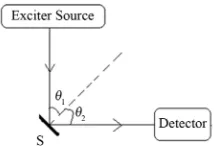
disturb the linearity between the analyte X-ray intensity and analyte amount. When S is irradiated with photons ia
from a source for selective excitation of a and the result-
[image:1.595.369.476.640.713.2]ing a X-rays are counted in a detector (Figure 1), the
counts “ ” under the X-ray photo peak of analyte
a from the sample can be expressed in terms of basic and
the experimental set up parameters as [11]:
S a a N i
1 2 2
1 2 1 exp cos cos 4π cos cos a i S v
a a o a
a
S S
a a
air a a
S S
a a
A N i I
M
i e
t
a e e
i e (1)
where, the number of incident photons at the sample sur- face Io, solid angle of target with detector 2
4π
, air ab- sorption correction aair
ea at emitted (ea) X-ray ener-gies and detector efficiency
ea of detector at emit- ted X-ray energy are experimental setup parameters. The X-ray production cross-section of a X-rays at incidentenergy ia, , Avogadro’s number Av, atomic
weight of analyte element Ma(g)andthe factor
cma
i a
2
(effective thickness),
1 2 1 2 1 exp cos cos cos cos S S a a S S a a i e t i e
in terms of absorption coefficients, ’s (cm2/g), of sam- ple Sat incident (ia) and emitted (ea) photon energies and
sample thickness t (g/cm2) are basic parameters. is the fractional analyte amount in target material.
In case of symmetrical geometry (θ1 = θ2 = θ) and for thick samples
t , the Equation (1) reduces to
Cos
4π2
a
S a a
i v
o a S S air a
a a
a
N i t A
a
I a e e
i e M (2)
Similarly, if the S is replaced by standard A, a com- pound of analyte a with its molecular weight MA that
comprises n atoms of a and the relation (2) reduces to
4π2
aA v a
a a o
a A
i
a A A ai
a a
A nM
N i t I
M M
Cos a e e
i e
r a a
(3)
Absorption Effects
Under selective excitation of analyte, a, absorption term of sample, S, relative to that of first standard, A, i.e.
S a A a
in terms of analyte amount and X-ray counts
under the analyte photo peak in S and A comes as
1 A
S N i
a a
a MA
A S
a
a M n Na ia
(4) where
and A a
incide
S a
are sum of absorpt for S A at nt ia and emitted a
ion coefficients
e photons i.e.
and
a iaea
.3. Empirical Relations
For empirical relations of matrix terms in rice saplings, rements [13] for Ca were ents, material of first
te
the earlier rice sapling measu used in relation (4). In the measurem standard was CaCO3 for Ca detection.
For selective excitation of calcium K X-rays with Ti K X-rays in double reflection set-up [13], the absorption
rm 3 CaS CaCO Ca
was evaluated with Equation (4) using
the observed counts of analyte (Ca) X-rays and deter- amounts
saplings. The derived terms were empirically related to mined of the analyte in different samples of rice the calcium amounts irrespective of their X-ray counts. Judged from the pattern of absorption term variations with determined amounts, different order polynomial fits were tried to find the closeness of generated terms with the actual ones. The polynomial fits in amounts of Ca were tried for
3 Ca CaCO Ca S n
term to evaluate polynomial relations as
3 Ca Ca CaCO Ca S q j j j pn Acof
(5)where Acofj’s are coefficients of fit for abs
For the fit, care was taken that the number
fitted must be greater than the number of Acof’s that
orption terms. of values to be
j
ensured optimization of the coefficients. Moreover, the uniqueness of the relations [14] was checked with dif- ferent permutations and combinations of a data set so that the same closeness of fitted values with the actual ones was there for each combination.
For the derived relation, the mean absolute percent de- viation Dp is measure of the analysis error. It was calcu-
lated according to the relation
100
p i i
im
D C C
nC
(6)where Ci and Ci
C
are the evaluated and act fractions and im is the mean of Ci’s.
values for the relation is also listed in Table 1.
4 fertilizers ual weight The calculated Dp
4. Results and Discussion
Table 1. Listing of relative absorption terms in selective excitation of Ca, its empirical relation with analyte amounts and mean absolute percent deviation Dp in rice saplings.
Fit used for
Percentage deviation Ratios
3 Ca CaCO Ca
S
n
for Ca q j j Acof j p
in Titanium excitation p q Dp
3 CaCO Ca n
Ca S
2
1 j j j
Acof
1 2 3.92on the contents K and Ca in rice pla , ata r nine pot samples is considered, where a pot numbered of nts [13] the d fo
1 was left untreated. Four pots (numbered 2 - 5) were treated with CaSO4 solutions; 50, 100, 150 and 200 mg/200 ml of water. The remaining four pots (numbered 6 - 9) were treated with KCl solutions; 50, 100, 150 and 200 mg of KCl per 200 ml of water.
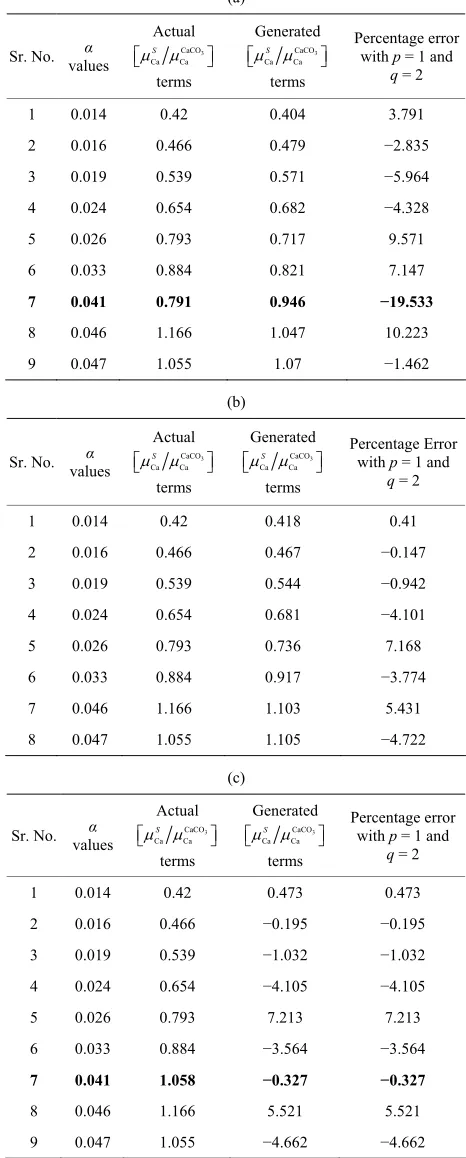
In the processing for absorption terms for rice saplings, a polynomial in analyte Ca amount with its power vary- ing for p = 1 and q = 2 was found appropriate for the nine sample data. The percentage deviation of fitted values from the actual ones is shown in the Table 2(a). Here the deviation is <10% for most of the samples except for one with fractional analyte amount 0.041, it is 19%. To re- duce the overall error, that particular sample was ex- cluded for the polynomial fitting. It was observed (in
Table 2(b)) that by excluding the sample, the deviation
reduced to a remarkable extent.
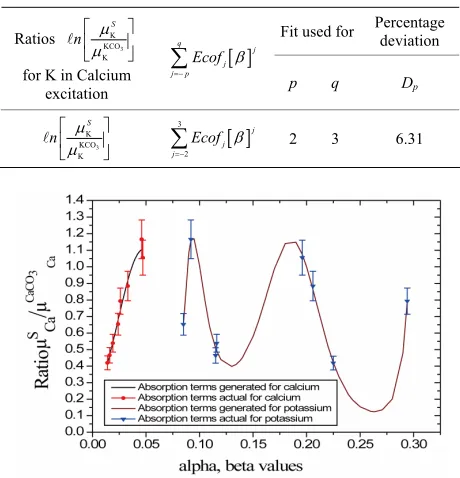
To certify these findings, the data on evaluated amounts of potassium in 9 samples [13] were tried for empirical relations of Ca absorption terms with potas- sium amounts as potassium in rice plants leads to strong absorption of Ca K X-rays. The absorption term ratios
3
Ca Ca
o represen samples
CO Ca
S
and K fractional amounts, , were
found t t a polynomial with p = 2 and q = 3 for the nine (Table 3).
Again a large deviation for the same sample was ob-served and with exclusion of the data of same troubling sample, the deviation reduces significantly (Tables 4(a)
& (b)).
In order to find the reason behind this disparity,
3
Ca
S
Ca
CaCO values are plotted against
and values
(Figure 2). From the plot, the determined value of =
0.041 gives the value of
3
Ca
Ca as 1.058. This value ratio corres
CO Ca
S
of relative absorption term ponds to value ~0.196 and vice-versa i.e. the determined value 0.197 corresponds to
3
Ca Ca
sorption terms with the actual ones: (a) including data for ; (b) excluding data for pot 6 in the
corrected data (taking
CO Ca
S
[image:3.595.305.538.149.728.2] value ~1.058.
Table 2. Comparison of empirically generated relative ab- pot 6 in the fitting data
fitting data; (c) Fit with into account
generated pot 6 values). (a)
Sr. No. valuesα
Actual
3
CaCO Ca Ca
S
terms
Generated
3
CaCO Ca Ca
S
terms
with p = 1 and
q = 2 Percentage error
1 0.014 0.42 0.404 3.791
2 0.016 0.466 0.479
3 0.019 −
−2.835
5.964 0.539 0.571
4 0.024 0.654 0.682 −4.328
5 0.026 0.793 0.717 9.571
6 0.033 0.884 0.821 7.147
7 0.041 0.791 0.946 −19.533 8 0.046 1.166 1.047 10.223
9 0.047 1.055 1.07 −1.462
(b)
Sr. No. valuesα
Actual
3
CaCO Ca
S
Generated
3
Ca
CaCO
Ca Ca
S
terms
Perce ror with d
q = 2 ntage Er
p = 1 an
terms
1 0.014 0.42 0.418 0.41
2 0.016 0.466 0.467
3 0.019 −
− −0.147
0.942 0.539 0.544
4 0.024 0.654 0.681 4.101
5 0.026 0.793 0.736 7.168
6 0.033 0.884 0.917 −3.774
7 0.046 1.166 1.103 5.431
8 0.047 1.055 1.105 −4.722
(c)
Sr. No. valuesα
Actual
3
CaCO Ca Ca
S
terms
Generated
3
CaCO Ca Ca
S
terms
Percen rror wit d
q = 2 tage e h p = 1 an
1 0.014 0.42 0.473 0.473
2 0.016 0.466 −0.195
3 0.019
−0.195
−1.032 0.539 −1.032
4 0.024 0.654 −4.105 −4.105
5 0.026 0.793 7.213 7.213
6 0.033 0.884 −3.564 −3.564
7 0.041 1.058 −0.327 −0.327 8 0.046 1.166 5.521 5.521
(b)
Sr. No. Βvalues Now, if and values red
rect, the ar me pro in absorption term value. O ute sca ng of the lculated val- ues of absorption it is fo t in this particular ca
are conside to be cor- n ther
n min
e ises so nni
blem earlier ca terms, und tha
[image:4.595.305.539.98.469.2]se, its value is quite large and is not matching with other samples’ values which signal to a flaw with the Table 3. Listing of relative absorption terms for Ca K X-rays, their empirical relations with potassium amounts, , and mean absolute percent deviation Dp in rice saplings.
Fit used for Percentage deviation Ratios
3
K KCO K
S
n
for K in Calcium excitation
q
j j j p
Ecof
p q Dp
3
K KCO K
S
n
3
2
j j j
Ecof
[image:4.595.57.287.203.442.2]
2 3 6.31Figure 2. Plot of relative absorption terms versus concen- tration and in rice saplings.
Table 4. Comparison of empirically generated relative e
ected data (taking into ac- n-hancement terms with the actual ones: (a) including data for pot 6 in the fitting data; (b) excluding data for pot 6 in
he fitting data; (c) fit with corr t
count generated pot 6 value). (a)
Sr. No. values β
Actual
3
CaCO Ca Ca
S
Generated
terms
3
CaCO
S
Percentage error with p = 2 and
Ca Ca
terms q = 3
1 0.225 0.42 0.431 −2.686
2
Actual
0
3
−1 2 .115 0.466
0.539
0.51 −9.41
8.811
0.116 0.492
4 0.085 0.654 0.654 0.045
5 0.294 0.793 0.792 0.072
6 0.206 0.884 0.798 9.7
7 0.092 1.166 1.166 −0.005
8 0.196 1.055 0.956 9.373
9 0.197 0.791 0.944 9.38
3
CaCO Ca Ca
Generated S
CaCO3
Ca
s
Ca
s S
term
Perce rror with
ntage e
p = 2 and
q = 3 term
1 0.225 0.42 0.423 −0.697
2 0.115
0.539 0.493
4 0.085 −0.152
0.
0. 0.466 0.51
0.655
−9.442
3 0.116 8.569
0.654
5 0.294 793 0.793 0.029
6 0.206 0.884 862 2.453
7 0.092 1.166 1.161 0.407
8 0.196 1.055 1.075 −1.916
(c)
Sr. No. Βvalues
Actual
3
CaCO Ca Ca
S
G
terms
enerated
3
CaCO Ca
Ca
terms S
Perc rror With
entage e
p = 2 and
q = 3
1 0.225 0.42 0.423 −0.7
2 0.115
0.539 0.493
4 0.085 0.654 0.655 −0.148
0. 0.
0.
−
0.466 0.51 −9.439
3 0.116 8.572
5 0.294 793 0.793 024
6 0.206 0.884 862 2.461
7 0.092 1.166 1.161 0.41
8 0.196 1.055 1.075 −1.903
9 0.197 1.058 1.058 0.008
nu ray c selecte er the p This sh s th h this od of fi sparity in the obs vation an be c at for.
generated absorption term
in the form of project grant (ref No. 2007/37/ 6/BRNS) for this work and from DST in the form of
In-n Deep is highly ackIn-nowl-
acknowl-w York, 1960.
[2] B. J. Mitchell, “Encyclopedia of X-Rays and Gamma Rays,” Reinho
[3] R. Jenkins, “An Introduction Spectrometry,” mber of X- ounts d und eak. ow at wit meth tting, the di
er
After rectifying th s c omb
e odd, the
ratios for both the cases are found to be within the error < 1%.
5. Acknowledgements
The financial assistance from BRNS, Government of India
spire fellowship to Ms. Kana edged.
REFERENCES
[1] B. J. Mitchell, “Encyclopedia of Spectroscopy,” Reinhold, Ne
[image:4.595.56.288.550.736.2]Gould and D. Gedcke, “Quantit
culation Methods for cal Chemistry, Vol. Heyden, London, New York, 1976.
[4] R. Jenkins, R. W. ative
X-Ray Spectrometry,” Marcel Dekker, New York, 1995. [5] J. W. Criss and L. S. Birks, “Cal
Fluorescent X-Ray Spectrometry, Empirical Coefficients vs Fundamental Parameters,” Analyti
40, No. 7, 1968, pp. 1080-1086. doi:10.1021/ac60263a023
[6] S. D. Rasberry and K. F. J. Heinrich, “Calibration for Inter Element Effects in X-Ray Fluorescence Analysis,” Analytical Chemistry, Vol. 46, No. 1, 1974, pp. 81-89. doi:10.1021/ac60337a027
[7] R. Mittal, K. L. Allawadhi and B. S. Sood, “Quantitative Analysis of Binary Mixtures Using a Simple X-Ray Fluo- rescence Technique,” X-Ray Spectrometry, Vol. 16, No. 1, 1987, pp. 37-39. doi:10.1002/xrs.1300160109
[8] R. Mittal, K. L. Allawadhi, B. S. Sood, N. Singh, A. Kumar and P. Kumar, “Determination of Potassium and Calcium in Vegetables by X-Ray Fluorescence Spectrome- try,” X-Ray Spectrometry, Vol. 22, No. 6, 1993, pp. 413- 417. doi:10.1002/xrs.1300220609
[9] H. K. Bandhu, J. S. Shahi, S. Puri, D. Mehta, M. L. Garg, N. Singh, P. C. Mangal and P. N. Trehan, “Analysis of
Aerosol Samples from Chandigarh, Using EDXRF Tech- nique,” Proceedings of National Symposium on Radiation Physics (NSRP), Patiala, October 1995, pp. 247-249. [10] R. Plesch, “X-Ray Secondary Fluorescence in Matrix
Correction,” X-Ray Spectrometry, Vol. 8, No. 3, 1979, pp. 114-116. doi:10.1002/xrs.1300080307
[11] M. Bansal, “Studies of X-Ray Fluorescence for Its Ana- lytical Applications,” Ph.D. Thesis, Punjabi University, Patiala, 2008.
[12] M. Bansal, K. Deep and R. Mittal, “Matrix Effect Studies with Empirical Formulations in Maize Saplings,” Applied Radiation and Isotopes, Vol. 70, No. 10, 2012, pp. 2525- 2533. doi:10.1016/j.apradiso.2012.07.011
[13] Vandana and R. Mittal, “Matrix Effects during Potassium and Calcium Determinations in Rice Saplings Using X- Ray Spectrometry,” Applied Radiation and Isotopes, Vol. 54, No. 3, 2001, pp. 377-382.
doi:10.1016/S0969-8043(00)00284-0
[14] M. Bansal and R. Mittal, “Parameterization and Genera- tion of Photon Induced K C