http://wrap.warwick.ac.uk/
Original citation:
Choy, James (2013) Constructing social division to support cooperation : theory and
evidence from Nepal. Working Paper. Coventry, UK: University of Warwick, Department
of Economics. (Warwick economics research papers series (TWERPS)).
Permanent WRAP url:
http://wrap.warwick.ac.uk/56595
Copyright and reuse:
The Warwick Research Archive Portal (WRAP) makes this work of researchers of the
University of Warwick available open access under the following conditions. Copyright ©
and all moral rights to the version of the paper presented here belong to the individual
author(s) and/or other copyright owners. To the extent reasonable and practicable the
material made available in WRAP has been checked for eligibility before being made
available.
Copies of full items can be used for personal research or study, educational, or
not-for-profit purposes without prior permission or charge. Provided that the authors, title and
full bibliographic details are credited, a hyperlink and/or URL is given for the original
metadata page and the content is not changed in any way.
A note on versions:
The version presented here is a working paper or pre-print that may be later published
elsewhere. If a published version is known of, the above WRAP url will contain details
on finding it.
Constructing Social Division to Support Cooperation:
Theory and Evidence from Nepal
James Choy
No 1011
WARWICK ECONOMIC RESEARCH PAPERS
Constructing Social Division to Support Cooperation: Theory and
Evidence from Nepal
∗
James P. Choy
†August 7, 2013
Abstract
Many societies are divided into multiple smaller groups. The defining feature of these groups is that certain kinds of interaction are more likely to take place within a group than across groups. I build a model in which group divisions are enforced through a reputational penalty for interacting with members of different groups. Agents who interact with members of different groups find that they can support lower levels of cooperation in the future. The model explains why agents may be punished by the other members of their group for interacting with members of different groups and why agents are punished for interacting with members of some groups but not others. I test the empirical implication that there should be less cooperation among members of groups that make up a larger percentage of their communities. I discuss the origin and possible future of social division.
Keywords: Cooperation, Caste, Social Institution JEL Classification Numbers: C7, O12, O17
∗I am grateful to Mark Rosenzweig, Larry Samuelson, and especially Chris Udry for their advice and support throughout this
project. Treb Allen, Priyanka Anand, David Berger, Gharad Bryan, Avinash Dixit, Tim Guinnane, Melanie Morten, Sharun Mukand, Joe Vavra, and various seminar participants provided helpful comments. I acknowledge research funding from the Yale Economic Growth Center.
1
Introduction
Many societies are divided into multiple smaller groups. These divisions are especially salient in many
developing countries, where the groups have names such as castes, tribes, or clans, but developed countries
are divided as well, for example by race and religion. One stylized fact about group divisions is that people
are more likely to interact in certain ways with members of their own groups than with members of different
groups. Interactions that take place primarily within groups include long-distance trade (Greif 1993), mutual
insurance (Grimard 1997, Munshi and Rosenzweig 2009, Mazzocco and Saini 2012), and job referrals (Munshi
and Rosenzweig 2006). At first glance this fact is puzzling, because the argument from the gains from trade
suggests that people should seek to interact with the most diverse possible range of partners. In this paper
I argue that people may have a reputational reason to avoid interacting with members of different groups,
even when such interactions would be profitable in the absence of the reputation mechanism. I then test
some of the empirical predictions of the model using data on interactions between caste members in rural
Nepal.
In my model, agents search over the community to find partners for cooperative relationships. If an
agent cheats in any relationship, then the relationship breaks up and both partners to the relationship must
search for a new partner. Agents who search over a larger proportion of the community pay a lower search
cost. Cooperation is maintained by the threat that any cheating agent will have to pay this search cost, and
the level of cooperation that any agent can support is inversely related to the search cost that the agent
is expected to incur at the end of the relationship. Thus an agent who is expected to search over a larger
proportion of the community can support a lower level of cooperation. Each agent is also a member of a
payoff-irrelevant group, and in equilibrium each agent searches for partners only within her own group. If
an agent is observed to have interacted with a member of a different group in the past, then it is believed
that the agent will continue to search for matches within that group as well as within her own group in the
future. Thus, agents who are observed to have interacted with members of different groups in the past are
able to support lower levels of cooperation in the future. This punishment for interacting with members of
different groups is sufficient to prevent members of different groups from interacting in equilibrium, even
though in the absence of reputational incentives interactions between members of different groups would be
just as profitable as interactions between members of the same group. I refer to this state of affairs as group
segregation. Group segregation increases the level of cooperation that each agent can support compared to
the situation without segregation, and if the benefits of cooperation are sufficiently important, then group
segregation is welfare improving for the community as a whole.
cooperation and thus increase welfare first appears in Eeckhout (2006). My theoretical contribution is
the reputation mechanism that punishes agents for interacting with members of different groups. This
mechanism ensures that two matched agents from different groups cannot profit by jointly deviating from
the equilibrium to cooperate with each other. At a technical level, the mechanism ensures that the equilibrium
is renegotiation-proof. This equilibrium concept was first applied to search and matching models by Ghosh
and Ray (1996).
The reputation mechanism yields novel theoretical insights. The first insight is that group members can
be punished by the other members of their group for interacting with members of different groups. Many real
groups inflict these kinds of punishments on their members. In the South Asian caste system, the common
understanding about this system of punishments is expressed in terms of ritual purity and pollution. Caste
members are prohibited from marrying, socializing with, or in some cases even touching members of certain
other castes. A caste member who violates these rules is said to be polluted, and must undergo a period of
ritual purification before being allowed to regain full membership in the caste community.1 Other societies
in other places have also developed similar systems.2
A second insight is that the reputation mechanism endogenously generates an asymmetry between groups.
Consider two groups, group 1 and group 2. If a member of group 1 interacts with a member of group 2,
then it is believed that the member of group 1 will continue to interact with members of both group 1 and
group 2 in the future, and this lowers the level of cooperation that the member of group 1 can support. For
this reason, members of group 1 are not willing to interact with members of group 2. However, in order for
this expectation to be rational, it must be the case that members of group 2 are willing to interact with
members of group 1. Since members of group 1 are not willing to interact with members of group 2, if a
member of group 2 does somehow manage to interact with a member of group 1 then it will be expected
that the member of group 2 will not be able to continue interacting with members of group 1 in the future.
As a result, members of group 2 who have interacted with members of group 1 can support the same level
of cooperation as members of group 2 who have not interacted with members of group 1. Thus, group
segregation is fundamentally asymmetric, with segregation being enforced by only one out of each pair of
groups. This asymmetry seems to correspond to the real asymmetry in the South Asian caste system, in
which members of higher castes are deemed to be polluted for interacting with members of lower castes, but
1See, e.g., Dumont (1970) for further discussion of these rules. H¨ofer (2004) discusses rules specific to the Nepalese caste
system.
2Berman (2000) discusses social norms among ultra-orthodox Jews in Israel. He argues that the extremely strict
members of lower castes are not deemed to be polluted for interacting with members of higher castes.
An empirical prediction of the model is that there should be less cooperation between members of groups
that make up a larger proportion of their communities. The reason is that it is easier for members of larger
groups to find new matches if their current matches break up, and so the penalty for cheating in any given
relationship is lower, which implies that the level of cooperation that can be supported is lower as well. I test
this prediction by studying borrowing and lending between caste members in rural Nepal. My prediction is
that households whose castes make up a larger percentage of the community should engage in less borrowing
and lending to and from members of the same caste. I also show that my model can be distinguished
empirically from a number of related models in the literature.
My theory offers a new perspective on the origin and possible future of social division. Most economic
theories of social division hypothesize that social divisions are defined by fundamental differences in
pref-erences or technologies between members of different groups, and that these diffpref-erences make interactions
between members of different groups unprofitable. In the political science literature, these kinds of divisions
are referred to as “primordial” divisions.3 In contrast, in my theory social divisions arise in equilibrium
betweenex ante identical groups as a result of the reputational penalties for interacting with members of
different groups, even when such interactions would be profitable in the absence of the reputation mechanism.
Thus the divisions in my theory are “socially constructed” divisions, that do not depend on fundamental
differences between the preferences or technologies of different groups. I argue that primordial theories of
social division have difficulty explaining the persistence of division within single communities, and thus that
most if not all observed persistent social divisions are constructed divisions of the type described in my
model.
Certain kinds of socio-economic changes may lead to the demise of socially constructed division. Suppose
that an improvement in the rule of law allows people to profit from some kinds of interactions even in the
absence of the intertemporal incentives that characterize informal cooperative relationships. This increase
may make interactions between members of different groups sufficiently profitable that people are willing
to accept the punishment for such interactions, thereby destroying the segregated equilibrium. This may
explain why social divisions seem to be more important in developing countries with weak formal institutions.
Interestingly, the breakdown of group segregation associated with improvement in the rule of law may reduce
welfare by reducing the level of cooperation in society. Thus, improvements to the rule of law may face
political opposition in divided societies.
2
Theory
2.1
Setup
There is a continuum of agents with massM. This mass is divided intoGgroups, with groupghaving mass
λg, and withP G
g=1λg =M. These groups are payoff irrelevant, but group membership is observable. The
groups are ranked hierarchically, with group 1 ranked the highest and groupGranked the lowest. I defer the
explanation of the significance of the group hierarchy. Time is discrete and all agents have a fixed discount
factorδ. In each period the following things happen:
1. Each unmatched agentichooses a set of groupsGi ⊆ {1, ..., G} over which to search for new partner.
I refer to this set as the search set. Each unmatched agent pays a search cost c(θi), where θi =
P
g∈Giλg
/M. I assume that c(θi)≥0 andc0(θi)<0 for allθi.
2. Each agent is provisionally matched with another agent according to a uniform probability function
weighted by the measure of groups over which each agent chooses to search. Specifically, suppose that
there are a finite number of kinds of agents, where a kind is a set of agents from the same group who
all choose the same search set. Let the proportion of kindκwithin the pool of unmatched agents be
ακ, and letG(κ) be the search set of agents of kindκ. Then given an unmatched agent of kind κ, the
probability that the agent is provisionally matched with an agent of kind κ0 is given by:
1G(κ)(κ0) ακ0
P
κ00 ∈G(κ)ακ00 +1G(κ
0)(κ)ακ0P ακ
κ00 ∈G(κ0)ακ00
1 + X
κ00s.t.κ⊆G(κ00) ακ00
ακ
P
κ000∈G(κ00)ακ000
Here1G(κ)is the indicator function for the setG(κ). This expression represents the following intuition.
An agent can be provisionally matched either by finding a partner through her own effort, or by being
found through her partner’s search effort. Suppose that conditional on an agent finding her partner
through her own effort, the agent has a uniform probability of provisionally matching with any agent
in her search set. Then the conditional probability that an agent of kind κfinds a partner of kindκ0
is given by the first term in the numerator of the expression above. Similarly, conditional on the agent
being found through her partner’s search effort, the probability that she is found by a partner of kind
κ0 is given by the second term in the numerator. When normalized by the factor in the denominator,
the sum of these terms then represents the total probability that an agent of kind κis provisionally
matched with an agent of kindκ0. Conditional on an agent of kindκbeing matched with an agent of
1G(κ)(κ0) ακ0
P
κ00 ∈G(κ)ακ00
1G(κ)(κ0) ακ0
P
κ00 ∈G(κ)ακ00 +1G(κ
0)(κ)ακ0P ακ
κ00 ∈G(κ0)ακ00
and that the agent of kindκis the “findee” with probability
1G(κ0)(κ)ακ0P ακ
κ00 ∈G(κ0)ακ00
1G(κ)(κ0) ακ0
P
κ00 ∈G(κ)ακ00 +1G(κ
0)(κ)ακ0P ακ
κ00 ∈G(κ0)ακ00
.
3. Provisionally matched agents observe all observable information about their partners, where what is
observable is discussed below. Each agent may then choose to accept or reject the match. If either
agent rejects the match, then both agents return to step 1, and in addition, the finder must pay a large
penalty. The point of the penalty is to prevent any agent from reducing her search cost by searching
over groups whose members would reject matches with that agent. Otherwise a match forms and both
agents continue to step 4.
4. Every agent ireceives a payoffyb(θi), whereb(θi)≥0 for allθi andb0(θi)>0.
5. All matched agents play a stage game, described below.
6. For each matched pair of agents i and j, let ai and aj be the actions chosen in the stage game. If
ai 6= aj, then the match breaks up and both players begin the next period unmatched. Otherwise,
continue to the final step.
7. All remaining matches break up exogenously with probabilityp. Any surviving matched pairs remain
matched at the beginning of the next period.
The stage game is as follows.4 Both partners in the relationship simultaneously choose a stage game
actiona∈[0,∞). An agent’s payoff is Π(a, a0), where the agent chooses actiona and her partner chooses
actiona0. Definev(a) = Π(a, a) andd(a) = Π(0, a). I make the following assumptions on Π,v, and d:
Assumption 1. 1. For alla >0and all a0,Π(0, a0)>Π(a, a0).
2. v(a)is bounded.
3. v(0) =d(0) = 0
4. v(a)andd(a)are continuous, twice differentiable, and strictly increasing ina.
5. v0(0) =d0(0)
6. v(a)is strictly concave in aandd(a) is strictly convex ina.
Part 1 of the assumption states that 0 is the strictly dominant action in the stage game, which can be
interpreted as a generalized prisoner’s dilemma with a continuum of actions. If both players play a then
both receive a payoffv(a), and I will sometimes refer to this as the value of cooperation at levela. If one
player plays a and the other plays 0, then the player who plays 0 gets d(a), and I will sometimes refer to
this as the value of cheating at levela. Part 2 is required to rule out Ponzi schemes, in which any level of
cooperation can be attained through the promise of ever higher levels of cooperation in the future. Parts 3
through 6 imply that the temptation to cheat is small forasmall, and that the temptation to cheat grows
large as agets large. These assumptions ensure that the solution to each agent’s maximization problem is
interior.
The unique Nash equilibrium of the stage game is for both players to play a = 0. However, it may
be possible to sustain higher levels of cooperation through intertemporal incentives, as is standard in the
literature on repeated games. Thus v(a) represents the value of a long-term relationship at level a. In
contrast, players automatically receive the payoffyb(θ) merely from being matched, and so these parameters
represent the value of a short-term relationship, which does not depend on intertemporal incentives. Many
kinds of relationships have both a long-term component and a short-term component. For example, the
short-term component of a trade relationship might be spot exchange of goods whose quality is observable.
A long-term component of this relationship might be exchange of goods whose quality is not observable. In
the long-term trade relationship there is greater opportunity to cheat by providing goods of low quality, and
so intertemporal incentives are more important for maintaining the relationship. Similarly, the short-term
component of a credit relationship might be a collateralized loan. The collateral provides the incentive to
repay the loan, and so intertemporal incentives are not necessary. In contrast, the long-term component
of a credit relationship might be an uncollateralized loan. In this case the incentive to repay the current
loan is the prospect of receiving additional loans in the future. A relationship may also combine short-term
and long-term components of different kinds. For example, two agents may exchange goods of observable
quality, and they may also provide each other with uncollateralized trade credit. The multiplier y indexes
the relative value of short-term and long-term relationships.
The search cost c(θ) for an agent to find a partner and the short-term benefit from being matched with
that partneryb(θ) depend on the proportionθthat measures the size of the search set relative to the size of
the population. Thec(·) function is decreasing inθ, which expresses the idea that it is easier to find a match
when searching over a larger set. Theb(·) function is increasing inθ, which expresses the benefit of diversity.
of partners to choose from and so she is more likely to end up with a match who is well-suited to her needs.
One way to justify the forms of thec(·) andb(·) functions is the following. Each agent finds a match by
assembling a set of potential matches of fixed size, and then selecting the best match from the set. In order
to find this set of potential matches, each agent draws partners randomly from the entire population, paying
a cost for each draw, and keeping only those potential matches who are in the agent’s search set. The larger
the proportion of the search set in the population, the more likely the agent is to draw a member of the
search set on each try and the smaller the expected cost of finding any fixed number of potential matches.
This explains the form of thec(·) function. After assembling a set of potential matches, each agent observes
the short-term relationship value of each potential match, and chooses to form a match with the potential
match that has the highest short-term relationship value. Potential matches are distributed in a space with
some metric, and the larger the search set, the more likely an agent is to draw potential matches that are
located far away from each other. In addition, the short-term relationship values of potential matches are
correlated, and the correlation is smaller between the values of potential matches that are located far away
from each other. Thus, the expected correlation between the short-term relationship values of the potential
matches is smaller if the agent searches over a larger set, and so the expected value of the highest value
potential match is higher. This explains the form of the b(·) function. In appendix A I provide a formal
microfoundation for the search process summarized by thec(·) andb(·) functions. However, it is also possible
to imagine search processes for whichc(·) and b(·) depend not only on the fraction of agents in the search
set as a proportion of the population,P
g∈Gλg
/M, but also or instead on the absolute number of agents
in the search set,P
g∈Gλg. While it does not matter much for my results ifb(·) depends on the proportion or the absolute size of the search set, whetherc(·) depends on the proportion or the absolute size is crucial.
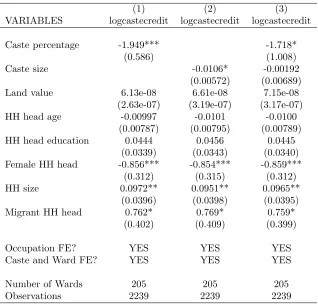
What c(·) depends on is ultimately an empirical question. In the empirical section, I show that the data
support the hypothesis that, at least to a first approximation, c(·) depends on the proportion of agents in
the search set and not on the absolute size of the search set, and I discuss the theoretical significance of this
finding.
Each agent can observe her group and the group of any other agent with whom she is matched. Each
agent can also observe the history of play within her current match, but she cannot observe the history of
play in any match in which she does not participate. However, each agent can observe something about with
whom her partner has matched in the past. Specifically, for each groupg, an agent can observe whether her
current partner has ever been matched with any agent in groupg. LetHi⊆ {1, ...G}be the set of groupsg
such that agentihas been matched with a member of groupgin the past. I refer to the setHias agenti’s
Letaτi be the action played in theτth period of the current match by player i, denote agenti’s partner
byµ(i), and let aτ
µ(i) be the action played by agenti’s partnerµ(i). Then the history of a match that has lasted forτ periods is hτ ={(a1
i, a1µ(i)), ...,(a τ
i, aτµ(i))}.
A (pure) strategy for agent i is a tuple si(hτ, gi, gµ(i),Hi,Hµ(i)) = {Gi(gi,Hi), mi(gi, gµ(i),Hi,Hµ(i)),
ai(hτ−1, gi, gµ(i),Hi,Hµ(i))}. HereGi is agenti’s search set,mi ∈ {A, R} is agenti’s decision to accept or
reject the match after observing her partner’s past match set as well as her group, andai is the stage game
action. Note that I do not allow agents to condition their strategies on the history of any match prior to the
current match.
2.2
The Information Assumption
Before continuing, I briefly discuss the information assumption. Most models in the community enforcement
literature follow Kandori (1992) and Okuno-Fujiwara and Postlewaite (1995) in assuming that players can
observe something about what their partners have donewithin their past relationships. In contrast, I assume
that players have no information about what their partners have done within their past relationships, but
that players can observe something aboutwith whom their partners have interacted in the past. I claim that
this information assumption reflects the true village information environment better than do the assumptions
of the previous literature.
Empirical evidence supports my characterization of the village information environment. Udry (1990)
notes that villagers have good information about their neighbors’ social and economic situations. In
partic-ular, he writes that villagers are able to report accurately about the ceremonies that their neighbors have
given and attended, which supports my claim that villagers keep track of with whom their neighbors interact.
In contrast, it is much harder to observe what happens within many kinds of relationships. For example,
consider a credit relationship. In this kind of relationship, the stage game actions correspond to financial
transactions between the relationship partners. However, various papers have shown that it is frequently very
difficult for people to observe their neighbors’ financial transactions. Goldstein (2000) and Anderson and
Baland (2002) show that people in village environments are frequently unaware even of their own spouses’
financial transactions. So my information assumption seems like a reasonable approximation to the true
information environment in villages, at least for many kinds of relationships.5
5It is also helpful to discuss the difference between my information assumption and the information assumption in Pe˛ski and
2.3
Equilibrium Concept
An equilibrium of my model is defined by three properties. First, an equilibrium must be a steady state. In
a steady state, no agent’s past match set can change from one period to the next on the equilibrium path.
Second, an equilibrium must satisfy an individual incentive compatibility condition analogous to subgame
perfection. This is the familiar requirement that the strategy profile must be robust to the possibility
of individual deviations. However, intuitively this requirement is not sufficient to prevent all plausible
deviations. In an environment in which matched partners can communicate prior to choosing their actions,
it is plausible to suppose that two matched agents could agree to deviate simultaneously from any given
strategy profile. This intuition motivates my third requirement, that an equilibrium strategy profile must
be robust to the possibility of joint deviations by any pair of matched agents. I adapt this requirement from
Ghosh and Ray (1996), and following their lead, I call the requirement bilateral rationality. It is closely
related to the various renegotiation-proofness concepts discussed in Bernheim and Ray (1989) and Farrell
and Maskin (1989).
Formally, an equilibrium consists of an assignment of a past match set to each agent and a strategy
profiles. Let γg be a vector that denotes, for each possible past match setH, the proportion of agents in
group gwho are assigned that past match set, and letγ denote the matrix of all theγg’s. I assume thatγ
is commonly known. I say that a past match set is reachable for an agent from an equilibrium if it would be
possible for that agent to have that past match set after some sequence of deviations from the equilibrium.6
Define the discounted expected utility for playeri byEUi[si, sµ(i), s−i, hτ, γ], which is the expected utility
that player ireceives while playing strategysi when matched with playerµ(i) playing strategy sµ(i), if all
other players are playing strategy profiles−i, given γ, after match historyhτ. Note that, due to the steady
state condition, the expected utility does not depend on the period or on any previous history from any past
match. In addition, define s0i
si to be the strategy of playings
0
i for the duration of the current match andsi
thereafter. Such a collection is a bilaterally rational equilibrium if:
1. No agent’s past match set changes from one period to the next on the equilibrium path.
2. EUi[si, sµ(i), s−i, hτ, γ]≥EUi[s0i, sµ(i), s−i, hτ, γ] for all strategiess0i and for all hτ,gi, Hi,gµ(i), and
Hµ(i) such thatHi andHµ(i)are reachable for agentsi andµ(i).
3. There do not exist anyhτ,g
i,Hi,gµ(i),Hµ(i),si0,s0µ(i) such thatHi andHµ(i) are reachable foriand
µ(i) and such that
EUi
" s0i si
,s 0
µ(i)
sµ(i)
, s−i, hτ, γ
#
≥EUi
"
s00i,s 0
µ(i)
sµ(i)
, s−i, hτ, γ
#
for alls00i and
EUµ(i)
" s0µ(i)
sµ(i)
,s 0
i
si
, s−i, hτ, γ
#
≥EUµ(i)
s00µ(i),s
0
i
si
, s−i, hτ, γ
for alls00µ(i)
and
EUi
" s0i si
, s0µ(i)
sµ(i)
, s−i, hτ, γ
#
≥EUi
si, sµ(i), s−i, hτ, γ
and
EUµ(i)
" s0µ(i)
sµ(i)
,s 0
i
si
, s−i, hτ, γ
#
≥EUµ(i)
sµ(i), si, s−i, hτ, γ
with at least one of the last two inequalities strict.
Condition 1 is the steady state condition. Condition 2 is the individual incentive compatibility condition.
Any agent i with any possible combination of group and reachable past match set must prefer to follow
the strategy profile instead of playing any alternate strategy when matched with a partner with any other
possible combination of group and reachable past match set, after any possible match history. This includes
combinations of groups and past match sets and match histories that cannot occur on the equilibrium path.
Note that I do not require the individual incentive compatibility condition to hold for any possibleγ, only for
the actual steady stateγ. Implicitly I am requiring the strategy profile to continue to be optimal after any
countable number of deviations, which can produce matches between agents with any possible combination
of groups and reachable past match sets. However, I do not require the strategy profile to be optimal after a
positive mass of agents have deviated, which could changeγ, or for agents with past match sets that are not
reachable from the equilibrium past match set assignment. Condition 3 is the bilateral rationality condition.
It states that it should not be possible for any two agents to renegotiate to a new strategy profile that is
individually incentive compatible for both of them and that is weakly Pareto superior. Once again, I require
the bilateral rationality condition to hold for any possible combination of groups, reachable past match sets,
and match histories, including combinations that only occur off the equilibrium path, but I only require the
2.4
A Benchmark Equilibrium
I will begin my analysis by discussing a benchmark strategy profile in which agents do not condition their
actions on their own or their partner’s group membership or past match set. If the benchmark strategy
profile is part of an equilibrium, I will refer to that equilibrium as a benchmark equilibrium.
In the benchmark strategy profile, every agent chooses to search over every group each period. Thus,
θ = 1 for all agents in all periods. Every agent accepts every match. In each period of each match, each
agent chooses action ¯a. If either player unilaterally deviates, then the match breaks up, so it is not necessary
to specify continuation strategies after such deviations. Joint deviations are ignored.
Since groups and past match sets are strategically irrelevant under the benchmark strategy profile, it is
unnecessary to specify the probabilities of matches between agents of different groups or past match sets.
Let Vm be the value of being an agent in a relationship that is not in the punishment phase at the
beginning of a period. Let Vu be the value of being an agent who is unmatched at the beginning of a
period. Finally, letVf be the value that an agent believes that she will receive from any future match with
any other agent. It is helpful to distinguish Vf from Vm since agents may be able to affect Vm through
renegotiation, but they cannot affectVf. Bilateral rationality dictates that each pair of agents chooses the
level of cooperation that maximizes their joint utility. That is,Vmmust satisfy:
Vm= max
a (1−δ)[v(a) +yb(1)] +δ[pV u+ (1
−p)Vm] (1)
subject to the constraint
Vm≥(1−δ)[d(a) +yb(1)] +δVu (2)
Equation (1) says that a matched agent gets v(a) +yb(1) in the current period. The match then breaks
up exogenously with probability p, in which case the agent gets the payoff to being unmatched Vu next
period, and otherwise the match continues providing the player with payoffVm. The constraint (2) is the
individual incentive compatibility constraint. It states that the value of cooperating must be greater than
the payoff that the agent receives from cheating, in which case the agent receives d(a) +yb(1) this period
and then becomes unmatched and receives payoffVu with probability 1 next period. The payoff to being
an unmatched agentVu is defined by:
Vu=−(1−δ)c(1) +Vf (3)
matched with a new partner.
It must also be the case in equilibrium that each agent optimally chooses to search over all groups, and
that it is optimal for each agent to accept every match. These conditions are trivial in the benchmark case,
since in the absence of concerns about past match sets or asymmetry between the strategies of members
of different groups it is always optimal to search over the entire community, as this both minimizes search
costs and maximizes short-term relationship quality. All match partners are identical, so it is also optimal
to accept all matches.
A benchmark equilibrium is a tuple {Vm, Vu, Vf,¯a} such that Vm, Vu, and Vf satisfy equation (1)
subject to (2) and equation (3), such that ¯amaximizes (1) subject to (2), and such thatVm=Vf.
Define ˆa(p) to be the value ofathat solves
max
a v(a)−(1−δ+δp)d(a).
The following proposition provides conditions under which a benchmark equilibrium exists, and derives
the level of cooperation in a benchmark equilibrium:
Proposition 1. A benchmark equilibrium exists if and only ifc satisfies
c(1)≥ 1
δ(1−p)[d(ˆa(p))−v(ˆa(p))]. (4)
If a benchmark equilibrium exists, then the equilibrium level of cooperation ¯asolves
d(¯a)−v(¯a) =δ(1−p)c(1) (5)
All proofs are in appendix B.
The interpretation of the expression for the level of cooperation in the benchmark equilibrium is
straight-forward. If an agent cheats in the current period, her net gain in the period is the difference between the
value of cheatingd(¯a) and the value of cooperatingv(¯a). The cost of cheating is that in the next period she
will have to pay the search cost to find a new partner with certainty, rather than with probabilityp, so the
net cost, discounted for one period, is δ(1−p)[c(1)]. The maximum level of cooperation that can be
sus-tained is the level of cooperation such that the net cost of cheating is equal to the net benefit. The bilateral
rationality condition ensures that all agents will renegotiate up to the highest possible level of cooperation,
so only the maximum sustainable level of cooperation is consistent with equilibrium.
I briefly discuss the intuition for the fact that no bilaterally rational equilibrium exists unless c(1) is
period. Since all agents accept all matches, any agent can cheat in her current relationship, break up the
relationship at the end of the period, pay the search cost c(1), and find a new partner in the next period.
Since all agents choose the same level of cooperation, the deviating agent will be able to cooperate at the
same level in her new relationship as she did in the old relationship. Thus, if c(1) is low, then the penalty
for cheating in any given relationship is low, and so the common sustainable level of cooperation is low.
However, if all agents are cooperating at some common low level, then any two matched agents can jointly
deviate to a higher level of cooperation. This higher level of cooperation does not violate the individual
incentive compatibility constraint, so long as only two agents are cooperating at the high level, because
the penalty for breaking up this deviant relationship is high: if either agent breaks the relationship, both
agents must go back to cooperating at the low common level of cooperation. Thus the individual incentive
compatibility requirement rules out all strategy profiles except those strategy profiles with a low common
level of cooperation, and the bilateral rationality requirement rules out strategy profiles with a low common
level of cooperation, so that there are no remaining equilibrium strategy profiles. Asc(1) gets larger, higher
levels of cooperation become compatible with the individual incentive compatibility constraint, and forc(1)
sufficiently large there exist levels of cooperation that are high enough to satisfy the bilateral rationality
requirement while still satisfying the individual incentive compatibility constraint.7
2.5
The Segregated Equilibrium
In this subsection I propose what I will call the segregated strategy profile. As before, if the segregated
strategy profile is part of an equilibrium, I refer to the equilibrium as a segregated equilibrium. The key
difference between the segregated equilibrium and the benchmark equilibrium is that on the segregated
equilibrium path agents interact only with members of their own group, while on the benchmark equilibrium
path agents interact with members of every group in the community.
The segregated strategy profile is as follows. An agent from group g with past match setHchooses to
search over all groupsg0such thatg0≥gandg0∈ H. The agent accepts all matches from members of groups
g0such thatg0≤gorg0∈ H. This asymmetry between higher and lower ranked groups under the segregated
equilibrium strategy profile is the only point where the group hierarchy is significant. I discuss the hierarchy
in more detail in section 2.7 below. Each combination of group and past match set is associated with a level
of cooperation ¯ag,H. If an agent with group and past match set (g,H) is matched with an agent with group
and past match set (g0,H0), then in each period of the match both agents choose action min{¯a
g,H,¯ag0,H0}.
As in the benchmark equilibrium, any unilateral deviation causes the match to break up, and joint deviations
are ignored.
Let H(g) be the past match set of group g on the equilibrium path. I look for steady states in which
H(g) ={g} for all groupsg. Each agent’s search set is defined byG(g,H) ={g00|g00≥g andg00∈ H}. That
is, each agent searches over her own group and any lower ranking group whose members she has interacted
with in the past. Thenθg,H=Pg0∈G(g,H)λg0/M for all agents. The matching probabilities are also simple so
long as there have been no more than a countable number of deviations. I defineqgg,0G,H0 to be the probability
that an unmatched agent from groupg who searches over a setG will match with an agent from groupg0
with past match setH0. On the equilibrium path and after any countable number of deviations, we have:
qg,g,{Gg}= 2λg
λg+Pg00∈Gλg00
ifg∈ G
= λg
λg+Pg00∈Gλg00
ifg /∈ G
qg 0,
{g0}
g,G =
λg0 λg+Pg00∈Gλg00
ifg06=g andg0 ∈ G
= 0 ifg0 6=gandg0∈ G/
I begin by deriving expressions for the levels of cooperation ¯ag,H, where ¯ag,H can be thought of as the
maximum symmetric cooperation level that could be sustained by an agent of group g and past match set
Hif the agent chose her search set and match acceptance strategy as specified in the strategy profile, but if
the agent expected to be matched each period with a partner who had an infinitely negative outside option.
DefineVm
g,H to be the value of being an agent of group and past match set (g,H) who expects to be matched
each period with a partner who has an infinitely negative outside option. Define Vu
g,H to be the value of
being an unmatched agent with the same expectations. We have:
Vg,mH= maxa (1−δ)[v(a) +yb(θg,H)] +δ[pVg,uH+ (1−p)Vg,mH] (6)
subject to the constraint
Vg,mH≥(1−δ)[d(a) +yb(θg,H)] +δVg,uH (7)
where we have
Vg,uH=−(1−δ)c(θg,H) +Vg,mH (8)
following lemma follows from simple manipulation of (6), (7), and (8), and so I present it without proof:
Lemma 1. Define¯ag,H to be the value ofathat solves (6) subject to (7) and (8). Then ¯ag,H is the value of
athat solves:
d(¯ag,H)−v(¯ag,H) =δ(1−p)c(θg,H). (9)
The expression for ¯ag,H can be compared to the very similar expression for the equilibrium level of
competition ¯a in the benchmark equilibrium. Notice that the maximum level of cooperation that can be
sustained by an agent of group and past match set (g,H) is decreasing inθg,H, because agents with higher
θg,H face a lower penalty for breaking a relationship.
I can now define a segregated equilibrium. Let Vg,g0H,H0 be the value of being an agent of group and
past match set (g,H) matched with an agent of group and past match set (g0,H0), and let V
g,H be the
value of being an agent of group and past match set (g,H) who is unmatched at the beginning of a period.
Let Vg,g0H,H0,f be the value that an agent of group and past match set (g,H) expects to receive if matched
with an agent of group and past match set (g0,H0) in the future. A segregated equilibrium is a tuple
{Vg,H, Vg 0,H0
g,H , V
g0,H0,f
g,H ,¯ag,H}which satisfies the following conditions:
1. The levels of cooperation ¯ag,H are defined by the expression in Lemma 1.
2. For allg andH, the values Vg,H, Vg, 0,H0
g,H ,andV
g,0,H0,f
g,H satisfy
Vg,g0H,H0 =Vg,g0H,H0,f = (1−δ)[v(min{¯ag,H,¯ag0,H0}) +yb(θg,H)] +δ[pVg,H+ (1−p)Vg 0,H0
g,H ] (10)
Vg,g0H,H0 ≥(1−δ)[d(min{¯ag,H,¯ag0,H0}) +yb(θg,H)] +δVg,H (11)
and
Vg,H =−(1−δ)c(θg,H) + X
g0,H0
qgg,0G,H(g,0H)Vg,g0H,H0. (12)
3. Agents prefer to accept matches with agents from the same or higher ranking groups rather than
rejecting those matches and continuing to search. That is, for all g, g0, H, and H0 such thatg0 ≤g,
g∈ H, andg, g0 ∈ H0,
4. Agents who have not yet interacted with members of a lower ranking group prefer to reject matches
with members of that group, rather than accepting such matches and adding the group to their past
match set. That is, for allg,g0,H, H0 such thatg0 > g,g∈ H, andg, g0∈ H0,
Vg,H≥Vg 0,H0
g,H∪{g0},G(g,H) (14)
where Vg,g0H,H,G0 is defined as the value of being an agent from groupg with past match historyHwho
has searched over a set G and subsequently formed a match with an agent from group g0 with past
match historyH0. That is, ifg00≥g for allg00∈ G,
Vg,g0H,H,G0(g,H)= (1−δ)
v(min{¯ag,H,a¯g0,H0}) +yb
X
g∈G λg
+δ
h
pVg,H+ (1−p)Vg 0,H0
g,H,G i
(15)
5. Agents prefer to search only over groups of equal or lower rank that are in their past match set, rather
than searching over lower ranked groups not in their past match set and possibly adding those groups
to their past match set. That is, for allg,H, andGsuch thatg∈ HandG ⊆ {g, g+ 1, ..., G}, we have
Vg,H≥ −(1−δ)c
X
g00∈G λg00
+
X
g0∈G h
qg,g0G,{g0}Vg,gH∪{0,{g0}g0},G i
(16)
The following proposition gives necessary and sufficient conditions for the existence of a segregated
equilibrium:
Proposition 2. A segregated equilibrium exists if and only if
1.
c(1)≥ 1
δ(1−p)[d(ˆa(p))−v(ˆa(p))] (17)
2. For allg and allHsuch that g∈ H,
(1−δ)c(θg,H)≥
1−δ
1−δ+δp[v(¯ag,H)−v(¯a1,{1,...,G})] (18)
3. For allg,g0,H,H0 such that g0 > g,g∈ H, andg, g0∈ H0,
(1−δ)c(θg,H) +δpc(θg,H)−c θg,H∪{g0}+ δp
1−δ+δpy
b θg,H∪{g0}−b(θg,H) (19)
4. For allg,HandG such that g∈ HandG ⊆ {g, ..., G},
y
1−δ
1−δ+δp[b(θg,H∪G)−b(θg,H)] + δp
1−δ+δp X
g0∈G/H
qgg,0G,{g0}[b(θg,H∪{g0})−b(θg,H)]
(20)
+ (1−δ) [c(θg,H)−c(θg,H∪G)] +δp X
g0∈G/H
qgg,0G,{g0}[c(θg,H)−c(θg,H∪{g0})]
≤ X
g0∈G/H qg
0, {g0}
g,G [v(¯ag,H)−v(¯ag,H∪{g0})]
If a segregated equilibrium exists, then the level of cooperation ¯ag,{g} achieved by agents from groupg on
the equilibrium path is defined by
d(¯ag,{g})−v(¯ag,{g}) =δ(1−p)c(λg). (21)
The first necessary condition for the existence of segregated equilibrium is the same as the condition for
the existence of a benchmark equilibrium, and it is necessary for the same reason. Under the segregated
equilibrium the individual incentive compatibility constraint and the bilateral rationality constraint must
be satisfied for each combination of group and past match history, and the constraints cannot be jointly
satisfied unless the search cost is sufficiently large. It is most difficult to satisfy both constraints for agents
from group 1 whose past match history includes all groups. These agents search over the entire community
(i.e. they chooseθ= 1) and thus have the lowest search costs. If both constraints can be satisfied for these
agents, then they can be satisfied for agents with all other combinations of group and past match history.
The second necessary condition is the condition that agents must prefer to accept matches with agents
from the same or higher ranking groups rather than rejecting those matches and continuing to search. The
condition is most difficult to satisfy when the agent is matched with a partner from group 1 whose past match
history includes all groups, since these partners can sustain the lowest levels of cooperation. The gain from
rejecting such a partner is that the with probability 1 the agent will then be matched with a partner from
her own group whose past match history includes only that group, and will be able to achieve a higher level
of cooperation for a period of time that depends on the expected length of the relationship, parameterized
byp. The loss is that she will have to pay the search cost in the current period. The condition states that
the loss from rejecting the agent with the larger past match history is greater than the gain.
The third necessary condition is the condition that an agent must prefer to reject matches with agents
from lower ranking groups with whom she has not previously interacted and to continue to search rather
than accepting those matches and increasing the size of her past match set. If an agent accepts a match with
group in the future she will also pay lower search costs and gain higher quality short-term relationships.
However, she will be able to support lower levels of cooperation in the future. The condition states that the
gain from rejecting a partner from a lower ranking group is greater than the loss. Notice that conditions 2
and 3 can only be satisfied simultaneously if pis sufficiently large. This reflects the fact that in order for
conditions 2 and 3 to be satisfied simultaneously, it must be the case that agents are willing to interact with
members of higher ranking groups but not with members of lower ranking groups. In both cases, the agent
sacrifices the ability to cooperate at a high level for the duration of the current relationship in exchange for
the benefit of not having to pay the search cost again. However, by interacting with a member of a lower
ranking group an agent also sacrifices the ability to cooperate at a high level in all future relationships.
Thus agents are only willing to behave differently towards members of higher ranking and lower ranking
groups if the benefit of cooperation in future relationships is sufficiently important, which is true only if the
probabilitypof moving on to a new relationship is sufficiently large.8
The final necessary condition is the condition that agents must prefer to search over their own group
rather than searching over their own and any set of lower ranking groups and incurring the possibility of
expanding their past match sets. The condition states that the multiplier y must be sufficiently small,
that is, the value of short-term relationships must not be too large in relation to the value of long-term
relationships. Otherwise, agents would be willing to forgo the benefits of higher levels of cooperation with
smaller past match sets in order to achieve higher quality short-term relationships by searching over a larger
set of potential partners. I defer further discussion of this condition to the final section of the paper.
While the notation involved in defining the segregated equilibrium is somewhat complex, the idea is
simple. When an agent is in a relationship, she would like to commit to interacting only with members
of her own group in the future, since by doing so she can lower the outside option to the relationship and
therefore support a higher level of cooperation within the relationship. However, when an agent is out of a
relationship, it is optimal for her to search over the entire community to find a new partner, since by doing
so she both minimizes her search cost and maximizes the short-term value of her next relationship. The
segregated equilibrium generates a reputation effect that allows agents to solve this commitment problem. If
an agent is observed to have interacted only with members of her own group in the past, then it is believed
8One way to relax this condition is to allow agents to have more than one relationship at any given time. In this case, by
interacting with an agent from a lower ranking group in one relationship, an agent immediately loses the ability to cooperate at a high level with all of her other relationship partners, while by interacting with a member of a higher ranking group the agent only loses the ability to cooperate at a high level in one relationship. Thus the difference between the payoffs for interacting with members of lower ranking groups and with members of higher ranking groups remains large even for arbitrarily smallp.
that she will continue to interact only with members of her own group in the future, and so she can support
a high level of cooperation. However, if an agent is observed to have interacted with a member of a lower
ranking group in the past, it is believed that she will continue to interact with members of that group in
the future. Thus it is believed that the agent has a higher outside option to any relationship, and so she
can only support a lower level of cooperation within any relationship. This punishment is sufficient to deter
agents from interacting with members of lower ranking groups if they have not done so in the past, while
agents who have interacted with members of a lower ranking group in the past cannot be subject to any
further punishment and so cannot be deterred from interacting with members of that group in the future.
Thus, all expectations are fulfilled in equilibrium.
2.6
Welfare, Optimal Group Size, and Group Formation
An immediate corollary of proposition 2 is:
Corollary 1. For any groupg with λg<1,
1. The segregated equilibrium level of cooperationa¯g,{g} is higher than the benchmark equilibrium level of
cooperation ¯a.
2. The segregated equilibrium search costc(λg)is higher than the benchmark equilibrium search costc(1)
and the segregated equilibrium short-term relationship quality b(λg)is lower than the benchmark
equi-librium short-term relationship quality b(1).
Corollary 1 demonstrates both the advantage and the disadvantages of the group segregation norm. On
the one hand, group segregation allows group members to support higher levels of cooperation. On the other
hand, group segregation both increases the search costs paid by each agent and reduces the quality of each
agent’s short-term relationships. Mathematically, define the average welfare under segregationWS
g in group
g by taking the mean of per-period utility in a given period across all members of group g. Similarly, let
WB be the average welfare in the benchmark equilibrium. Then we have:
WgS =v(¯ag,{g}) +yb(λg)−pc(λg) (22)
and
WB=v(¯a) +yb(1)−pc(1) (23)
WgS−WB= [v(¯ag,{g})−v(¯a)]−y[b(1)−b(λg)]−p[c(λg)−c(1)] (24)
Welfare is higher under group segregation ifpandy are sufficiently small.
Notice that the disutility from high search costs under segregation decreases as the exogenous breakup
probabilitypfalls, while the disutility from low quality short-term relationships does not depend onp. Thus
in situations where relationships are relatively stable, it seems likely that the disadvantage of segregation
from low quality short-term relationships is more important than the disadvantage from high search costs.
It is also possible to derive a result on the optimal group size under segregation. In general, WgS is not
concave in λg, and so there is not necessarily a unique maximizer of WgS(λg) on [0,1]. However, WgS is
supermodular in (λg, y). Therefore, by Topkis’ theorem (Topkis 1998, theorem 2.8.3), we have
Proposition 3. The set arg maxλg∈[0,1]W
S
g(λg) has a greatest element and a least element, and both the
greatest and the least element are increasing in y.
Proposition 3 gives a more precise statement of the intuition that the optimal group size is increasing as
the relative importance of short-term relationships increases.
Proposition 3 need not imply a positive theory explaining observed group sizes. Group membership must
be common knowledge in the community, and so agents cannot unilaterally change groups even if doing
so would increase welfare. For this reason, shocks that change group sizes or that make salient new group
divisions may have persistent consequences. Understanding the determinants of observed group sizes would
be an interesting project for future research.
2.7
Equilibrium Selection and the Hierarchy
I have shown that there exists an equilibrium in which agents interact only with members of their own
groups, and that this equilibrium allows agents to support higher levels of cooperation than the benchmark
equilibrium. Without the bilateral rationality condition, this result would be trivial. Consider the strategy
profile in which agents search only over their own groups and accept matches only with members of their
own groups, regardless of past match history, and then choose the highest sustainable level of cooperation
within each match. This strategy profile satisfies the individual incentive compatibility requirement, because
no agent has a profitable individual deviation. However, the strategy profile does not satisfy the bilateral
rationality requirement. Given that all other agents are following the strategy profile, any two provisionally
it.9 Thus, all of the theoretical interest of the model comes from the need to satisfy the bilateral rationality
requirement.10
However, even though the bilateral rationality requirement rules out many possible alternative strategy
profiles, bilateral rationality does not uniquely select one strategy profile as the equilibrium. Thus it is
necessary to explain why the segregated equilibrium would be selected. In particular, the hierarchical
structure of the segregated equilibrium may seem to be an arbitrary addition to the other assumptions of the
model. However, in this subsection I will show that given plausible additional assumptions, any equilibrium
in which all agents interact only with members of their own groups on the equilibrium path must have the
hierarchical structure of the segregated equilibrium. That is, I will show that segregation necessarily implies
hierarchy.
My first additional assumption is:
No irrelevant updating (NIU): An equilibrium satisfies NIU if, under the equilibrium strategy profile,
whenever an agent’s past match set does not contain groupg, the agent’s search set does not contain group
g. Formally, ifg /∈ H, then for all g0,g /∈ G(g0,H).
The point of this principle is to rule out strategy profiles such as the strategy profile under which if a
member of group 1 is observed to have interacted with a member of group 2, then it is believed that the
member of group 1 will search for matches from group 3 in the future. The idea is that observing a change
in how the member of group 1 behaves towards members of group 2 should not affect beliefs about whether
the member of group 1 will interact with members of group 3. In other words, the principle states that each
agents’ willingness to interact with members of any group is in some sense independent of her willingness to
interact with members of any other group.
NIU implies that the hierarchical structure of the segregated equilibrium must apply between any two
groups in any equilibrium, given that agents interact only with members of their own group on the equilibrium
path. Roughly speaking, the intuition for this result is that an agent from groupgonly rejects matches with
members of some group g0 6=g if matching with a member of groupg0 would lower the level of cooperation
that the member of group g could expect to achieve in the future. The level of cooperation that the agent
can support in the future is inversely related to the expected size of the agent’s search set. By NIU, the
fact that the agent has interacted with a member of groupg0 in the past cannot change expectations about
9The bilateral rationality condition also rules out “starting small” strategies such as the strategy profile in Ghosh and Ray
(1996), in which agents cooperate at a lower level at the beginning of their relationship and then build up to a higher level of cooperation. With symmetric information, the low initial level of cooperation is Pareto sub-optimal and hence not renegotiation proof.
10One other strategy profile that has been mentioned in the literature as a way to support high levels of cooperation in random
whether the agent will search over any third groupg006=g0 in the future. Thus, if interacting with members
of groupg0lowers the level of cooperation that the agent expects to achieve in the future, it must be because
after interacting with a member of groupg0, the agent is expected to search over groupg0 in the future. In
order for this expectation to be rational, members of groupg0 must accept matches with members of groupg
on the equilibrium path. Thus, on the equilibrium path, if members of groupgreject matches with members
of groupg0, then members of groupg0 must accept matches with members of groupg.
NIU does not rule out the possibility of cycles, in which on the equilibrium path members of group 1
reject matches with members of group 2, members of group 2 reject matches with members of group 3, and
members of group 3 reject matches with members of group 1. In order to rule out this possibility I introduce
a second assumption:
Transitivity: For allg,g0,g00, ifm(g,{g}, g0,{g0}) =Randm(g0,{g0}, g00,{g00}) =R, thenm(g,{g}, g00,{g00}) =
R.
Transitivity implies that there is a well defined ordering of groups in which one group is prior to another
group in the order if members of the first group reject matches with members of the second group on the
equilibrium path. Given the conditions on model parameters from proposition 2, the segregated equilibrium
is the unique equilibrium that satisfies NIU and transitivity, and in which all agents interact only with
members of their own groups on the equilibrium path. Proposition 4 states this result formally:
Proposition 4. Consider an equilibrium, and letH(g)be the past match set of groupg on the equilibrium
path. Suppose that:
1. For all groupsg,G(g,H(g)) ={g} .
2. The equilibrium satisfies NIU and transitivity.
3. The parameters of the model satisfy the conditions in proposition 2.
Then the equilibrium is the segregated equilibrium.
Note that if G = 2, then NIU and transitivity are automatically satisfied in all equilibria, and so the
second condition of proposition 4 is redundant forG= 2.
The result that segregation implies hierarchy is unexpected. It is not baked into the motivation of the
paper. Nevertheless, the result does seem to be relevant to understanding real world segregation. Casual
empiricism suggests that segregation is frequently associated with hierarchy and inequality, although
inter-estingly the group that is at the top of the ritual purity hierarchy need not be the group at the top of the
the top of both the ritual purity hierarchy and the socio-economic scale, groups such as the Gypsies and the
ultra-orthodox Jews are at the top of the ritual purity hierarchy even though they are near the bottom of
the socio-economic scale in their respective societies.
At a more abstract level, the key takeaway from proposition 4 is that segregation is fundamentally an
asymmetric relationship, enforced by only one group out of each pair of groups. This suggests, for example,
that in order to implement policies to combat segregation between two groups it is first necessary to identify
which group is enforcing segregation and which group is merely accepting it.
2.8
From Theory to Empirics
The following is another immediate corollary to proposition 2:
Corollary 2. The segregated equilibrium level of cooperation¯ag,{g} for members of groupg is decreasing in
λg, the percentage of members of groupg in the community.
I test this proposition by studying informal credit relationships between villagers in rural Nepal. Informal
credit relationships benefit households by allowing them to borrow in response to unforeseen shocks or
opportunities. However, because formal contract enforcement is unavailable in rural Nepal, households have
the option of refusing to repay their loans. Households are willing to repay their loans because by doing so
they increase the likelihood that they will be able to receive additional loans in the future.11 The informal
credit relationship therefore meets my definition of a cooperative relationship. My measure of the level of
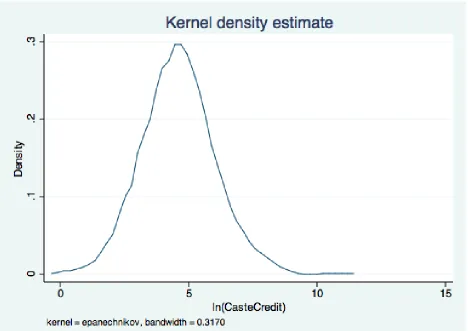
cooperation engaged in by each household is the logarithm of the sum of the outstanding amount owed by the
household to friends and family members and the outstanding amount owed by friends and family members
to the household. My definition of a community is an administrative unit called a ward. My main empirical
hypothesis is thus the following:
Empirical Hypothesis: The amount of informal credit that a household engages in is decreasing in the
percentage of the household’s caste in the ward.
The next section is devoted to testing this hypothesis.
11See Ligon, Thomas, and Worrall 2002 for a much more in-depth discussion of the theory of informal insurance under limited
3
Empirics
3.1
Data
My dataset is the first round of the Nepal Living Standards Survey (NLSS), collected in a joint effort by
the Nepalese government and the World Bank between 1995 and 1996. The survey consisted of a nationally
representative sample of administrative units called wards, stratified by the major regions of the country.
Within each sampled ward, 12 households were chosen to be interviewed. A rural ward typically contains
between 50 and 500 households, and consists of a single village in those parts of the country in which houses
are clustered into villages. In some parts of the country houses are distributed more or less evenly across
the countryside rather than being clustered into villages, and in those parts of the country the ward is a
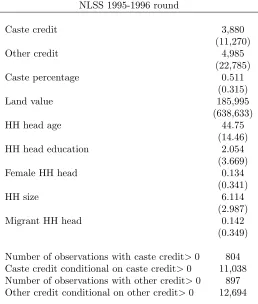
somewhat arbitrary administrative division. Table 1 presents summary statistics. Monetary amounts are in
Nepalese rupees; there were approximately 50 rupees to the dollar in 1996. Two additional rounds of data
were also collected, from 2003-2004 and from 2010-2011. These rounds were affected by the fighting and
aftermath of the Nepalese civil war, which began with a few minor incidents in 1996, escalated in 2001, and
ended in 2006. The civil war appears to have had a dramatic effect on the structure of the Nepalese caste
system, and the results from the second and third rounds of the survey are quite different from the results
from the first round. I discuss the civil war and its effects in more detail in Appendix C.
One advantage of the Nepalese context for my study is the Nepalese government has a fairly short,
standardized list of castes that it uses for all surveys. This contrasts markedly with the situation in India,
where there are tens of thousands of castes, and where no official data on caste membership has been collected
since 1931. The NLSS 1 includes 14 named caste categories, which are the 14 largest castes from the 1991
census making up about 80% of the Nepalese population, and a 15th category, “other”. I check that my
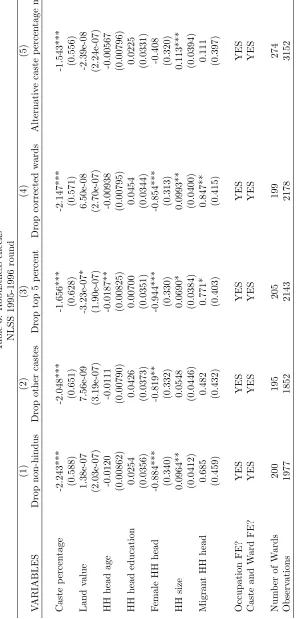
regressions are robust to dropping the “other” category.
The NLSS 1 did not include a census of the surveyed wards. An official in each ward was asked to provide
estimates of the total number of households in the ward and the number of households in each caste in the
ward. I use these data to construct the percentage of each caste in each ward. However, I am only able to
match the caste of the household to a caste named by the ward official in 67% of cases. As a robustness
check, I also estimate the percentage of each caste in each ward by the percentage of each caste within the set
of sampled households in each ward. This specification allows me to generate a caste percentage measure for