MASTER THESIS
Optimization of a control network
for binding in combinatorial
sentence structures.
Koen Meijer, s1744275
Faculty of Cognitive Psychology and Ergonomics Human Factors and Engineering Psychology
EXAMINATION COMMITTEE
Prof. F. van der Velde & Dr. M. Schmettow.
2
Optimization of a control network for binding in combinatorial
sentence structures.
Koen Meijer, s1744275
Date: 1-8-2019
Supervisors: Prof. F. van der Velde & Dr. M. Schmettow.
Human Factors and Engineering Psychology
3
Abstract
The ability of human to understand and produce combinatorial structures in language is an
important feat of cognition. It allows for the understanding of a huge set of sentences
generated by the combination of a known sentence structure and known words. How these
combinatorial structures can be instantiated in neural terms is still faced by some challenges. The neural blackboard architecture (NBA) aims to solve these challenges. In this architecture
words are bound together in a temporary sentence structure that encodes the relations between
the words. The question remains with what network the binding in the NBA can best be
controlled. Therefore, the goal of this thesis was twofold. The first being the replication of the
FFN trained by van der Velde and de Kamps (2010). The second being finding the best
hidden layer size for this FFN. Accuracy as reported by Keras showed a decline for
processing of the test sentences for the models with six or fewer hidden nodes. However, a
model configuration that completely omitted the hidden layer scored an accuracy equal to the
model with 12 hidden nodes. Further inspection of the activations made by the models
revealed that the model without a hidden layer made more errors. In conclusion it can be said
that a model without a hidden layer is not adequate to perform the controlling task for binding
in the NBA if the performance requirements of van der Velde and de Kamps (2010) are
applied. However, when the standard Keras thresholds for accuracy are used the model
without a hidden layer seems to be able to control the binding. This points towards the data
4
Contents
1. Introduction ...5
2. Theoretical framework ...7
2.1 Combinatorial productivity/structures. ...7
2.2 Grounded representations ...8
2.3 Recurrent Neural Networks and combinatorial productivity ...8
2.4 The Neural Blackboard architecture of combinatorial structures. ... 10
2.5 Control of binding in the Neural Blackboard Architecture ... 11
2.6 Research aims ... 14
3. Network architectures ... 16
4. Method ... 21
4.1 Categories in the in- and output data ... 21
4.2 Training and testing data ... 22
4.3 Training of the network ... 25
4.4 Evaluation ... 26
5. Results ... 27
5.1 Performance on training data ... 27
5.2 Performance on test data ... 28
5.3 Effect of number of nodes in the hidden layer ... 33
6. Discussion ... 42
6.1 Conclusions ... 42
6.2 Limitations ... 45
6.3 Recommendations and future directions ... 47
7. Literature ... 48
8. Appendix ... 50
Appendix 1: Python code ... 51
Appendix two: Encoded training sentences ... 54
Appendix three: Encoded test sentences ... 56
5
1. Introduction
Language comprehension or semantic cognition is the ability to use, manipulate and
generalize knowledge to support both verbal and non-verbal behaviours (Lambon-Ralph,
Jefferies, Patterson & Rogers, 2017). A fundamental characteristic of human semantic
cognition is that it relies on combinatorial structures. Humans use combinatorial structures in language by combining vowels and consonants into syllables, syllables into words and words
into sentences (Zuidema & de Boer, 2018). This ability is almost unending as humans can
always create new words using known phonemes and can express complex thoughts using
new combinations of words forming novel sentences. This combinatorial productivity even
results from combining simple sentence structures with a large but finite lexicon. It is not
unlimited but still results in a huge set of sentences that can be understood because this results
from combining a finite lexicon with restricted sentence structure. When new words are
learned in a particular sentence context, these words can also be recognized in other sentence
contexts without explicitly learning these first. Adult language users possess this form of
productivity. Thus, with combinatorial productivity new words only have to be learned in a
few sentence contexts. They could then be used in other sentence context as well..
Studying how these combinatorial structures can be instantiated in neural terms is
essential to understanding the basis of human cognition. The representation of words and
concepts are formed by neural cell assemblies (Hebb, 1949). Such an assembly consists of a
group of interconnected neurons that is distributed across the brain. The hub and spokes
model of semantic cognition (Lambon-Ralph et al., 2017) is a more recent version of this
hypothesis. In this model semantic cognition relies on two interacting neural systems. The
first system is a system of representation in which knowledge of concepts is encoded. The
second system manipulates the activation within the first system and is therefore a system of
control. This two systems view is called the controlled semantic cognition (CSC) framework
(Lambon-Ralph et al., 2017). However, the neural instantiation of the combination of such
structures poses some fundamental problems. These problems are the massiveness of binding,
the problem of two, the problem of variables and the transformation of combinatorial
structures from working memory to long-term memory (Jackendoff, 2002). The Neural
Blackboard Architecture (NBA) (van der Velde & de Kamps, 2006) can solve these
challenges to cognitive neuroscience. Moreover, this is a neural architecture that aims to
integrates three important features of human cognition. These features are productivity,
6 described above. Dynamics refers to the ability of interacting with the environment in a
dynamical way. Grounding refers to the nature of cognitive representations.
These representations are always grounded in perception. Especially the combination of these
features is important to human cognition and not found often, except in the human brain.
Therefore, to better understand the nature of human cognition an architecture that integrates
these features is important (van der Velde & de Kamps, 2006). The NBA can create
combinatorial structures. However, without a control network that has learned in which way
to activate certain structure assemblies the NBA is not capable of processing novel structures.
A control network is therefore needed to make the model capable of productivity.
Once a specific sentence structure is learned; let’s say a N-V-N structure, this can be
generalized to all sentences of this type as long as it consists of nouns and verbs that are
known to the human/model. So the need to train a neural network on a significant number of
sentences of the overall set humans can understand can be avoided (van der Velde, van der
Voort van der Kleij & de Kamps, 2004). In this study a control network for a model of
sentence structure will be tested. This control network will provide the necessary input for the
NBA (van der Velde & de Kamps, 2006) to make it capable of processing novel sentences.
Further testing with the control network will determine whether it is capable of processing the
combinatorial structures in the same way as humans. A control network could make the NBA
capable of processing novel sentences just like humans are able to process and produce
combinatorial structures (van der Velde & de Kamps, 2006). The first part of this of thesis
will be dedicated to replicating the study by van der Velde and de Kamps (2010) on learning
of control in a neural architecture of grounded language processing. The second part will
consider trying different configurations of the model to optimize the performance. Mainly, the
7
2.
Theoretical framework
2.1 Combinatorial productivity/structures.
The combinatorial nature of language refers to the way human combine sounds to
form word (combinatorial phonology) and the way in which humans combine words into
sentences (compositional structures) (Zuidema & de Boer, 2018). In this way humans can
combine words to form novel sentences, as long as the words are known.
The ability to provide ‘who does what to whom’ information can be seen as the
communicative aspect of language. Two sentences with the same syntactic structure can give
very different information. By answering who does what to whom question this information
can be derived. This is called a binding question since it is related to the manner in which the
constituents in the sentence structure are bound together. For instance, the information in a
sentence changes meaning when a noun goes from the object to the subject position.
Answering such binding questions is an important feature of human language processing (van
der Velde, van der Voort van der Kleij & de Kamps, 2004).
Human language processing is very productive in representing who does what to
whom information. With a vocabulary of 1000 words and one specific sentence structure a
huge set of sentences can be created. Every human that knows the words that are in the
vocabulary and is familiar with the specific sentence structure can then understand each
sentence in this set and would be able to answer binding questions. The combinatorial
productivity of language results from combining sentence structures with a large lexicon (vocabulary). This will result in a set of sentence which is ‘astronomical’ in its size but still
understandable to the average person because they are the result of combing a large but finite
lexicon with restricted sentence structures (van der Velde, van der Voort van der Kleij & de
Kamps, 2004). To deal with learning a set of this size combinatorial productivity in a model is
also needed. This way, not every combination of words and sentence structures has to be
trained but new words can be trained in a few contexts and then used in others. Or a model
can learn different sentence structures without simultaneously learning specific words.
The ability of a model to learn a specific word in one type of sentence and then use it
in another is a form of productivity referred to as strong systematicity. However, this type of
systematicity could be difficult for a neural network to learn because the word as well as the
syntactic position have to be learned at the same time. Moreover, for combinatorial
productivity strong systematicity may be not be necessary. Alternatively, a form of weak
8 sentences may be sufficient to produce combinatorial productivity (van der Velde, van der
Voort van der Kleij & de Kamps, 2004).
2.2 Grounded representations
A grounded representation of a specific word is made up from all the related aspects to
that word in an interconnected network. The aspects that are related include perceptual
information, processes related to actions (petting a cat), emotional information related to the
word and all other forms of information.
Several studies have investigated grounded word representations in the brain. One
interesting finding is that of modality specific activation in the brain during the
comprehension of words. Motor related words activated brain areas that are associated with
motor skills and sensory brain areas where activated during the comprehension of sensory
related words (Vigliocco et al., 2006). Difference in activation between several words related
to motor action were also found. Parts of the premotor cortex that are activated by specific
actions were activated by words related to these specific actions (Tettamanti et al., 2005).
The hub-and-spoke theory of semantic representations explains how conceptual
knowledge can arise. This theory assumes that the most important sources for constructing
concepts are multimodal verbal and non- verbal experiences. These sources of information are
encoded in modality specific brain areas that are distributed across the brain. These are called
the spokes. The second idea of this theory is that interactions across modalities are mediated by a trans-modal hub that is situated bilaterally in the anterior temporal lobes (ATL)
(Lambon-Ralph et al., 2017).
There is empirical evidence that motivates that the hub is situated on the anterior
temporal lobes, mainly from cognitive neuropsychological studies. Damage to higher-order
association cortices can lead to trans-modal semantic impairments. An interesting study on
semantic dementia (SD) showed that the ATL-hub might be important for all types of
concepts. Patients with SD show atrophy and hypometabolism in the anterior temporal
regions bilaterally. With semantic SD there are impairments across all modalities and all types
of concepts. This seems to point towards a central, trans-modal hub (Lambon-Ralph et al.,
2017).
2.3 Recurrent Neural Networks and combinatorial productivity
Recurrent neural networks can be used to study sentence processing. An example of
9 (Elman, 1991). A SRN is essentially a multilayer neural network with connections between
the input layer and hidden layer and the hidden layer and output layer. Recurrence is made
possible by copying information from the hidden layer back to the input layer. This is done
via the context nodes as shown in figure 1. The information that is stored in the context layer
is combined with the next input. In this way the hidden layer of the model relates both new
and prior information to the output layer (Elman, 1991). This model was trained on a set of
sentences so that it could predict the lexical category of the next word in a new sentence.
In a more recent study a SRN was used to examine whether such a model would be
capable of combinatorial productivity (van der Velde, van der Voort van der Kleij & de
Kamps, 2004). However, the model that was used failed on the test of combinatorial
productivity. The SRN was capable of learning the training sentences but with the test
sentences in which words from the learned sentences were combined it failed to correctly
predict the lexical category of the next word. In their article they call this a falsification of the
idea that a SRN can manage human language productivity (van der Velde & de Kamps,
2004).
Figure 1: A simple recurrent neural network (van der Velde, van der Voort van der Kleij & de Kamps, 2004).
Combinatorial productivity is not the same as recursive productivity. Recursive
productivity refers to processing increasingly complex structures whereas combinatorial
productivity concerns combining a big lexicon with limited syntactic structures (van der
Velde & de Kamps, 2006). The long short-term memory recurrent network has, as opposed to
SRN and humans, unlimited recursive productivity. It can also handle context free language by using ‘memory units’ that work as counters during learning. However, counting elements
10 is encountered in a sentence differences between sentences cannot be represented.
Additionally, this method would not work for new sentences with words that have not been
encountered before and therefore do not have a counter yet. This shows that the ability to
process increasingly complex languages does not assure that combinatorial productivity can
also be processed (van der Velde & de Kamps, 2006).
Another issue with a SRN is related to the binding problem, which entails the way in
which the structural relations between parts can be kept when these parts are bound together
momentarily. Instead of processing words directly a SRN could be trained to process
sentences based on their abstract structure. The problem with this however would be that all
sentences with the same syntactic structure, such as Noun-Verb-Noun would be the same for
this model even though they convey different messages. Humans have the ability to answer
binding questions for this type of sentence but these questions are impossible to answer based
solely on the abstract sentence structure. To be able to distinguish the different messages of
sentence with a similar abstract structure the binding has to be performed according to the
hierarchical structure of the sentence. This is a form of language processing of which a SRN
is not capable (van der Velde & de Kamps, 2006).
2.4 The Neural Blackboard architecture of combinatorial structures.
In a combinatorial structure parts and their relations are both present. This means that
a neural model of combinatorial structures can only be useful when it instantiates the
individual parts as well as the relations between them in a combinatorial structure. Moreover,
in a sentence structure the individual parts consist of the grounded word representations as
described in the hub-and spoke model (Lambon-Ralph et al., 2017). The combination of
combinatorial productivity with grounded word representations presents challenges. It means
that connections should be possible between all of the different grounded representations of
nouns and all grounded representations of verbs. Additionally, connections between these
grounded representations cannot be formed directly when a new combination of nouns and
verbs is encountered. Therefore, combinatorial productivity has to be possible in a connection
structure that is already established (van der Velde, 2019).
The neural blackboard architecture makes this combination possible by forming a
temporary connection between arbitrary nouns and verbs (van der Velde & de Kamps, 2006).
This temporary connection structure is formed on a ‘blackboard’ consisting of specialized
processors that can interact. Each of these processors can process and alter the information on
11 the grounded word representations in a sentence structure. There are noun assemblies and verb assemblies. When a sentences is processed all the nouns are linked to an individual noun assembly and the verbs are linked to verb assemblies. The noun and verb assemblies are
linked together in a manner that encodes the relations between these words. Within the
structure assemblies for nouns and verbs are subassemblies for the different roles these words
can have in a sentence structure. For example, for the sentence dog sees cat, dog and cat are linked to two different noun assemblies. Sees is linked to a verb assembly. Next, these
assemblies are linked together by the appropriate subassemblies. Dog is linked as the agent of sees, and cat as the theme of sees. This linking of structure assemblies in the NBA is called binding. The binding in the architecture is achieved by activating the correct binding gates in
the structure assemblies (for a detailed description of binding gates in the NBA sees van der
Velde & de Kamps, 2006).
In the NBA the activation of binding gates needs to be controlled. A control network
for this task was proposed by van der Velde and de Kamps (2010). This network received
information about the word types in a sentence structure and feedback from the NBA
concerning expectations of the sentence structure. For instance, verbs usually have themes
therefore when a theme is encountered this is signalled to the control network. How this
control works is discussed in detail in the next section.
2.5 Control of binding in the Neural Blackboard Architecture
In a recent study a control network for the neural blackboard architecture was
presented (van der Velde & de Kamps, 2010). The network that was used to control the
binding was a feedforward network (FFN) with one hidden layer that operated on abstract
binding symbols. These binding symbols/categories could then be used to activate the
appropriate structure assemblies in the NBA. The main goal of this study was to investigate
whether a neural network is capable of generalizing knowledge of these binding classes to
novel sentence structures. To this intent two main types of sentences were trained. Namely,
sentences with a noun-verb-noun structure and sentences with an embedded clause. Below is
a description of the input-output relations the FFN learned to control the binding.
During binding, nodes are activated that represent a lexical category. This is done
from the assumption that grounded word representations also entail information about lexical
categories. For the noun-verb-noun sentences there are several of these categories that were
uses to train the control network on the binding steps. These are nouns with a relative clause
12 there are two categories that are meant for starting and ending sentence structures in the NBA
and there are conditional nodes. Figure 4 shows the binding steps for the sentence cat sees dog. For each word in this sentence ate least one or more nodes in the input- and output layer are activated. All the necessary steps in the binding process for this sentences is discussed
below.
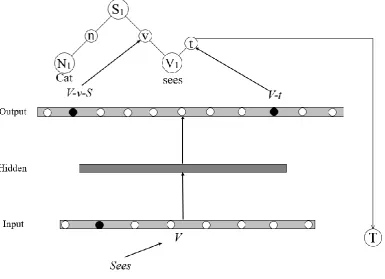
The FFN that was trained operates on sentence level in which the parts of the sentence
structure are processed word for word. The first action is that cat activates an input node in the FFN. This does not happen directly but rather by recognizing the category to which cat belongs first. In the case of cat this category is noun with a possible relative clause (Nrc). In the input layer of the FFN there is a node dedicated for signalling the to the output layer that
the input is Nrc. The trained model has learned to activate the correct output in this case. The
correct output that needs to be produced by the FFN consists of two nodes. The first is for
activating the noun cat as the subject of the sentence (N-n-S). This node will signal to the NBA that these two structure assemblies are bound together via their noun-subassemblies. Cat (N1) will then be bound to the sentence structure (S1) as the subject. Additionally, the FFN
has learned to activate a node that reflects the expectation of an incoming relative clause
(RC). This is an example of a conditional node that is not used as input for the model directly.
Rather, it is used as feedback for the FFN. The RC node will serve as input together with a
13
Figure 2: Schematic presentation of the processing of a noun with possible relative clause Cat through the FFN. Dots represent nodes in the input- and output layer; black dots are nodes that are activated.
The verb sees falls under the verb category which activates the V node in the input layer of the FFN as displayed in figure 3. The trained FFN has learned to activate two nodes
for verb inputs. The first is the V-v-S node. When this node is activated it signals to the NBA
that the verb (V1) should be bound to the sentence structure (S1) as a verb. Since verbs
usually have a theme an additional node is activated in the output layer of the FFN. The V-t
node reflects the expectation that the next word in the sentence structure could be the theme
of the verb sees. In the NBA, the result is that a gate is opened for theme-subassembly in the V1 structure assembly. A feedback signal is also produced. The conditional node T is
activated and will remain active until new input will satisfy the condition of being a theme
[image:13.595.80.466.364.643.2](van der Velde & de Kamps, 2010).
Figure 3: Binding of the verb sees as the verb of the sentence structure cat sees dog. The anticipation of a theme is reflected by the V-t node and the conditional T node which is given
14 The last word of the sentence, dog, is another noun with a possible relative clause (Nrc). Therefore, similarly to the first noun cat the Nrc node in the input layer of the FFN is activated. However, this time another node in the input layer is active. The conditional T node
that was given as feedback after processing the verb sees is also active. The FFN has learned to activate two nodes in this case. The RC node for a possible incoming relative clause and
the N-t node. This N-t node signals that the noun dog is a theme and therefore the theme subassembly of N2 should be activated. Together with the theme subassembly of V1 this
forms the binding of dog as the theme of the verb sees. Since the condition of the T conditional node is now met it is no longer activated and therefore not given as feedback
[image:14.595.77.430.303.579.2]again (van der Velde & de Kamps, 2010).
Figure 4: Activation in the FFN for the noun dog in the sentence cat sees dog. The result is that dog is bound as the theme of the verb sees. Black circles represent activated nodes in the in-and output layer.
2.6 Research aims
The first aim of this study was to replicate the results by van der Velde and de Kamps
15 sentences and sentences with an embedded clause. After training the model was evaluated to
see if it is capable of controlling the binding task similarly to the original model.
After the replication of model the second aim was to evaluate the effect of hidden the
layer size on the performance of the model. In the original study the number of hidden nodes
was chosen without explicit thought. Therefore, the hidden layer size was lowered from the
original size of 12 nodes until a model was created without a hidden later at all, called a
perceptron. All of these architectures will be discussed in the sections below.
In the original study the number of epochs for training was set to 50.000. However,
this number was chosen without a specific reason. Therefore, during the evaluation the
number of epochs and the extent to which training for 50.000 epochs is necessary for the
binding task was also evaluated.
The last research aim is related to the tools that were used in the original study. At that
time software packages such as Keras were not available for use. Keras provides a clear
framework for creating neural networks and makes it more accessible to be used by those who
16
3. Network architectures
A Feedforward Neural Network for classification was used to serve as a control
structure for the Blackboard architecture. The code for this model can be found in appendix 1.
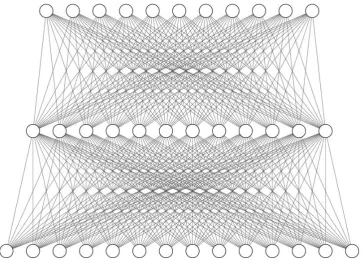
This type of network is also called a Multilayer Perceptron and is illustrated with figure five.
It consists of three densely connected layers of which the middle is the ‘hidden layer’. The
first layer is the input layer and contains eleven nodes or neurons. Each neuron in the input layer is connected to each neuron in the hidden layer. In turn each neuron in the hidden layer
is connected to the neurons in the output layer that consist of 14 nodes. In this way the neurons can take the input data or the output of other neurons as input. These data are then
multiplied by the neurons weight. This is initially a random number but through optimization the weight is adjusted so that the prediction of the model becomes closer to the desired value.
This is done by calculating a distance value to the true score, the loss value. The gradient of the loss is calculated and the parameters of the network are moved in the opposite direction of
the gradient (Chollet, 2018). This way the combination of weights in the network that creates
the smallest loss value can be found. These computations involve a series of computations to
[image:16.595.76.440.425.697.2]calculate the gradient, called backpropagation. The process of optimizing the network based on these computations is called stochastic gradient descent (Chollet, 2018).
17 As the activation function in the last layer of the network the Sigmoid function was
used. The sigmoid function is defined as:
𝑓(𝑥) =
1
1 − ⅇ
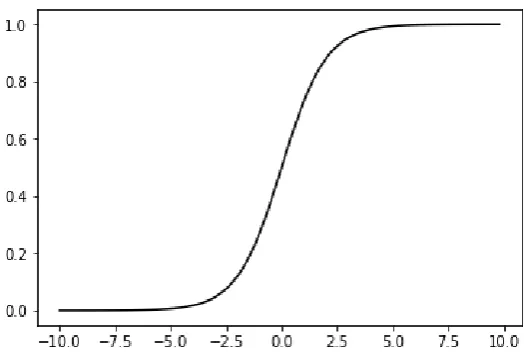
−𝑥The sigmoid function has a distinctive s-shape as shown in figure six. This shows that the sigmoid function is a ‘squashing function’. A large range of values are squashed into the
range of 0 and 1. This value indicates the probability that a given input belongs to a certain
output class. Since this value is calculated for each neuron in the output layer separately this
function can handle the data used to train the model. The classification task that needs to be
performed to control the binding in the blackboard architecture is one in which each input can
be related to multiple output categories simultaneously. This is called a multi-label
[image:17.595.74.339.320.501.2]classification task.
Figure 6: The sigmoid function
All of the FFN models that were used in this study only differ with respect to the size
of the hidden layer. The middle section of the connections structure in figure five becomes
smaller as the number of nodes decreases. This also decreases the number of connections that
are made between the three layers. The final model that was tested consisted of only two
layers, an input and an output layer. This connection structure is pictured in figure 11. Such a
connection structure in which the input directly passes through to the output layer is called a
perceptron model. The process through which a perceptron model learns is different compared
to that of the FFN model described above. A perceptron model does not have a hidden layer
of neurons. It can only handle data that can be separated in a linear manner. This is directly related to the classification task a model needs to perform. There are two forms of
18 AND and OR classification. These two types of classification will be illustrated with a
perceptron model consisting of two layers illustrated in figure seven. In the first layer there
are two neurons; x and y. The last layer consists of 1 neuron which is the output of the model.
[image:18.595.72.222.521.655.2]All of the neuron can have a value of 1 or 0.
Figure 7: Simple perceptron with two input nodes: x and y.
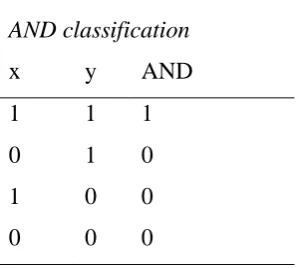
For the AND classification the neuron in the output layer will have a value of 1 if both
the x and y neuron have a value of 1. This gives the following input space as shown in figure
8. In table 1 the result of the different combination of x and y on with the AND classification
are given. These points can be plotted as x,y coordinates. In figure eight this is translated to a
dot for the output value being 0 and triangle for an output value of 1. The red line shows that
for this input space, a linear line can separate the dots from the triangle.
Table 1.
AND classification
x y AND
1 1 1
0 1 0
1 0 0
0 0 0
Figure 8: Input space for AND classification. A single line can separate the two classes: dots and
19 The second example of classification that a perceptron model can handle is OR
classification. In this case the output of the model becomes 1 when either the x or y node is a
1. This gives the following output as sees in table 2. In contrast to the AND classification this
type of classification results in more values of 1. In figure nine this translates to more
triangles. However, the triangles can still be separated from the dots with one linear line.
Figure 9: Input space for OR classification. This type of classification is linearly separable as shown by the red
line separating the triangles from the dot.
The exclusive/or (EXOR) classification however cannot be separated in a linear
manner and can therefore not be classified by a perceptron model. For this classification task
the output neuron in the perceptron neuron should take the value of 1 if only x or only y has a
value of 1. Figure 10 shows that a single line cannot separate the two classes in the input
space.
Figure 10: Input space for EXOR classification. Not linearly separable with a single line.
Table 2.
OR classification
x y OR
1 1 1
0 1 1
1 0 1
0 0 0
Table 3.
EXOR classification
x y EXOR
1 1 0
0 1 1
1 0 1
20 The data used in this study was assumed to not be linear separable and therefore it was
expected that this perceptron model could not correctly serve as a control network for the
NBA. The perceptron model that was used is shown in figure 11. An input layer with 11
nodes, one for each class in the input data is directly connected to the output layer of 14
nodes. Again, there is one node for each class of the output data. The specific classes in the
dataset are discussed in the next section.
21
4. Method
In this section the specific in- and output data that were used to model the binding
tasks are described. The training and test sentences are given and the way they were encoded
to be used by the model is explained. Lastly, the procedure of training the networks and the
way in which the networks were evaluated is reported.
4.1 Categories in the in- and output data
The number of nodes in the in-and output layers of the FFN and perceptron model
correspond to the number of binding categories that were used. For the input data the different
categories and the corresponding nodes in the model are given in table four. The first two
nodes in the input layer are dedicated to starting and ending sentences structures. Similar to
the study by van der Velde & de Kamps (2006) there are nodes for nouns with a possible
relative clause, nouns with a complement clause, verbs and clauses. In addition to these nodes there are five conditional nodes. These conditional nodes cannot be input to the network
directly but have to be activated by output first. They then remain active until input either
satisfies the condition for the conditional node or new input terminates the activation of the
conditional node. An example of how this works is described above in the section on control
in the NBA.
Table 4.
Binding categories in the training data
Input layer FFNN
Symbol Meaning Node number
B Begin S 1
E End S 2
Nrc Noun with possible relative clause 3
Ncc Noun with possible complement clause 4
V Verb (all verbs have themes) 5
C Clause (clause word: that, who) 6
T Theme conditional node 7
CC Complement Clause conditional node 8
CV Clause-verb conditional node 9
CT Clause-theme conditional node 10
22 For the output layer the first two nodes are dedicated for activating and deactivating
structure assemblies. In table five the categories and their corresponding node number are
presented. Next there two nodes that encode a noun as either the subject of the sentence as a
whole (N-n-S) or as the subject of an embedded clause within the sentence (N-n-C). For
binding of a noun as the theme of a verb there is the N-t-V node. The next three nodes are
used to bind verbs in the main sentence v-S), verb as the verb of an embedded clause
(V-v-C) and clause as a theme of a verb (V-t-C). Binding of a clause as a relative or complement
clause to a noun is done with the C-c-N node. Similarly to the input layer the remaining nodes
are the conditional ones.
Table 5.
Output symbols (representing output nodes in FFNN)
Output layer FFNN
Symbol Meaning Node number
S Activate S assembly 1
-S Deactivate S assembly 2
N-n-S Binding N-n-S: noun as subject of sentence 3
N-n-C Binding N-n-C: noun as subject of clause 4
N-t-V Binding N-t-V: noun as theme (object) of verb 5 V-v-S Binding V-v-S: verb as verb of sentence 6
V-v-C Binding V-v-C: verb as verb of clause 7
V-t-C Binding V-t-C: Clause word as theme of verb 8
C-c-N Binding C-c-N: Clause as RC or CC of noun 9
T T conditional node 10
CC CC conditional node 11
CV CV conditional node 12
CT CT conditional node 13
RC RC conditional node 14
4.2 Training and testing data
The data that was used to train the network consisted of a set of training sentences that
noun-23 verb-noun sentences and sentences with an embedded clause. The set of sentences that were
used were taken from a paper in which the control is also learned (van der Velde & de Kamps,
2010). Since the neural network cannot process words and sentences directly these were
encoded as binary vectors. The input arrays consisted of 11 indices where each index
corresponds to one of the binding symbols. This also counts for the output arrays that consist
of 14 indices. The index corresponding to the correct binding symbol for a certain word
would be encoded as a one and the remaining indices were encoded as zeros. This resulted in
arrays as shown in table six. All of the training sentences were stored in a .csv file so it could
be read into Python. The complete training and testing data sets can be found in appendix two.
Table 6
Encoding of the data
Binding symbols Active nodes Binary encoding
Nrc (input example) 3 0,0,1,0,0,0,0,0,0,0,0
N-n-S, RC (output example) 3, 14 0,0,1,0,0,0,0,0,0,0,0,0,0,1
The set of seven test sentences were created so that all the required input-output
relations for N-V-N sentences and sentences with an embedded clause were introduced. In
total the training set contained three N-V-N sentences and four sentences with an embedded
clause. Appendix three contains tables for each of these sentences and the exact input-output
relations that were trained and tested. In table seven, the seven sentences that were used to
train the model are given. The first three sentences are N-V-N structures that introduce nouns
with a possible relative clause (cat), verbs and nouns with a complement clause (fact). These two different nouns are both introduced in the subject as well as the object position. The
remaining sentences introduce the relations needed to bind embedded clauses in the sentence
structures.
Table 7.
Set of training sentences that were used for training the network on the input-output relations.
Sentence Type
24
Fact worries cat N-V-N: Noun with possible complement
clause in object position.
Cat knows fact N-V-N: Noun with possible complement
clause in subject position.
Cat that chases mouse sees dog Embedded clause: subject relative Cat that dog sees chases mouse Embedded clause: object relative
Cat who fact worries chases mouse Embedded clause: object relative with Noun with possible complement clause word.
Fact that cat chases mouse worries dog Embedded clause: Complement clause
In table eight the sentences that were used for evaluating the trained models are
shown. These sentences are extensions of the clauses used in the trainings set. In the first test
sentence cat that chases mouse that likes boy sees dog, there are two relative clauses. The theme of the first relative clause, cat that chases, is the relative clause mouse that likes boy. In the second test sentence, cat sees dog that chases mouse, the relative clause is on the
object/theme position. The relative clause dog that chases mouse is theme of the verb sees, of which cat is the subject. The remaining sentences all have multiple embedded clauses in either the subject or object position with the last four sentences combining both complement
and relative clauses. The binding that has to occur changes based on whether the complement
or relative clause is first in the sentence as well as whether the clause is in the object or
subject position in the sentence structure.
Table 8.
Set of test sentences that were used for testing the network on the input-output relations. Sentence
Cat that chases mouse that likes boy sees dog Multiple subject relative clause in subject position
Cat sees dog that chases mouse Subject relative clause in object position
Cat that dog that boy likes sees chases mouse Multiple object relative clauses in object position
25
Fact that cat that boy likes chases mouse worries dog Complement clause with object relative clause in subject position
Dog knows fact that cat that boy likes chases mouse Complement clause with object relative clause in object position
Cat who fact that boy likes dog worries chases mouse Object relative clause with complement clause in subject
position
Cat chases mouse who fact that boy likes dog worries Object relative clause with complement clause in object
position
4.3 Training of the network
The materials that were used for the simulations were a laptop with windows and
python 3.6 installed. The neural network was created with the Python language using the
Keras deep learning library (Chollet, 2015). Programming of the neural network was mainly
done on Jupyter Notebook which allows for quick interactive sessions. The training and
testing data were stored in a .csv file. The code and the training and testing data can be found
in appendix one and two.
The network was trained by feeding the data in a string of arrays to the model. As a
training method the method as described by Elman (1993) was used. This entails that the
training is performed in several phases. Furthermore, in the study by van der Velde & de
Kamps (2010) this method is also applied. Therefore the training was performed in two phases. In the first phase only the simple sentences are trained, in this case these are the
noun-verb-noun sentences. The second phase consisted of training with all of the sentences so both
the N-V-N sentences and the sentences with an embedded clause. Each of these phases
consisted of training with 50.000 epochs. An epoch is an iteration of the model of all of the
data points in the trainings dataset. After the training in the first phase the model was saved
and the weights were stored so they could be loaded for the training in the second phase.
After the two phase training to replicate the study by van der Velde & de Kamps
(2010) effort was given to evaluate the configuration of the model. Mainly the number of
nodes in the hidden layer were adjusted to see the effect of this on the performance of the
model. It was assumed that the number of hidden nodes was quite high compared with the
input and output layer. Having too many nodes in the hidden layer can result in overfitting.
26 nodes to evaluate at what point the performance started to be affected. The smallest model
that was used consisted of only two layers; an input layer and an output layer. Since there is
no hidden layer in this version it is no longer a multilayer FFN, but simply a perceptron
model. The connection structure of this model is shown in figure 11. The process of training
the models was exactly as described above.
4.4 Evaluation
The neural network will be evaluated by how well it performs on the set of test
sentences. Since this simulation is a replication of the study by van der Velde and de Kamps
(2010) the network output will be directly compared with the results from that study in which
a threshold of .9 was used as minimum activation for desired nodes. Moreover, the other
nodes that are not relevant for a given input-output relation should have activation no higher
than .1. For every input-output relation in the test set the activation levels were collected and
manually checked for adequate activation or spurious activation. In addition to the specific
activation levels the accuracy and loss as reported by Keras will be used as determiners of the
performance of the network. The accuracy is a measure of the amount of correct predictions
the model has made. The loss value is a measure of the distance between the desired output
and the output the model computes during the training epochs.
The effect of the hidden layer size was evaluated by running the set of set sentences
for each model. The accuracy of these models was compared to judge any performance
differences. Additionally, the performance of the model without a hidden layer was inspected
in the same manner as the original model. This was done to investigate in more detail whether
a simple perceptron model is capable of controlling the binding process for the NBA. The
number of correct activations and spurious activations were evaluated for several models for
comparison. With these numbers the proportion of correct activations in relation to all the
activation of a model was calculated with a simple formula; correct activations / (required
activations (170) + number of spurious activations). A perfect model would correctly activate
all required nodes and make no spurious activations and therefore have a proportion correct of
170 / (170 + 0) = 1.0. For example a model that made 5 failed activations and 2 spurious
activations would give: 170 + 2 = 172 total activations. Of these 172, 7 were incorrect giving
27
5. Results
5.1 Performance on training data
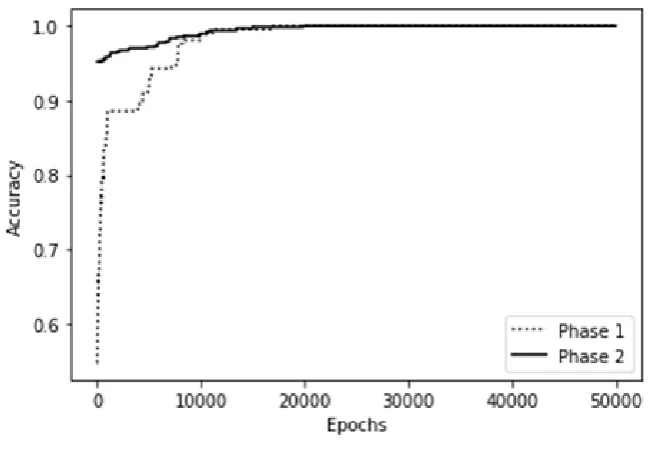
After the two phases of training the model reported an accuracy of 1.0 and a loss of
0.0015. The maximum accuracy of 1.0 is already reached after approximately 20.000 epochs
in both phases. The accuracy of the model during the training is shown in figure 12. After
introducing the new sentences with an embedded clause for phase 2 the accuracy initially
dropped to .93. This is to be expected when new input-output relations are introduced. With
the new data added the accuracy reached 1.0 after approximately 20.000 epochs. The loss kept
decreasing until it reached 0.0017 after 50.000 epochs. This accuracy is considered very high
and may be an indication of overfitting. Overfitting occurs when the model overoptimizes on
the set of training data and learns all the specifics of the training set that cannot be generalized
to other new data (Chollet, 2018). This would lead to less predictive power for the test data.
The input-output relations in the training set are learned to perfection and are therefore classified correctly when fed to the model after training. For every output the activation for
each node ranges between 0 and 1. The correct outputs are produced by the model for the
training set with activation levels above 0.9 and there are no spurious activations (< 0.1). This
is similar to the results by van der Velde & de Kamps (2010). The next step to determine the
performance of the model was to test it with the set of test sentences. These sentences are
[image:27.595.73.402.481.707.2]based on the training set with different combinations and extensions of the clauses.
28
5.2 Performance on test data
Evaluation of the fully trained model in Keras gives an accuracy of .99 and a loss of
0.066 for the test data. These results are comparable to the results on the training data and
therefore it seems the model has not overfit. The output activation for each word in the set of
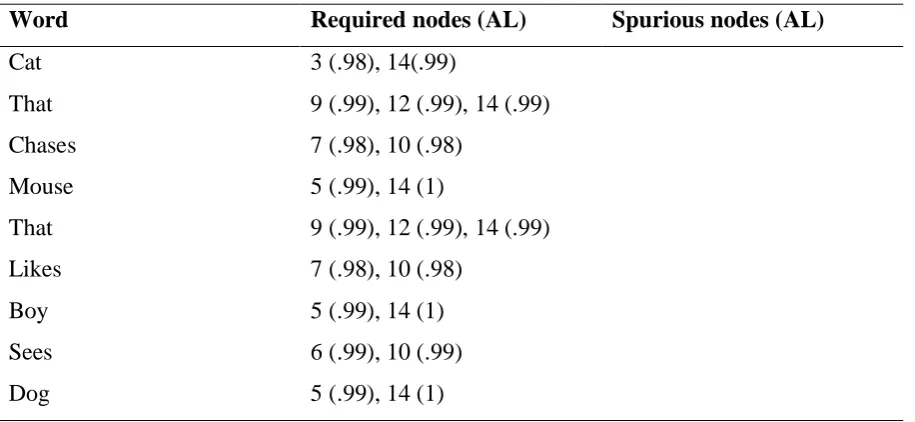
test sentences was evaluated to see the performance in detail.
The first sentence in the test set is an extension of a sentence with an embedded clause
in which the theme in a relative clause also has a relative clause. The trained model produced
the correct output for this sentence. Every required output node had an activation higher than
0.9 and the other nodes were all below 0.1 meaning that there was no spurious activation. The
[image:28.595.72.530.352.563.2]exact activation levels for each input are given in table nine.
Table 9
Activation levels (AL) as given by the model with 12 hidden nodes for the test sentence: Cat that chases mouse that likes boy sees dog.
Word Required nodes (AL) Spurious nodes (AL)
Cat 3 (.98), 14(.99)
That 9 (.99), 12 (.99), 14 (.99)
Chases 7 (.98), 10 (.98)
Mouse 5 (.99), 14 (1)
That 9 (.99), 12 (.99), 14 (.99)
Likes 7 (.98), 10 (.98)
Boy 5 (.99), 14 (1)
Sees 6 (.99), 10 (.99)
Dog 5 (.99), 14 (1)
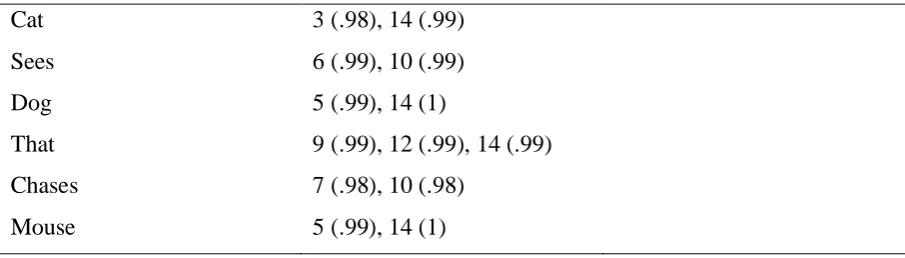
The second sentence in the test set, Cat sees dog that chases mouse, has a subject relative clause in the object position. The model was only trained with subject relative clauses
in the subject position. However, the trained model correctly activated the required nodes with
levels above 0.9 and again no spurious activations as shown in table 10 .
Table10
Activation levels (AL) as given by the model with 12 hidden nodes for the test sentence: Cat sees dog that chases mouse.
29
Cat 3 (.98), 14 (.99)
Sees 6 (.99), 10 (.99)
Dog 5 (.99), 14 (1)
That 9 (.99), 12 (.99), 14 (.99)
Chases 7 (.98), 10 (.98)
Mouse 5 (.99), 14 (1)
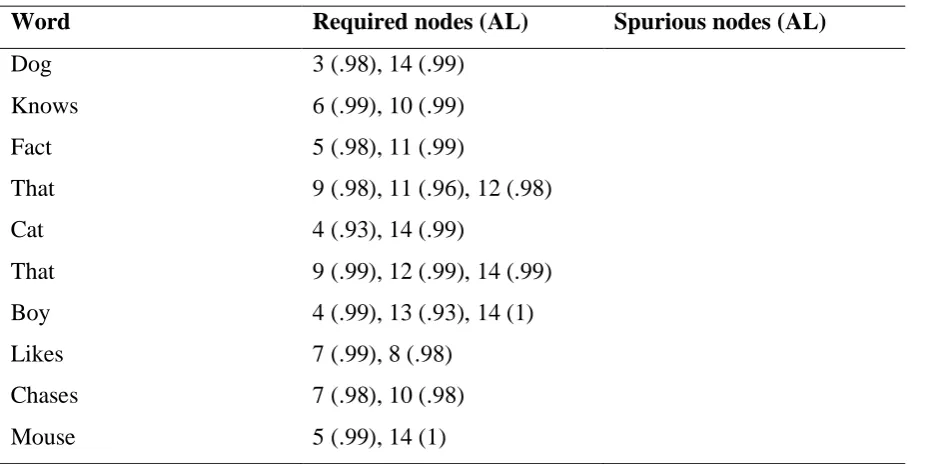
The third sentence in the test set is one with a multiple object-relative clause and is
difficult for humans to understand (van der Velde & de Kamps, 2010). However, the model
was able to correctly activate the required binding categories for all the input-output relations.
[image:29.595.71.524.69.198.2]There were no spurious activation and all the required activation were above 0.9 as shown in
[image:29.595.71.533.402.612.2]table 11.
Table 11
Activation levels (AL) as given by the model with 12 hidden nodes for the test sentence: Cat that dog that boy likes sees chases mouse.
Word Required nodes (AL) Spurious nodes (AL)
Cat 3 (.98), 14(.99)
That 9 (.99), 12 (.99), 14 (.99)
Dog 4 (.99), 13 (.93), 14 (1)
That 9 (.99), 12 (.99), 14 (.99)
Boy 4 (.99), 13 (.93), 14 (1)
Likes 7 (.99), 8 (.98)
Sees 7 (.99), 8 (.98)
Chases 6 (.99), 10 (.99)
Mouse 5 (.99), 14 (1.0)
In table 12 the activation levels for the test sentence, Cat chases mouse that dog that boy likes sees, are given. Again all the required nodes are activated with levels above .9 and there are no spurious activations.
30
Activation levels (AL) as given by the model with 12 hidden nodes for the test sentence: Cat chases mouse that dog that boy likes sees.
Word Required nodes (AL) Spurious nodes (AL)
Cat 3 (.98), 14(.99)
Chases 6 (.99), 10 (.99)
Mouse 5 (.99), 14 (1)
That 9 (.99), 12 (.99), 14 (.99)
Dog 4 (.99), 13 (.93), 14 (1)
That 9 (.99), 12 (.99), 14 (.99)
Boy 4 (.99), 13 (.93), 14 (1)
Likes 7 (.99), 8 (.98)
Sees 7 (.99), 8 (.98)
For the test sentence: Fact that cat that boy likes chases mouse worries dog all input-output relations were processed correctly by the trained model. All with activations above 0.9
[image:30.595.69.535.111.322.2]and without spurious activation as shown in table 13.
Table 13
Activation levels (AL) as given by the model with 12 hidden nodes for the test sentence: Fact that cat that boy likes chases mouse worries dog.
Word Required nodes (AL) Spurious nodes (AL)
Fact 3 (.99), 11 (.99)
That 9 (.98), 11 (.96), 12 (.98)
Cat 4 (.93), 14 (.99)
That 9 (.99), 12 (.99), 14 (.99)
Boy 4 (.99), 13 (.93), 14 (1)
Likes 7 (.99), 8 (.98)
Chases 7 (.98), 10 (.98)
Mouse 5 (.99), 14 (1)
Worries 6 (.99), 10 (.99)
Dog 5 (.99), 14 (1)
31 binding categories are activated by the trained model. All of the activation are higher than .9
and therefore sufficient to create the appropriate bindings. No other nodes were activated with
[image:31.595.71.535.213.445.2]a level higher than .1 meaning there is no spurious activation for this sentence structure.
Table 14
Activation levels (AL) as given by the model with 12 hidden nodes for the test sentence: Dog knows fact that cat that boy likes chases mouse.
Word Required nodes (AL) Spurious nodes (AL)
Dog 3 (.98), 14 (.99)
Knows 6 (.99), 10 (.99)
Fact 5 (.98), 11 (.99)
That 9 (.98), 11 (.96), 12 (.98)
Cat 4 (.93), 14 (.99)
That 9 (.99), 12 (.99), 14 (.99)
Boy 4 (.99), 13 (.93), 14 (1)
Likes 7 (.99), 8 (.98)
Chases 7 (.98), 10 (.98)
Mouse 5 (.99), 14 (1)
In the remaining sentences in the test set there are some outputs that the model did not
activate correctly. For the sentence, Cat who fact that boy likes dog worries chases mouse, an error was made by the model. Firstly, for the verb likes the wrong binding categories were activated. The verb is correctly bound as the verb of a clause (V-v-C). However, the node for theme (T, node 10) is not correctly activated and instead the node for clause as theme of a
verb (V-t-C, node 8) is activated. This In table 15 the activation levels for these nodes is
shown.
Table 15
Activation levels (AL) as given by the model with 12 hidden nodes for the test sentence: Cat who fact that boy likes dog worries chases mouse.
Word Required nodes (AL) Spurious nodes (AL)
Cat 3 (.98), 14 (.99)
32
Fact 4 (.99), 11 (.99), 13 (.98)
That 9 (.98), 11 (.96), 12 (.98)
Boy 4 (.99), 13 (.91), 14 (1)
Likes 7 (.99), 10 (.01)* 8 (.98)
Dog 5 (.99), 14 (1)
Worries 7 (.99), 8 (.98)
Chases 6 (.99), 10 (.99)
Mouse 5 (.99), 14 (1)
Note: *AL below threshold of .9.
In the last test sentence of the test set for the verb likes the theme node (T) is not correctly activated. Instead the node for binding a clause word as theme of a verb (V-t-C) is
activated. The activation levels for this sentence are given in table 16. The error made by the
model is the same error as the one that was made in the test sentence shown in table 10. This
shows that the model was not able to learn to activate the desired nodes for these input-output
[image:32.595.73.533.486.714.2]relations. This result will be discussed more extensively in the discussion section.
Table 16
Activation levels (AL) as given by the model with 12 hidden nodes for the test sentence: Cat chases mouse who fact that boy likes dog worries.
Word Required nodes (AL) Spurious nodes (AL)
Cat 3 (.98), 14 (.99)
Chases 6 (.99), 10 (.99)
Mouse 5 (.99), 14 (1)
Who 9 (.99), 12 (.99), 14 (.99)
Fact 4 (.99), 11 (.99), 13 (.98)
That 9 (.98), 11 (.96), 12 (.98)
Boy 4 (.93), 14 (.99)
Likes 7 (.99), 10 (.01)* 8 (.98)
Dog 5 (.99), 14 (1)
Worries 7 (.99), 8 (.98)
33 With the exception of the last two sentences the results of van der Velde and de
Kamps (2010) could be replicated. The first six sentences of the test set are processed without
any problems by the trained model. All of the bindings in these sentences proceed correctly,
under the assumption that the conditional nodes are activated in the NBA.
5.3 Effect of number of nodes in the hidden layer
After these first simulations the configuration of the model was adjusted to study the
effect on the performance. Mainly, the number of hidden nodes was lowered from the initial
twelve to no nodes/hidden layer at all. All other configurations and training steps were kept
the same as the replication with the original model described above. In figure 13 the effect on
the model accuracy is shown. For each number of nodes in the hidden layer the performance
for processing the set of training and test sentences was evaluated. The change in accuracy
across the varying amount of hidden neurons is slightly erratic. With as little as seven hidden
nodes the accuracy of the model for the predicting the test data remains near perfect. It is only
with less than six nodes that the accuracy starts to drop but not in a significant amount. The
accuracy stays well above a level of .96 until a model with only three nodes in the hidden
layer. The model with a hidden layer consisting of one or two hidden nodes has the lowest
accuracy. Even lower than a model that has no hidden layer at all. In fact, the model in which
the hidden layer was completely omitted showed a performance similar to the original model
with a hidden layer consisting of 12 nodes.
34 The loss, shown in figure 14, shows a similar pattern across the varying hidden layer
sizes. Loss is the highest for the models with one and two hidden nodes. For hidden layer
sizes between seven and twelve the loss remains relatively low. In parallel with the accuracy,
the loss for the model without a hidden layer is similar to that of the original model with
[image:34.595.75.386.180.383.2]twelve hidden nodes.
Figure 14. Loss shown per model with different number of nodes in the hidden layer.
To investigate the effect of the hidden layer even further all of the test sentences where
processed with the model with zero hidden nodes. The accuracy for this model is just as high
as a model with as many as 12 hidden nodes. This is quite remarkable and therefore all
input-output relations in the test set are examined below. The connection structure of the model
without a hidden layer is shown in figure 12 in the architectures section. This shows that each
input node is directly connected to all nodes in the output layer. The input data thus, does not
pass through a hidden layer first.
In table 17 the first sentence is presented; Cat that chases mouse that likes boy sees dog. All the required nodes are activated with sufficient levels of activation (> .9). However, in two cases there is spurious activation. For chases and likes the eighth node is spuriously activated with a level of .1. This node should only be activated when theword is a clause
word as a theme of a verb. This sentence did not present these difficulties for the original
model with a hidden layer consisting of 12 nodes.
35
Activation levels (AL) as given by the model with 0 hidden nodes for the test sentence: Cat that chases mouse that likes boy sees dog.
Word Required nodes (AL) Spurious nodes (AL)
Cat 3 (.95), 14(.99)
That 9 (.98), 12 (.99), 14 (.97)
Chases 7 (.93), 10 (.91) 8 (.10)
Mouse 5 (.99), 14 (.99)
That 9 (.98), 12 (.98), 14 (.96)
Likes 7 (.93), 10 (.91) 8 (.10)
Boy 5 (.99), 14 (.99)
Sees 6 (.98), 10 (.99)
Dog 5 (.99), 14 (.99)
In table 18 the test sentence cat sees dog that chases mouse is presented. Again, for a verb, chases, node eight is spuriously activated. The rest of the binding categories are
[image:35.595.72.533.110.322.2]activated correctly.
Table 18
Activation levels (AL) as given by the model with 0 hidden nodes for the test sentence: Cat sees dog that chases mouse.
Word Required nodes (AL) Spurious nodes (AL)
Cat 3 (.95), 14(.99)
Sees 6 (.98), 10 (.99)
Dog 5 (.99), 14 (.99)
That 9 (.98), 12 (.98), 14 (.96)
Chases 7 (.93), 10 (.91) 8 (0.10)
Mouse 5 (.99), 14 (.99)
36 clause theme. For dog and boy the activation level is .8. additionally, For the two verbs, likes and sees in this test sentence there is an insufficient activation level for node 8.
Table 19
Activation levels (AL) as given by the model with 0 hidden nodes for the test sentence: Cat that dog that boy likes sees chases mouse.
Word Required nodes (AL) Spurious nodes (AL)
Cat 3 (.95), 14(.99)
That 9 (.98), 12 (.98), 14 (.96)
Dog 4 (.87)*, 13 (.80)*, 14 (.99)
That 9 (.98), 12 (.98), 14 (.96)
Boy 4 (.87)*, 13 (.80)*, 14 (.99)
Likes 7 (.99), 8 (.89)*
Sees 7 (.99), 8 (.89)*
Chases 6 (.98), 10 (.99)
Mouse 5 (.99), 14 (.99)
Note: * AL below the threshold of .9.
As shown in table 20, for the next test sentence the model with no hidden layer makes
the same mistakes as earlier. Namely, the activation levels for nodes 4 and 13 for two noun
inputs are insufficient. And node 8 is not activated adequately for a verb input. The model
[image:36.595.70.538.194.403.2]with a hidden layer of 12 nodes processed this test sentence without any difficulties.
Table 20
Activation levels (AL) as given by the model with 0 hidden nodes for the test sentence: Cat chases mouse that dog that boy likes sees.
Word Required nodes (AL) Spurious nodes (AL)
Cat 3 (.95), 14(.99)
Chases 6 (.98), 10 (.99)
Mouse 5 (.99), 14 (.99)
That 9 (.98), 12 (.98), 14 (.96)
Dog 4 (.87)*, 13 (.80)*, 14 (.99)
37
Boy 4 (.87)*, 13 (.80)*, 14 (.99)
Likes 7 (.99), 8 (.89)*
Sees 7 (.99), 8 (.89)*
Note: *AL below .9.
Activation levels for fact that cat that boy likes chases mouse worries dog are shown in table 21. The model without hidden layer has made several mistakes in processing this sentence. The first occurs at the clause word that. Here, node 11 has an insufficient activation level of .88. The next word in the sentence, cat, is also not processed correctly. Firstly, node 4 has a low activation (.63). Secondly, there is spurious activation for node 3 (AL .15). For the
word boy the same activation levels before are reported. Node 4 and 13 have insufficient activation levels. Lastly, there is a slightly too low activation for node 8 at the verb likes and there is spurious activation for the verb chases.
[image:37.595.75.525.422.655.2]
Table 21
Activation levels (AL) as given by the model with 0 hidden nodes for the test sentence: Cat chases mouse that dog that boy likes sees.
Word Required nodes (AL) Spurious nodes (AL)
Fact 3 (.95), 11 (.99)
That 9 (.98), 11 (.88)*, 12 (.97)
Cat 4 (.63)*, 14 (.97) 3 (.15)
That 9 (.98), 12 (.98), 14 (.96)
Boy 4 (.87)*, 13 (.80)*, 14 (.99)
Likes 7 (.99), 8 (.89)*
Chases 7 (.93), 10 (.91) 8 (.10)
Mouse 5 (.99), 14 (.99)
Worries 6 (.98), 10 (.99)
Dog 5 (.99), 14 (.99)
Note: *AL below .9.
38 word in the sentence could be part of a complement clause. However, the activation is
insufficient at a level of .88. the next word cat should then be bound as a noun as the subject of a clause (N-n-C, node 4). This binding fails due to an activation level of .63, which is too
low. Additionally, the node for binding a noun as the subject of a sentence structure is
spuriously activated (AL .15 for node 3). Another two insufficient activations occur at the
noun boy. Node three and 13 are both too low which means boy is not correctly bound as a noun as subject of a clause (N-n-C). Additionally, the clause theme conditional node is not
activated. This would result in a failure to bind the embedded clause cat that boy likes in which boy is the theme of likes. This is also reflected in the fact that at likes the node for binding a word as the theme of a verb (V-t-C) is not sufficiently activated (AL for node 8 =
[image:38.595.72.532.381.611.2].89). Lastly, in this sentence structure node 8 is spuriously activated for chases.
Table 22
Activation levels (AL) as given by the model with 0 hidden nodes for the test sentence: Dog knows fact that cat that boy likes chases mouse.
Word Required nodes (AL) Spurious nodes (AL)
Dog 3 (.95), 14 (.99)
Knows 6 (.98), 10 (.99)
Fact 5 (.98), 11 (.99)
That 9 (.98), 11 (.88)*, 12 (.97)
Cat 4 (.63)*, 14 (.96) 3 (.15)
That 9 (.98), 12 (.98), 14 (.96)
Boy 4 (.87)*, 13 (.80)*, 14 (.99)
8Likes 7 (.99), 8 (.89)*
Chases 7 (.93), 10 (.91) 8 (.10)
Mouse 5 (.99), 14 (.99)
Note: *AL below .9.
In table 23 the activation output for cat who fact that boy likes dog worries chases is shown. This is also the first of the two sentences that was not processed correctly by the
original model with 12 hidden nodes. The activation levels follow a similar pattern to those of
the sentences presented above. There is a combination of activation levels that do not reach
39 with a too low activation level of .88. At fact a clause theme should also be anticipated with the conditional node CT (node 13). Again, this binding fails.
Table 23
Activation levels (AL) as given by the model with 0 hidden nodes for the test sentence: Cat who fact that boy likes dog worries chases mouse.
Word Required nodes (AL) Spurious nodes (AL)
Cat 3 (.95), 14 (.99)
Who 9 (.98), 12 (.98), 14 (.96)
Fact 4 (.88)*, 11 (.98), 13 (.87)*
That 9 (.98), 11 (.88)*, 12 (.97)
Boy 4 (.99), 13 (.90), 14 (.96) 5 (.22), 12 (.10)
Likes 7 (.99), 10 (.07)* 8 (.89)
Dog 5 (.99), 14 (.99)
Worries 7 (.99), 8 (.89)*
Chases 6 (.98), 10 (.99)
Mouse 5 (.99), 14 (.99)
Note: *AL below .9.
The activation levels as given by the model with zero hidden nodes for the test
[image:39.595.73.531.194.428.2]sentence cat chases mouse who fact that boy likes dog worries are given in table 24. At the input word fact the first error occurs. The activation levels for node four and 13 are too low. Another node that is not sufficiently activated is node 11 for the input word that. For boy there is both too little activation and spurious activation. The same counts for the verb likes. Here the same error occurs as with the model with 12 hidden nodes.
Table 24
Activation levels (AL) as given by the model with 0 hidden nodes for the test sentence: Cat chases mouse who fact that boy likes dog worries.
Word Required nodes (AL) Spurious nodes (AL)
Cat 3 (.95), 14 (.99)
Chases 6 (.98), 10 (.99)
40
Who 9 (.98), 12 (.98), 14 (.97)
Fact 4 (.88)*, 11 (.98), 13 (.87)*
That 9 (.98), 11 (.88)*, 12 (.97)
Boy 4 (.63)*, 14 (.97) 3 (.15)
Likes 7 (.99), 10 (.07)* 8 (.89)
Dog 5 (.99), 14 (.99)
Worries 7 (.99), 8 (.89)*
Note: *AL below .9.
After reviewing the activation levels for every input-output relation in the test set for
both the model with 12 hidden nodes and the model without a hidden layer, it becomes clear
that the latter is off on way more activations than the former. Where the original model
processed 6 of the 8 test sentences flawlessly, the model without a hidden layer made
mistakes in every sentence. In table 25 some descriptive statistics regarding the models are
presented. The performance of the models is indicated with the number of unsuccessful
bindings and spurious bindings. The model with a hidden layer size of 12 nodes had too low
activation levels for two nodes. On the other hand, the model without a hidden layer made 33 inadequate activations. However, the model without a hidden layer is not the worst
performing model. As can be seen in table 25 and figure 15, the models with ranging from
one to four and the models with six or seven nodes all perform worse. All of these models
have a higher number of failed bindings, more spurious bindings and therefore a lower
proportion correct out of the total activations made. That being said, this analyse paints a
different picture than the accuracy as reported by Keras. The model without a hidden layer is
[image:40.595.71.515.641.767.2]not capable of flawlessly controlling the binding for the NBA according to these criteria.
Table 25
Overview of the models based on number of failed activations, spurious activations and proportion correct activations.
Model Number of
failed bindings;
AL < .9
Number of spurious
bindings;
AL > .1
Proportion correct
activations out of total
activations
12 hidden nodes 2 2 0.98
11 hidden nodes 2 9 0.94
41
9 hidden nodes 14 7 0.88
8 hidden nodes 3 4 0.96
7 hidden nodes 44 13 0.69
6 hidden nodes 76 86 0.37
5 hidden nodes 19 17 0.81
4 hidden nodes 64 86 0.41
3 hidden nodes 76 62 0.41
2 hidden nodes 170 385 0
1 hidden node 129 417 0.07
No hidden layer 33 12 0.75
[image:41.595.75.461.214.549.2]