warwick.ac.uk/lib-publications
Manuscript version: Author’s Accepted Manuscript
The version presented in WRAP is the author’s accepted manuscript and may differ from the
published version or Version of Record.
Persistent WRAP URL:
http://wrap.warwick.ac.uk/111734
How to cite:
Please refer to published version for the most recent bibliographic citation information.
If a published version is known of, the repository item page linked to above, will contain
details on accessing it.
Copyright and reuse:
The Warwick Research Archive Portal (WRAP) makes this work by researchers of the
University of Warwick available open access under the following conditions.
Copyright © and all moral rights to the version of the paper presented here belong to the
individual author(s) and/or other copyright owners. To the extent reasonable and
practicable the material made available in WRAP has been checked for eligibility before
being made available.
Copies of full items can be used for personal research or study, educational, or not-for-profit
purposes without prior permission or charge. Provided that the authors, title and full
bibliographic details are credited, a hyperlink and/or URL is given for the original metadata
page and the content is not changed in any way.
Publisher’s statement:
Please refer to the repository item page, publisher’s statement section, for further
information.
ID2S Password-Authenticated Key Exchange
Protocols
Xun Yi, Fang-Yu Rao, Zahir Tari, Feng Hao, Elisa Bertino, Ibrahim Khalil and Albert Y. Zomaya
Abstract—In two-server password-authenticated key exchange (PAKE) protocol, a client splits its password and stores two shares of its password in the two servers, respectively, and the two servers then cooperate to authenticate the client without knowing the password of the client. In case one server is compromised by an adversary, the password of the client is required to remain secure. In this paper, we present two compilers that transform any two-party PAKE protocol to a two-server PAKE protocol on the basis of the identity-based cryptography, called ID2S PAKE protocol. By the compilers, we can construct ID2S PAKE protocols which achieve implicit authentication. As long as the underlying two-party PAKE protocol and identity-based encryption or signature scheme have provable security without random oracles, the ID2S PAKE protocols constructed by the compilers can be proven to be secure without random oracles. Compared with the Katz et al.’s two-server PAKE protocol with provable security without random oracles, our ID2S PAKE protocol can save from 22% to 66% of computation in each server.
Index Terms—Password-authenticated key exchange, identity-based encryption and signature, Diffie-Hellman key exchange, decisional Diffie-Hellman problem
F
1
I
NTRODUCTIONT
Osecure communications between two parties, an au-thenticated encryption key is required to agree on in advance. So far, two models have existed for authenticated key exchange. One model assumes that two parties already share some cryptographically-strong information: either a secret key which can be used for encryption/authentication of messages, or a public key which can be used for encryp-tion/signing of messages. These keys are random and hard to remember. In practice, a user often keeps his keys in a personal device protected by a password/PIN. Another model assumes that users, without help of personal devices, are only capable of storing “human-memorable” passwords. Bellovin and Merritt [4] were the first to introduce password-based authenticated key exchange (PAKE), where two parties, based only on their knowledge of a password, establish a cryptographic key by exchange of messages. A PAKE protocol has to be immune to on-line and off-line dic-tionary attacks. In an off-line dicdic-tionary attack, an adversary exhaustively tries all possible passwords in a dictionary in order to determine the password of the client on the basis of the exchanged messages. In on-line dictionary attack, an adversary simply attempts to login repeatedly, trying each possible password. By cryptographic means only, none of PAKE protocols can prevent on-line dictionary attacks. But on-line attacks can be stopped simply by setting a threshold to the number of login failures.• Xun Yi, Zahir Tari and Ibrahim Khalil are with the School of Computer Science and IT, RMIT University, Melbourne, Australia.
• Fang-Yu Rao and Elisa Bertino are with the Department of Computer Science, Purdue University, USA.
• Feng Hao is with the School of Computing Science, Newcastle University, UK.
• Albert Y. Zomaya is with the School of Information Technologies, Univer-sity of Sydney, Australia.
Since Bellovin and Merritt [4] introduced the idea of PAKE, numerous PAKE protocols have been proposed. In general, there exist two kinds of PAKE settings, one assumes that the password of the client is stored in a single server and another assumes that the password of the client is distributed in multiple servers.
PAKE protocols in the single-server setting can be classi-fied into three categories as follows.
Password-only PAKE: Typical examples are the “encrypted key exchange” (EKE) protocols given by Bellovin and Mer-ritt [4], where two parties, who share a password, exchange messages encrypted by the password, and establish a com-mon secret key. The formal model of security for PAKE was firstly given in [3], [8]. Based on the security model, PAKE protocols [1], [2], [5], [10], [11], [16], [20], [22] have been proposed and proved to be secure.
PKI-based PAKE: PKI-based PAKE protocol was first given by Gong et al. [17], where the client stores the server’s public key in addition to share a password with the server. Halevi and Krawczyk [18] were the first to provide formal definitions and rigorous proofs of security for PKI-based PAKE.
ID-based PAKE: ID-based PAKE protocols were proposed by Yi et al. [32], [33], where the client needs to remember a password in addition to the identity of the server, whereas the server keeps the password in addition to a private key related to its identity. ID-based PAKE can be thought as a trade-off between password-only and PKI-based PAKE.
2
To address this problem, the multi-server setting for PAKE was first suggested in [15], [19], where the password of the client is distributed innservers. PAKE protocols in the multi-server setting can be classified into two categories as follows.
Threshold PAKE: The first PKI-based threshold PAKE pro-tocol was given by Ford and Kaliski [15], where nsevers, sharing the password of the client, cooperate to authenticate the client and establish independent session keys with the client. As long asn−1or fewer servers are compromised, their protocol remains secure. Jablon [19] gave a protocol with similar functionality in the password-only setting. MacKenzie et al. proposed a PKI-based threshold PAKE protocol which requires onlytout ofnservers to cooperate in order to authenticate the client. Their protocol remains secure as long ast−1 or fewer servers are compromised. Di Raimondo and Gennaro [26] suggested a password-only threshold PAKE protocol which requires fewer than 1/3 of the servers to be compromised.
Two-server PAKE: Two-server PKI-based PAKE was first given by Brainard [9], where two servers cooperate to au-thenticate the client and the password remains secure if one server is compromised. A variant of the protocol was later proved to be secure in [27]. A two-server password-only PAKE protocol was given by Katz et al. [23], in which two servers symmetrically contribute to the authentication of the client. The protocol in the server side can run in parallel. Efficient protocols [21], [29], [30], [31] were later proposed, where the front-end server authenticates the client with the help of the back-end server and only the front-end server establishes a session key with the client. These protocols are asymmetric in the server side and have to run in sequence. Yi et al. gave a symmetric solution [34] which is even more efficient than asymmetric protocols [21], [29], [30], [31]. Recently, Yi et al. constructed an ID2S PAKE protocol with the identity-based encryption scheme (IBE) [35].
In this paper, we will consider the two-server setting for PAKE only. In two-server PAKE, a client splits its pass-word and stores two shares of its passpass-word in the two servers, respectively, and the two servers then cooperate to authenticate the client without knowing the password of the client. Even if one server is compromised, the attacker is still unable to pretend any client to authenticate against another server.
A typical example is the two-server PAKE protocol given by Katz et al. [23], which is built upon the two-party PAKE protocol (i.e., the KOY protocol [22]), where two parties, who share a password, exchange messages to establish a common secret key. Their basic two-server protocol is secure against a passive (i.e., “honest-but-curious”) adversary who has access to one of the servers throughout the protocol execution, but cannot cause this server to deviate from its prescribed behavior. In [23], Katz et al. also showed how to modify their basic protocol so as to achieve security against an active adversary who may cause a corrupted server to deviate arbitrarily from the protocol. The core of their protocol is the KOY protocol. The client looks like running two KOY protocols with two servers in parallel. However, each server must perform a total of roughly 80 exponentiations (i.e., each server’s work is increased by a factor of roughly 6 as compared to the basic protocol [23]).
In [35], a security model for ID2S PAKE protocol was given and a compiler that transforms any two-party PAKE protocol to an ID2S PAKE protocol was proposed on the basis of the Cramer-Shoup public key encryption scheme [13] and any identity-based encryption scheme, such as the Waters’ scheme [28].
Our Contribution. In this paper, we propose a new com-piler for ID2S PAKE protocol based on any identity-based signature scheme (IBS), such as the Paterson et al.’s scheme [25]. The basic idea is: The client splits its password into two shares and each server keeps one share of the password in addition to a private key related to its identity for signing. In key exchange, each server sends the client its public key for encryption with its identity-based signature on it. The signature can be verified by the client on the basis of the identity of the server. If the signature is genuine, the client submits to the server one share of the password encrypted with the public key of the server. With the decryption keys, both servers can derive the same one-time password, by which the two servers can run a two-party PAKE protocol to authenticate the client.
In addition, we generalize the compiler based on IBE in [35] by replacing the Cramer-Shoup public key encryption scheme with any public key encryption scheme. Unlike the compiler based on IBS, the compiler based on IBE assumes that each server has a private key related to its identity for decryption. In key exchange, the client sends to each server one share of the password encrypted according to the identity of the server. In addition, a one-time public key encryption scheme is used to protect the messages (containing the password information) from the servers to the client. The one-time public key is generated by the client and sent to the servers along with the password information in the first phase.
In the identity-based cryptography, the decryption key or the signing key of a server is usually generated by a Pri-vate Key Generator (PKG). Therefore the PKG can decrypt any messages encrypted with the identity of the server or sign any document on behalf of the server. As mentioned in [7], using standard techniques from threshold cryptography, the PKG can be distributed so that the master-key is never available in a single location. Like [35], our strategy is to employ multiple PKGs which cooperate to generate the decryption key or the signing key for the server. As long as one of the PKGs is honest to follow the protocol, the decryption key or the signing key for the server is known only to the server. Since we can assume that the two servers in two-server PAKE never collude, we can also assume that at least one of the PKGs do not collude with other PKGs.
ID2S PAKE protocol with provable security in the standard model.
We also compare our ID2S PAKE protocols with the Katz et al.’s two-server PAKE protocol [23] with provable security in the standard model. The Katz et al.’s protocol is password-only, where the client needs to remember the password only and refer to common public parameters, and each server, having a public and private key pair, and keeps a share of the password. Our protocols are identity-based, where the client needs to remember the password in addition to the meaningful identities of the two servers, and refer to common public parameters, including the master public key, and each server, having a private key related to his identity, keeps a share of the password.
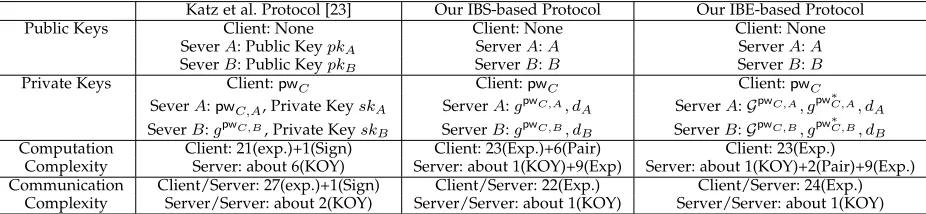
In terms of the setting and the client performance, the Katz et al.’s protocol is superior to our protocols. How-ever, in the Katz et al.’s protocol, each server performs approximately six times the amount of the work as the KOY protocol, whereas in our protocols, each server performs the same amount of work as the KOY protocol in addition to one identity-based decryption (or signature) and one public key encryption (or decryption).
We have implemented our ID2S PAKE protocols. Our experiments show that our protocols save from 22% to 66% of computation in each server, compared with the Katz et al.’s protocol. The server performance is critical to the performance of the whole protocol when the servers provide services to a great number of clients concurrently. In addition, our experiments show that less than one second is needed for the client to execute our protocols.
Organization.In Section 2, we describe the security model for ID2S PAKE protocol given in [35]. In Section 3, we present our new ID2S PAKE compilers. After that, in Section 4, a rigorous proof of security for our protocols is provided. In Section 5, we analyze the performance of our protocols and compare them with the Katz’s protocol by experiments. We conclude this paper in Section 6.
2
D
EFINITIONSA formal model of security for two-server PAKE was given by Katz et al. [23] (based on the MacKenzie et al.’s model for PKI-based PAKE [24]). Boneh and Franklin [7] defined chosen ciphertext security for IBE under chosen identity attack. Combining the two models, a model for ID2S PAKE protocol was given in [35] and can be described as follows. Participants, Initialization and Passwords.An ID2S PAKE protocol involves three kinds of protocol participants: (1) A set of clients (denoted asClient), each of which requests services from servers on the network; (2) A set of servers (denoted as Server), each of which provides services to clients on the network; (3) A group of Private Key Gener-ators (PKGs), which generate public parameters and corre-sponding private keys for servers.
We assume that ClientServerTriple is the set of triples of the client and two servers, where the client is au-thorized to use services provided by the two servers,
ClientT
Server = ∅, User = ClientS
Server, any PKG 6∈
User, andClientServerTriple⊆Client×Server×Server. Prior to any execution of the protocol, we assume that an initialization phase occurs. During initialization, thePKGs
cooperate to generate public parameters for the protocol, which are available to all participants, and private keys for servers, which are given to the appropriate servers. The user may keep the public parameter in a personal device, such as a smart card or a USB flash drive. When thePKGs generate the private key for a server, eachPKGgenerates and sends a private key component to the server via a secure channel. The server then derives its private key by combining all private key components from all PKGs. We assume that at least one of PKGs is honest to follow the protocol. Therefore, the private key of the server is known to the server only.
For any triple (C, A, B) ∈ ClientServerTriple, we as-sume that the client C chooses its password pwC inde-pendently and uniformly at random from a “dictionary” D = {pw1,pw2, · · ·,pwN} of size N, where D ⊂ Zq,N
is a fixed constant which is independent of any security parameter, and q is a large prime. The password is then split into two shares pwC,A and pwC,B and stored at the
two servers A and B, respectively, for authentication. We assume that the two servers never collude to determine the password of the client. The clientCneeds to remember
pwCto log into the serversAandB.
For simplicity, we assume that each client C shares its passwordpwC with exactly two servers A and B. In this case, we say that serversAandBare associated withC. A server may be associated with multiple clients.
Execution of the Protocol. In the real world, a protocol determines how users behave in response to input from their environments. In the formal model, these inputs are provided by the adversary. Each user is assumed to be able to execute the protocol multiple times (possibly concur-rently) with different partners. This is modeled by allowing each user to have unlimited number of instances (please refer to [3]) with which to execute the protocol. We denote instancei of userU asUi. A given instance may be used
only once. The adversary is given oracle access to these different instances. Furthermore, each instance maintains (local) state which is updated during the course of the experiment. In particular, each instanceUiis associated with the following variables, initialized as NULL or FALSE (as appropriate) during the initialization phase.
— sidiU,pid i
U and sk i
U are variables containing the session
identity, partner identity, and session key for an instanceUi,
respectively. Computation of the session key is, of course, the ultimate goal of the protocol. The session identity is simply a way to keep track of the different executions of a particular userU. Without loss of generality, we simply let this be the (ordered) concatenation of all messages sent and received by instance Ui. The partner identity denotes the
identity of the user with whomUibelieves it is interacting.
For a clientC,skiC consists of a pair (skiC,A,skiC,B), which are the two keys shared with serversAandB, respectively. —acci
U andtermiU are boolean variables denoting whether
a given instance Ui
4
accepted,sidiU,pidiU andskiU are no longerNULL. — statei
U records any state necessary for execution of the
protocol byUi
.
—usediUis a boolean variable denoting whether an instance
Ui has begun executing the protocol. This is a formalism
which will ensure each instance is used only once.
The adversary A is assumed to have complete control over all communications in the network (between the clients and servers, and between servers and servers) and the adversary’s interaction with the users (more specifically, with various instances) is modelled via access to oracles. The state of an instance may be updated during an oracle call, and the oracle’s output may depend upon the relevant instance. The oracle types include:
—Send(C, i, A, B, M)– This sends messageM to a client instance Ci, supposedly from two servers A and B.
As-suming termi
C = FALSE, this instance runs according to
the protocol specification, updating state as appropriate. The output ofCi (i.e., the message sent by the instance) is given to the adversary, who receives the updated values of
sidiC,pidiC,acciC, andtermiC. This oracle call models the ac-tive attack to a protocol. IfM is empty, this query represents a prompt forCto initiate the protocol.
— Send(S, i, U, M) – This sends message M to a server instance Si
, supposedly from a user U (either a client or a server). Assuming termiS = FALSE, this instance runs according to the protocol specification, updating state as appropriate. The output ofSi
(i.e., the message sent by the instance) is given to the adversary, who receives the updated values ofsidiS,pidiS,acci
S, andtermiS. IfS is corrupted, the
adversary also receives the entire internal state ofS. This oracle call also models the active attack to a protocol. — Execute(C, i, A, j, B, k) – If the client instance Ci and the server instances Aj and Bk have not yet been used
(where(C, A, B) ∈ ClientServerTriple), this oracle executes the protocol between these instances and outputs the tran-script of this execution. This oracle call represents passive eavesdropping of a protocol execution. In addition to the transcript, the adversary receives the values ofsid,pid,acc, and term for client and server instances, at each step of protocol execution. In addition, ifS ∈ {A, B}is corrupted, the adversary is given the entire internal state ofS.
—Corrupt(S)– This sends the private key of the serverSin addition to all password information stored in the serverS
to the adversary. This oracle models possible compromising of a server due to, for example, hacking into the server. — Corrupt(C) – This query allows the adversary to learn the password of the clientC, which models the possibility of subverting a client by, for example, witnessing a user typing in his password, or installing a “Trojan horse” on his machine.
— Reveal(U, U0, i) – This outputs the current value of session key skiU,U0 held by instance Ui if acciU = TRUE, whereU0 ∈pidiU. This oracle call models possible leakages of session keys due to, for example, improper erasure of session keys after use, compromise of a host computer, or cryptanalysis.
—Test(U, U0, i)– This oracle does not model any real-world capability of the adversary, but is instead used to define security. AssumeU0 ∈pidiU, ifacci
U =TRUE, a random bit
bis generated. If b = 0, the adversary is givenskiU,U0, and ifb = 1the adversary is given a random session key. The adversary is allowed only a singleTestquery, at any time during its execution.
Partnering.Let(C, A, B)∈ClientServerTriple. For the client instanceCi, letsidiC = (sid
i C,A,sid
i
C,B), wheresid i
C,A(resp., sidiC,B)denotes the ordered sequence of messages sent to / from the clientCand the serverA(resp., serverB). For the server instanceAj
, letsidjA= (sidjA,C,sidjA,B), wheresidjA,C
denotes the ordered sequence of messages sent to / from the serverA and the clientC, andsidjA,B denotes the ordered sequence of message sent to / from the serverA and the serverB. We say that instancesCi
andAj
are partnered if (1) sidiC,A = sid
j
A,C 6= NULL and (2) A ∈ pid i
C and C ∈ pidjA. We say that instancesAj andBk are partnered if (1) sidjA,B=sidkB,A6=NULLand (2)A∈pidkBandB∈pidjA.
Correctness.To be viable, a key exchange protocol must sat-isfy the following notion of correctness: If a client instance
Ciand server instancesAj andBkrun an honest execution
of the protocol with no interference from the adversary, then acciC = accjA = acckB = TRUE, and skiC,A = sk
j A,C, skiC,B = skkB,C and skiC,A 6= skiC,B. Note that a correct protocol may not be secure. The security of a protocol is defined as follows.
Freshness. To formally define the adversary’s success we need to define a notion of freshness for a session key, where freshness of a key is meant to indicate that the adversary does not trivially know the value of the session key. We say a session key skiU,U0 is fresh if (1) both U and U0 are not corrupted; (2) the adversary never queriedReveal(U, U0, i); (3) the adversary never queried Reveal(U0, U, j)where Ui
andU0jare partnered.
Advantage of the Adversary. Informally, the adversary succeeds if it can guess the bit b used by theTest oracle. We say an adversaryAsucceeds if it makes a single query
Test(U, U0, i)to a fresh instanceUi, withacci
U =TRUEat
the time of this query, and outputs a single bitb0withb0 =b
(recall thatbis the bit chosen by theTestoracle). We denote this event bySucc. The advantage of adversaryAin attack-ing protocolP is then given byAdvPA(k) = 2·Pr[Succ]−1, where the probability is taken over the random coins used by the adversary and the random coins used during the course of the experiment (including the initialization phase). An adversary can always succeed by trying all pass-words one-by-one in an on-line impersonation attack. A protocol is secure if this is the best an adversary can do. The on-line attacks correspond to Send queries. Formally, each instance for which the adversary has made a Send
query counts as one on-line attack. Instances with which the adversary interacts via Executeare not counted as on-line attacks. The number of on-line attacks represents a bound on the number of passwords the adversary could have tested in an on-line fashion.
3
ID2S PAKE P
ROTOCOLSIn this section, we present two compilers transforming any two-party PAKE protocolP to an ID2S PAKE protocol P0
with identity-based cryptography. The first compiler is built on identity-based signature (IBS) and the second compiler is based on identity-based encryption (IBE).
3.1 ID2S PAKE Based on IBS
3.1.1 Protocol Description
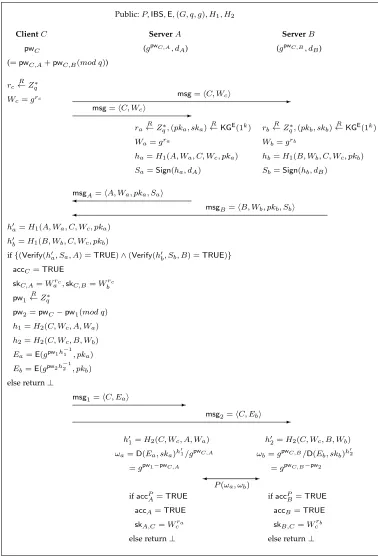
We need an identity-based signature scheme (IBS) as our cryptographic building block. A high-level description of our compiler is given in Fig. 1, in which the client C and two servers A and B establish two authenticated keys, respectively. If we remove authentication elements from our compiler, our key exchange protocol is essentially the Diffie-Hellman key exchange protocol [14]. We present the protocol by describing initialization and execution.
Initialization.Given a security parameterk∈N(the set of
all natural number), the initialization includes:
Parameter Generation: On input k, (1) m PKGs cooperate to run SetupP of the two-party PAKE protocol P to gen-erate system parameters, denoted asparamsP. (2) mPKGs
cooperate to run SetupIBS of the IBS scheme to generate public system parameters for the IBS scheme, denoted as
paramsIBS
(including a subgroup G of the additive group
of points of an elliptic curve), and the secretmaster-keyIBS. (3) m PKGs choose a public key encryption scheme E, e.g., [13], whose plaintext group is a large cyclic groupG
with a prime order q and a generator g and select two hash functions, H1 : {0,1}∗ → Zn∗, where n is the order
of G, and H2 : {0,1}∗ → Zq∗, from a collision-resistant
hash family. The public system parameters for the protocol
P0 is params = paramsP,IBS,ES
{(G, q, g),(H1, H2)} and the secret master-keyIBS is secretly shared by the PKGs in a manner that any coalition of PKGs cannot determine
master-keyIBSas long as one of thePKGs is honest to follow the protocol.
Remark. Taking the Paterson-Schuldt IBS scheme [25] for example,mPKGs agree on randomly chosenG,G2∈Gand
each PKG randomly chooses αi ∈ Zp and broadcast Gαi
with a zero-knowledge proof of knowingαiand a signature.
Then we can setG1=G P
iαi as the public master key and the secretmaster-keyIBS =G
P iαi
2 . The secret master key is privately shared amongmPKGs and unknown to anyone even ifm−1PKGs maliciously collude.
Key Generation: On input the identity S of a server S ∈
Server, paramsIBS, and the secret sharing master-keyIBS
,
PKGs cooperate to run ExtractIBS of the IBS scheme and generate a private (signing) key forS, denoted asdS, in a
manner that any coalition ofPKGs cannot determinedS as
long as one of thePKGs is honest to follow the protocol. Remark.In the Paterson-Schuldt IBS scheme withmPKGs , each PKG computes one component of the private key for a serverS, i.e.,(Gαi
2 H(S)ri,Gri), whereHis the Waters’ hash function, and sends it to the server via a secure channel. Combining all components, the server can construct its pri-vate keydS = (G
P iαi 2 H(S)
P iri,G
P
iri), which is known to the server only even ifm−1PKGs maliciously collude. In
addition, the identity of a server is public, meaningful, like an e-mail address, and easy to remember or keep. Anyone can write down the identity of a server on a note.
Password Generation: On input a triple (C, A, B) ∈ Client ServerTriple, a stringpwC, the password, is uniformly drawn from the dictionaryD={pw1,pw2,· · ·,pwN}by the client
C, and randomly split into pwC,A and pwC,B such that
pwC,A+pwC,B=pwC(mod q).gpwC,AandgpwC,Bare stored
in the serversAandB, respectively. We implicitly assume thatN < min(n, q), which will certainly be true in practice. Protocol Execution. Given a triple (C, A, B) ∈ Client ServerTriple, the clientC (knowing its passwordpwC) runs the protocolP0with the two serversA(knowinggpwC,Aand its private keydA) andB (knowing gpwC,B and its private
keydB) to establish two session keys, respectively, as shown
in Fig. 1.
At first, the clientCrandomly chooses an integerrcfrom
Zq∗ and computesWc =grc and broadcastsmsg=hC, Wci
to the serversAandB.
Remark.To facilitate the communications between the client and two servers, a gateway may be used to forward mes-sages between the client and the two servers. In this case, the client needs to communicate with the gateway only.
After receivingmsgfrom the client, the serverX (either
Aor B) randomly generates a public and private key pair (pkx, skx) (where x is either a or b) for the public key
encryption scheme E, and randomly chooses an integer rx
fromZq∗and computes
Wx=grx, hx=H1(X, Wx, C, Wx, pkx), Sx=Sign(hx, dX)
whereSx denotes an identity-based signature ofX onhx.
Then the server X replies to the client C with msgX =
hX, Wx, pkx, Sxi.
Remark.The public and private key pair for the public key encryption schemeEcan be generated once only and used repeatedly.
When getting the responses msgA,msgB from the
serversAandB, the clientCcomputes
h0a =H1(A, Wa, C, Wc, pka), h0b=H1(B, Wb, C, Wc, pkb)
and verifies the two signatures Sa, Sb on the basis of the
identities of the serversAandB. If
(Verify(h0a, Sa, A) =TRUE)∧(Verify(h0b, Sb, B) =TRUE)
the clientC setsaccC = TRUEand computes two session
keysskC,A=Warc,skC,B =Wbrc.
Furthermore, the client C randomly chooses pw1 from
Zq∗and computes
pw2=pwC−pw1(mod q)
h1=H2(C, Wc, A, Wa), h2=H2(C, Wc, B, Wb).
Next, according to the public keyspka, pkbfrom the servers
AandB, the clientCperforms the public key encryptions
Ea=E(gpw1h
−1
1 , pka), Eb=E(gpw2h
−1 2 , pkb)
whereEdenotes the encryption algorithm. Then, the client sends msg1 = hC, Eai and msg2 = hC, Ebi to the two
6
Public:P,IBS,E,(G, q, g), H1, H2
ClientC
pwC
(=pwC,A+pwC,B(mod q))
ServerA
(gpwC,A, d
A)
ServerB
(gpwC,B, d
B)
rc R
←Z∗q
Wc=grc
-msg=hC, Wci
-msg=hC, Wci
ra←R Zq∗,(pka, ska)←R KGE(1k)
Wa=gra
ha=H1(A, Wa, C, Wc, pka)
Sa=Sign(ha, dA)
rb R
←Zq∗,(pkb, skb) R
←KGE(1k)
Wb=grb
hb=H1(B, Wb, C, Wc, pkb)
Sb=Sign(hb, dB)
msgA=hA, Wa, pka, Sai
msgB=hB, Wb, pkb, Sbi
h0a=H1(A, Wa, C, Wc, pka)
h0b=H1(B, Wb, C, Wc, pkb)
if{(Verify(h0
a, Sa, A) =TRUE)∧(Verify(h0b, Sb, B) =TRUE)}
accC=TRUE
skC,A=Warc,skC,B=Wbrc
pw1 R
←Zq∗
pw2=pwC−pw1(mod q)
h1=H2(C, Wc, A, Wa)
h2=H2(C, Wc, B, Wb)
Ea=E(gpw1h
−1 1 , pka) Eb=E(gpw2h
−1 2 , pkb) else return⊥
-msg1=hC, Eai
-msg2=hC, Ebi
h01=H2(C, Wc, A, Wa)
ωa=D(Ea, ska)h
0
1/gpwC,A
=gpw1−pwC,A
ifaccP
A=TRUE
accA=TRUE
skA,C=Wcra
else return⊥
h02=H2(C, Wc, B, Wb)
ωb=gpwC,B/D(Eb, skb)h
0
2 =gpwC,B−pw2
ifaccP
B=TRUE
accB=TRUE
skB,C=Wcrb
else return⊥
[image:7.612.116.494.104.660.2]
P(ωa, ωb)
After receivingmsg1fromC, the serverAcomputes
h01=H2(C, Wc, A, Wa), ωa =D(Ea, ska)h
0
1/gpwC,A,
whereDdenotes the decryption algorithm.
After receivingmsg2fromC, the serverBcomputes
h02=H2(C, Wc, B, Wb), ωb=gpwC,B/D(Eb, skb)h
0
2.
BecausepwC=pwC,A+pwC,B(mod q)andpwC=pw1+ pw2(mod q), we haveωa =gpw1−pwC,A=gpwC,B−pw2=ωb.
Using ωa and ωb as one-time password, the servers A
and B run a two-party PAKE protocol P to establish a session key. If the server A accepts the session key as an authenticated key according toP (i.e.,accP
A = TRUE), the
serverAsetsaccA =TRUEand computes the session key skA,C =Wcra.If the serverBaccepts the session key as an
authenticated key according toP (i.e., accPB = TRUE), the serverB setsaccB =TRUEand computes the session key skB,C=Wcrb.
3.1.2 Correctness
Assume that a client instance Ci and server instancesAj
andBkrun an honest execution of the protocolP0 with no
interference from the adversary and the two-party PAKEP
has the correctness property.
With reference to Fig. 1, we haveh0
a =ha, h0b =hb and
the signatures are genuine. Therefore, the clientCcomputes two session keys, i.e.,skC,A =Warc,skC,B =Wbrc, and lets acci
C =TRUE.
With reference to Fig. 1, the server instancesAj andBk
are able to derive the same one-time passwordωa (=ωb).
Because P has the correctness property, after running P
based onωaandωb, the server instancesAj andBk accept
the established session key as an authenticated key. This indicates that the clientChas provided a correct password
pwC. Next, the server instances Aj and Bk compute the
session keys with the client C, i.e., skA,C = Wcra and skB,C=Wcrb, and letacc
j
A=TRUEandacc k
B=TRUE.
Since Wc = grc, Wa = gra, Wb = grb, we have skC,A =Warc =grarc =Wcra =skA,C andskC,B =Wbrc =
grbrc =Wrb
c =skB,C. In addition, becausera, rbare chosen
randomly, the probability of skC,A = skC,B is negligible.
Therefore, our protocol has the correctness property.
3.1.3 Explicit Authentication
By verifying the signaturesSa, Sbwith the identities of the
serversAandB, the clientCcan make sure that its intended servers A and B are authentic and the computed session keysskC,A=Warc,skC,B =Wbrcare authentic.
By running the two-party PAKE protocol P based on
wa (derived by pwC,A) and wb (derived by pwC,B), the
two serversA andB can verify if the clientC provides a passwordpwC such that pwC = pwC,A+pwC,B(mod q). This shows that whenaccjA =TRUE, the server Aknows that its intended client C and server B are authentic. Our protocol achieves the implicit authentication. Using the hash function like [6], [35], however, it is easy to add explicit authentication to any protocol achieving implicit authenti-cation.
Remark.After the execution of our protocol, the password in the client cache must be deleted like SSL-based Internet banking.
3.2 ID2S PAKE Based on IBE
3.2.1 Protocol Description
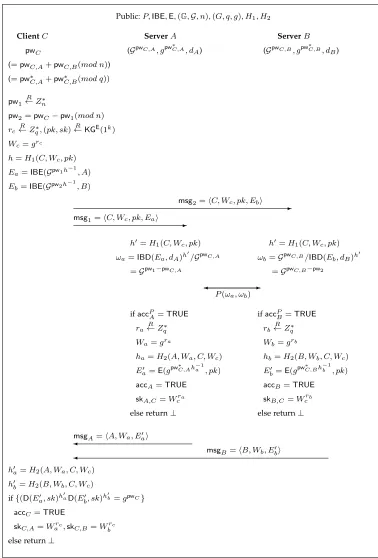
A high-level description of our compiler based on identity-based encryption (IBE) is given in Fig. 2. We present the protocol by describing initialization and execution.
Initialization.Given a security parameterk∈N, the
initial-ization includes:
Parameter Generation: On input k, (1) m PKGs cooperate to runSetupPof the two-party PAKE protocolPto generate system parameters, denoted asparamsP. (2)mPKGs
cooper-ate to runSetupIBEof the IBE scheme to generate public sys-tem parameters for the IBE scheme, denoted asparamsIBE, and the secretmaster-keyIBE. Assume thatGis a generator of IBE plaintext groupGwith an ordern. (3)mPKGs choose a
public key encryption schemeE, e.g., [13], whose plaintext group is a large cyclic groupGwith a prime orderqand a generatorgand select two hash functions,H1 : {0,1}∗ →
Zn∗ and H2 : {0,1}∗ → Zq∗, from a collision-resistant hash
family. The public system parameters for the protocol P0
is params = paramsP,IBE,ES
{(G,G, n),(G, q, g),(H1, H2)} and the secretmaster-keyIBE is secretly shared by thePKGs in a manner that any coalition of PKGs cannot determine
master-keyIBEas long as one of thePKGs is honest to follow the protocol.
Key Generation: On input the identity S of a server S ∈
Server, paramsIBE, and the secret sharing master-keyIBE
,
PKGs cooperate to run ExtractIBE of the IBE scheme and generate a private (decryption) key forS, denoted asdS, in
a manner that any coalition ofPKGs cannot determinedSas
long as one of thePKGs is honest to follow the protocol.
Password Generation: On input a triple (C, A, B) ∈ Client ServerTriple, a stringpwC, the password, is uniformly drawn from the dictionaryD={pw1,pw2,· · ·,pwN}by the client
C, and randomly split into pwC,A and pwC,B such that
pwC,A+pwC,B =pwC(mod n), andpw∗C,Aandpw∗C,B such thatpw∗C,A+pw∗C,B = pwC(mod q). (GpwC,A, gpw
∗ C,A) and
(GpwC,B,gpw∗C,B)are stored in seversAandB, respectively. We implicitly assume that N < min(n, q), which will certainly be true in practice.
Protocol Execution. Given a triple (C, A, B) ∈ Client ServerTriple, the clientC (knowing its passwordpwC) runs the protocol P0 with the two serversA (knowingGpwC,A
,
gpw∗C,A and its private key dA) and B (knowing GpwC,B,
gpw∗C,Band its private keydB) to establish two session keys, respectively, as shown in Fig. 2.
At first, the client randomly chooses pw1 from Zn∗ and computes pw2 = pwC −pw1(mod n). Next the client C
randomly generates a one-time public and private key pair (pk, sk) for the public key encryption scheme E, and ran-domly chooses an integerrcfromZq∗and computes
Wc=grc, h=H1(C, Wc, pk).
Next, according to the identities of the two serversAand
B, the clientCperforms the identity-based encryptions
Ea=IBE(Gpw1h
−1
, A), Eb =IBE(Gpw2h
−1
, B).
Then, the client sends msg1 = hC, Wc, pk, Eai and msg2=hC, Wc, pk, Ebito the two serversAandB,
8
Public:P,IBE,E,(G,G, n),(G, q, g), H1, H2
ClientC
pwC
(=pwC,A+pwC,B(mod n))
(=pw∗
C,A+pw
∗
C,B(mod q))
ServerA
(GpwC,A, gpw∗C,A, d
A)
ServerB
(GpwC,B, gpw∗C,B, d
B)
pw1←R Z∗
n
pw2=pwC−pw1(mod n)
rc←R Z∗q,(pk, sk) R
←KGE(1k)
Wc=grc
h=H1(C, Wc, pk)
Ea=IBE(Gpw1h−1, A)
Eb=IBE(Gpw2h
−1
, B)
-msg1=hC, Wc, pk, Eai
-msg2=hC, Wc, pk, Ebi
h0=H1(C, Wc, pk)
ωa=IBD(Ea, dA)h
0
/GpwC,A
=Gpw1−pwC,A
ifaccP
A=TRUE ra←R Zq∗
Wa=gra
ha=H2(A, Wa, C, Wc)
E0
a=E(gpw
∗
C,Ah−a1, pk)
accA=TRUE
skA,C=Wcra
else return⊥
h0=H1(C, Wc, pk)
ωb=GpwC,B/IBD(Eb, dB)h
0
=GpwC,B−pw2
ifaccP
B=TRUE rb
R
←Zq∗
Wb=grb
hb=H2(B, Wb, C, Wc)
E0
b=E(g
pw∗C,Bh−b1, pk)
accB=TRUE
skB,C=Wcrb
else return⊥
P(ωa, ωb)
msgA=hA, Wa, Ea0i
msgB=hB, Wb, E0bi
h0a=H2(A, Wa, C, Wc)
h0
b=H2(B, Wb, C, Wc) if{(D(Ea0, sk)h
0 aD(E0
b, sk)
h0b=gpwC}
accC=TRUE
skC,A=Warc,skC,B=Wbrc
[image:9.612.115.493.102.660.2]else return⊥
After receivingmsg1fromC, the serverAcomputes
h0=H1(C, Wc, pk), ωa=IBD(Ea, dA)h
0
/GpwC,A,
whereIBDdenotes identity-based decryption.
After receivingmsg2fromC, the serverBcomputes
h0=H1(C, Wc, pk), ωb=GpwC,B/IBD(Ea, dB)h
0
,
Because pwC = pwC,A +pwC,B(mod n) and pwC = pw1 + pw2(mod n), we have ωa = Gpw1−pwC,A =
GpwC,B−pw2 =ω b.
Using ωa and ωb as one-time password, the servers A
and B run a two-party PAKE protocol P to establish a session key. If the server X (either A or B) accepts the session key as an authenticated key according to P (i.e.,
accP
X =TRUE), it randomly chooses an integerrx(wherex
is eitheraorb) fromZ∗
q and computes
Wx=grx, hx=H2(X, Wx, C, Wc),
Ex0 =E(gpw∗C,Xh −1
x , pk),sk
X,C=Wcrx
whereskX,C is the session key betweenX andCandEx0 is
the encryption ofgpw∗C,Xh −1
x . Then the serverX setsaccX=
TRUEand replies to the clientCwithmsgX =hX, Wx, Ex0i.
Finally, after receivingmsgAandmsgB,Ccomputes
h0a=H2(A, Wa, C, Wc), h0b=H2(B, Wb, C, Wc),
and check if D(E1, sk)h 0
aD(E2, sk)h 0
b = gpwC. If so, the clientCsetsaccC =TRUEand computes two session keys skC,A=Warc,skC,B=Wbrc.
Remark.Our IBE-based protocol needs less rounds of com-munication than our IBS-based protocol. This can be seen by comparing Fig. 1 and Fig. 2.
3.2.2 Correctness
Assume that a client instance Ci and server instancesAj
andBkrun an honest execution of the protocolP0 with no
interference from the adversary and the two-party PAKEP
has the correctness property.
With reference to Fig. 2, the server instancesAj andBk
are able to derive the same one-time passwordωa (=ωb).
Because P has the correctness property, after running P
based onωaandωb, the server instancesAj andBk accept
the established session key as an authenticated key. This indicates that the clientChas provided a correct password
pwC. Next, the server instances Aj
and Bk
compute the session keys with the client C, i.e., skA,C = Wcra and skB,C=Wcrb, and letacc
j
A=TRUEandacckB=TRUE.
With reference to Fig. 2, we haveh0a=ha, h0b=hb, and
D(E1, sk)h 0
1D(E
2, sk)h 0
b = (gpw ∗ C,Ah
−1
a )h 0 a(gpw
∗ C,Bh
−1
b )h 0 b
= gpw∗C,A+pw ∗
C,B =gpwC
Therefore, the client instanceCicomputes two session keys,
i.e., skC,A = Warc,skC,B = Wbrc, and lets acc i
C = TRUE.
Since Wc = grc, Wa = gra, Wb = grb, we have skC,A =
Wrc
a = grarc = Wcra = skA,C and skC,B = Wbrc =
grbrc =Wrb
c =skB,C. In addition, becausera, rbare chosen
randomly, the probability of skC,A = skC,B is negligible.
Therefore, our protocol has the correctness property.
3.2.3 Explicit Authentication
By running the two-party PAKE protocol P based on wa
(derived by pwC,A) and wb (derived by pwC,B), the two
servers A and B can verify if the client C provides a passwordpwCsuch thatpwC=pwC,A+pwC,B(mod n). In
addition, by checking thatD(E1, sk)h 0
aD(E2, sk)h 0
b =gpwC (involvingpwC), the clientC can verify if the two servers
provide two shares of the password,pw∗C,Aandpw∗C,B, such thatpwC =pw∗C,A+pw∗C,B(mod q). This shows that when
accjA =TRUE, the server Aknows that its intended client
C and server B are authentic, and when acciC = TRUE, the clientC knows that its intended serversA and B are authentic. Our protocol achieves the implicit authentication. Using the hash function like [6], [35], however, it is easy to add explicit authentication to any protocol achieving implicit authentication.
4
P
ROOF OFS
ECURITYBased on the security model defined in Section 2, we pro-vide a rigorous proof of security for our compilers in this section.
4.1 Security of ID2S PAKE Protocol Based on IBS
Theorem 1.Assuming that (1) the identity-based signature (IBS) scheme is existentially unforgeable under an adap-tive chosen-message attack; (2) the public key encryption schemeEis secure against the chosen-ciphertext attack; (3) the decisional Diffie-Hellman problem is hard over(G, g, q); (4) the protocolP is a secure two-party PAKE protocol with explicit authentication; (5) H1, H2 are collision-resistant hash functions, then the protocolP0 illustrated in Fig. 1 is a secure ID2S PAKE protocol according to Definition 1. Proof. Given an adversary A attacking the protocol, we imagine a simulatorSthat runs the protocol forA.
First of all, the simulator S initializes the system by generating params = paramsP,IBS,ES
{(G, q, g),(H1, H2)} and the secretmaster-keyIBS. Next,Client,Server, andClient ServerTriple sets are determined. Passwords for clients are chosen at random and split, and then stored at correspond-ing servers. Private keys for servers are computed uscorrespond-ing
master-keyIBS.
The public information is provided to the adversary. Considering(C, A, B)∈ClinetServerTriple, we assume that the adversary A chooses the server B to corrupt and the simulatorS gives the adversaryAthe information held by the corrupted server B, including the private key of the server B, i.e., dB, and one share of the password of the
clientC,gpwC,B. After computing the appropriate answer to any oracle query, the simulatorSprovides the adversaryA with the internal state of the corrupted serverBinvolved in the query.
We view the adversary’s queries to its Send oracles as queries to five different oracles as follows:
— Send(C, i, A, B) represents a request for instanceCi of clientCto initiate the protocol. The output of this query is
msg=hC, Wci.
10
—Send(C, i, A, B,msgA|msgB)represents sending the mes-sagemsgA|msgB to instanceCiof the clientC. The output
of this query is eithermsg1=hC, Eai|msg2=hC, Ebior⊥.
—Send(A, j, C,msg1)represents sending messagemsg1 to instanceAjof the serverAfromC. The output of this query
is eitheraccA=TRUEor⊥.
— SendP(A, j, B, M) represents sending message M to instance Aj of the server A, supposedly by the server B, in the two-party PAKE protocolP. The input and output of this query depends on the protocolP.
WhenAqueries theTestoracle, the simulatorSchooses a random bitb. When the adversary completes its execution and outputs a bit b0, the simulator can tell whether the adversary succeeds by checking if (1) a single Test query was made regarding some fresh session keyskiU,U0, and (2)
b0 = b. Success of the adversary is denoted by eventSucc.
For any experimentP0, we denoteAdvPA0 = 2·Pr[Succ]−1, where Pr[·] denotes the probability of an event when the simulator interacts with the adversary in accordance with experimentP0.
We will use some terminology throughout the proof. A given message is called oracle-generated if it was output by the simulator in response to some oracle query. The message is said to be adversarially-generated otherwise.An adversarially-generated message must not be the same as any oracle-generated message.
We refer to the real execution of the experiment, as described above, as P0. We introduce a sequence of trans-formations to the experiment P0 and bound the effect of each transformation on the adversary’s advantage. We then bound the adversary’s advantage in the final experiment. This immediately yields a bound on the adversary’s advan-tage in the original experiment.
Experiment P1: In this experiment, the simulator interacts with the adversary as P0 except that the adversary does not succeed, and the experiment is aborted, if any of the following occurs: 1) At any point during the experiment, an oracle-generated message (e.g.,msg,msg1,msg2,msgA, or
msgB) is repeated; 2) At any point during the experiment, a collision occurs in the hash functionH1orH2(regardless of whether this is due to a direct action of the adversary, or whether this occurs during the course of the simulator’s response to an oracle query).
It is immediate that events 1 occurs with only negligi-ble probability, event 2 occurs with negliginegligi-ble probability assumingH1, H2 as collision-resistant hash functions. Put everything together, we are able to see that
Claim 1. IfH1andH2are collision-resistant hash functions,
|AdvP0A(k)−AdvP1A(k)|is negligible.
Experiment P2: In this experiment, the simulator interacts with the adversaryAas in experimentP1except that the ad-versary’s queries toExecuteoracles are handled differently: in anyExecute(C, i, A, j, B, k), where the adversaryA has not queriedcorrupt(A), but may have queriedcorrupt(B), the plaintext gpw1h−11 in the public key encryption E
a is
replaced with a random element inG.
The difference between the current experiment and the previous one is bounded by the probability that an
adver-sary breaks the semantic security of the public key encryp-tionE. More precisely, we have
Claim 2.If the public key encryption schemeEis semanti-cally secure,|AdvP1
A(k)−Adv P2
A(k)|is negligible.
Remark.If a public key encryption scheme is secure against the chosen-ciphertext attack (CCA), it is secure against the chosen-plaintext attack (CPA) (i.e., it is semantically secure). Experiment P3: In this experiment, the simulator interacts with the adversary A as in experiment P2 except that: for any Execute(C, i, A, j, B, k) oracle, where the adver-saryA has not queriedcorrupt(A), but may have queried
corrupt(B), the session keys skC,A and skA,C are replaced
with a same random element in the groupG.
The difference between the current experiment and the previous one is bounded by the probability to solve the decisional Diffie-Hellman (DDH) problem over (G, g, q). More precisely, we have
Claim 3.If the decisional Diffie-Hellman (DDH) problem is hard over (G, q, g),|AdvP2A(k)−AdvP3A(k)|is negligible.
If|AdvP2A(k)−AdvP3A(k)|is non-negligible, we show that the simulator can useAas a subroutine to solve the DDH problem with non-negligible probability as follows.
Given a DDH problem (gα, gβ, Z), where α, β are
ran-domly chosen from Z∗
q and Z is either gαβ or a random
elementz fromG, the simulator replacesWc withgα, and
Wawithgβ, and the session keysskC,A,skA,CwithZ. When
Z = gαβ
, the experiment is the same as the experiment
P2. When Z is a random element z in G, the experiment
is the same as the experiment P3. If the adversary can distinguish the experimentsP2andP3with non-negligible probability, the simulator can solve the DDH problem with non-negligible probability. Assuming that the DDH problem is hard, Claim 3 is true.
In experimentP3, the adversary’s probability of correctly guessing the bitbused by theTestoracle is exactly 1/2 when theTestquery is made to a fresh client instanceCior a fresh
server instance Aj invoked by an Execute(C, i, A, j, B, k)
oracle, even if the adversary queried corrupt(B) (i.e., the adversary corrupted the server B). This is so because the session keysskC,A andskA,C for such instances in P3 are chosen at random from G, and hence there is no way to distinguish whether theTestoracle outputs a random ses-sion key or the “actual” sesses-sion key (which is just a random element, anyway). Therefore, all passive adversaries cannot win the game, even if they can queryCorrupt(B)oracles.
The rest of the proof concentrates on the instances in-voked bySendoracles.
Experiment P4: In this experiment, we modify the sim-ulator’s responses to Send(C, i, A, B,msgA|msgB) and
Send(A, j, C,msg1)queries.
Before describing this change we introduce some ter-minology. For a querySend(C, i, A, B,msgA|msgB), where
msgA|msgB is adversarially-generated, if acci
C = TRUE,
then msgA|msgB is said to be valid. Otherwise, it is said
continue with our description of experimentP4. When the adversary makes oracle querySend(C, i, A, B,msgA|msgB),
the simulator examines msgA|msgB. If the message is adversarially-generated and valid, the simulator halts and
acciCis assigned the special value∇. In any other case, (i.e.,
msgA|msgB is oracle-generated, or adversarially-generated but invalid), the query is answered exactly as in ex-periment P3. When the adversary makes oracle query
Send(A, j, C,msg1), the simulator examines msg1. If it is adversarially-generated and valid, the simulator halts and
accjA is assigned the special value ∇. In any other case, (i.e., msg1 is oracle-generated, or adversarially-generated but invalid), the query is answered exactly as inP3.
Now, we change the definition of the adversary’s suc-cess in P4. At first, we define that a client instance
Ci is fresh if the adversary has not queried Corrupt(C)
and a server instance Aj is fresh if the adversary has
not queried Corrupt(A). If the adversary ever queries
Send(C, i, A, B,msgA|msgB)oracle to a fresh client instance
Ci withacci
C =∇ orSend(A, j, C,msg1)oracle to a fresh server instanceAj withaccj
A =∇, the simulator halts and
the adversary succeeds. Otherwise the adversary’s success is determined as in experimentP3.
The distribution on the adversary’s view in experiments
P3andP4are identical up to the point when the adversary queriesSend(C, i, A, B,msgA|msgB)oracle to a fresh client
instance withacci
C = ∇ orSend(A, j, C,msg1)oracle to a fresh server instance withaccjA=∇. If such a query is never made, the distributions on the view are identical. Therefore, we have
Claim 4.AdvP3A(k)≤AdvP4A(k).
Experiment P5: In this experiment, the simulator interacts with the adversary A as in experiment P4 except that the adversary’s queries to Send(A, j, C,msg1) oracles are handled differently: in any Send(A, j, C,msg1), where the adversary A has not queried corrupt(A), but may have queriedcorrupt(B), the plaintextgpw1h−11 inE
a is replaced
with a random element in the groupG. As we prove Claims 2, we can prove
Claim 5.If the public key encryption schemeEis semanti-cally secure,|AdvP4
A(k)−Adv P5
A(k)|is negligible.
In experiment P5,msg1 from ExecuteandSend oracles become independent of the passwordpwCused by the client
C in the view of the adversary A, even if A may require
Corrupt(B). In addition, although the adversary who has corrupted the serverB is able to obtain gpw2
,gpwC,B, they are independent of the password pwC in the view of the
adversary because the referencemsg1is independent of the password in the view of the adversary. In view of this, any off-line dictionary attack cannot succeed.
The adversaryAsucceeds only if one of the following oc-curs: (1) the adversary queriesSend(C, i, A, B,msgA|msgB)
oracle to a fresh client instance Ci for adversarially-generated and valid msgA|msgB, that is, acci
C = ∇
(let Succ1 denote this event); (2) the adversary queries
Send(A, j, C,msg1)oracle to a fresh server instanceAj
for adversarially-generated and validmsg1, that is, accjA = ∇ (let Succ2 denote this event); (3) neither Succ1 nor Succ2 happens, the adversary wins the game by aTestquery to a
fresh instanceCior a server instanceAj.
Claim 6. If the identity-based signature (IBS) scheme is existentially unforgeable under an adaptive chosen-message attack and the hash function H1 is collision-resistant,
Pr[Succ1]is negligible.
msgA contains a signature Sa of the server A on
H1(A, Wa, C, Wc, pka). If the adversaryAis able to findWa0
(6=Wa) orpk0a (6=pka) such thatH1(A, Wa0, C, Wc, pk0a) =
H1(A, Wa, C, Wc, pk)for givenWc, he may makeacciC=∇
with the same Sa. However, this probability is negligible
because we assume that the hash functionH1 is collision-resistant. If the adversary can forge a new signature Sa0
of the server A on H1(A, Wa0, C, Wc, pka0) for chosen Wa0
(6= Wa) or pka0 (6= pka), he may also make acciC = ∇.
However, this probability is also negligible because we assume that the identity-based signature (IBS) scheme is existentially unforgeable under an adaptive chosen-message attack. Therefore, Claim 6 is true.
Claim 7.If (1)P is a secure two-party PAKE protocol with explicit authentication; (2) the public key encryptionEis se-cure against the chosen-ciphertext attack; (3)H2is collision-resistant hash functions, thenPr[Succ2] ≤Q(k)/N+ε(k), whereQ(k)denotes the number of on-line attacks andε(k)
is a negligible function.
To evaluate Pr[Succ2], we assume that the adversary
A has corrupted the serverB and consider three cases as follows.
Case 1. If the adversary A is able to find Wc0 (6= Wc)
such thatH2(C, Wc0, A, Wa) = H2(C, Wc, A, Wa)for given
Wa, he may make acc j
A = ∇ with the same Ea in msg1. However, this probability is negligible because we assume that the hash functionH2is collision-resistant.
Case 2.If the adversaryAis able to replace the plaintext
gpw1h
−1
1 in Ea with gpw1h∗1
−1
(like homomorphic encryp-tion), where h∗1 6= h1, he may make accjA = ∇ with Ea0
transformed fromEa. However, this probability is negligible
because we assume that the public key encryption E is secure against the chosen-ciphertext attack.
Case 3. The adversary A forges msg0 = hC, Wc0i and msg01 = hC, Ea0i where E0a = E(gpw
∗
1h
∗
1
−1
, pka) and h∗1 =
H2(C, Wc0, A, Wa)andpw∗1is chosen by the adversary. After receiving msg01, the server A derives ωa = gpw
∗
1−pwC,A =
gpw∗1+pwC,B−pwC = gpw ∗
1+pwC,B/gpwC and then runs two-party PAKE protocolP with the serverB(controlled by the adversary) on the basis ofωa. In the view of the adversary,
ωa can be anyone of{gpw
∗
1+pwC,B/gpw|pw ∈ D}even if he knowspw∗1+pwC,B. Without knowingωa, this probability
ofaccPA=TRUEis less thanQP(k)/N+ε(k), whereQP(k)
denotes the number of on-line attacks in the protocol P, because we assume that P is a secure two-party PAKE protocol with explicit authentication.
In experimentP5, the adversary’s probability of success when neitherSucc1norSucc2occurs is 1/2. The preceding discussion implies that
PrP6
A[Succ]≤Q(k)/N+ε(k) + 1/2·(1−Q(k)/N−ε(k))
and thus the adversary’s advantage in experimentP5
AdvP5
A(k) = 2Pr P5
12
≤ 2Q(k)/N+ 2ε(k) + 1−Q(k)/N−ε(k)−1 = Q(k)/N+ε(k)
for some negligible function ε(·). The sequence of claims proved above show that
AdvP0
A(k)≤Adv P5
A(k) +ε(k)≤Q(k)/N+ε(k)
for some negligible functionε(·). This completes the proof of the theorem.
4.2 Security of ID2S PAKE Protocol Based on IBE
Theorem 2.Assuming that (1) the identity-based encryption (IBE) scheme is secure against the chosen-ciphertext attack; (2) the public key encryption schemeEis secure against the chosen-ciphertext attack; (3) the decisional Diffie-Hellman problem is hard over (G, g, q); (4) the protocolP is a secure two-party PAKE protocol with explicit authentication; (5)
H1, H2 are collision-resistant hash functions, then the pro-tocolP0illustrated in Fig. 2 is a secure ID2S PAKE protocol according to Definition 1.
Proof. Given an adversary A attacking the protocol, a simulator S runs the protocol forA. First of all, the sim-ulator S initializes the system by generating params = paramsP,IBE,ES
{(G,G, n),(G, q, g),(H1, H2)}and the secret
master-keyIBE. Next, Client, Server, and ClientServerTriple
sets are determined. Passwords for clients are chosen at random and split, and then stored at corresponding servers. Private keys for servers are computed usingmaster-keyIBE.
The public information is provided to the adversary. Considering(C, A, B)∈ClinetServerTriple, we assume that the adversary A chooses the server B to corrupt and the simulatorS gives the adversaryAthe information held by the corrupted server B, including the private key of the serverB, i.e.,dB, and one share of the password of the client
C, GpwC,B and gpw∗C,B. After computing the appropriate answer to any oracle query, the simulator S provides the adversaryAwith the internal state of the corrupted server
Binvolved in the query.
We view the adversary’s queries to its Send oracles as queries to four different oracles as follows:
— Send(C, i, A, B) represents a request for instanceCi of clientCto initiate the protocol. The output of this query is
msg1=hC, Wc, pk, Eaiandmsg2=hC, Wc, pk, Ebi.
—Send(A, j, C,msg1)represents sending messagemsg1 to instanceAjof the serverA. The output of this query is either msgA=hA, Wa, E1ior⊥.
—Send(C, i, A, B,msgA|msgB)represents sending the mes-sagemsgA|msgB to instanceCiof the clientC. The output
is eitheracci
C=TRUEor⊥.
— SendP(A, j, B, M) represents sending message M to instance Aj of the server A, supposedly by the server B, in the two-party PAKE protocolP. The input and output of this query depends on the protocolP.
We refer to the real execution of the experiment, as described above, asP0.
Experiment P1: In this experiment, the simulator interacts with the adversary as P0 except that the adversary does not succeed, and the experiment is aborted, if any of the following occurs:
1) At any point during the experiment, an oracle-generated message is repeated.
2) At any point during the experiment, a collision occurs in the hash functionH1orH2
Claim 1. IfH1andH2are collision-resistant hash functions,
|AdvP0
A(k)−Adv P1
A(k)|is negligible.
Experiment P2: In this experiment, the simulator interacts with the adversaryAas in P1 except that the adversary’s queries to Execute oracles are handled differently: in any
Execute(C, i, A, j, B, k), where the adversary A has not queried corrupt(A), but may have queried corrupt(B), (1) the plaintext Gpw1h−1 in E
a is replaced with a random
element inG; (2) the plaintext gpw
∗ C,Ah
−1
a inE0
a is replaced
by a random element inG; (3) the session keysskC,A and skA,C are replaced with a same random element inG.
Claim 2.If (1) the identity-based encryption (IBE) scheme is secure against the chosen-ciphertext attack; (2) the public key encryption scheme E is secure against the chosen-ciphertext attack; (3) the decisional Diffie-Hellman problem is hard over (G, g, q),|AdvP1A(k)−AdvP2A(k)|is negligible.
Experiment P3: In this experiment, we modify the simulator’s responses to Send(A, j, C,msg1) and
Send(C, i, A, B,msgA|msgB) queries. If the adversary
ever queries Send(A, j, C,msg1) oracle to a fresh server instanceAj with a adversarially-generated and validmsg
1 (denoted as accjA = ∇) or Send(C, i, A, B,msgA|msgB)
oracle to a fresh client instance Ci with a adversarially-generated and valid msgA|msgB (denoted as acci
C = ∇),
the simulator halts and the adversary succeeds. Otherwise the adversary’s success is determined as in experimentP2.
Claim 3.AdvP2A(k)≤AdvP3A(k).
Experiment P4: In this experiment, the simulator interacts with the adversary A as in experiment P3 except that the adversary’s queries to Send(A, j, C,msg1)
and Send(C, i, A, B,msgA|msgB) oracles are
han-dled differently: in any Send(A, j, C,msg1) or
Send(C, i, A, B,msgA|msgB) oracles where the adversary A has not queried corrupt(A), but may have queried
corrupt(B), the plaintext Gpw1h−1
in Ea is replaced with a
random element inGand the plaintextgpw
∗ C,Ah
−1
a inE0
a (if
any) is replaced with a random element inG.
Claim 4. If both the IBE scheme and the public key en-cryption scheme E are semantically secure, |AdvP3
A(k)− AdvP4
A(k)|is negligible.
The adversary A succeeds only if one of the follow-ing occurs: (1) the adversary queries Send(A, j, C,msg1)
oracle to a fresh server instance Aj
with accjA = ∇ (let Succ1 denote this event); (2) the adversary queries
Send(C, i, A, B,msgA|msgB)oracle to a fresh client instance
Ci
withacci
C =∇(letSucc2denote this event); (3) neither
Succ1norSucc2happens, the adversary wins the game by a
Testquery to a fresh instanceCior a server instanceAj.
To evaluatePr[Succ1]andPr[Succ2], we assume that the adversaryAhas corrupted the serverB and consider two as follows.
Case 1.The adversaryAforgesmsg01=hC, Wc0, pk0, Ea0i
where Ea0 = IBE(Gpw
∗
1h
∗ −1
, A), h∗ = H1(C, Wc0, pk0),