University of Warwick institutional repository: http://go.warwick.ac.uk/wrap
A Thesis Submitted for the Degree of PhD at the University of Warwick
http://go.warwick.ac.uk/wrap/72647
This thesis is made available online and is protected by original copyright. Please scroll down to view the document itself.
Network Coding for Computer
Networking
by
Alaa Alsebae
A thesis submitted in partial fulfilment of the requirements for
the degree of Doctor of Philosophy
School of Engineering
ii
iii
Table of Contents
Table of Contents ... iii
List of Figures ... vii
List of Tables ... xiii
Acknowledgements ... xiv
Declaration ... xv
Abstract ... xvi
List of Abbreviations ... xvii
Publications Associated with This Research Work ... xviii
Published Papers ... xviii
Submitted Papers ... xviii
Chapter 1Introduction ... 1
Aims and Motivations ... 3
The list of contributions drives the entire thesis ... 5
Thesis Outline ... 7
Chapter 2Network Coding ... 10
2.1 Introduction ... 10
2.2 Network Coding in Wireless Networks ... 14
2.3 Synchronous and Asynchronous Network Coding ... 15
2.4 Linear Network Coding (LNC) ... 16
2.4.1 Deterministic linear network coding ... 17
2.4.2 Random linear network coding ... 18
2.4.3 Full-rank Vandermonde Matrix ... 18
2.5 Network Coding in Computer Networks ... 20
2.5.1 Network coding based error control techniques ... 20
2.5.2 Network coding based queuing theory ... 23
2.6 Conclusions ... 30
Chapter 3Computer Network Flow Control ... 29
3.1 Introduction ... 29
3.2 Data Link Flow Error Control ... 30
iv
3.2.1.1 Stop-and-wait protocol architecture in SimEvents ... 35
3.2.2 Sliding Window Flow Control ... 46
3.3 Conclusions ... 51
Chapter 4Network Coding for SW ARQ Based Communication ... 53
4.1 Introduction ... 53
4.2 The Network Model ... 54
4.3 Simulation Model ... 58
4.4 Throughput Analysis ... 60
4.4.1 Throughput comparison under varying incoming links and packet error probability ... 63
4.4.2 Throughput comparison under varying propagation time ... 64
4.4.3 Performance optimization ... 65
4.5 Conclusions ... 67
Chapter 5Network Coding for SR ARQ Communication... 68
5.1 Introduction ... 68
5.2 The Unicast Scenario ... 69
5.2.1 Performance analysis ... 69
5.2.2 The Unicast communication model ... 73
5.2.3 Simulation results for the unicast model ... 75
5.3 Two-Sink Multicast Scenario ... 79
5.3.1 The communication model ... 80
5.3.2 Performance analysis ... 82
5.3.3 Simulation results for the multicast model ... 83
5.4 Conclusions ... 87
Chapter 6Improved Selective Repeat Protocol in a Network Coding Scheme . 89 6.1 Introduction ... 89
6.2 System Model ... 91
6.3 NC-SR ARQ Architecture in SimEvents ... 94
6.3.1 The multicast network modelled ... 94
v
6.4 NC Implementation in SimEvents ... 98
6.4.1 Source model ... 98
6.4.2 Traditional intermediate node ... 99
6.4.3 NC intermediate node ... 100
6.5 NC-SR ARQ Performance Analysis in SimEvents ... 101
6.5.1 Assumptions and parameter setup ... 101
6.5.2 Performance results ... 102
a) Error-free scenario ... 102
b) Noisy scenario... 103
c) Different channel bandwidth scenario ... 104
d) Different SNR scenarios ... 105
e) Different source data rates ... 107
f) Synchronous NC scenario ... 108
6.6 Conclusions ... 109
Chapter 7Network coding based M/M/1 queuing model analysis ... 111
7.1 Introduction ... 111
7.2 System model and assumptions ... 113
7.3 Queuing Analysis of NC-based M/M/1 ... 115
7.3.1 The arrival rate of two merged Poisson streams ... 115
7.3.2 Arrival rate of the coded packets without input buffers ... 115
7.3.3 Arrival rate of coded packets for k=3 streams ... 117
7.4 Mean Waiting Time (MWT) in the FIFO Queue ... 119
7.4.1 The mean queue waiting time in traditional routing ... 119
7.4.2 NC mean waiting time without input buffers ... 119
7.4.3 Mean waiting time of coded packets with three input streams ... 124
7.5 Model Validation and Numerical Results ... 125
7.5.1 Arrival rate validation ... 126
7.5.2 Queue mean waiting time validation... 134
vi
7.7 Server Utilization ... 141
7.7.1 Traditional routing server utilization ... 141
7.7.2 NC server utilization ... 142
7.8 NC-based M/M/1 with Finite Capacity K ... 143
7.9 Conclusions ... 146
Chapter 8Performance of a Network Coding Queuing Model with Deterministic Service ... 148
8.1 Introduction ... 148
8.2 System Model and Assumptions ... 149
8.3 Queuing Analysis of NC-Based M/D/1 ... 150
8.3.1 Arrival rate of merged Poisson-distributed streams ... 151
8.3.2 Arrival rate of coded packets without input buffers ... 151
8.4 Model Validation and Numerical Results ... 151
8.4.1 Arrival rate validation ... 153
8.4.2 Queue mean waiting time... 157
8.4.3 Server utilization ... 160
8.5 Conclusions ... 163
Chapter 9 Conclusions and Future Work ... 164
Future Work ... 169
vii
List of Figures
Figure 1.1: (a) Traditional store-and-forward network and (b) Network coding based
network. ... 1
Figure 2.1: A network that requires coding to achieve multicast ... 11
Figure 2.2: A transmission scenario in (a) store-and-forward and (b) NC wireless communication systems ... 14
Figure 2.3: A intermediate link employing LNC ... 16
Figure 2.4: An example of the distribution of two blocks B1 and B2 with NC [44] . 19 Figure 2.5: NC-based scenario where one ACK signal is sufficient for (a) coded packets of size nk, (b) coded packets of size n ... 21
Figure 2.6:Maximum throughput versus PER of the butterfly network [54] ... 23
Figure 2.7: A typical queuing system with K incoming links ... 24
Figure 2.8: Queuing model of the encoding node with two inputs and one output [34] ... 27
Figure 2.9: Histogram of the interval time in f3 [34] ... 27
Figure 2.10: Queue length variation via time in f1 and f2 [34] ... 27
Figure 3.1: Stop-and-Wait ARQ protocol [82] ... 32
Figure 3.2: Stop-and-Wait protocol in error-free transmission ... 33
Figure 3.3: Stop-and-Wait protocol in an erroneous transmission ... 33
Figure 3.4: SimEvents-based point-to-point communication network ... 39
Figure 3.5: The transmitter main blocks ... 39
Figure 3.6: The transmitter control unit components ... 40
Figure 3.7: Exponential packets intergeneration ... 41
Figure 3.8: Constant packet generation with PER=0.1 ... 41
viii
Figure 3.10: SW ARQ throughput as a function of PER ... 43
Figure 3.11: Average queue length as a function of PER ... 44
Figure 3.12: Average waiting time as a function of PER ... 45
Figure 3.13: Queue size as a function of packets data rate ... 46
Figure 3.14: A typical SR ARQ transmission procedure [80] ... 48
Figure 3.15: Sender view of sequence numbers in SR ARQ ... 49
Figure 3.16: Receiver view of sequence numbers in SR ARQ ... 50
Figure 3.17: Graphical and coded representation of the sorting algorithm... 51
Figure 4.1: The multicast scenario model studied ... 55
Figure 4.2: (a) Typical SW ARQ transmission, (b) NC based SW ARQ transmission ... 56
Figure 4.3: Packets are linearly combined to form one block, k=4... 58
Figure 4.4: SW-ARQ based communication system ... 59
Figure 4.5: NC process model prior to transmission stage ... 59
Figure 4.6: Traditional SW and NC-SW throughput over an error-free channel, k = 5 ... 62
Figure 4.7: Traditional SW and NC-SW throughput when PER is 0.1, k = 5 ... 63
Figure 4.8: Throughput comparison of SW (k=1) and NC-SW ARQ with various PER and incoming links. ... 64
Figure 4.9: SW throughput comparison of traditional routing and NC with various propagation times ... 65
Figure 4.10: Optimized NC-SW ARQ ... 66
Figure 5.1: A NC intermediate link... 69
Figure 5.2: SR ARQ Packets over the channel when W < 2Tp + Tr ... 71
ix
Figure 5.4: Packet generation general blocks ... 75
Figure 5.5: SR and NC-SR throughput as a function of α when PER is 0.01 ... 76
Figure 5.6: SR and NC-SR throughput as a function of α when PER is 0.1 ... 77
Figure 5.7: NC-SR ARQ forward queue size when PER = 0.01, W=120 ... 78
Figure 5.8: SR and NC-SR throughput when bandwidth is 10 kbps ... 79
Figure 5.9: The studied multicast model ... 80
Figure 5.10: A normalized throughput of 100 kbps network bandwidth ... 84
Figure 5.11: A normalized throughput of 10 kbps network ... 85
Figure 5.12: Error at a coding link ... 86
Figure 5.13: Error at a non-coding link ... 87
Figure 6.1: A multicast network distributing three blocks with NC ... 92
Figure 6.2: An extended butterfly network in SimEvents... 96
Figure 6.3: A representation of a source node in SimEvents ... 99
Figure 6.4: A traditional intermediate node modeled in SimEvents ... 100
Figure 6.5: The NC intermediate node modeled in SimEvents ... 101
Figure 6.6: A throughput comparison of both NC and Traditional multicast network. ... 103
Figure 6.7: A throughput comparison of both NC and traditional multicast network in the presence of errors (SNR = 4 dB) ... 104
Figure 6.8: A comparison of throughput performance as a function of β ... 105
Figure 6.9: A throughput comparison between traditional and unsynchronized NC SR ARQ scheme ... 106
Figure 6.10: A throughout comparison at different data rates sources ... 108
x
Figure 7.1: Queuing model of an intermediate node with k incoming streams without
input buffers ... 113
Figure 7.2: The time delay, T, incurred by matching ... 116
Figure 7.3: Transition probability diagram for embedded Markov chain ... 121
Figure 7.4: NC queuing model in SimEvents ... 126
Figure 7.5: Histogram of inter-arrival time of merged packets with λ1=0.3, λ2 =0.4 ... 127
Figure 7.6: Histogram of inter-arrival time of coded packets with λ1=0.3, λ2 =0.4 with input buffers ... 128
Figure 7.7: Histogram of inter-arrival time of coded packets with λ1=λ2 and input buffers ... 129
Figure 7.8: Length of each input buffer with different arrival rates ... 130
Figure 7.9: Histogram of inter-arrival time of the coded packets with λ1=0.3, λ2 =0.4. ... 131
Figure 7.10: The pdf of inter-arrival time of the coded packets ... 131
Figure 7.11: Histogram of inter-arrival time of coded packets with λ1=λ2 ... 132
Figure 7.12: Histogram of inter-arrival time of coded packets with λ1, λ2, λ3=0.4 .. 133
Figure 7.13: Histogram of inter-arrival time of coded packets with λ1=0.2, λ2=0.3 and λ3=0.4 ... 134
Figure 7.14: Average mean waiting time of merged packets in FIFO queue with λ1=0.3, λ2 =0.4 ... 135
Figure 7.15: Average mean waiting time of coded packets in FIFO queue with λ1=0.3, λ2 =0.4 and without input buffers ... 135
xi
Figure 7.17: Average mean waiting time of coded packets in FIFO queue with λ1 = λ2 =λ3=0.4. ... 137 Figure 7.18: Average mean waiting time of coded packets in FIFO queue with
λ1=0.3, λ2 =0.4 with input buffers ... 138 Figure 7.19: An average queue waiting times for NC-based node for a fixed λ1 and varying λ2 ... 139 Figure 7.20: Average queue waiting times for traditional node for various mean
waiting time values ... 139
Figure 7.21: Average queue waiting times for NC-based node for various mean
waiting time values ... 140
Figure 7.22: Server utilization of traditional routing when λ1=0.4, λ2=0.3 ... 142 Figure 7.23: Server utilization of NC when λ1=0.4, λ2=0.5 ... 143 Figure 7.24: M/M/1/K packet loss probability in both traditional and NC routing
scenarios ... 146
Figure 8.1: A NC-based queuing system with two incoming links and without input
buffers ... 149
Figure 8.2: NC queuing model in SimEvents ... 153
Figure 8.3: Histogram of inter-arrival time of merged packets with λ1=0.4, λ2 =0.5 ... 154
Figure 8.4: A comparison between the analytical and simulated pdf of the merged
packet inter-arrival time ... 154
Figure 8.5: Histogram of inter-arrival time of coded packets with λ1=0.3, λ2 =0.4. 155 Figure 8.6: The pdf of the coded packet inter-arrival time. ... 156
Figure 8.7: A pdf comparison of four coding scenarios with various input buffer
xii
Figure 8.8: Average mean waiting time of merged packets in FIFO queue with
λ1=0.4, λ2 =0.5 ... 158 Figure 8.9: Mean waiting time of coded packets in the FIFO queue with λ1=0.3, λ2 =0.4, without input buffers ... 159
Figure 8.10: Average queue waiting times for traditional node for various arrival
rates ... 160
Figure 8.11: Average queue waiting times for NC-based node for various arrival
rates ... 160
xiii
List of Tables
Table 2.1: Data transmission in a butterfly network using traditional routing. ... 12
xiv
Acknowledgements
I would like to express my sincere gratitude to my supervisors Dr. Mark Leeson and
Prof. Roger Green without whom this work would have not been completed.
Through continuous support, patience, motivation and immense knowledge, their
guidance enlightened my research and writing up journey.
I am indebted to my parents who have shown a full support during this work despite
the suffering they endured during the hard time in Syria. Special thanks go to my
brother, Dr. Belal, who spared no efforts to strengthen my morals and motivate me to
complete this work.
I am also very thankful to all my friends who kindly provided their best advice
throughout this work especially Ms. Zeina Rihawi, School of Engineering and Mr.
Karim El Haloui, the Warwick Mathematics Institute, for their invaluable support
and discussions.
Finally, I would like to thank Mr. Abdulqader Alyasin who kindly supported and
xv
Declaration
I herewith declare that this thesis contains my own research performed under the
supervision of Dr. Mark Leeson and Prof. Roger Green, without assistance of third
parties, unless stated otherwise. No part of this thesis was previously published or
xvi
Abstract
Conventional communication networks route data packets in a store-and-forward
mode. A router buffers received packets and forwards them intact towards their intended destination. Network Coding (NC), however, generalises this method by allowing the router to perform algebraic operations on the packets before forwarding them. The purpose of NC is to improve the network performance to achieve its maximum capacity also known as max-flow min-cut bound. NC has become very well established in the field of information theory, however, practical implementations in real-world networks is yet to be explored. In this thesis, new implementations of NC are brought forward. The effect of NC on flow error control protocols and queuing over computer networks is investigated by establishing and designing a mathematical and simulation framework. One goal of such investigation is to understand how NC technique can reduce the number of packets required to acknowledge the reception of those sent over the network while error-control schemes are employed. Another goal is to control the network queuing stability by reducing the number of packets required to convey a set of information. A custom-built simulator based on SimEvents® has been developed in order to model several scenarios within this approach. The work in this thesis is divided into two key parts.
The objective of the first part is to study the performance of communication networks employing error control protocols when NC is adopted. In particular, two main Automatic Repeat reQuest (ARQ) schemes are invoked, namely the Stop-and-Wait (SW) and Selective Repeat (SR) ARQ. Results show that in unicast point-to-point communication, the proposed NC scheme offers an increase in the throughput over traditional SW ARQ between 2.5% and 50.5% at each link, with negligible decoding delay. Additionally, in a Butterfly network, SR ARQ employing NC achieves a throughput gain between 22% and 44% over traditional SR ARQ when the number of incoming links to the intermediate node varies between 2 and 5. Moreover, in an extended Butterfly network, NC offered a throughput increase of up to 48% under an error-free scenario and 50% in the presence of errors.
Despite the extensive research on synchronous NC performance in various fields, little has been said about its queuing behaviour. One assumption is that packets are served following a Poisson distribution. The packets from different streams are coded prior to being served and then exit through only one stream. This study determines the arrival distribution that coded packets follow at the serving node. In general this leads to study general queuing systems of type G/M/1. Hence, the objective of the second part of this study is twofold. The study aims to determine the distribution of the coded packets and estimate the waiting time faced by coded packets before their complete serving process. Results show that NC brings a new solution for queuing stability as evidenced by the small waiting time the coded packets spend in the intermediate node queue before serving. This work is further enhanced by studying the server utilization in traditional routing and NC scenarios. NC-based M/M/1 with finite capacity K is also analysed to investigate packet loss probability for both scenarios.
xvii
synchronous NC can bring a solution for systems’ stability with packet-controlled sources and limited input buffers.
List of Abbreviations
ARQ Automatic Repeat reQuest
AWGN Additive white Gaussian Noise
BER/ PER Bit/ Packet Error Rate
BPSK Binary Phase Shift Keying
CRC Cyclic Redundancy Check
FEC Forward Error Correction
FIFO First-In-First-Out
GBN Go-Back-N
MWT Mean Waiting Time
NC Network Coding
RLC Random Linear Coding
SR ARQ Selective Repeat ARQ
SW ARQ Stop-and-Wait ARQ
TR Traditional Routing
ONC Opportunistic NC
NP-hard Non-deterministic Polynomial-time hard
M/M/1 Poisson arrival and departure queue with one server and infinite buffer
M/M/1/K Poisson arrival and departure queue with one server and finite buffer of size K
M/D/1 Poisson arrival and deterministic departure queue with one server.
xviii
Publications Associated with This Research Work
Published Papers
1. A. Alsebae, M. S. Leeson and R. J. Green, “On modelling network coded
ARQ-Based channels," International Journal of Space-Based and Situated
Computing (IJSSC), June, 2014.
2. A. Alsebae, M. S. Leeson and R. J. Green, "The Throughput Benefits of
Network Coding for SW-ARQ Communication," The 27th International
Conference on Advanced Information Networking and Applications (AINA
2013), 25-28 March 2013.
3. A. Alsebae, M. S. Leeson and R. J. Green, "SimEvents-based Modeling and
Simulation Study of Stop-and-Wait Protocol," The 5th International
Conference on Modeling, Identification and Control (ICMIC 2013),
Aug31-1-2 Sept 2013.
4. A. Alsebae, M. S. Leeson and R. J. Green, "The Throughput Benefits of
Network Coding for SR ARQ Communication," the 5th Computer Science
and Electronic Engineering Conference (CEEC 2013), 17 -18 Sept 2013.
5. A. Alsebae, M. S. Leeson and R. J. Green, “Performance of a Network
Coding Queuing Model with Deterministic Service," The 9th International
Symposium on Communication Systems, Networks & Digital Signal
Processing (CSNDSP), 23-25 July 2014.
Submitted Papers
1. A. Alsebae, M. S. Leeson and R. J. Green, “SimEvents-based analysis for an
improved selective repeat protocol in network coding scheme," Journal of
Performance Evaluation. (under review)
2. A. Alsebae, M. S. Leeson and R. J. Green, “Synchronous network coding
1
Chapter 1
Introduction
Since the advent of data communication systems, conventional communication
networks have been operating in a store-and-forward mode; a router accepts
incoming packets, stores, and forwards them intact towards their ultimate
destination. In 2000 [1], a new concept, network coding, fundamentally changed the
‘received wisdom’ which states that information transmission in a point-to-point
network is equivalent to mail delivery in a postal system.
Network coding (NC) generalizes classical routing by assuming that routers are
allowed to modify incoming packets prior to forwarding them. The reason for this
assumption is that - when there is more than one destination node - it is not sufficient
to replicate information at certain intermediate nodes, as illustrated in the following
example.
Consider a communication system with two wireless nodes S1 and S2 that generate packets a and b, respectively. The packets are to be exchanged through a relay node,
W, assuming that the wireless nodes cannot either transmit and receive
simultaneously, or receive a transmission from more than one neighbouring node at a
time, as shown in Figure 1.1.
(a) (b)
Figure 1.1: (a) Traditional store-and-forward network and (b) Network coding based network.
b a a
S1 W S2
b b
a⨁b
S1 W S2
a
2
S1 and S2 send packets a and b to W, respectively. Without NC, node W simply relays packet a from S1 to S2 and vice-versa for packet b; as a result, this scheme will take a total of four time units to complete. On the other hand, adopting NC allows
the intermediate node W to generate a new packet based on the packets it receives
from S1 and S2. For example, applying modulo 2 addition or performing an Xor operation on packets a and b results in the transmission of a new packet a⨁b to S1 and S2. Since S1 and S2 already have packets a and b respectively, S1 can recover packet b by applying a⨁(a⨁b), and S2 can recover packet a by performing b⨁(a⨁b). Clearly, using NC, only three transmissions are required for S1 and S2 to exchange their packets.
Network coding can be performed in both a synchronous and an asynchronous
fashion. In synchronous NC, a coding node matches incoming packets from different
streams by holding previously arrived packets until all required packets are present.
However, with random packet arrival, packet delay will occur, because packets are
required to wait for the other packets to undergo NC. Hence, packets arriving at
finite buffers will be lost or dropped if synchronous NC is adopted, since packets
that wait to be network-coded can exceed the buffer capacity. On the other hand,
coding functions can also be bounded by time; a coding node may transmit packets
without coding, if all streams are yet to have their packets ready within a predefined
time. This is referred to as asynchronous NC, which was first implemented in
wireless networks as described in [2, 3].
Improving the network performance using NC depends on the number of incoming
packets to be combined, the way in which they are combined, and the information
3
topology. NC has shown its greatest impact in the fields of mathematics, information
theory and computer and communication networks.
Aims and Motivations
Reduced to its basic form, a computer or communication network consists of nodes
and communication channels. Therefore, one of the most important issues in
communication networks is ensuring that messages at the sender nodes are
ultimately delivered to the destination correctly, and without duplication.
Additionally, packets flowing from node-to-node should not form undesirable
queues when the demand for a service is larger than the capacity for the service
available at the node. Hence, in computer networks, flow error control protocols are
adopted to regulate data flow and compensate for transmission node errors [4]. In
common error control techniques, the receiver performs error detection and returns a
positive acknowledgment (ACK) for error-free transmission, or a negative
acknowledgment (NAK) when an error is detected. Additionally, the source
retransmits any packet that has not been acknowledged within a predetermined
amount of time. This procedure is referred to as Automatic Repeat ReQuest (ARQ)
[4, 5].
The general principle of ARQ protocols is to request the transmitter to repeat the
sending of erroneously-received packets; this is done after checking the validity of
each packet using an error-detection technique. ARQ mainly operates according to
three protocols, listed in the order of an increasing complexity: Stop-and-Wait (SW),
Go-Back-N (GBN), and Selective Repeat (SR).
Within the same context, in computer networks, a queuing delay may occur at an
4
equal to 𝜆 = ∑𝑘𝑖=1𝜆𝑖, which could exceed the service rate, μ. Hence, flow control and
queuing analysis play an important role in computer and communication design, and
their study gives the flexibility to adjust various parameters in the early stages of
network planning rather than in the operational phase.
The advantages of NC, such as combining several packets into one, will allow the
communication systems to send only one acknowledgment signal for several
combined packets [6], and to reduce congestion at the intermediate node queues [7,
8]. This reduction will significantly improve the communication system throughput,
transmission delay and energy consumption.
Motivated by the aforementioned NC characteristics, and the potential system
performance improvements, the work in this thesis aims to provide SimEvents® -based models of six network scenarios that show the merit of using NC, which are
presented in two parts: The first investigates the benefits of NC when employed with
unicast SW and SR ARQ, multicast SR ARQ, and extended multicast SR ARQ
networks. The second presents a network model of two types of queuing models,
M/M/1 and M/D/1, residing at an intermediate node and employing synchronous NC
defined in the following chapter.
SimEvents® is an event-driven software tool which simulates system behaviour using a hierarchical modelling strategy, working upward from the basic subsystems
to represent and compile the complete network [9]. SimEvents, which is a library
element in MATLAB® Simulink with a user-friendly Graphical User Interface (GUI), has the ability to utilize relevant library elements for realistic network
modelling. It consists of predefined blocks, such as queues, servers and switches to
5
such as delay, throughput, packet loss, average queue length, and other metrics.
Paths can be established by connecting gate and switching blocks on which packets
can travel in response to events and according to selective switching criteria and
imposed delays. This allows the modelling of simple and complex networks of
queues and servers. Therefore, SimEvents is suitable for the particular scenarios
analysed in this thesis. Despite its features, there have been as yet few academic
papers based on the use of SimEvents [10-12]. Most studies on computer and
communication networks have been extensively utilizing the well-known network
simulators NS-2 and OPNET [13-15].
The work will in general focus purely on the use of NC from the error-control
schemes and the queuing system perspective. To the best of the author’s knowledge,
NC with these settings has not been applied in this way with this focus and it will be
shown that its use will bring benefits to the research area. It should also be stated that
the method and results presented here are not mutually exclusive, and this work is
not shown to be a solution, but part of the solution.
It is hoped that the benefits of this work are taken further by others researchers,
particularly the network optimisers who may be able to find the conditions for which
the network have high throughput, and potentially fulfilling the system design
requirements. It is also hoped that this thesis will as well act as a guideline on the
usage of SimEvents as a tool for analytical validation.
The list of contributions drives the entire thesis
The following contributions have been produced as a result of the work contained
6
1. The work starts by constructing a control unit to be used for the first time in
SimEvents®, enabling the simulation of traditional SW ARQ. This control unit solves the problem where, in SW ARQ, the sender cannot transmit a new packet
until it receives an acknowledgment from the previous packet. Since there is no
acknowledgment received prior to the first packet, a mechanism to solve this
problem is proposed.
2. The work then exploits the control unit to model a communication system
employing traditional SW protocol as an error-control scheme.
3. The modelling of the traditional SW protocol is then integrated to investigate the
throughput benefits of NC when employed along with the SW ARQ protocol.
4. The promising results obtained by employing NC with SW ARQ extend the
work to encompass the investigation of the throughput benefits of NC, when
employed along with the SR ARQ protocol in both unicast and multicast
butterfly networks.
5. The investigation of the throughput benefits of NC, when employed along with
SR ARQ protocol in a simple butterfly network, allows the expansion of the
work to investigate NC when employed in an extended butterfly network with
two intermediate coding nodes and three sinks.
6. The introduction of synchronous NC, when studying its benefits in the extended
butterfly network, highlights the need to study the effects of synchronous NC on
an intermediate node queuing system. This is manifested by analysing the
performance of an NC-based queuing model with exponential inter-arrival and an
exponential service, M/M/1. A theoretical construction of the coded packets
7
simulation; this is in addition to the investigation of the mean waiting time and
server utilization of the system.
7. Under the same arrangement of the M/M/1 system, the performance analysis of a
NC-based queuing model with exponential arrival and deterministic service,
M/D/1, is carried out by exploiting the theoretical results of the coded packets
behaviour previously obtained. This is further validated via simulation under the
new arrangement where the mean waiting time and the server utilization are also
provided.
Thesis Outline
The thesis is organised into 9 chapters, of which Chapters 3, 4, 5 and 6 constitute the
first part, and Chapters 7 and 8 represent the second.
Chapter 2 discusses the theory and practice of the NC technique, and the literature
relevant to the study. Specifically, it explores the fundamental concepts of NC, and
also the various sub-types of NC such as Linear NC (LNC), random and
deterministic NC. Synchronous and asynchronous NC and their applications in both
error control schemes and queuing theory are also explained.
Chapter 3 elaborates the three main types of ARQ scheme. The main focus will be
on SW and SR ARQ. Within this chapter, a simulation-based analysis of the
traditional SW ARQ protocol performance is provided. A transmitter control unit is
proposed to tackle the issue of sending the first packet without a previous
acknowledgment (ACK) signal being required from the receiver; this enables the
implementation of NC in the SW ARQ scheme proposed in the following chapter.
Chapter 4 illustrates the usefulness of adopting a modified NC scheme in a SW
8
in a multicast network. A Vandermonde coding matrix is utilised so that the receiver
will be able to send one ACK signal for several linearly-coded packets. For various
packet error rates and propagations times, it is shown that the link throughput can be
greatly improved, depending on the number of incoming links to which the
intermediate nodes are connected.
Chapter 5 investigates the throughput gain that NC can offer to both unicast and
multicast scenarios, adopting SR ARQ as an error-control scheme. In both unicast
and multicast scenarios, k of n-dimensional packets are firstly coded into only one
packet of size n, and then advanced into the channel, which makes it less prone to
errors and consume less transmission time. The throughput performance of SR and
SR NC-based systems is compared under various packet error rates and propagation
delays.
Chapter 6 extends the work carried out in Chapter 5 by utilizing NC in an extended
butterfly scenario, where a network has two encoding nodes and three sinks. The
introduction of a synchronization scheme - where a destination node holds the
decoding operation until all required coding packets from all flows arrive - highlights
the importance of studying the queuing behaviour of a coding node, since its input
buffers become intractable when the required packets in one flow take a long time to
arrive, which is the topic discussed in both Chapter 7 and Chapter 8.
Chapter 7 explores the consequences of applying synchronous NC on an
intermediate queuing system. It starts with providing a mathematical derivation and
simulation of the behaviour of coded packets in a Poisson arrival and exponential
service queuing model, M/M/1. Theoretical and simulation results show that the
9
distribution after coding. Additionally, NC is shown to achieve significant queuing
stability in terms of waiting time and packet loss probability, compared to the case of
traditional routing. Server utilization of both traditional routing and NC is also
provided. Furthermore, a study of packet loss probability is investigated for an
M/M/1 queuing model with limited capacity K.
Chapter 8 exploits the results obtained from Chapter 7, and studies the behaviour
of coded packets in a Poisson-arrival and deterministic service, M/D/1 queuing
model. The coded packets distribution expression is again stated and verified via
simulation. Simulation-based results of performance measures including the
comparison of the FIFO queue mean waiting time and server utilization for merged
and coded packets are also presented.
Chapter 9 concludes the research presented throughout the thesis, and summarizes
the major results achieved from the previous chapters. This is followed by
suggestions for further research that may be considered given the results presented
10
Chapter 2
Network Coding
2.1
Introduction
Chapter 1 has provided a brief introduction to the concept of network coding (NC).
The goal of this chapter is to detail the theory pertaining NC and its application in
the subject areas of error control protocols and queuing theory. Introduced in [1], NC
can achieve the multicast capacity between the sending node and each receiving
node. Unlike conventional store-and-forward routing [16], NC allows the
intermediate nodes to perform mathematical operations on data received at their
incoming links when information is multicast in a network. The concept of NC is
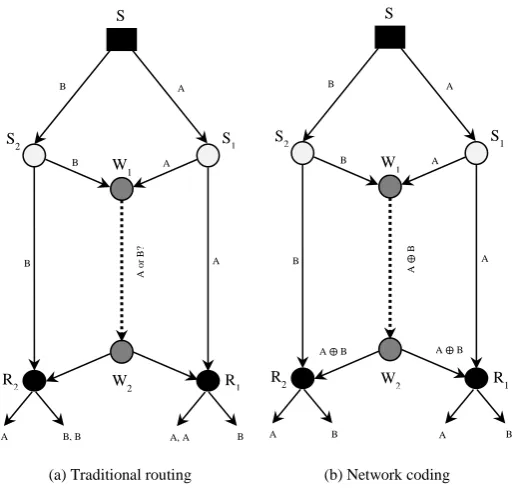
best illustrated by the butterfly network presented in Figure 2.1, which is considered
as the starting point of NC.
The butterfly model is a directed graph G = (V, E), where V is the set of nodes that
encompasses hosts and routers, and E is the set of edges that connects these routers
together. The source node 𝑆 ⊂ 𝑉 generates information bits A and B at a rate of two
per time unit, and wishes to convey these bits to both sinks R1 and R2⊂ 𝑉. Each link in the network has the capacity to transmit one single bit at a time. Nodes W1 and W2 are the intermediate nodes, which act as typical switching or relay stations. A key
11
[image:30.595.190.448.164.408.2]When the network is operated based on a traditional routing (TR) scheme, node W1 can only advance one bit downward through the bottleneck link (W1, W2) upon receiving A and B, causing a congestion problem.
Figure 2.1: A network that requires coding to achieve multicast
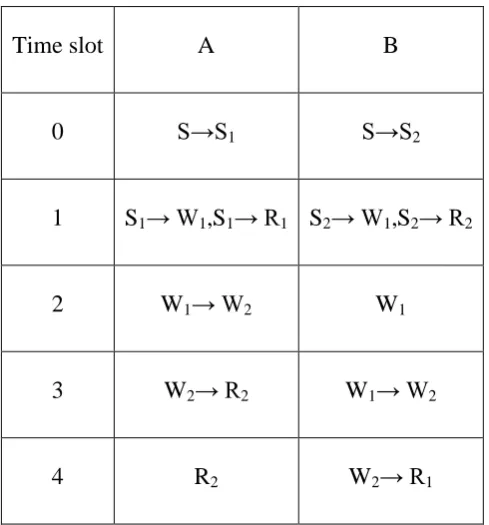
If A is forwarded through W1, sink R1 will, in a single time slot, receive A twice but not B; the same applies for R2 when B is forwarded. Nevertheless, by allowing W1 to combine A and B simply using the modulo 2 sum (XOR function), R1 and R2 receive pairs (A, A⨁B) and (B, A⨁B), respectively. This allows destination R1 to recover B= A⨁(A⨁B), and R2 to recover A= B⨁(A⨁B). Therefore, R1 and R2 can easily recover the original packet bits by performing a simple algebraic operation, but at the
expense of an encoding and decoding operation cost at the intermediate and
destination nodes, respectively. The transmission procedure is summarised in Table
2.1 and Table 2.2 for traditional routing and network coding, respectively.
B B
A A
A B
R1 R2 W2
S1 S2 W1 S A B A B A ⨁ B
A ⨁ B A ⨁ B
B, B B
A A, A
A B
R1 R2 W2
S1 S2 W1 S A B A B A or B?
12
Table 2.1: Data transmission in a butterfly network using traditional routing.
Time slot A B
0 S→S1 S→S2
1 S1→ W1,S1→ R1 S2→ W1,S2→ R2
2 W1→ W2 W1
3 W2→ R2 W1→ W2
4 R2 W2→ R1
Table 2.2: Data transmission in a butterfly network using network coding.
Time slot A B A⨁B
0 S→S1 S→S2
1 S1→ W1,S1→ R1 S2→ W1,S2→ R2
2 R1 R2 W1→ W2
3 R1 R2 W2→ R1, W2→ R2
It can be seen that traditional routing consumes a total of four time-slots to transmit
data bits A and B; however, NC is capable of conveying A and B in three time-slots,
which results in 2/3 = 0.667 bits per time-slot compared to 0.5 bits per time-slot in
[image:31.595.146.493.387.608.2]13
thus offers numerous advantages over the conventional routing in multicast
throughput [1, 17, 18].
It has been proved [19] that in an acyclic coding networks, the number of encoding
nodes required to achieve the network capacity is bounded by h3k3,where h is the number of packets needed to be delivered to a set of k sinks. It is been also observed
that the number of encoding nodes is independent of the size of the network and is
bounded by h3k3.
It is important to determine the location and number of nodes which should employ
NC, however, finding a minimal set of encoding nodes where coding is required is
NP-hard [19]. Several papers [17, 20-25] have addressed coding and decoding
options, and have established the theoretical ability of NC to improve network
throughput. An algebraic framework for NC with an investigation of linear network
codes for directed graphs with cycles was developed in [23]. This scheme was later
used by [20] to show that random NC coefficients can be efficiently constructed. An
efficient construction of deterministic network codes - when the topology is known -
was proposed in [22]. This is manifested by providing deterministic polynomial time
algorithms for designing linear codes, given a directed acyclic graph with an edge,
of unit capacity, that is tolerant to edge failure.
The idea of random linear network coding was first implemented by Chou et al. [26];
the authors proposed a practical real-world NC scheme by designing a packet format
that removes the need for any centralized knowledge of the graph topology and the
encoding or decoding functions. A stream of information is divided into generations,
and random NC is applied within each generation. Coding coefficients are carried by
14
capacity with low delay [26]. Based upon this practical NC scheme, a commercial
application for file content distribution (named Avalanche) is proposed in [27]. NC
has diverse applications in wired and wireless networks, such as peer-to-peer
networks, sensor, ad hoc and cellular networks [28].
2.2
Network Coding in Wireless Networks
The use of NC has also demonstrated advantages in increasing the throughput and
bandwidth efficiency of wireless networks, and in saving wireless resources [3, 21,
29-31]. As an illustration, consider a communication system shown in Figure 2.2,
with two wireless nodes A and C, that wish to exchange their bits through an
intermediate relay node B. It is assumed that the wireless node cannot either receive
a transmission from more than one neighbouring node, or simultaneously transmit
and receive data.
Figure 2.2: A transmission scenario in (a) store-and-forward and (b) NC wireless communication
systems
Figure 2.2 (a) shows that a traditional routing scheme takes a total of k = 4 time-slots
to complete the exchange procedure. With the help of NC, the transmission time can
be reduced to three time-slots, as shown in Figure 2.2 (b). Hence, in comparison with
the TR scheme, NC can save one time slot, and hence save transmission bandwidth. (b)
(a)
b1
b2
A B C
A B C
A b1⨁b2 B b1⨁b2 C
b1
b2
k=4 k=3 k=2
A B C
A B C
A B C
A B C
k=1
b1
15
Furthermore, NC can offer significant benefits by saving transmission energy when
deployed [32]. The first implementation of NC in a real-world wireless environment
was presented in [2] using an opportunistic approach to NC called COPE, where
each node intercepts data on the medium, and detects coding opportunities after
learning the status of the neighbouring nodes. This is then implemented in real-world
wired networks in [26, 27]. The scenario presented in Figure 2.2 can also be
considered as a model of a satellite communication system, where A and C
correspond to ground stations that communicate with each other through node B,
which corresponds to the satellite. This concept was first introduced in [33], before it
was fully developed by [1]; in the latter the term “network coding” was coined.
2.3
Synchronous and Asynchronous Network Coding
In the early stages of the development of NC, the maximum network capacity
achieved by NC implicitly assumed that packets of different flows are well
synchronised. In synchronous NC, a coding node holds its coding operation until all
required packets from different flows arrive. However, since real-world networks
present stochastic packet arrivals and unpredictable delays, the size of the coding
node buffers may increase to infinity [34]. This led to the proposal of the
asynchronous NC approach, where the node calculates the probability that the
packets it is waiting to combine are decoded by the receiver. If the probability is
greater than a certain threshold, the node sends a packet combination, otherwise the
packet is sent without coding. Additionally, a coding node may transit un-coded
packets if no coding opportunities occur within a predefined time or pre-set
conditions. This concept was fist implemented and evaluated by [2, 3] and attracted
16
2.4
Linear Network Coding (LNC)
The encoding functions fe for e ∈E can be very complicated, and the role of NC is to
design a function which ensures the reception of coded blocks that are represented by
a set of equations that have a unique solution at the receivers.
Li et al. [17] concluded that a linear encoding process is sufficient to achieve the
max-flow bound in a multicast network, between a source and each receiver; a
detailed algebraic description of such a function in NC is presented in [23]. The use
of linear coding makes the coding and decoding processes faster, and easier to
implement in practice [35].
Let 𝑏1, 𝑏2, … 𝑏𝑘 ∈ 𝔽𝑞 be the message packets arrive at the intermediate node W1.
Figure 2.3: A intermediate link employing LNC
The transmission on the link is assumed to be synchronized in such a way that several
packets are present at W1 at the same time. The transmitted packets 𝑋(𝑒) denote the symbol that is being sent on link 𝑒 ∈ 𝐸, and are related to the received packets by the
linear equation, which is expressed as a combination of the packets that enter at node
W1:
𝑋(𝑒) = 𝑓𝑒({𝑋(𝑒́)}𝑒́∈𝐼𝑛𝑝𝑢𝑡(𝑊1)) = 𝐿𝑤. 𝑋(𝑒́)
where Lw is the local transfer matrix at W1. Each outgoing packet X(e) is a linear combination of the incoming packets at the edge 𝑒́ entering node W1. The intermediate node W2 relays the coded blocks 𝑋(𝑒) to its outgoing ports toward the
𝑋(𝑒)
𝑋(𝑒) 𝑋(𝑒)
W2 𝑒
𝑒’
b1
b2
bk
𝑋(𝑒) = 𝑓𝑒({𝑋(𝑒́)}𝑒́∈𝐼𝑛𝑝𝑢𝑡(𝑊1))
17
sink nodes 𝑡𝑖 ∈ 𝑇 ⊂ 𝑉, which should be able to retrieve the original packets by
solving the set of equations
{𝑓𝑒(𝑏1, 𝑏2, … 𝑏𝑘) = 𝑋(𝑒)}𝑒∈𝑖𝑛𝑝𝑢𝑡 (𝑡𝑖).
Since only linear operations are performed in the network, every packet transmitted
along an edge is a linear combination of the source packets, 𝑏1, 𝑏2, … 𝑏𝑘. That is, for
every node 𝑣 ∈ 𝑉, X(e) can be given by
𝑋𝑣(𝑒́) = 𝐺𝑣[
𝑏1
⋮
𝑏𝑘]
where Gv is the global transfer matrix at v. In order for a sink node 𝑡 ∈ 𝑉 to recover
the source packets, it is necessary for 𝐺𝑡 at t to have a rank k [26], since only then
does 𝐺𝑡 have an inverse 𝐺𝑡−1 satisfying 𝐺𝑡−1𝐺𝑡= 𝐼𝑘, where 𝐼𝑘 is the identity matrix.
The result of encoding a set of packets that satisfies the coding conditions is called a
coded block. The encoding function coefficients can be chosen in a deterministic or
random way, highlighted in the following sections.
2.4.1 Deterministic linear network coding
When the data segment blocks are about to transmit, the source S chooses a set of
coding coefficients C to produce a linear combination of the original data blocks. In
deterministic NC [22, 36], C is chosen according to a predefined set of coefficients,
nodes use the same encoding function at each run, and the encoding coefficients are
known to every node. Hence, a full knowledge of the network topology is required,
and nodes should be informed about the encoding design; this eliminates the need for
overheads, and the operational cost of decoding will be low [37]. However, packets in
18
topology is difficult to obtain. These constraints are overcome by random NC
addressed in the following section.
2.4.2 Random linear network coding
In random NC [20, 38, 39], coding coefficients are not carefully designed, but simply
chosen at random from a finite field. Hence, no previous knowledge of the network
topology is required, which makes it suitable for large and dynamic networks. This
property provides the flexibility to cope with arbitrary network topologies, and the
ability to be applied in wireless networks [3, 40], P2P networks [27, 41], network
security [42] and optical networks [43]. However, this randomized method requires a
certain amount of overhead, such as the calculation of coding coefficients which are
attached and transmitted in each coded block. Moreover, the higher operational cost
of such a random coding scheme cannot be avoided, since the receivers have to solve
a new system of equations for each transmission [37]. It can be concluded that
random NC is resistant to packet loss, delays, different link capacities and variations
in network topology [44].
2.4.3 Full-rank Vandermonde Matrix
As already mentioned, coding coefficients can be randomly generated and embedded
in each coded block header [26]; this makes the approach suitable for large and
dynamic networks. An alternative approach is for the sender and receiver to agree on
one deterministic invertible encoding matrix, V. This method requires prior
knowledge of the network topology, but it reduces the operational cost of the
decoding process, as the receivers solve the same system of equations for each
19
𝑉 =
(
1 1 … 1
𝛼1 𝛼2 … 𝛼𝑘
𝛼12
⋮
𝛼1𝑘−1
𝛼22 …
⋮ ⋱
𝛼2𝑘−1 …
𝛼𝑘2
⋮
𝛼𝑘𝑘−1)
(2.1)
The row elements of 𝑉 ensure a non-linear relationship between the encoded blocks,
which allows the receiver to perform a decoding operation once k blocks have been
[image:38.595.237.409.72.147.2]received.
Figure 2.4 gives an illustrative example of a source S, multicasting blocks B1 and B2 to both receivers R1 and R2. Although both nodes W1 and W2 can serve node R1, they may end up transmitting the same block B2 to node R1, since there is no connection between W1 and W2. In this case, the bandwidth of W1 is wasted. Similarly, W1 may transmit block B1 to node R2, which has already received B1 through S1.
Figure 2.4: An example of the distribution of two blocks B1 and B2 with NC [44]
With NC, however, W1 can transmit a coded block Y=c1B1+c2B2, with randomly chosen coefficients c1 and c2, to both R1 and R2. In this case R1 can retrieve the original blocks B1 and B2 by solving the following set of simultaneous equations:
R1 R2 B1 B2 B2 B2 B1
B1 B
[image:38.595.254.380.414.602.2]20
[BB1
2] = [
0 1
c1 c2]
−1
. [B2
𝑌] (2.2)
The computational complexity of NC escalates with an increasing number of blocks;
to reduce the effect of this, blocks in a file can be divided into multiple generations,
with NC only being applied within the same generation [26].
2.5
Network Coding in Computer Networks
2.5.1 Network coding based error control techniques
The use of NC has been explored extensively in order to exploit its usefulness in
improving multicast capacity. However, NC is still emerging from the fields of
mathematics and information theory, therefore its practical application in real-world
data communications systems has not been fully explored in existing research work.
Usually, the performance of communication systems employing NC is investigated
under the assumption that packets travel in error-free networks [1, 17]. Since
transmission errors are unavoidable, communication networks adopt error control
techniques to ensure reliable packet delivery. Packets which are received incorrectly
must be retransmitted according to one of the most commonly used Automatic
Repeat reQuest (ARQ) protocols: Stop-and-Wait (SW), Go BACK N (GBN) and
Selective Repeat (SR). These protocols are based on the same mechanisms: the
sender starts a countdown timer whenever it transmits a packet; the receiver
transmits an acknowledgment for every correct reception; and the sender assumes
that a packet has been lost when its acknowledgment does not arrive before the timer
expires [46, 47].
The benefits of NC, as described in Chapters 4, 5 and 6, can be combined with ARQ
21
next-hop destination to send one feedback message (ACK signal) for either k linearly
coded packets of size kn, or one combination of size n, depending on the coding
scheme utilised, as depicted in Figure 2.5. This yields better network performance in
terms of throughput, transmission bandwidth and energy consumption.
Figure 2.5: NC-based scenario where one ACK signal is sufficient for (a) coded packets of size nk, (b) coded packets of size n
Network coding with feedback was first attempted by Fragouli et al. [6]; the authors
present a number of simple observations that indicate the possible benefits of using
feedback in the context of NC. In [48], the authors analyse the reliability gain of NC
for reliable multicasting in wireless networks; they show that NC significantly
reduces the number of retransmissions in error-prone networks compared with an
end-to-end ARQ scheme.
As a natural extension of ARQ schemes, [49] proposes a new coding and queuing
management algorithm for communication networks, which employs linear NC. This
scheme combines the benefits of NC and ARQ, enabling the sender to control its
queued packets upon receiving acknowledgments based on the receivers’ states of
knowledge. In a single-hop wireless network [50], a hybrid ARQ-random NC
framework for real-time media broadcast is proposed, which aims to minimise the
packet erasure rate in order to enhance the media quality at receivers. Within the ARQ
Pk P2 P1 Sender Receiver
ACK1
(a)
... ...
... ARQ
Pk P2 P1 Sender Receiver b1
bk b2 b1
ACK1
(b) Packet size n
Coded packet size nk
Packet size n
Packet size n
22
same context [51], some NC schemes have been proposed to reduce the number of
broadcast transmissions from the sender to multiple receivers, compared to ARQ
schemes. This is carried out by maintaining and then XORing a list of N lost packets
at the sender, before transmitting them to all receivers. A receiver is able to recover
its lost packet by XORing the successfully-received combined packet with an
appropriate set of previous correctly received packets. By integrating NC and ARQ
schemes in [52], the end-to-end delay performance of reliable communications over
a lossy wireless network was studied, based on the model presented in [48].
The steady-state throughput of general NC nodes is studied in [53]. In this study, a
NC node with H incoming links perform coding, and transmit the coded packets via
one outgoing port, through Stop-and-Wait ARQ protected links. The authors assume
that the system operates in a synchronous manner, and that the incoming node links
are provided with a FIFO queue to store packets, which are assumed to be ready to
send. The authors conclude that the throughput of a NC node decreases as the
number of incoming links increases and hence an increasing buffer size of the
involved links is suggested. In the context of the three types of ARQ schemes, the
authors in [54] investigated the maximum achievable throughput of the Butterfly
networks. Figure 2.6 shows that in an error-free environment, the system attains the
maximum possible throughput that the ARQ scheme can achieve. The work
presented in this thesis, however, compares the performance of the three types of
ARQ with and without employing NC. This makes the effect of NC improvement to
23
Figure 2.6:Maximum throughput versus PER of the butterfly network [54]
The authors in [55] present an NC-based cooperative ARQ scheme, which improves
the network’s bandwidth by minimizing the number of total transmissions, while
significantly reducing the average time to transmit data packets. Among ARQ
schemes, the Stop-and-Wait protocol is the most suitable one that can be used in
half-duplex underwater networks [56]. However, the low bandwidth, long
propagation delays and high error probability makes other ARQ techniques
unsuitable for such environments [57]. The authors in [57] propose an error recovery
scheme that carefully couples NC and multiple paths in underwater sensor networks.
A number of downstream neighbour nodes are utilized to improve the efficiency of
NC through adjusting the routing paths and the amount of redundancy on each node.
2.5.2 Network coding based queuing theory
The use of NC can achieve a significant capacity gain when the incoming data are
properly synchronised. Hence, it is important to investigate the impact of employing
synchronised NC on the behaviour of an encoding node. If synchronized NC is
adopted over an intermediate encoding node with K incoming links, coding will not
24
buffers attached to incoming links with high data rates will suffer from queuing
problems, which leads to their buffer size approaching infinity [34]. Although the
performance of communication systems employing asynchronous NC has been the
subject of substantial interest in recent years, very little work exists that considers the
queuing behaviour when synchronous NC is adopted. Figure 2.7 shows a general
queuing system with two incoming links and input buffers.
In Chapters 7 and 8, an intermediate node with K input links is considered, as
depicted in Figure 2.7.
Figure 2.7: A typical queuing system with K incoming links
Each link is connected to a source that generates packets independently according to
a Poisson process with rate λK.In the case of traditional routing, the total incoming traffic rate with two sources at the intermediate node queue is λ= λ1 + λ2. The employment of a synchronous NC scheme forces packets to wait for the arrival of
other packets with which they will be combined, incurring a potential
synchronization delay. In order to tackle this problem, several strategies have been
proposed based on the concept of sending un-coded packets should packets of other
sources not arrive within a predefined time. This may cause transmission
inefficiency, since un-coded packet streams can only communicate one packet at a
time, whereas coded packet streams can communicate two or more packets during
the same duration of transmission. Therefore, introducing asynchronous NC may
offer an advantage in terms of increasing coding opportunities, as a coding node may
Server Output queue
Arrival rate, λK
Arrival rate, λ1
Departure rate Netwo rk co d in g
… λ
Buffer 1
25
wait some time for a packet to be received from the other node. However, system
performance may degrade if this waiting time is prolonged.
In the literature, various approaches have been taken to tackle the problem of
synchronization, and to quantify the benefits of NC from the queuing perspective.
The opportunistic NC (ONC) method has been proposed where the coding decision
depends on certain conditions [2, 3]. Within the context of queuing analysis, an
opportunistic NC approach has been proposed by [58] where the decision of coding
depends on the buffer’s state at a given node. In the developed queuing model, the
decision to transmit un-coded packets depends on the number of packets in the
buffers. The impact of this decision on the energy-delay trade-offs is analysed in
[59]. The authors introduced energy-efficient transmission strategies based on the
instantaneous queue contents for stable operation, and highlight the cross-layer
optimization trade-offs between different measures of throughput and energy
efficiency. ONC is also employed in [60] to solve the problem of synchronization
where a use of a dynamic buffer allocation at the relay station is proposed. The
authors proposed a discrete-time Markov queuing model for a wireless lossy
butterfly network, where opportunistic NC scheduling protocol [2, 7, 58] is
employed at the relay node. In [61], the authors model an energy-delay trade-off
problem as a continuous Markov chain with exponential arrival rates. The method
proposes a threshold for the buffer used to accommodate waiting packets – when this
is exceeded, packets are transmitted un-coded. This work has been extended in [62],
a study which captures the different functionality of NC, including packet
classification, route processing, coding and transmission. It is assumed that the
relay’s buffers have unlimited capacity; therefore, loss of packets due to buffer
26
at intermediate nodes, to fully exploit the coding opportunities. The authors in [64]
analysed the behaviour of a system employing ONC for the case of general arrival
rates. The analysis studies the trade-off between the delay due to waiting for coding
opportunities and the increased efficiency of spectrum access due to NC.
Through solving queuing systems for the buffer behaviour at a relay node, [65]
derives closed-form expressions for the throughput and packet delay of NC in the
slotted ALOHA protocol. In [66], the authors present a queuing model for RLC for
time-division-duplex (TDD) channels in a bulk-service queuing system; numerical
results for the mean number of packets in the queue are presented, and an optimal
choice for the bulk-size that minimizes the mean number of packets in the queue is
shown.
Presented in Figure 2.8, the model proposed by [34], concludes that Poisson
distributed incoming packets results in coded packets asymptotically follow a
Poisson distribution as shown in Figure 2.9. It also concludes that due to
synchronization, the queue size of the encoding node will approach infinity, as
shown in Figure 2.10. This observation has led to the proposal of an opportunistic
scheduling strategy, Combined Opportunistic Scheduling and Encoding (COSE), in
which a clearing stage is associated with an encoding stage to transmit unmatched
packets to clear non-empty queues. This scheme has come to be regarded as an
27
Figure 2.8: Queuing model of the encoding node with two inputs and one output [34]
Figure 2.9: Histogram of the interval time in f3 [34]
Figure 2.10: Queue length variation via time in f1 and f2 [34]
In [67], the additional delay at the intermediate nodes caused by synchronous and
asynchronous partial coding is evaluated. In a wireless Butterfly network [7], the
authors compare the classical routing with NC in delay-sensitive applications. Two
28
of the second queue in the presence of stochastic arrivals and limited service rates. In
the wireless broadcast medium, RLC is also studied in [8]. The authors present a
queuing model for RLC and explore the delay performance of RLC that adapts to the
stochastic arrivals of traffic at source node, which is analysed as a discrete-time
bulk-service queue.
In further research, the authors in [68] built a generic queuing model under
asynchronous NC, based on the Internet core scenario. They studied the stability of
the system, and the maximum achievable coding gain in a stable system. In addition,
a quantitative relation between different metrics such as packet delay, traffic arrival
rate and service rate under general traffic arrival is described.
In contrast to previous work, Chapter 7 extends the results obtained by [34] and
introduces a new analytical model for an M/M/1 system, with two and three source
nodes addressing one intermediate node, but without input buffers. The source nodes
are assumed to hold their packets until all packets from other sources have their
packets ready for coding simultaneously. The study aims to investigate the coded
packet distribution prior to their entry to the intermediate node queue, and also their
waiting times before they are served. The results show that the resulting coded
packets follow a random general distribution. The M/M/1 queue has a Poisson
distribution for arrivals and departures and has infinite buffer size with one server. If
the queue has a finite buffer of K then it will be referred to as M/M/1/K. Later in
Chapters 7 and 8, the terminologies of newly formed queues will be identified and
defined accordingly.
Based on the analytical results obtained in Chapter 7, Chapter 8 studies the
![Figure 2.4: An example of the distribution of two blocks B1 and B2 with NC [44]](https://thumb-us.123doks.com/thumbv2/123dok_us/9555861.460343/38.595.237.409.72.147/figure-example-distribution-blocks-b-b-nc.webp)