warwick.ac.uk/lib-publications
Original citation:
Wade, Sara and Ghahramani, Zoubin. (2017) Bayesian cluster analysis : point estimation and
credible balls. Bayesian Analysis.
Permanent WRAP URL:
http://wrap.warwick.ac.uk/92153
Copyright and reuse:
The Warwick Research Archive Portal (WRAP) makes this work of researchers of the
University of Warwick available open access under the following conditions.
This article is made available under the Creative Commons Attribution 4.0 International
license (CC BY 4.0) and may be reused according to the conditions of the license. For more
details see:
http://creativecommons.org/licenses/by/4.0/
A note on versions:
The version presented in WRAP is the published version, or, version of record, and may be
cited as it appears here.
Bayesian Cluster Analysis: Point Estimation and
Credible Balls
Sara Wade∗ and Zoubin Ghahramani†
Abstract. Clustering is widely studied in statistics and machine learning, with applications in a variety of fields. As opposed to popular algorithms such as ag-glomerative hierarchical clustering or k-means which return a single clustering solution, Bayesian nonparametric models provide a posterior over the entire space of partitions, allowing one to assess statistical properties, such as uncertainty on the number of clusters. However, an important problem is how to summarize the posterior; the huge dimension of partition space and difficulties in visualizing it add to this problem. In a Bayesian analysis, the posterior of a real-valued pa-rameter of interest is often summarized by reporting a point estimate such as the posterior mean along with 95% credible intervals to characterize uncertainty. In this paper, we extend these ideas to develop appropriate point estimates and cred-ible sets to summarize the posterior of the clustering structure based on decision and information theoretic techniques.
Keywords:mixture model, random partition, variation of information, Binder’s loss.
1
Introduction
Clustering is widely studied in statistics and machine learning, with applications in a variety of fields. Numerous models and algorithms for clustering exist, and new studies which apply these methods to cluster new datasets or develop novel models or algorithms are constantly being produced. Classical algorithms such as agglomerative hierarchical clustering or the k-means algorithm (Hartigan and Wong (1979)) are popular but only explore a nested subset of partitions or require specifying the number of clusters apriori. Moreover, they are largely heuristic and not based on formal models, prohibiting the use of statistical tools, for example, in determining the number of clusters.
Model-based clustering methods utilize finite mixture models, where each mixture component corresponds to a cluster (Fraley and Raftery (2002)). Problems of determin-ing the number of clusters and the component probability distribution can be dealt with through statistical model selection, for example, through various information criteria. The expectation-maximization (EM) algorithm is typically used for maximum likelihood estimation (MLE) of the mixture model parameters. Given the MLEs of the parameters, the posterior probability that a data point belongs to a class can be computed through Bayes rule. The cluster assignment of the data point corresponds to the class with max-imal posterior probability, with the corresponding posterior probability reported as a
∗University of Warwick,[email protected] †University of Cambridge,[email protected]
c
measure of uncertainty. Importantly, however, this measure of uncertainty ignores un-certainty in the parameter estimates. As opposed to MLE, Bayesian mixture models incorporate prior information on the parameters and allow one to assess uncertainty in the clustering structure unconditional on the parameter estimates.
Bayesian nonparametric mixture models assume that the number of components is infinite. As opposed to finite mixture models, this not only avoids specification of the number of components but also allows the number of clusters present in the data to grow unboundedly as more data is collected. Bayesian nonparametric mixture models induce a random partition model (Quintana (2006)) of the data points into clusters, and the posterior of the random partition reflects our belief and uncertainty of the clustering structure given the data.
However, an important problem in Bayesian nonparametric cluster analysis is how to summarize this posterior; indeed, often the first question one asks is what is an ap-propriate point estimate of the clustering structure based on the posterior. Such a point estimate is useful for concisely representing the posterior and often needed in applica-tions. Moreover, a characterization of the uncertainty around this point estimate would be desirable in many applications. Even in studies of Bayesian nonparametric models where the latent partition is used simply as a tool to construct flexible models, such as in mixture models for density estimation (Lo (1984)), it is important to understand the behavior of the latent partition to improve understanding of the model. To do so, the researcher needs to be equipped with appropriate summary tools for the posterior of the partition.
Inference in Bayesian nonparametric partition models usually relies on Markov chain Monte Carlo (MCMC) techniques, which produce a large number of partitions that represent approximate samples from the posterior. Due to the huge dimension of the partition space and the fact that many of these partitions are quite similar differing only in a few data points, the posterior is typically spread out across a large number of partitions. Clearly, describing all the unique partitions sampled would be unfeasi-ble, further emphasizing the need for appropriate summary tools to communicate our findings.
In a typical Bayesian analysis, the posterior of a univariate parameter of interest is often summarized by reporting a point estimate such as the posterior mean, median, or mode, along with a 95% credible interval to characterize uncertainty. In this paper, we aim to extend these ideas to develop summary tools for the posterior on partitions. In particular, we seek to answer the two questions: 1) What is an appropriate point estimate of the partition based on the posterior? 2) Can we construct a 95% credible region around this point estimate to characterize our uncertainty?
or are not utilized or hyperpriors are assigned to any hyperparameters. More generally, the posterior mode can be found by reporting the partition visited most frequently in the sampler. Yet this approach can be problematic, as producing reliable frequency counts is intractable due to the huge dimension of the partition space. In fact, in many examples, the MCMC chain does not visit a partition more than once. To overcome this, alter-native search techniques have been developed to locate the posterior mode (Heller and Ghahramani (2005), Heard et al. (2006), Dahl (2009), Raykov et al. (2014)). However, it is well-known that the mode can be unrepresentative of the center of a distribution.
Alternative methods have been proposed based on the posterior similarity matrix. For a sample size of N, the elements of thisN byN matrix represent the probability that two data points are in the same cluster, which can be estimated by the proportion of MCMC samples that cluster the two data points together. Then, classical hierarchical or partitioning algorithms are applied based on the similarity matrix (Medvedovic and Sivaganesan (2002), Medvedovic et al. (2004), Rasmussen et al. (2009), Molitor et al. (2010)). These methods have the disadvantage of being ad-hoc.
A more elegant solution is based on decision theory. In this case, one defines a loss function over clusterings. The optimal point estimate is that which minimizes the posterior expectation of the loss function. For example, for a real-valued parameter θ, the optimal point estimate is the posterior mean under the squared error lossL2(θ,θ) =
(θ−θ)2 and the posterior median under the absolute error lossL
1(θ,θ) =|θ−θ|.
The question to answer then becomes what is an appropriate loss function on the space of clusterings. The 0-1 loss function, a simple choice which leads to the posterior mode as the point estimate, is not ideal as it does not take into account the similarity between two clusterings. More general loss functions were developed by Binder (1978), and the so-called Binder’s loss, which measures the disagreements in all possible pairs of observations between the true and estimated clusterings, was studied in a Bayesian nonparametric setting by Lau and Green (2007). Alternative loss functions considered in Bayesian nonparametrics can be found in Quintana and Iglesias (2003) and Fritsch and Ickstadt (2009).
In this paper, we propose to use the variation of information developed by Meil˘a (2007) as a loss function in a Bayesian nonparametric setting. Both the variation of information and Binder’s loss possess the desirable properties of being metrics on the space of partitions and beingalignedwith the lattice of partitions. We provide a detailed comparison of these two metrics and discuss the advantages of the variation of informa-tion over Binder’s loss as a loss funcinforma-tion in Bayesian cluster analysis. Addiinforma-tionally, we propose a novel algorithm to locate the optimal partition, taking advantage of the fact that both metrics are aligned on the space of partitions.
However, there is no precise quantification of how much uncertainty is represented by the posterior similarity matrix, and in a comparison with the 95% credible balls, we find that the uncertainty is under-represented by the posterior similarity matrix. Finally, we provide an algorithm to construct the credible ball and discuss ways to depict or report it.
The paper is organized as follows. Section2provides a review of Bayesian nonpara-metric clustering and existing point estimates of the clustering structure from a decision theoretic approach. In Section 3, we give a detailed comparison of two loss functions, Binder’s loss and the variation of information, pointing out advantages of the latter. The optimal point estimate under the variation of information is derived in Section 4
and a novel algorithm to locate the optimal partition is proposed. In Section5, we con-struct a credible ball around the point estimate to characterize posterior uncertainty and discuss how to compute and depict it. Finally, simulated and real examples are provided in Section6.
2
Review
This section provides a review of Bayesian nonparametric clustering models and existing point estimates of the clustering in literature.
2.1
Bayesian nonparametric clustering
Mixture models are one of the most popular modeling tools in Bayesian nonparametrics. The data is assumed conditionally i.i.d. with density
f(y|P) =
K(y|θ)dP(θ),
whereK(y|θ) is a specified parametric density on the sample space with mixing param-eter θ ∈ Θ andP is a probability measure on Θ. In a Bayesian setting, the model is completed with a prior on the unknown parameter, which in this case, is the unknown mixing measure. In the most general setting, this parameterP can be any probability measure on Θ, requiring a nonparametric prior. Typically the nonparametric prior has discrete realizations almost surely (a.s.) with
P =
∞
j=1
wjδθj a.s.,
where it is often assumed that the weights (wj) and atoms (θj) are independent and the
θj are i.i.d. from some base measureP0. Thus, the density is modeled with a countably
infinite mixture model
f(y|P) =
∞
j=1
wjK(y|θj).
component. The partition can be represented by c= (C1, . . . , CkN), whereCj contains
the indices of data points in the jth cluster and kN is the number of clusters in the
sample of size N. Alternatively, the partition can be represented by c = (c1, . . . , cN),
wherecn=j if thenth data point is in the jth cluster.
A key difference with finite mixture models is that the number of mixture compo-nents is infinite; this allows the data to determine the number of clusters kN present
in the data, which can grow unboundedly with the data. Letting yj ={yn}n∈Cj, the
marginal likelihood for the datay1:N given the partition is
f(y1:N|c) = kN
j=1
m(yj) = kN
j=1 n∈Cj
K(yn|θ)dP0(θ).
The posterior of the partition, which reflects our beliefs and uncertainty in the clus-tering given the data, is simply proportional to the prior times the marginal likelihood
p(c|y1:N)∝p(c) kN
j=1
m(yj), (1)
where the prior of the partition is obtained from the selected prior on the mixing mea-sure. For example, a Dirichlet process prior (Ferguson (1973)) forPwith mass parameter
αcorresponds to
p(c) = Γ(α) Γ(α+N)α
kN
kN
j=1
Γ(nj),
where nj = |Cj| is the number of data points in cluster j. Various other priors
de-veloped in Bayesian nonparametric literature can be considered for the mixing mea-sure P, such as the Pitman–Yor process (Pitman and Yor (1997)), also known as the two-parameter Poisson–Dirichlet process, or the normalized generalized Gamma pro-cess or more generally, a prior within the class of normalized completely random mea-sures, Poisson–Kingman models (Pitman (2003)), or stick-breaking priors (Ishwaran and James (2001)). See Lijoi and Pr¨unster (2011) for an overview.
In general, the marginal likelihood of the data given the partition or the prior of the partition used to compute the posterior in (1) may not be available in closed form. Moreover, there are
SN,k=
1
k!
k
j=0
(−1)j
k j
(k−j)N,
a Stirling number of the second kind, ways to partition theN data points intokgroups and
BN = N
k=1
SN,k,
of prior and likelihood. Thus, MCMC techniques are typically employed, such as the marginal samplers described by Neal (2000) with extensions in Favaro and Teh (2013) for normalized completely random measures and in Lomell´ı et al. (2016) for σ-stable Poisson–Kingman models; the conditional samplers described in Ishwaran and James (2001), Papaspiliopoulos and Roberts (2008), or Kalli et al. (2011), with extensions in Favaro and Teh (2013) for normalized completely random measures and in Favaro and Walker (2012) for σ-stable Poisson–Kingman models; or the recently introduced class of hybrid samplers forσ-stable Poisson–Kingman models in Lomell´ı et al. (2015). These algorithms produce approximate samples (cm)M
m=1from the posterior (1). Clearly,
describing all the posterior samples is infeasible, and our aim is to develop appropriate summary tools to characterize the posterior.
Extensions of Bayesian nonparametric mixture models are numerous and allow one to model increasingly complex data. These include extensions for partially exchangeable data (Teh et al. (2006)), inclusion of covariates (MacEachern (2000)), time dependent data (Griffin and Steel (2006)), and spatially dependent data (Duan et al. (2007)) to name a few. See M¨uller and Quintana (2004) and Dunson (2010) for an overview. These extensions also induce latent clusterings of the observations, and the summary tools developed here are applicable for these settings as well.
2.2
Point estimation for clustering
Firstly, we seek a point estimate of the clustering that is representative of the posterior, which may be of direct interest to the researcher or, more generally, important for understanding the behavior of the posterior. From decision theory, a point estimate is obtained by specifying a loss functionL(c,c), which measures the loss of estimating the true clusteringcwithc. Since the true clustering is unknown, the loss is averaged across all possible true clusterings, where the loss associated to each potential true clustering is weighted by its posterior probability. The point estimatec∗corresponds to the estimate which minimizes the posterior expected loss,
c∗= argmin
c
E[L(c,c)|y1:N] = argmin
c
c
L(c,c)p(c|y1:N).
A simple choice for the loss function is the 0-1 loss,L0−1(c,c) = 1(c=c), which
assumes a loss of 0 if the estimate is equal to the truth and a loss of 1 otherwise. Under the 0-1 loss, the optimal point estimate is the posterior mode. However, this loss function is unsatisfactory because it doesn’t take into account similarity between two clusterings; a partition which differs from the truth in the allocation of only one observation is penalized the same as a partition which differs from the truth in the allocation of many observations. Moreover, it is well-known that the mode can be unrepresentative of the center of a distribution. Thus, more general loss functions are needed.
implies that the loss is a function of the countsni j=|Ci∩Cj|, which is the cardinality
of the intersection betweenCi, the set of data point indices in clusteriunderc, andCj,
the set of data point indices in cluster j underc, for i= 1, . . . , kN andj = 1, . . . ,kN;
the notationkN andkN represents the number of clusters in candc, respectively. He
explores loss functions satisfying these principles, starting with simple functions of the countsni j. The so-called Binder’s loss is a quadratic function of the counts, which for
all possible pairs of observations, penalizes the two errors of allocating two observations to different clusters when they should be in the same cluster or allocating them to the same cluster when they should be in different clusters:
B(c,c) =
n<n
l11(cn=cn)1(cn=cn) +l21(cn=cn)1(cn =cn).
If the two types of errors are penalized equally, l1=l2= 1, then
B(c,c) =1 2
⎛ ⎝kN
i=1
n2i++
kN
j=1
n2+j−2
kN i=1 kN j=1
n2i j
⎞ ⎠,
where ni+=
jni j andn+j =
ini j. Under Binder’s loss withl1=l2, the optimal
partition c∗ is the partitioncwhich minimizes
n<n
|1(cn=cn)−pn n|,
or equivalently, the partition cwhich minimizes
n<n
(1(cn=cn)−pn n)2, (2)
wherepn n =P(cn=cn|y1:N) is the posterior probability that two observationsnand
nare clustered together. This loss function was first studied in Bayesian nonparametrics by Lau and Green (2007). We note that in earlier work Dahl (2006) considered mini-mization of (2) but without the connection to Binder’s loss and the decision theoretic approach.
Binder’s loss counts the total number of disagreements,D, in theN2possible pairs of observations. The Rand index (Rand (1971)), a cluster comparison criterion, is defined as the number of agreements, A, in all possible pairs divided by the total number of possible pairs. Since D+A=N2, Binder’s loss and the Rand index, denoted R(c,c), are related:
B(c,c) = (1−R(c,c))
N
2
,
3
A comparison of the variation of information and
Binder’s loss
Meil˘a (2007) introduces thevariation of information(VI) for cluster comparison, which is constructed from information theory and compares the information in two clusterings with the information shared between the two clusterings. More formally, the VI is defined as
VI(c,c) = H(c) + H(c)−2I(c,c)
=−
kN
i=1
ni+
N log n i+ N − kN j=1
n+j
N log n +j N −2 kN i=1 kN j=1
ni j
N log
ni jN
ni+n+j
,
where log denotes log base 2. The first two terms represent the entropy of the two clus-terings, which measures the uncertainty in bits of the cluster allocation of an unknown randomly chosen data point given a particular clustering of the data points. The last term is the mutual information between the two clusterings and measures the reduction in the uncertainty of the cluster allocation of a data point in c when we are told its cluster allocation inc. The VI ranges from 0 to log(N). A review of extensions of the VI to normalize or correct for chance are discussed in Vinh et al. (2010). However, some desirable properties of the VI are lost under these extensions.
In this paper, we propose to use the VI as a loss function. Note that since I(c,c) = H(c) + H(c)−H(c,c), we can write
VI(c,c) = H(c) + H(c)−2H(c)−2H(c) + 2H(c,c),
=−H(c)−H(c) + 2H(c,c),
=
kN
i=1
ni+
N log n i+ N + kN j=1
n+j
N log n +j N −2 kN i=1 kN j=1
ni j
N log n i j N .
We provide a detailed comparison with an N-invariant version of Binder’s loss, defined as
˜
B(c,c) = 2
N2B(c,c) =
kN i=1 n i+ N 2 + kN j=1 n +j N 2 −2 kN i=1 kN j=1 n i j N 2 .
Both loss functions are considered N-invariant as they only depend onN through the proportionsni j/N. We focus on these two loss functions as they satisfy several desirable
properties.
The first important property is that both VI and ˜B are metrics on the space of partitions.
Property 1. Both VI andB are metrics on the space of partitions.˜
A proof for VI can be found in Meil˘a (2007). For ˜B, the proof results from the fact that ˜
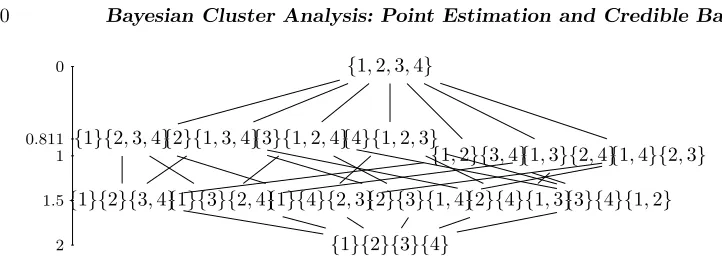
Figure 1: Hasse diagram for the lattice of partitions with a sample of sizeN = 4. A line is drawn fromcup tocwhencis covered byc.
The next properties involve first viewing the space of partitions as a partially ordered set. In particular, consider the space of partitions C and the binary relation ≤ onC
defined by set containment, i.e. for c,c ∈ C, c≤ c if for alli = 1, . . . , kN, Ci ⊆ Cj
for somej∈ {1, . . . ,kN}. The partition spaceCequipped with≤is a partially ordered
set.
For any c,c∈C,cis covered byc, denoted c≺c, if c<cand there is no c∈C
such that c<c<c. This covering relation is used to define theHasse diagram, where the elements ofC are represented as nodes of a graph and a line is drawn fromcup to
cwhenc≺c. An example of the Hasse diagram forN = 4 is depicted in Figure1.
The space of partitions possesses an even richer structure; it forms a lattice. This follows from the fact that every pair of partitions has agreatest lower bound andleast upper bound; for a subset S⊆C, an element c∈C is an upper bound for Sifs≤c
for all s ∈ S, and c ∈ C is the least upper bound for S, denoted c = l.u.b.(S), if
c is an upper bound for S and c ≤ c for all upper bounds c of S. A lower bound and the greatest lower bound for a subset S ⊆ C are similarly defined, the latter denoted by g.l.b.(S). We define the operators ∧, called the meet, and ∨, called the join, as c∧c= g.l.b.(c,c) andc∨c= l.u.b.(c,c). Following the conventions of lattice theory, we will use1to denote the greatest element of the lattice of partitions, i.e. the partition with every observation in one clusterc= ({1, . . . , N}), and 0to denote the least element of the lattice of partitions, i.e. the partition with every observation in its own cluster c = ({1}, . . . ,{N}). See Nation (1991) for more details on lattice theory and the Supplementary Material (Wade and Ghahramani, 2017) for specific details on the lattice of partitions.
Figure 2: Hasse diagram stretched by VI with a sample of sizeN= 4. Note 2−34log(3)≈ 0.811. From the VI stretched Hasse diagram, we can determine the distance between any two partitions. Example: if c = ({1,2},{3,4}) and c = ({1},{3},{2,4}), then
c∧c= ({1},{2},{3},{4}) and d(c,c) = d(c∧c,1)−d(c,1) +d(c∧c,1)−d(c,1) = 2−1 + 2−1.5 = 1.5.
Figure 3: Hasse diagram stretched by ˜B with a sample of size N = 4. From the ˜B stretched Hasse diagram, we can determine the distance between any two partitions. Example: ifc= ({1,2},{3,4}) andc= ({1},{3},{2,4}), thenc∧c= ({1},{2},{3},{4}) andd(c,c) =d(c∧c,1)−d(c,1)+d(c∧c,1)−d(c,1) = 0.75−0.5+0.75−0.625 = 0.375.
Property 2. For both VI and B, if˜ c≥c≥c, then
d(c,c) =d(c,c) +d(c,c).
Property 3. For both VI and B,˜
d(c,c) =d(c,c∧c) +d(c,c∧c).
Proofs can be found in the Supplementary Material. These two properties imply that if the Hasse diagram is stretched to reflect the distance between any partition and1, the distance between any two partitions can be easily determined from thestretched Hasse diagram. Figures 2 and 3 depict the Hasse diagram for N = 4 in Figure 1 stretched according to VI and ˜B respectively.
[image:11.612.134.481.310.411.2]Property 4. A distance on partitions satisfying Properties 2 and 3 has the property that for any two partitions candc,
d(c,c)≤d(1,0).
Thus,
VI(c,c)≤log(N) and B˜(c,c)≤1− 1
N.
A proof can be found in the Supplementary Material. In both cases, the bound on the distance between two clusterings depends on the sample sizeN. However, the behavior of this bound is very different; for VI, it approaches infinity as N → ∞, and for ˜B, it approaches one as N → ∞. As N grows, the number of total partitions BN increases
drastically. Thus, it is sensible that the bound on the metric grows as the size of the space grows. In particular, 1and 0 become more distant as N → ∞, as there is an increasing number, BN −2, of partitions between these two extremes; for ˜B, the loss
of estimating one of these extremes with the other approaches the fixed number one, while for VI, the loss approaches infinity.
From the stretched Hasse diagram in Figures 2 and 3, we can determine the clos-est partitions to any c. For example, the closest partitions to 1 are the partitions which split 1 into two clusters, one singleton and one containing all other observa-tions; and the closest partitions to ({1},{2},{3,4}) are the partition which merges the two smallest clusters ({1,2},{3,4}) and the partition which splits the cluster of size two ({1},{2},{3},{4}).
Property 5. For both metrics VI andB, the closest partitions to a partition˜ care:
• ifccontains at least two clusters of size one and at least one cluster of size two, the partitions which merge any two clusters of size one and the partitions which split any cluster of size two.
• if c contains at least two clusters of size one and no clusters of size two, the partitions which merge any two clusters of size one.
• ifccontains at most one cluster of size one, the partitions which split the smallest cluster of size greater than one into a singleton and a cluster with the remaining observations of the original cluster.
A proof can be found in the Supplementary Material. This property characterizes the set of estimated partitions which are given the smallest loss. Under both loss functions, the smallest loss of zero occurs when the estimated partition is equal to the truth. Otherwise, the smallest loss occurs when the estimated clustering differs from the truth by merging two singleton clusters or splitting a cluster of size two, or, if neither is possible, splitting the smallest cluster of size n into a singleton and a cluster of size
n−1. We further note that the loss of estimating the true clustering with a clustering which merges two singletons or splits a cluster of size two, is N2 and N22 for VI and ˜B respectively, which converges to 0 as N → ∞for both metrics, but at a faster rate for
Next, we note that the Hasse diagram stretched by ˜B in Figure3appears asymmetric, in the sense that 1 is more separated from the others when compared to the Hasse diagram stretched by VI in Figure2.
Property 6. SupposeN is divisible byk, and letck denote a partition withk clusters
of equal size N/k.
˜
B(1,ck) = 1−
1
k >
1
k −
1
N = ˜B(0,ck).
VI(1,ck) = log(k)≤log(N)−log(k) =VI(0,ck), fork≤ √
N ,
and
VI(1,ck) = log(k)≥log(N)−log(k) =VI(0,ck), fork≥ √
N .
Property 6 reflects the asymmetry apparent in Figure 3. In particular, for ˜B, a partition with two clusters of equal sizec2will always be closer to the extreme0of each
data point in its own cluster than the extreme1of everyone in one cluster. However, as the sample size increases,c2becomes equally distant between the two extremes. For all
other values ofk, the extreme0will always be closer. This behavior is counter-intuitive for a loss function on clusterings. VI is much more sensible in this regard. Ifk=√N,
0and1are equally good estimates ofck. Fork < √
N,ck is better estimated by1and
fork >√N,ck is better estimated by0; as the sample size increases, these preferences
become stronger. In particular, note that loss of estimating c2 with 1 will always be
smaller than estimating it with0forN >4.
Additionally, we observe from Figure3that the partitions with two clusters of sizes one and three are equally distant between the two extremes under ˜B. The following property generalizes this observation.
Property 7. SupposeN is an even and square integer. Then, the partitions with two clusters of sizes n= 12(N−√N)andN−nare equally distant from 1and0under B.˜
This property is unappealing for a loss function, as it states that the loss of esti-mating a partition consisting of two clusters of sizes 12(N−√N) and 12(N+√N) with the partition of only one cluster or with the partition of all singletons is the same. In-tuitively, however,1is a better estimate. The behavior of VI is much more reasonable, as partitions with two clusters will always be better estimated by 1than0forN >4 and partitions with √N clusters of equal size are equally distant from0and1.
Finally, we note that as both VI and ˜B are metrics on the space of clusterings, we can construct a ball around cof size , defined as:
B(c) ={c∈C:d(c,c)≤}.
4
Point estimation via the variation of information
As detailed in the previous section, both VI and ˜B share several desirable properties including being aligned with the lattice of partitions and coinciding in the smallest non-trivial ball around any clustering. However, in our comparison, differences also emerged. Particularly, we find that ˜B exhibits some peculiar asymmetries, preferring to split clusters over merging, and we find that the VI ball more closely reflects our intuition of the neighborhood of a partition. In light of this, we propose to use VI as a loss function in Bayesian cluster analysis. Under the VI, the optimal partitionc∗ is
c∗= argmin
c
E[VI(c,c)|D]
= argmin c N n=1 log( N
n=1
1(cn =cn))−2 N n=1 E[log( N
n=1
1(cn =cn,cn =cn))|D], (3)
with Ddenoting the data. For a givenc, the second term in (3) can be approximated based on the MCMC output, and evaluating this term is of order O(M N2) (recallM
is the number of MCMC samples). This may be computationally demanding if the number of MCMC samples is large and if (3) must be evaluated for a large number of
c. Alternatively, one can use Jensen’s inequality, swapping the log and expectation, to obtain a lower bound on the expected loss which is computationally more efficient to evaluate: argmin c N n=1 log( N
n=1
1(cn =cn))−2 N n=1 log( N
n=1
P(cn =cn|D)1(cn =cn)). (4)
Similar to minimization of the posterior expected Binder’s loss, minimization of (4) only depends on the posterior through the posterior similarity matrix, which can be pre-computed based on the MCMC output. In this case, computational complexity for a givencis reduced toO(N2).
Due to the huge dimensions of the partition space, computing the lower bound in (4) for every possible c is practically impossible. A simple technique to find the optimal partitionc∗restricts the search space to some smaller space of partitions. TheR package ‘mcclust’ (Fritsch (2012)), which contains tools for point estimation in Bayesian cluster analysis and cluster comparison, includes a functionminbinder()that finds the partition minimizing the poster expected Binder’s loss among the subset of partitions 1) visited in the MCMC chain or 2) explored in a hierarchical clustering algorithm with a distance of 1−P(cn =cn|D) and average or complete linkage. An alternative
search algorithm developed in Lau and Green (2007), which is based on binary integer programming, is also implemented.
We propose a greedy search algorithm to locate the optimal partitionc∗based on the Hasse diagram, which can be used for both VI and ˜B. In particular, given some partition
c, we consider the l closest partitions that cover c and the l closest partitions that c
no reduction in the posterior expected loss is obtained or when a maximum number of iterations has been reached. At each iteration, the computational complexity isO(lN2).
We have developed anR package ‘mcclust.ext’ (Wade (2015)), expanding upon the ‘mcclust’ package, that is currently available on the author’s website1 and includes functions minbinder.ext() and minVI() to find the partition minimizing the poste-rior expected Binder’s loss and VI, respectively. In addition to implementing the search algorithms of minbinder() in ‘mcclust’ described previously, the greedy search algo-rithm is also included. As is common in greedy search algoalgo-rithms, results are sensitive to both the starting value ofcand the step sizel. In practice, we recommend multiple restarts, for example, at different MCMC samples or the best partition found by the other search algorithms. A larger value ofl will allow more exploration and reduce the need for multiple restarts, and we have chosen a default value ofl= 2N as this showed good exploration in the examples considered with little sensitivity to the initial value ofc. However, for larger datasets, this may be too expensive and multiple restarts with smallerl may be preferred.
An advantage of the greedy search algorithm over simply restricting to partitions visited in the chain is that partitions not explored in the MCMC algorithm can be considered; in fact, in almost all simulated and real examples, the clustering estimate is not among the sampled partitions and results in a lower expected loss than any sampled partition.
5
Credible balls of partitions
To characterize the uncertainty in the point estimate c∗, we propose to construct a credible ball of a given credible level 1−α,α∈[0,1], defined as
B∗(c∗) ={c:d(c∗,c)≤∗},
where ∗ is the smallest ≥ 0 such that P(B(c∗)|D) ≥ 1−α. The credible ball is
the smallest ball around c∗ with posterior probability at least 1−α. It reflects the posterior uncertainty in the point estimate c∗; with probability 1−α, we believe that the clustering is within a distance of ∗ from the point estimate c∗ given the data. It can be defined based on any metric on the space of partitions, such as VI and ˜B. If the smallest non-trivial ball under VI or ˜B has posterior probability of at least 1−α, the credible balls under the two metrics will coincide (see Property 5). Typically, however, they will be different.
From the MCMC output, we can obtain an estimate of∗, and thus the credible ball of level 1−α. First, the distance between all MCMC samples{cm}andc∗is computed.
For any≥0,
P(B(c∗)|D) =E[1(d(c∗,c)≤)|D]≈
1
M
M
m=1
1(d(c∗,cm)≤),
and∗ is the smallest≥0 such that M1 Mm=11(d(c∗,cm)≤)≥1−α.
To characterize the credible ball, we define the vertical and horizontal bounds of the credible ball. The vertical upper bounds consist of the partitions in the credible ball with the smallest number of clusters that are most distant from c∗. The vertical lower bounds consist of the partitions in the credible ball with the largest number of clusters that are most distant fromc∗. The horizontal bounds consist of the partitions in the credible ball that are most distant fromc∗. The bounds are defined more formally below, where the notationk(c) is used for the number of clusters inc.
Definition 1 (Vertical upper bounds). The vertical upper bounds of the credible ball B∗(c∗), denotedvu∗(c∗), are defined as
vu∗(c∗) ={c∈B∗(c∗) :k(c)≤k(c)∀c ∈B∗(c∗) and
d(c,c∗)≥d(c,c∗)∀c∈B∗(c∗)with k(c) =k(c)}.
Definition 2 (Vertical lower bounds). The vertical lower bounds of the credible ball B∗(c∗), denotedvl∗(c∗), are defined as
vl∗(c∗) ={c∈B∗(c∗) :k(c)≥k(c)∀c ∈B∗(c∗) and
d(c,c∗)≥d(c,c∗)∀c∈B∗(c∗)with k(c) =k(c)}.
Definition 3 (Horizontal bounds). The horizontal bounds of the credible ball B∗(c∗),
denoted h∗(c∗), are defined as
h∗(c∗) ={c∈B∗(c∗) :d(c,c∗)≥d(c,c∗)∀c∈B∗(c∗)}.
These bounds describe the extremes of the credible ball and with 1−α posterior probability, how different we believe the partition may be fromc∗. An example is pro-vided in the Supplementary Material. In practice, we define the vertical and horizontal bounds based on the partitions in the credible ball with positive estimated posterior probability.
In existing literature, quantification of uncertainty in the clustering structure is typically described through a heat map of the estimated posterior similarity matrix. However, as opposed to the credible ball of Bayesian confidence level 1−α, there is no precise quantification of how much uncertainty is represented by the posterior similar-ity matrix. Moreover, in the examples of Section6, we find that in a comparison with the 95% credible balls, the uncertainty is under-represented by the posterior similar-ity matrix. Additionally, the credible balls have the added desirable interpretation of characterizing the uncertainty around the point estimate c∗.
6
Examples
Figure 4: The data is simulated from a mixture of four normals with locations (±2,±2) and colored by cluster membership. In (b) components having varying standard devia-tions.
6.1
Simulated examples
Two datasets of sizen= 200 are simulated from:
Xiiid∼
4 j=1 1 4N
(−1)(j−21)2 (−1)j−12
,
σ2
j 0
0 σj2
.
In the first example,σj= 1 for all components, while in the second example, components
have varying standard deviations; σj = 1 for the two components located in the first
and third quadrants, σj = 0.5 in the second quadrant, and σj = 1.5 in the fourth
quadrant. The datasets for both examples are depicted in Figure 4 and colored by cluster membership.
We consider a Dirichlet process (DP) mixture model:
Xi|Piid∼
N μ1 μ2 , σ2 1 0
0 σ2 2
dP(μ,Σ) and P ∼DP(αP0), (5)
where μ = (μ1, μ2) and Σ is a diagonal matrix with diagonal elements (σ12, σ22). The
base measure of the DP is the conjugate product of normal inverse gamma priors with parameters (μ0,i, ci, ai, bi) fori= 1,2, i.e.P0has density
p0(μ1, μ2, σ12, σ22)∝ 2 i=1 ci σ2 i exp − ci
2σ2
i
(μi−μ0,i)2
(σ2i)−ai−1exp
−bi
σ2
i
.
The parameters were fixed to μ0,i= 0, ci = 1/2, ai = 2, bi = 1 for i= 1,2. The mass
parameter αis given a Gam(1,1) hyperprior.
Figure 5: Clustering estimate with color representing cluster membership for Binder’s loss (first row) and VI (second row) with columns corresponding to examples.
shown) suggest convergence. Among partitions sampled in the MCMC, only one is visited twice and all others are visited once in the first example, while no partitions are visited more than once in the second example.
Figure 5 depicts the partition estimate found by the greedy search algorithm for Binder’s loss and VI and for both examples (with multiple restarts and the default value of l = 2N); colors represent cluster membership with the posterior expected cluster-specific mean and variance represented through stars and ellipses, respectively. Tables in the Supplementary Material provide a comparison of the true partition with the estimates through a cross tabulation of cluster labels. In all examples, the four true clusters are visible; however, Binder’s loss creates new small clusters for observations on the border between clusters where cluster membership is uncertain, overestimating the number of clusters. This effect is most extreme for the second example, where the fourth cluster (blue in Figure4b) has increased overlap with the second and third clusters (red and green in Figure 4b), while the first cluster (black in Figure 4b) with decreased variance is well separated from the other clusters and identified in both estimates.
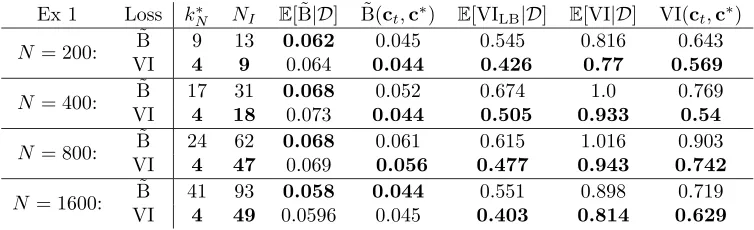
Loss kN∗ NI E[ ˜B|D] B(˜ ct,c∗) E[VILB|D] E[VI|D] VI(ct,c∗)
Ex 1: B˜ 9 13 0.062 0.045 0.545 0.816 0.643
VI 4 9 0.064 0.044 0.426 0.77 0.569
Ex 2: B˜ 12 18 0.088 0.056 0.846 1.068 0.764
[image:19.612.117.494.113.185.2]VI 4 10 0.093 0.049 0.668 0.99 0.561
Table 1: A comparison of the clustering estimate with ˜B or VI in terms of 1) number of clustersk∗N; 2) number of data points incorrectly classified, denotedNI; 3) expected
˜
B; 4) ˜B between the optimal and true clusterings; 5) expected lower bound of VI; 6) expected VI; and 7) VI between the optimal and true clusterings for both examples.
Ex 1 Loss kN∗ NI E[ ˜B|D] B(˜ ct,c∗) E[VILB|D] E[VI|D] VI(ct,c∗)
N = 200: B˜ 9 13 0.062 0.045 0.545 0.816 0.643
VI 4 9 0.064 0.044 0.426 0.77 0.569
N = 400: B˜ 17 31 0.068 0.052 0.674 1.0 0.769
VI 4 18 0.073 0.044 0.505 0.933 0.54
N = 800: B˜ 24 62 0.068 0.061 0.615 1.016 0.903
VI 4 47 0.069 0.056 0.477 0.943 0.742
N= 1600: B˜ 41 93 0.058 0.044 0.551 0.898 0.719
VI 4 49 0.0596 0.045 0.403 0.814 0.629
Table 2: Example 1 with increasing sample size: a comparison of the clustering estimate with ˜B or VI in terms of 1) number of clusterskN∗; 2) number of data points incorrectly classified, denotedNI; 3) expected ˜B; 4) ˜B between the optimal and true clusterings; 5)
expected lower bound of VI; 6) expected VI; and 7) VI between the optimal and true clusterings.
VI estimate achieve the lowest posterior expected loss for ˜B and VI, respectively, but interestingly, the VI estimate has the smallest distance from the truth for both ˜B and VI in both examples, with the greatest improvement in the second example. Furthermore, the number of incorrectly classified data points is greater for the ˜B estimate than the VI estimate.
Additional simulated experiments were performed to analyze the effect of increasing the sample size in the first example. The results are succinctly summarized in Table2. As the sample size increases, more points are located on the border where cluster mem-bership is uncertain. This results in an increasing number of clusters in the ˜B estimate (up to 41 clusters for N = 1600), while the VI estimate contains only four clusters for all sample sizes. In both estimates, the number of incorrectly classified data points increases with the sample size, however this number is smaller for the VI estimate in all sample sizes, with the difference between this number for Binder’s and VI growing with the sample size. Furthermore, the VI estimate has improved VI distance with truth and improved or comparable ˜B distance with truth when compared with the ˜B estimate.
[image:19.612.117.494.244.359.2]Figure 6: Example 1: 95% credible ball with Binder’s loss aroundc∗ (a) represented by the (b) horizontal bound, (c) upper vertical bound, and (d) lower vertical bound, where color denotes cluster membership, and a heat map of the posterior similarity matrix (e).
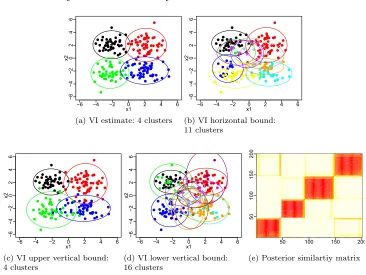
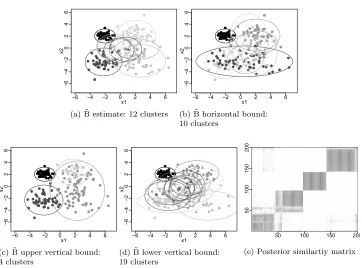
For the first example, Figures6and7represent the 95% credible ball around the opti-mal partition for ˜B and VI, respectively, through the upper vertical bound, lower vertical bound, and horizontal bound, with data points colored according to cluster membership. Analogous plots for the second example are found in Figures8and9. The Supplemen-tary Material provides tables comparing the bounds with the true clustering through a cross tabulation of the true cluster labels with the cluster labels for each bound.
In the first example, we observe that elements of the 95% credible ball with positive estimated posterior probability have at least four clusters for both metrics and at most 18 clusters for ˜B or 16 clusters for VI, while the most distant elements contain 11 clusters for ˜B and VI (Table3). For both metrics, these bounds reallocate uncertain data points on the border with these points either added to one of the four main clusters or to new small to medium-sized clusters. For example, in the ˜B upper bound, 19 elements of the third cluster (green in Figure4a) are added to the fourth cluster (blue in Figure4a) and in the ˜B lower bound, the fourth cluster (blue in Figure4a) is split in two medium-sized clusters and several small clusters.
re-Figure 7: Example 1: 95% credible ball with VI aroundc∗ (a) represented by the (b) horizontal bound, (c) upper vertical bound, and (d) lower vertical bound, where color denotes cluster membership, and a heat map of the posterior similarity matrix (e).
Loss Upper Lower Horizontal
ku
N d(c∗,cu) klN d(c∗,cl) khN d(c∗,ch)
Ex 1: B˜ 4 0.097 18 0.097 11 0.097
VI 4 1.02 16 1.152 11 1.213
Ex 2: B˜ 4 0.137 19 0.131 10 0.137
[image:21.612.121.487.108.383.2]VI 3 1.043 16 1.342 6 1.403
Table 3: A summary of the credible bounds with ˜B or VI in terms of the number of clusters and distance to the clustering estimate for the upper vertical, lower vertical, and horizontal bounds and for both examples.
maining data points into 3 to 18 clusters for ˜B and 2 to 15 clusters for VI (Table 3). Notice the high uncertainty in the fourth cluster with increased variance (blue in Fig-ure4b). Additionally, note the greater uncertainty around the optimal estimate in Ex-ample 2, as the horizontal distance in Table3is greater for Example 2 for both metrics.
[image:21.612.162.449.443.517.2]Figure 8: Example 2: 95% credible ball with Binder’s loss around c∗ (a) represented by the (b) horizontal bound, (c) upper vertical bounds (only one of two shown for conciseness), and (d) lower vertical bound, where color denotes cluster membership, and a heat map of the posterior similarity matrix (e).
uncertainty in allocation of a few data points in Example 1. Moreover, the 95% credible ball gives a precise quantification of the uncertainty.
6.2
Galaxy example
We consider an analysis of the galaxy data (Roeder (1990)), available in the MASS package of R, which contains measurements of velocities in km/sec of 82 galaxies from a survey of the Corona Borealis region. The presence of clusters provides evidence for voids and superclusters in the far universe. The data is modeled with a DP mixture (5). The parameters were selected empirically with μ0= ¯x, c= 1/2, a= 2, b=s2, where ¯x
represents the sample mean ands2represents the sample variance. The mass parameter
αis given a Gam(1,1) hyperprior.
Figure 9: Example 2: 95% credible ball with VI aroundc∗ (a) represented by the (b) horizontal bound, (c) upper vertical bound, and (d) lower vertical bound, where color denotes cluster membership and a heat map of the posterior similarity matrix (e).
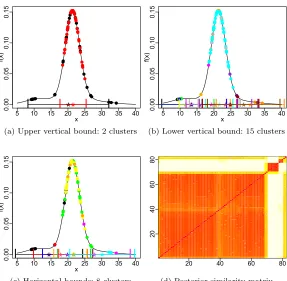
plotted against the estimated density values from the DP mixture model and colored according to cluster membership, with correspondingly colored stars and bars along the x-axis representing the posterior mean and variance within cluster. Again, we observe that Binder’s loss places observations with uncertain allocation into singleton clusters, with a total of 7 clusters, 4 of which are singletons, while the VI solution contains 3 clusters. Table 4 compares the point estimates in terms of the posterior expected ˜B, lower bound of VI, and VI; as anticipated, the ˜B solution has the smallest posterior expected ˜B and the VI solution has the smallest posterior expected VI.
Loss kN∗ E[ ˜B|D] E[VILB|D] E[VI|D]
˜
B 7 0.218 0.746 1.014
[image:23.612.205.402.557.597.2]VI 3 0.237 0.573 0.939
Table 4: Galaxy example: a comparison of the optimal partition with Binder’s loss and VI in terms of posterior expected ˜B, lower bound to VI, and VI.
Figure 10: Galaxy example: optimal clustering estimate with color representing cluster membership for Binder’s loss and VI, with correspondingly colored stars and bars along the x-axis representing the posterior mean and variance within cluster.
Upper Lower Horizontal
ku
N d(c∗,cu) klN d(c∗,cl) kNh d(c∗,ch)
Galaxy 2 1.364 15 1.669 8 1.832
Table 5: Galaxy example: a summary of the credible bounds with VI in terms of the number of clusters and distance to the clustering estimate for the upper vertical, lower vertical, and horizontal bounds.
in cross tabulation tables in the Supplementary Material. We observe a large amount of variability around the optimal partition. With 95% posterior probability, we believe that, on one extreme, the data could be modeled using only 2 components, one with a large variance to account for outliers (black cluster in Figure (11a)). On the other extreme, the data could be further split into one medium sized cluster and many, 14 to be precise, smaller clusters. The horizontal bound, the most extreme partition in the credible ball, splits the largest cluster (red in Figure 10b) into two medium sized clusters and four small clusters and reallocates some of its data points to the first cluster (black in Figure 10b). Figure11d emphasizes that the posterior similarity ma-trix under-represents the uncertainty around the point estimate in comparison to the credible ball.
7
Discusssion
[image:24.612.177.436.317.356.2]Figure 11: Galaxy example: 95% credible ball with VI represented by the (a) upper vertical bound, (b) lower vertical bound, and (c) horizontal bound, where color denotes cluster membership, with correspondingly colored stars and bars along the x-axis rep-resenting the posterior mean and variance within cluster, and (d) a heat map of the posterior similarity matrix.
have developed tools to obtain a point estimate of clustering based on the posterior and describe uncertainty around this estimate via the 95% credible ball.
Obtaining a point estimate through a formal decision theory framework requires the specification of a loss function. Previous literature focused on Binder’s loss. In this work, we propose to use an information theoretic measure, the variation of information, and provide a detailed comparison of the two metrics. We find that Binder’s loss ex-hibits peculiar asymmetries, preferring to split over merge clusters, and the variation of information is more symmetric in this regard. This behavior of Binder’s loss causes the optimal partition to overestimate the number of clusters, allocating uncertain data points to small additional clusters. In addition, we have developed a novel greedy search algorithm to locate the optimal partition, allowing one to explore beyond the space of partitions visited in the MCMC chain.
vertical, and horizontal bounds. In addition to a heat map of the posterior similarity matrix, which is often reported in literature, the 95% credible ball enriches our un-derstanding of the uncertainty present. Indeed, it provides a precise quantification of the uncertainty present around the point estimate, and in examples, we find that an analysis based on the posterior similarity matrix leads one to be over certain in the clus-tering structure. The developed posterior summary tools for Bayesian cluster analysis are available2 through anR package ‘mcclust.ext’ (Wade (2015)), expanding upon the existing Rpackage ‘mcclust’ (Fritsch (2012)).
In future work, we aim to extend these ideas to Bayesian feature allocation analy-sis, an extension of clustering which allows observations to belong to multiple clusters (Griffiths and Ghahramani (2011)). A further direction of research will be to explore posterior consistency for the number of clusters based on the VI estimate for Bayesian nonparametric mixture models; this is of particular interest in light of the negative re-sults of Miller and Harrison (2013) and Miller and Harrison (2014) and the positive results in our simulation studies (Table2). Finally, scalability issues of Bayesian non-parametric mixture models are an important concern for very large datasets. To scale with large sample sizes, a number of papers have avoided exploration of the posterior on partitions through MCMC and focused on finding a point estimate of the partition, of-ten through MAP inference (Heller and Ghahramani (2005), Dahl (2009), Raykov et al. (2014)) or the DP-means algorithm and its extensions (Kulis and Jordan (2012), Jiang et al. (2012), Broderick et al. (2013)). One direction of future research is to develop an algorithm to find the point estimate which minimizes the posterior expected VI that avoids MCMC. Of course, while gaining in scalability, we lose the uncertainty in the clustering structure.
Supplementary Material
Supplementary material for Bayesian cluster analysis: Point estimation and credible balls (DOI: 10.1214/17-BA1073SUPP; .pdf).
References
Binder, D. (1978). “Bayesian Cluster Analysis.” Biometrika, 65: 31–38. MR0501592. doi:http://dx.doi.org/10.1093/biomet/65.1.31. 3,6
Broderick, T., Kulis, B., and Jordan, M. (2013). “MAD-Bayes: MAP-based asymptotic derivations from Bayes.” InProceedings of the 30th International Conference on Ma-chine Learning, 226–234. 25
Dahl, D. (2006). “Model-based clustering for expression data via a Dirichlet process mixture model.” In Do, K., M¨uller, P., and Vannucci, M. (eds.),Bayesian Inference for Gene Expression and Proteomic, 201–218. Cambridge University Press.MR2706330.
7
2Through the author’s website https://www2.warwick.ac.uk/fac/sci/statistics/staff/
Dahl, D. (2009). “Modal clustering in a class of product partition models.” Bayesian Analysis, 4: 243–264.MR2507363. doi:http://dx.doi.org/10.1214/09-BA409. 3,
25
Duan, J., Guindani, M., and Gelfand, A. (2007). “Generalized spatial Dirichlet pro-cesses.” Biometrika, 94: 809–825. MR2416794. doi: http://dx.doi.org/10.1093/ biomet/asm071. 6
Dunson, D. (2010). “Nonparametric Bayes applications to biostatistics.” In Hjort, N., Holmes, C., M¨uller, P., and Walker, S. (eds.),Bayesian nonparametrics. Cambridge University Press.MR2730665. 6
Favaro, S. and Teh, Y. (2013). “MCMC for normalized random measure mixture models.” Statistical Science, 28: 335–359. MR3135536. doi: http://dx.doi.org/ 10.1214/13-STS422. 6
Favaro, S. and Walker, S. (2012). “Slice sampling σ-stable Poisson–Kingman mix-ture models.” Journal of Computational and Graphical Statistics, 22: 830–847.
MR3173745. doi:http://dx.doi.org/10.1080/10618600.2012.681211. 6
Ferguson, T. (1973). “A Bayesian analysis of some nonparametric problems.”Annals of Statistics, 1: 209–230.MR0350949. 5
Fraley, C. and Raftery, A. (2002). “Model-based clustering, discriminant analysis, and density estimation.” Journal of the American Statistical Association, 97: 611–631.
MR1951635. doi:http://dx.doi.org/10.1198/016214502760047131. 1
Fritsch, A. (2012). mcclust: Process an MCMC Sample of Clusterings. URL http:// cran.r-project.org/web/packages/mcclust/mcclust.pdf 13,25
Fritsch, A. and Ickstadt, K. (2009). “Improved criteria for clustering based on the posterior similarity matrix.” Bayesian Analysis, 4: 367–392. MR2507368. doi:http://dx.doi.org/10.1214/09-BA414. 3,7
Griffin, J. and Steel, M. (2006). “Order-based dependent Dirichlet processes.”
Journal of the American Statistical Association, 10: 179–194. MR2268037. doi:http://dx.doi.org/10.1198/016214505000000727. 6
Griffiths, T. and Ghahramani, Z. (2011). “The Indian buffet process: An introduction and review.”Journal of Machine Learning Research, 12: 1185–1224.MR2804598. 25
Hartigan, J. and Wong, M. (1979). “Algorithm AS 136: A k-means clustering algorithm.”
Journal of the Royal Statistical Society, Series C, 28: 100–108.MR0405726. 1
Heard, N., Holmes, C., and Stephens, D. (2006). “A quantitative study of gene regulation involved in the immune response of anopheline mosquitos: An application of Bayesian hierarchical clustering of curves.” Journal of the American Statistical Association, 101: 18–29. MR2252430. doi: http://dx.doi.org/10.1198/016214505000000187.
3
Hubert, L. and Arabie, P. (1985). “Comparing partitions.”Journal of Classification, 2: 193–218. 7
Ishwaran, H. and James, L. (2001). “Gibbs campling methods for stick-breaking pri-ors.” Journal of the American Statistical Association, 96: 161–173. MR1952729. doi:http://dx.doi.org/10.1198/016214501750332758. 5,6
Jiang, K., Kulis, B., and Jordan, M. (2012). “Small-variance asymptotics for exponen-tial family Dirichlet process mixture models.” In Advances in Neural Information Processing Systems, 3158–3166. 25
Kalli, M., Griffin, J., and Walker, S. (2011). “Slice sampling mixture models.” Statis-tics and Computing, 21: 93–105. MR2746606. doi: http://dx.doi.org/10.1007/ s11222-009-9150-y. 6
Kulis, B. and Jordan, M. (2012). “Revisiting K-means: New algorithms via Bayesian nonparametrics.” In Proceedings of the 29th International Conference on Machine Learning, 513–520. 25
Lau, J. and Green, P. (2007). “Bayesian model-based clustering procedures.”
Journal of Computational and Graphical Statistics, 16: 526–558. MR2351079. doi:http://dx.doi.org/10.1198/106186007X238855. 3,7,13
Lijoi, A. and Pr¨unster, I. (2011). “Models beyond the Dirichlet process.” In Hjort, N., Holmes, C., M¨uller, P., and Walker, S. (eds.), Bayesian Nonparametrics, 80–136. Cambridge, UK: Cambridge University Press.MR2730661. 5
Lo, A. (1984). “On a class of Bayesian nonparametric estimates: I. Density estimates.”
Annals of Statistics, 12: 351–357. MR0733519. doi: http://dx.doi.org/10.1214/ aos/1176346412. 2
Lomell´ı, M., Favaro, S., and Teh, Y. (2015). “A hybrid sampler for Poisson–Kingman mixture models.” In Cortes, C., Lawrence, N., Lee, D., Sugiyama, M., and Garnett, R. (eds.),Advances in Neural Information Processing Systems 28. 6
Lomell´ı, M., Favaro, S., and Teh, Y. (2016). “A marginal sampler forσ-stable Poisson– Kingman mixture models.” Journal of Computational and Graphical Statistics. To appear. 6
MacEachern, S. (2000). “Dependent Dirichlet processes.”Technical Report, Department of Statistics, Ohio State University. 6
Medvedovic, M. and Sivaganesan, S. (2002). “Bayesian infinite mixture model based clustering of gene expression profiles.” Bioinformatics, 18: 1194–1206. 3
Medvedovic, M., Yeung, K., and Bumgarner, R. (2004). “Bayesian mixture model based clustering of replicated microarray data.”Bioinformatics, 20: 1222–1232. 3
Miller, J. and Harrison, M. (2013). “A simple example of Dirichlet process mixture inconsistency for the number of components.” In Burges, C., Bottou, L., Welling, M., Ghahramani, Z., and Weinberger, K. (eds.), Advances in Neural Information Processing Systems 26. Curran Associates, Inc. 25
Miller, J. and Harrison, M. (2014). “Inconsistency of Pitman–Yor process mixtures for the number of components.”Journal of Machine Learning Research, 15: 3333–3370.
MR3277163. 25
Molitor, J., Papathomas, M., Jerrett, M., and Richardson, S. (2010). “Bayesian profile regression with an application to the national survey of children’s health.” Biostatis-tics, 11: 484–498. 3
M¨uller, P. and Quintana, F. (2004). “Nonparametric Bayesian data analysis.”
Statistical Science, 19: 95–110. MR2082149. doi: http://dx.doi.org/10.1214/ 088342304000000017. 6
Nation, J. (1991).Notes on Lattice Theory.http://www.math.hawaii.edu/~jb/books. html. 9
Neal, R. (2000). “Markov chain sampling methods for Dirichlet process mixture mod-els.” Journal of Computational and Graphical Statistcs, 9: 249–265. MR1823804. doi:http://dx.doi.org/10.2307/1390653. 6,16
Papaspiliopoulos, O. and Roberts, G. (2008). “Retrospective Markov chain Monte Carlo methods for Dirichlet process hierarchical models.” Biometrika, 95(1): 169– 186.MR2409721. doi:http://dx.doi.org/10.1093/biomet/asm086. 6
Pitman, J. (2003). “Poisson Kingman partitions.” In Statistics and Science: a Festschrift for Terry Speed, 1–34. Beachwood: IMS Lecture Notes. MR2004330. doi:http://dx.doi.org/10.1214/lnms/1215091133. 5
Pitman, J. and Yor, M. (1997). “The two-parameter Poisson–Dirichlet distribution de-rived from a stable subordinator.” Annals of Probability, 25: 855–900. MR1434129. doi:http://dx.doi.org/10.1214/aop/1024404422. 5
Quintana, F. (2006). “A predictive view of Bayesian clustering.” Journal of Statisti-cal Planning and Inference, 136: 2407–2429.MR2279815. doi:http://dx.doi.org/ 10.1016/j.jspi.2004.09.015. 2
Quintana, F. and Iglesias, P. (2003). “Bayesian clustering and product partition mod-els.” Journal of the Royal Statistical Society: Series B, 65: 557–574. MR1983764. doi:http://dx.doi.org/10.1111/1467-9868.00402. 3, 7
Rand, W. (1971). “Objective criteria for the evaluation of clustering methods.”Journal of the American Statistical Association, 66: 846–850. 7
Rasmussen, C., De la Cruz, B., Ghahramani, Z., and Wild, D. (2009). “Modeling and visualizing uncertainty in gene expression clusters using Dirichlet process mixtures.”
Computational Biology and Bioinformatics, IEEE/ACM Transactions on, 6: 615–628.