353
©IJRASET: All Rights are Reserved
Hand Gesture Based Character Recognition using
Neural Network
Dr. Abha Choubey1, Shilpa Devdas2, Dr. Siddharth Choubey3 1, 2, 3
SSTC (SSGI )(SSCET), Dept. of Computer Science & Engineering, Bhilai, Chhattisgarh, India
Abstract: Communication is the trading of thoughts, messages, or data, as by discourse, visuals, signs, composing, or conduct. Hard of hearing and unable to speak individuals impart among themselves utilizing gesture-based communications, however they think that its hard to open themselves to the outside world. This paper proposes a visual based strategy for Communication amongst hard of hearing and unable to speak individuals with the outside world utilizing computers. This strategy utilizes Indian communication via gestures hand motions given by the client as contribution through webcam and is changed over into an instant message. Not at all like the ordinary strategy for hand signal acknowledgment which makes utilization of gloves or markers or some other gadgets, this technique does not require any extra equipment and makes the client agreeable. Productivity is accomplished by utilizing a blend of various Algorithm together to extract features as opposed to depending on a solitary calculation.
Keywords: Neural Network, Feature Extarction, Computer Vision, Sign Language.
I. INTRODUCTION
Hard of hearing and unable to speak individuals utilize their hands to express their thoughts. The gestures incorporate the development of English letters in order. This is called communication via gestures. When they convey through the computer; the gestures may not be agreeable for the individual on the opposite side.
Accordingly for them to see effectively, these gestures can be changed over to messages. The gesture based communication is provincial. There is a different communication through signing in America that utilizations just a single hand for imagining the gestures. In any case, the Indian communication through signing is very surprising.
It utilizes both the hands for speaking to the letter sets. While there are a ton of endeavors going into American Sign Language identification the same can't be said in regards to Indian Sign Language.
The current frameworks for motion acknowledgment can choose their own hand gestures for any activity, however this paper proposes acknowledgment of Standard Indian communication through signing gestures.
The principle contrast to other comparative frameworks is that the proposed framework does not require any extra equipment. This paper proposes a system to include hand gestures through webcam associated with the computer. Picture preparing procedures are being utilized to distinguish the gestures.
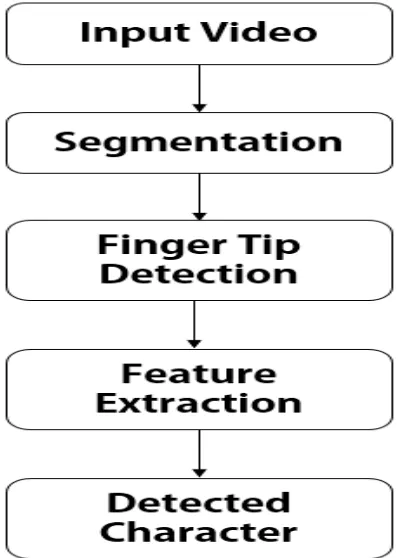
The input picture is fragmented for handling. After division, the districts like finger, palm is extricated. From the removed area of the fingers, fingertip is distinguished. The separation between the fingers is ascertained.
The distinctive highlights of the fingers like point, stance of the finger are recognized. The stance of the finger indicates whether the finger is semi shut, half shut, completely shut or completely open.
These highlights are put away as vector preparing and for each sign letters in order. These vectors are then utilized for perceiving the right motion.
II. GESTURE USEAGE
354
[image:2.612.205.404.87.366.2]©IJRASET: All Rights are Reserved
Fig. 1. Shows the basic architecture of gesture recognition
A. Computer Applications
In desktop computing applications, gestures can give an elective interaction to the mouse and console [5]. Numerous gestures for work area computing errands include controlling graphics, or annotating and editing documents utilizing pen-based gestures [6].
B. Games
When, we take a gander at gestures for computer games. Tracked a player's hand or body position to control development and introduction of interactive diversion objects such as cars. Utilized gestures to control the development of symbols in a virtual world, and Play Station 2 has introduced the Eye Toy, a camera that tracks hand developments for interactive games.
C. Sign Language
Since sign languages are exceptionally structural, they are extremely reasonable as test beds for vision algorithms [10]. In the meantime, they can likewise be a decent method to help the handicapped to interact with computers. Sign language for the hard of hearing (e.g. American Sign Language) is a case that has received significant consideration in the gesture.
III. LITERATURE SURVEY
[1], this paper proposes a limited state and fluffy rationale based way to deal with hand signal learning and acknowledgment. The area of 2D picture spots of the hands of the customer is gotten by Edge location and vector extraction. These are used to recognize the hand demonstration and furthermore the focal point of the hand of the customer. We at first take in the spatial information without data division and course of action. By then the data is accumulated into groups that are related with information for common game plan.
355
©IJRASET: All Rights are Reserved
present, PC interfacing essentially incorporates reassure, mouse, and joystick or gaming wrangles voice acknowledgment for customer input.
[3], in this paper, we propose another method for perceiving hand gestures in a nonstop video stream using a dynamic Bayesian framework or DBN appear. The proposed technique for DBN-based induction is gone before by endeavors of skin extraction and showing, and development following. By then we develop a signal show for possibly a couple hand gestures. They are used to portray a cyclic signal orchestrate showing ceaseless motion stream.
[4], this paper presents a fantasy based ceaseless motion based correspondence acknowledgment (CSR) structure. This CSR structure can isolate the signs in vocabulary and the non-signs. In any case, the persistent motion based correspondence is partitioned into isolated sign areas. By then, the sign segment which can be interpreted side-effect HMMs (pHMM) is a sign, else it is a non-sign.
[5], Hand motion has turned into a viable means for human-PC association. Traditional motion acknowledgment essentially consider hand direction. For some particular applications, for example, virtual reality, more trademark gestures are required, which are mind boggling and contain advancement in 3-D space. In this paper, we acquaint a HMM-based methodology with perceive complex single hand gestures. Motion pictures are grabbed by a typical web camera. Skin shading is used to part hand zone from the picture to outline a hand picture arrangement.
[6], this paper is concerned about the acknowledgment of dynamic hand gestures. A technique in perspective of Hidden Markov Models (HMMs) is shown for dynamic motion direction exhibiting and acknowledgment. Adaboost calculation is used to recognize the customer's hand and a form based hand tracker is encircled consolidating buildup and divided.
[7], Virtual circumstances have constantly been considered as a methods for more instinctive and proficient human PC connection by an extended extent of uses. The range of utilizations incorporates examination of complex logical data, medicinal getting ready, military reenactment, fear treatment and virtual prototyping. Improvement of all inclusive processing, current customer cooperation approaches with support, mouse and pen are not adequate for the up 'til now widening range of Human PC communication.
[8], as of late, the change of human-PC collaboration (HCI) procedures is fast and the run of the mill application is the signal communication innovation. This paper proposes a supportive and lively unique signal acknowledgment system. The underlying advance is to identify turn in each picture layout obtained from a USB camera, through skin division and hand feature extraction. [9], Indian Sign Language (ISL) is a visual-spatial lingo which gives etymological information using hands, arms, facial explanations, and head/body positions. Our proposed work goes for perceiving 3D dynamic signs comparing to ISL words. With the approach of 3D sensors like Microsoft Kinect Cameras, 3D geometric handling of pictures has gotten much thought in late examines.
[10], with the speedy headway of human-PC cooperation innovation, signal acknowledgment ends up one of the key advances of human-PC collaboration. In this paper, we propose another technique for dynamic hand gestures acknowledgment. The procedure grasps the various leveled distinguishing proof show for dynamic hand gestures acknowledgment.
IV. METHODOLOGY
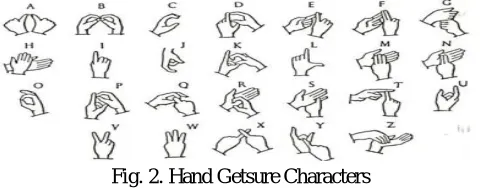
[image:3.612.186.430.565.659.2]The letter sets in Indian Sign Language appeared in Figure 2, utilizes both the hands which separate it from American Sign Language. Indian Sign Language characters are relatively like the characters themselves. Thus the beginning of the task will be with the contribution of gestures through a webcam and the yield will be the letters in order in the content configuration.
Fig. 2. Hand Getsure Characters
356
©IJRASET: All Rights are Reserved
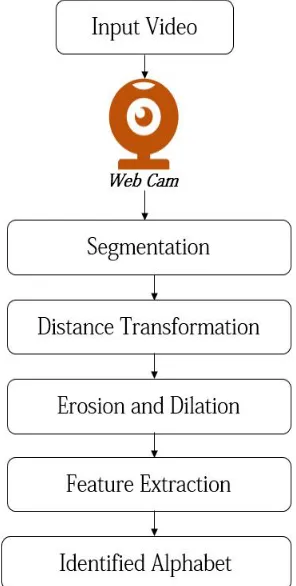
[image:4.612.238.386.161.454.2]The parallel picture is utilized for the procedure of widening and disintegration which gives the area extraction part. From these procedures, the extricated locale will be the finger area and the palm district in isolated variants. At that point utilizing the parallel picture, the fingertips are distinguished and the length of each finger is figured. From that the finger is identified and their highlights like closeness of the finger, point between the fingers are figured. From these highlights, the letters in order are perceived since every letter set has its own highlights not the same as others. By this the yield can be accomplished.
Fig. 3. Propsoed system acrchitecture
A. Segmentation
This method does not utilize glove, so the skin shading must be perceived for recognizing the hand motions. So the info that is taken through the webcam is first isolated into outlines for handling. The info pictures are in RGB shading model. In the RGB shading model change in iridescence influences the picture quality. So this picture is first changed over to HSI demonstrate (Hue Saturation Intensity). This transformation isolates the radiance segment (i.e. power) from the shading parts. One supposition made is that the hand is the biggest question in the info picture.
B. Fingertip Detection
The quantity of dynamic fingers needs to known to recognize the motion. So the fingertip is figured. To figure this, the unrelated point between the two fingers is gotten. A chart is plotter with the limit number in the x-pivot and point in the y-hub. This chart is utilized to check the number if changes from white to dark district. The area where the bend tumbles down is distinguished utilizing differential channel as the fingertip. This number gives the quantity of dynamic fingers. In the wake of getting the quantity of dynamic fingers the motion can be resolved utilizing fingertips.
C. Distance Transform Method
357
©IJRASET: All Rights are Reserved
between the fingers is discovered. This edge gives essential data to recognize communication via gestures motions having a similar number of open fingers. Promote completely close, completely open and half open conditions of each finger are acquired utilizing the lengths of the fingers.
D. Finger Division
From the distance transform method we got the completely opened hand with the most distant distance from the palm. In any case, the fingers need to twist for a few characters. In such a case, the opened fingers alone can't be utilized. So with a specific end goal to incorporate those cases, the hand is separated into three sections. As the distance between the tip of the finger and the crossing point of palm and finger locale of each finger is known, at that point the two focuses can be found as
x = 1/3*major hub 1ength y = 2/3*major hub length
In the wake of figuring, the focuses are plotted. In any case, if the finger isn't open the finger isn't at all recognized.
E. Finger Detection
Amid the underlying preparing stage which goes on for 50 outlines, the length of each finger and the distance of each open finger to each other finger are found and an upper triangular grid is gotten. Again amid the exploratory stage, length of each finger and the distance between them is figured and contrasted and the qualities got amid preparing stage. From this the fingers are recognized and can tell whether the finger is semi shut or half shut, and so on. In view of these highlights the acknowledgment is finished amid the genuine communication through signing acknowledgment stage.
V. RESULTS
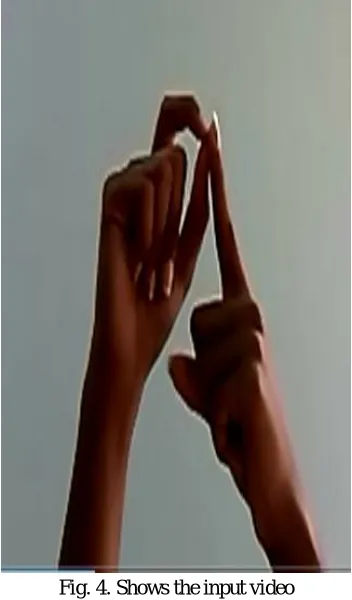
[image:5.612.218.394.362.662.2]The test results of the investigation stage which comes after the training stage for the 50 frames of input video is given beneath. Fig 4 is the input picture given through the webcam .It represents to one of the 50 edges of the information video.
Fig. 4. Shows the input video
The distance transformation function is applied to the video files frames. The image is captured from the video file are converted into binary as shown in figure 5.
358
[image:6.612.219.390.74.381.2]©IJRASET: All Rights are Reserved
[image:6.612.225.388.78.229.2]Fig. 5. Binary Image
Fig. 6. Region of Finger
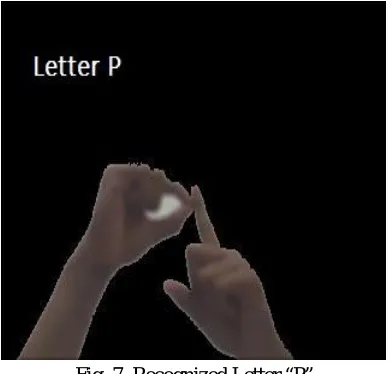
After this process the system is ready to recognize the image from the database which are trained earlier. The output will be of form as shown in fig. 7.
Fig. 7. Recognized Letter “P”
VI. CONCLUSION
[image:6.612.209.404.437.624.2]359
©IJRASET: All Rights are Reserved
REFERENCES
[1] Verma, R., and Dev, A. 2009. Vision based hand gesture recognition using finite state machines and fuzzy logic. In Ultra Modern Telecommunications & Workshops, 2009. ICUMT'09. International Conference on (pp. 1-6). IEEE.
[2] Zou, Z, et al. "Dynamic hand gesture recognition system using moment invariants." Information and Automation for Sustainability (ICIAFs), 2010 5th International Conference on. IEEE, 2010.
[3] Suk, H. I., Sin, B. K., and Lee, S. W. 2010. Hand gesture recognition based on dynamic Bayesian network framework. Pattern Recognition, 43(9), 3059-3072. [4] Yu, S., et al. "Vision-based continuous sign language recognition using product HMM." Pattern Recognition (ACPR), 2011 First Asian Conference on. IEEE,
2011.
[5] Yang, Z., et al. "Dynamic hand gesture recognition using hidden Markov models." Computer Science & Education (ICCSE), 2012 7th International Conference on. IEEE, 2012.
[6] Wang, X., et al. "Hidden-markov-models-based dynamic hand gesture recognition." Mathematical Problems in Engineering 2012 (2012). [7] [7] Rautaray, S. S., and Agrawal, A. 2012. Real time hand gesture recognition system for dynamic applications. Int J UbiComp, 3(1), 21-31.
[8] Jiang, X., et al. "A dynamic gesture recognition method based on computer vision." Image and Signal Processing (CISP), 2013 6th International Congress on. Vol. 2. IEEE, 2013.
[9] Geetha, M., et al. "A vision based dynamic gesture recognition of Indian Sign Language on Kinect based depth images." Emerging Trends in Communication, Control, Signal Processing & Computing Applications (C2SPCA), 2013 International Conference on. IEEE, 2013.