Abstract— This paper addresses resource allocation for sum throughput maximization in a sectorized two-cell downlink OFDMA systems impaired by multicell interference. It is well known that the optimization problem for this scenario is NP-hard and combinational, which is here converted to a novel sum throughput maximization problem based on the intercell interference limitation. Then, two subclasses of this new problem are solved. By the first subclass, on the assumption that subcarrier allocation parameters are fixed, an algorithm for optimal power allocation is obtained. By the second subclass, the problem is reduced to a single cell case where the intercell interference in each subcarrier is limited to a certain threshold. The solution shows that the subcarrier allocation can be performed prior to power distribution. Based on the solution of the single cell problem, a distributed resource allocation scheme with the aim of small information exchange between the coordinated base stations is proposed.
Keywords- Dual method, multicell resource allocation, OFDMA, interference limitation, convex optimization,
I. INTRODUCTION
RTHOGONAL FREQUENCY division multiple access is a popular technique due to its capability to avoid intracell interference and its flexibility in subcarrier allocation. The use of Orthogonal Frequency Division Multiplexing (OFDM) mitigates frequency-dependent distortion across the channel band and simplifying the equalization in a multipath fading environment. This technique is widely used in recent cellular systems such as the 3GPP Long Term Evolution (LTE) [1] and IEEE 802.16m [2].
Yu and Liu [3] showed that in multicarrier applications, Lagrange dual-decomposition methods can be used to find the optimal solution of maximum total throughput problem subject to system resource constraints. They showed that in single cell case, when number of subcarriers tends to infinity, the duality gap becomes zero.
But in multicell case, the intercell interference makes the problem more complex and problem cannot be solved by ordinary methods. Due to intercell interference, the achievable throughput of each cell not only depends on the power and subcarrier allocation of its own, but also depends on resource allocation in adjacent cells.
General formulation of optimization problems for allocating bandwidths and powers for networks of interfering links are provided in [4] and authors characterized computational complexity of dynamic spectrum management problem by establishing the NP-hardness under various practical Seyed Mehdi Hosseini Andargoli1 and Kamal Mohamed-pour2 are with
the Electrical Engineering Department, K.N.Toosi university of technology, Tehran, Iran (e-mail: 1[email protected], 2[email protected]).
settings. The complexity stems from the combinational nature of the problem, in which there are many subcarriers that must be allocated to the users with different conditions. The other difficulty is a lack of convexity when interference is taken into account. Although the paper [4] has focused on digital subcarrier line (DSL) applications, these difficulties also exist in multicell OFDMA systems if intercell interference in each subcarrier is taken into account. This motivates the search for problem formulations that avoid these difficulties.
In [5], an analytical expression of the optimal power allocation with two interfering cells in single-carrier transmission is obtained, and the capacity region study serves as the basis to build the interference graph for power control. Authors of [5] assume that subcarrier allocation and power allocation are performed in sequence.
Authors of [6] and [7] studied sum power minimization problem in a sectorized two-cell downlink OFDMA system impaired by multicell interference. They proposed optimal and suboptimal power control and subcarrier assignment schemes. In their scenario, the first part of the available bandwidth is likely to be reused by different base stations (and is thus subject to multicell interference) and that the second part of the bandwidth is shared in an orthogonal way between the different base stations.
Multicell resource allocation methods can be categorized as centralized or distributed in terms of network location in which resource allocation takes place. If resource allocation resides in Radio Network Controller (RNC), it is called centralized and if it resides in base station it is called distributed.
In distributed resource allocation schemes, each base station manages its resources independently and has little knowledge about intercell interference or control upon. Inadequate intercell interference management strategy particularly in highly loaded systems is an inherent problem of distributed schemes. but in centralized schemes ,one center manages resources of all cells and this center can control intercell interference by appropriate strategy for channel allocation and power control. The basic disadvantage of centralized over distributed approach is due to its requirement to channel conditions of all users in all cells and its more complexity.
In this paper, we study sum throughput maximization problem and obtain a solution for resource allocation in the two adjacent cells. We limit itercell interference on each subcarrier by inserting two constraints to the original problem, and then we maximize a lower bound of sum throughput as a cost function. First we obtain the optimum power allocation algorithm assuming subchannel allocation parameters was fixed. In next section, we define a new
Distributed Resource Allocation for Downlink
Multicell OFDMA Systems
Seyed Mehdi Hosseini Andargoli1 , Kamal Mohamed-pour2
single cell resource allocation problem that considers intercell interference as an optimization constraint. Based on solution of the new problem we propose a distributed resource allocation algorithm for two interfering cells. The remainder of this paper is organized as follows. In section II, we describe system model and original problem. Then subclasses of original problem and their solutions are presented in section III. The numerical results are provided in sections IV.
II. SYSTEM MODEL
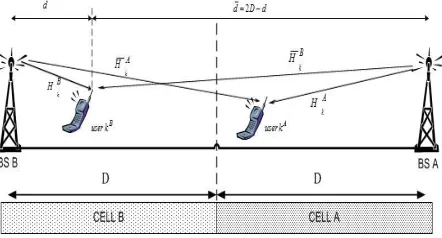
We consider a downlink OFDMA sectorized cellular network. In order to simplify the presentation of our results the network is supposed to be one-dimensional (linear) as in a number of existing studies (for instance [6]-[8] and references there in). The motivation behind our choice of the one-dimensional network is that such a simple model can provide a good understanding on the problem while still grasping the main aspects of a real-world cellular system. It provides also some interesting guidelines that help to implement practical cellular systems and we can extend our results to 2D-Networks in straightforward manner.
We consider the case of sectorized networks i.e. users belonging to different sectors of the same cell are spatially orthogonal [6]. In this case, it is reasonable to assume that a given user is only subject to interference from the nearest interfering base station. Thus we focus on two interfering sectors of two adjacent cells, say Cell A and Cell B as illustrated by Fig.1. Denote by D the radius of each cell which is assumed to be identical for all cells without restriction. We denote by KA and B
K the number of users
in Cell A and B respectively. The total number of available subcarriers is denoted by N and all subcarriers are available in each cell.
For a given user {1,2,..., A}
K
k∈ in cell A, we denote by A
k
N the set of indexes corresponding to the subcarriers
modulated by k. A
k
N is a subset of{01,,...,N−1}. By definition of OFDMA, to distinct users k , k′ belonging
to cell A are such that ∩ A′=φ
k A
k N
N in other word each
subcarrier allocated only to one user in each cell. For each user {1,2,..., A}
K
k∈ of cell A, the signal received by kat the nth subcarrier (n∈NkA) and at the mth OFDM block is
given by
∑
= +
+ =
B n
n l n
k n k n k n k n
k
l B A
A A
A A
m x m H m w m x m H m y
κ ( ) ).
( ) ( ) ( ) ( )
( , , , , ,
, (1)
Where ( )
, m
xA n
k represents the data symbol transmitted by
Base Station A to user k on the subcarrier n. process )
( , m
wA n
k is an additive Gaussian noise with zero mean and
variance
N B N0 2 =
σ which Bis total bandwidth and N0 is
power spectral density of thermal noise. Coefficient
A n k A A
g L m H
k n
k, ( )= . , is frequency response of the channel at
the subcarrier n and the OFDM block m between user k
in cell A and Base Station A and including pass loss component A
k
L and rayleigh fading gkA,n. κnB denote the
user assigned to subbcarrier n in cell B.
∑
= B n
n l n
k
l B
A m x m
H
κ ( ) ).
( ,
, represent intercell interference such
that coefficient HA, (m) n
k is frequency response of the channel at the subcarrier n and the OFDM block m
between user k in cell A and Base Station B and
) ( , m
xB n
k represents the data symbol transmitted by Base
Station B on the subcarrier n.
Channel coefficients are supposed to be perfectly known at the base station side and receiver side.
We assume each subcarrier is allocated to one user in each cell. By assuming subcarrier n is assigned to user kin cell
A, The link capacity of user kin subcarrier n is
) 1
( log ) , (
, ,
, , ,
, 2
2 2
2
∑
= + + =
B n
n l n k
n k n k n
n k n k
l B A
A A B
A A
p H
p H p
C
κ
σ
p (2)
Sum throughput maximization problem in two adjacent cells was defined in the following. This problem is NP-hard and can’t be solved by standard convex optimization methods [9]. Hardness of this problem is result of two parameters I) discrete subcarrier assignment constraint II) the lack of convexity due to intercell interference term.
{
,12,...,}
,{
,12,...,}
(3) ,, 0
,
,
) , ( )
, ( max
1 1
' '
1 1
1 1
, ,
, ,
, ,
, , ,
,
, ,
U
U
B
k A
k
k k k
k n k n k
B
A k
T n k A
A k
T n k
B
B k
n n k n k A
A k
n n k n k B
n k B k
A n k A k
K
k B K
k A
B B A
A B A
K
k n N
B B K
k n N
A A
K
k n N
A B B K
k n N
B A A
p N
p N
N N
N N
k k N
N k k N
N
n k all for p
p
P p P
p to
subject
p C p
C
= =
= ∈ = ∈
= ∈ = ∈
⊆ ⊆
≠ ∀ = ∩ ≠
∀ = ∩
≥
≤ ≤
+
′ ′
∑ ∑
∑ ∑
∑
∑
∑
∑
φ φ
p p
The first and second constraints limits the total transmit power of each BS. Third and fourth ensures nonnegative powers and constraints 5-8 implies that each subcarrier is assigned to no more than one user in each cell.
In this problem because of intercell interference term the utility function is not concave in ( B
n k A
n
k p
p , , , ) and problem is
n k for I H p I H p A n n l n k B n n l n k l A B l B
A . 2 , . 2 ,
, ,
,
,
∑
≤∑
≤ ∀=
=κ κ
(4) These constraints ensure that power control is performed in each cell such that intercell interference does not exceed a certain threshold in each subchannel.
By this constraint insertion we can insure that
B n l A B A n l B
A p I fork H p I fork
H A n n l n k B n n l n
k κ κ
κ
κ ≤ = ≤ =
∑ ∑ = = , , , , 2 2 ., . (5)
As we can see by these constraints the allocated power in each cell is related to subchannel allocation in adjacent cell. therefore we must determine users subchannel allocation index and allocated power such that intercell interference in each subcarrier don’t exceed a predetermined threshold, if these constraints satisfied we can show that
A n A A l B A A A k for I p H p H p H n k n k B n n l n k n k n k κ σ σ κ = + + ≥ + + ∑ = ) 1 ( log ) 1 ( log 2 2 2 2 2 2
2 , ,
, , , , B n B B l A B B B k for I p H p H p H n k n k A n n l n k n k n k κ σ σ κ = + + ≥ + + ∑ = ) 1 ( log ) 1 ( log 2 2 2 2 2 2
2 , ,
, ,
, ,
(6) We simplify the notation as a following
) 1 ( log ) 1 ( log ) ( , , , , 2 2 2 2 ,
, kAn A
A A A n k A n k n k n k n k p I p H p C γ
σ + = +
+ = ) 1 ( log ) 1 ( log ) ( , , , , 2 2 2 2 ,
, kBn B
B B B n k B n
k kn
n k n k p I p H p C γ
σ + = +
+ = B B A A n k n k n k n k I H I H , , , , 2 2 2 2 , γ σ γ
σ + = + = (7)
If we use these lower bounds as a cost function, the problem becomes concave with regard to B
n k A
n
k p
p , , , but the mutual couple of power in adjacent cells is not removed and due to new constraints the channel allocation and power allocation in each cell depend to resource allocation parameters in adjacent cell. the new problem is
n k all for I H p I H p P p P p to subject p C p C A n n l n k B n n l n k B B k T n k A A k T n k B B k n k n k A A k n k n k B n k B k A n k A k l A B l B A K
k n N
B B K
k n N
A A
K
k n N
B B K
k n N
A A p N p N , . , . ) 8 ( , ) ( ) ( max 2 2 1 1 1 1 , , , , , , , , , , , , , , ≤ ≤ ≤ ≤ +
∑
∑
∑ ∑
∑ ∑
∑
∑
∑
∑
= = = ∈ = ∈ = ∈ = ∈ κ κBefore we solve this problem first we obtain optimal power allocation strategy based on constant subcarrier allocation assumption. Then we define single cell problem that focuses
on resource allocation in one cell, and assumes that the resource allocation parameters of users in the other cell are fixed. Solution of single cell problem can be used for distributed multicell resource allocation by some verification.
III. MULTICELL RESOURCE ALLOCATION
A. Optimal power allocation
In this subclass of the above problem we assume the subcarrier allocation was performed and we want to allocate power such that the total sum capacity of two cells is maximized and the constraints are satisfied. We simplify the problem by denote
∑ ∑ = = = = A
n ln
B
n ln l
A A n B n l B B n A n H I I H I I κ κ κ
κ 2 2
, , ) ( , )
( (9)
Where ( B)
n A n
I κ is power limit on subcarrier n in cell A and is a function of the subcarrier allocation in cell B. By this simplifying, the problem decreased to
n k all for I p I p P p P p to subject p C p C B n B A n A K k n N
B B K
k n N
A A
K
k n N
B B K
k n N
A A p p n k n k B B k T n k A A k T n k B B k n k n k A A k n k n k B n k A n k , , , ) ( ) ( max , , , , , , , , , , 1 1 1 1 , ≤ ≤ ≤ ≤ + ∑ ∑ ∑ ∑ ∑ ∑ ∑ ∑ = ∈ = ∈ = ∈ = ∈ (10)
Due to B
n A n κ
κ , are fixed, this problem is concave respect to
( B n k A n k p
p, , , ) and can be solved by convex optimization
methods. Using standard optimization techniques in [9], we obtain the Lagrangian over domain Das
∑ ∑ ∑ ∑ ∑ ∑ ∑ ∑ ∑ ∑ ∑ ∑ = = = = = ∈ = ∈ = ∈ = ∈ − Ω − − Ω − − − − − + = Ω Ω N n B n B K k B N n A n A K k A K k n N
B B B
K k n N
A A A
K k n N
B B K
k n N
A A B A B A B n k A n k I p I p P p P p p C p C p p L n k B n k n k A n k B B k T n k A A k T n k B B k n k n k A A k n k n k n k n k 1 1 1 1 1 1 1 1 , , ) ( ) ( ) ( ) ( ) ( ) ( }) { }, { , , }, { }, ({ , , , , , , , , , , , , λ λ λ λ (11)
Where , , , 0
, , Ω ≥
ΩA B
B A n k n k λ
λ are the Lagrangian multipliers
for constraints. Dis defined as the set of all non-negative A n k p , , B n k p
, ’s for all k, such that for each n n, only one user can have positive power allocation due to OFDMA constraint. Then, the Lagrange dual function is
})} { }, ({ { max }) { }, { , , ( , , , , , , , B A p p B A B A n k n k B n k A n k n k n
k L p p
gλ λ Ω Ω = . The
dual problem can be expressed as
(12) })} { }, { , , ( { min } { }, { , , , , , , , , } { }, { , , B A B A B A B A n k n k B n k A n k B A n k n k
g Ω Ω
= Ω Ω
Ω
Ω λ λ
λ λ
λ λ
≥ − < = ∑ ∑ = + = N n A A n A n A A N n A A n A n A n k T n k T P I I P I I p 1 1 *
, 1 ) , ),
) 2 ln( 1 min(( , , γ λ (13) ≥ − < = ∑ ∑ = + = N n B B n B n B B N n B B n B n B n k T n k T P I I P I I p 1 1 *
, 1 ) , ),
) 2 ln( 1 min(( , , γ λ
Where(x)+=max(x,0). If ∑
= ≥ N n A A n T P I
1 or ∑= ≥
N n B B n T P I 1 ,
the optimal values of λA or λB is chosen to fulfill the total
power constraint with equality. The solution shows that the power allocation in cell A is independent from power allocation in cell B. therefore the power can be allocated in two cells separately. We can use an optimization algorithm based on bisection method to obtain the optimal value of
A
λ and λB. The optimal power allocation algorithm in cell
A is derived in the following. The power allocation algorithm in cell B is the same.
Algorithm1: optimal power allocation
step1: initialization. Set λl =0and λu =δN where δ is
sufficiently large. Compute A n k,
γ and A n
I based on
subcarrier allocation parameter in cellB. step2 : power allocation
IF ∑ = < N n A A n T P I 1 then A n A I p n
k, = for n∈Nk ELSE
WHILE ∑ ∑ − >ε
= = A T n k K k N n A A P p
1 1 ,
2 ) ( l u
A λ λ
λ = +
) , ) 1 ) 2 ln( 1 min(( , , A n A A A I p n k n k + − = γ
λ for n∈Nk
IF ∑ ∑ = = <
A T n k K k N n A A P p
1 1 , then
A u λ
λ = ELSE , A
l λ
λ = END IF END WHILE
RETURN { }
,
A n k p
The parameter ε is a small positive number defining the error tolerance in the optimal water level computed. The algorithm will converge, i.e., either the total power constraint will be met or power of user assigned to subcarrier is equal interference limit in that subcarrier. Due to there are (KAKB)Npossible subcarrier allocations in two
cells, for a certain subcarrier allocation, optimal power allocation can be used to maximize the sum capacity. The maximum capacity over all (KAKB)Nsubcarrier allocation
schemes is the global maximum and the corresponding subcarrier allocation and power distribution is the optimal resource allocation scheme. Therefore optimum solution is obtained by an exhaustive search and applying the optimum power allocation algorithm. In practice due to exhaustive search complexity, this algorithm is not applicable. In next
section we propose a suboptimal resource allocation scheme that its complexity improvement is considerable.
B. Distributed resource allocation
In distributed resource allocation schemes, the subchannel allocation and power control is performed in each BS independently. But each BS can aware from resource allocation parameters in adjacent cell by separate high speed link.
Therefore it is useful to consider the simpler single cell problem. The single cell problem focuses on resource allocation in one cell, and assumes that the resource allocation parameters of users in the other cell are fixed.
(14) n k I p P p to subject p C A n A K
k n N
A A K
k n N
A A p N n k A A k T n k A A k n k n k B n k A k , , ) ( max , , , , , 1 1 , ∀ ≤ ≤ ∑ ∑ ∑ ∑ = ∈ = ∈
In this new problem, we assume the subchannel allocation and power allocation was performed in cell B and are fixed during resource allocation in cell A, and we want to allocate subcarriers and power to users of cell A based on introduced cost function and constraints. The Lagrangian over domain
D is
(15) ∑ ∑ ∑ ∑ ∑ ∑ = = = ∈ = ∈ − Ω − − − = Ω N n A n A K k A K
k n N
A A A
K k n N
A A A A A k A n k I p P p p C N p L n k A n k A A
k kn T
A A k n k n k n k 1 1 1 1 , ) ( ) ( ) ( }) { , }, { }, ({ , , , , , , λ λ
Where D is defined as the set of all non-negative A n k p
, ’s for all k, such that for each n n, only one user can have positive power allocation due to OFDMA constraint. Then, the Lagrange dual function is
(16) })} { }, ({ { max }) { , ( , , , , A A p N A A k n k A n k A k n
k L p N
g λ Ω =
The dual problem can be expressed as (17) })} { , ( { min } { , , , , ,{ } A A A A n k A n k A n
k = g Ω
Ω
Ω λ
λ
λ
for convenience, the dual function ( ,{ }) ,
A A
n k
g λ Ω can be
rewritten as (18) A A N n A A n A A T n k n
k g P
g λ Ω = ∑ λ Ω +λ
=1 ( ,{ }) }) { , ( , , Where (19) )} ( ) ( { max }) { , ( , , , , , , , , 1 1 1 } { }, { A n A K k A K k A A K k A A p N A A n I p p p C g n k A n k A n k A n k n k A n k A n k n k − Ω − − = Ω ∑ ∑ ∑ = = = λ λ
Based on Karush-Kuhun-Tucker (KKT) conditions, we obtain the following results:
(20) ≥ − < = ∑ ∑ = + = N n A A n A n A A N n A A n A n A n k T n k T P I I P I I p 1 1 *
, 1 ) , ,)
) 2 ln( 1 min(( , , γ λ (21) n for p p C A k A A A A k A n n k n k n k n
k − = ∀
=argmax{ ( ) } argmax{ }
, ,
,
, λ γ
Where A n
κ is the user which subcarrier nis assigned exclusively to one. The solution show that subcarrier allocation is independent from power allocation and subcarrier allocation and power distribution can be performed in sequence. Therefore in the optimization algorithm we first allocate subcarriers to users due to equation (21) and then we use algorithm 1 to distribute power between users assigned to subcarriers. The complexity of subcarrier allocation in this scheme is
)
( A
NK
O . Based on the solution of single cell problem we can propose a distributed resource allocation for two interfering cells. In this scheme the subcarrier allocation and power control is performed in sequence. First we allocate subcarriers in cell A and cell B based on equation (21) for cell A and same equation for cell B. Then we compute subcarrier power limit in each subcarrier for cell A and cell B based on subcarrier allocation in pervious step. Finally the power is distributed by Algorithm 1 and same algorithm for cell B. This algorithm is summarized in the following. Algorithm 2: Distributed resource allocation Step1: initialization.
compute A B n k n
k, ,γ ,
γ for each k,n step2:subcarrier allocation
for each subcarrier B
k B n A k A n
n k n
k, , argmax ,
max
arg γ κ γ
κ = = .
Step3: subcarrier power limit Compute A
n
I based on subcarrier allocation in cell A and B
n
I based on subcarrier allocation in cell A.
Step4: power distribution
Distribute power in cell A by Algorithm 1 and distribute power in cell B same as cell A.
In the distributed resource allocation algorithm, first each BS allocates subcarriers separately and subcarrier allocation parameters are reported to adjacent cell. Then each cell computes the subcarrier power limit based on the received report. Finally each BS distributes power separately. Complexity of distributed resource allocation is
)) (
(N KA KB
O + . The main advantage of proposed distributed resource allocation over centralized resource allocation is that power control and subcarrier allocation can be performed separately in each BS and subchannel allocation parameters is transported only. Therefore, its complexity is more lower than centralized algorithms. In the proposed distributed resource allocation scheme we allocate subcarriers without intercell interference consideration but in the continue we limit intercell interference by power control in each cell due to subcarrier allocation in adjacent cell.
IV. NUMERICAL RESULT
In our simulations we used Okumura-Hata model for open areas with a pass loss exponent s=3, or free space loss model characterized by a pass loss exponent s=2 [6]. Each cell has a radius D=500m and contains the same number of users.
The distance between users and base stations is considered as a random variable which distributed uniformly on the
interval [50,D].
N B
N0 variance of noise in each subcarrier
is set to -105 dBm. Number of subcarriers in each cell is 256. Total power of each base station is 20 watts.
The joint resource allocation problem for cell A and cell B was solved for a large number of random variables realization containing users distance variables, Rayleigh fading variable and shadowing variable. The average of resulting sum throughput is plotted. We give now more details on the way simulation were carried out.
Define A
d as the vector containing the distance of all users
in cell A and define dBfor cell. Recall that A k d k,
∀ and
B k
d are random variables with a uniform distribution on
] , 50
[ D . Then compute pass loss component based on
Okumura-Hata model for s=3 or free space loss model characterized by a pass loss component s=2 and by
considering shadowing effect
A A
k A
k A k
k l d
d
L ( )=20log10( )+40.04+ that A k
l is a real
Gaussian random variable with zero mean and standard deviation 7 accounting for large-scale Log-normal shadowing. Then due to small scale fading
A n k L A
n
k g
H
A dB
, 20
, 10 .
−
= that A
n k
g , is a complex Gaussian random variable with zero mean and a certain variance accounting for Rayleigh fast fading. For each realization of
A k
d , lkA and gkA,n, we calculate sum throughput of two
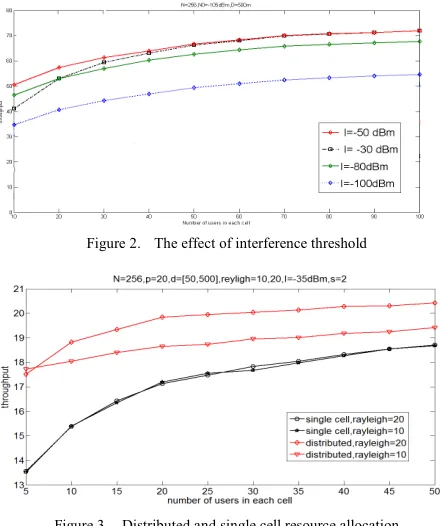
cells based on power allocation and subchannel assignment. The Fig 2 illustrates the sum throughput versus number of users in each cell in different intercell interference thresholds. Simulation results illustrate the effect of the multiuser diversity on the throughput improvement. We can set an appropriate threshold that has a better performance than others.
The Fig.3 compares performance between distributed resource allocation algorithm and single cell resource allocation algorithm in deferent channel conditions. Standard deviation of Rayleigh fading is 10 and 20. Single cell resource allocation algorithm does not consider intercell interference, therefore performance of distributed algorithm is better than single cell algorithm.
ACKNOWLEDGEMENT:
[image:5.612.318.539.593.712.2]This work was supported by a grant from Iranian research institute for ICT under grant 9424/500.
Figure 2. The effect of interference threshold
Figure 3. Distributed and single cell resource allocation
Reference
[1] 3GPP Long-Term Evolution (LTE). [online]. Available: http://www.3gpp.org/Highlights/LTE/LTE.htm
[2] IEEE 802.16 Task Group m. [online]. Available: http://ieee302.org/16/tgm
[3] W. Yu and R. Lui, “Dual methods for nonconvex spectrum optimization of multicarrier systems,” IEEE Trans. Commun., vol. 54, no. 7,pp. 1310–1322, Jul. 2006.
[4] Zhi-Quan (Tom) Luo , Shuzhong Zhang “Dynamic Spectrum Management: Complexity and Duality” IEEE JOURNAL OF SELECTED TOPICS IN SIGNAL PROCESSING , VOL.2,NO.1,FEBRUARY 2008
[5] Mylene Pischella , Jean-Claude Belfiore “Weighted Sum Throughput Maximization in Multicell OFDMA Networks” IEEE Trans. Veh. Tech, VOL. 59, NO. 2, FEBRUARY 2010
[6] Nassar Ksairi, Pascal Bianchi, Philippe Cibalt and Walid Hachem “ Resource Allocation for Downlink Cellular OFDMA Systems-part I: Optimal Allocation” IEEE TRANSACTIONS ON SIGNAL PROCESSING, VOL. 58, NO. 2, FEBRUARY 2010
[7] N. Ksairi, P. Bianchi, P. Ciblat and W. Hachem, "Resource Allocation for Downlink Cellular OFDMA Systems—Part II: Practical Algorithms and Optimal Reuse Factor" IEEE Trans On SIGNAL PROCESSING, VOL. 58, NO. 2, FEBRUARY 2010, pp. 735-749 [8] S. Gault, W. Hachem, and P. Ciblat, “Performance analysis of an
OFDMA transmission system in a multi-cell environment,” IEEE Trans. Commun., vol. 55, no. 12, pp. 2143–2159, Dec. 2005.