Distributed Resource Allocation Assisted by Intercell
Interference Mitigation in Downlink Multicell MC
DS-CDMA Systems
Jia Shi, Zhengyu Song,
IEEE Member, and Qiang Ni,
IEEE Senior Member
Abstract— This paper investigates the allocation of resources including subcarriers and spreading codes, as well as intercell interference (ICI) mitigation for multicell downlink multicarrier direct-sequence code division multiple-access (MC DS-CDMA) systems, which aim to maximize the system’s spectral efficiency (SE). The analytical benchmark scheme for resource allocation and ICI mitigation is derived by solving or closely solving a series of mixed integer non-convex optimization problems. Based on the optimization objectives same as the benchmark scheme, we propose a novel distributed resource allocation assisted by ICI mitigation scheme referred to as RAIM, which requires very low implementation complexity and demands little backhaul resource. Our RAIM algorithm is a fully distributed algorithm, which con-sists of the subcarrier allocation (SA) algorithm named RAIM-SA, spreading code allocation (CA) algorithm called RAIM-CA and the ICI mitigation algorithm termed RAIM-IM. The advantages of the RAIM include that, its CA only requires limited binary ICI information of intracell channels, and it is able to make mitigation decisions without any knowledge of ICI information. Our simulation results show that, the proposed RAIM scheme with very low complexity required achieves significantly better SE performance than other existing schemes, and its performance is very close to that obtained by the benchmark scheme.
Index Terms— Resource allocation, multicell, MC DS-CDMA, intercell interference mitigation.
I. INTRODUCTION
Dynamic resource allocation has become more and more important in future broadband multicarrier communications by exploiting time-varying characteristics of wireless channels and making use of multiuser diversity. However, resource allocation also faces a lot of challenges, including the possible huge sig-naling overhead, limited backhaul resources, high-complexity backhaul operations, expansive servicing area, highly diverse services, etc. Resource allocation in single-cell multicarrier systems has been widely investigated in [1–4]. However, it becomes very challenging in multicell systems due to severe intercell interference (ICI) caused by frequency reuse.
Resource allocation in multicell multicarrier systems can be categorized into two classes, namely centralized and distributed approaches. Specifically, centralized resource allocation has been widely investigated and studied in multicell scenarios, such as [5, 6]. Despite exploiting various degrees of freedom
This work is supported by EU H2020 TWEETHER project under grant agreement number 644678.
J. Shi and Q. Ni are with School of Computing and Communications, Lan-caster University, LA1 4WA, UK. Z. Song is with the School of Electronic and Information Engineering, Beijing Jiaotong University, Beijing 100044, China. (E-mail: [email protected], [email protected], [email protected]).
in terms of allocation, centralized approach usually demands a very high implementation complexity and backhaul resources. By contrast, when distributed approach is used, resources can be managed and assigned independently by each base station (BS). In comparison with centralized approach, distributed resource allocation requires a significantly lower complexity, and it can also release huge burden on the backhaul system and reduce massive signaling overhead. Furthermore, distributed approach is able to quickly respond to the dynamic and fast varying channel environments of wireless communication sys-tems. Exploiting the above advantages, distributed resource allocation will be more and more useful and desirable in future wireless systems considering a large number of cells. Hence, distributed resource allocation has attracted intensive atten-tions, e.g. [7–10] in multicell orthogonal frequency division multiple access (OFDMA) systems. However, some distributed schemes, such as those in [8, 9], still need BSs to exchange channel state information (CSI) of their users, as a result, these schemes are less competitive for practical implementation. On the other hand, due to lack of ICI information, combating ICI for distributed resource allocation is more challenging than that for centralized resource allocation. In the literature, BS coop-eration is an efficient ICI mitigation approach, which shifts the processing burden from mobile terminals to BSs. The authors in [11, 12] have studied the scheduling and power-allocation in the multicell downlink OFDMA networks, which handles ICI via BS coordination supported by CSI exchange among BSs. By contrast, the researches in [13, 14] have studied the resource allocation in the multicell systems with full BS cooperation requiring both CSI and data information exchanged among BSs, which is however not allowed in many practical scenarios.
the same information using different subcarriers, which are then coherently combined at receiver. In this case, the number of subcarriers of MC DS-CDMA will be at the order of the number of time domain resolvable paths of wireless channels and, hence, will usually be low [16]. By exploiting the above-mentioned advantages, MC DS-CDMA can be a promising solution for supporting ubiquitous wireless communications in diverse environments, such as indoor, rural, and urban areas. It is feasible for accessing a large and possibly discontinuous bandwidth. This property is especially beneficial to the cogni-tive radio systems, where the bandwidth for supporting multi-user communications is obtained from the spectrum holes of primary radio systems. However, very limited researches, such as [17–22], have been devoted to resource allocation in MC DS-CDMA systems. In [17, 18], the joint allocation of sub-carrier and non-orthogonal spreading codes have been studied in the single-cell MC DS-CDMA systems. Moreover, a code assignment scheme with multiple-access interference avoid-ance has been proposed for the generalized MC DS-CDMA systems in [19, 20]. Recently, with the aid of non-cooperative game approach, the paper in [21] has addressed the resource allocation including only transmit power and subchannels for the multicell distributed MC DS-CDMA network. The authors in [22] have proposed a joint spreading code allocation and subcarrier scrambling scheme to reduce the PAPR in the single-cell MC CDMA system, where the interference issue has not been addressed. In our paper [23], we have investigated low-complexity subcarrier allocation in the single-cell MC DS-CDMA systems. However, efficient resource allocation in mul-ticell scenarios will be very challenging due to existence of strong ICI as well as high implementation complexity.
To the best of our knowledge, there are no published ref-erences that have studied resource allocation and interference mitigation together for the multicell MC DS-CDMA systems. Against the background, in this paper, we investigate how to ef-ficiently allocate resources including subcarriers and spreading codes, while effectively mitigating ICI for multicell downlink MC DS-CDMA systems, which aims to maximize the system’s spectral efficiency (SE). The main contributions of our paper can be summarized as follows.
• We derive a novel benchmark scheme for the distributed resource allocation and ICI mitigation in the multicell MC DS-CDMA systems. The benchmark scheme proposes an efficient approach to allocate subcarriers and codes, while mitigating ICI, which can be obtained by solving and closely solving a series of mixed integer non-convex opti-mization problems. As proposed, the distributed subcarrier allocation (SA) is first carried out, then the distributed spreading code allocation (CA) is implemented, aiming to maximize the sum rate of each cell. After that, the ICI mitigation is operated for maximizing the sum rate of cell-edge users.
• Inspired by the benchmark scheme, we propose a novel low-complexity scheme, namely distributed resource allo-cation assisted by ICI mitigation (RAIM), for the multicell downlink MC DS-CDMA systems. Based on the optimiza-tion objectives same as the benchmark scheme, our RAIM
scheme is designed to be of very low implementation complexity and small backhaul resource demanded. The RAIM first operates the distributed SA algorithm named SA, then runs the CA algorithm called RAIM-CA. In contrast to the benchmark, after the SA and CA the RAIM carries out the fully distributed ICI mitigation algorithm termed RAIM-IM.
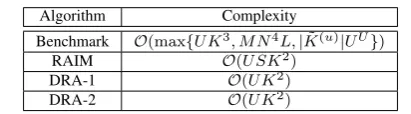
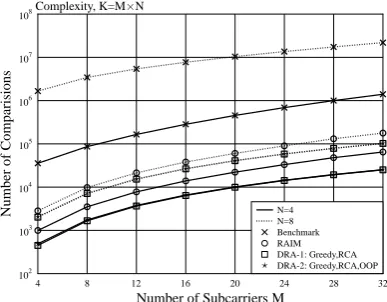
• We analyze the characteristics and complexity of the RAIM and the benchmark schemes employed by our multicell MC DS-CDMA systems. The proposed schemes have a range of advantages, including quick response to wireless channel environments, requring minimum back-haul burden and minimum load on feedback channels, as well as easily applicable for large system, etc. According to the complexity analysis, the RAIM scheme requires much lower complexity than the benchmark scheme, which implies the RAIM is very advantegeous in practical implementation.
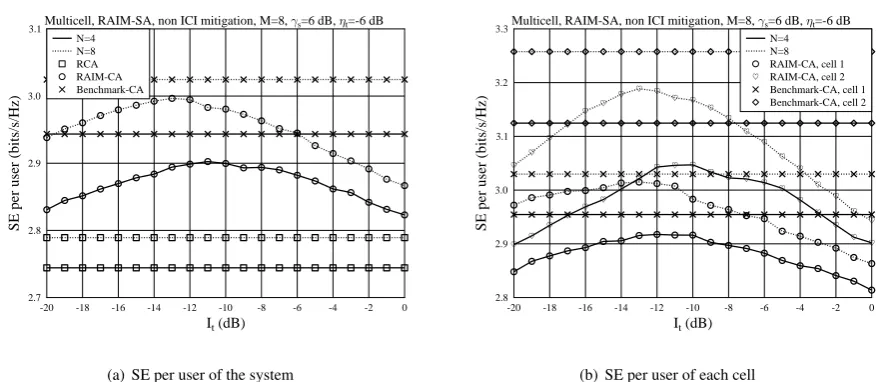
• We carry out comprehensive performance analysis for the proposed RAIM and benchmark schemes employed by the multicell systems. It is shown that, the proposed RAIM scheme achieves significantly better SE performance than other existing distributed resource allocation algorithms, and its performance is very close to that obtained by the benchmark scheme. Therefore, the MC DS-CDMA asso-ciated with the RAIM scheme may constitute a promising candidate that facilitates practical implementation in fu-ture communication systems.
The rest of this paper is organized as follows. Section II introduces the system model, and states our optimization prob-lems. Section III derives the benchmark for our resource allo-cation. Section IV proposes the novel RAIM scheme. Section V analyzes the characteristics and complexity of the proposed schemes. Performance results are shown in Section VI. Finally, we summarize the main conclusions in Section VII.
II. SYSTEMMODEL ANDPROBLEMFORMULATION
In this section, we present the system model followed by describing the main optimization problems for the resource allocation and ICI mitigation in the multicell MC DS-CDMA systems.
A. System Model
Intracell Link Intercell Interference (ICI) Link
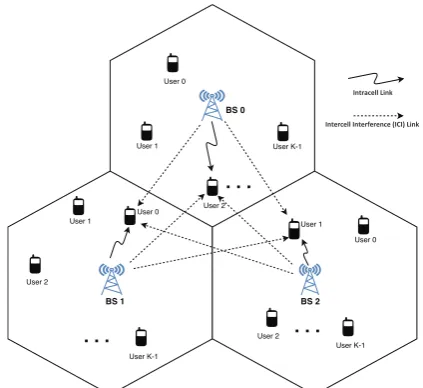
Fig. 1: Conceptual structure of the downlink multicell MC DS-CDMA systems.
In order to avoid intracell interference, users in the same cell are allocated either different subcarriers or different codes, or both are different. However, the “co-subcarrier-code” users in different cells assigned the same subcarrier and code, such as users2,0and1of cells0,1and2in Fig. 1, will cause ICI to each other. Furthermore, in each cell we assume for simplicity ideal power control as in [1, 13, 26], for maintaining the same average received power of one unit per user when there are no SA and CA. In that case, we define an ICI factorα, considering the combined effects of propagation pathloss and shadowing, as [27]
α= √(
d0
d1 )µ
10ζ010−ζ1 (1)
where d0 and d1 represent the distances from a BS to its
intracell and intercell users respectively. In (1),µis the pathloss exponent, and (ζ0 −ζ1) (in dB) obeys the log-normal
distri-bution with standard deviationΥ(in dB), which accounts for the shadowing effect [27]. In addition, each transmission also experiences fast fading, which is assumed to be the independent Rayleigh flat fading.
Let us assume that the data symbols transmitted by BSu(u∈
U ={0,1,2}) to itsKintracell users are expressed asxxx(u)= [x(0u), x(1u), . . . , xK(u−)1]T, wherex(u)
k is the data symbol to user
k, and is assumed to satisfyE[x(ku)] = 0andE[|x(ku)|2] = 1.
Assume that users k,k′ in cellsu,u′ are co-subcarrier-code users, which are assigned subcarriermand coden. The signals received by userkcan be written by
y y
y(k,mu) =h(k,mu)VVVmWWW(u)xxx(u)+ ∑
u′∈U,u′̸=u
h(k,mu′)αk,k(u′)′VVVmWWW(u
′) x x x(u′)
+nnn(ku), k∈ K(u), m∈ M (2)
where K(u) contains the indexes of users in cell u, and M includes the indexes of subcarriers of the system. In (2),yyy(k,mu)
is a length-N observation vector, andh(k,mu) is the fast fading channel gain from BSuto userkof subcarrierm. As defined
in (1), α(k,ku′)′ characterizes the ICI from BS u′ to user k. We
assume VVV is a (N ×K)-dimensional matrix with columns consisting of the spreading sequences taken from a(N ×N)
orthogonal spreading code matrix. Hence,VVVmis a(N×K) -dimensional matrix formed fromVVV by setting those columns for the subcarriers other thanmto zero vectors. The vectornnn(ku)= [n(k,u0), . . . , nk,N(u)−1]T is a complex Gaussian noise vector at user
k, which has zero mean and a variance of 2σ2 = 1/γs. We defineγsas the average signal-to-noise ratio (SNR) per symbol, when there is no SA/CA. We assume that a BS is capable of ac-quiring the CSI of its intracell channels. Hence, the preprocess-ing matrix can be set asWWW(u)=diag{w(u)
0 , w
(u) 1 , . . . , w
(u) K−1}
with w(ku) = (
h(k,mu)
)∗
/
√
|h(k,mu)|2, where (·)∗ denotes the
conjugate operation. However, to minimize backhaul burden and implementation complexity, BSs are not allowed to ex-change the information about both intracell and ICI channels of the users. After despreading, the decision variable of userk
becomes
zk,m(u) = √
|h(k,mu)|2x(u)
k +
∑
u′∈U,u′̸=u
h(k,mu′)α(k,ku′)′w
(u′) k′ x
(u′) k′
| {z }
ICI
+n(ku), k∈ K(u), m∈ M (3)
From (3), we know the signal-to-interference-plus-noise ratio (SINR) of userk, given by
γ(k,mu) = |h (u) k,m|
2 ∑
u′∈U,u′̸=u|h (u′) k,mα
(u′) k,k′w
(u′)
k′ |2+ 2σ2
= 1
(A(k,mu))−1+ (η(u) k,m)−1
, k∈ K(u), m∈ M (4)
where A(k,mu) and ηk,m(u) are respectively the SNR and signal-to-interference (SIR) for userkof subcarrierm. They can be written as
A(k,mu) = |h (u) k,m|
2
2σ2 =γs|h (u) k,m|
2, η(u)
k,m=
|h(k,mu)|2 ∑
u′∈U,u′̸=uI (u′) k,k′,m
,
k∈ K(u), k′ ∈ K(u′), m∈ M (5)
whereIk,k(u′)′,m =|h (u′) k,mα
(u′) k,k′w
(u′) k′ |
2is the ICI power of userk
received from BSu′.
B. Problem Formulation
This section discusses the general theories and formulates the optimization problems for the distributed resource allocation and ICI mitigation in the multicell systems. First, the distributed resource allocation including SA and CA aims to maximize the sum rate of each cell, described as
{S(u),C(u)}∗=
arg max
{S(u),C(u)}
∑
k∈K(u) R(ku)
R(ku)= log2 (
1 +
∑
m∈Ms
(u) k,m|h
(u) k,m|
2 ∑
u′∈U,u′̸=u ∑
k′∈K(u′)
∑ n∈N
∑ m∈Mc
(u) k,nc
(u′) k′,ns
(u) k,ms
(u′) k′,mI
(u′)
k,k′,m+ 2σ2 )
(7)
subject to
s(k,mu) ={0,1}, ∀m∈ M, ∀k∈ K(u), (8) ∑
k∈K(u)
s(k,mu) =N, ∀m∈ M, (9) ∑
m∈M
s(k,mu) = 1, ∀k∈ K(u), (10)
c(k,nu)={0,1}, ∀k∈ K(u), ∀n∈ N, (11) ∑
n∈N
c(k,nu) = 1, ∀k∈ K(u), (12) ∑
k∈K(u)
c(k,nu) =M, ∀n∈ N. (13)
Above, R(ku), given by (7), is the achievable rate of userkin cellu. In (6),S(u)={s(k,mu),∀k, m}andC(u) ={c(k,nu),∀k, n}
contain the SA and CA variables, while{S(u),C(u)}∗denotes
the final results of cellu. The indicators(k,mu) = 1if subcarrier
mis allocated to userkin cellu, otherwises(k,mu) = 0. Similarly, the indicatorc(k,nu) = 1if codenis assigned to userkin cellu, otherwisec(k,nu) = 0. In above equations,N contains the indexes of codes in the system. Note that, the constraints of (9) and (10) follow the assumption that each subcarrier is assigned toN
users in one cell, while each user is allocated one subcarrier. By contrast, (12) and (13) constrain that each user is only allocated one code, and each code is assigned toM users.
To solve problem (6), the BSs are required to share the full ICI information of all users, which is however not allowed by our assumption for achieving minimum backhaul burden and low implementation complexity. Therefore, limited by this assumption, each BS first independently carries out the SA for solving problem (14), then operates CA for solving problem (16) which can approximate problem (6). After that, ICI mitiga-tion is implemented based on the optimizamitiga-tion problem of (19), which aims to maximize the sum rate of the cell-edge users for further improving the system throughput. First, the distributed SA aims to maximize the sum rate of each cell, described as
{S(u)
m ,∀m}∗=arg max
{S(u) m ,∀m}
∑
k∈K(u) R(ku)
,∀u∈ U (14)
subject to (8), (9), and (10).
In (14), the achievable rate of userk, i.e.R(ku), becomes
R(ku)= log2 (
1 + ∑
m∈Ms
(u) k,m|h
(u) k,m|
2
∑Ik+ 2σ2 )
. (15)
In (14),Sm(u)={s (u)
k,m,∀k}contains the SA variables of cellu. Note that in (15),∑Ikdenotes the sum of the ICI experienced by userk, and it can be given by the first term of the SINR’s denominator in (7). However, we focus on studying distributed resource allocation, and the BSs are not allowed to share the full ICI information of all users and, hence,∑Ikin (15) cannot
be known. Furthermore, each user’s ICI only comes from its co-subcarrier-code users, which can be known after the SA and CA. Hence, users’ ICI cannot be determined when carrying out the SA based on (14).
After SA, each BS independently carries out CA, which aims to maximize the sum rate of each cell. In order to avoid intracell interference, the co-subcarrier users in a cell are distinguished by different codes. Therefore, based on the SA results, max-imizing the sum rate of a cell is equivalent to independently maximizing the sum rate of every co-subcarrier user group in a cell. Correspondingly, the CA problem can be expressed as
{C(u)
m }∗=argmax {C(u)
m }
∑
k∈Fm(u)
Rk(u)| {Sm(u)}∗ ,
∀m∈ M,∀u∈ U (16)
subject to (11), (12), and ∑
k∈Fm(u)
c(k,nu) = 1, ∀n∈ N. (17)
In (16), Cm(u) = {c (u)
k,n,∀k ∈ F (u)
m ,∀n} contains the CA variables for the users allocated subcarrier m, where Fm(u) includes the indexes of the users assigned to subcarrierm in cellu. For avoiding intracell interference, (17) constrains the users in a co-subcarrier user group are assigned different codes. In (16), the rate of userkcan be expressed by
Rk(u)= log2
1 +
|h(k,mu)|2
∑
u′∈U,u′̸=u
∑
k′∈Fm(u′) ∑
n∈N
c(k,nu)c(ku′′,n)I
(u′)
k,k′,m+ 2σ
2
.
(18)
Note that, (18) is derived by removing all the SA variables in (7), since SA has been done. In addition, seen from (18), each user’s potential ICI can only come from its co-subcarrier users in the other cells.
Finally, based on the SA and CA, our ICI mitigation is attempted for cell-edge users suffering from strong ICI. Let us defineKˆ(u) = {k|η
k < ηt, k ∈ K(u)} as the set of users in cellu, whose SIRs are below the SIR thresholdηt, which can be set according to various communication objectives. Then, cell-edge users are collected into K˜(u), which includes both
the users in Kˆ(u) as well as the users in (K(u)−Kˆ(u))that share the same subcarriers and codes as the users inKˆ(u′)and
ˆ
K(u′′). Therefore, the ICI mitigation for cell-edge users aims to
maximize the sum rate of every cell-edge user group containing three co-subcarrier-code users. The optimization problem can be expressed as
{Dm,n}∗=arg max {Dm,n}
∑
u∈U ∑
k∈Bm,n(u)
R(ku)| {S,C}∗
,
subject to
d(m,nu) ={k, k′, k′′,−1},
ifk∈ B(m,nu) &k′ ∈ Bm,n(u′)&k′′∈ Bm,n(u′′), ∀u∈ U, (20) U∑−1
u=0
d(m,nu) ≥ −2, (21)
dm,n(u) ̸=dm,n(u′′), ifdm,n(u) =d(m,nu′) =k, ∀u. (22)
Above, B(m,nu) = ˜K(u)∩ Fm(u)∩ Vn(u) is the set of indexes of the cell-edge users assigned subcarriermand coden, in which V(u)
n contains the indexes of the users assigned to codenin cell
u. Similarly,B(m,nu′)= ˜K(u
′)
∩F(u′)
m ∩V
(u′)
n andB
(u′′) m,n = ˜K(u
′′)
∩ F(u′′)
m ∩V(u
′′)
n . Further, we define ICI mitigation decision (IMD) variable set asDm,n ={d
(u)
m,n,∀u∈ U}for subcarriermand coden. As described by (20), variabled(m,nu) can be defined as
d(m,nu) =
k BSutransmitsx(ku)to userkon subcarrierm and coden,
−1 BSuturns off its transmission on subcarrierm and coden,
k′(ork′′) BSuhelps to sendxk(u′′)(orx(u ′′)
k′′ )to userk′
(ork′′)on subcarriermand coden,
if k∈ B(m,n, ku) ′∈ Bm,n, k(u′) ′′∈ Bm,n(u′′). (23)
As shown by (23), two strategies, i.e. power off and cooper-ation, are jointly utilized for ICI mitigation. The system’s SE may be significantly improved by switching off some trans-missions which impose strong ICI on other transtrans-missions [28]. Furthermore, when cooperation is available between two BSs, the space time block coding (STBC) [29] aided BS cooperation can be a promising scheme, which only needs to exchange data symbols, but no CSI, between the two BSs. (21) and (22) constrains that at most two users are allowed to switch off, and only two BSs can cooperate for a user in a cell-edge group.
So far, we can readily know that the optimization problems in (14), (16) and (19) for the SA, CA and the ICI mitigation are mixed integer non-convex problems, which are extremely hard to solve. In Section III, we motivate to solve the prob-lems in (14), (16) and (19) respectively, resulting in a bench-mark scheme. Furthermore, aiming to obtaining promising sub-optimum solutions, we propose a novel low-complexity scheme, namely RAIM, which follows the design objectives of the benchmark scheme.
III. BENCHMARKANALYSIS OFRESOURCEALLOCATION ANDICI MITIGATION
In this section, we derive a novel benchmark scheme for the resource allocation and ICI mitigation in multicell downlink MC DS-CDMA systems. The benchmark scheme is obtained by closely solving the problems in (14) and (16), as well as solving problem (19). The benchmark scheme consists of the distributed SA algorithm referred to as the benchmark-SA, the distributed CA algorithm termed as benchmark-CA and the centralized ICI mitigation algorithm called as benchmark-IM. In order to solve the problem of (19), the BSs are only allowed to exchange the ICI information of cell-edge users.
A. Benchmark of Distributed Subcarrier Allocation: Benchmark-SA
Our distributed SA aims to maximize the sum rate of the users in each cell, as shown in (14). However, to solve (14) it requires all users’ ICI information exchanged among the BSs, which is not allowed in our assumption and in most of practical systems. In this case, as done in [23, 30] and the references therein, the best sub-optimum solution to problem (14) can be achieved by maximizing every user’s SNR without considering ICI effect, having the distributed SA problem of
{S(u)
m ,∀m}∗=
arg max
{S(u) m ,∀m}
{ ∑
m∈M
sk,m(u)Ak,m(u),∀k∈ K(u)
}
,∀u∈ U (24)
subject to (8), (9) and (10).
However, the problem of (24) is still a combinatorial prob-lem, which is very hard to solve. By contrast, in [2, 31], the authors have proved that the Hungarian algorithm is the op-timum SA solutions for maximizing the SNR of all users in the single-cell OFDMA system employing the channel-inverse power-allocation. Furthermore, as shown in [23, 30], the Hun-garian algorithm is able to closely solve the problem of (24). Therefore, the benchmark for our SA can be obtained by inde-pendently operating the Hungarian algorithm at each BS, which corresponds to the benchmark-SA. However, the Benchmark-SA algorithm still has very high complexity, especially, when the number of users in the system is large.
B. Benchmark of Distributed Spreading Code Allocation: Benchmark-CA
After the SA, our distributed CA is carried out in each cell, aiming at maximizing the sum rate of every co-subcarrier user group, as shown in (16). However, the problem of (16) for the CA is a mixed integer nonlinear non-convex problem, which is hard to find the optimum solution. Moreover, directly solving (16) requires the BSs to exchange the full ICI information of users in different cells, which is not practical in real systems. Because of the above issues, we convert the problem in (16) to the concave problems of (25) and (27) by relaxing the constraint of (11) and reforming the users’ rate expressions in (18), in order to study the benchmark performance of the system employing distributed CA. Specifically, the benchmark for our distributed CA, i.e. benchmark-CA, can be obtained by solving the relaxed problems of (25) and (27), which, for our three-cell system, is implemented in three stages by BSsu,u′ andu′′
given by
{C(u′)
m }∗=
arg max
{C(u′) m }
∑
k′∈Fm(u′)
Rk(u′′)| {Cm(u),S (u′)
m }∗
,∀m∈ M (25)
subject to the constraints of (12), (13) with superscriptu sub-stituted byu′, and the relaxed constraint of
0≤ck(u′,n′) ≤1, ∀k′∈ F (u′)
m , ∀n∈ N. (26)
Following the CA in cell u′, the users in cell u′′ can now inform BSu′′the ICI from the other two BSs. Therefore, during the last stage, BSu′′can operate its CA with the knowledge of the ICI from both BSs uandu′, by solving the optimization problem of
{C(u′′)
m }∗=
arg max
{C(u′′) m }
∑
k′′∈Fm(u′′)
R(ku′′′′)| {Cm(u),C (u′)
m ,S
(u′′)
m }∗
,∀m∈ M
(27)
subject to the constraints in (12), (13) with superscriptu substi-tuted byu′′, and the relaxed constraint of
0≤ck(u′′′′,n) ≤1, ∀k′′∈ F (u′′)
m , ∀n∈ N. (28)
Furthermore, in order to make the problems in (25) and (27) the concave problems, the ratesR(ku′′)andR(u
′′)
k′′ are evaluated by the formulas of (29) and (30), which are equivalent to (18) by our simulation under the successive CA. In (30),I˜k(u′,m,n) is the ICI from BS uto userk′in cellu′ assigned subcarriermand code nassigned. I¯k(u′′′) is the average ICI from BSu′′, which
is evaluated asI¯k(u′′′) = (∑j∈F(u′′) m I
(u′′)
k′,j,m)/N, since the CA in cellu′′has not been done yet. Similarly, in (30),I˜k(u′′),nand
˜
Ik(u′′′,n) count the ICI from BSsuandu′.
The CA problems in (25) and (27) are concave problems associated with the constraints in (12), (13), and the rates in (29), (30). The corresponding proofs are given in the Appendix. Therefore, there are many methods, such as the interior point method [32], that can be employed to solve the problems of (25) and (27). However, in order to solve the problems in (25) and (27), BSs u and u′ need to know the analog ICI information of their users, which may become challenging for the feedback channels in practice if there are a lot of users. In order to mitigate this demand, in this paper, we propose the RAIM scheme including the heuristic CA algorithm, which only requires the bit-valued ICI information by the BSs.
C. Benchmark of Intercell Interference Mitigation: Benchmark-IM
After the SA and CA, we can derive the centralized benchmark-IM algorithm, which can find the optimum solution to the problem of (19). In order to derive the optimum solution, the benchmark-IM carries out the exhaustive search with the knowledge of full ICI information for cell-edge users, and its principles can be summarized in Algorithm 1.
(Algorithm 1) Benchmark of ICI Mitigation: Benchmark-IM 1: Initialization:Bm,n={k|k∈K˜(u)∩ F
(u)
m ∩ V
(u)
n ,∀u},
d(m,nu) =kifF
(u)
m ∩ V
(u)
n ={k},∀m∈ M,∀u∈ U; 2: ForForFor subcarrierm= 0, . . . , M−1 &coden= 0, . . . , N−1
3: IfIfIfBm,n̸=∅
4: Compute sum rates of all optional decisions (OPs) with power off only:
OP(1) Power off for one user:
ˆ
d(m,nu) =−1,dˆ
(u′)
m,n=d
(u′)
m,n,dˆ(m,nu′′)=d
(u′′)
m,n,∀u,
OP(2) Power off for two users:
ˆ
d(m,nu) = ˆd(u
′)
m,n=−1,dˆ(u
′′)
m,n =d(u
′′)
m,n,∀u;
5: Compute sum rates of all the OPs with cooperation only:
OP(3) Cooperation between two BSs:
ˆ
d(m,nu) = ˆd(u
′)
m,n=d(m,n,u) dˆ(u
′′)
m,n =d(u
′′)
m,n,∀u,
OP(4) Cooperation among three BSs:
ˆ
d(m,ni) =d(m,n,u) ∀i∈ {u, u′, u′′},∀u;
6: Compute sum rates of all the OPs with both power off and cooperation:
OP(5) Power off for one user, cooperation for one user:
ˆ
d(m,nu) = ˆd(u
′)
m,n=d(m,n,u) dˆ(u
′′)
m,n =−1,∀u; 7: Identify the best decision:
{d(m,n,u) ∀u}= max{∀dˆ(u) m,n,∀u}
{∑
k∈Bm,nRk }
; 8: EndEndEnd
9: EndEndEnd
In detail, under the benchmark-IM, we assume that a control unit (CU) collects the ICI information of all cell-edge users in the three cells. Then, the CU makes the best ICI mitigation decisions, which are informed to the BSs. The decisions are made independently for the cell-edge user groups of each containing three co-subcarrier-code users. For a cell-edge user group, the CU finds the best mitigation decision achieving the highest sum rate by exhaustively searching the 21 possible decisions, as stated in lines 3-8 of Algorithm 1. However, the benchmark-IM requires analog ICI information of all cell-edge users for decision making, which is required to be sent to the CU. In this case, the benchmark-IM may impose a heavy complexity burden on the backhaul network, especially when there is a big number of cell-edge users. Therefore, in Section IV, we propose the distributed ICI mitigation algorithm under the RAIM scheme, which does not require the BSs to know any ICI information of users.
IV. NOVELDISTRIBUTEDRESOURCEALLOCATION ASSISTED BYICI MITIGATION
In this section, we propose a novel low-complexity heuristic scheme, namely RAIM, which can approximate the benchmark scheme in Section III. The proposed RAIM is a fully distributed scheme for the resource allocation and ICI mitigation in the considered multicell system, and it does not require the BSs to share any channel information. The fully distributed RAIM scheme consists of the SA, CA and ICI mitigation algorithms, which are referred to as the RAIM-SA, the RAIM-CA and the RAIM-IM. Let us now first discuss the RAIM-SA algorithm.
A. RAIM’s Subcarrier Allocation: RAIM-SA
Rk(u′′)=
∑
n∈N
c(ku′,n′)log2
1 + |h
(u′) k′,m|
2 ∑
n∈Nc (u′) k′,nI˜
(u) k′,m,n+ ¯I
(u′′) k′ + 2σ2
, k′ ∈ Fm(u′), (29)
Rk(u′′′′)=
∑
n∈N
c(ku′′′′,n)log2
1 + |h
(u′′) k′′,m|
2 ∑
n∈Nc (u′′) k′′,n( ˜I
(u) k′′,m,n+ ˜I
(u′)
k′′,m,n) + 2σ2
, k′′∈ Fm(u′′). (30)
(Algorithm 2) Stage I of RAIM-SA: Candidate Searching (For BSu,∀u∈ U)
1: Initialization:Fm(u)=Um(u)=∅,∀m∈ M;Q(ku)=∅,
M(u)
k =M,∀k∈ K
(u)
; 2: RepeatRepeatRepeat
3: Each user identifies an unselected subcarrier having the best subchannel quality as a candidate:
(E2.1): m′k=argmaxm∈M(u) k {
A(k,mu)}, ∀k∈ K(u);
4: Update: (D2.1): Um(u′)
k ← U
(u)
m′k∪ {k},Q
(u)
k ← Q
(u)
k ∪ {m′k},
∀k∈ K(u),
(D2.2): M(ku)← Mk(u)− {m′k},∀k∈ K
(u)
; 5: Condition check:
(C2.1): |Um(u)| ≥N,∀m∈ M; 6: UntilUntilUntil C2.1=true
RAIM-SA has two stages, and is independently operated by each BS. During Stage I, the algorithm searches the candidates (including the subcarriers and users) having the best subchannel qualities. During Stage II, it allocates the candidates in the way that completes the allocation with the minimum number of candidates required. The principles of the RAIM-SA are summarized in Algorithms 2 and 3.
In Stage I given by Algorithm 2, it iteratively searches the best candidates in each cell. During an iteration, each user in cell uidentifies a candidate subcarrier which has not been selected and has the best subchannel quality. For the example in (E2.1), userkfinds that subcarrierm′kis a candidate, and user
kis also seen as a candidate of subcarrierm′k. Then in line 4, BSuupdates the candidate setsUm(u)andQ
(u)
k , which contain the candidate indexes, respectively, for subcarriermand userk
in cellu. At the end of each iteration, the algorithm checks if enough candidates are found, i.e. Condition (C2.1) is satisfied. The algorithm proceeds to Stage II when each subcarrier has at leastNcandidate users, which is required by our allocation.
In Stage II, one candidate subcarrier is allocated to one candi-date user in each iteration. The RAIM-SA algorithm motivates to complete the allocation in Stage II with the minimum number of candidates. As shown in Algorithm 3, during an iteration it first tries to finds the candidate which only has the fixed allocation option/options but no other options, as shown in lines 3-6. For instance, in line 3, it finds that subcarrier m∗
has to be assigned to its candidate user k∗. This is because, as shown in (E3.1), the number of the candidate users for subcarrier m∗ is equal to its possible number of allocations. Similarly, in line 5, user k∗ has the only one candidate, i.e. subcarrier m∗. When the fixed allocation is unavailable, the allocation of the candidates having more than one allocation options follows the max-min method, which aims to maximize the minimum subchannel quality of the candidate assigned. In
(Algorithm 3) Stage II of RAIM-SA: Candidate Assigning (For BSu,∀u∈ U)
1: Initialization:M˜ =M,K˜(u)= ˜K(u);
2: RepeatRepeatRepeat
(Fixed Allocation)
3: Identify subcarrierm∗with fixed allocation option/options and find its candidate userk∗:
(E3.1):m∗∈Mˇ ={m| |Um(u)|=N− |F
(u)
m |, m∈M}˜ ,
k∗∈ Um(u∗);
4: IfIfIfMˇ =∅
5: Identify userk∗having candidate subcarrierm∗only: (E3.2): k∗∈Kˇ(u)={k| |Q(u)
k |= 1, k∈K˜
(u)}
,
m∗∈ Uk(u∗);
6: EndEndEnd
(Max-Min Allocation) 7: IfIfIfMˇ =∅& ˇK(u)=∅
8: Identify userk∗having the minimum worst candidate subchannel quality:
(E3.3): k∗=arg mink∈K˜(u) {
min
m∈Q(u) k {
A(k,mu)}
}
;
9: Find userk∗the best candidate subcarrierm∗having the highest subchannel quality:
(E3.4): m∗=argmax
m∈Q(u) k∗{A
(u)
k∗,m}; 10: EndEndEnd
11: Allocate subcarrierm∗to candidate userk∗:
F(u)
m∗ ← F
(u)
m∗ ∪ {k∗}; 12: Update:
(D3.1): Um(u∗)← Um(u∗)− {k∗};Q
(u)
k∗ ← Q
(u)
k∗ − {m∗}, (D3.2): K˜(u)←K˜(u)− {k∗},
˜
M ←M − {˜ m∗}if|F(u)
m |=N; 13: Condition check:
(C3.1): |Um(u)| ≥N− |F
(u)
m |,∀m∈M˜
& |Q(ku)| ≥1,∀k∈K˜(u);
14: UntilUntilUntilM˜ =∅ or (C3.1)=false
15: Go back to line 2 of Stage I if (C3.1)=false;
(E3.3), among the remaining users inK(u), userk∗is identified
since it has the minimum worst candidate subchannel quality. Then it finds the best candidate subcarrier for userk∗, which is subcarrierm∗ having the highest subchannel quality. Once having identified the candidates, it carries out the corresponding allocation, which is given in line 11. The algorithm completes the candidate allocation when allocation requirement is met. However, when there are not enough candidates for remaining allocation, i.e. Condition (C3.1) is unsatisfied, the algorithm goes back to Stage I to add more candidates.
B. RAIM’s Code allocation: RAIM-CA
of each co-subcarrier user group in each cell. The RAIM-CA is carried out in three stages successively and independently by the three BSs. Similar to the benchmark-CA, during the first stage, BS 0randomly allocates codes to its users. During the second and third stages, the CAs of cells1 and2follows the principles in Algorithm 4 based on the knowledge of the bit-valued ICI (bICI) information of intracell users.
Shown by Algorithm 4, the CA is carried out independently for each co-subcarrier user group containingN users, and one code is allocated to a user during each ofN iterations. First of all, the users estimate their ICI from the cell/cells whose CA has/have been done in previous stage/stages. Then the users inform its BS the bICI for the allocation. For the example shown in (E4.1),Iˆk(u′,k,m) is the bICI received by userk′ from BSu, when assuming both userskandk′in cellsuandu′ are assigned subcarrierm. The bICIIˆk(u′,k,m) can be given by
ˆ
Ik(u′,k,m) = {
0 ifIk(u′,k,m) < It, 1 ifIk(u′,k,m) ≥It
(31)
where It is the threshold that defines if the ICI is small (Iˆk(u′,k,m) = 0) or strong (Iˆ
(u)
k′,k,m = 0). Known from (E4.1), during the second stage, BS u′ (u′ = 1) only makes use of its users’ bICI from BS 0, which is evaluated as I˜k(u′,k,m) =
ˆ
Ik(u′,k,m) = {0,1}. By contrast, during the third stage, BS u′ (u′ = 2) employs the combined bICI from both BSs0and1, which is evaluated as I˜k(u′,k,m) = {0,1,2}. Specifically, when
˜
Ik(u′,k,m) = 2, it means that userk′ suffers strong ICI from the other two BSs, which is the case that the RAIM-CA motivates to avoid.
As shown in lines 5-10, the RAIM-CA identifies a co-code user pair for allocating a code during each iteration. In line 12, when the pair (ku∗, k∗u′)is identified, user k∗u′ is allocated code n∗ which has been allocated to user ku∗ in a previous stage. Note that, during the third stage, it actually finds a pair of co-code users for the user in cell2, since the CAs of cells
0 and 1 have been done in previous stages. The algorithm motivates to find the user pair of small ICI, which contains the co-code user generating the small ICI to the user. Therefore, the algorithm first tries to identify a user pair of small ICI for fixed allocation. As the example shown in line 5, when the pair
(k, k′)inΘ˜m,(u,u0′) is identified, it means userk′ has only one co-code user available, i.e. userk, generating small ICI to user
k′. By contrast, when the pair(k, k′) inΘ˜(m,u,u1′)is identified, user k generates strong ICI to all the users of subcarrier m
in cellu′ except userk′. Note that, in (E4.2),F˜m(u′) contains the indexes of the users with subcarriermallocated in cellu′
but without codes assigned, andV˜m(u)contains the indexes of available co-code users in cellufor the users inF˜m(u′). When the fixed allocation of small ICI is unavailable, i.e.Θ˜(mu,u′)=∅, the RAIM-CA selects the user pair of small ICI that can avoid the maximum number of the allocation of strong ICI in future allocation, which is described by line 6.
Furthermore, when there is no co-code user pair of small ICI found, i.e.Θ(mu,u′)=∅, the RAIM-CA tries to identify a desired user pair containing the user, which suffers strong ICI from only one BS. The identification process for this given in lines 8-9 is
(Algorithm 4) RAIM’s Code Allocation: RAIM-CA (For BSu′= 1,2)
1: Initialization:Vm(u′)=∅,V˜m(u)=Vm(u),F˜(u
′)
m =F(u
′)
m ,
u= 0,∀m∈ M;
2: ForForFor Subcarrierm= 0, . . . , M−1
3: Users allocated subcarrierminform BSu′bICI information
{Iˆ(u)
k′,k,m, k′, k}, BSu′forms information{I˜
(u)
k′,k,m, k′, k}: (E4.1):I˜k(u′,k,m) =
∑u i=0Iˆ
(i)
k′,ki,m,k∈ F
(u)
m ,ki∈ Fm(i),
∀k′∈ Fm(u′); 4: RepeatRepeatRepeat
5: Identify a co-code user pair of small ICI(k∗u, k∗u′)∈Θ˜
(u,u′)
m
for fixed allocation, andΘ˜(mu,u′)= ˜Θ(u,u
′)
m,0 ∪Θ˜ (u,u′)
m,1
which are defined in (E4.2), (E4.3) and (E4.4);
6: Find the co-code user pair of small ICI(ku∗, k∗u′)that avoids the maximum number of strong ICI assignments
ifΘ˜(mu,u′)=∅& Θ(u,u
′)
m ̸=∅:
(E4.5):(k∗u, k∗u′) =argmax(k,k′)∈Θ(mu,u′){|
ˇ
K(u)
k |+|Kˇ
(u′)
k′ |}, (E4.6):Kˇ(ku)={j′|I˜j(u′,k,m) ̸= 0,∀j′∈F˜
(u′)
m },
ˇ
K(u′)
k′ ={j|I˜
(u)
k′,j,m̸= 0,∀j∈V˜
(u)
m };
7: IfIfIfΘ(mu,u′)=∅
8: Identify a desired co-code user pair of strong ICI
(k∗u, ku∗′)∈Λ˜
(u,u′)
m for fixed allocation, and
˜
Λ(mu,u′)= ˜Λ(u,u
′)
m,0 ∪Λ˜ (u,u′)
m,1 , which are defined in (E4.7),
(E4.8) and (E4.9);
9: Identify a desired co-code user pair of strong ICI
(k∗u, ku∗′)∈Λ
(u,u′)
m ifΛ˜(u,u
′)
m =∅;
10: Select a co-code user pair of strong ICI(k∗u, k∗u′), where
k∈V˜m(u),k′∈F˜
(u′)
m ifΛ
(u,u′)
m =∅;
11: EndEndEnd
12: Allocate coden∗to userku∗′:V(u ′)
m ← V
(u′)
m (n∗)∪ {k∗u′}, whereVm(u)(n∗) ={k∗u};
13: Update:V˜m(u)←V˜m(u)− {ku∗},F˜
(u′)
m ←F˜(u
′)
m − {ku∗′}; 14: UntilUntilUntilF˜m(u′)=∅
15: EndEndEnd
16: Update:u←u+ 1;
similar to that for a user pair of small ICI shown in lines 5-6. Finally, when a desired co-code user pair cannot be identified, as in line 10, the algorithm is forced to select a co-code user pair including the user, which suffers strong ICI from two BSs.
C. RAIM’s ICI Mitigation: RAIM-IM
(E4.2) : Θ(mu,u′)=
{
(k, k′)|I˜k(u′,k,m) = 0, k∈V˜
(u)
m , k′∈F˜(u
′)
m
}
,(E4.3) : ˜Θ(m,u,u0′)=
{
(k, k′)|∏
j∈V˜(u) m ,j̸=k
˜
Ik(u′,j,m) ̸= 0,(k, k
′)∈Θ(u,u′)
m
}
,
(E4.4) : ˜Θ(m,u,u1′)=
{
(k, k′)| ∏
j′∈F˜(u′) m ,j′̸=k′
˜
Ij(u′,k,m) ̸= 0, (k, k
′)∈Θ(u,u′)
m
}
.
(E4.7) : Λ(mu,u′)=
{
(k, k′)|I˜k(u′,k,m) = 1, k∈V˜
(u)
m , k′∈F˜( u′)
m
}
,(E4.8) : ˜Λ(m,u,u0′)=
{
(k, k′)|I˜k(u′,j,m) = 2, j̸=k,∀j∈V˜
(u)
m ,(k, k′)∈Λ( u,u′)
m
}
,
(E4.9) : ˜Λ(m,u,u1′)=
{
(k, k′)|I˜j(u′,k,m) = 2, j
′̸=k′,∀j′∈F˜(u′)
m ,(k, k′)∈Λ
(u,u′)
m
}
.
(Algorithm 5) RAIM’s ICI mitigation: RAIM-IM (For Subcarrierm,∀m∈ Mand Coden,∀n∈ N) 1: Initialization:Initialization:Initialization:d(m,nu) =k,d
(u′)
m,n=k′,d
(u′′)
m,n =k′′, where
V(u)
m (n) =k,V
(u′)
m (n) =k′,V
(u′′)
m (n) =k′′;u̸=u′̸=u′′,
∀u′, u′′∈ U; 2: ForForFor Stageu= 0,1,2
3: Userkestimates its SIRη(k,mu),
ifη(k,mu) < ηt&d(m,nu) =k, execute:execute:execute:
4: Userkinforms BSuthe requirement of the cooperation from BSu′(oru′′) if (C5.1)=true (or (C5.2)=true), (C5.1):η˜(k,mu) ≥ηt&Ik,k(u′′′′),m< Ic≤I
(u′)
k,k′,m, (C5.2):η˜(k,mu) ≥ηt&Ik,k(u′)′,m< Ic≤I
(u′′)
k,k′′,m;
5: BSurequests BSu′(oru′′) for the cooperation for userk; 6: BSu′(oru′′) accepts the cooperation for userk:d(m,nu′)=k
(ord(m,nu′′)=k), if BSu′(oru′′) is availabled(u
′)
m,n=k′ (ord(m,nu′′)=k′′);
7: IfIfIf ((C5.1)=false and/ordm,n(u′)=k′′) & ((C5.2)=false and/ord(m,nu′′)=k′)
8: BSubroadcasts message that it can provide cooperation; 9: BSsu′(oru′′) confirms that userk′(ork′′) requires the
cooperation from BSuif (C5.3)=true (or (C5.4)=true), (C5.3):d(m,nu′) =k′&˜η(u
′)
k′,m≥ηt&I
(u)
k′′,k,m< Ic≤I
(u)
k′,k,m, (C5.4):d(m,nu′′)=k′′&˜η(u
′′)
k′′,m≥ηt&I
(u)
k′,k,m< Ic≤I
(u)
k′′,k,m; 10: BSuaccepts the cooperation for userk′:d(m,nu) =k′, if
η(ku′,m′) < ηt. Otherwise, BSuaccepts the cooperation for
userk′′:d(m,nu) =k′′;
11: BSuswitches off the transmission to userk:d(m,nu) =−1, if (C5.3)=false&(C5.4)=false;
12: EndEndEnd 13: EndEndEnd
stages. The OOP algorithm makes the ICI mitigation decisions independently for the cell-edge user groups. During stage u
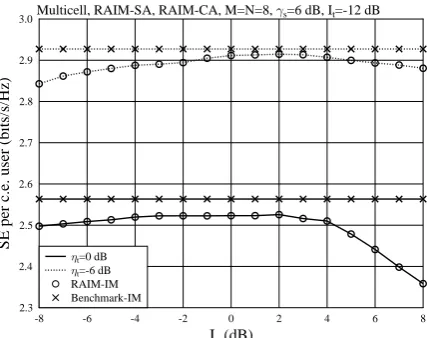
(u∈ U ={0,1,2}), BSuturns off the transmission to the user with poor SIR, such as userk(ηk(u)< ηt), whereηtis the SIR threshold. By turning off the transmissions having poor SIR, it saves power for future transmissions, when the transmissions’ communication qualities become improved. In addition, the ICI imposed by these transmissions with poor channel conditions on the other cells can also be removed.
By contrast, our RAIM-IM algorithm employs STBC based BS cooperation in addition to the strategy of power off, in order to achieve improved performance. However, the cooperation cost is mainly the increase of the complexity for exchanging users’ data among BSs, and that the BSs have to stop trans-mitting information to some of their own users. Therefore, the RAIM-IM aims to maximize the pay-off from BS cooperation, while minimizing the cost. The principles of the RAIM-IM are summarized in Algorithm 5.
The RAIM-IM makes the ICI mitigation decisions for the
cell-edge user groups of each containing three co-subcarrier-code users within three stages. As the example of Algorithm 5, subcarrier mand code nare assumed in line 1 to allocate to users k, k′ andk′′ in cells u, u′ and u′′. During stage u, user k informs BS u the requirement of ICI mitigation if it finds that its SIR is below the threshold, i.e.ηk,m(u) < ηt. Then the mitigation decision can be made by lines 3-14. The RAIM-IM algorithm motivates to maximize the benefit from using BS cooperation. Hence, in line 4 userkfirst checks if the conditions for cooperation are met, i.e. (C5.1) and/or (C5.2) are satisfied. User k requests the cooperation from BSu′ when (C5.1) is true. There are two conditions included in (C5.1). First, the new SIR of user k after the cooperation, i.e. η˜k,m,n(u) , should exceed the SIR threshold, which is η(k,m,nu) ≤ ηt ≤ η˜
(u) k,m,n. Second, only one neighboring imposes strong ICI on user k, i.e.Ik,k(u′′′′),m < Ic ≤ I
(u′) k,k′,m orI
(u′)
k,k′,m < Ic ≤ I (u′′) k,k′′,m. The philosophy behind the second condition can be explained as follows. If BSsu′ anduset up the cooperative transmission for userk, the SIRs of the three users become
˜
ηk,m(u) = |h (u) k,m|
2+I(u′) k,k′,m
Ik,k(u′′′′),m
, η˜(ku′,m′) = 0,
˜
ηk(u′′′′,m) =
|h(ku′′′′,m)| 2
Ik(u′′),k,m+I (u′) k′′,k′,m
. (32)
Known from (32), the SIR of user k can be significantly improved, whenIk,k(u′)′,m is large but I
(u′′)
k,k′′,m is small. In this case, the sum rate of the three users is most probably increased owing to making use of the strong ICI ofIk,k(u′)′,m. By contrast, when bothIk,k(u′′),mandI
(u′′)
k,k′′,mare very weak or very strong, the sum rate of the three users contributed by this BS cooperation is insignificant. As stated in line 6, BSu′accepts the cooperation request for user k when it is available d(m,nu′) = k′, in other words, when it has not established a cooperation with another BS. Note that, when two BSs agree on a cooperation, the BS sends its user’s data information to the cooperating BS. For the example, BSusends the data symbol of userkto BSu′so that the two BSs carry out the STBC transmission to userk.
that, when both the BSs request the cooperation from BS u, the algorithm always prefers to set up the cooperation for the user with poor SIR. As shown in line 10, BS u accepts the cooperation for userk′, since ηk(u′,m′) < ηt. However, when no cooperation can be set up, BSuhas to turn off the transmission to userk, shown by line 11.
V. CHARACTERISTIC ANDCOMPLEXITYANALYSIS
In this section, we analyze the characteristics and the com-plexity of the RAIM scheme as well as the benchmark scheme.
A. Characteristic Analysis
The proposed benchmark scheme is obtained by solving and closely solving the formulated problems in (14), (16) and (19), which are respectively for the distributed SA and CA, as well as the ICI mitigation. For the considered multicell DS-CDMA system, the benchmark scheme proposes a novel strategy of resource allocation and ICI mitigation. It proposes that distributed SA is first carried out for maximizing intra-cell subchannel quality, then distributed CA is operated for maximizing the sum rate of the co-subcarrier users, and ICI mitigation is finally implemented for maximizing the sum rate of cell-edge users. The proposed strategy can be efficiently employed by practical multicell communication systems ow-ing to the various advantages summarized as follows. First, the strategy employs distributed resource allocation which can quickly respond to various wireless environments, and it can also be easily extended to large systems with the minimum amount of cost needed. Second, the proposed strategy motivates to keep backhaul burden as low as possible. Third, the proposed strategy also aims to minimize the load on intracell feedback channels, where very limited ICI information is only required to transmit.
The RAIM scheme follows the novel strategy proposed by the benchmark scheme, and it also motivates to achieve the optimization objectives of the benchmark. By contrast, the RAIM scheme is designed to approach the performance of the benchmark scheme, while lowering implementation complexity and further minimizing backhaul burden as well as decreasing the cost of feedback channels. Let us now discuss the charac-teristics of the RAIM’s SA, CA and ICI mitigation algorithms, and compare them with those of the benchmark scheme.
The RAIM-SA is a fully distributed SA algorithm, which re-quires much lower complexity than the benchmark-SA and the other existing SA algorithms as analyzed in Section V-B. The complexity required by the RAIM-SA is directly proportional to the number of times S for operating Stage II to complete allocation. Hence, in Table I, we summarize the average values ofSˆaccording to the simulation considering the various cases. Seen from Table I, S ≤ 2 is always very small even when the values ofM andN are big. In contrast to the benchmark-SA and the other existing benchmark-SA algorithms, the RAIM-benchmark-SA only requires each BS to know the intracell CSI of a part of its users, which guarantees very small signaling burden on feedback channels and very low implementation complexity. From Table I, we also observe the RAIM-SA algorithm requires a BS to know the intracell CSI of less than 50% users, i.e. ρ < 0.5,
for most scenarios. Due to the above advantages, the RAIM-SA can be efficiently used for the RAIM-SA in other multicarrier systems which employ very high number of subcarriers, such as OFDMA systems.
As suggested by the benchmark-CA, the RAIM-CA inde-pendently and successively operate the CA for the cells in two stages, which guarantees very low implementation complexity. By contrast, the RAIM-CA motivates to maximize the sum rate of co-subcarrier users by avoiding strong ICI as many as possible in order to efficiently mitigate ICI. Furthermore, for minimizing the signal burden on intracell feedback channels, the RAIM-CA only requires a BS to carry out the CA based on the binary information about a part of ICI for its users.
Both the benchmark-IM and RAIM-IM algorithms aim to maximize the sum rate of the cell-edge users with the aid of BS cooperation and power off. The two algorithms establish the cooperation between two BSs instead of that among three BSs in the considered three-cell systems, which keeps the cooperation cost and implementation complexity as low as possible. The benchmark-IM requires the BSs to exchange the ICI information of cell-edge users, which can be avoided by the RAIM-IM in order to further lower the backhaul resources. Moreover, the benchmark-IM is able to find the optimal ICI mitigation solutions by means of the exhaustive search with a relatively high complexity required. By contrast, the distributed RAIM-IM algorithm mainly motivates to minimize the imple-mentation complexity, while finding the suboptimal ICI mitiga-tion solumitiga-tions by maximizing the benefit of BS cooperamitiga-tion.
The proposed benchmark and RAIM schemes can be modi-fied for deployment in practical systems which may have a large number of cells and users. First, the proposed SA algorithms will be directly used in practical systems, since they are fully distributed algorithms based on the intracell CSI only. Note that in practical systems, the RAIM-SA algorithm can find better suboptimal SA solutions, since more number of subcarriers employed by practical systems allows the SA to exploit higher selecting diversity. Second, similar to the three-cell case, the CA is also carried out cell by cell in practical scenarios. The CA for a cell needs to consider the ICI effect from the cells that have done CA in previous stages. Owing to the structure of the practical cellular systems, one user can usually simultaneously receive strong ICI from two neighboring cells at most, which happens when a user is located near the borders of three cells. Hence, the cells operating the CA after the second stage can consider the strongest two ICI effects only on each user, which will release a lot signal burden on feedback channels. Third, the proposed ICI mitigation algorithms can be directly applied to practical systems, where each cell-edge user group contains only three co-subcarrier-code users generating strong ICI to each other. However, there is still a possibility that one user is simultaneously a member of two or more cell-edge user groups. In this case, the ICI mitigation algorithms can be modified to simply switch off the transmission to a user belonging to two or more cell-edge user groups.
B. Complexity Analysis