Abstract - The possibility of increasing the usage of Fly ash (FA) in concrete has been a subject of interest and investigation by the authors. In the previous work, a composite of Fly ash-
β-cyclodextrin (FA-β-CD) has been seen to have the tendencies of improving hydration reaction. To have further insight on how this composite can affect the mechanical properties of concrete, its rheological properties (viscosity and setting time) are assessed in this article. FA was used in percentages of 30 and 50, while β-CD was used in 0.025, 0.05 and 0.1 percentages. These percentages were based on the total percentage of cement (by mass). The results showed that increased in FA and
β-CD contents, reduced the viscosity of the cement paste. Also, higher contents of FA and β-CD, reduced the water required for consistency and extended the setting times.
Keywords: Cement paste; Consistency; Cyclodextrin; Fly ash; Setting time; Viscosity
I. INTRODUCTION
HE rheological properties of cement paste influence concrete workability, placement and eventually affect the mechanical and durability properties of concrete. According to Bingham’s model [1-4], fresh concrete, mortar and cement paste are regarded as viscoplastic materials; whereby they have to overcome a certain yield stress (τ0) in order to initialize flow. In addition, there is a linear relation between the shear stress (τ) and the shear rate (γ˙), named plastic viscosity (µ) after the flow initialization [4]. The model is governed by Equation (1). The initial resistance to flow is quantitatively measured by yield stress τ0) while the flow after initiation is governed by plastic viscosity (µ) [5].
τ = τ0 + μ γ˙; τ ≥ τ0: (1)
Manuscript received July 19, 2016; revised August 02, 2016.
B.D. Ikotun is with the Department of Civil and Chemical Engineering, College of Science, Engineering and Technology, University of South Africa, Johannesburg 1710, South Africa. [email protected]
G.C Fanourakis is with the Department of Civil Engineering Technology,Faculty of Engineering, University of Johannesburg, South Africa. [email protected]
S.B Mishra is with the Nanotechnology and Water Sustainability Unit, College of Science, Engineering and Technology, University of South Africa, Florida Campus, Johannesburg, South Africa.
The addition of pozzolans in concrete will, in most cases lower the yield stress that needs to be overcome and cause early flow initialization. Laskar and Talukdar [5] accounted the reduction of the frictional forces responsible for the lower yield stress of FA to the spherical shape, which causes a ball bearing effect. The lowered yield stress would result in a lower viscosity and in principle retard setting. FA has been reported previously to have a retarding effect on the setting time of concrete [6-8], this was attributed to the adsorption of FA particles to the surface of the cement. β-cyclodextrin (β-CD) based superplasticizer was also reported to have retarded the setting time of concrete [9-10]. Li et al [10] attributed the retarding effect of the β-CD based superplasticizer to the active hydroxyl adsorption groups that were adsorbed on the surface of cement during the hydration process by hydrogen bonds, which prevent and retard further hydration of cement. Retardation is not totally disadvantageous in concrete production, especially when an increase in concrete strength and durability properties is envisaged. The retarding effect of some additives in concrete favors the increase of operating time and the decrease of the consistency or slump loss of freshly mixed materials [11].
Cement paste will be more appropriate to use in investigating the viscosity of FA, β-CD and FA-β-CD composites in a cementitious environment than concrete, following the observation of Wallevik and Wallevik [4]. They [4] reported that the plastic viscosity will remain relatively unaffected when a superplasticizer (SP) is added to concrete while in the case of cement paste, a SP could reduce the plastic viscosity in a similar way as when water is added. Banfill [3] observed a similar behaviour for concrete, he stated that the addition of a superplasticiser to concrete reduces the yield stress (increases slump or flow) but does not change the plastic viscosity. β-CD might have a similar effect because the few documented works on β-CD in concrete technology dealt with β-CD as a superplasticiser [9-10]. A correlation between yield stress and setting time was reported by Kovler and Roussel [12]; the initial setting time corresponds to a yield stress of the order of a couple hundred kPa compared to a few Pa or tens of Pa of a freshly mixed cement paste. This study aimed at investigating the effectiveness of using FA-cyclodextrin (an enzymatic modification of starch) composite, to beneficially modify concrete’s hydration products and hence increase FA usage in concrete technology. Hence, the paper presents the effect of FA, β-CD and FA- β-CD composites on cement paste viscosity and setting time.
T
The Effect of Fly Ash, Beta-cyclodextrin and Fly
Ash-Beta-cyclodextrin Composites on Cement
Paste’s Viscosity and Setting Times
II. MATERIALS AND MIXES
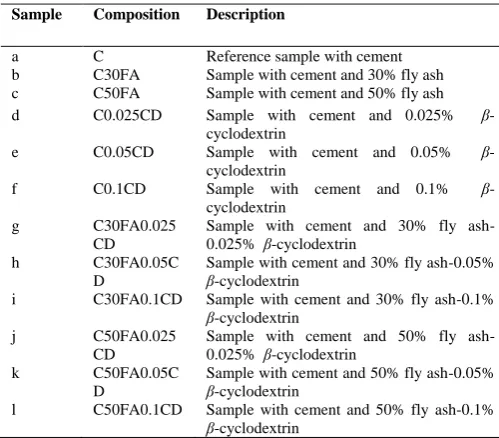
The main materials used are Class F FA, CEM152.5N cement and β-cyclodextrin (β-CD). The FA was obtained from Matla ESKOM power station, South Africa. β-CD was obtained from Industrial Urethanes (Pty) Ltd, South Africa, its chemical composition as supplied by the producer is presented in Table 2. The cement type (CEMI52.5N) was obtained from Pretoria Portland Cement Company (PPC), South Africa. FA-β-CD composites mixtures were synthesized based on physical mixtures as explained in the previous articles [13-14]. The mixtures are described in Table 1. FA was used as a substitution to cement. Twelve cement paste samples were prepared for the viscosity tests for each of the three different water/binder ratios (W/B) (0.4, 0.5 and 0.6) used. Thirty six samples were tested in all. The setting time test was also performed using the mixtures described in Table 1. The quantity of water used for the setting time test depends on the amount of water that produced a consistent mix for each sample as described in SANS50196-3 [15].
Table I: Description of samples used
III. EXPERIMENTAL PROCEDURE
A. Viscosity
The viscosity of the cement paste samples was determined by a VT-04F portable viscotester manufactured by the Rion Co. Ltd as shown in Fig. 1. The viscosity of the pastes was determined by the instrument through the rotation of a rotor in the sample which causes viscous resistance. Samples were prepared to fill the viscometer cup up till the center of the fluid mark on the rotor. Samples with a mass of 150 g were used for mixtures with 0.5 and 0.6-W/B with No. 3 rotor and No. 3 viscometer cup (as specified in the manual) due to the lower viscosity expected for these mixtures in comparison with the mixtures with 0.4-W/B. Samples with a mass of 300 g were used for the 0.4-W/B mixes, with a No. 1 rotor and 300 ml beaker. The calibration unit was attached to the clamp horizontally and the rotor
[image:2.595.301.558.226.413.2]was fixed to the calibration unit. Samples were mixed in the cup/beaker for 10 s and the rotor was placed in the center of the sample in the cup/beaker. The power switch was then set to ON. As the rotor started to turn, the viscosity indicator needle temporarily deflected to the right and then balanced out at the position that corresponded to the viscosity of the sample. The viscosity at this point was recorded as the initial viscosity reading. Thereafter, the viscosity was recorded at 1, 2, 3, 4, 5, 10, 15 and 20 mins or until a constant viscosity value was recorded. The results are expressed in deci Pascal second (d Pa s), which is equivalent to a kilogram per metre second (kg/ m s).
Table II: Characterisation of the β-cyclodextrin used
Fig 1: Viscometer
B. Setting time
The setting time test was done based on the procedure described in SANS 50196-3 [15] standard at the AFRISAM materials laboratory. An automatic, ToniSET Vicat apparatus, conforming to the requirements of the reference method, consisting of twelve Vicat moulds and connected to the computer for capturing setting time results was used. A mass of 500 g of cement/combined materials was measured. A mass of 170 g of water was measured; part of the water was added to the samples over 10 s, in a HOBART mixer, conforming to SANS 50196-1 [16]. The mixer was started at a low speed and zero time was recorded. The total mixing time was 3 mins according to SANS 50196-3 [15]. The paste was transferred to the already oiled mould placed on a lightly oiled base-plate. The mould was filled to have a smooth upper surface without undue compaction or vibration. The water for the standard consistence was determined by lowering the plunger into the filled mould within 4 min ±10 s after zero time. The scale was read at least 5 s after penetration had ceased. The scale reading indicates the distance between the bottom face of the plunger and the base-plate. The test was repeated by adding more water or reducing water, as the case may be, until the distance between plunger and base-plate was (6 ± 2) mm. The water content at this point was taken as the water for the standard consistence of the sample. The mould containing the consistence sample was then placed in a water bath such
Property β -CD
Empirical formula C42H70O35
Bulk density 400-700 kg/m3
Solubility in water at 25 oC 18.5 g/l
Content (on dry basis) Min. 95 %
Sample Composition Description
a C Reference sample with cement
b C30FA Sample with cement and 30% fly ash c C50FA Sample with cement and 50% fly ash d C0.025CD Sample with cement and 0.025% β
-cyclodextrin
e C0.05CD Sample with cement and 0.05% β -cyclodextrin
f C0.1CD Sample with cement and 0.1% β -cyclodextrin
g C30FA0.025
CD
Sample with cement and 30% fly ash-0.025% β-cyclodextrin
h C30FA0.05C
D
Sample with cement and 30% fly ash-0.05%
β-cyclodextrin
i C30FA0.1CD Sample with cement and 30% fly ash-0.1%
β-cyclodextrin
j C50FA0.025
CD
Sample with cement and 50% fly ash-0.025% β-cyclodextrin
k C50FA0.05C
D
Sample with cement and 50% fly ash-0.05%
β-cyclodextrin
l C50FA0.1CD Sample with cement and 50% fly ash-0.1%
[image:2.595.41.291.335.554.2]that the surface of the paste was submerged to a depth of at least 5 mm. The automatic Vicat apparatus used had been calibrated and programmed such that the needle was gently lowered into the paste at the required time. The initial and final setting times were recorded by the automatic Vicat apparatus.
IV. RESULTS AND DISCUSSIONS
A. The effect of FA, β-CD and FA- β-CD composites on cement paste viscosity
[image:3.595.304.563.75.234.2]The results are divided into binary samples (comprising two dry materials) and ternary samples (comprising three dry materials), for better graph visibility and interpretation. Fig. 2 shows the viscosity results of the binary cement paste samples with a 0.6-W/B. It is evident from the graph that FA reduced the viscosity of the cement paste. With higher content of FA (50%), a higher reduction in viscosity was observed, which is in agreement with Laskar and Talukdar [5]. A reduction in viscosity was also observed for β-CD samples. The higher the β-CD content, the lower the viscosity observed. The β-CD samples generally showed a higher viscosity when compared to FA samples, but the sample with 0.1% β-CD exhibited a lower viscosity than the sample with 30% FA from 10 mins upward. The results of ternary samples with 0.6-W/B, shown in Fig. 3, revealed a further reduction of viscosity with FA-β-CD composite samples. The lowest viscosity was observed for sample with the combination of 50% FA and 0.1% β-CD due to the higher contents of FA and β-CD in this sample compared to the other samples.
Fig 2: Viscosity of binary cement paste samples with 0.6-W/B
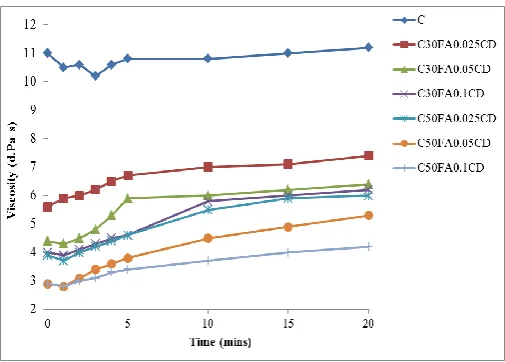
As expected, the viscosity increased with a decrease in W/B (to 0.5) as shown in Fig. 4 and 5 for the binary and ternary samples, respectively. For all samples (binary and ternary) with a 0.5-W/B, the rate of increase in viscosity with time decreased as compared to the samples with 0.6-W/B. In Fig. 4, the β-CD showed a greater effect in reducing viscosity compared to FA. The higher the β-CD content, the higher the viscosity reduction effect as stated also for 0.6-W/B samples. The ternary samples (Fig. 5) also revealed the same trend. The viscosity of the ternary samples was lower
[image:3.595.305.564.298.471.2]than the binary samples.
Fig 3: Viscosity of ternary cement paste samples with 0.6-W/B
Fig 4: Viscosity of binary cement paste samples with 0.5-W/B
Fig 5: Viscosity of ternary cement paste samples with 0.5-W/B
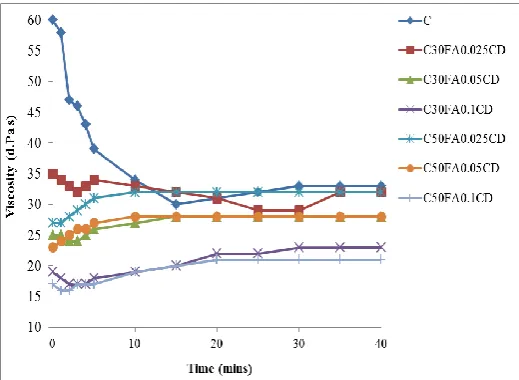
[image:3.595.47.290.446.609.2] [image:3.595.305.558.535.716.2]led to the drastic drop in viscosity at the initial minutes (0 to 15 mins) for all the binary samples shown in Fig. 4.9 with the largest drop for FA samples (approximately 65% for the C30FA and 46% for the C50FA). In the case of 0.6-W/B and 0.5-W/B samples, small yield stress was required to be overcome because of the fluidity of the samples. Little or no drop was observed for these samples at the initial minutes (Fig. 2 - 5). In the case of the ternary samples with 0.4-W/B (Fig. 7), the samples exhibited an insignificant yield stress to be overcome because of the effect of FA-β-CD composite in the samples, which caused more fluidity of the samples. As shown in Fig. 6, the viscosities of the FA samples picked up after 20 mins while the viscosities of β-CD samples were approximately maintained. A further reduction in viscosity was observed for all the ternary samples compared to binary samples. The reduction of viscosity with time of the ternary samples (relative to the binary samples of each W/B) decreased with decreasing W/B.
[image:4.595.305.565.49.239.2]The results (Fig. 2 – 7) also showed that the fluidity of the cement paste increased with an increase in the FA and β-CD contents. According to Burgos-Montes [17], the increase fluidity of cement paste with FA may be due to the spherical morphology of the FA particles, which would reduce inter-particulate friction and therefore raise paste fluidity. The viscosity results also confirmed the X-ray powder diffraction (XRD) results reported previously [18]. The XRD results showed a higher dissolution of anhydrous phases of cement paste samples with lower formation of CH at higher contents of FA and β-CD at the early period of hydration (24 hours). The lower formation of CH was also attributed to the dilution effect, which resulted from the addition of FA and reduced clinker content.
Fig 6: Viscosity of binary cement paste samples with 0.4-W/B
Fig 7: Viscosity of ternary cement paste samples with 0.4-W/B
B. The effect of FA, β-CD and FA- β-CD composites on cement paste setting times
Fig. 8 shows the water content needed to maintain the cement paste consistency of the samples. Average of three results is recorded for each sample. It was observed that decreased water content was needed for samples containing FA and β-CD when compared to the control sample. A further decrease in water content was also observed for the samples with FA-β-CD composites (ternary samples). Similar observations were recorded by some researchers for FA and β-CD based superplasticisers [9, 17, 19]. The higher the FA and β-CD contents, the lesser the water required for consistency. The lower water content required for cement paste consistency for FA-β-CD composite samples will help the samples to have adequate workability at reduced W/B.
[image:4.595.45.557.471.659.2]
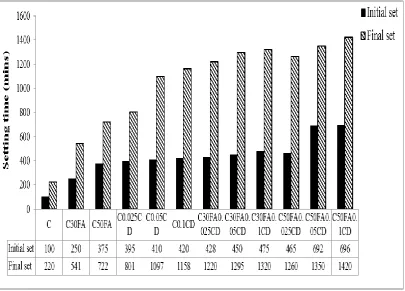
The initial and final setting times of the cement pastes were affected by FA, β-CD and FA-β-CD composites. Fig. 9 shows the initial and final setting times of the samples. Average of three results is recorded for each sample. An increase in both the initial and final setting times was observed in binary samples while a further increase in both initial and final setting times was observed in ternary samples. The β-CD showed a higher effect in increasing setting time than FA, which can be attributed to the β-CD effect in increasing the fluidity of cement paste than FA as shown in the viscosities results (Fig. 2 – 7). The greater fluidity of sample retarded the hydration process and thereby increased the setting time. Li et al [12] attributed the retarding effect of a β-CD based superplasticiser on the setting time to the large amount of hydroxyl groups in the β -CD based superplasticiser that prevented the hydration process.
According to Brooks et al [7], retardation in the setting times could be as a result of the dispersion effects of mineral admixtures (FA) and superplasticiser on the cement particles. They also reported that the setting of cement paste has been postulated to result from two fundamental steps: establishing contacts between particles (coagulation) and the formation of hydrates in the contact zones making rigid the coagulation structure. This postulation was also confirmed by Lv et al [9] and Li et al [10], they stated that the retardation in cement paste depends on the connectivity of particles. Due to increase in the fluidity effect of FA and β -CD on cement paste, the inter-particle contact could be reduced leading to the retardation of setting times.
The XRD results reported previously [18] showed that at an early hydration period (24 hours), β-CD aided the
dissolution of anhydrous phases of cement paste samples with a lower formation of CH. The lower formation of CH will therefore reduce the rigidity of the coagulation structure as explained by Brooks et al [7], resulting in setting retardation at this hydration period. The FT-IR results reported [18] also revealed that samples with FA, β-CD and FA-β-CD composites exhibited IR shift of the Si–O asymmetric stretching vibration to lower wavenumbers compared to control sample at a 24 hour hydration period, which confirmed the potential retardation effect of FA, β -CD and FA-β-CD composites. The higher the FA and β-CD contents, the greater the setting times observed (Fig. 9), with the highest of 696 mins and 1420 mins initial and final setting times, respectively, observed for C50FA0.1CD sample.
V. CONCLUSIONS
The viscosity results showed that W/B had an inverse effect on the viscosity of cement paste. The higher the W/B, the lower the viscosity observed for all the samples. The FA,
[image:5.595.96.502.474.765.2]β-CD and FA-β-CD composites reduced the viscosity of the cement paste, with the β-CD having a higher effect in reducing the viscosity compared to the FA. The lowest viscosity was observed with the FA-β-CD composites samples for all the W/B. The higher the FA and β-CD contents, the lower the viscosity observed. These observations revealed an indication of the effect of FA, β -CD and FA-β-CD composites on the amount of water required for consistency and setting time. The trend observed with the viscosity results was also observed in setting times results. The higher the FA and β-CD contents, the lower the water required for consistency and the longer the setting times observed, with FA-β-CD composites samples exhibiting the longest setting times.
REFERENCES
[1] P. F. G Banfill, Rheology of fresh cement and concrete. Rheo. Rev. (2006) 61 – 130.
[2] M. Zhang, K. Sisomphon, T.S. Ng, D.J. Sun, Effect of superplasticizers on workability retention and initial setting time of cement pastes. Constr and Build. Mat. 24 (2010) 1700–1707.
[3] P.F.G Banfill, Additivity effects in the rheology of fresh concrete containing water-reducing admixtures. Constr. and Build. Mat. 25 (2011) 2955–2960. [4] O.H. Wallevik., J.E. Wallevik, Rheology as a tool in
concrete science: The use of rheographs and workability boxes. Cem. and Concr. Res. 41 (2011) 1279–1288.
[5] A.I. Laskar, S. Talukdar, Rheological behavior of high performance concrete with mineral admixtures and their blending. Constr. and Build. Mat. 22 (2008) 2345–2354.
[6] D. Ravina, P.K. Mehta, Properties of fresh concrete containing large amounts of fly ash. Cem and Concr. Res. 16(1986) 227-238.
[7] J.J. Brooks, M.A.M. Johari, M. Mazloom, Effect of admixtures on the setting times of high-strength concrete. Cem and Concr. Com. 22(2000) 293-301. [8] A. Durán-Herrera, C.A. Juárez, P. Valdez, D.P. Bentz,
Evaluation of sustainable high-volume fly ash concretes. Cem and Concr. Com.33(2011) 39-45. [9] S. Lv, R. Gao, Q. Cao, D. Li, J. Duan, Preparation and
characterization of poly-carboxymethyl-β-cyclodextrin superplasticizer. Cem. and Concr. Res. 42 (2012) 1356–1361.
[10] Y. Li, H. Guo, Y. Zhang, J. Zheng, Z. Li, C. Yang, M. Lu, Synthesis of copolymers with cyclodextrin as pendants and its end group effect as superplasticizer. Carbo. Poly. 102 (2014) 278– 287.
[11] O.Z. Hua, M.B. Guo, J.S. Wei, Influence of cellulose ethers molecular parameters on hydration kinetics of Portland cement at early ages. Constr. and Build. Mat. 33 (2012) 78–83.
[12] K. Kovler, N. Roussel, Properties of fresh and hardened concrete. Cem. and Concr. Res. 41 (2011) 775–792.
[13] B.D. Ikotun, S. Mishra, G.C. Fanourakis, Study on the synthesis, morphology and structural analysis of fly ash–cyclodextrin composite. J. of Incl. Phenom. and Macro. Chem 79(2014) 311-317.
[14] B.D. Ikotun, S. Mishra, G.C. Fanourakis, Structural Characterisation of four South African fly ashes and their structural changes with β-cyclodextrin. Part. Sci. and Tech. Imprint: Taylor and Francis 32 (2014) 360-365.
[15] SANS50196-3:2006: South African national standard. Methods of testing cement Part 3: Determination of setting times and soundness, ISBN 0-626-17598-4. Edition 2.
[16] SANS 50196-1:2006: South African national standard. Methods of testing cement Part 1: Determination of strength, ISBN 0-626-17596-8. Edition 2.
[17] O. Burgos-Montes, M.M. Alonso, F. Puertas, Viscosity and water demand of limestone- and fly ash-blended cement pastes in the presence of superplasticisers. Constr. and Build. Mat. 48 (2013)
417–423.
[18] B.D. Ikotun, Modification of fly ash structure using cyclodextrin for concrete strength and durability development.. Doctorate thesis submitted to the University of Johannesburg, (2016).