Abstract— The aim of the project was to evaluate the effect of heating rate on the microstructures and mechanical properties of spark plasma sintered (SPS) Ni-Fe-Cr alloy. Four samples of Nickel, Iron, and Chromium powders with the same composition were mixed with in a turbula mixer for 5 hours at rotational speed of 49 rpm. The samples were sintered using spark plasma sintering at a temperature of 1000 ºC with heating rates of 50, 100, 150 and 200 ºC/min, respectively. The processing holding time of 5 min under a pressure of 50MPa was used. The disc-shaped samples were obtained and had dimensions of 30 mm diameter and 5 mm in height. Fully densified samples were obtained by SPS at heating rates of 50 and 100 °C/min. The highest density and microhardness of the alloy 59Ni-18Fe-23Cr was recorded with 50 °C/min. The results show that the microhardness and relative density depends on the heating rates which also affects the microstructure and the mechanical properties.
Index Terms—Spark plasma sintering, Microstructure, Hardness, heating rate.
I. INTRODUCTION
ickel and nickel base alloys have been widely used in automotive and aerospace applications due to their high specific strength, high corrosion, fatigue resistance and toughness (Mohanta et al., 2014; Borkar & Banerjee, 2014). Mxolisi B. Shongwe is with the Institute for NanoEngineering Research, Department of Chemical, Metallurgical and Materials Engineering, Tshwane University of Technology, Pretoria, South Africa (email: [email protected])
Dumisane A. Moyana is with the Institute for NanoEngineering Research, Department of Chemical, Metallurgical and Materials Engineering, Tshwane University of Technology, Pretoria, South Africa (email: [email protected])
Isaac M. Makena is with the Institute for NanoEngineering Research, Department of Chemical, Metallurgical and Materials Engineering, Tshwane University of Technology, Pretoria, South Africa (email: [email protected])
Munyadziwa M. Ramakokovhu is with the Institute for NanoEngineering Research, Department of Chemical, Metallurgical and Materials Engineering, Tshwane University of Technology, Pretoria, South Africa (Email: [email protected])
Moipone L. Lethabane is with the Institute for NanoEngineering Research, Department of Chemical, Metallurgical and Materials Engineering, Tshwane University of Technology, Pretoria, South Africa ([email protected])
The financial assistance of the Department of Higher Education and Training [DHET] funding under the Tshwane University of Technology, Emerging Program Grant. This work is based on the research supported in part by the National Research Foundation of South Africa for the grant, Unique Grant No. 99348.
Several nickel base alloys are synthesised by sintering, and other conventional methods at high temperatures and pressures to form the specimen which are porous free (Tang et al., 2008). This alloys works better at elevated temperatures and does not readily fracture (Mohanta et al., 2014). Nickel-Iron-Chromium alloys also show several crucial characteristics such as corrosion resistance, resistance to thermal creep deformation and low and elevated temperatures strength. Their crystal structure is typically faced-centred cubic austenitic (Zickler et al., 2009). The alloy has however received little attention by fabrication using spark plasma sintering (SPS) and as a result the aim of this work is evaluate the effect of heating rate on the microstructure and mechanical properties of spark plasma sintered (SPSed) alloy. The focus will be on the alloys microstructure and mechanical properties (hardness). The produced alloy will then in future be compared with other conventional methods such as hybrid conventional system and casting techniques (Borkar & Banerjee, 2014) which is the scope of the ongoing work. This work serves to also evaluate if SPS is a viable technique to produce alloys that will meet industrial challenges (Kushan et al., 2012). On a bigger scope, future work will also look on the variations on compositions by reducing iron and adding elements like cobalt, tungsten and aluminium in order to better the performance of the superalloys at elevated temperatures (Elliott et al., 2004; Zickler et al., 2009).
II. EXPERIMENTAL PROCEDURE
Metal powders mixtures of the desired stoichiometry of Ni-18Fe-23Cr were blended utilizing a tubular mixer at an ambient temperature for 5 hour at the rotating speed of 49 rpm to ensure a well-blended mixture. The powders were poured into a graphite die with a diameter of 30 mm and 5 mm height. The sintering was accomplished utilizing the spark plasma sintering system (model HHPD-25 from FCT Germany) at a proposed temperature of 1000 ºC with various heating rates (50, 100, 150 and 200 ºC/min), and a holding time of 5 min under a pressure of 50 MPa in vacuum. A detailed description of this sintering technique
Effect of Heating Rate on the Density, Hardness
and Microstructural Properties of Spark Plasma
Sintered Ni-Fe-Cr Alloys
Mxolisi B. Shongwe, Dumisane A. Moyana, Isaac M. Makena, Munyadziwa M. Ramakokovhu, Moipane L. Lethabane
(SPS) is given in (Suarez et al., 2010; Gullion et al., 2011; Shongwe et al., 2015; Makena et al., 2017).
The uneven edges of the sample were ground utilizing sandpaper 180 µm. Grinding 1 was done using Aka-Piatto 220 and lubricating with water at the speed of 300 rpm and the force of 30 N. Grinding 2 was performed using Aka-Allegran 3 and the form of lubricant used was Diamaxx 6 µm Poly, the speed and force was 30 N and 300 rpm, respectively, for 5 min. Polishing consisted of two stages also. Stage 1 was performed using Aka-Daran and lubricated with diamax 3 µm Poly at 150 rpm with the force of 25 N for 4 min. Stage 2 was accomplished with Aka-Chemal disc and lubricated with fumed silica 0.2 µm and the forced used was 20 N at the speed of 20 rpm for 2 min.
The as-received and admixed powders were characterised using the scanning electron microscope (SEM) (JOEL JSM-7600F SEM). The optical microstructures of sintered compacts were taken using the Nikon eclipse LV500. The Vickers hardness (Hv) at room temperature was measured by a micro-hardness tester (Future-tech) at indentation load (P) 100 gf for 15 seconds. Furthermore, the sintered densities of the samples were measured using Archimedes principles.
Table 1: Characteristics of the raw powders used to prepare Ni-18%Fe-23Cr.
[image:2.595.341.524.50.197.2]III. RESULTS AND DISCUSSION
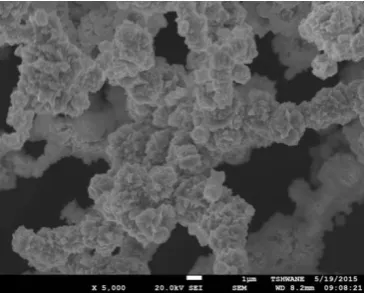
Figure 1 – 4 show SEM micrographs of the as-received and admixed Ni, Fe, Cr powders. Ni particles (fig. 1) show non-disruptive colloidal shapes that formed by agglomeration of very small particles, while Fe (fig. 2) had a distinctive shape of an atomized powder. Micrographs of Cr (fig. 3) show irregular particles with only few small particle agglomerates and clusters of smaller particles. The SEM images revealed that particle size of both Fe and Cr are larger than that of Ni. Figure 4 shows the homogeneous distribution of the particles and confirm particles retaining their original shape irrespective of five hours mixing.
Figure 1: Scanning electron micrograph showing the morphology of nickel (Ni) powder.
Figure 2: Scanning electron micrograph showing the morphology of iron (Fe) powder.
Figure 3: Scanning electron micrograph showing the morphology of Chromium (Cr) powder.
Figure 4: Scanning electron micrograph showing the morphology of admixed powders.
Powders Composition
(wt%) Purity (%) Particle size Supplier
Ni 59 99.5 > 70 µm F.J BRODMAN
& CO.,L. L. C.
Fe 18 99.9 > 70 µm F.J BRODMAN
& CO., L. L. C.
Cr 23 99.2 > 70 µm F.J BRODMAN
[image:2.595.338.517.239.383.2] [image:2.595.337.516.434.576.2] [image:2.595.40.291.448.530.2] [image:2.595.332.519.597.750.2]The SPS processing parameters considered when sintering Ni-Fe-Cr alloy are shown in the table below (Table 2). Four samples were sintered as shown in the Table. The samples were admixed to the required stoichiometric amounts using a tubular mixer. Temperature, holding time and pressure were kept constant while the heating rate was varied.
Table 2: Variations of heating rate in spark plasma sintering of Ni-18Fe-23Cr alloy.
Sample
name
Heating rates
(ºC/min)
Temperature
(ºC)
Pressure
(MPa)
Hold up
time (min)
Sample a 50 1000 50 5
Sample b 100 1000 50 5
Sample c 150 1000 50 5
Sample d 200 1000 50 5
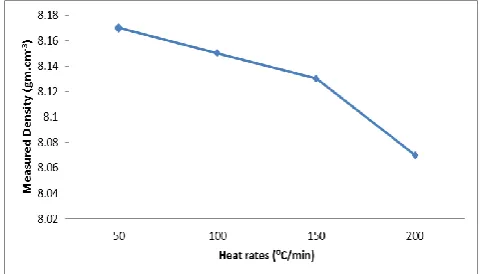
[image:3.595.45.289.463.600.2]The temperature is the most effective parameter. The use of sintering pressure of 50 MPa and temperature 1000 oC for the Ni-Fe-Cr alloys is widely reported (Shu-long et al., 2013; Borkar & Banerjee, 2014). The full densified samples were obtained at the heating rate of 50 and 100 °C/min by applying a pressure of 50 MPa and a hold up time of 5 min. It is indicated that densification gradually decreases with increasing heating rates at constant sintering temperature, as shown in Figure 5.
Figure 5: Effect of heating rate on the density of Ni-Fe-Cr alloys synthesised via spark plasma sintering.
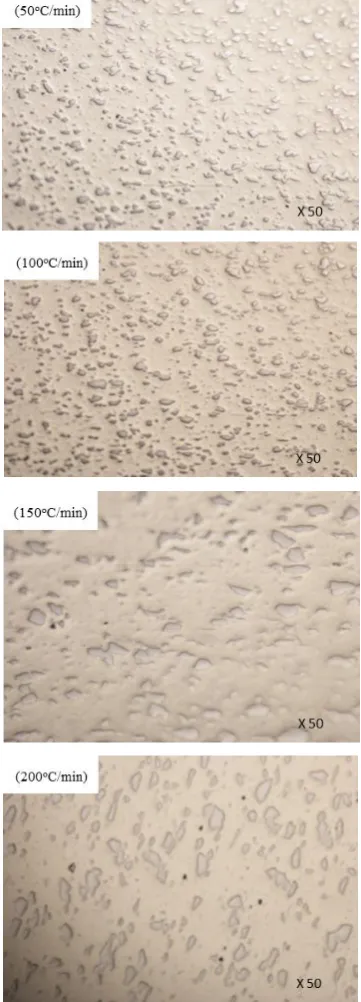
Density is the key factor that affects the mechanical properties of metallic alloys. Higher sintering temperature generates high density alloys, which improves the mechanical properties ((Shongwe et al., 2015). In order to gain insight on the effect of temperature on the densification behaviour, optical microscopy analysis was carried out on Ni-Fe-Cr sintered at four different heating rates, as shown in Figure 6. Figure 6 (sample a and b) illustrates the phase with no pores and well compacted structure with fine particles that are formed at lower heating rates of 50 and 100 °C/min
and proves that this samples are having high microhardness values. Figure 6 (sample c and d) illustrates several large and small pores which were obtained from high heating rate of 150 and 200 °C/min and are related to poor consolidations. This leads to the difference in microhardness within the sample, and again the grains appears coarser and non-uniformly distributed.
Figure 7 shows the Vickers hardness of all the specimens as a function of sintering temperature. It shows that the lower the heating rate the higher the hardness. At sintering heating rate of 50 °C/min, the hardness of SPSed Ni-Fe-Cr base alloy (218 Hv) is higher than that of the higher heating rate that is about 187.49 Hv. It is also clear that the hardness of the specimen at 200 °C/min (sample d) is higher than that at heating rate of 150 °C/min (sample c) specimens sintered at same temperature. This can be attributed to the slight grain growth/coarsening as shown in Figure 7 for higher heating rates. The sample is less porous which proves that sample d is harder than sample c. Clearly, the hardness of Ni-Fe-Cr alloy specimen is substantially affected by spark plasma sintering heating rate. The specimens with smaller apparent porosity and lower sintering heating rate exhibit higher Vickers hardness (Ziwei et al., 2009)
Figure 8 shows the indentations of Ni-Fe-Cr alloys sintered at various heating rates of 50, 100, 150 and 200 °C/min. The samples were obtained at a magnification of X50. The uneven shapes of diamonds are shown in samples sintered at various heating rates. The micrograph for samples sintered with 50 and 100°C/min heating rate, illustrates the well compacted structures and also looks well densified. Samples have less porosity as indicated by smooth surfaces of less pores on the samples (fig. 8). The fracture (diamond) is too small which shows the greater strength in both samples. Thus, the samples sintered at heating rates of 50 and 100 °C/min and hold up time of 5 min at 1000 °C responded well under room temperature stress.
Figure 6: The above are optical images of polished surfaces sintered at various heating rates (50, 100, 150 & 200oC/min).
Figure 7: Vickers hardness of specimens sintered by SPS at various heat rates of: 50, 100, 150 and 200 °C/min.
[image:4.595.79.260.56.558.2] [image:4.595.46.287.610.752.2]IV. CONCLUSIONS
This study demonstrated that it is possible to obtain sintered Ni-18Fe-23Cr products with relatively high densities and homogeneous microstructure. However, the best of SPSed alloy can be readily exploited but provided the correct operating parameters are known. It was observed that with rising heating rate, densification of Ni-18Fe-23Cr alloy declines. This phenomenon was also observed with microhardness. Vickers microhardness was mutually affected by increasing sintering rate. Thus, the optimum heating rate was observed to be 50 and 100oC/min. Alloys sintered at higher heating rates shows extended plastic deformation. In addition, samples sintered at higher heating rates give coarser grains and pores.
ACKNOWLEDGMENT
The financial assistance of the Department of Higher Education and Training [DHET] funding is under the Tshwane, University of Technology, Emerging Program Grant. This work is based on the research supported in part by the National Research Foundation of South Africa for the grant, Unique Grant No. 99348. Research facilities support by the Institute for NanoEngineering Research, Tshwane University of Technology.
REFERENCES
[1] Borkar, T. & Banerjee, R. (2014) ‘Influence of spark plasma sintering (SPS) processing parameters on microstructure and mechanical properties of nickel.’ Materials Science & Engineering A, 618 (2014) 176-181.
[2] El Saeed, M.A., Deorsola F.A., & Rashad, R.M. (2013) Influence of SPS parameters on the density and mechanical properties of sintered Ti3SiC2 powders, Int. Journal of
Refractory Metals and Hard Materials, 41 (2013) 48–53. [3] Elliott, A. J., Tin, S., King, W. T., Huang, S.-C., Gigliotti, M.
F. X. and Pollock, T. M. (2004) ‘Directional Solidification of Large Superalloy Castings with Radiation and Liquid Metal Cooling: A Comparative Assessment.’ Metallurgical and
Materials Transactions A, Vol. 35A, No. 10, 2004, pp. 3221–
3231.
[4] Kushan, M. C., Uzgur, S. C., Uzunonat, Y., & Diltemiz, F., (2012), ‘ALLVAC 718 Plus™ Superalloy for Aircraft Engine Applications’, Intech open science | open mind, 24, February. [5] Makena, M.I., Shongwe, M.B., Ramakokovhu, M.M., &
Olubambi, P.A., (2017), Effect of sintering parameters on densification, corrosion and wear behaviour of Ni-50Fe alloy prepared by spark plasma sintering, Journal of Alloys and Compounds, Vol. 699 (2017) 1166-1179.
[6] Mohanta, L., Sathyanarayan, R., & Venkateswaran, K., 2014, Study of The Nickel Base Alloy For High Performance Application, Abdur Rahman University, 6(10) 1-5.
[7] Opportunities for Spark Plasma Sintering: A Key Technology for a New Generation of Materials.’ Nanomaterials and Nanotechnology Research Center, pp 319.
[8] Shongwe, M.B., Diouf, S., Durowoju, M.O., & Olubambi, P.A., (2015) Effect of sintering temperature on the microstructure and mechanical properties of Fe-30%Ni alloys produced by spark plasma sintering, Journal of Alloys and Compounds, 649 (2015) 824-832.
[9] Shu-long, X., Li-juan, X., Yu-yong, C. & Hong-bao, Y. (2012) ‘Microstructure and mechanical properties of
TiAl-based alloy prepared by double mechanical milling and spark plasma sintering.’ Transactions Nonferrous Metals Society of China, 22(2012) 1086-1091.
[10]Suarez, M., Fernandez A., Menendez, J.L., Torrecillas, R., Kessel, H.U., Hennicke, J., Kirchner, R. & Kessel, T. (2010) ‘Challenges and
[11]Tang, C.F., Pan, F., Qu, X.H. & He, X.B. (2008) ‘Nickel base superalloy GH4049 prepared by powder metallurgy.’ Alloy and Compounds, 474 (2009), 201.
[12]Zickler, G.A., Schnitzer, R., Radis, R., Hochfellener, R., Scheweins, R., Stockinger, M. & LEITNER, H. (2009) ‘Microstructures and mechanical properties of the super alloy Ati Allvac 718plus’. Materials science and engineering, 4, June, 1-9.
[13]Gullion, O. (2011) ‘Technological aspects of FAST’. Technische universitat Darmstadt, 21, March, 1-37.