Abstract—Feeder bus route design must consider the coverage of existing routes, the distribution of residential zones, the level of service and the availability of financial subsidies. The optimal solution is difficult to find and implement; therefore, a market potential index (MPI)-based model was proposed in this study. Moreover, particle swarm optimization was employed to solve the model. The feeder bus routes of the Taiwan High-Speed Rail Miaoli Station served as the case study. The results showed that the bus route produced by this method is superior to the routes designed by the government based on experience and conventional indicators. The proposed method can be used as a template and applied to the design of feeder bus routes for railway stations.
Index Terms—feeder bus, market potential index, particle swarm optimization, route design
I. INTRODUCTION
VER the past few years, a considerable number of studies have investigated the feeder bus network design problem (FBNDP). Kuah and Perl [1] developed a mathematical programming model to determine the optimal route spacing, operating headway, and stop spacing of a feeder bus system designed to access an existing rail transit network, minimizing the sum of user and operator costs. Martins and Pato [2] extended the work of Kuah and Perl [1] by designing heuristic methods, such as the sequential savings approach and the two-phase method, to improve upon previously obtained solutions. Kuan et al. [3], [4] expanded the research of Kuah and Perl [1] by applying metaheuristic methods, such as tabu search, simulated annealing, genetic algorithms (GAs) and ant colony optimization, to improve the solution quality and computational efficiency. Deng et al. [5] studied the classic FBNDP and extended the demand pattern from M-to-1 to M-to-M; they comprehensively considered passenger travel costs, which include the waiting and riding costs for buses, riding cost for rail transportation, and transfer cost between these two transportation modes, and presented a new GA that determines the optimal feeder bus operating frequencies under strict constraints. Almasi et al. [6], [7] proposed an improved real-life model for handling the FBNDP by actualizing the cost function and applying additional constraints; in their investigations, optimized transit services and coordinated
Manuscript received March 07, 2019; revised June 20, 2019.
W.-C. Ho is with Chung Hua University, Hsinchu, 300 Taiwan (corresponding author phone: +886-0975-308598; fax: +886-3-186545; e-mail: [email protected]).
J.-M. Su is with Feng Chia University, Taichung, 407 Taiwan (e-mail: [email protected]).
C.-Y. Chang is with Chung Hua University, Hsinchu, 300 Taiwan (e-mail: [email protected]).
schedules were developed using metaheuristic algorithms such as GAs. Some of these studies [1], [5] emphasized the consideration of additional details to more accurately represent real-life situations to enhance the feeder bus route design model. In contrast, other studies [2]–[4], [6], [7] emphasized the application of metaheuristic algorithms to improve the solution quality and computational efficiency.
Although a large number of studies on the FBNDP have been conducted, many have focused on the complete redesign of routes or long-term planning without considering the coverage of existing public transportation networks. For example, the feeder bus routes of the Taiwan High-Speed Rail (THSR) Miaoli Station were developed under short-term planning; to encourage people to use these services, they were provided free of charge during the initial period. Therefore, existing public transportation networks must be considered to prevent networks from overlapping, avoid wasting resources, and circumvent destructive competition. On the other hand, in addition to the mode of transportation itself, passenger characteristics affect the use of a route. Nevertheless, existing methods assume that travel demand is fixed and known and ignore considerations related to and market research on potential riders. Therefore, a new index that considers the coverage of existing transportation networks and the needs of stakeholders is proposed in this study. The new index is named the market potential index (MPI), and the optimization of feeder bus route design involves maximizing the MPI.
The FBNDP is a non-deterministic polynomial-time (NP)-hard problem [2], [5], [8], [9] for which it is difficult to obtain an exact optimal solution within a reasonable time via traditional mathematical programming due to the embedded traveling salesman problem, nonlinearity, nonconvexity, discreteness and multiobjectivity. Thus, a heuristic algorithm is suitable for finding a realizable solution in a limited timeframe, especially for large-scale practical road networks. The particle swarm optimization (PSO) heuristic algorithm has shown great potential for solving optimization problems due to its simplistic structure, ease of implementation and robust performance. PSO has been widely applied in many applications and research areas, for example, prediction intervals [10], function optimization [11], resource allocation [12], motif detection [13] and route optimization [14]. For the reasons stated above, PSO is employed to solve the proposed MPI-based model in this study.
A case study of the feeder bus routes of the THSR station in Miaoli County is conducted in this study. The THSR plays a key role in national land use planning and promotes local development and the development of new urban centers [15]. To encourage the development of new urban centers, stations are located mostly in suburban areas away from central
Maximal Market Potential of Feeder Bus Route
Design Using Particle Swarm Optimization
Wen-Chi Ho, Jau-Ming Su, and Chien-Yen Chang
O
IAENG International Journal of Applied Mathematics, 49:4, IJAM_49_4_12
business districts, making access inconvenient. Therefore, optimizing the feeder bus route design is important for improving THSR service. The proposed MPI-based model ultimately produces a better feeder bus route design than that produced by conventional methods.
The rest of this paper is organized as follows. Section II presents the methodology, which includes the definition of the MPI, optimization model and PSO. Then, a case study in Miaoli County is discussed in Section III. Section IV presents the main results. Finally, some conclusions are drawn in Section V.
II. METHODOLOGY
A. Defining a Potential Transit Demand Index for Feeder Buses
The factors influencing the choice of transportation mode can be broadly categorized into the socioeconomic statuses of passengers, the service standards of the transportation mode, and the land use at each destination. These factors include gender, occupation, age, personal income, car ownership, travel time, travel costs, safety, comfort, employment, and land use [16]–[18]. In the present study, after considering the difficulty of obtaining data on influencing factors and financial constraints, we collected addresses, population distributions, the locations of universities and government agencies, land use, and registered real estate values. We used these data to predict potential user groups as follows: 1) From a service gap analysis of feeder services, we found that when located in a service gap, people are unable to take a direct public transportation route and are forced to choose private transport. Access to a feeder bus service in this case would improve the public transportation service level. 2) We also studied the locations of buildings. However, there are many types of buildings, including residential homes, businesses, administrative agencies, and educational institutions. These types of buildings are normally destinations of socioeconomic activity and can be both origin and destination points for journeys. Therefore, the more building locations there are within a route’s service scope, the greater its accessibility. 3) If the routes cover a considerable number of people, more people may choose to take feeder buses. An increase in the population coverage will also create a larger source of customers. 4) The main passenger groups of feeder bus services might be students or government employees, indicating higher potential demand in school and government areas. 5) With regard to visiting friends and relatives, we identified land used for residential purposes, including purely residential, mixed residential and industrial use, mixed residential and commercial use, and mixed residential and other uses, to predict household locations. A service area that includes residential areas can satisfy the demands for visiting friends and relatives. 6) Since personal income data and car ownership data are difficult to obtain and are not identifiable due to privacy issues, we were unable to determine detailed locations. Housing prices are higher in residential areas with higher incomes than in residential areas with lower incomes [19]. Therefore, housing prices were used instead of personal income. If the service scope of a route covers areas with relatively low housing prices, then incomes in the area are generally low, and there is potential for additional people to
use feeder bus services.
We define the MPI, which represents the likelihood that a demand point constitutes a potential user, as shown in (1). The higher the value, the higher the possibility that the demand point is a potential user, indicating a greater likelihood of using feeder bus services. The MPI is based on the standardized values of service gaps, number of buildings, population, agencies, housing prices, and residential areas, where 𝑤𝐺 denotes the weighting for gaps. 𝐺𝑘 represents
whether a demand point at location k falls within a service area gap: if a demand point at location k falls within a service area gap, 𝐺𝑘 =1; otherwise, 𝐺𝑘 =0. 𝑤𝐻 represents the
weighting for households. 𝐻𝑘 represents the number of
households at a demand point at location k. 𝑤𝑃 is the
population weighting. 𝑃𝑘 represents the population at a
demand point at location k: min(𝑃) represents the smallest population within the scope of the study, andmax(𝑃)
represents the largest population within the scope of the study.
𝑤𝑎 represents the location weighting for agencies. 𝐴𝑘
indicates whether a demand point is the specified agency: if yes, 𝐴𝑘 = 1; otherwise, 𝐴𝑘 = 0. 𝑤𝐶 represents the weighting
for housing prices. 𝐶𝑘 represents the housing prices at a
demand point at location k: min(𝐶) is the lowest housing price within the scope of the study, and max(𝐶) is the highest housing price within the scope of the study. 𝑤𝑅 represents the
weighting for residential areas. 𝑅𝑘 indicates whether the land
use at demand point k is residential: if yes, 𝑅𝑘= 1; otherwise,
𝑅𝑘= 0.
B. Model for Feeder Bus Routes
The present study refers to the maximum covering shortest-path problem proposed by Current et al. [20]; herein, the objective function is adjusted to the maximum MPI, and route budget constraints are added to define the design model for feeder bus routes. The model and its symbols are as follows.
K is the set of demand points. 𝑀𝑃𝐼𝑘 represents the market
potential for demand point k. 𝑦𝑘 indicates whether demand
point k is within the area served by the feeder bus route in the plan: when 𝑦𝑘 = 1, demand point 𝑘 is within the area served
by the feeder bus route; otherwise, 𝑦𝑘 = 0. 𝑆 denotes the set of
candidate stops. 𝑐𝑖𝑗 is the shortest-path cost from candidate stop
𝑖 to candidate stop𝑗. 𝑥𝑖𝑗 is the decision-making variable that
indicates whether section 𝑖𝑗 is included in the plan: when 𝑥𝑖𝑗 =
1, section 𝑖𝑗 is included in the plan; otherwise, 𝑥𝑖𝑗 = 0. 𝑐𝑚𝑎𝑥 is
the maximum budget for the feeder bus route. 𝐷𝑖𝑗 is the
shortest-path distance from candidate stop 𝑖 to candidate stop𝑗.
𝐷0𝑛 is the shortest-path distance from starting stop 0 to terminal
stop 𝑛 in the plan. 𝜆 represents the circuity. 𝑆𝑖 is the set of
candidate stops included in the plan such that 𝑆𝑖=
{𝑖|section𝑖𝑗isincludedinthepan} . 𝑆𝑘 is the set of
candidate stops included in the plan within the maximum acceptable walking distance 𝑑max from demand point 𝑘: 𝑆𝑘 =
{𝑗|𝑑𝑗𝑘≤ 𝑑max}.
𝑀𝑃𝐼𝑘 = 𝑤𝐺∙ 𝐺𝑘+ 𝑤𝐻∙ 𝐻𝑘+ 𝑤𝑃
𝑃𝑘− min(𝑃)
max(𝑃) − min(𝑃) + 𝑤𝐴∙ 𝐴𝑘
+ 𝑤𝐶(1 −
𝐶𝑘− min(𝐶)
max(𝐶) − min(𝐶)) + 𝑤𝑅∙ 𝑅𝑘
(1)
IAENG International Journal of Applied Mathematics, 49:4, IJAM_49_4_12
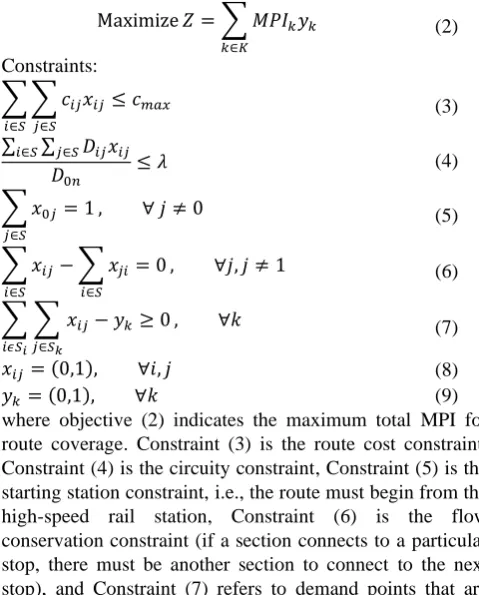
Maximize 𝑍 = ∑ 𝑀𝑃𝐼𝑘𝑦𝑘 𝑘∈𝐾
(2) Constraints:
∑ ∑ 𝑐𝑖𝑗𝑥𝑖𝑗 ≤ 𝑐𝑚𝑎𝑥 𝑗∈𝑆
𝑖∈𝑆
(3)
∑𝑖∈𝑆∑𝑗∈𝑆𝐷𝑖𝑗𝑥𝑖𝑗
𝐷0𝑛
≤ 𝜆 (4)
∑ 𝑥0𝑗 = 1 𝑗∈𝑆
, ∀𝑗 ≠ 0 (5)
∑ 𝑥𝑖𝑗− ∑ 𝑥𝑗𝑖 𝑖∈𝑆
= 0
𝑖∈𝑆
, ∀𝑗, 𝑗 ≠ 1 (6)
∑ ∑ 𝑥𝑖𝑗 𝑗∈𝑆𝑘
− 𝑦𝑘 ≥ 0 𝑖𝜖𝑆𝑖
, ∀𝑘 (7)
𝑥𝑖𝑗 = (0,1), ∀𝑖, 𝑗 (8)
𝑦𝑘 = (0,1), ∀𝑘 (9)
where objective (2) indicates the maximum total MPI for route coverage. Constraint (3) is the route cost constraint, Constraint (4) is the circuity constraint, Constraint (5) is the starting station constraint, i.e., the route must begin from the high-speed rail station, Constraint (6) is the flow conservation constraint (if a section connects to a particular stop, there must be another section to connect to the next stop), and Constraint (7) refers to demand points that are covered by essential parts of the route. 𝑦𝑘 equals zero unless
demand point 𝑘 is covered by the route. Finally, Constraints (8) and (9) are 0 and 1 integer constraints, respectively.
C. Solution Algorithm Design 1) Particle Swarm Optimization
In the present study, we attempt to solve the FBNDP using PSO. Originally developed by Eberhart and Kennedy [21], PSO is an optimization method based on the social behavior of flocks of birds and/or schools of fish. The basic concept is to randomly initialize a particle swarm in the feasible solution space and velocity space to establish the initial position and velocity for each particle and then use the interactively updated speed and velocity to identify the optimal value. The positions of the particles correspond to a feasible solution for the optimization problem, where the quality of the solution is determined by the fitness value calculated by the objective function of the optimization problem. In each iteration, the particle velocity and position are influenced by the individual intertidal velocity, the currently optimal individual solution best and the optimal group influence g𝑏𝑒𝑠𝑡. The updating equations are shown as (9) and (10), where𝑣𝑖𝑗𝑘 is the speed
vector for particle i in dimension j in iteration𝑘, 𝑥𝑖𝑗𝑘 is the
position of particle i in dimension j in iteration k, 𝑝𝑏𝑒𝑠𝑡𝑖𝑗𝑘 is
the best solution for particle i in dimension j in iteration k,
𝑔𝑏𝑒𝑠𝑡𝑗𝑘 is the best solution for the group for dimension j in
iteration k for finding h, 𝑤 is the inertia weight, 𝑐1 is the
cognitive parameter, and𝑐2 is a social parameter. 𝑤 is a
random number in the interval (0, 1), and 𝑐1, 𝑐2 are random
numbers in the interval (0, 2), while 𝑟0, 𝑟1are used to establish
the diversity of the group and are random numbers evenly distributed in the interval (0, 1).
𝑣𝑖𝑗𝑘+1= 𝑤 ∗ 𝑟0∗ 𝑣𝑖𝑗𝑘 + 𝑐1∗ 𝑟1∗ (𝑝𝑏𝑒𝑠𝑡𝑖𝑗𝑘 − 𝑥𝑖𝑗𝑘)
+ 𝑐2∗ 𝑟2∗ (𝑔𝑏𝑒𝑠𝑡𝑗𝑘− 𝑥𝑖𝑗𝑘)
(9)
𝑥𝑖𝑗𝑘+1= 𝑥𝑖𝑗𝑘 + 𝑣𝑖𝑗𝑘 (10)
2) Using PSO to Solve the Feeder Bus Route Model
PSO is used mainly for solving continuous optimization problems. Therefore, in the present study, the particle coding scheme and updating mechanisms are revised. Discrete PSO is proposed to resolve the FBNDP under 0-1 integer programming. Each particle represents a solution or, in other words, a possible candidate route. Each particle dimension is composed of the codes of candidate stops; the first stop is 0, which represents the starting stop. A particle code of 0-3-5-4-2 indicates that the feeder bus route travels from starting stop 0 to candidate stop 3, candidate stop 5, candidate stop 4, and finally candidate stop 2. The length of each particle is not fixed mainly due to route cost limitations. The steps for the solution are described below:
Step 1: Randomly select a candidate stop from the candidate stop set and continue inserting stops until the candidate route is linked. Each time a stop is inserted, check that the cost of the route does not exceed the budget. If the limit is exceeded, remove the last inserted candidate stop; otherwise, continue to insert stops. Repeat the process to produce random initial solutions.
Step 2: For each particle swarm, use the 2-opt algorithm [22] to improve the feasible solutions. If route costs decrease following improvements, continue to insert candidate stops until the quality of the solution no longer improves and the length of the route cannot be reduced.
Step 3: Calculate the MPI for each particle to find the best solution for each individual and the best solution for the group.
Step 4: The particle updating mechanism is shown in Fig. 1. First, a random value 𝑟0 is generated for the dimensions of
the current particles. If the value is lower than the inertia weight factor 𝑤, the stop is included in the candidate route. Then, a random value 𝑟1 is generated for each dimension of
the individual best particle. If this value is lower than the cognitive parameter 𝑐1, the stop is included in the candidate
route. Next, a random value 𝑟2 is generated for each
dimension of the group’s best particle. If the value is lower than the social parameter 𝑐2, the stop is included in the
candidate route. Finally, duplicate stops are deleted from the candidate route.
p
ip
ibestg
bestp
ip
ibestg
best0 3 5 4 2 1 4 7 11 55 22 99 1010 0 1 5 2 9 10
0 1 4 7 0 3 5 4 2
c1 c2
w
r0 0.79 0.81 0.05 0.96 r1 0.38 0.78 0.94 r2 0.48 0.33 0.26 0.52 0.91
0.4 0.4 0.4 0.4 0.6 0.6 0.6 0.6 0.6 0.6 0.6 0.6
[image:3.595.46.286.51.349.2]0 4 1 1 5 2 9
Fig. 1. Updating process of PSO.
IAENG International Journal of Applied Mathematics, 49:4, IJAM_49_4_12
Step 5: Compare the updated particle with 𝑝𝑏𝑒𝑠𝑡. If the updated particle is better than 𝑝𝑏𝑒𝑠𝑡, then the updated particle becomes the new 𝑝𝑏𝑒𝑠𝑡.
Step 6: Compare the updated 𝑝𝑏𝑒𝑠𝑡 and 𝑔𝑏𝑒𝑠𝑡. If the former is better than𝑔𝑏𝑒𝑠𝑡, the updated 𝑝𝑏𝑒𝑠𝑡 becomes the new 𝑔𝑏𝑒𝑠𝑡.
Step 7: Repeat Steps 2-6 until the set termination condition is met or 𝑔𝑏𝑒𝑠𝑡 is the most acceptable solution.
III. CASE STUDY
A case study of the feeder bus route design of the THSR Miaoli Station is used to verify the feasibility of the model and algorithm proposed in this study. The THSR Miaoli Station located in Miaoli County in north-central Taiwan began operations on December 1, 2015. This county covers 1,820 square kilometers and has a population of 559,557 (as of November 2016).
The raw data and the procedures used to calculate the MPI are shown in Table I and described below. 1) Computation of 𝐺𝑘. The spatial gaps in the THSR feeder
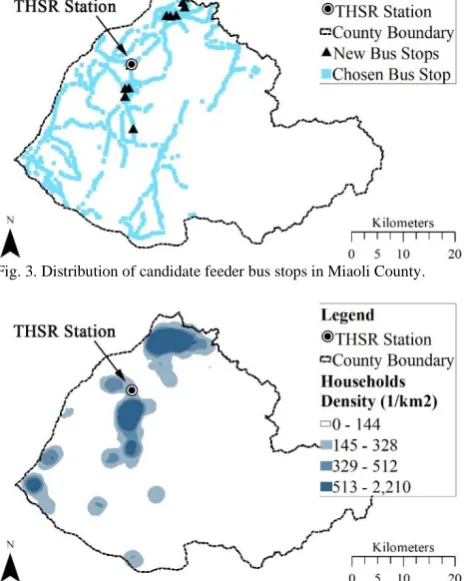
transportation service along existing bus routes were identified using a geographic information system. These locations were considered demand points and service areas for feeder bus route design, as shown in Fig. 2. For the selection of candidate stops within the high-speed rail bus service, the behavior of the user, waiting space, and route integration were considered, and existing bus stops within the THSR feeder transportation service gaps were included. In addition, to satisfy emerging journey demands, new stops on the three routes designed by the Miaoli County government were included as candidate stops, as shown in Fig. 3. 2) Computation of 𝐻𝑘 .
Households are concentrated in the northern, western and central parts of Miaoli County, as shown in Fig. 4. The number of households at each demand point was counted. 3) Computation of 𝑃𝑘 . According to citation [23],
passengers who use the bus to access the high-speed rail station are mostly under 25 years of age. Therefore, the number of people under the age of 25 years at each demand point was counted. max(𝑃) was 35, and min(𝑃)
was 0. 4) Computation of 𝐴𝑘. The users of bus services as
the mode of transportation to high-speed rail stations are mostly military and government personnel and students [23], [24]. Therefore, we selected universities, colleges, and government agencies, as shown in Fig. 5. The number of government agencies at each demand point was counted. 5) Computation of 𝐶𝑘 . Since the location
information associated with a registered real estate value is an address or a parcel number, the value must be geocoded and converted into coordinates. After doing so, Delaunay triangulations were constructed, as shown in Fig. 6, and the house price of each demand point was determined. max(𝐶) was 108,281, and min(𝐶) was 7,795. 6) Computation of𝑅𝑘. The distribution of residential
zones is shown in Fig. 7. Whether each demand point was located within a residential zone was determined; accordingly, we assumed that each influencing factor is equally important and that the weight values (𝑤𝐺,𝑤𝐻,𝑤𝑃,𝑤𝐴,𝑤𝐶) were each 1.
TABLE I
DATA ON THE INFLUENCING FACTORS FOR THE CASE STUDY
Data Content Type Data Source
Transit stops Point Directorate General of Highways, Ministry of Transportation and Communications
Road network Line Institute of Transportation, Ministry of Transportation and
Communications Household
addresses
Point Information Center, Ministry of the Interior
Population distribution (under 25 years of age)
Point Miaoli County Government
Locations of universities and government agencies
Polygon Institute of Transportation, Ministry of Transportation and
Communications
Land use types Point National Land Surveying and Mapping Center, Ministry of the Interior
Registered values of real estate
[image:4.595.301.542.72.449.2]Point Department of Land Administration, Ministry of the Interior
[image:4.595.307.541.488.779.2]Fig. 2. Distribution of demand points falling within service gaps in Miaoli County.
Fig. 3. Distribution of candidate feeder bus stops in Miaoli County.
Fig. 4. Distribution of households in Miaoli County.
IAENG International Journal of Applied Mathematics, 49:4, IJAM_49_4_12
Fig. 5. Distribution of government officesand universities in Miaoli County.
[image:5.595.50.306.236.563.2]Fig. 6. Distribution of housing prices in Miaoli County.
Fig. 7. Distribution of residential zones in Miaoli County.
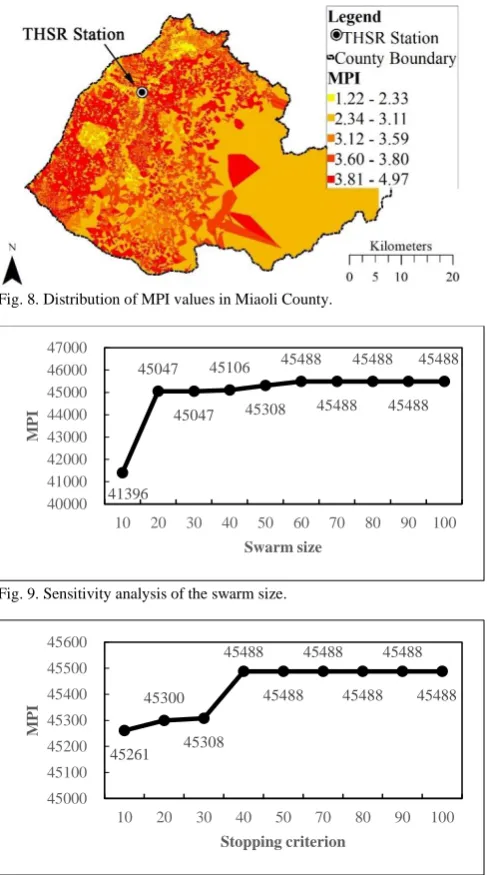
After calculating the MPI of each demand point, as shown in Fig. 8, the algorithm proposed in this study was used to solve the FBNDP. To obtain appropriate values for the PSO parameters and validate the implementation of the proposed algorithm, a parametric study was carried out. The parameters that determine the PSO performance were the swarm size 𝑃, the stopping criterion, the inertia weight 𝑤, the cognitive parameter
𝑐1, and the social parameter 𝑐2. To study the effect of the
swarm size, the algorithm was iterated by varying the value of
𝑃 from 10 to 100, and the results are shown in Fig. 9. In general, the larger the population size was, the better the improved performance. However, a large population size led to an increase in the calculation time in terms of evaluating the MPI. Therefore, a swarm size of 60 was adopted. The stopping criterion represents the convergence of the MPI; i.e., the iterations will cease if the optimal MPI is not updated within a specific number of iterations. To determine the necessary
number of iterations, trial runs were executed with the number of iterations ranging from 10 to 100, and the results are shown in Fig. 10. The maximal MPI was achieved with 40 iterations; therefore, 40 was chosen as the optimal number of iterations in terms of performance. The inertia weight parameter serves to balance the global search and local search and is used to create a random change along a route. The cognitive parameter represents the sharing of historical information between particle individuals. The social parameter represents the sharing of social information between particle individuals; if the value is too large, the PSO algorithm will easily fall into a local optimum, causing premature convergence to occur. In order to study the effect of the inertia weight, the cognitive weight, and the social parameter, we record the best MPI under the different parameter combinations of of 𝑤, 𝑐1, and 𝑐2. Note that 𝑤, 𝑐1,
and 𝑐2 are in the range of [0, 1]. The main effects of the
parameter combinations are show in Fig. 11. The results show that the combinations of {𝑤 = 0.2, 𝑐1 = 0.5, and 𝑐2 = 0.9}, {𝑤
= 0.3, 𝑐1 = 0.4, and 𝑐2 = 0.2}, and {𝑤 = 0.9, 𝑐1 = 0.5, and 𝑐2 =
[image:5.595.306.550.341.779.2]0.6} are better than other parameter combinations. The algorithm parameters are given in Table II. In summary, the initial PSO parameters were as follows: swarm size, 60 individuals; inertia weight, 0.9; cognitive weight, 0.5; and social component, 0.6.
Fig. 8. Distribution of MPI values in Miaoli County.
Fig. 9. Sensitivity analysis of the swarm size.
Fig. 10. Sensitivity analysis of the stopping criterion.
41396 45047
45047 45106
45308 45488
45488 45488
45488 45488
40000 41000 42000 43000 44000 45000 46000 47000
10 20 30 40 50 60 70 80 90 100
M
PI
Swarm size
45261 45300
45308 45488
45488 45488
45488 45488
45488
45000 45100 45200 45300 45400 45500 45600
10 20 30 40 50 70 80 90 100
M
PI
Stopping criterion
IAENG International Journal of Applied Mathematics, 49:4, IJAM_49_4_12
Fig. 11. Sensitivity analysis of the inertia weight; the cognitive parameter, and the social parameter.
TABLE II PARAMETER SETTINGS
Parameter Value
Swarm size 𝑃 (number of particles) 60
Stopping criterion The optimal solution was not updated for 40 iterations.
Inertia weight 𝑤 0.9
Cognitive parameter 𝑐1 0.5
Social parameter 𝑐2 0.6
Starting stop THSR Miaoli Station
Budget 𝑐𝑚𝑎𝑥 12.5 million
Circuity 𝜆 1.2
IV. RESULTS AND DISCUSSION
[image:6.595.46.281.224.379.2]The case study results are presented in Table III. We used the route design method for high-speed rail feeder bus routes in this survey with an interval of NT$2.5 million and annual budget limits of NT$2.5 million and NT$35 million. We found that an investment of NT$12.39 million had the greatest benefit, as shown in Fig. 12. For every NT$10 thousand invested, the MPI increased by 27.1. The route with the greatest benefit route is labeled “This Study A” in Table III with a length of approximately 8.3 kilometers; the corresponding distribution map is shown in Fig. 13. The length of the route with the greatest benefit was determined based on bus operating costs for each kilometer of NT$37.662 per kilometer according to the subsidy standards for the public transport plans of each county set by the Directorate General of Highways, Ministry of Transportation and Communications. Based on 108 service runs each day for 365 days, the estimated cost for each journey was NT$313, resulting in an annual cost of approximately NT$12.39 million.
Fig. 12. Investment benefit for the considered feeder bus routes.
Fig. 13. Bus routes proposed in this study.
TABLE III
DATA COMPARISONS AMONG DIFFERENT FEEDER BUS ROUTES
Route Name Route 1 Route 2 Route 3 This Study A
This Study B Population covered
(under 25 years of age)
2,625 2,929 897 4,896 7,657
Number of served
households 5,456 6,382 2,099 11,733 17,426 Number of served
households in service gap area
3,908 4,528 186 2,410 8,276
Number of served universities and government agencies
5 33 7 39 66
Number of served residential areas
3,913 5,040 1,650 9,830 14,539
MPI 16,499 21,296 5,529 33,548 54,406
Route length (km) 22.1 16.3 5.6 8.3 21.8 Assumed number of
services 108 108 108 108 108
Annual operating
costs (ten thousand) 3,286 2,424 826 1,239 3,236 MPI per operating
cost (1/ten thousand) 5.0 8.8 6.7 27.1 16.8
Three bus routes were proposed by the local government based on experience to provide feeder services, as shown in Fig. 14. The MPI per operating cost of the proposed feeder bus route labeled “This Study A” was 27.1, as shown in Table III, which is substantially higher than the MPI values of the three existing routes proposed by the local government, indicating that the method proposed in this study can be used to design an efficient THSR feeder bus route. A higher MPI represents a greater opportunity to attract more passengers, which constitutes a positive benefit for bus companies and the THSR.
Fig. 14. Bus routes proposed by the local government. 30000
35000 40000 45000 50000
0 1 2 3 4 5 6 7 8 9 10
M
PI
Iterations
(0.2, 0.5, 0.9)
(0.9, 0.5, 0.6)
(0.3, 0.4, 0.2) (w, c1, c2)
27.1 0 5 10 15 20 25 30 35 40 2 3 8 4 8 3 7 4 6 9 9 8 1 2 3 9 1 4 7 5 1 7 4 9 2 0 0 0 2 2 4 7 2 4 8 6 2 7 3 8 2 9 4 3 3 2 3 6 3 4 9 1 M PI p er o p er a ti n g c o st (1 /t en th o u sa n d )
Annual operating costs (ten thousand)
IAENG International Journal of Applied Mathematics, 49:4, IJAM_49_4_12
[image:6.595.59.540.638.778.2]Route design models should avoid overlap with the coverage of existing transportation services. The service gap area of the route labeled “This Study A” contains fewer served households than the route labeled “Route 1” proposed by the local government; however, this may be due to the length of the route. The length of the route labeled “This Study B” is similar to that of the route labeled “Route 1”, but the former serves a higher number of households in service gap areas than does the latter. Additionally, the proposed route labeled “This Study B” fills the transportation service gap and enhances the accessibility of the THSR Miaoli Station. Transportation service could be provided for 8,276 households that are currently without public transit services, thereby effectively utilizing public transportation resources. Notably, this study emphasizes that an analysis of transportation service gaps should consider route accessibility in addition to bus stop accessibility because the presence of a bus stop within an acceptable walking distance of a household does not mean that the bus route services the desired destination.
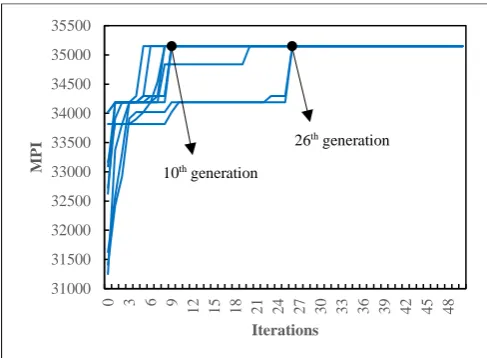
To examine the efficacy of the PSO algorithm, we performed another 10 experiments, and the stopping criterion was set to 100 (the maximum number of iterations). Fig. 15 shows the convergence of the calculation with a budget limit of NT$12.5 million and a circuity constraint of 1.2. Each line presents the convergence of each experiment. Evidently, the MPI increased rapidly before the 10th generation and then varied smoothly. The optimal MPI value appeared approximately at the 26th generation. In addition, few changes were observed in the MPI among the ten experiments, indicating that our algorithm exhibits good convergence.
Fig. 15. Convergence diagram of the MPI in the iteration of the PSO algorithm.
In this case study, the MPI was designed to assess the spatial distributions of potential passenger groups and assign higher ratings to spatial locations based on identified potential passenger group characteristics. The function of the MPI-based model is to develop feeder bus routes that pass through highly rated locations under cost and route circuity restrictions. In other words, goal-oriented feeder bus routes can be designed via the MPI-based model. For example, a medical feeder bus route can be designed based on the location distribution of people aged 65 years or older and
low-income households if such individuals are identified as a high-potential passenger group of a medical feeder bus.
PSO was originally developed for continuous optimization problems. This study follows the design basis of PSO and improves the iterative updating method to develop a discrete PSO algorithm based on the search for local and global optimal solutions. The results of the case study indicate that discrete PSO can be utilized to solve combinatorial optimization problems. Moreover, as a result of the broad applicability of PSO, the proposed discrete PSO algorithm could be helpful in solving discrete optimization problems in other areas.
V. CONCLUSION
In the present study, we proposed a mathematical model based on the optimization of the MPI with budget and route length constraints to solve the FBNDP. We also proposed a discrete PSO algorithm with an improved coding scheme and updating mechanisms to generate the optimal solution. The method to calculate the MPI uses household registration data, land prices, land use, and open data on landmarks to understand the distributions of potential user groups for high-speed rail feeder buses and to determine the service areas of high-speed rail feeder buses without overlapping existing services. A case study was conducted on the feeder bus routes for the THSR station in Miaoli County, Taiwan. The proposed feeder bus route is superior to the three routes proposed by the local government based on experience and conventional indicators.
The MPI calculated in this study does not consider the characteristics of tourist attractions. If an area exhibits an obvious tourism demand, the MPI model can be modified for the design of other types of bus lines. In addition, this study considers only the number of universities and government agencies and not the scale of these institutions, although these data would increase the accuracy of the MPI calculation.
REFERENCES
[1] G. K. Kuah and J. Perl, "Optimization of feeder bus routes and bus-stop spacing," J. Transp. Eng., vol. 114, no.3, pp. 341–354, May 1988. [2] C. L. Martins and M. V. Pato, "Search strategies for the feeder bus
network design problem," Eur. J. Oper. Res., vol. 106, no. 2, pp. 425– 440, Apr. 1998.
[3] S. N. Kuan, H. L. Ong, and K. M. Ng, "Applying metaheuristics to feeder bus network design problem," Asia-Pacific J. Oper. Res., vol. 21, no. 4, pp. 543–560, Jan. 2004.
[4] S. N. Kuan, H. L. Ong, and K. M. Ng, "Solving the feeder bus network design problem by genetic algorithms and ant colony optimization,"
Adv. Eng. Softw., vol. 37, no. 6, pp. 351–359, Jun. 2006.
[5] L. Deng, W. Gao, Y. Fu, and W. Zhou, "Optimal design of the feeder-bus network based on the transfer system," Discrete Dynamics
Nature Soc., vol. 2013, pp. 1–10, Dec. 2013.
[6] M. H. Almasi, A. Sadollah, S. M. Mounes, and M. R. Karim, "Optimization of a transit services model with a feeder bus and rail system using metaheuristic algorithms," J. Comput. Civil Eng., vol. 29, no. 6, pp. 04014090-1–04014090-13, Jul. 2014.
[7] M. H. Almasi, S. M. Mounes, and M. R. Karim, "Validating an improved model for feeder bus network design using genetic algorithm (GA) and particle swarm optimization (PSO)," J. Eastern Asia Soc.
Transp. Stud., vol. 11, pp. 507–522, May 2015.
[8] G. K. Kuah and J. Perl, "The feeder-bus network-design problem," J.
Oper. Res. Soc., vol. 40, no. 8, pp. 751–767, Aug. 1989.
[9] L.-B. Deng, W. Gao, W.-L. Zhou, and T.-Z. Lai, "Optimal design of feeder-bus network related to urban rail line based on transfer system,"
Procedia Soc. Behavior Sci., vol. 96, pp. 2383–2394, Nov. 2013.
[10] X. Kang and D. Pi, "Forecasting satellite power system parameter interval based on relevance vector machine with modified particle swarm optimization," IAENG International Journal of Computer Science, vol. 44, no. 1, pp. 68–78, 2017.
31000 31500 32000 32500 33000 33500 34000 34500 35000 35500
0 3 6 9 12 15 18 21 24 27 30 33 36 39 42 45 48
M
PI
Iterations
26th generation
10th generation
IAENG International Journal of Applied Mathematics, 49:4, IJAM_49_4_12
[image:7.595.46.290.447.626.2][11] J. S. Wang and J. D. Song, "A hybrid algorithm based on gravitational search and particle swarm optimization algorithm to solve function optimization problems," Engineering Letters, vol. 25, no. 1, pp. 22–29, 2017.
[12] S. Li, L. Jiao, Y. Zhang, Y. Wang, and W. Sun, "A scheme of resource allocation for heterogeneous services in peer-to-peer networks using particle swarm optimization," IAENG International Journal of
Computer Science, vol. 44, no. 4, pp. 482–488, 2017.
[13] S. Som and W. Kimpan, "NexusPSO: A novel algorithm to detect transcription factor binding sites," IAENG International Journal of
Computer Science, vol. 45, no. 3, pp. 478–487, 2018.
[14] B. Tutuko, S. Nurmaini, and S. Masyarif, "Route optimization of non-holonomic leader-follower control using dynamic particle swarm optimization," IAENG International Journal of Computer Science, vol. 46, no. 1, pp. 1–11, 2019.
[15] N.-H. Ho, "Study of Taoyuan station area development and outreach transportation system of Taiwan high speed rail," J. Performance Strategy Res., vol. 10, no. 1, pp. 1–32, May 2013.
[16] J. L. Korf and M. J. Demetsky, "Analysis of rapid transit access mode choice," Transp. Res. Rec., no. 817, pp. 29–35, Jan. 1981.
[17] J. Sobieniak, R. Westin, T. Rosapep, and T. Shin, "Choice of access mode to intercity terminals," Transp. Res. Rec, no. 728, pp. 47–53, 1979.
[18] T. Messenger and R. Ewing, Transit-oriented development in the sun belt. Transp. Res. Rec.: J. Transp. Res. Board, Vol. 1552, no, 1, pp. 145–153, Jan. 1996.
[19] R. Feldman, The Affordable Housing Shortage Considering the
Problem, Causes and Solutions. Minneapolis, US: Federal Reserve
Bank of Minneapolis, 2002.
[20] J. R. Current, C. S. Re Velle, and J. L. Cohon, "The maximum covering/shortest path problem: A multiobjective network design and routing formulation," Eur. J. Oper. Res., vol. 21, no. 2, pp. 189–199, Aug. 1985.
[21] R. Eberhart and J. Kennedy, "Particle swarm optimization," in Proc.
IEEE Int. Conf. Neural. Netw., Piscataway, 1995, pp. 1942–1948.
[22] G. A. Croes, "A method for solving traveling-salesman problems," Oper. Res., vol. 6, no. 6, pp. 791–812, Dec. 1958.
[23] W.-Y. Hsieh, "Passengers' trip-planning behavior of Taiwan high speed rail – a case study of Kaohsiung-Taipei intercity market," Ph.D. dissertation, Nat. Cheng Kung Univ., Tainan, Taiwan, 2002. [24] M.-T. Lu, "Egress mode choices for Taiwan high speed Rail," M.S.
thesis. Feng Chia Univ., Taichung, Taiwan, 2006.