ST 2-50.4 (FM 34-8)
COMBAT COMMANDERS
HANDBOOK ON INTELLIGENCE
US Army Intelligence Center and Fort Huachuca
Fort Huachuca, Arizona 85613-6000
SEPTEMBER 2001
PREFACE
Combat commanders need timely and accurate intelligence. In order to drive intelligence as a part of the intelligence operating system, commanders must understand what
intelligence can do, how to focus it on specific requirements, and how you can integrate it with other operating systems.
This handbook addresses these requirements, expanding on the doctrine in FM 2-0 (FM 34-1), FM 3-0 (FM 100-5), FM 5-0 and FM 6-0 (FM 101-5), and FM 2-01.3 (FM 34-1 30).
This handbook is written primarily for maneuver commanders and executive officers at brigade or regiment and battalion or squadron levels to include Active Components (AC) and Reserve Component (RC) commanders. It should also be useful to principal staff officers and combat support (CS) and combat service support (CSS) commanders.
Unless this publication states otherwise, masculine nouns and pronouns do not refer exclusively to men. Throughout the manual, “you” refers to the combat commander and also applies to the executive officer as he integrates and synchronizes the orders process and directs and supervises the staff.
The proponent of this publication is the US Army Intelligence Center and Fort Huachuca. We consider this a living manual and will dynamically revise this doctrine as frequently as necessary based on comments and suggestions from the field. Under normal
circumstances appropriate revisions will be made within two weeks of receipt. While the initial (one time) distribution of this field manual will be made on CD-ROM, users should realize that to capture the dynamic changes/revisions of the manual as soon as they occur, they should check the Intelligence Center Homepage frequently for the most current version. We welcome your comments and recommended changes at any time. You may email them directly to the proponent at [email protected] or mail them to: Commander, US Army Intelligence Center and Fort Huachuca (ATZS-FDRCD), Fort Huachuca, Arizona 85613-6000. You can also access the Doctrine Division
Homepage at http://usaic.hua.army.mil/doctrine.htm and leave your comments or changes with the webmaster.
This handbook does not implement any international Standardization Agreements (STANAG5). It complies with all applicable STANAGs and Quadripartite Standardization Agreements. This document contains copyrighted material.
SPECIAL TEXT USAIC&FH No. 2-50.4 (FM 34-8) Fort Huachuca, AZ 86513-6000
6 September 2001
TABLE OF CONTENTS
Page
PREFACE ... iii
CHAPTER 1 THE INTELLIGENCE CHALLENGE FOR
COMMANDERS ... 1-1 Intelligence Operating System ... 1-1 ISR Operations ... 1-2 Intelligence Tasks... 1-4 Effective Intelligence ... 1-6
CHAPTER 2 INTELLIGENCE PREPARATION OF THE
BATTLEFIELD... 2-1 Responsibilities ... 2-1
What You Should Expect ... 2-5 Effective Techniques During Mission Analysis ... 2-5
CHAPTER 3 S2/G2 ORGANIZATIONS AND FUNCTIONS ... 3-1 The Battalion S2 ... 3-1 The Brigade S2 ... 3-2 The Division and Corps G2 ... 3-4
CHAPTER 4 MILITARY INTELLIGENCE CAPABILITIES... 4-1
Intelligence Disciplines ... 4-1 Intelligence Functions... 4-4 MI Organizations ... 4-5 Limitations of Intelligence ... 4-9
APPENDIX A INTELLIGENCE AND THE MILITARY DECISION-
MAKING PROCESS... A-1 What to Expect from Your S2 ... A-1
Targeting Meeting ... A-6
DISTRIBUTION RESTRICTION: Approved for public release; distribution is unlimited.
APPENDIX B COMMANDER’S CRITICAL INFORMATION
REQUIREMENTS ... B-1 Priority Intelligence Requirements... B-2
Friendly Forces Information Requirements ... B-3 Essential Elements of Friendly Information ... B-3
APPENDIX C ISR INTEGRATION WITHIN THE SYNCHRONIZATION
MATRIX ... C-1
APPENDIX D INTELLIGENCE, SURVEILLANCE, AND
RECONNAISSANCE PLANNING ... D-1
APPENDIX E FOREIGN LANGUAGE SUPPORT... E-1
Introduction... E-1 Linguistic Support Categories ... E-1
Determining Linguist Requirements ... E-1 Planning and Managing Linguist Support... E-2 Identifying Sources of Linguists... E-9
APPENDIX F STABILITY OPERATIONS, SUPPORT OPERATIONS, AND INTELLIGENCE PREPARATION OF THE
BATTLEFIELD... F-1 IPB Modifications for Stability Operations and
Support Operations ... F-1 Urban Operations Considerations ... F-3
GLOSSARY ... Glossary-1
Chapter 1
The Intelligence Challenge for Commanders
Intelligence is your tool; it is the foundation for synchronizing operations, massing combat power and effects, and protecting the force. There is no such thing as perfect intelligence but, when properly focused and planned and executed, intelligence operations are
invaluable. To effectively use intelligence, you must understand
• The capabilities and limitations of the intelligence operating system.
• The intelligence architecture (which includes command and control (C2);
processing; collaborative and distributed analysis; intelligence, surveillance, and reconnaissance [ISR] operations; and intelligence networks and communications).
• How you focus ISR operations.
• How you and your staff synchronize ISR with other operations.
INTELLIGENCE OPERATING SYSTEM
1-1. The mission of your intelligence operating system is to provide timely, relevant, accurate, and predictive intelligence support to you, your staff, and subordinates when planning, preparing, and executing decisive actions within the area of operations (AO). Implied within this mission, or associated with intelligence, are—
• Integrated ISR planning (focused through the S2 and S3 but thoroughly planned by the entire staff).
• Changes and adjustments to ISR collection.
• Analysis, production, and dissemination (to include presentation) of intelligence and combat information—the heart of the intelligence operating system.
• Electronic Warfare (EW), which is an integrated part of fires, targeting, and effects. EW should always be employed as an integrated and complementary capability.
ISR OPERATIONS
1-2. ISR planning and execution do not reflect a change to fundamental Army doctrine. Recent emphasis on ISR operations reflects the importance of a unified, integrated, and synchronized effort to
• Plan and direct the ISR effort.
• Collect and process information.
• Produce intelligence.
• Disseminate intelligence and combat information to those who need it, when they need it.
1-3. Two concepts are imbedded in recent ISR doctrine:
• There are a finite number of “traditional intelligence collection” and “traditional reconnaissance and surveillance (R&S)” assets, but there are many potential ISR assets.
• There is a different “mindset” among each operating systems or proponent on how to plan, task, and control assets; how and where to report information; and how to use the information. However, ISR doctrine is designed to break the operating system or functional “stovepipes” for planning, reporting, processing, and analyzing information.
EMERGING DOCTRINE (IBCT) (See Chapter 4)
In recognition of the importance of ISR operations and the unique challenges of small-scale contingencies, the initial brigade combat team (IBCT) is uniquely organized to facilitate ISR operations:
• The Military Intelligence (MI) Company (subordinate to the brigade) includes an ISR integration platoon, HUMINT platoon, more robust analytical capability, and organic control teams (specifically the operational management team [OMT] to help the commander control tactical HUMINT operations).
• The reconnaissance, surveillance, and target acquisition (RSTA) squadron S2 is supported by an ISR Integration Team (from the Surveillance Squadron).
• The surveillance troop (subordinate to the RSTA squadron) consists of soldiers and assets that execute nuclear, biological, and chemical (NBC) surveillance and other ISR operations (operations traditionally described as intelligence operationsfrom three disciplines). Another new characteristic is multi-sensor teams that employ sensors from more than one intelligence discipline.
• The reconnaissance troop (subordinate to the RSTA squadron) includes an organic HUMINT collection capability.
CRITICAL ELEMENTS OF ISR OPERATIONS
• Clearly articulate your priority intelligence requirements (PIR) with a latest time intelligence is of value (LTIOV).
• Drive the IPB process throughout the military decision-making process (MDMP) (see Chapter 2).
1-5. Carefully plan ISR operations. You must ensure that intelligence preparation of the battlefield (IPB) drives the rest of the planning process and that all ISR operations are thoroughly planned (to include synchronized) and controlled as an integrated staff effort through the C2 system. Although the G2 (S2) is the IPB and ISR integrator and the G3 (S3) plays a critical role in synchronizing ISR with the operation, every staff member plays an important role in both tasks. Your primary tool in accomplishing these
integration tasks is the Chief of Staff (CofS) or executive officer (XO). The CofS (XO) is responsible to ensure all staff members participate in and provide their functional
expertise into the IPB process and ISR planning and execution under the direction of the G2 (S2). There are a number of different techniques that the CofS (XO) can employ to facilitate interaction among the entire staff during the IPB process and ISR integration. However, the desired endstate is an efficient process that supports planning and helps facilitate the commander’s visualization and understanding.
1-6. Ensure ISR operations are continuous. Your S2 (through the intelligence architecture) continuously performs intelligence tasks to meet your requirements before deploying and during operations. No echelon has enough time, ISR assets, and
analytical tools to satisfy all of its requirements. Therefore, never keep your ISR assets in reserve.
1-7. Use the C2 system (as described in FM 5-0 and FM 6-0 (FM 101.5)). Clear C2 through centralized planning and decentralized execution is important. (This extends beyond collection management, as described in FM 2-33.4 (FM 34-2)). Command and support relationships for ISR units are developed by thorough staff planning (through mission, enemy, terrain and weather, troops, time available, and civilians [METT-TC] analysis). Use habitual relationships, when possible, to optimize effective operations as a combined arms team.
1-8. Ensure ISR is a distributed operation. Timely reporting to the right analytical element at the right echelon is critical to ISR operations. Intelligence Reach is a process by which deployed military forces rapidly access information from, receive support from, and conduct collaboration and information sharing with other units (deployed in theater and from outside the theater) unconstrained by geographic proximity, echelon, or
command. G2s, S2s, and intelligence analytical elements (for example, the analysis and control element [ACE] and the analysis and control team [ACT] within the direct support [DS] MI company) utilize Intelligence Reach to collaborate, participate in distributed analysis, and share access to the intelligence between echelons and units. Every
echelon must work together and tailor the intelligence architecture so that it is as close to seamless as possibleno barriers.
ISR TRAINING
responsible for training his section and helping you train your unit on ISR issues. However, the G2/S2 (Senior Intelligence Officer) and intelligence commanders and leaders also train a significant portion of the intelligence operating system.
INTELLIGENCE TASKS
1-10. The intelligence battlefield operations system (BOS) is divided into the following four intelligence tasks. It is important that you understand the tasks that the S2 section performs during operations. Each task corresponds with a critical aspect of operations.
• Facilitate commander’s visualization and understanding of the threat and the environment. This task provides information and intelligence to the commander to support his achievement of battlefield visualization. This task is comprised of three subtasks:
Perform Intelligence Preparation of the Battlefield (IPB) - IPB is the staff planning activity undertaken to understand the battlefield and the options it presents to friendly and threat forces. It is a systematic process of analyzing the threat and environment in a specific geographic area for a specific
mission. By applying IPB, the commander gains the information necessary to selectively apply and maximize his combat power at critical points in time and space.
Perform Indications and Warnings (I&W) – I&W provide the commander with early warning and prevents surprise through anticipation of significant changes in threat activities. I&W provide the commander the ability to quickly reorient his forces on unexpected major contingencies and shape the
battlefield.
Perform Situation Development – This subtask confirms or denies threat courses of action (COAs), explains what the threat is doing in relation to the friendly force commander’s intent, and provides an estimate of threat combat effectiveness. Commanders use situation development to help understand the AO, thereby reducing risk and uncertainty. Situation development helps the commander make decisions and execute branches and sequels.
• Counter the Threat - This task provides the commander information and
intelligence support for targeting of the threat’s forces, threat organizations, units and systems through lethal and non-lethal fires to include electronic attack (EA) and information operations. It also includes the tactics, techniques, and
procedures (TTPs) to deny or degrade the threat ISR capabilities to access and collect information and intelligence on friendly forces. This task is comprised of two subtasks:
Support Targeting - Targeting is supported by the staff to develop target systems, locate the targets, and perform battle damage assessment (BDA) on engaged targets. Included in this task is the use of EA against threat forces.
• Intelligence, Surveillance, and Reconnaissance Integration. This task
integrates ISR assets into an effort that produces intelligence, which leads to the commander’s gaining situational understanding. These capabilities to collect, process, analyze and produce, and disseminate are critical to successful planning and conducting operations. Intelligence requirements are identified, prioritized, and validated; an ISR plan is developed and synchronized with the scheme of maneuver. This task is comprised of four subtasks:
Develop Requirements - Intelligence officers develop a prioritized list of what information needs to be collected and produced into intelligence. This list is placed against an LTIOV to ensure intelligence and information are reported to the unit in order for operations to proceed as planned.
Analyze Requirements and Resources Available - The entire staff under the direction of the intelligence staff analyzes each requirement to determine how best to satisfy it. The staff will receive orders and requests for
information (RFIs) from both subordinate and adjacent units and higher headquarters. These requests are then balanced with resources available for tasking to ensure requirements can be met with available assets and their specific capabilities.
Develop Specific Information Requirements (SIRs) - SIRs break
requirements into specific questions which, when answered, can satisfy the larger intelligence requirements. The requirements manager will develop sets of SIRs for each requirement with an LTIOV associated with each one.
Develop ISR Plan. The XO integrates and supervises the entire staff under the direction of the intelligence staff and develops an integrated and
synchronized plan that places requirements to include time with
recommended ISR assets. The ISR plan creates a collection strategy and employment scheme that will produce the intelligence required to effectively answer the commander’s PIR.
• Manage Intelligence Support to Information Operations - Intelligence, both in offensive and defensive operations, provides the critical links for engagement with offensive IO. Intelligence also provides the capabilities and limitation of threat IO. This forms the basis of the defensive IO plan. Intelligence supports IO through its intelligence tasks and subtasks focusing on the target of IO.
EFFECTIVE INTELLIGENCE
1-11. The effectiveness of intelligence is measured against the following standards:
• Timely: Intelligence is useful only if you receive it soon enough to support planning, influence decisions, and prevent surprise.
• Relevant: Intelligence must answer your requirements and the requirements of your staff about the environment and threat in the format you designate. Your S2 must present you some basic products that help you visualize your battlespace (proportionate to his resources and the time available).
When a certain degree of doubt exists, your S2 must capture and present that uncertainty.
Chapter 2
Intelligence Preparation of the Battlefield
Longstreet looked up the long rise. He could begin to see it. When the troops came out of the woods the artillery would open up. Long-range artillery, percussion and solid shot, every gun on the hill. The guns to the right, on the Rocky Hill, would enfilade the line. The troops would be under fire with more than a mile to walk. And so they would go. A few hundred yards out, still in the open field, they would come within range of skirmish, aimed rifles. Losses would steadily increase. When they reached the road they would be slowed by the fence there, and the formation, if it still held would begin to come apart. Then they would be in range of the rifles on the crest. When they crossed the road, they would begin to take canister fire and thousands of balls of shrapnel wiping huge holes in the line. As they got close, there would be double canister. If they reached the wall without breaking, there would not be many left. It was a mathematical equation.
Shaara, Michael. Killer Angels. New York, NY: Ballantine Books, 1974, p. 303.
RESPONSIBILITIES
2-1. The above passage details the vision General Longstreet had prior to the assault on Cemetery Ridge during the battle of Gettysburg. Because General Longstreet understood the critical elements of the terrain and the enemy, he was able to visualize this battle before it occurred. You rely on your S2 and staff to provide IPB analysis and graphic products that enable you to effectively visualize the battlefield and make decisions.
2-2. To visualize the battlefield, it is important that you and your XO take the lead to ensure that the IPB process is really an integrated staff effort (this is sometimes referred to as the cross-BOS IPB effort). Your S2 and staff must participate in initial IPB by
• Analyzing the threat equivalent for their staff or functional area (red hat analysis). For example, the Engineer Officer will help analyze threat mobility,
countermobility, and survivability capabilities.
• Helping the S2 capture any threat equivalent actions within the threat COAs for their staff or functional area (red hat actions) within standard or unique IPB products.
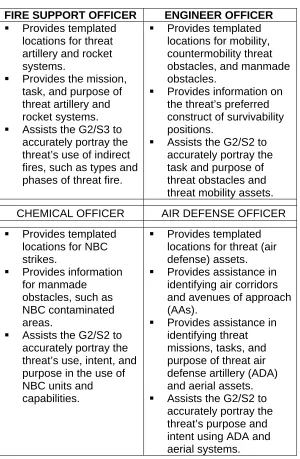
2-3. Although IPB is a G2/S2 responsibility, the entire staff contributes to the IPB process as shown in the Figure 2-1. However, Figure 2-2 shows the three most important MDMP steps for the commander to drive IPB.
FIRE SUPPORT OFFICER ENGINEER OFFICER Provides templated
locations for threat artillery and rocket systems.
Provides the mission, task, and purpose of threat artillery and rocket systems. Assists the G2/S3 to accurately portray the threat’s use of indirect fires, such as types and phases of threat fire.
Provides templated locations for mobility, countermobility threat obstacles, and manmade obstacles.
Provides information on the threat’s preferred construct of survivability positions.
Assists the G2/S2 to accurately portray the task and purpose of threat obstacles and threat mobility assets.
CHEMICAL OFFICER AIR DEFENSE OFFICER
Provides templated locations for NBC strikes.
Provides information for manmade
obstacles, such as NBC contaminated areas.
Assists the G2/S2 to accurately portray the threat’s use, intent, and purpose in the use of NBC units and capabilities.
Provides templated locations for threat (air defense) assets. Provides assistance in identifying air corridors and avenues of approach (AAs).
[image:12.612.100.400.114.573.2]Provides assistance in identifying threat missions, tasks, and purpose of threat air defense artillery (ADA) and aerial assets. Assists the G2/S2 to accurately portray the threat’s purpose and intent using ADA and aerial systems.
Figure 2-1. Example of staff IPB contributions to the G2/S2
COMMANDER’S INITIAL GUIDANCE - (STEP 1: RECEIPT OF MISSION)
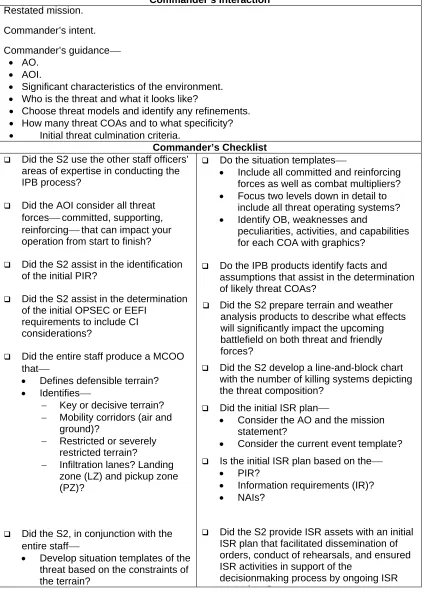
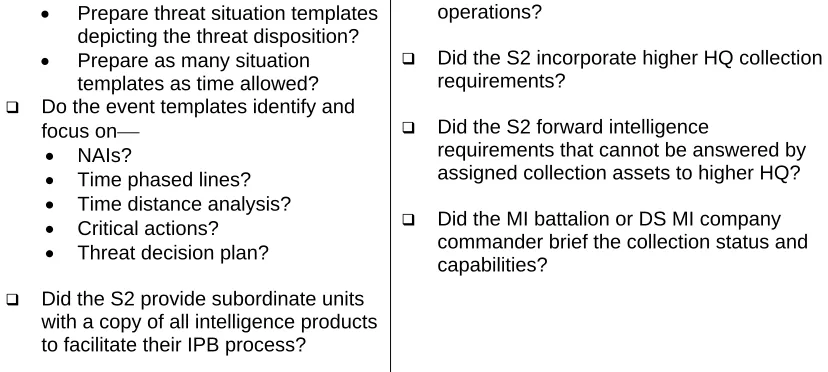
2-4. In order to drive the IPB process, you must answer several questions:
• Does the staff need to focus on any particular part of the IPB process?
MDMP
Steps
Step 1: Receipt of Mission Step 2: Mission Analysis Step 6: COA ApprovalCommander’s
Output
Initial Guidance Restarted Mission. Commander’s Intent. Commander’s Guidance. Approved COA. Refined Commander’s Intent.Specified Type of Order. Specified Type of Rehearsal. HPTL.
The Commander
Drive IPB
Disagree with higher IPB? Abbreviated initial IPB? Initial ISR support?
Additional IPB analysis (besides normal procedures)?
Area of interest (AOI). Significant characteristics of
the environment.
Important environment factors. Choose threat models and
identify any refinements. How many threat COAs and
their specifics? Initial threat culmination
criteria.
Final threat culmination criteria.
Guidance on refining IPB analysis and products.
MDMP
Steps
Step 1: Receipt of Mission Step 2: Mission Analysis Step 6: COA ApprovalMDMP
Steps
Step 1: Receipt of Mission Step 2: Mission Analysis Step 6: COA Approval Step 1: Receipt of Mission Step 2: Mission Analysis Step 6: COA ApprovalCommander’s
Output
Initial Guidance Restarted Mission. Commander’s Intent. Commander’s Guidance. Approved COA. Refined Commander’s Intent.Specified Type of Order. Specified Type of Rehearsal. HPTL. Initial Guidance Restarted Mission. Commander’s Intent. Commander’s Guidance. Approved COA. Refined Commander’s Intent.
Specified Type of Order. Specified Type of Rehearsal. HPTL.
The Commander
Drive IPB
Disagree with higher IPB? Abbreviated initial IPB? Initial ISR support?
Additional IPB analysis (besides normal procedures)?
Area of interest (AOI). Significant characteristics of
the environment.
Important environment factors. Choose threat models and
identify any refinements. How many threat COAs and
their specifics? Initial threat culmination
criteria.
Final threat culmination criteria.
Guidance on refining IPB analysis and products.
The Commander
Drive IPB
Disagree with higher IPB? Abbreviated initial IPB? Initial ISR support?
Additional IPB analysis (besides normal procedures)?
Area of interest (AOI). Significant characteristics of
the environment.
Important environment factors. Choose threat models and
identify any refinements. How many threat COAs and
their specifics? Initial threat culmination
criteria.
Final threat culmination criteria.
Guidance on refining IPB analysis and products. Disagree with higher IPB? Abbreviated initial IPB? Initial ISR support?
Additional IPB analysis (besides normal procedures)?
Area of interest (AOI). Significant characteristics of
the environment.
Important environment factors. Choose threat models and
identify any refinements. How many threat COAs and
their specifics? Initial threat culmination
criteria.
Final threat culmination criteria.
Guidance on refining IPB analysis and products.
• Are there any immediate ISR requirements that need to be addressed early?
Figure 2-2. Driving IPB
COMMANDER’S INTENT AND GUIDANCE - (STEP 2: MISSION ANALYSIS)
2-5. You must allocate adequate time and guidance to your S2 and staff to perform the initial IPB. Successful mission analysis requires a thorough initial IPB to provide the staff with the impact of the environment, weather, and threat for use in subsequent steps of
mission analysis.
2-6. In this step the staff starts to convert your visualization of the battlefield into an operational framework. Focus the efforts of your S2 and staff on IPB.
Why is this important? Failure to focus on only the relevant significant characteristics wastes time and the IPB process will not influence mission success. On the other hand, failure to identify all the significant characteristics may result in your unit’s failure to deal with a feature of the battlefield that you and your staff overlooked.
• Describe the Battlefield Effects. The S2 and staff use the factors defined in Step 1 and other characteristics to evaluate the battlefield thoroughly and to describe the
battlefield effects. In stability operations and support operations, you and your battlestaff must view terrain in a unique way and keep in mind the political, economic, ethnic, and other characteristics of the population (the key terrain).
Why is this important? Commanders with a poor understanding of the battlefield effects will probably fail to exploit the opportunities the environment provides, and the threat will find and exploit opportunities in a way the command did not anticipate.
• Evaluate the Threat. Most of the analytical work for this step is performed prior to deployment; it is a part of intelligence readiness activities and contingency planning. It is at this point that your S2 and staff clearly define who the threat is and what the threat looks like. In stability operations and support operations the threat could range from conventional military forces to paramilitary forces, insurgents, terrorists, political groups, refugees, or environmental disasters. Understanding the threat’s intent provides focus to the S2 so that as he moves to step 4, the threat COAs make sense.
Why is this important? Failure to evaluate the threat adequately may result in
A lack of intelligence, which is needed for planning.
Wasted time and effort in planning against threat capabilities that do not exist.
Surprise because of an unknown threat capability.
• Determine Threat COAs. Dictate how many and to what level of detail you want the S2 and staff to develop threat COAs, then provide macro-level guidance on how you visualize your intent in relationship to threat objectives and endstate. Finally, provide the S2 and staff guidance on criteria that will lead to culmination of the threat. For example, you could intend to defeat the threat by destroying 75 percent of his organic and attached artillery and 50 percent of the lead motorized rifle battalions (MRBs).
Why is this important? Failure to adequately determine threat COAs will allow the threat to surprise you and your staff. Viable and tactically sound threat COAs provides the framework required to build a successful friendly COA.
throughout the MDMP. You can also modify your intent (this provides the link between the mission and the concept of operations). Your last responsibility is to provide your staff with enough additional guidance to focus staff activities during the remainder of planning.
COMMANDER’S DECISION BRIEFING - (STEP 6: COA APPROVAL)
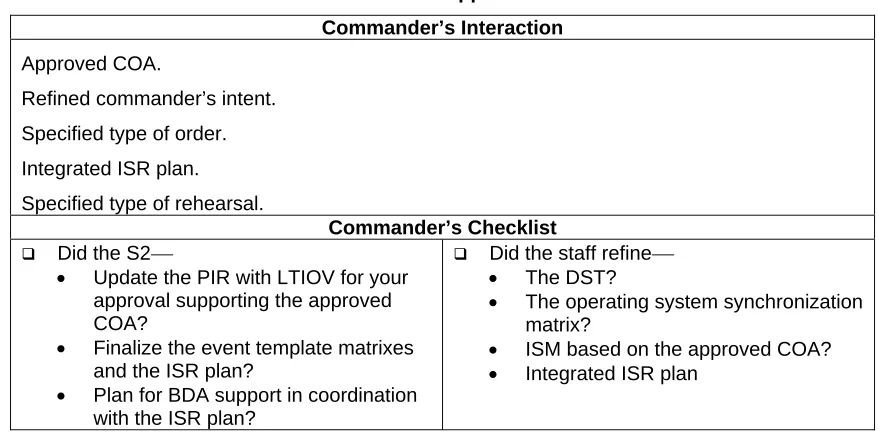
2-8. After the decision briefing, you approve the COA you believe to be the most advantageous; you then modify your intent statement and your commander's critical information requirements (CCIR) to support this selected COA and issue further guidance:
• State the final threat culmination criteria.
• Direct refinements for the IPB analysis and products to include greater detail on threat branches and sequels.
WHAT YOU SHOULD EXPECT
2-9. Your S2 and staff must complete IPB early in the MDMP because this process lays the groundwork for COA development and the subsequent steps of the MDMP. IPB analysis and products must help you and your staff do the following:
• Visualize the battlefield.
• Complete COA development, the wargame process, and COA refinement (to include building flexibility into the operation).
• Plan ISR operations.
• Provide the framework so your S2 can perform situation development and your XO/S3 can provide the common operational picture during the operation.
2-10. To meet these requirements, your S2 and staff perform IPB analysis and produce graphic products that
• Describe the threat’s mission, intent (two levels up), and how they see us.
• Portray an adaptive, cunning, and uncooperative threat. Provide a detailed picture of how the threat will operate with all of his combat multipliers (not just a template of how and where he will move).
• Include the task and purpose of all relevant threat ISR systems.
EFFECTIVE TECHNIQUES DURING MISSION ANALYSIS
2-11. The lessons learned discussed herein are from the National Training Center but apply to any brigade or regiment and battalion or squadron level S2.
2-12. During mission analysis, expect your S2 and staff to “paint a picture” you can remember. Require your S2 to begin with the bottom line up front. They should produce the following during mission analysis and present it during the mission analysis brief.
• Battlefield environment visualization analysis and products to include terrain and current weather and weather effect charts.
• Threat organization and timelines: macro to micro. Develop the threat picture from the largest echelon given all the way down to individual vehicle, time permitting. The timelines should also reflect from largest echelon to smallest element.
• Threat commander’s intent (two levels up in terms of strategic and tactical missions).
• Threat COA sketches (macro-level).
• Threat COA snapshots. This includes sketches and overlays consisting of the task and purpose of all relevant threat intelligence operating systems (for example, detailed situation templates).
BATTLEFIELD ENVIRONMENT VISUALIZATION ANALYSIS AND PRODUCTS
Terrain
2-13. Expect your staff (led by the S2 and supported by the Engineer Officer) to clearly illustrate how terrain will affect the movement of friendly and threat forces.
• Include the entire AOI.
• Demonstrate the terrain’s effects (line of sight, covered and concealed mobility corridors) on combat, CS, and CSS operations.
• Emphasize the significance of key and decisive terrain.
2-15. In stability operations and support operations, your S2 and staff must analyze and describe those population characteristics that are important to your mission (for example, knowing the routes that are off limits to US forces but available for the threat to
accomplish house bombings and theft of building supply materials).
Weather
2-16. Expect your S2 to communicate how weather affects operations in the initial IPB analysis and products. An example of an important impact of weather is the increased effectiveness of obscuration during an operation because of a low wind speed and temperature inversion.
2-17. Weather may have a unique impact on stability operations and support operations in both threat and friendly operational patterns. For example, weather could
• Cause the threat to cancel demonstrations or rallies during inclement weather.
• Affect friendly psychological operations (PSYOP) because rain and heavy winds disrupt leaflet drops.
• Impact civil affairs (CA) operations; heavy rain could disrupt construction projects or a medical and veterinary assistance program.
THE THREAT
2-18. The S2 should remember that the threat will be capable of adaptive operations, asymmetric methods of attack, hiding their operational patterns from friendly forces, and conducting atypical operations. An asymmetric approach is the employment of non-conventional forces, means, or technology (such as weapons of mass destruction [WMD], small-scale chemical attacks or computer network attacks) to offset the advantage of a superior military force. One possible threat COA would be to apply an asymmetrical method and attack US Forces at a critical point when we are vulnerable in order to prevent us from synchronizing our operations. For example, a terrorist attack on the infrastructure of a port of debarkation just as US Forces start to deploy could have a devastating impact.
2-20. One technique to deal with the uncertainty of making predictions without a threat template for an adaptive adversary is to develop more tailored threat models and templates for specific types of smaller scale activities than the staff produces for
conventional offensive operations. While some of the models and templates will contain less level of detail, these products can cover more “worst case” and “most likely” threat operational patterns and COAs. Like most staff planning processes, IPB only reflects the staff’s best assessment. In these circumstances operational planners may use
techniques to accept less or mitigate risk in the conduct of operations (for example, developing more branches and sequels). Even after the intelligence staff identifies threat patterns and develops threat models, analysts must remain vigilant and try to predict those operational changes an adaptive threat is most likely to adopt. The IPB discussion within most of the rest of this chapter is based on Krasnovian Opposing Forces (the Army’s standard training and simulations tool) and the use of threat models and the other mandatory IPB.
Threat Organization And Timelines: Macro to Micro
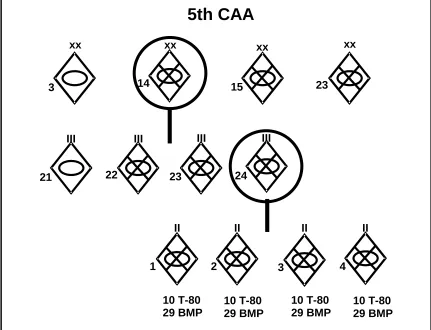
2-21. Expect the S2 to describe those forces the threat will use, or potentially use, in the conduct of his operations. An order of battle (OB) chart, as shown in Figure 2-3, is a good tool. The chart should include the unit designation, if known, the type of unit such as a tank regiment, and the equipment by nomenclature and number within the unit (for example, 104 x T-72's; 33 x BMP-3's), and unit subordination.
2-22. Some threats could use indirect, often subtle methods to attack US Forces. The assumption that the adversary will “fight fair,” consider delivery methods or collateral damage, or comply with the current “laws of warfare” is not necessarily true.
3 14 15 23
xx xx xx xx
5th CAA
21 22 23 24
III III III III
1 2 3 4
II II II II
10 T-80 29 BMP
10 T-80 29 BMP
10 T-80 29 BMP
[image:19.612.114.545.59.389.2]10 T-80 29 BMP
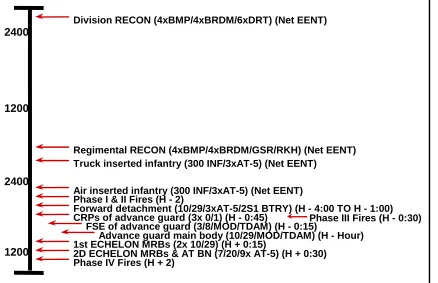
2-24. The threat COA matrix works equally well in stability operations and support operations. The threat COA may include demonstrations causing US casualties, interrupting relocation efforts, or disrupting elections. The rest of the matrix should reflect friendly actions to counter threat actions.
2400
2400
Division RECON (4xBMP/4xBRDM/6xDRT) (Net EENT)
Regimental RECON (4xBMP/4xBRDM/GSR/RKH) (Net EENT) Truck inserted infantry (300 INF/3xAT-5) (Net EENT)
Air inserted infantry (300 INF/3xAT-5) (Net EENT)
1200
1200
Forward detachment (10/29/3xAT-5/2S1 BTRY) (H - 4:00 TO H - 1:00) CRPs of advance guard (3x 0/1) (H - 0:45)
FSE of advance guard (3/8/MOD/TDAM) (H - 0:15)
Advance guard main body (10/29/MOD/TDAM) (H - Hour) 1st ECHELON MRBs (2x 10/29) (H + 0:15)
2D ECHELON MRBs & AT BN (7/20/9x AT-5) (H + 0:30) Phase I & II Fires (H - 2)
Phase III Fires (H - 0:30)
[image:20.612.107.545.118.401.2]Phase IV Fires (H + 2)
Threat COA 1
(Brown Pass) (Debnam Pass)Threat COA 2 Threat COA 3(South Wall) Truck insert and
infiltrate to goat trail to attrit CO/TM
Air insert and infiltrate through Bruno Escarpment to attrit northern CO/TM
Atk to secure Brown Pass to open point of penetration
Prevent forces from repositioning north out of Colorado/Washboard
Atk to secure Brown cut or reinforce FD
Atk to secure Crash Hill to protect the south flank of the regiment
Atk to seize the regiment subsequent objective
Atk to seize the regimental subsequent objective; O/O protect the south flank of the regiment
Protect the south flank of the regiment
Follow and assume main effort TF Destroyer TF Angel FD Special Munitions FSE of AG AGMB 1st Echelon North 1st Echelon South AT Bn 2d Echelon
Truck insert and infiltrate to Debnam Pass to breach and facilitate movement of the regiment main body
Air insert vic Matterhorn and infiltrate to attrit CO/TM
Atk to Brigade Hill to facilitate movement of regiment main body
Prevent forces repositioning out of Colorado/Washboard and protect the north flank of the regiment
Atk to secure Debnam Pass to facilitate movement of the regiment main body
Atk to secure Debnam Pass to facilitate movement of the regiment main body
Atk to secure Crash Hill to protect the north flank of the regiment
Atk to secure firing lines vic Matterhorn to protect the south flank of the regiment
Protect the south flank of the regiment
Follow and assume main effort
Truck insert and infiltrate to secure Hill 899 to facilitate the movement of the AGMB
Air insert vic Matterhorn and infiltrate to prevent repositioning
FD: Atk to fix two CO/TMs of northern TF
Protect the north flank of the regiment
Atk to Brigade Hill to facilitate movement of regiment main body
Atk to Hill 899 to facilitate movement of regiment main body
Atk to secure firing lines to protect the north flank of the regiment
Atk to secure the regimental
subsequent objective
Protect the north flank of the regiment
Follow and assume main effort Threat COA 1
(Brown Pass) (Debnam Pass)Threat COA 2 Threat COA 3(South Wall) Truck insert and
infiltrate to goat trail to attrit CO/TM
Air insert and infiltrate through Bruno Escarpment to attrit northern CO/TM
Atk to secure Brown Pass to open point of penetration
Prevent forces from repositioning north out of Colorado/Washboard
Atk to secure Brown cut or reinforce FD
Atk to secure Crash Hill to protect the south flank of the regiment
Atk to seize the regiment subsequent objective
Atk to seize the regimental subsequent objective; O/O protect the south flank of the regiment
Protect the south flank of the regiment
Follow and assume main effort TF Destroyer TF Angel FD Special Munitions FSE of AG AGMB 1st Echelon North 1st Echelon South AT Bn 2d Echelon
Truck insert and infiltrate to Debnam Pass to breach and facilitate movement of the regiment main body
Air insert vic Matterhorn and infiltrate to attrit CO/TM
Atk to Brigade Hill to facilitate movement of regiment main body
Prevent forces repositioning out of Colorado/Washboard and protect the north flank of the regiment
Atk to secure Debnam Pass to facilitate movement of the regiment main body
Atk to secure Debnam Pass to facilitate movement of the regiment main body
Atk to secure Crash Hill to protect the north flank of the regiment
Atk to secure firing lines vic Matterhorn to protect the south flank of the regiment
Protect the south flank of the regiment
Follow and assume main effort
Truck insert and infiltrate to secure Hill 899 to facilitate the movement of the AGMB
Air insert vic Matterhorn and infiltrate to prevent repositioning
FD: Atk to fix two CO/TMs of northern TF
Protect the north flank of the regiment
Atk to Brigade Hill to facilitate movement of regiment main body
Atk to Hill 899 to facilitate movement of regiment main body
Atk to secure firing lines to protect the north flank of the regiment
Atk to secure the regimental
subsequent objective
Protect the north flank of the regiment
Follow and assume main effort
Figure 2-5. Threat COA matrix
Threat Commander’s Intent
2-25. Expect your S2 to clearly articulate how the threat perceives our operations and the threat commander's intent (from one echelon down to two echelons up). The threat commander's intent should be loosely based off your intent. The threat's perception of us and the threat intent drives how the S2 develops each threat COA (by identifying logical options).
2-26. Your S2 should develop the threat intent and the initial threat COA from macro to micro resolution. Many threats use some form of doctrine to conduct operations (for example, fixing a part of a defensive position, while suppressing, and flanking another part of the same position).
Threat COA Sketches (Macro-Level)
should address all the sketches to better prepare you to deal with a thinking and adaptive threat.
2-28. Although the S2 can develop a full set (five or more) of broad sketches, he
rarely has the time to develop that many detailed threat COAs (for example,
detailed situation templates). Your S2 should provide you with two or three
detailed threat COAs and two or three broad threat COAs. The total package
helps build more flexibility into the plan. At a minimum, the detailed threat COAs
must include the most dangerous and most likely threat COAs. Remember, the
most likely and most dangerous threat COAs can change based on your actions
or COA and how much information the threat collects about you.
Example for Most Probable Threat COA
During mission analysis the S2 decides the threat's most probable COA is to attack into the northern part of the friendly sector. The IPB process drives a friendly COA to defend with a heavily weighted effort in the north. Successful threat reconnaissance reports that the bulk of the engineer effort, especially
obstacle work, is occurring in the north. The threat may have initially planned to attack north but decided against it once
his reconnaissance confirmed your strength. Expect your S2 to consider and articulate this type of possibility when briefing.
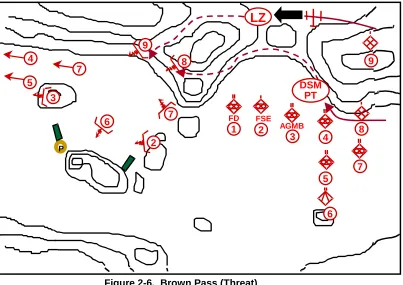
2-29. Figures 2-6 through 2-9 show a method of using a combination of text and graphics to communicate several feasible threat COAs quickly and clearly.
[image:22.612.107.510.396.681.2]
Figure 2-6. Brown Pass (Threat)
P
FSE FD
AGMB
4
LZ
5
7
6
2 7
8 9
3
9
DSM PT
1 2
3 4
5
7 8
FSE FD AGMB 6 LZ DSMT PT P 4 7 5 9 3 2 8 1 9 8 6 1 2 7 5 3 4 FSE FD AGMB 6 LZ DSMT PT P 4 7 5 9 3 2 8 1 9 8 6 1 2 7 5 3 4 FSE FSE FD AGMB 6 6 LZ DSMT PT DSMT PT P P 4 4 7 7 5 5 9 9 3 3 2 2 8 8 1 1 9
9 88
6 6 1
1 22
7 7 5 5 3 3 4 4
Figure 2-7. Debnam Pass (Threat COA 2)
ED DSMT PT LZ P 4 9 1 1 5 6 7 8 3 2 9 2 8 5 FSE AGMB 6 7 3 4 ED DSMT DSMT PT LZ P P 4 4 9 9 1
1 11
5 5 6 6 7 7 8 8 33
2 2 9 9 2 2 8 8 5 5 FSE AGMB 6 6 7 7 3
3 44
P
LZ
P P COA1
COA2
COA3
Air Inserted
Infantry
Special Munitions Truck
Inserted Infantry
Advanced Guard
Main Effort
P P
LZ LZ
P P P P COA1
COA2
COA3 COA1
COA2
COA3
Air Inserted
Infantry
Special Munitions Truck
Inserted Infantry
Advanced Guard
Main Effort Main Effort
LZ LZ LZ
Figure 2-9. The Storyboard
2-31. In a stability operation or support operation, intelligence may reveal that the intent of the threat is to force the US military to leave. Based on this intent, the S2 develops a threat COA for inflicting US casualties. The S2 expects the attack will come from a paramilitary organization and describes the threat COA using a sketch (see Figure 2-10).
Figure 2-10. Threat COA
Tsets
Mangut
Onon
EASTIA
N
Bsets Psets Usets
AOI
AOI Narhan
LEGEND:
--Likely ambushes
--Likely assembly areas
--Infiltration lanes
Andorhaan
Zsets
MSR BLUE
MSR RED
Threat COA Snapshots
2-33. Without an accurate depiction of how and when threat forces will deploy, it is difficult to adequately plan operations (in accordance with your intent). If possible, your S2 should develop threat models before deployment. If your S2 “front loads” this work, he can easily build a detailed situation template.
2-34. It is also important that your XO takes the lead and ensures that the IPB process is really an integrated staff effort. Every staff or functional area representative should fully participate in each step of IPB (this is sometimes referred to as the cross-BOS IPB effort). The bottom line of this participation is “red hat” analysis of their staff or functional equivalent and integrating the results into existing or additional IPB products. For
example, the brigade fire support coordinator (FSCOORD) should help the S2 template threat artillery, identify the threat’s high-payoff targets (HPTs) (friendly assets whose destruction is critical to support the threat mission), and timeline important phases of fire. This type of staff interaction is critical to the quality of the IPB process and products and to meet the short timelines for initial IPB.
2-35. Expect your S2 and staff to provide you with the threat’s method of employment to include dispositions, main effort, scheme of maneuver, and his use of a full range of combat multipliers. An effective way to do this is to create predictive snapshots of the threat at critical places and times. Figures 2-11 through 2-13 illustrate a technique to display the critical events of an MRR attack. Figure 2-14 shows these figures in a consolidated format. ... BP 30 31 FSE SA14 CAS BP 25 2 SA14 FD 1 1. FD moves in Advance Guard formation and seizes Granite Pass. 2. FD pushes FSE NE to secure MRR N flank and destroy BP 31; sets firing lines with main body to hold pass and keep AAs clear for follow-on MRR.
The FD ... BP 30 31 FSE SA14 CAS BP 25 2 ... BP 30 31 FSE SA14 CAS BP 25 2 2 SA14 FD 1 SA14 FD FD 11 1. FD moves in Advance Guard formation and seizes Granite Pass. 2. FD pushes FSE NE to secure MRR N flank and destroy BP 31; sets firing lines with main body to hold pass and keep AAs clear for follow-on MRR.
The FD 1. FD moves in Advance Guard formation and seizes Granite Pass. 2. FD pushes FSE NE to secure MRR N flank and destroy BP 31; sets firing lines with main body to hold pass and keep AAs clear for follow-on MRR.
The FD 1. FD moves in Advance Guard formation and seizes Granite Pass. 2. FD pushes FSE NE to secure MRR N flank and destroy BP 31; sets firing lines with main body to hold pass and keep AAs clear for follow-on MRR.
The FD
...
1ST ECH MRBs ... BP 30 31 FD FSE SA14 SA14 BP 25 1 2 NP NP NP NP 3
1. Phase II fires destroy/suppress weapons systems C2and troops.
NP chemicals on BPs to FIX; on N flank to seal boundary.
2. N 1st echelon MRB occupies SBF PSN with AT Btry to suppress BP 30.
3. S 1st echelon MRB supports and breaches 2 lanes in S flank BP 30; ATGM Btry in support force. 4. Phase III fires continue to suppress and destroy BPs and C2.
Fix/Support and Breach South
1ST ECH MRBs 1ST ECH MRBs 1ST ECH MRBs ... BP 30 31 FD FSE SA14 SA14 BP 25 1 2 NP NP NP NP 3 ... BP 30 31 FD FSE SA14 SA14 BP 25 1 2 NP NP NP NP 3 ... BP 30 31 FD FSE SA14 SA14 BP 25 BP 25 1 1 2 2 NP NP NP NP NP NP NP NP 3 3
1. Phase II fires destroy/suppress weapons systems C2and troops.
NP chemicals on BPs to FIX; on N flank to seal boundary.
2. N 1st echelon MRB occupies SBF PSN with AT Btry to suppress BP 30.
3. S 1st echelon MRB supports and breaches 2 lanes in S flank BP 30; ATGM Btry in support force. 4. Phase III fires continue to suppress and destroy BPs and C2.
Fix/Support and Breach South
1. Phase II fires destroy/suppress weapons systems C2and troops.
NP chemicals on BPs to FIX; on N flank to seal boundary.
2. N 1st echelon MRB occupies SBF PSN with AT Btry to suppress BP 30.
3. S 1st echelon MRB supports and breaches 2 lanes in S flank BP 30; ATGM Btry in support force. 4. Phase III fires continue to suppress and destroy BPs and C2.
Fix/Support and Breach South
1. Phase II fires destroy/suppress weapons systems C2and troops.
NP chemicals on BPs to FIX; on N flank to seal boundary.
2. N 1st echelon MRB occupies SBF PSN with AT Btry to suppress BP 30.
3. S 1st echelon MRB supports and breaches 2 lanes in S flank BP 30; ATGM Btry in support force. 4. Phase III fires continue to suppress and destroy BPs and C2.
Fix/Support and Breach South
EEEEE
Figure 2-12. Snapshot Sketch #2
2nd ECH MRBs ... BP 30 31 SA14 BP 25 BP 30 FD FSE SA14 1 3 2
Assault & Penetrate
1. Phase IV fires support 2d echelon battalion’s advance by attacking newly acquired targets, those not destroyed in previous phases, and CATK forces.
2. Lead 2d echelon bn occupies SBF position with ATGM Btry.
3. Follow-on 2d echelon bn assaults and penetrates BP 30.
2nd ECH MRBs ... BP 30 31 SA14 BP 25 BP 30 FD FSE SA14 1 3 2 2nd ECH MRBs ... BP 30 31 SA14 BP 25 BP 25 BP 30 FD FSE SA14 1 3 2 BP 30 FD FSE SA14 11 33 22
Assault & Penetrate
1. Phase IV fires support 2d echelon battalion’s advance by attacking newly acquired targets, those not destroyed in previous phases, and CATK forces.
2. Lead 2d echelon bn occupies SBF position with ATGM Btry.
3. Follow-on 2d echelon bn assaults and penetrates BP 30.
Assault & Penetrate
1. Phase IV fires support 2d echelon battalion’s advance by attacking newly acquired targets, those not destroyed in previous phases, and CATK forces.
2. Lead 2d echelon bn occupies SBF position with ATGM Btry.
3. Follow-on 2d echelon bn assaults and penetrates BP 30.
Assault & Penetrate
1. Phase IV fires support 2d echelon battalion’s advance by attacking newly acquired targets, those not destroyed in previous phases, and CATK forces.
2. Lead 2d echelon bn occupies SBF position with ATGM Btry.
3. Follow-on 2d echelon bn assaults and penetrates BP 30.
LD + 1 ENY ENY ENY ENY ENY
ENY BLUFOR lead TF identified; enemy fires PCHEM on axis to disrupt and attrit. III R AT LD ENY ENY ENY ENY ENY
Enemy RECON reports movement of BLUFOR toward defensive positions; vehicles leave hide positions and move to prepared positions. ENY
R
Enemy reserve commits north; repositions to create new reserve; weakness created in south.
BLUFOR lead TF hits FASCAM; unable to breach; prepares to pass trail TF.
LD + 3
ENY ENY ENY ENY ENY ENY II II R R
LD + 2
ENY ENY
II
II
BLUFOR lead TF in PCHEM; takes casualties; marks bypass.
Enemy fires
FASCAM on axis of lead TF; identifies trail TF; believes main effort will be in north; re-orients combat power in center issues WARNO to south. R ENY ENY ENY ENY
LD + 1
ENY
ENY ENY
ENY ENY
ENY BLUFOR lead TF identified; enemy fires PCHEM on axis to disrupt and attrit.
III
R
LD + 1
ENY ENY ENY ENY ENY ENY ENY
ENY BLUFOR lead TF identified; enemy fires PCHEM on axis to disrupt and attrit. III III III R R AT LD ENY ENY ENY ENY ENY
Enemy RECON reports movement of BLUFOR toward defensive positions; vehicles leave hide positions and move to prepared positions. ENY R AT LD ENY ENY ENY ENY ENY ENY ENY ENY
Enemy RECON reports movement of BLUFOR toward defensive positions; vehicles leave hide positions and move to prepared positions. ENY R ENY ENY R R
Enemy reserve commits north; repositions to create new reserve; weakness created in south.
BLUFOR lead TF hits FASCAM; unable to breach; prepares to pass trail TF.
LD + 3
ENY ENY ENY ENY ENY ENY II II R R
Enemy reserve commits north; repositions to create new reserve; weakness created in south.
BLUFOR lead TF hits FASCAM; unable to breach; prepares to pass trail TF.
LD + 3
ENY ENY ENY ENY ENY ENY II II II II R R R R
LD + 2
ENY ENY
II
II
BLUFOR lead TF in PCHEM; takes casualties; marks bypass.
Enemy fires
FASCAM on axis of lead TF; identifies trail TF; believes main effort will be in north; re-orients combat power in center issues WARNO to south. R ENY ENY ENY ENY
LD + 2
ENY ENY ENY ENY II II II II
BLUFOR lead TF in PCHEM; takes casualties; marks bypass.
Enemy fires
FASCAM on axis of lead TF; identifies trail TF; believes main effort will be in north; re-orients combat power in center issues WARNO to south. R R ENY ENY ENY ENY ENY ENY ENY ENY
Figure 2-14. Threat COA sketch
FRIENDLY VULNERABILITES
2-36. Your S2 is responsible to provide a detailed description of how the threat can exploit any friendly vulnerabilities. There are three questions that your S2 uses to predict how the threat will try to exploit friendly vulnerabilities.
• Where are we vulnerable? The S2 must determine where (for example, critical systems or world opinion) the threat believes we are vulnerable and also looks at where you and your staff assess you are vulnerable.
• What will they attack? The S2 then looks at the friendly plan and threat
capabilities and COAs to determine what the threat commander will most likely attack. This analysis supports the determination of essential elements of friendly information (EEFI) and friendly operations security (OPSEC) measures.
Additionally, at higher echelons this helps drive CI analysis.
Chapter 3
S2/G2 Organizations and Functions
THE BATTALION S2
3-1. Your battalion S2 section is austere. Even when fully staffed, your S2 section is not resourced to conduct sustained operations at both the tactical operations center (TOC) and tactical command post (TAC). Battalion S2 operations usually provide few detailed products because of the lack of time and resources.
OPERATIONS
3-2. Every member of the S2 section should be able to perform any of the intelligence functions. Your S2's priorities are to
• Perform mature IPB (for more information, see Chapter 2).
• Plan, task (through your S3), and control ISR operations as part of an integrated effort by your staff. You must protect your scant resources and focus on your PIR.
3-3. The S2 must carefully drive planning that leads to the scout platoon mission. The fragmentary order (FRAGO) that the scout platoon uses to begin its mission must include precise guidance on the infiltration method, collection tasks, reporting criteria and
timelines, fire support, casualty evacuation plan, and many other aspects of the mission. The S2 should also debrief scouts and patrols, when time permits, to obtain all relevant information. The S2 should also
• Task frontline troops and combat patrols for collection.
• Perform a very basic level of situation development to advise you on threat actions, capabilities, and vulnerabilities.
3-4. Reports from scout platoons and every company or company team vary in accuracy. The S2 must conduct analysis to integrate all the information from many means (for example, the scouts, fire support net, and command net) to provide you timely, relevant, accurate, and predictive intelligence as you execute the operation.
STAFF INTERACTION
PRODUCTS
3-6. Your S2 does not have the time nor the resources to develop many detailed IPB products. Once you and your S2 accept the brigade IPB results, the S2 section starts to develop those products to the level of detail needed to support battalion operations.
3-7. Your S2 should always produce (and modify when necessary) the following:
• A set of detailed situation templates or other threat model for at least two threat COAs (most dangerous and most likely).
• An event template.
• An integrated ISR plan to answer your PIR in a timely manner.
• The intelligence portion of the decision support template (DST).
MI SUPPORT AND ATTACHMENTS
3-8. Except for ground surveillance radar (GSR) and the Remotely Monitored Battlefield Sensor System (REMBASS), you will probably not have MI assets attached to your unit. Ensure your staff fully integrates any MI assets you receive into the ISR plan. However, you can expect additional MI support and assets operating in your AO during stability operations and support operations (particularly tactical HUMINT teams
).
THE BRIGADE S2
3-9. The S2 section is much larger at the brigade level than at the battalion. However, light brigades will have fewer personnel than heavy brigades.
OPERATIONS
3-10. IPB is a more systematic process at brigade level than at battalion level. A significant amount of training is necessary at the brigade level to bring the section together as a team. Your S2 will have to conduct a more thorough and comprehensive IPB and situation development (this includes accepting risks with the predictive nature of IPB). These tasks require a confident, experienced tactical MI officer who understands friendly operations and the threat.
3-11. If you do not have organic scout assets (like the brigade reconnaissance troop), you will have to either use subordinate unit soldiers and equipment to perform that function or rely on subordinate battalions and the division to provide you information and intelligence. When scouts are organic to the brigade, the brigade S2 should drive the planning just like the battalion S2.
STAFF INTERACTION
effective briefings. Through the XO, train your S2 on the products you expect him to produce and your standards. You and your XO must also train your staff on intelligence capabilities, limitations, and operations.
3-13. As a rule, the S2 sends an assistant S2 with an analyst to the brigade TAC to perform limited analysis and advise the commander and any staff (when they are present). For detailed analysis the TAC must depend on the TOC.
PRODUCTS
3-14. Your brigade S2 develops more products (representing a larger area and some with more detail) than the battalion S2. When your brigade S2 completes his products and forwards them to the battalion S2, he should expect to explain the results, answer questions on his analysis and products, and change any products as appropriate. Your S2 should always produce (and modify when necessary) the following:
• Basic products to describe the battlefield’s effects to include weather and terrain. In stability operations and support operations, the S2 must produce more complex products that graphically depict key characteristics of the local population.
• A set of detailed situation templates or other threat models for at least three threat COAs (to include the most dangerous and most likely).
• An event template, the intelligence estimate, and an integrated ISR plan (with a supporting ISR matrix) to answer your PIR in a timely manner.
• The intelligence portions of the DST and operating system synchronization matrix (for example, PIR, named areas of interest [NAIs], and R&S collection).
• A separate ISR synchronization matrix that ties the integrated ISR plan with the operating system matrix.
• Appendix B, Intelligence to the OPORD (a good matrix appendix is acceptable).
TYPICAL MI SUPPORT TO A BRIGADE
3-15. Your brigade is normally supported by a direct support (DS) MI company with a habitual relationship to your brigade (see Chapter 4). The DS MI Company provides several significant capabilities:
• A commander to help the S2 plan.
• C2 for all MI assets (to include any other assets or units attached or supporting the brigade). The MI company command post serves as the control mechanism for all MI assets. Any additional control teams that support the brigade (for example, a tactical HUMINT control team during some types of operations) collocate and operate with the analysis and control team (ACT).
• Analytical support to the S2 and processing and fusion systems.
• Organic intelligence collection systems.
THE DIVISION AND CORPS G2
a Deputy G2, Operations, Plans, Training, special security officer (SSO), CI, terrain team, and the ACE, and is supported by the staff weather officer (SWO).
OPERATIONS
3-17. The G2 operations officer directs and coordinates intelligence, the division SSO, the staff weather team, and the terrain team based on G2 guidance. He is responsible for proper integration and dissemination of all intelligence and combat information that the ACE and subordinate S2s report. He combines that intelligence and combat information and presents the current intelligence (the threat portion of the common operational picture) to the commander and staff. This helps the division commander visualize his battlespace, by graphically and effectively depicting the environment, and depict current threat actions and predicted threat capabilities, intentions, and COAs.
ANALYSIS AND CONTROL ELEMENT (OPCON)
3-18. The ACE is the focal point for all division ISR operations (to include planning, processing, producing, and dissemination). It consists of a single-source analysis section, an all-source analysis section, a collection management team, and a targeting team. The ACE is under operational control (OPCON) to the G2 (from the MI battalion). ACE personnel perform all of the tactical intelligence tasks (see Chapter 1) in support of division operations. The ACE fuses information from all ISR assets and units into intelligence products and the all-source correlated database. The ACE also provides an accurate, relevant picture of the battlefield to the G2 operations section. The G2, terrain team, SWO, and ACE work together to develop, present, and distribute IPB products across the division.
PLANS
3-19. The G2 plans is responsible for all products required for mission analysis and wargaming. (He is supported by the all-source production section of the ACE.) The G2 plans drives the MDMP because he understands and describes the environment and the threat. During mission analysis, the planner also relies on the electronic warfare officer (EWO), SWO, and terrain team for products and integrates the products into the
wargame and targeting sessions.
TRAINING
3-20. The G2 training office can help you train your S2 and his section. The training officer prepares and consolidates the intelligence requirements for field training exercises, command post exercises, joint training support, and other training events. Along with the G3, this office develops the training requirements and standards for the division intelligence system and interfaces with intelligence simulation systems. The training office also manages the division’s readiness training and other valuable intelligence training programs.
STAFF WEATHER OFFICER (SPECIAL STAFF UNDER THE G2)
3-21. The Air Force provides an SWO and a supporting combat weather team (CWT) to major subordinate commands, corps, divisions, and separate brigades to work under the supervision of the G2. The CWT can provide tailored tactical decision aids and overlays depicting the effects of weather on systems, personnel, and equipment.
TERRAIN TEAM (NO COMMAND OR SUPPORT RELATIONSHIP)
the G2 by providing terrain analysis and analysis products to describe the battlefield’s effects. The terrain team can provide unique products for use by the intelligence analysts in determining AAs, axis of advance, and mobility corridors. (NOTE: the G4, and not the terrain team, is responsible for supplying Army units with maps.)
ELECTRONIC WARFARE OFFICER (NO COMMAND OR SUPPORT
RELATIONSHIP)
3-23. Although the EWO works directly for the G3 and is integral to integrating EW into the targeting process, he is an intelligence officer and works closely with the ACE and G2 plans officer. He is also involved in coordinating frequency management and
deconfliction with the division signal officer prior to planning and executing EA missions.
OPERATIONS
3-24. The division and corps G2s work together to build a complementary intelligence architecture within the corps. Each echelon has unique collection capabilities and requirements, but both G2s (and their ACEs) rely on a distributed and collaborative environment that allows users to share both information and intelligence down to the battalion level (through your S2).
3-25. Depending on the intelligence architecture and who is designated the joint task force (JTF) and/or the Army force (ARFOR), the division G2 coordinates with the corps or ARFOR G2 to
• Maintain the integrity of most intelligence databases.
• Provide detailed, thorough, and “long-term” analysis.
Chapter 4
Military Intelligence Capabilities
No single echelon has sufficient organic intelligence capabilities to satisfy all of your requirements. In order to efficiently use the intelligence operating system, you must understand the following:
• Intelligence disciplines.
• Intelligence functions.
Combat information and intelligence.
Electronic warfare.
• MI organizations.
• Limitations of intelligence.
To clearly describe the intelligence operating system, intelligence is divided into five disciplines and two multidiscipline functions (CI and Technical intelligence [TECHINT]).
• HUMINT.
• Imagery intelligence (IMINT).
• Measurement and signature intelligence (MASINT).
• Signals intelligence (SIGINT).
• All-source intelligence.
INTELLIGENCE DISCIPLINES
4-1. The first five disciplines are directed toward the collection, processing, and analysis of information from a specific category of sources. The two multidiscipline functions are directed toward the integration of the information collected through the first five
disciplines and the production of a category or categories of intelligence. Intelligence production includes the intelligence categories of I&W, current, general military, target, and scientific and technical intelligence (S&TI). CI produces the intelligence category of CI.
4-2. Single-discipline collection or analysis rarely produces a comprehensive picture of the threat and is subject to deception. However, all-source intelligence that is produced from an adequate amount and mix of information (from the different disciplines) will meet your requirements. Each discipline must complement and cross-cue each other for maximum effectiveness. All disciplines use a combination of open and closed sources in the process of their collection and/or production.
HUMAN INTELLIGENCE (HUMINT)
includes those personnel and organizations directed toward the collection, processing, analysis, and production of HUMINT.
• A HUMINT source isa person from whom information can be obtained. The source may either possess first- or second-hand knowledge normally obtained through sight or hearing. HUMINT sources include literally every human being (non-US citizens). Potential HUMINT sources include threat, neutral, and friendl