Ensemble-based Semantic Lexicon Induction for Semantic Tagging
Ashequl Qadir University of Utah School of Computing Salt Lake City, UT 84112, USA
Ellen Riloff University of Utah School of Computing Salt Lake City, UT 84112, USA
Abstract
We present an ensemble-based framework for semantic lexicon induction that incorpo-rates three diverse approaches for semantic class identification. Our architecture brings together previous bootstrapping methods for pattern-based semantic lexicon induction and contextual semantic tagging, and incorpo-rates a novel approach for inducing semantic classes from coreference chains. The three methods are embedded in a bootstrapping ar-chitecture where they produce independent hypotheses, consensus words are added to the lexicon, and the process repeats. Our results show that the ensemble outperforms individ-ual methods in terms of both lexicon qindivid-uality and instance-based semantic tagging.
1 Introduction
One of the most fundamental aspects of meaning is the association between words and semantic cate-gories, which allows us to understand that a “cow” is ananimal and a “house” is a structure. We will use the termsemantic lexiconto refer to a dictionary that associates words with semantic classes. Se-mantic dictionaries are useful for many NLP tasks, as evidenced by the widespread use of WordNet (Miller, 1990). However, off-the-shelf resources are not always sufficient for specialized domains, such as medicine, chemistry, or microelectronics. Fur-thermore, in virtually every domain, texts contain lexical variations that are often missing from dic-tionaries, such as acronyms, abbreviations, spelling variants, informal shorthand terms (e.g., “abx” for
“antibiotics”), and composite terms (e.g., “may-december” or “virus/worm”). To address this prob-lem, techniques have been developed to automate the construction of semantic lexicons from text cor-pora using bootstrapping methods (Riloff and Shep-herd, 1997; Roark and Charniak, 1998; Phillips and Riloff, 2002; Thelen and Riloff, 2002; Ng, 2007; McIntosh and Curran, 2009; McIntosh, 2010), but accuracy is still far from perfect.
Our research explores the use ofensemble meth-ods to improve the accuracy of semantic lexicon in-duction. Our observation is that semantic class as-sociations can be learned using several fundamen-tally different types of corpus analysis. Bootstrap-ping methods for semantic lexicon induction (e.g., (Riloff and Jones, 1999; Thelen and Riloff, 2002; McIntosh and Curran, 2009)) collect corpus-wide statistics for individual words based on shared con-textual patterns. In contrast, classifiers for semantic tagging (e.g., (Collins and Singer, 1999; Niu et al., 2003; Huang and Riloff, 2010)) labelword instances
and focus on the local context surrounding each in-stance. The difference between these approaches is that semantic taggers make decisions based on a sin-gle context and can assign different labels to differ-ent instances, whereas lexicon induction algorithms compile corpus statistics from multiple instances of a word and typically assign each word to a single semantic category.1 We also hypothesize that coref-erence resolution can be exploited to infer semantic
1This approach would be untenable for broad-coverage
se-mantic knowledge acquisition, but within a specialized domain most words have a dominant word sense. Our experimental re-sults support this assumption.
class labels. Intuitively, if we know that two noun phrases are coreferent, then they probably belong to the same high-level semantic category (e.g., “dog” and “terrier” are bothanimals).
In this paper, we present an ensemble-based framework for semantic lexicon induction. We in-corporate a pattern-based bootstrapping method for lexicon induction, a contextual semantic tagger, and a new coreference-based method for lexicon induc-tion. Our results show that coalescing the decisions produced by diverse methods produces a better dic-tionary than any individual method alone.
A second contribution of this paper is an analysis of the effectiveness of dictionaries for semantic tag-ging. In principle, an NLP system should be able to assign different semantic labels to different senses of a word. But within a specialized domain, most words have a dominant sense and we argue that us-ing domain-specific dictionaries for taggus-ing may be equally, if not more, effective. We analyze the trade-offs between using an instance-based semantic tag-ger versus dictionary lookup on a collection of dis-ease outbreak articles. Our results show that the in-duced dictionaries yield better performance than an instance-based semantic tagger, achieving higher ac-curacy with comparable levels of recall.
2 Related Work
Several techniques have been developed for seman-tic class induction(also calledset expansion) using bootstrapping methods that consider co-occurrence statistics based on nouns (Riloff and Shepherd, 1997), syntactic structures (Roark and Charniak, 1998; Phillips and Riloff, 2002), and contextual pat-terns (Riloff and Jones, 1999; Thelen and Riloff, 2002; McIntosh and Curran, 2008; McIntosh and Curran, 2009). To improve the accuracy of in-duced lexicons, some research has incorporated neg-ative information from human judgements (Vyas and Pantel, 2009), automatically discovered neg-ative classes (McIntosh, 2010), and distributional similarity metrics to recognize concept drift (McIn-tosh and Curran, 2009). Phillips and Riloff (2002) used co-training (Blum and Mitchell, 1998) to ex-ploit three simple classifiers that each recognized a different type of syntactic structure. The research most closely related to ours is an ensemble-based
method for automatic thesaurus construction (Cur-ran, 2002). However, that goal was to acquire fine-grained semantic information that is more akin to synonymy (e.g., words similar to “house”), whereas we associate words with high-level semantic classes (e.g., a “house” is atransient structure).
Semantic class tagging is closely related tonamed entity recognition (NER) (e.g., (Bikel et al., 1997; Collins and Singer, 1999; Cucerzan and Yarowsky, 1999; Fleischman and Hovy, 2002)). Some boot-strapping methods have been used for NER (e.g., (Collins and Singer, 1999; Niu et al., 2003) to learn from unannotated texts. However, most NER systems will not label nominal noun phrases (e.g., they will not identify “the dentist” as a person) or recognize semantic classes that are not associ-ated with proper named entities (e.g., symptoms).2 ACE mention detection systems (e.g., (ACE, 2007; ACE, 2008)) can label noun phrases that are asso-ciated with 5-7 semantic classes and are typically trained with supervised learning. Recently, (Huang and Riloff, 2010) developed a bootstrapping tech-nique that induces a semantic tagger from unanno-tated texts. We use their system in our ensemble.
There has also been work on extracting semantic class members from the Web (e.g., (Pas¸ca, 2004; Et-zioni et al., 2005; Kozareva et al., 2008; Carlson et al., 2009)). This line of research is fundamentally different from ours because these techniques benefit from the vast repository of information available on the Web and are therefore designed to harvest a wide swath of general-purpose semantic information. Our research is aimed at acquiring domain-specific se-mantic dictionaries using a collection of documents representing a specialized domain.
3 Ensemble-based Semantic Lexicon Induction
3.1 Motivation
Our research combines three fundamentally differ-ent techniques into an ensemble-based bootstrap-ping framework for semantic lexicon induction: pattern-based dictionary induction, contextual se-mantic tagging, and coreference resolution. Our motivation for using an ensemble of different
tech-2Some NER systems will handle special constructions such
niques is driven by the observation that these meth-ods exploit different types of information to infer se-mantic class knowledge. The coreference resolver uses features associated with coreference, such as syntactic constructions (e.g., appositives, predicate nominals), word overlap, semantic similarity, prox-imity, etc. The pattern-based lexicon induction al-gorithm uses corpus-wide statistics gathered from the contexts of all instances of a word and compares them with the contexts of known category members. The contextual semantic tagger uses local context windows around words and classifies each word in-stance independently from the others.
Since each technique draws its conclusions from different types of information, they represent inde-pendent sources of evidence to confirm whether a word belongs to a semantic class. Our hypothe-sis is that, combining these different sources of ev-idence in an ensemble-based learning framework should produce better accuracy than using any one method alone. Based on this intuition, we create an ensemble-based bootstrapping framework that it-eratively collects the hypotheses produced by each individual learner and selects the words that were hypothesized by at least 2 of the 3 learners. This approach produces a bootstrapping process with improved precision, both at the critical beginning stages of the bootstrapping process and during sub-sequent bootstrapping iterations.
3.2 Component Systems in the Ensemble
In the following sections, we describe each of the component systems used in our ensemble.
3.2.1 Pattern-based Lexicon Induction
The first component of our ensemble is Basilisk (Thelen and Riloff, 2002), which identifies nouns belonging to a semantic class based on collec-tive information over lexico-syntactic pattern con-texts. The patterns are automatically generated us-ing AutoSlog-TS (Riloff, 1996). Basilisk begins with a small set of seed words for each seman-tic class and a collection of unannotated documents for the domain. In an iterative bootstrapping pro-cess, Basilisk identifies candidate nouns, ranks them based on its scoring criteria, selects the 5 most confi-dent words for inclusion in the lexicon, and this pro-cess repeats using the new words as additional seeds
in subsequent iterations.
3.2.2 Lexicon Induction with a Contextual Semantic Tagger
The second component in our ensemble is a con-textual semantic tagger (Huang and Riloff, 2010). Like Basilisk, the semantic tagger also begins with seed nouns, trains itself on a large collection of unannotated documents using bootstrapping, and it-eratively labels new instances. This tagger labels noun instances and does not produce a dictionary.
To adapt it for our purposes, we ran the bootstrap-ping process over the training texts to induce a se-mantic classifier. We then applied the classifier to the same set of training documents and compiled a lexicon by collecting the set of nouns that were as-signed to each semantic class. We ignored words that were assigned different labels in different con-texts to avoid conflicts in the lexicons. We used the identical configuration described by (Huang and Riloff, 2010) that applies a 1.0 confidence threshold for semantic class assignment.
3.2.3 Coreference-Based Lexicon Construction
The third component of our ensemble is a new method for semantic lexicon induction that exploits coreference resolution. Members of a coreference chain represent the same entity, so all references to the entity should belong to the same semantic class. For example, suppose“Paris”and“the city”are in the same coreference chain. If we know thatcityis aFixed Location, then we can infer thatParisis also aFixed Location.
We induced lexicons from coreference chains us-ing a similar bootstrappus-ing framework that begins with seed nouns and unannotated texts. LetS de-note a set of semantic classes andW denote a set of unknown words. For anys ∈ S andw ∈ W, let
Ns,wdenote the number of instances ofsin the cur-rent lexicon3 that are coreferent with w in the text corpus. Then we estimate the probability that word
wbelongs to semantic classsas:
P(s|w) = Ns,w P
s0∈SNs0,w
We hypothesize the semantic class of w,
SemClass(w)by:
SemClass(w) = arg maxsP(s|w)
3
To ensure high precision for the induced lexicons, we use a threshold of 0.5. All words with a prob-ability above this thresold are added to the lexicon, and the bootstrapping process repeats. Although the coreference chains remain the same throughout the process, the lexicon grows so more words in the chains have semantic class labels as bootstrapping progresses. Bootstrapping ends when fewer than 5 words are learned for each of the semantic classes.
Many noun phrases are singletons (i.e., they are not coreferent with any other NPs), which limits the set of words that can be learned using coreference chains. Furthermore, coreference resolvers make mistakes, so the accuracy of the induced lexicons depends on the quality of the chains. For our experi-ments, we used Reconcile (Stoyanov et al., 2010), a freely available supervised coreference resolver.
[image:4.612.98.264.520.647.2]3.3 Ensemble-based Bootstrapping Framework
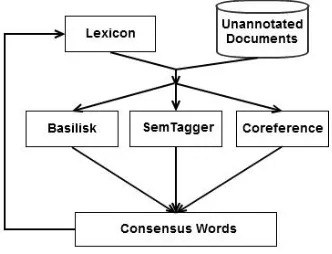
Figure 1 shows the architecture of our ensemble-based bootstrapping framework. Initially, each lexi-con only lexi-contains the seed nouns. Each component hypothesizes a set of candidate words for each se-mantic class, based on its own criteria. The word lists produced by the three systems are then com-pared, and we retain only the words that were hy-pothesized with the same class label by at least two of the three systems. The remaining words are dis-carded. The consenus words are added to the lexi-con, and the bootstrapping process repeats. As soon as fewer than 5 words are learned for each of the semantic classes, bootstrapping stops.
Figure 1: Ensemble-based bootstrapping framework
We ran each individual system with the same seed
words. Since bootstrapping typically yields the best precision during the earliest stages, we used the se-mantic tagger’s trained model immediately after its first bootstrapping iteration. Basilisk generates 5 words per cycle, so we report results for lexicons generated after 20 bootstrapping cycles (100 words) and after 80 bootstrapping cycles (400 words).
3.4 Co-Training Framework
The three components in our ensemble use different types of features (views) to identify semantic class members, so we also experimented with co-training. Our co-training model uses an identical framework, but the hypotheses produced by the different meth-ods are all added to the lexicon, so each method can benefit from the hypotheses produced by the others. To be conservative, each time we added only the 10 most confident words hypothesized by each method. In contrast, the ensemble approach only adds words to the lexicon if they are hypothesized by two different methods. As we will see in Section 4.4, the ensemble performs much better than co-training. The reason is that the individual methods do not con-sistently achieve high precision on their own. Con-sequently, many mistakes are added to the lexicon, which is used as training data for subsequent boot-strapping. The benefit of the ensemble is that con-sensus is required across two methods, which serves as a form of cross-checking to boost precision and maintain a high-quality lexicon.
4 Evaluation
4.1 Semantic Class Definitions
We evaluated our approach on nine semantic cate-gories associated with disease outbreaks. The se-mantic classes are defined below.
Animal: Mammals, birds, fish, insects and other animal groups. (e.g.,cow, crow, mosquito, herd)
4http://www.nlm.nih.gov/research/umls/ 5http://www.maxmind.com/app/worldcities 6
http://www.listofcountriesoftheworld. com/
7
http://names.mongabay.com/most_common_ surnames.htm
8http://www.sec.gov/rules/other/
4-460list.htm
9http://www.utexas.edu/world/univ/state/ 10http://www.uta.fi/FAST/GC/usabacro.
Semantic External Word List Sources Class
Animal WordNet: [animal], [mammal family], [animal group]
Body Part WordNet: [body part], [body substance], [body covering], [body waste]
DisSym WordNet: [symptom], [physical condition], [infectious agent];Wikipedia: common and infectious diseases, symptoms, disease acronyms;UMLS Thesaurus4: diseases, abnormalities, microorganisms (Archaea, Bacteria, Fungus, Virus)
Fixed Loc. WordNet: [geographic area], [land], [district, territory], [region];Wiki:US-states;Other:cities5, countries6 Human WordNet: [person], [people], [personnel];Wikipedia: people names, office holder titles, nationalities,
occupations, medical personnels & acronyms, players;Other: common people names & surnames7 Org WordNet: [organization], [assembly];Wikipedia: acronyms in healthcare, medical organization acronyms,
news agencies, pharmaceutical companies;Other: companies8, US-universities9, organizations10 Plant & Food WordNet: [food], [plant, flora], [plant part]
Temp. Ref. WordNet: [time], [time interval], [time unit],[time period]
TimeBank: TimeBank1.2 (Pustejovsky et al., 2003) TIMEX3 expressions
[image:5.612.75.537.56.238.2]Trans. Struct. WordNet: [structure, construction], [road, route], [facility, installation], [work place]
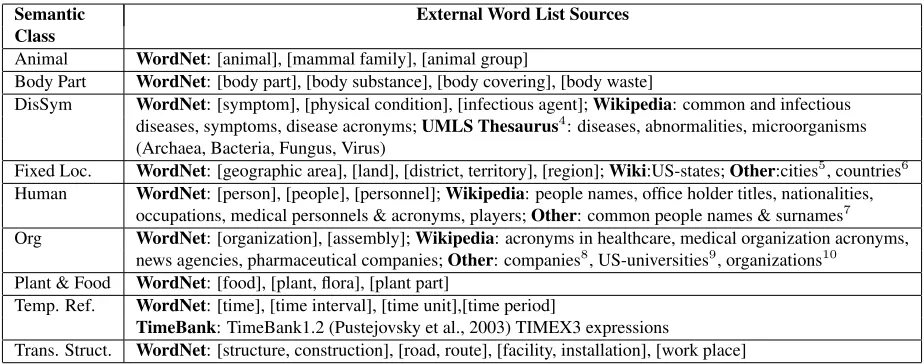
Table 1: External Word List Sources
Body Part: A part of a human or animal body, in-cluding organs, bodily fluids, and microscopic parts. (e.g.,hand, heart, blood, DNA)
Diseases and Symptoms (DisSym): Diseases and symptoms. We also include fungi and disease carriers because, in this domain, they almost always refer to the disease that they carry. (e.g. FMD, An-thrax, fever, virus)
Fixed Location(Fixed Loc.): Named locations, including countries, cities, states, etc. We also in-clude directions and well-defined geographic areas or geo-political entities. (e.g.,Brazil, north, valley)
Human: All references to people, including names, titles, professions, and groups. (e.g., John, farmer, traders)
Organization(Org.): An entity that represents a group of people acting as a single recognized body, including named organizations, departments, gov-ernments, and their acronyms. (e.g., department, WHO, commission, council)
Temporal Reference (Temp. Ref.): Any refer-ence to a time or duration, including months, days, seasons, etc. (e.g.,night, May, summer, week)
Plants & Food11: plants, plant parts, or any type of food. (e.g.,seed, mango, beef, milk)
Transient Structures(Trans. Struct.): Transient physical structures. (e.g.,hospital, building, home)
Additionally, we defined a Miscellaneous class for words that do not belong to any of the other
cat-11We merged plants and food into a single category as it is
difficult to separate them because many food items are plants.
egories. (e.g.,output, information, media, point).
4.2 Data Set
We ran our experiments on ProMED-mail12articles. ProMED-mail is an internet based reporting system for infectious disease outbreaks, which can involve people, animals, and plants grown for food. Our ProMED corpus contains 5004 documents. We used 4959 documents as (unannotated) training data for bootstrapping. For the remaining 45 documents, we used 22 documents to train the coreference re-solver (Reconcile) and 23 documents as our test set. The coreference training set contains MUC-7 style (Hirschman, 1997) coreference annotations13. Once trained, Reconcile was applied to the 4959 unanno-tated documents to produce coreference chains.
4.3 Gold Standard Semantic Class Annotations
To obtain gold standard annotations for the test set, two annotators assigned one of the 9 semantic class labels, or Miscellaneous, to each head noun based on its surrounding context. A noun with multiple senses could get assigned different semantic class labels in different contexts. The annotators first annotated 13 of the 23 documents, and discussed the cases where they disagreed. Then they independelty annotated
12http://www.promedmail.org/
13We omit the details of the coreference annotations since
the remaining 10 documents and measured inter-annotator agreement with Cohen’s Kappa (κ) (Car-letta, 1996). Theκscore for these 10 documents was 0.91, indicating a high level of agreement. The an-notators then adjudicated their disagreements on all 23 documents to create the gold standard.
4.4 Dictionary Evaluation
To assess the quality of the lexicons, we estimated their accuracy by compiling external word lists from freely available sources such as Wikipedia14 and WordNet (Miller, 1990). Table 1 shows the sources that we used, where the bracketed items re-fer to WordNet hypernym categories. We searched each WordNet hypernym tree (also, instance-relationship) for all senses of the word. Addition-ally, we collected the manually labeled words in our test set and included them in our gold standard lists. Since the induced lexicons contain individual nouns, we extracted only the head nouns of multi-word phrases in the external resources. This can produce incorrect entries for non-compositional phrases, but we found this issue to be relatively rare and we manually removed obviously wrong entries. We adopted a conservative strategy and assumed that any lexicon entries not present in our gold standard lists are incorrect. But we observed many correct en-tries that were missing from the external resources, so our results should be interpreted as a lower bound on the true accuracy of the induced lexicons.
We generated lexicons for each method sepa-rately, and also for the ensemble and co-training models. We ran Basilisk for 100 iterations (500 words). We refer to a Basilisk lexicon of size N
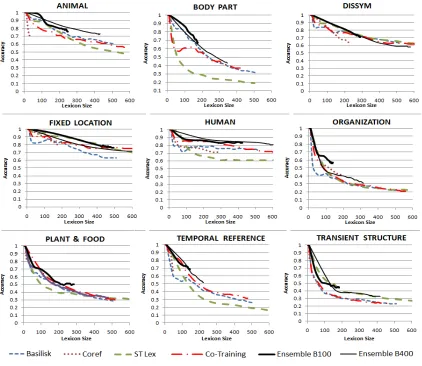
using the notationB[N]. For example,B400refers to a lexicon containing 400 words, which was gen-erated from 80 bootstrapping cycles. We refer to the lexicon obtained from the semantic tagger asST Lex. Figure 2 shows the dictionary evaluation results. We plotted Basilisk’s accuracy after every 5 boot-strapping cycles (25 words). ForST Lex, we sorted the words by their confidence scores and plotted the accuracy of the top-ranked words in increments of 50. The plots forCoref,Co-Training, andEnsemble B[N]are based on the lexicons produced after each bootstrapping cycle.
14www.wikipedia.org/
The ensemble-based framework yields consis-tently better accuracy than the individual methods forAnimal,Body Part,HumanandTemporal Refer-ence, and similar if not better forDisease & Symp-tom, Fixed Location, Organization, Plant & Food. However, relying on consensus from multiple mod-els produce smaller dictionaries. Big dictionaries are not always better than small dictionaries in practice, though. We believe, it matters more whether a dic-tionary contains the most frequent words for a do-main, because they account for a disproportionate number of instances. Basilisk, for example, often learns infrequent words, so its dictionaries may have high accuracy but often fail to recognize common words. We investigate this issue in the next section.
4.5 Instance-based Tagging Evaluation
We also evaluated the effectiveness of the induced lexicons with respect to instance-based semantic tagging. Our goal was to determine how useful the dictionaries are in two respects: (1) do the lexicons contain words that appear frequently in the domain, and (2) is dictionary look-up sufficient for instance-based labeling? Our bootstrapping processes en-force a constraint that a word can only belong to one semantic class, so if polysemy is common, then dic-tionary look-up will be problematic.15
The instance-based evaluation assigns a semantic label to each instance of a head noun. When using a lexicon, all instances of the same noun are assigned the same semantic class via dictionary look-up. The semantic tagger (SemTag), however, is applied di-rectly since it was designed to label instances.
Table 2 presents the results. As a baseline, the
W.Net row shows the performance of WordNet for instance tagging. For words with multiple senses, we only used the first sense listed in WordNet. The Seeds row shows the results when perform-ing dictionary look-up usperform-ing only the seed words. The remaining rows show the results for Basilisk (B100 and B400), coreference-based lexicon induc-tion (Coref), lexicon inducinduc-tion using the semantic tagger (ST Lex), and the original instance-based tag-ger (SemTag). The following rows show the results for co-training (after 4 iterations and 20 iterations)
15Only coarse polysemy across semantic classes is an issue
Figure 2: Dictionary Evaluation Results
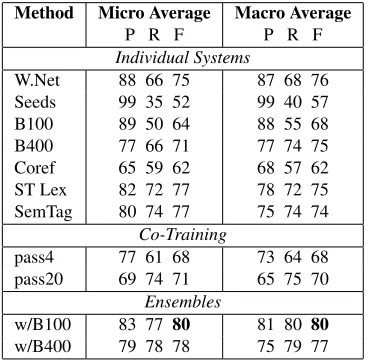
and for the ensemble (using Basilisk size 100 and size 400). Table 3 shows the micro & macro average results across all semantic categories.
Table 3 shows that the dictionaries produced by the Ensemble w/B100 achieved better results than the individual methods and co-training with an F score of 80%. Table 2 shows that the ensemble achieved better performance than the other methods for 4 of the 9 classes, and was usually competitive on the remaining 5 classes. WordNet(W.Net) con-sistently produced high precision, but with compar-atively lower recall, indicating that WordNet does not have sufficient coverage for this domain.
4.6 Analysis
Table 4 shows the performance of our ensemble when using only 2 of the 3 component methods.
Removing any one method decreases the average F-measure by at least 3-5%. Component pairs that include induced lexicons from coreference (ST Lex+Coref and B100+Coref) yield high precision but low recall. The component pair ST Lex+B100
produces higher recall but with slightly lower accu-racy. The ensemble framework boosted recall even more, while maintaining the same precision.
Method Animal Body DisSym Fixed Human Org. Plant & Temp. Trans.
Part Loc. Food Ref. Struct.
P R F P R F P R F P R F P R F P R F P R F P R F P R F
Individual Methods
W.Net 92 88 90 93 59 72 99 77 87 86 58 69 83 55 66 86 44 59 65 79 71 93 8589 85 64 73 Seeds 100 54 70 92 55 69 100 59 74 95 10 18 100 22 36 100 41 58 100 6176 100 52 69 100 09 17 B100 99 77 86 94 7382 100 66 80 96 23 37 96 31 47 91 58 71 82 64 72 68 83 75 67 22 33 B400 94 90 92 51 86 64 100 69 81 97 35 51 91 51 65 79 77 78 46 82 59 49 94 64 83 7880
Coref 90 67 77 92 55 69 66 83 73 65 46 54 57 50 53 54 68 60 81 61 69 60 74 67 45 09 15 ST Lex 94 89 91 68 77 72 80 91 85 91 74 82 79 43 55 84 62 71 51 68 58 73 91 81 82 49 61 SemTag 91 90 90 52 68 59 77 90 83 91 7884 81 48 60 80 63 70 43 82 56 77 93 84 83 53 64
Co-Training
pass4 64 76 70 67 73 70 91 79 85 91 39 54 98 44 61 83 69 76 43 68 53 73 94 82 49 36 42 pass20 60 89 71 56 91 69 88 91 90 83 64 72 92 54 68 72 77 74 28 71 40 65 98 78 46 40 43
Ensembles
w/B100 93 9494 74 77 76 93 81 86 92 73 81 94 5570 90 7884 56 89 68 55 94 70 79 75 77
[image:8.612.72.547.60.247.2]w/B400 94 93 93 65 91 75 96 8791 89 75 81 92 5670 79 79 79 47 86 61 53 94 68 63 55 58
Table 2: Instance-based Semantic Tagging Results (P = Precision, R = Recall, F = F-measure)
Method Micro Average Macro Average
P R F P R F
Individual Systems
W.Net 88 66 75 87 68 76
Seeds 99 35 52 99 40 57
B100 89 50 64 88 55 68
B400 77 66 71 77 74 75
Coref 65 59 62 68 57 62
ST Lex 82 72 77 78 72 75 SemTag 80 74 77 75 74 74
Co-Training
pass4 77 61 68 73 64 68
pass20 69 74 71 65 75 70 Ensembles
w/B100 83 77 80 81 80 80
w/B400 79 78 78 75 79 77
Table 3: Micro & Macro Average for Semantic Tagging
cut across semantic classes) is a relatively minor is-sue within a specialized domain.
5 Conclusions
Our research combined three diverse methods for semantic lexicon induction in a bootstrapped ensemble-based framework, including a novel ap-proach for lexicon induction based on coreference chains. Our ensemble-based approach performed better than the individual methods, in terms of both dictionary accuracy and instance-based seman-tic tagging. In future work, we believe this ap-proach could be enhanced further by adding new types of techniques to the ensemble and by
investi-Method Micro Average Macro Average
P R F P R F
Ensemble with component pairs
ST Lex+Coref 92 59 72 92 57 70
B100+Coref 92 40 56 94 44 60
ST Lex+B100 82 69 75 81 75 77
Ensemble with all components
[image:8.612.94.278.292.472.2]ST Lex+B100+Coref 83 77 80 81 80 80
Table 4: Ablation Study of the Ensemble Framework for Semantic Tagging
gating better methods for estimating the confidence scores from the individual components.
Acknowledgments
[image:8.612.310.540.294.385.2]References
ACE. 2007. NIST ACE evaluation website. In http://www.nist.gov/speech/tests/ace/2007.
ACE. 2008. NIST ACE evaluation website. In http://www.nist.gov/speech/tests/ace/2008.
Daniel M. Bikel, Scott Miller, Richard Schwartz, and Ralph Weischedel. 1997. Nymble: a high-performance learning name-finder. InProceedings of ANLP-97, pages 194–201.
A. Blum and T. Mitchell. 1998. Combining Labeled and Unlabeled Data with Co-Training. InProceedings of the 11th Annual Conference on Computational Learn-ing Theory (COLT-98).
Jean Carletta. 1996. Assessing agreement on classifi-cation tasks: the kappa statistic. Comput. Linguist., 22:249–254, June.
Andrew Carlson, Justin Betteridge, Estevam R. Hr-uschka Jr., and Tom M. Mitchell. 2009. Coupling semi-supervised learning of categories and relations. In HLT-NAACL 2009 Workshop on Semi-Supervised Learning for NLP.
M. Collins and Y. Singer. 1999. Unsupervised Mod-els for Named Entity Classification. In Proceedings of the Joint SIGDAT Conference on Empirical Meth-ods in Natural Language Processing and Very Large Corpora (EMNLP/VLC-99).
S. Cucerzan and D. Yarowsky. 1999. Language Inde-pendent Named Entity Recognition Combining Mor-phologi cal and Contextual Evidence. InProceedings of the Joint SIGDAT Conference on Empirical Meth-ods in Natural Language Processing and Very Large Corpora (EMNLP/VLC-99).
J. Curran. 2002. Ensemble Methods for Automatic The-saurus Extraction. InProceedings of the 2002 Confer-ence on Empirical Methods in Natural Language Pro-cessing.
O. Etzioni, M. Cafarella, D. Downey, A. Popescu, T. Shaked, S. Soderland, D. Weld, and A. Yates. 2005. Unsupervised named-entity extraction from the web: an experimental study. Artificial Intelligence, 165(1):91–134, June.
M.B. Fleischman and E.H. Hovy. 2002. Fine grained classification of named entities. InProceedings of the COLING conference, August.
L. Hirschman. 1997. MUC-7 Coreference Task Defini-tion.
Ruihong Huang and Ellen Riloff. 2010. Inducing domain-specific semantic class taggers from (almost) nothing. In Proceedings of the 48th Annual Meeting of the Association for Computational Linguistics. Z. Kozareva, E. Riloff, and E. Hovy. 2008. Semantic
Class Learning from the Web with Hyponym Pattern Linkage Graphs. InProceedings of the 46th Annual
Meeting of the Association for Computational Linguis-tics: Human Language Technologies (ACL-08). T. McIntosh and J. Curran. 2008. Weighted mutual
exclusion bootstrapping for domain independent lex-icon and template acquisition. InProceedings of the Australasian Language Technology Association Work-shop.
T. McIntosh and J. Curran. 2009. Reducing Semantic Drift with Bagging and Distributional Similarity. In Proceedings of the 47th Annual Meeting of the Associ-ation for ComputAssoci-ational Linguistics.
T. McIntosh. 2010. Unsupervised Discovery of Negative Categories in Lexicon Bootstrapping. InProceedings of the 2010 Conference on Empirical Methods in Nat-ural Language Processing.
G. Miller. 1990. Wordnet: An On-line Lexical Database. International Journal of Lexicography, 3(4).
V. Ng. 2007. Semantic Class Induction and Coreference Resolution. InProceedings of the 45th Annual Meet-ing of the Association for Computational LMeet-inguistics. Cheng Niu, Wei Li, Jihong Ding, and Rohini K. Srihari.
2003. A bootstrapping approach to named entity clas-sification using successive learners. InProceedings of the 41st Annual Meeting on Association for Computa-tional Linguistics (ACL-03), pages 335–342.
M. Pas¸ca. 2004. Acquisition of categorized named en-tities for web search. InProc. of the Thirteenth ACM International Conference on Information and Knowl-edge Management, pages 137–145.
W. Phillips and E. Riloff. 2002. Exploiting Strong Syn-tactic Heuristics and Co-Training to Learn Semantic Lexicons. InProceedings of the 2002 Conference on Empirical Methods in Natural Language Processing, pages 125–132.
J. Pustejovsky, P. Hanks, R. Saur´ı, A. See, R. Gaizauskas, A. Setzer, D. Radev, B. Sundheim, D. Day, L. Ferro, and M. Lazo. 2003. The TIMEBANK Corpus. In Proceedings of Corpus Linguistics 2003, pages 647– 656.
E. Riloff and R. Jones. 1999. Learning Dictionaries for Information Extraction by Multi-Level Bootstrapping. In Proceedings of the Sixteenth National Conference on Artificial Intelligence.
E. Riloff and J. Shepherd. 1997. A Corpus-Based Ap-proach for Building Semantic Lexicons. In Proceed-ings of the Second Conference on Empirical Methods in Natural Language Processing, pages 117–124. E. Riloff. 1996. Automatically Generating Extraction
Lexicon Construction. In Proceedings of the 36th Annual Meeting of the Association for Computational Linguistics, pages 1110–1116.
Veselin Stoyanov, Claire Cardie, Nathan Gilbert, Ellen Riloff, David Buttler, and David Hysom. 2010. Coref-erence resolution with Reconcile. InProceedings of the ACL 2010 Conference Short Papers, pages 156– 161.
M. Thelen and E. Riloff. 2002. A Bootstrapping Method for Learning Semantic Lexicons Using Extraction Pa ttern Contexts. InProceedings of the 2002 Conference on Empirical Methods in Natural Language Process-ing, pages 214–221.