Original Article
Clinical analysis of the application
of hand-assistant laparoscopic surgery with
D3 lymph node dissection for right colon cancer
Tianbao Xiao, Wanling Liang
Guizhou Provincial Hospital of Traditional Chinese Medicine, Anorectal Disease Hospital Two Wards in Guizhou Province, Guiyang 550008, Guizhou, China
Received January 14, 2016; Accepted March 27, 2016; Epub August 15, 2016; Published August 30, 2016
Abstract: Objective: This retrospective study aims to compare the clinical outcomes between conventional laparot-omy and hand-assisted laparoscopic surgery (HALS) with D3 lymph node dissection in the treatment of right colon cancer and to analyze and evaluate the feasibility and safety of HALS with D3 lymph node dissection. Methods: Among 63 patients, 35 underwent HALS with D3 lymph node dissection (study group) and 28 underwent conven-tional laparotomy (control group). The operation durations, the number of lymph node harvest, bleeding volumes, postoperative draining volumes, recovery time of gastrointestinal function, hospitalization time, hospitalization ex-penses, postoperative complications rate and cosmetic satisfactory scores were compared between the two groups. Results: The bleeding volume, postoperative draining volume and the hospitalization expenses in study group were lower than control group. The hospitalization time in study group was shorter than control group. The cosmetic sat-isfactory scores in study group were higher than in control group. The number of lymph node harvest, the recovery time of gastrointestinal function and the postoperative complications rate were no significantly differences between the two groups. Conclusion: HALS with D3 lymph node dissection got the same clinical curative effect compared with traditional open surgery for right colon cancer.
Keywords: Hand-assistant laparoscopic surgery, right colon cancer, D3 lymph node dissection
Introduction
Colon cancer is the common clinic malignant tumor. Its incidence accounts for approximately 8% of the digestive tract tumors and continues to increase. Open radical resection of colon cancer is a major component of treatment and could effectively remove cancerous tissue, but it causes a large trauma in the abdomen, leads to a variety of complications and seriously affects the recovery of intestinal function [1, 2]. Laparoscopic surgery has rapidly become a popular procedure worldwide and has been widely carried out in recent years because of the advantages of less trauma, less pain and
quicker recovery since its first report in 1993
[3]. Accumulating evidence has shown that lap-aroscopic surgery is similar to the clinical out-comes of open surgery [4-8], so it is a promis-ing alternative method for curpromis-ing colon cancer.
Since laparoscopic surgery derived many kinds, surgeons have been faced with a variety of operative techniques, such as hand-assisted or conventional laparoscopic surgery and single-port laparoscopic surgery [9-11]. All kinds of operations have their own merits. Hand-as- sisted laparoscopic surgery (HALS) incorporat-ing the laparoscopic surgery and the traditional open surgery is a kind of hybrid laparoscopic technique [12-15]. HALS is a kind of minimally invasive surgery and its most important advan-tage is that the surgeon regains tactile feed-back. Surgeons can palpate the tumor or or-
gans, which is benefit for surgeon to perform
blunt dissection, retraction, control of bleeding, and specimen removal [16-21].
Japanese Classification of Colorectal
Carcino-ma states that a radical D3 lymph node dissec-tion of colon cancer should be performed to remove the paracolic lymph nodes, intermedi-ate lymph nodes and central lymph nodes. It could decrease the tumor recurrence and lead to good prognosis of tumor [22, 23]. However, the application of a hand-assisted laparoscopic approach to perform D3 lymph node dissection procedure for the treatment of right colon can-cer has only been sporadically reported, and its
oncologic benefits remain unclear. Therefore,
this study was designed to compare the out-comes of a HALS with D3 lymph node dissec-tion and a convendissec-tional laparotomy in patients with right colon cancer and to analyze and eval-uate the feasibility and safety of HALS with D3 lymph node dissection.
Materials and methods
Patient population
This study was approved by the Institutional Review Board of Guizhou Provincial Hospital of
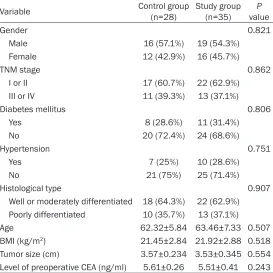
mph node dissection from March 2012 to April 2015 at our hospital were retrospectively reviewed. Among the patients, 35 patients who underwent a hand-assisted laparoscopic right hemicolectomy with D3 lymph node dissection and 28 patients who underwent a conventional open right hemicolectomy were enrolled as the study and the control groups, respectively. The control group was selected so as to be case-matched with the study group in the aspects of age, sex, medical history, tumor size, and tumor-node-metastasis (TNM) stage during the same period (Table 1).
All patients had conventional preoperative examinations including chest radiographs, ab- dominal computed tomography (CT), colonos-copy and biopsy, routine laboratory testing, and
testing of tumor markers to confirm the tumor
location and type. The following patients were excluded from the study: (1) patients who were performed a right hemicolectomy but colon
cancer was not confirmed by pathology after
surgery; (2) patients who had peritonitis, peri-Table 1. Patients’ characteristics and pathologic variables
Variable Control group (n=28) Study group (n=35) valueP
Gender 0.821
Male 16 (57.1%) 19 (54.3%)
Female 12 (42.9%) 16 (45.7%)
TNM stage 0.862
I or II 17 (60.7%) 22 (62.9%)
III or IV 11 (39.3%) 13 (37.1%)
Diabetes mellitus 0.806
Yes 8 (28.6%) 11 (31.4%)
No 20 (72.4%) 24 (68.6%)
Hypertension 0.751
Yes 7 (25%) 10 (28.6%)
No 21 (75%) 25 (71.4%)
Histological type 0.907
Well or moderately differentiated 18 (64.3%) 22 (62.9%) Poorly differentiated 10 (35.7%) 13 (37.1%)
Age 62.32±5.84 63.46±7.33 0.507
BMI (kg/m2) 21.45±2.84 21.92±2.88 0.518 Tumor size (cm) 3.57±0.234 3.53±0.345 0.554 Level of preoperative CEA (ng/ml) 5.61±0.26 5.51±0.41 0.243
Values are presented as mean ± standard deviation (SD) or number (%). TNM, tumor-node-metastasis; BMI, body mass index; CEA, carcinoembryonic antigen. Control group: the patients underwent conventional open right hemicolectomy; Study group: the patients underwent hand-assisted laparoscopic right hemico-lectomy with D3 lymph node dissection.
Traditional Chinese Medicine, Anorectal Disease Hospital Two Wards in Guizhou Province. Due to its retrospective nature, the requirement regarding inform- ed consent for the study was waived. But all patients who underwent surgical operation signed a standard informed con-sent form that we used in our surgical unit. On this standard consent form, we detailed the surgical procedures, including
the risks and benefits of the
[image:2.612.93.366.86.359.2]colic abscess or sepsis, etc.; (3) patients with metastatic disease on preoperative work-up; (4) patients who had received emergency sur-gery due to acute intestinal obstruction or per-foration; and (5) patients who were pregnant, severely obese, or had serious diseases of the heart, lung, liver, or kidney.
Surgical procedure
Under general anesthesia with endotracheal intubation, a patient was positioned on the sur-gical table in the supine position with lags apart. The surgeon and camera holder stood on the left and the surgical assistant on the right side. A Foley catheter was inserted, but no nasogastric tube was used routinely. The
oper-ative field was covered with saline soaked ster -ile gauze.
Firstly, the navel as the center, surgeon made a mid-midline skin incision with a 6- or 7-cm length and put a Gelport (Applied Medical Resources Co., Rancho Santa Margarita, CA, USA) to the skin incision. The Gelport is a kind of hand-port device that can maintain the pneu-moperitoneum while the surgeon’s hand is in the abdominal cavity. The pneumoperitoneum was maintained at 10 mmHg using CO2. Under visualization with a 30-degree laparoscope, two 12-mm trocars were inserted into the epi-gastric and the suprapubic area at the midline. Then, the camera assistant, who was located to the left of patient and to the left of surgeon, inserted the laparoscopic camera via the supra-pubic port. The surgeon’s left hand was insert-ed into the intraabdominal cavity via the hand-port, and the laparoscopic instrument was inserted via the epigastric port [24].
Then, complete dissection of all regional lymph nodes is recorded as D3 dissection. The extent of D3 lymph node dissection included paracolic lymph nodes, intermediate lymph nodes, and lymph nodes in the root of inferior mesenteric artery. The scope of extra-mesenteric dissec-tion included the clearance of lymph nodes along common iliac artery and vein, to abdomi-nal aorta, upward to the level of duodeabdomi-nal third portion, and to the left renal vein [23].
Finally, tumor resection, meticulous hemosta-sis and wound closure were performed. They were similar to those of open surgery. The ter-minal ileum and the ascending and transverse
colon were exteriorized. The transverse colon and the terminal ileum were resected with
suf-ficient margins from the tumor. Anastomosis
was performed using the hand-sewn and end-to-end method or the side-to-side stapled method. After saline irrigation and meticulous hemostasis, a pneumoperitoneum was made using the Gelport. Then, anastomosis align-ment and complete hemostasis were checked.
Postoperative care
During postoperative care, intravenous
patient-controlled analgesics were applied for the first
2 or 3 days, according the condition of patients. Vital signs and urine output are monitored every 4 hours. Routine laboratory tests were performed on postoperative days 1, 2, 4 and 7; especially. Antibiotic therapy is discontinued after a few days or it will be continue to inject unless the patient has a continuing infection. Drinking water was started when patients had
no abdominal discomfort after first flatus. If
they were tolerable to this step, soft diet began. Clinicopathologic, intraoperative and postoper-ative parameters were statistically analyzed between the study and the control groups, such as age, gender, body mass index (BMI), length of incision, total operative time, operative blood loss, number of resected lymph nodes, the recovery time of bowel function, the time of early ambulation after operation, postoperative hospital stay, and the incidence of postopera-tive complications, including frequency of post-operative respiratory complications, frequency of anastomotic leakage, frequency of incision infection, frequency of urinary tract infection, and retention of urine and so on.
Statistical analysis
The patients were analyzed according to the intent to-treat statistical principle. SPSS 19.0 software (SPSS, Inc., Chicago, IL, USA) was used to perform statistical analysis. Student’s t-tests were used to analyze the difference between study group and control group. Me- asurement data were expressed as the mean ± standard deviation (SD) value. The differences between means were analyzed statistically using t-tests. Quantitative data were analyzed by chi-squared test or Fisher’s exact test as appropriate. A P value of less than 0.05 was
Results
Comparison of basic clinical data between study group and control group
A total of 63 cases consisted of 35 cases in the study group and 28 cases in the control group were enrolled in this study. As shown in Table 1, the study group consisted of 19 males and 16 females with an average age of 63.46±7.33 years, and the control group consisted of 16 males and 12 females with a mean age of 62.32±5.84 years. There were no differences in gender (P=0.821) or age (P=0.507) between the groups. The two groups were similar with respect to histological type and tumor-node-metastasis (TNM) stage. In the study group, tumors were well or moderately differentiated and poorly differentiated in 22 (62.9%) and 13 (37.1%) patients, respectively, in the control group in 18 (64.3%) and 10 (35.7%) patients, respectively, and tumors were I or II stage and III or IV stage in 22 (62.9%) and 13 (37.1%) patients, respectively, in the control group in 17 (60.7%) and 11 (39.3%) patients, respectively.
Moreover, there was no significant difference in
diabetes mellitus and hypertension between the two groups (P=0.806 and P=0.751). Besides, the body mass index, tumor size and level of preoperative CEA of the study group and control group were similar (21.45±2.84 kg/m2 vs. 21.92±2.88 kg/m2, respectively,
P=0.518; 3.57±0.234 vs. 3.53±0.345 cm,
group. It was 40 minutes longer in the study group than in the control group, and the
differ-ence was statistically significant (P=0.000). Besides, the study group had a significantly
shorter total incision length (184.99±2.92 vs. 64.45±2.65 mm, respectively, P=0.000), and
significantly less blood loss (153.08±29.37 vs.
85.31±3.17 ml, respectively, P=0.000) than the control group. However, between the two
groups, no significant differences were noted in
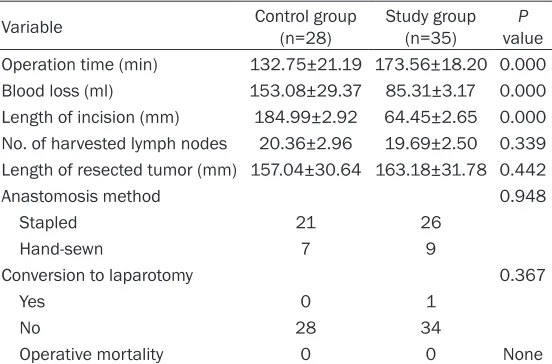
number of retrieved lymph nodes (P=0.339), length of resected tumor (P=0.442) or anasto-mosis method (P=0.948). In the study group, there was 1 case performing conversion to open surgery. In both group, there were no intraoperative complications, such as ureter injury, hemorrhage, reanastomosis, and so on. The most important thing was no death occurred during perioperative period.
Comparison of postoperative correlative index and complication between study group and control group
In the aspect of postoperative laboratory data,
[image:4.612.92.368.84.266.2]there were no significant differences in the dif -ference between the preoperative and the postoperative white blood cell (WBC) counts and the difference in hemoglobin (Hb), as shown in Table 3. The mean of the difference between the preoperative and the postopera-tive WBC counts and the difference in Hb respectively was 5.73 and 1.39 in the study Table 2. Operative variables in control and study group
Variable Control group (n=28) Study group (n=35) valueP Operation time (min) 132.75±21.19 173.56±18.20 0.000 Blood loss (ml) 153.08±29.37 85.31±3.17 0.000 Length of incision (mm) 184.99±2.92 64.45±2.65 0.000 No. of harvested lymph nodes 20.36±2.96 19.69±2.50 0.339 Length of resected tumor (mm) 157.04±30.64 163.18±31.78 0.442
Anastomosis method 0.948
Stapled 21 26
Hand-sewn 7 9
Conversion to laparotomy 0.367
Yes 0 1
No 28 34
Operative mortality 0 0 None
Values are presented as mean ± standard deviation or number (%). Control group: the patients underwent conventional open right hemicolectomy; Study group: the patients underwent hand-assisted laparoscopic right hemicolectomy with D3 lymph node dissection.
respectively, P=0.554; and 5.61±0.26 vs. 5.51±0.41 ng/ ml, respectively, P=0.243). In conclusion, there were no
significant differences in gen -der, age, histological type, TNM stage, tumor size, preoperative comorbidities, BMI and level of preoperative CEA between the study groups and control group. So the patients could perform a case-control study.
Comparison of operative cor-relative index between study group and control group
group, 4.60 and 1.53 in the control group (P=0.051 and P=0.077, respectively).
Postoperative recovery parameters are also presented in Table 3. First flatus was shown on
postoperative day 3.32 in the study group and 3.37 in the control group (P=0.473). Eating soft diet were started on postoperative days 5.55 in the study group and the control group (P=0.934). However, significant differences
were noted in length of hospital stay, cosmetic satisfactory scores, operation fare and hospi-tal stay and pharmacy cost. The study group
had a significantly shorter length of hospital
stay (13.5±0.27 vs. 10.4±0.26 days, P=0.000),
significantly higher cosmetic satisfactory
sc-ores (1.437±0.28 vs. 4.67±0.31, P=0.000),
significantly higher operation fare (6201.33±
336.72 vs. 8975.88±302.82 RMB, P=0.000),
and significantly lower hospital stay and phar -macy cost (18545.2±2808.2 vs. 15372.4± 2660.7 RMB, P=0.000) than the control group.
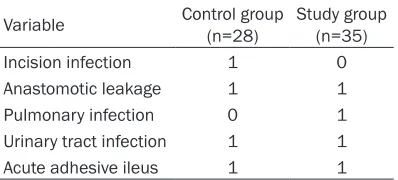
difference was noted between groups (P>0.05). All complications were successfully managed prior to discharge. All patients recovered after conservative management. No postoperative mortalities or reoperations occurred in either group.
Discussion
Nowadays, laparoscopic surgery has been increasingly practiced worldwide and has been extended to all areas of surgery. A surgical lit-erature has reported that Laparoscopic colec-tomy was performed to colon cancer since 1991 [25]. The laparoscopic surgery as a mini-mally invasive therapy has obvious advantages in the treatment of cancer, including the small-er incision, the fastsmall-er recovsmall-ery, and the shortsmall-er hospital stay. But, some new problems in daily work has been discovered, such as the longer operative time, the need for more expensive instrumentation, risk of port-site cancer recur-rences, the procedural complexity, the lack of optimal retracting devices, and the loss of tac-tile feedback. Besides, laparoscopic resections
can be technically demanding and difficult to
learn and teach [26-30]. Due to the above shortcomings of laparoscopy, some patients cannot be carried out laparoscopic surgery, such as patients with seriously dilated bowel loops and a distended abdomen and patients
with bulky and fixed obstructing tumors [31,
32]. So we needed to improve the laparoscopic technology.
Along with the technical development,
[image:5.612.91.396.85.215.2]Kusminsky et al. [33] completed the first HALS
Table 3. Postoperative laboratory data and recovery parameters Variable Control group (n=28) Study group (n=35) valueP WBC count differencea 4.60±1.98 5.73±2.29 0.051
Hb differenceb 1.53±0.31 1.39±0.30 0.077
Days to flatus (d) 3.37±0.24 3.32±0.26 0.473
Days to soft diet (d) 5.55±0.269 5.55±0.29 0.934 Days to discharge (d) 13.5±0.27 10.4±0.26 0.000 Operation fare 6201.33±336.72 8975.88±302.82 0.000 Hospital stay and pharmacy cost 18545.2±2808.2 15372.4±2660.7 0.000 Cosmetic satisfactory scores 1.437±0.28 4.67±0.31 0.000
Values are presented as mean ± standard deviation or number (%). aPostoperative WBC count-preoperative WBC count; bPreoperative Hb-postoperative Hb. WBC, white blood cell; Hb, hemoglobin. Control group: the patients underwent conventional open right hemicolectomy; Study group: the patients underwent hand-assisted laparoscopic right hemicolectomy with D3 lymph node dissection.
Table 4. Postoperative complications
Variable Control group (n=28) Study group (n=35)
Incision infection 1 0
Anastomotic leakage 1 1
Pulmonary infection 0 1
Urinary tract infection 1 1
Acute adhesive ileus 1 1
Control group: the patients underwent conventional open right hemicolectomy; Study group: the patients under-went hand-assisted laparoscopic right hemicolectomy with D3 lymph node dissection.
[image:5.612.91.290.304.394.2]splenectomy. The advantages of HALS include better control of hemorrhagic accidents, there-by reducing the conversion rate, metastatic lesions, small lesions, and lymph nodes, which
are hard to find by laparoscopic exploration,
and the local staging of tumors can be detect-ed. Insertion of the hand restores the tactile feeling and the sensation of depth and facili-tates the exposure, traction, and retraction maneuvers during the procedure [34-36]. HALS may be a bridge of conventional laparoscopic and open surgery, because it incorporates ele-ments of both the laparoscopic and the
tradi-tional open techniques. Besides, it simplifies the performance of difficult procedures of lapa -roscopic surgery and make the less experi-enced surgeons to initiate the advanced lapa-roscopic surgery [37]. In recent years, some scholars compared open surgery with HALS for colorectal diseases, the common conclusion was that HALS is a better choice because of a smaller incision, a faster recovery, and a short-er hospital stay [38, 39]. Our data showed simi-lar results.
With the development of technology, research-ers added D3 lymph node dissection to HALS. Jae-Hoon Sim et al. reported that with the cur-rent of laparoscopic technology, D3 lymph node dissection for rectosigmoid cancer could be performed by laparoscopic approach with ac- ceptable oncologic results and quick postoper-ative recovery for the patients. It has been gen-erally accepted that a progressive increase in recurrence rate is observed in parallel with a higher level and number of involved nodes [40]. In the present study, we explore the feasibility and safety of HALS with D3 lymph node dissec-tion in the treatment of right colon cancer. According to our data, compared to the patients in the open right hemicolectomy group, those who underwent a hand-assisted laparoscopic right hemicolectomy with D3 lymph node dis-section for right colon cancer had similar short-term clinical outcomes.
First of all, we counted the basic clinic data of all the participants. The results showed that
there were no significant differences in gender,
age, histological type, TNM stage, tumor size, preoperative comorbidities, BMI and level of preoperative CEA between the study groups and control group. So the patients could per-form a case-control study. Then, we considered
and evaluated the feasibility of surgery and its oncologic safety. We compared the operative variables in control group and study group. In our data, the mean of operation time was lon-ger in the HALS group than in the open surlon-gery group. Kang et al. [13] reported that operation times were similar between HALS and open sur-gery in the case of operations by one experi-enced surgeon. Thus, the longer operation time in the HALS group is mainly due to the lack of surgeon’s experience, not the method of opera-tion. In addition, we found the open surgery
group had a significantly shorter total incision
length and less blood loss than the HALS group. Lastly, we explored the clinical short-term out-comes between the two groups. Our results showed that HALS patients had a shorter inci-sion and length of hospital stay, higher cosmet-ic satisfactory and lower hospital stay and phar-macy cost than the patients with conventional laparoscopic surgery.
In conclusion, patients with right colon cancer who underwent a HALS with D3 lymph node dis-section had not only smaller incisions and shorter hospital stays but also a radicality of lymph-node dissection similar to that in pa- tients with right colon cancer who underwent conventional open surgery. Therefore, a hand-assisted right hemicolectomy for the treatment of right colon cancer is safe and feasible, and can be considered as an alternative operation to conventional open surgery.
Disclosure of conflict of interest
None.
Address correspondence to: Wanling Liang, Guizhou Provincial Hospital of Traditional Chinese Medicine, Anorectal Disease Hospital Two Wards in Guizhou Province, Guiyang 550008, Guizhou, China. E-mail: [email protected]
References
[1] Mori S, Baba K, Yanagi M, Kita Y, Yanagita S, Uchikado Y, Arigami T, Uenosono Y, Okumura H, Nakajo A, Maemuras K, Ishigami S and Natsugoe S. Laparoscopic complete mesocolic excision with radical lymph node dissection along the surgical trunk for right colon cancer. Surg Endosc 2015; 29: 34-40.
[3] Langenfeld SJ, Thompson JS and Oleynikov D. Laparoscopic colon resection: is it being uti-lized? Adv Surg 2013; 47: 29-43.
[4] Buunen M, Veldkamp R, Hop WC, Kuhry E, Jeekel J, Haglind E, Pahlman L, Cuesta MA, Msika S, Morino M, Lacy A and Bonjer HJ. Survival after laparoscopic surgery versus open surgery for colon cancer: long-term out-come of a randomised clinical trial. Lancet Oncol 2009; 10: 44-52.
[5] Veldkamp R, Kuhry E, Hop WC, Jeekel J, Kazemier G, Bonjer HJ, Haglind E, Pahlman L, Cuesta MA, Msika S, Morino M and Lacy AM. Laparoscopic surgery versus open surgery for colon cancer: short-term outcomes of a ran-domised trial. Lancet Oncol 2005; 6: 477-484. [6] A comparison of laparoscopically assisted and
open colectomy for colon cancer. N Engl J Med 2004; 350: 2050-2059.
[7] Lacy AM, Garcia-Valdecasas JC, Delgado S, Castells A, Taura P, Pique JM and Visa J. Laparoscopy-assisted colectomy versus open colectomy for treatment of non-metastatic co-lon cancer: a randomised trial. Lancet 2002; 359: 2224-2229.
[8] Hazebroek EJ. COLOR: a randomized clinical trial comparing laparoscopic and open resec-tion for colon cancer. Surg Endosc 2002; 16: 949-953.
[9] Ballantyne GH and Leahy PF. Hand-assisted laparoscopic colectomy: evolution to a clinical-ly useful technique. Dis Colon Rectum 2004; 47: 753-765.
[10] Sheng QS, Lin JJ, Chen WB, Liu FL, Xu XM, Lin CZ, Wang JH and Li YD. Hand-assisted laparo-scopic versus open right hemicolectomy: short-term outcomes in a single institution from China. Surg Laparosc Endosc Percutan Tech 2012; 22: 267-271.
[11] Yun HR, Cho YK, Cho YB, Kim HC, Yun SH, Lee WY and Chun HK. Comparison and short-term outcomes between hand-assisted laparoscop-ic surgery and conventional laparoscoplaparoscop-ic sur-gery for anterior resections of left-sided colon cancer. Int J Colorectal Dis 2010; 25: 975-981. [12] Darzi A. Hand-assisted laparoscopic colorectal
surgery. Surg Endosc 2000; 14: 999-1004. [13] Kang JC, Chung MH, Chao PC, Yeh CC, Hsiao
CW, Lee TY and Jao SW. Hand-assisted laparo-scopic colectomy vs open colectomy: a pro-spective randomized study. Surg Endosc 2004; 18: 577-581.
[14] Marcello PW. Hand-assisted laparoscopic col-ectomy: a helping hand? Clin Colon Rectal Surg 2004; 17: 125-129.
[15] Marcello PW, Fleshman JW, Milsom JW, Read TE, Arnell TD, Birnbaum EH, Feingold DL, Lee SW, Mutch MG, Sonoda T, Yan Y and Whelan RL. Hand-assisted laparoscopic vs.
laparo-scopic colorectal surgery: a multicenter, pro-spective, randomized trial. Dis Colon Rectum 2008; 51: 818-826; discussion 826-818. [16] Darzi A. Hand-assisted laparoscopic colorectal
surgery. Semin Laparosc Surg 2001; 8: 153-160.
[17] Cima RR, Pendlimari R, Holubar SD, Pattana-Arun J, Larson DW, Dozois EJ, Wolff BG and Pemberton JH. Utility and short-term outcomes of hand-assisted laparoscopic colorectal sur-gery: a single-institution experience in 1103 patients. Dis Colon Rectum 2011; 54: 1076-1081.
[18] Ozturk E, da Luz Moreira A and Vogel JD. Hand-assisted laparoscopic colectomy: the learning curve is for operative speed, not for quality. Colorectal Dis 2010; 12: e304-309.
[19] Nakajima K, Milsom JW, Margolin DA and Szilagy EJ. Use of the surgical towel in colorec-tal hand-assisted laparoscopic surgery (HALS). Surg Endosc 2004; 18: 552-553.
[20] Hanna GB, Elamass M and Cuschieri A. Ergonomics of hand-assisted laparoscopic sur-gery. Semin Laparosc Surg 2001; 8: 92-95. [21] Romanelli JR, Kelly JJ and Litwin DE.
Hand-assisted laparoscopic surgery in the United States: an overview. Semin Laparosc Surg 2001; 8: 96-103.
[22] Yao HW and Liu YH. Re-examination of the standardization of colon cancer surgery. Gastroenterol Rep (Oxf) 2013; 1: 113-118. [23] Liang JT, Huang KC, Lai HS, Lee PH and Sun
CT. Oncologic results of laparoscopic D3 lymphadenectomy for male sigmoid and upper rectal cancer with clinically positive lymph nodes. Ann Surg Oncol 2007; 14: 1980-1990. [24] Sim JH, Jung EJ, Ryu CG, Paik JH, Kim G, Kim
SR and Hwang DY. Short-term Outcomes of Hand-Assisted Laparoscopic Surgery vs. Open Surgery on Right Colon Cancer: A Case-Controlled Study. Ann Coloproctol 2013; 29: 72-76.
[25] Osarogiagbon RU, Ogbeide O, Ogbeide E and George RK. Hand-assisted laparoscopic colec-tomy compared with open coleccolec-tomy in a non-tertiary care setting. Clin Colorectal Cancer 2007; 6: 588-592.
[26] Nakajima K, Lee SW, Cocilovo C, Foglia C, Sonoda T and Milsom JW. Laparoscopic total colectomy: hand-assisted vs standard tech-nique. Surg Endosc 2004; 18: 582-586. [27] Lezoche E, Feliciotti F, Guerrieri M, Paganini
AM, De Sanctis A, Campagnacci R and D’Ambrosio G. Laparoscopic versus open hemicolectomy. Minerva Chir 2003; 58: 491-502, 502-497.
lapa-roscopic and hand-assisted oncologic segmen-tal colonic resection. Surg Endosc 2007; 21: 2137-2141.
[29] Aalbers AG, Biere SS, van Berge Henegouwen MI and Bemelman WA. Hand-assisted or lapa-roscopic-assisted approach in colorectal sur-gery: a systematic review and meta-analysis. Surg Endosc 2008; 22: 1769-1780.
[30] Ding J, Xia Y, Liao GQ, Zhang ZM, Liu S, Zhang Y and Yan ZS. Hand-assisted laparoscopic sur-gery versus open sursur-gery for colorectal dis-ease: a systematic review and meta-analysis. Am J Surg 2014; 207: 109-119.
[31] Ng SS, Yiu RY, Li JC, Lee JF and Leung KL. Emergency laparoscopically assisted right hemicolectomy for obstructing right-sided co-lon carcinoma. J Laparoendosc Adv Surg Tech A 2006; 16: 350-354.
[32] Ng SS, Lee JF, Yiu RY, Li JC, Leung WW and Leung KL. Emergency laparoscopic-assisted versus open right hemicolectomy for obstruct-ing right-sided colonic carcinoma: a compara-tive study of short-term clinical outcomes. World J Surg 2008; 32: 454-458.
[33] Kusminsky RE, Boland JP, Tiley EH and Deluca JA. Hand-assisted laparoscopic splenectomy. Surg Laparosc Endosc 1995; 5: 463-467. [34] Pendlimari R, Holubar SD, Pattan-Arun J,
Larson DW, Dozois EJ, Pemberton JH and Cima RR. Hand-assisted laparoscopic colon and rec-tal cancer surgery: feasibility, short-term, and oncological outcomes. Surgery 2010; 148: 378-385.
[35] Kim H. Hand-assisted laparoscopic right colec-tomy: is it useful? Ann Coloproctol 2014; 30: 1. [36] Ng LW, Tung LM, Cheung HY, Wong JC, Chung
CC and Li MK. Hand-assisted laparoscopic ver-sus total laparoscopic right colectomy: a ran-domized controlled trial. Colorectal Dis 2012; 14: e612-617.
[37] Li Z, Li D, Jie Z, Zhang G and Liu Y. Comparative Study on Therapeutic Efficacy Between Hand-Assisted Laparoscopic Surgery and Conven- tional Laparotomy for Acute Obstructive Right-Sided Colon Cancer. J Laparoendosc Adv Surg Tech A 2015; 25: 548-554.
[38] Orenstein SB, Elliott HL, Reines LA and Novitsky YW. Advantages of the hand-assisted versus the open approach to elective colecto-mies. Surg Endosc 2011; 25: 1364-1368. [39] Chiu CC. Letter 1: Short-term outcomes from a
prospective randomized trial comparing lapa-roscopic and open surgery for colorectal can-cer (Br J Surg 2009; 96: 1458-1467). Br J Surg 2010; 97: 789; author reply 790-781.