OpenNMT: Neural Machine Translation Toolkit
Guillaume Klein
SYSTRANYoon Kim
Harvard UniversityYuntian Deng
Harvard UniversityVincent Nguyen
UbiqusJean Senellart
SYSTRANAlexander M. Rush
Harvard UniversityAbstract
OpenNMT is an open-source toolkit for neural machine translation (NMT). The system prior-itizes efficiency, modularity, and extensibility with the goal of supporting NMT research into model architectures, feature representations, and source modalities, while maintaining compet-itive performance and reasonable training requirements. The toolkit consists of modeling and translation support, as well as detailed pedagogical documentation about the underlying tech-niques. OpenNMT has been used in several production MT systems, modified for numerous research papers, and is implemented across several deep learning frameworks.
1
Introduction
Neural machine translation (NMT) is a new methodology for machine translation that has led to remarkable improvements, particularly in terms of human evaluation, compared to rule-based and statistical machine translation (SMT) systems (Wu et al., 2016; Crego et al., 2016). Orig-inally developed using pure sequence-to-sequence models (Sutskever et al., 2014; Cho et al., 2014) and improved upon using attention-based variants (Bahdanau et al., 2014; Luong et al., 2015a), NMT has now become a widely-applied technique for machine translation, as well as an effective approach for other related NLP tasks such as dialogue, parsing, and summarization. As NMT approaches are standardized, it becomes more important for the machine trans-lation and NLP community to develop open implementations for researchers to benchmark against, learn from, and extend upon. Just as the SMT community benefited greatly from toolk-its like Moses (Koehn et al., 2007) for phrase-based SMT and CDec (Dyer et al., 2010) for syntax-based SMT, NMT toolkits can provide a foundation to build upon. A toolkit should aim to provide a shared framework for developing and comparing open-source systems, while at the same time being efficient and accurate enough to be used in production contexts.
With these goals in mind, in this work we present an open-source toolkit for developing neural machine translation systems, known asOpenNMT (http://opennmt.net). Since its launch in December 2016, OpenNMT has become a collection of implementations targeting both academia and industry. The system is designed to be simple to use and easy to extend, while maintaining efficiency and state-of-the-art accuracy. In addition to providing code for the core translation tasks, OpenNMT was designed with two aims: (a) prioritize training and test efficiency, (b) maintain model modularity and readability hence research extensibility.
(a) (b)
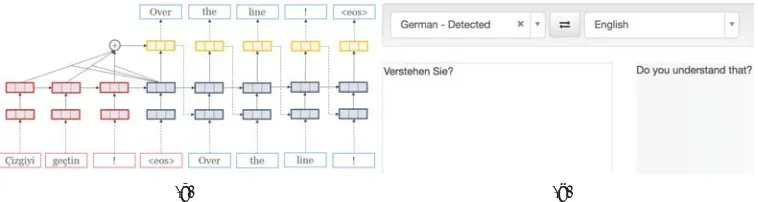
Figure 1: (a). Schematic view of neural machine translation. Theredsource words are first mapped to word vectors and then fed into a recurrent neural network (RNN). Upon seeing theeossymbol, the final time step initializes a targetblueRNN. At each target time step, attention is applied over the source RNN and combined with the current hidden state to produce a predictionp(wt|w1:t−1, x)of the next word. This prediction is then fed back into the target RNN. (b). Live demo of the OpenNMT system.
released, includingGroundHog, Blocks, Nematus,tensorflow-seq2seq,GNMT,fair-seq, Ten-sor2Tensor,Sockeye,Neural Monkey,lamtram,XNMT,SGNMT, andMarian. These projects mostly implement variants of the same underlying systems, and differ in their prioritization of features. The open-source community around this area is flourishing, and is providing the NLP community a useful variety of open-source NMT frameworks. In the ongoing development of OpenNMT, we aim to build upon the strengths of those systems, while supporting a framework with high-accuracy translation, multiple options and clear documentation.
This engineering report describes how the system targets our design goals. We begin by briefly surveying the background for NMT, and then describing the high-level implementation details. We end by showing benchmarks of the system in terms of accuracy, speed, and memory usage for several translation and natural language generation tasks.
2
Background
NMT has now been extensively described in many excellent tutorials (see for instancehttps: //sites.google.com/site/acl16nmt/home). We give only a condensed overview.
NMT takes a conditional language modeling view of translation by modeling the probability of a target sentence w1:T given a source sentence x1:S as p(w1:T|x) = T
1 p(wt|w1:t−1, x;θ)where the distribution is parameterized withθ. This distribution is esti-mated using an attention-based encoder-decoder architecture (Bahdanau et al., 2014). A source encoder recurrent neural network (RNN) maps each source word to a word vector, and pro-cesses these to a sequence of hidden vectorsh1, . . . ,hS. The target decoder combines an RNN hidden representation of previously generated words (w1, ...wt−1) with source hidden vectors to predict scores for each possible next word. A softmax layer is then used to produce a next-word distributionp(wt|w1:t−1, x;θ). The source hidden vectors influence the distribution through an attention pooling layer that weights each source word relative to its expected contribution to the target prediction. The complete model is trained end-to-end to minimize the negative log-likelihood of the training corpus. An unfolded network diagram is shown in Figure 1(a).
as the predicted word, has been shown to be quite helpful for machine translation (Luong et al., 2015a). (d) Test-time decoding is done throughbeam searchwhere multiple hypothesis target predictions are considered at each time step. Implementing these correctly can be difficult, which motivates their inclusion in a NMT framework.
3
Implementation
OpenNMT is a community of projects supporting easy adoption neural machine translation. At the heart of the project are libraries for training, using, and deploying neural machine translation models. The system was based originally onseq2seq-attn, which was rewritten for ease of efficiency, readability, and generalizability. The project supports vanilla NMT models along with support for attention, gating, stacking, input feeding, regularization, copy models, beam search and all other options necessary for state-of-the-art performance.
OpenNMT has currently three main implementations. All of them are actively maintained:
• OpenNMT-luaThe original project developed in Torch 7. Full-featured, optimized, and stable code ready for quick experiments and production.
• OpenNMT-pyAn OpenNMT-lua clone using PyTorch. Initially created by by Adam Lerer and the Facebook AI research team as an example, this implementation is easy to extend and particularly suited for research.
• OpenNMT-tfAn implementation following the style of TensorFlow. This is a newer project focusing on large scale experiments and high performance model serving using the latest TensorFlow features.
OpenNMT is developed completely in the open on GitHub at (http://github.com/ opennmt) and is MIT licensed. The initial release has primarily contributions from SYS-TRAN Paris, the Harvard NLP group and Facebook AI research. Since official beta release, the project (OpenNMT-lua, OpenNMT-py and OpenNMT-tf) has been starred by over 2500 users in total, and there have been over 100 outside contributors. The project has an active forum for community feedback with over five hundred posts in the last two months. There is also a live demonstration available of the system in use (Figure 1(b)).
One often overlooked benefit of NMT compared to SMT is its relative compactness. OpenNMT-lua including preprocessing and model variants is roughly 16K lines of code, the PyTorch version is less than 4K lines and Tensorflow version has around 7K lines. For compar-ison the Moses SMT framework including language modeling is over 100K lines. This makes our system easy to completely understand for newcomers. Each project is fully self-contained depending on minimal number of external libraries and also includes some preprocessing, visu-alization and analysis tools.
4
Design Goals
4.1 System Efficiency
As NMT systems can take from days to weeks to train, training efficiency is a paramount con-cern. Slightly faster training can make the difference between plausible and impossible experi-ments.
Memory Sharing & Sharding When training GPU-based NMT models, memory size
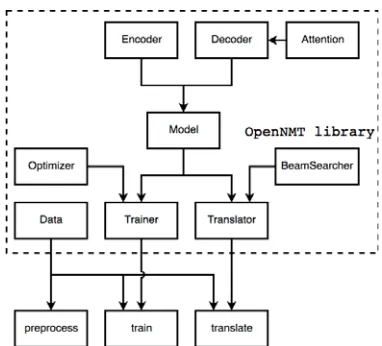
Figure 2:Schematic overview of OpenNMT-py code
and so we implemented an external memory sharing system that exploits the known time-series control flow of NMT systems and aggressively shares the internal buffers between clones. The potential shared buffers are dynamically calculated by exploration of the network graph before starting training. In practical use, aggressive memory reuse provides a saving of 70% of GPU memory with the default model size. For OpenNMT-py, we implemented a sharding mechanism both for data loading to enable training on extremely large datasets that cannot fit into memory, and for back-propagation to reduce memory footprints during training.
Multi-GPU OpenNMT additionally supports multi-GPU training using data parallelism.
Each GPU has a replica of the master parameters and processes independent batches during training phase. Two modes are available: synchronous and asynchronous training (Dean et al., 2012). Experiments with 8 GPUs show a 6×speed up in per epoch, but a slight loss in training efficiency. When training to similar loss, it gives a 3.5×total speed-up to training.
C/Mobile/GPU Translation Training NMT systems requires significant code complexity to
facilitate fast back-propagation-through-time. At deployment, the system is much less complex, and only requires (i) forwarding values through the network and (ii) running a beam search that is much simplified compared to SMT. OpenNMT includes several different translation deploy-ments specialized for different run-time environdeploy-ments: a batched CPU/GPU implementation for very quickly translating a large set of sentences, a simple single-instance implementation for use on mobile devices, and a specialized C implementation suited for industrial use.
4.2 Modularity for Research
System BLEU-cased
uedin-nmt-ensemble 28.3
LMU-nmt-reranked-wmt17-en-de 27.1
[image:5.612.205.425.107.167.2]SYSTRAN-single (OpenNMT) 26.7
Table 1:Top 3 on English-Germannewstest2017WMT17.
System Speed tok/sec BLEU Train Trans
Nematus 3221 252 18.25
ONMT 5254 457 19.34
Table 2: Performance results for EN→DE on WMT15 tested on newstest2014. Both systems 2x500 RNN, embedding size 300, 13 epochs, batch size 64, beam size 5. We compare on a 32k BPE setting.
System newstest14 newstest17
seq2seq 22.19
-Sockeye - 25.55
[image:5.612.321.513.202.260.2]ONMT 23.23 [19.34] 25.06 [22.69]
Table 3: OpenNMT’s performance as reported by Britz et al. (2017) and Hieber et al. (2017) (brack-eted) compared to our best results. ONMT used 32k BPE, 2-layers bi-RNN of 1024, embedding size 512, dropout 0.1 and max length 100.
Extensible Data, Models, and Search In addition to plain text, OpenNMT also supports
different input types including models with discrete features (Sennrich and Haddow, 2016), models with non-sequential input such as tables, continuous data such as speech signals, and multi-dimensional data such as images. To support these different input modalities the library implements image encoder (Xu et al., 2015; Deng et al., 2017) and audio encoders (Chan et al., 2015). OpenNMT implements various attention types including general, dot product, and con-catenation (Luong et al., 2015a; Britz et al., 2017). This also includes recent extensions to these standard modules such as the copy mechanism (Vinyals et al., 2015; Gu et al., 2016), which is widely used in summarization and generation applications.
The newer implementations of OpenNMT have also been updated to include support for recent innovations in non-recurrent translation models. In particular recent support has been added for convolution translation (Gehring et al., 2017) and the attention-only transformer net-work (Vaswani et al., 2017).
Finally, the translation code allows for user customization. In addition to out-of-vocabulary (OOV) handling (Luong et al., 2015b), OpenNMT also allows beam search with various normal-izations including length and attention coverage normalization (Wu et al., 2016), and dynamic dictionary support for copy/pointer networks. We also provide an interface for customized hy-pothesis filtering, enabling beam search under various constraints such as maximum number of OOV’s and lexical constraints.
Modularity Due to the deliberate modularity of our code, OpenNMT is readily extensible
for novel feature development. As one example, by substituting the attention module, we can implement local attention (Luong et al., 2015a), sparse-max attention (Martins and Astudillo, 2016) and structured attention (Kim et al., 2017) with minimal change of code. As another example, in order to get feature-based factored neural translation (Sennrich and Haddow, 2016) we simply need to modify the input network to process the feature-based representation, and the output network to produce multiple conditionally independent predictions.
[image:5.612.140.294.202.260.2]data-to-System newstest14 newstest15
GNMT 4 layers 23.7 26.5
GNMT 8 layers 24.4 27.6
WMT reference 20.6 24.9
ONMT 23.2 26.0
Table 4: Comparison with GNMT on EN→DE. ONMT used 2-layers bi-RNN of 1024, embedding size 512, dropout 0.1 and max length 100.
System newstest14 newstest17
T2T 27.3 27.8
ONMT T2T 26.8 28.0
GNMT (rnn) 24.6
-ONMT (rnn) 23.2 25.1
Table 5:Transformer Results on English-German newstest14 and newstest17. We use 6-layer trans-former with model size of 512.
document (Wiseman et al., 2017; Gardent et al., 2017), and transliteration (Ameur et al., 2017), to name a few of many applications.
Additional Tools OpenNMT packages several additional tools, including: 1) reversible
tok-enizer, which can also perform Byte Pair Encoding (BPE) (Sennrich et al., 2015); 2) loading and exporting word embeddings; 3) translation server which enables showcase results remotely; and 4) visualization tools for debugging or understanding, such as beam search visualization, profiler and TensorBoard logging.
5
Experiments
OpenNMT achieves competitive results against other systems, e.g. in the recent WMT 2017 translation task, it won third place in English-German translation with a single model as shown in Table 1. The system is also competitive in speed as shown in Table 2. Here we compare train-ing and test speed to the publicly availableNematussystem1on English-to-German (EN→DE)
using the WMT20152dataset.
We have found that OpenNMT’s default setting is useful for experiments, but not opti-mal for large-scale NMT. This has been a cause of poor reported performance in other default comparisons by Britz et al. (2017) and Hieber et al. (2017). We trained models with our best effort to conform to their settings and report our results in Table 3, which shows comparable performance with other systems. We suspect that the reported poor performance is due to the fact that our default setting discards sequences of length greater than 50, which is too short for BPE. Moreover, while the reported poor performance was obtained by training with ADAM, we find that training with (the default) SGD with learning rate decay is generally better.
We also compare OpenNMT with theGNMT(Wu et al., 2016) model in Table 4. Vaswani et al. (2017) have established a new state-of-the-art with the Transformer model. We have also implemented this in our framework, and compare it withTensor2Tensor(T2T) in Table 5. (These experiments are run on a modified version of WMT 2017, namely News Comm v11 instead of v12, and no Rapid 2016.)
Additionally we have found interest from the community in using OpenNMT for lan-guage geneation tasks like sentence document summarization and dialogue response genera-tion, among others. Using OpenNMT, we were able to replicate the sentence summarization results of Chopra et al. (2016), reaching a ROUGE-1 score of 35.51 on the Gigaword data. We have also trained a model on 14 million sentences of the OpenSubtitles data set based on the work Vinyals and Le (2015), achieving comparable perplexity. Many other models are at
http://opennmt.net/Models-pyandhttp://opennmt.net/Models.
1https://github.com/rsennrich/nematus Comparison with OpenNMT/Nematus github revisions
907824/75c6ab1
References
Ameur, M. S. H., Meziane, F., and Guessoum, A. (2017). Arabic machine transliteration using an attention-based encoder-decoder model.Procedia Computer Science, 117:287–297.
Bahdanau, D., Cho, K., and Bengio, Y. (2014). Neural Machine Translation By Jointly Learning To Align and Translate. InICLR, pages 1–15.
Britz, D., Goldie, A., Luong, T., and Le, Q. (2017). Massive exploration of neural machine translation architectures.arXiv preprint arXiv:1703.03906.
Chan, W., Jaitly, N., Le, Q. V., and Vinyals, O. (2015). Listen, attend and spell.CoRR, abs/1508.01211.
Cho, K., van Merrienboer, B., Gulcehre, C., Bahdanau, D., Bougares, F., Schwenk, H., and Bengio, Y. (2014). Learning Phrase Representations using RNN Encoder-Decoder for Statistical Machine Trans-lation. InProc of EMNLP.
Chopra, S., Auli, M., and Rush, A. M. (2016). Abstractive sentence summarization with attentive recurrent neural networks.Proceedings of NAACL-HLT16, pages 93–98.
Chung, J., Gulcehre, C., Cho, K., and Bengio, Y. (2014). Empirical evaluation of gated recurrent neural networks on sequence modeling.arXiv preprint arXiv:1412.3555.
Crego, J., Kim, J., and Senellart, J. (2016). Systran’s pure neural machine translation system. arXiv preprint arXiv:1602.06023.
Dean, J., Corrado, G., Monga, R., Chen, K., Devin, M., Mao, M., Senior, A., Tucker, P., Yang, K., Le, Q. V., et al. (2012). Large scale distributed deep networks. InAdvances in neural information processing systems, pages 1223–1231.
Deng, Y., Kanervisto, A., Ling, J., and Rush, A. M. (2017). Image-to-markup generation with coarse-to-fine attention. InInternational Conference on Machine Learning, pages 980–989.
Dyer, C., Weese, J., Setiawan, H., Lopez, A., Ture, F., Eidelman, V., Ganitkevitch, J., Blunsom, P., and Resnik, P. (2010). cdec: A decoder, alignment, and learning framework for finite-state and context-free translation models. InProceedings of the ACL 2010 System Demonstrations, pages 7–12. Association for Computational Linguistics.
Gardent, C., Shimorina, A., Narayan, S., and Perez-Beltrachini, L. (2017). The webnlg challenge: Gen-erating text from rdf data. InProceedings of the 10th International Conference on Natural Language Generation, pages 124–133.
Gehring, J., Auli, M., Grangier, D., Yarats, D., and Dauphin, Y. N. (2017). Convolutional sequence to sequence learning.arXiv preprint arXiv:1705.03122.
Gu, J., Lu, Z., Li, H., and Li, V. O. (2016). Incorporating copying mechanism in sequence-to-sequence learning.arXiv preprint arXiv:1603.06393.
Ha, T.-L., Niehues, J., and Waibel, A. (2017). Effective strategies in zero-shot neural machine translation.
arXiv preprint arXiv:1711.07893.
Hieber, F., Domhan, T., Denkowski, M., Vilar, D., Sokolov, A., Clifton, A., and Post, M. (2017). Sockeye: A toolkit for neural machine translation.arXiv preprint arXiv:1712.05690.
Kim, Y., Denton, C., Hoang, L., and Rush, A. M. (2017). Structured attention networks. arXiv preprint arXiv:1702.00887.
Koehn, P., Hoang, H., Birch, A., Callison-Burch, C., Federico, M., Bertoldi, N., Cowan, B., Shen, W., Moran, C., Zens, R., et al. (2007). Moses: Open source toolkit for statistical machine translation. In
Proc ACL, pages 177–180. Association for Computational Linguistics.
Levin, P., Dhanuka, N., Khalil, T., Kovalev, F., and Khalilov, M. (2017). Toward a full-scale neural machine translation in production: the booking. com use case.arXiv preprint arXiv:1709.05820.
Ling, J. and Rush, A. (2017). Coarse-to-fine attention models for document summarization. In Proceed-ings of the Workshop on New Frontiers in Summarization, pages 33–42.
Luong, M.-T., Pham, H., and Manning, C. D. (2015a). Effective Approaches to Attention-based Neural Machine Translation. InProc of EMNLP.
Luong, M.-T., Sutskever, I., Le, Q., Vinyals, O., and Zaremba, W. (2015b). Addressing the Rare Word Problem in Neural Machine Translation. InProc of ACL.
Ma, M., Li, D., Zhao, K., and Huang, L. (2017). Osu multimodal machine translation system report.arXiv preprint arXiv:1710.02718.
Martins, A. F. and Astudillo, R. F. (2016). From softmax to sparsemax: A sparse model of attention and multi-label classification.arXiv preprint arXiv:1602.02068.
Sennrich, R. and Haddow, B. (2016). Linguistic input features improve neural machine translation.arXiv preprint arXiv:1606.02892.
Sennrich, R., Haddow, B., and Birch, A. (2015). Neural machine translation of rare words with subword units.CoRR, abs/1508.07909.
Sutskever, I., Vinyals, O., and Le, Q. V. (2014). Sequence to Sequence Learning with Neural Networks. InNIPS, page 9.
van Noord, R. and Bos, J. (2017). Neural semantic parsing by character-based translation: Experiments with abstract meaning representations.arXiv preprint arXiv:1705.09980.
Vaswani, A., Shazeer, N., Parmar, N., Uszkoreit, J., Jones, L., Gomez, A. N., Kaiser, L., and Polosukhin, I. (2017). Attention is all you need.arXiv preprint arXiv:1706.03762.
Vinyals, O., Fortunato, M., and Jaitly, N. (2015). Pointer networks. InAdvances in Neural Information Processing Systems, pages 2692–2700.
Vinyals, O. and Le, Q. (2015). A neural conversational model.arXiv preprint arXiv:1506.05869.
Wiseman, S., Shieber, S. M., and Rush, A. M. (2017). Challenges in data-to-document generation.arXiv preprint arXiv:1707.08052.
Wu, Y., Schuster, M., Chen, Z., Le, Q. V., Norouzi, M., Macherey, W., Krikun, M., Cao, Y., Gao, Q., Macherey, K., et al. (2016). Google’s neural machine translation system: Bridging the gap between human and machine translation.arXiv preprint arXiv:1609.08144.