Knowledge-enriched Two-layered Attention Network for Sentiment
Analysis
Abhishek Kumara, Daisuke Kawaharab, Sadao Kurohashib aIndian Institute of Technology Patna, India
bKyoto University, Japan
{abhishek.ee14}@iitp.ac.in
{dk,kuro}@i.kyoto-u.ac.jp
Abstract
We propose a novel two-layered attention net-work based on Bidirectional Long Short-Term Memory for sentiment analysis. The novel two-layered attention network takes advantage of the external knowledge bases to improve the sentiment prediction. It uses the Knowledge Graph Embedding generated using the Word-Net. We build our model by combining the two-layered attention network with the super-vised model based on Support Vector Regres-sion using a Multilayer Perceptron network for sentiment analysis. We evaluate our model on the benchmark dataset of SemEval 2017 Task 5. Experimental results show that the proposed model surpasses the top system of SemEval 2017 Task 5. The model performs significantly better by improving the state-of-the-art system at SemEval 2017 Task 5 by 1.7 and 3.7 points for sub-tracks 1 and 2 respectively.
1 Introduction
With the rise of microblogging websites, people have access and option to reach to the large crowd using as few words as possible. Microblog and news headlines are one of the common ways to dispense information online. The dynamic nature of these texts can be effectively used in the finan-cial domain to track and predict the stock prices (Goonatilake and Herath, 2007). These can be used by an individual or an organization to make an informed prediction related to any company or stock (Si et al.,2013).
This gives rise to an interesting problem of sen-timent analysis in financial domain. A study in-dicates that sentiment analysis of public mood de-rived from Twitter feeds can be used to eventu-ally forecast movements of individual stock prices (Smailovi´c et al.,2014). An efficient system for sentiment analysis is a core component of a com-pany involved in financial stock market price pre-diction.
Social media texts are prone to word shortening, exaggeration, lack of grammar and appropriate punctuations. Moreover, the word limit constraint forces a user to limit their content and squeeze in their opinion about companies. These inconsisten-cies make it challenging to solve any natural lan-guage processing tasks including sentiment analy-sis (Khanarian and Alwarez-Melis,2012).
Bag-of-words and named entities were used by
Schumaker and Chen (2009) for predicting stock market. For predicting the explicit and implicit sentiment in the financial text, de Kauter et al.
(2015) used a fine-grained sentiment annotation scheme. Kumar et al.(2017) used a classical su-pervised approach based on Support Vector Re-gression for sentiment analysis in financial do-main. Oliveira et al. (2013) relied on multiple regression models. Akhtar et al. (2017) used an ensemble of four different systems for pre-dicting the sentiment. It used a combination of Long Short-Term Memory (LSTM) (Hochreiter and Schmidhuber, 1997), Gated Recurrent Unit (GRU) (Cho et al., 2014), Convolutional Neural Network (CNN) (Kim,2014) and Support Vector Regression (SVR) (Smola and Sch¨olkopf, 2004).
Yang et al.(2016) used a hierarchical attention net-work to build the document representation incre-mentally for document classification.
Our model focuses on interpretability and us-age of knowledge bases. Knowledge bases have been recognized important for natural language understanding tasks (Minsky, 1986). Our main contribution is a two-layered attention network which utilizes background knowledge bases to build good word level representation at the pri-mary level. The secondary attention mechanism works on top of the primary layer to build mean-ingful sentence representations. This provides a good intuitive working insight of the attention net-work.
2 Proposed Methodology
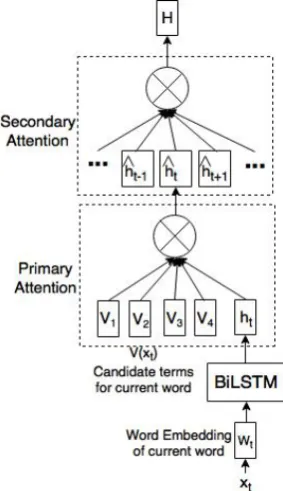
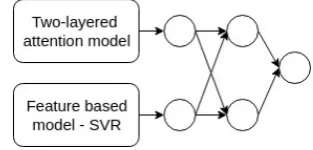
[image:2.595.110.252.313.559.2]We propose a two-layered attention network which leverages external knowledge for sentiment analysis. It consists of a bidirectional Long Short-Term Memory (BiLSTM) (Graves et al., 2005) based word encoder, word level attention mech-anism for capturing the background knowledge and a sentence level attention mechanism aimed at grasping the context and the important words. The output of the two-layered attention network is then ensembled with the output of the feature based SVR using the Multilayer perceptron based approach described in Akhtar et al. (2017). The overall ensembled system is shown in Figure 2. Each of the components is explained in the fol-lowing subsections and an overview of the two-layered attention network is depicted in Figure1.
Figure 1: Two-layered attention network
2.1 Two Layered Attention Model 2.1.1 BiLSTM based word encoder
A Long-Short Term Memory (LSTM) is a special kind of Recurrent Neural Network. It handles the long-term dependencies where the current output is dependent on many prior inputs. BiLSTM, in essence, is a combination of two different LSTM - one working in forward and the other working in the backward direction. The contextual informa-tion about both past and future helps in determin-ing the current output.
The two hidden states−→htand←h−tfor forward and
backward LSTM are the information about past and future respectively at any time step t. Their
concatenationht= [−→ht,←h−t] provides complete
in-formation. Each word of the sentence is fed to the network in form of word embeddings which are encoded using the BiLSTM.
2.1.2 Word Level Attention
External knowledge in form of Knowledge Graph Embedding (Yang et al., 2015) or top-k simi-lar words are captured by using the word level attention mechanism. This serves the purpose of primary attention which leverages the external knowledge to get the best representation for each word. At each time step we get V(xt) relevant
terms of each inputxt with vi being the
ding for each term. (Relevant terms and embed-dings are described in next section). The primary attention mechanism assigns an attention coeffi-cient to each of relevant term having index i ∈
V(xt):
αti∝hTtWvvi (1)
whereWv is a parameter matrix to be learned.
mt=
X
i∈V(xt)
αtivi (2)
b
ht=mt+ht (3)
The knowledge aware vector (mt) is calculated
as Equation2, which is concatenated with the hid-den state vector to get the final vector representa-tion for each word.
2.1.3 Sentence Level Attention
The secondary attention mechanism captures im-portant words in a sentence with the help of con-text vectors. Each final vector representing the words is assigned a weight indicating its relative importance with respect to other words. The at-tention coefficientαt for each final vector
repre-sentation is calculated as:
αt∝hcTtWsus (4)
H=X
t
αthbt (5)
whereWsis a parameter matrix andusis the
con-text vector to be learned. His finally fed to a one
2.2 Relevant Terms and Embeddings
External knowledge can provide explicit infor-mation for the model which the training data lacks. This helps the model to make better pre-dictions. We relied on Knowledge Graph Embed-dings based on WordNet and Distributional The-saurus to get relevant terms and their correspond-ing embeddcorrespond-ings for each word in the text.
2.2.1 Knowledge Graph Embedding
WordNet1 is a lexical database which contains
triplets in the form of (subject, relation, object). Both subject and object are synsets in WordNet. Each word in the text serves as the subject of the triplet. The relevant terms for the current word are the triplets having the current word as the sub-ject. We then employ Knowledge Graph Embed-dings to learn the representation of the triplet. A 100-dimensional dense vector representation for each subject, relation and object were learned us-ing the DistMult approach (Yang et al.,2015) and concatenated. These served as the relevant em-beddings. An example of triplet in WordNet is (bronze age,part of,prehistory).
2.2.2 Distributional Thesaurus
Distributional Thesaurus (DT) (Biemann and Riedl, 2013) is an automatically computed word list which ranks words according to their seman-tic similarity. We use a pre-trained DT to expand a current word. For each current word, top-4 tar-get words are found which are the relevant terms. The relevant embeddings are obtained by using a 300-dimensional pre-trained Word2Vec (Mikolov et al.,2013) and GloVe (Pennington et al.,2014) model. An example of the DT expansion of the word ’touchpad’ ismouse,trackball,joystickand
trackpad.
2.3 Feature Based Model - SVR
The following hand-crafted features are extracted and used to train a Support Vector Regression (SVR).
- Tf-Idf: Term frequency-inverse document fre-quency (Tf-Idf) reflects the importance of each word in a document. We use Tf-Idf score as a fea-ture value for each word.
- Lexicon Features: Sentiment lexicons are an important resource for sentiment analysis. We em-ploy the following lexicons: Bing Liu opinion lex-icon (Ding et al., 2008) and MPQA subjectivity
1https://wordnet.princeton.edu
lexicon (Wilson et al.,2005), SentiWordNet ( Bac-cianella et al.,2010) and Vader sentiment (Gilbert,
2014). From the above lexicons we extracted the agreement score (Rao and Srivastava, 2012) and the count of the number of occurrences of all pos-itive and negative words in the text.
[image:3.595.335.492.211.286.2]- Word embedding:We use the 300-dimensional pre-trained Word2Vec and GloVe embedding. The sentence embedding was obtained by concatenat-ing the embeddconcatenat-ing for all words in the sentence.
Figure 2: Multilayer perceptron based ensemble
3 Experiments 3.1 Dataset
We evaluate our proposed approach for sentiment analysis on the benchmark datasets of SemEval-2017 shared task 5. The task ’Fine-Grained Senti-ment Analysis on Financial Microblogs and News’ (Keith Cortis and Davis,2017) had two sub-tracks. Track 1 - ’Microblog Messages’ had 1,700 and 800 train and test instances respectively. Track 2 - ’News Statements & Headlines’ had 1,142 and 491 train and test instances respectively. The task was to predict a regression score in between -1 and 1 indicating the sentiment with -1 being negative and +1 being positive.
3.2 Implementation Details
3.3 Results
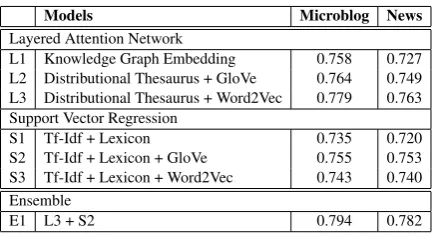
We compare our system with the state-of-the-art systems of SemEval 2017 Task 5 and the system proposed byAkhtar et al.(2017). Table1 shows evaluation of our various models. Team ECNU (Lan et al.,2017) and Fortia-FBK (Mansar et al.,
2017) were the top systems for sub-tracks 1 and 2 respectively. Team ECNU and Fortia-FBK re-ported a cosine similarity of 0.777 and 0.745 for sub-tracks 1 and 2 respectively. Team ECNU em-ployed a number of systems - Support Vector Re-gression, XGBoost Regressor, AdaBoost Regres-sor and Bagging RegresRegres-sor ensembled together. Team Fortia-FBK used a Convolutional Neural Network for this task. The system proposed by
Akhtar et al.utilizes an ensemble of LSTM, GRU, CNN and a SVR and reported a cosine similarity of 0.797 and 0.786 for the two sub-tracks.
Our proposed system has a cosine similarity of 0.794 and 0.782 for sub-tracks 1 and 2 re-spectively. The proposed system performs signif-icantly better than top systems of SemEval 2017 Task 5 for both the tasks. Moreover, the sys-tem performs at par with the syssys-tem proposed by
Akhtar et al. with half the number of subsystems involved in the ensemble. This shows that our pro-posed system is not only robust since it performs for both the task equally well but also powerful as it involves fewer subcomponents while having the same expressive power.
The two-layered attention network alone per-forms better than the best system of SemEval 2017 Task for both the sub-track. It manages to achieve much higher score than any of the deep learn-ing component utilized by the system proposed by
Akhtar et al. (2017) as shown in Table 2. This shows that the two-layered attention network helps to reduce overall model complexity without com-promising the performance.
Models Microblog News
Layered Attention Network
L1 Knowledge Graph Embedding 0.758 0.727 L2 Distributional Thesaurus + GloVe 0.764 0.749 L3 Distributional Thesaurus + Word2Vec 0.779 0.763 Support Vector Regression
S1 Tf-Idf + Lexicon 0.735 0.720 S2 Tf-Idf + Lexicon + GloVe 0.755 0.753 S3 Tf-Idf + Lexicon + Word2Vec 0.743 0.740 Ensemble
[image:4.595.309.528.62.194.2]E1 L3 + S2 0.794 0.782
Table 1: Cosine similarity score of various models on test dataset.
Models Microblog News
Single systems
Mansar et al.(Team Fortia-FBK) - 0.745
Akhtar et al.- LSTM 0.727 0.720
Akhtar et al.- GRU 0.721 0.721
Akhtar et al.- CNN 0.724 0.722
L3 (proposed) 0.779 0.763
Ensembled systems
Lan et al.(Team ECNU) 0.777 0.710
Akhtar et al. 0.797 0.786
[image:4.595.74.291.602.719.2]E1 (proposed) 0.794 0.782
Table 2: Comparison with the state-of-the-art systems.
3.4 Error Analysis
We performed error analysis and observed that the proposed system faces difficulty at times. Follow-ing are the situations when the system failed and incorrectly predicted values of the opposite polar-ity:
•Sometimes the system fails to identify an inten-sifier. In the example below, ’pure’ is used as an intensifier.
Text :Pure garbage stock
Actual:-0.946 Predicted:0.042
•The system fails when it does not have enough
real-world information. In the example below, a low share price is a good opportunity to buy for an individual but from a company’s point of view, a low share price does not indicate a prosperous situation.
Text :Good opportunity to buy
Actual:-0.771 Predicted:0.260
4 Conclusion
5 Acknowledgements
This work was supported by the Kyoto Univer-sity Cooperative Intelligence Short-term Intern-ship Program.
References
Md Shad Akhtar, Abhishek Kumar, Deepanway Ghosal, Asif Ekbal, and Pushpak Bhattacharyya. 2017. A multilayer perceptron based ensemble tech-nique for fine-grained financial sentiment analysis.
In Proceedings of the 2017 Conference on
Empiri-cal Methods in Natural Language Processing, pages
551–557.
Stefano Baccianella, Andrea Esuli, and Fabrizio Sebas-tiani. 2010. Sentiwordnet 3.0: An enhanced lexical resource for sentiment analysis and opinion mining. InLREC, volume 10, pages 2200–2204.
Chris Biemann and Martin Riedl. 2013. Text: now in 2D! A framework for lexical expansion with contex-tual similarity.J. Language Modelling, 1(1):55–95. KyungHyun Cho, Bart van Merrienboer, Dzmitry Bah-danau, and Yoshua Bengio. 2014. On the Properties of Neural Machine Translation: Encoder-Decoder Approaches.CoRR, abs/1409.1259.
Xiaowen Ding, Bing Liu, and Philip S Yu. 2008. A Holistic Lexicon-Based Approach to Opinion Min-ing. InProceedings of the 2008 international
con-ference on web search and data mining, pages 231–
240. ACM.
CJ Hutto Eric Gilbert. 2014. VADER: A Parsimo-nious Rule-based Model for Sentiment Analysis of Social Media Text. In Eighth International Con-ference on Weblogs and Social Media (ICWSM-14). Available at (20/04/16) http://comp. social. gatech. edu/papers/icwsm14. vader. hutto. pdf.
Rohitha Goonatilake and Susantha Herath. 2007. The Volatility of the Stock Market and News.
Interna-tional Research Journal of Finance and Economics,
3(11):53–65.
Alex Graves, Santiago Fern´andez, and J¨urgen Schmid-huber. 2005. Bidirectional lstm networks for improved phoneme classification and recognition.
In Proceedings of the 15th International
Con-ference on Artificial Neural Networks: Formal
Models and Their Applications - Volume Part II,
ICANN’05, pages 799–804, Berlin, Heidelberg. Springer-Verlag.
Sepp Hochreiter and J¨urgen Schmidhuber. 1997. Long Short-Term Memory. Neural computation, 9(8):1735–1780.
Marjan Van de Kauter, Diane Breesch, and Vronique Hoste. 2015. Fine-grained analysis of explicit and implicit sentiment in financial news articles. Expert Systems with Applications, 42(11):4999 – 5010.
Tobias Daudert Manuela Huerlimann Manel Zarrouk Keith Cortis, Andre Freitas and Brian Davis. 2017. SemEval-2017 Task 5: Fine-Grained Sentiment Analysis on Financial Microblogs and News. In
Proceedings of the 11th International Workshop on
Semantic Evaluations (SemEval-2017), pages 519–
535, Vancouver, Canada. ACL.
Michael Khanarian and David Alwarez-Melis. 2012. Sentiment classification in twitter: A comparison between domain adaptation and distant supervision. Technical report, CSAIL, MIT. Statistical NLP Fi-nal Project.
Yoon Kim. 2014. Convolutional Neural Networks for Sentence Classification. InProceedings of the 2014 Conference on Empirical Methods in Natural Lan-guage Processing, EMNLP 2014, October 25-29, 2014, Doha, Qatar, A meeting of SIGDAT, a Special
Interest Group of the ACL, pages 1746–1751.
Diederik P. Kingma and Jimmy Ba. 2014. Adam: A Method for Stochastic Optimization. CoRR, abs/1412.6980.
Abhishek Kumar, Abhishek Sethi, Md Shad Akhtar, Asif Ekbal, Chris Biemann, and Pushpak Bhat-tacharyya. 2017. Iitpb at semeval-2017 task 5: Sen-timent prediction in financial text. InProceedings of the 11th International Workshop on Semantic
Eval-uation (SemEval-2017), pages 894–898.
Man Lan, Mengxiao Jiang, and Yuanbin Wu. 2017. ECNU at SemEval-2017 Task 5: An Ensemble of Regression Algorithms with Effective Features for Fine-grained Sentiment Analysis in Financial Do-main. In Proceedings of the 11th International
Workshop on Semantic Evaluation (SemEval-2017),
pages 888–893, Vancouver, Canada. ACL.
Youness Mansar, Lorenzo Gatti, Sira Ferradans, Marco Guerini, and Jacopo Staiano. 2017. Fortia-FBK at SemEval-2017 Task 5: Bullish or Bearish? Infer-ring Sentiment towards Brands from Financial News Headlines. InProceedings of the 11th International
Workshop on Semantic Evaluation (SemEval-2017),
pages 817–822, Vancouver, Canada. ACL.
Tomas Mikolov, Ilya Sutskever, Kai Chen, Greg S. Cor-rado, and Jeff Dean. 2013. Distributed representa-tions of words and phrases and their compositional-ity. InAdvances in neural information processing
systems, pages 3111–3119, Lake Tahoe, NV, USA.
Marvin Minsky. 1986. The Society of Mind. Simon & Schuster, Inc., New York, NY, USA.
Nuno Oliveira, Paulo Cortez, and Nelson Areal. 2013. On the Predictability of Stock Market Behavior Us-ing StockTwits Sentiment and PostUs-ing Volume. In
EPIA, volume 8154 ofLecture Notes in Computer Science, pages 355–365. Springer.
word representation. InEmpirical Methods in
Nat-ural Language Processing (EMNLP), pages 1532–
1543.
Tushar Rao and Saket Srivastava. 2012. Analyzing stock market movements using twitter sentiment analysis. InProceedings of the 2012 International Conference on Advances in Social Networks
Anal-ysis and Mining (ASONAM 2012), pages 119–123.
IEEE Computer Society.
Robert P. Schumaker and Hsinchun Chen. 2009. Tex-tual Analysis of Stock Market Prediction Using Breaking Financial News: The AZFin Text System.
ACM Transactions on Information Systems, 27(2).
Jianfeng Si, Arjun Mukherjee, Bing Liu, Qing Li, Huayi Li, and Xiaotie Deng. 2013. Exploiting topic based twitter sentiment for stock prediction. In Pro-ceedings of the 51st Annual Meeting of the Associa-tion for ComputaAssocia-tional Linguistics (Volume 2: Short Papers), pages 24–29, Sofia, Bulgaria. Association for Computational Linguistics.
Jasmina Smailovi´c, Miha Grˇcar, Nada Lavraˇc, and Martin ˇZnidarˇsiˇc. 2014. Stream-based active learn-ing for sentiment analysis in the financial domain.
Information Sciences, 285:181–203.
Alex J. Smola and Bernhard Sch¨olkopf. 2004. A Tu-torial on Support Vector Regression. Statistics and
Computing, 14(3):199–222.
Nitish Srivastava, Geoffrey Hinton, Alex Krizhevsky, Ilya Sutskever, and Ruslan Salakhutdinov. 2014. Dropout: A simple way to prevent neural networks from overfitting. Journal of Machine Learning
Re-search, 15:1929–1958.
Theresa Wilson, Janyce Wiebe, and Paul Hoffmann. 2005. Recognizing Contextual Polarity in Phrase-level Sentiment Analysis. In Proceedings of the Conference on Human Language Technology and Empirical Methods in Natural Language Process-ing, pages 347–354. Association for Computational Linguistics.
Bishan Yang, Wen-tau Yih, Xiaodong He, Jianfeng Gao, and Li Deng. 2015. Embedding entities and relations for learning and inference in knowledge bases. In International Conference on Learning Representations (ICLR).
Zichao Yang, Diyi Yang, Chris Dyer, Xiaodong He, Alex Smola, and Eduard Hovy. 2016. Hierarchi-cal attention networks for document classification.
InProceedings of the 2016 Conference of the North
American Chapter of the Association for
Computa-tional Linguistics: Human Language Technologies,