Proceedings of NAACL-HLT 2016 (Demonstrations), pages 67–71,
A Tag-based English Math Word Problem Solver
with Understanding, Reasoning and Explanation
Chao-Chun Liang, Kuang-Yi Hsu, Chien-Tsung Huang,
Chung-Min Li, Shen-Yu Miao, Keh-Yih Su
Institute of Information Science, Academia Sinica, Taiwan
{ccliang, ianhsu, joecth, cmli, jackymiu, kysu}@iis.sinica.edu.tw
Abstract
This paper presents a tag-based statistical math word problem solver with understand-ing, reasonunderstand-ing, and explanation. It analyzes the text and transforms both body and ques-tion parts into their tag-based logic forms, and then performs inference on them. The pro-posed tag-based approach provides the flexi-bility for annotating an extracted math quanti-ty with its associated syntactic and semantic information, which can be used to identify the desired operand and filter out irrelevant quan-tities. The proposed approach is thus less sen-sitive to the irrelevant information and could provide the answer more precisely. Also, it can handle much more problem types other than addition and subtraction.
1
Introduction
The math word problem (MWP) (Mukherjee and Garain, 2008) is frequently chosen to study natural language understanding due to the following rea-sons: (1) Since the answer for the MWP cannot be extracted by simply performing keyword/pattern matching, MWP can clearly show the merits of understanding and inference. (2) As MWP usually possesses less complicated syntax and requires less amount of domain knowledge, it can let the re-searcher focus on the task of understanding and reasoning. (3) The body part of MWP (which men-tions the given information for solving the problem) consists of only a few sentences. The
understand-ing and reasonunderstand-ing procedure could be checked more efficiently. (4) The MWP solver has its own
standalone applications such as Computer Math
Tutor and Helper for Math in Daily Life.
Previous English MWP solvers can be classified into three categories: (1) Rule-based approaches with logic inference (Bobrow, 1964; Slagle, 1965), which apply rules to get the answer (via identifying entities, quantities, operations, etc.) with a logic in-ference engine. (2) Rule-based approaches without logic inference (Charniak, 1968 and 1969; Gelb, 1971; Ballard, 1979; Biermann and Ballard, 1980; Biermann et al., 1982; Fletcher, 1985; Dellarosa, 1986; Bakman, 2007; Liguda and Pfeiffer, 2012; Hosseini et al., 2014), which apply rules (usually defined as schemata) to get the answer without a logic inference engine. (3) Purely statistic-based approaches (Kushman et al., 2014; Roy et al., 2015), which use statistical models to identify enti-ties, quantienti-ties, operations, and get the answer without conducting language analysis or inference. The main problem of the rule-based approaches mentioned above is that the coverage rate problem is serious, as rules with wide coverage are difficult and expensive to construct. Also, it is awkward in resolving ambiguity problems. Besides, most of
them only handle addition and subtraction these
two math operations. On the other hand, the main problem of those approaches without adopting log-ic inference is that they cannot share the common reasoning part among various problem types. In contrast, the main problems of those purely statis-tical approaches are that they are sensitive to
evant information and that the performance deteri-orates significantly when they encounter compli-cated problems (Hosseini et al., 2014), because the problem is solved without first understanding the text. Besides, they only handle algebra problems.
A tag-based statistical English MWP solver is thus proposed to perform understanding and rea-soning, and avoid the problems mentioned above. The text of the MWP is first analyzed into its cor-responding syntactic tree and then annotated with resolved co-reference chains. Afterwards, it is converted into the logic form via a few mapping rules. The obtained logic form is further mapped into the corresponding domain dependent generic concepts (also expressed in logic form). Finally, the logic inference is performed on those logic statements to get the answer. Various statistical classifiers are applied when there are choices.
Since different questions could be asked for the same given body text, we keep all syntactic rela-tions in the logic form, which are regarded as vari-ous tags for selecting the appropriate operands
re-lated to the specified question. For example, “Fred
picked 36 limes” will be converted into “quan(q1, #, lime)&verb(q1, pick)&nsubj(q1, Fred) = 36” (where tags are connected with logic “&”), in
which the quantity “36” is identified with a label
“q1” and attached with its associated tags. The
proposed tag provides the flexibility for annotating a given math quantity with associated syntactic and semantic information, which can be used to identi-fy the desired operand and filter out irrelevant quantities. It thus makes our MWP solver less sen-sitive to the irrelevant information and could pro-vide the answer more precisely.
2
System Framework
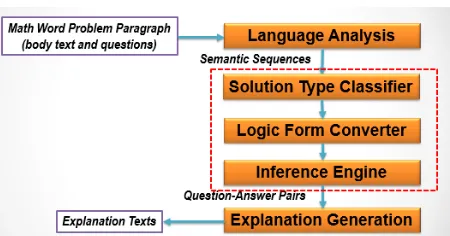
The block diagram of proposed math word prob-lem solver is shown in Figure 1. First, each
sen-tence in an MWP is analyzed by the Language
An-alyzer (LA) module. The associated linguistic
in-formation is then sent to the Solution Type
Classi-fier (STC) to find out the corresponding math
op-eration. Afterwards, they are converted into the
logic form by the Logic Form Converter (LFC).
The Inference Engine (IE) then obtains the answer from those obtained logic expressions. Finally, the Explanation Generator (EG) module will explain how the answer is obtained according to the given
reasoning chain (Russel and Norvig, 2009). Among those modules, the STC is responsible for suggesting a way (i.e., a solution type such as addition, subtraction, multiplication, division, etc.) to solve the problem for each question of the MWP. The LFC extracts the related facts from the given linguistic information and then represents those
facts as the first-order logic (FOL)
predi-cates/functions (Russel and Norvig, 2009). It also transforms each question into a FOL-like utility function according to the suggested solution type. The IE then derives new facts according to infer-ence rules and old facts provided by the LFC. It is also responsible for providing utilities to perform math operations on related facts to get the answer. Detailed description of each module is given below.
2.1
Language AnalysisThe Stanford CoreNLP suite(Manning et al., 2014)
is adopted as our LA, which enables a list of anno-tators to generate the necessary linguistic infor-mation. The list includes: tokenization, sentence splitting, POS tagging, lemmatization, named enti-ty recognition, parsing and co-reference resolution. The generated linguistic representation mainly de-picts the syntactic relations between its words. To solve MWPs, it is crucial to know the relations be-tween various entities. Dependency relation and co-reference resolution will provide such infor-mation.
2.2
Solution Type Identification [image:2.612.315.540.77.195.2]The STC will select a math operation (that LFC should adopt to solve the problem) based on the global information across various input sentences. Table 1 shows 12 different solution types currently provided. A SVM classifier with linear kernel functions (Chang and Lin, 2011) is used, and it
adopted various featusets: (1) verb category re-lated features, (2) various keyword indicators, and (3) different pattern-matching indicators for vari-ous specified aggregative patterns.
2.3
Logic Form TransformationA two-stage approach is adopted to transform the linguistic representation of a sentence into its cor-responding logic forms. In the first stage, the FOL predicates are generated (via a few deterministic mapping rules) by traversing the input linguistic
representation. For example, the sentence “Fred
picks 36 limes” will be transformed into the fol-lowing FOL predicates separated by the logic AND operator “&”:
verb(v1,pick)&nsubj(v1, Fred)&
dobj(v1,n1)&head(n1, lime)&nummod(n1, 36) All the first arguments of the above FOL predi-cates (i.e., v1 and n1) are identifies, and the predi-cate-names are the domain-independent syntactic dependency relation of the constituents in the de-pendency structure.
The domain-dependent logic forms are non-deterministically generated in the second stage, which are derived from crucial math facts associ-ated with quantities and relations between quanti-ties. The following FOL function is used to de-scribe the facts about quantities:
𝑞𝑞𝑞𝑞𝑞𝑞𝑞𝑞(𝑞𝑞𝑞𝑞𝑞𝑞𝑞𝑞𝑖𝑖𝑖𝑖, 𝑞𝑞𝑞𝑞𝑢𝑢𝑡𝑡𝑖𝑖𝑖𝑖, 𝑜𝑜𝑜𝑜𝑜𝑜𝑜𝑜𝑜𝑜𝑡𝑡𝑖𝑖𝑖𝑖) = 𝑞𝑞𝑞𝑞𝑛𝑛𝑜𝑜𝑜𝑜𝑛𝑛 (1) For example, “quan(q1, #, lime)=36” means “36 limes” (the second argument is the unit adopted, and ignored here). Besides domain-dependent facts, some auxiliary domain-independent facts associat-ed with the math fact are also creatassociat-ed in this stage to help the IE to find the solutions. For example, “verb(q1, pick)&nsubj(q1, Fred)” is the associated auxiliary facts of “quan(q1, #, lime)=36”. Those auxiliary facts are our proposed tags to make the system less sensitive to the irrelevant information. They also provide the flexibility of handling vari-ous kinds of possible questions.
The questions in the MWP will be transformed into FOL-like utility functions provided by the IE according to the suggested solution type. Take the
question “How many limes were picked in total?”
as an example. The STC will assign the “Sum”
op-eration type to it. Based on that, the LFC will gen-erate the FOL function “Sum(quan(?q, #, limes), verb(?q, pick)” to search all quantities that are
as-sociated with object “lime” and also attached with
the verb tag “pick”.
2.4
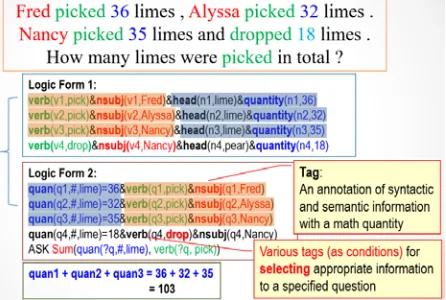
Logic InferenceThe IE is used to find the solution of an MWP. It is responsible for providing utilities to select desired facts and then obtain the answer by taking math operations on those selected facts. In addition, it is also responsible for using inference rules to derive new facts from those facts which are directly de-rived from the description of the MWP. Consider the example shown in Figure 2, the IE will first se-lect all qualified quantities which match “quan(?q, #, lime)” and with a “pick” verb tag, and then
per-form a “Sum” operation on them. The irrelevant
quantity “quan(q4, #, pear)” in that example is thus pruned out as its verb tag is “drop”, not “pick”. The answer is then obtained by summing those quantities q1, q2 and q3.
2.5
Explanation GenerationBased on the reasoning chain generated from the IE (an example is shown in Figure 3), a math oper-ation oriented approach is adopted to explain how the answer is obtained (Huang et al., 2015). A spe-cific template is used to generate the explanation text for each kind of operation. Consider the
ex-Addition Multiplication Surplus Subtraction
[image:3.612.74.286.145.208.2]Common-Division Comparison Sum Floor-Division Algebra Difference Ceil-Division Time Variant
Table 1: Various solution types for solving the MWP
[image:3.612.316.539.436.586.2]ample given in Figure 2, the template for “Sum”
operation would be “Totally verb Child_1 +
Child_2 + Child_3 + ...+ Child_n = Parent.”.
Ac-cording to that template and the reasoning chain shown in Figure 3, The EG will generate the
ex-planation text “Totally pick 36 limes + 32 limes +
35 limes = 103 limes”, which explains that the ob-tained answer is a summation of “36 limes”, “32 limes” and “35 limes”.
3
Demonstration Outline
The MWP solver comprises a web user interface and a processing server. The web interface is used to input the problem and display the processing outputs (from each module) of the submitted MWP. The server is responsible to process the submitted problem to get the answer.
The user can use the web interface (Figure 4) to submit various MWPs. After an MWP is submitted, various processing modules will be invoked in a pipelined manner (shown in Figure 1) to solve the given problem. Once the process is finished, the user can browse the outputs generated from each module: (1) Parse Trees, Dependency and Co-Reference chains, which are from the language an-alyzer. (2) Corresponding linguistic representations, which are converted from the above language analysis result. (3) Suggested solution type, which identifies the desired math operation that the LFC should adopt. (4) Obtained logical forms, which
are transformed from the linguistic representation. (5) Generated reasoning chains and explanation text, which explains how the problem is solved.
Anonline demo can be found at:
http://nlul.iis.sinica.edu.tw/Engl
ishMathSolver/mathDemo.py.
4
Experiments
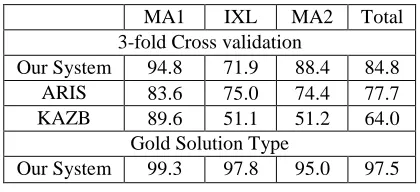
The experiments are performed on the datasets MA1, MA2 and IXL provided by Hosseini et al. (2014), which are the first publically available da-tasets that can be used to compare various systems. The datasets include 395 problems and 1,483 sen-tences in total. MA1 covers simple MWPs on ad-dition and subtraction for third, fourth, and fifth graders. Problems in MA2 includes more irrele-vant information compared to the other two da-tasets, and IXL includes more information gaps (Hosseini et al., 2014). The performance of our system is compared with ARIS (Hosseini et al., 2014) which is a rule-based system that changes the entity attribute according to the schema. The result is also compared with KAZB (Kushman et al., 2014), which is a purely statistical approach that aligns the text with various pre-extracted equation templates. We follow the same evaluation setting. Table 2 shows that our system significant-ly outperforms them in overall performance.
5
Conclusion
A tag-based statistical framework is proposed to perform understanding and reasoning for solving MWPs. The adopted tag can help identify desired operands and filter out irrelevant quantities. Many rule-based approaches only handle addition and subtraction math operations, but we can solve much more problems types, such as Multiplication, Division, Comparison, Algebra, etc.
[image:4.612.328.538.467.563.2]Figure 3: The reasoning Chain from the Inference Engine
Figure 4: A web interface of the MWP solver
MA1 IXL MA2 Total 3-fold Cross validation
Our System 94.8 71.9 88.4 84.8 ARIS 83.6 75.0 74.4 77.7 KAZB 89.6 51.1 51.2 64.0
Gold Solution Type
Our System 99.3 97.8 95.0 97.5
References
A. Mukherjee, U. Garain. 2008. A review of methods for automatic understanding of natural language mathematical problems, Artif Intell Rev.
D.G. Bobrow. 1964. Natural language input for a com-puter problem solving system, Ph.D. Dissertation, Massachusetts Institute of Technology.
J.R. Slagle. 1965. Experiments with a deductive ques-tion-answering program, J-CACM 8:792-798. E. Charniak, CARPS. 1968. A program which solves
calculus word problems, Report MAC-TR-51, Project MAC, MIT.
E. Charniak. 1969. Computer solution of calculus word problems, In Proc. of International Joint Conference on Artificial Intelligence.
D. Dellarosa. 1986. A computer simulation of children's arithmetic word-problem solving, Behavior Research Methods, Instraments, & Computers, 18 147-154. Y. Bakman. 2007. Robust Understanding of Word
Prob-lems With Extraneous Information.
J.P. Gelb. 1971. Experiments with a natural language problem solving system, In Pros. of IJCAI-71. B. Ballard. A. Biermann. 1979. PROGRAMMING IN
NATURAL LANGUAGE : "NLC" AS A PROTO-TYPE, ACM-Webinar.
A.W. Biermann, B.W. Ballard 1980. Toward Natural Language Computation American Journal of Compu-tational Linguistic, 6.
A. Biermann, R. Rodman, B. Ballard, T. Betancourt, G. Bilbro, H. Deas, L. Fineman, P. Fink, K. Gilbert, D. Gregory, F. Heidlage. 1982. INTERACTIVE NAT-URAL LANGUAGE PROBLEM SOLVING:A PRAGMATIC APPROACH In Pros. of the first con-ference on applied natural language processing. C.R. Fletcher. 1985. COMPUTER SIMULATION --
Understanding and solving arithmetic word prob-lems: A computer simulation, Behavior Research Methods, Instruments, & Computers, 17 565-571. M.J. Hosseini, H. Hajishirzi, O. Etzioni, N. Kushman.
2014. Learning to Solve Arithmetic Word Problems with Verb Categorization, EMNLP.
N. Kushman, Y. Artzi, L. Zettlemoyer, R. Barzilay, 2014. Learning to Automatically Solve Algebra Word Problems, ACL.
C. Liguda, T. Pfeiffer, 2012, Modeling Math Word Prob-lems with Augmented Semantic Networks, NLDB. S.I. Roy, T.J.H. Vieira, D.I. Roth. 2015. Reasoning
about Quantities in Natural Language, TACL, 3 1-13. S. J. Russell and P. Norvig, 2009. Artificial Intelligence:
A Modern Approach (3rd Edition), Prentice Hall. C.D. Manning, M. Surdeanu, J. Bauer, J. Finkel, S. J.
Bethard, and D. McClosky. 2014. The Stanford CoreNLP Natural Language Processing Toolkit In Proceedings of the 52nd Annual Meeting of the
As-sociation for Computational Linguistics: System Demonstrations, pp. 55-60.
C.-C. Chang, C.-J. Lin. 2011. LIBSVM: A library for support vector machines. ACM Transactions on Intel-ligent Systems and Technology.
Y.-C. Lin, C.-C. Liang, K.-Y. Hsu, C.-T. Huang, S.-Y. Miao, W.-Y. Ma, L.-W. Ku, C.-J. Liau, K.-Y. Su. 2015. Designing a Tag-Based Statistical Math Word Problem Solver with Reasoning and Explanation, In-ternational Journal of Computational Linguistics and Chinese Language Processing, 20(2), 1-26.