A Thesis Submitted for the Degree of PhD at the University of Warwick
Permanent WRAP URL:
http://wrap.warwick.ac.uk/111668
Copyright and reuse:
This thesis is made available online and is protected by original copyright. Please scroll down to view the document itself.
Please refer to the repository record for this item for information to help you to cite it. Our policy information is available from the repository home page.
A Visual Adaptive Authoring Framework for Adaptive Hypermedia
By
Javed Arif Khan
A thesis submitted in partial fulfilment of the requirements for the degree of
Contents
1 Introduction ... 16
1.1 Background and Motivation ... 16
1.2 Aims ... 18
1.3 Problem Description and Challenges ... 18
1.4 Research Questions ... 19
1.5 Objectives ... 20
1.6 Research Contributions ... 22
1.7 Thesis Outline ... 23
2 Background and Related Research... 25
2.1 Introduction ... 25
2.2 What is an Adaptive Educational Hypermedia System? ... 26
2.3 Authoring of Adaptive Educational Hypermedia Systems ... 27
2.4 Frameworks for Adaptive Hypermedia ... 28
2.5 Authoring Systems for Adaptive Hypermedia... 36
2.6 Generic Problems with the Authoring in Adaptive Hypermedia Systems ... 55
2.7 Authoring Imperatives ... 58
2.8 Interoperability between Adaptive Educational Hypermedia Systems ... 59
2.9 Visual Programming Systems ... 60
2.10 Conclusion... 63
3 Methodology ... 64
3.1 Literature Review and Background Review ... 64
3.4 Experimental Methodology ... 70
3.5 Summary and discussion ... 78
4 Theoretical Framework: Author Roles & Functionality Matrix for Adaptive Authoring Tools .. 79
4.1 Introduction ... 79
4.2 Author Role Functionality Matrix ... 80
4.3 Conclusion ... 87
5 Creating a Visual language for LAG and constructing VASE ... 89
5.1 Introduction ... 89
5.2 LAGBlocks: the visual language for adaptive hypermedia ... 89
5.3 Enhancing the LAG programming language ... 97
5.4 VASE 1.0: the initial approach towards a visual adaptive authoring tool ... 97
5.5 VASE 2.0: The Extended Adaptive Authoring System ... 104
5.6 Conclusions ... 120
6 Evaluation of VASE: the Visual Adaptive Strategy Environment ... 121
6.1 Introduction ... 121
6.2 Hypotheses ... 122
6.3 Non-professional Programmers’ Case Study ... 123
7.2 Addressing the Research Objectives ... 173
7.3 Original Contributions ... 176
7.4 Recommendations for Future Work ... 177
8 References ... 179
APPENDIX A: LAG Grammar ... 188
APPENDIX B: LAG Grammar Semantics ... 189
APPENDIX C: LAG Extension ... 192
APPENDIX D: Novice Group Evaluation ... 193
APPENDIX E: Non-professional programmer evaluation results ... 194
APPENDIX F: The CAF Language Format ... 199
APPENDIX G: ADE 0.2 and LAG 4.0 Demonstration Courses ... 200
List of Figures
Figure 1: Adaptive Hypermedia Application Model (AHAM) ... 28
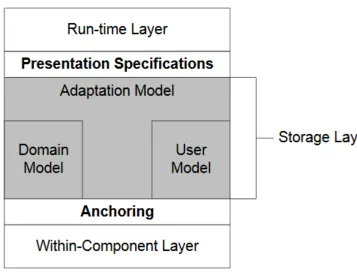
Figure 2: LAOS framework (5 Layers) [20] ... 29
Figure 3: An example of course material shown in InterBook in the Netscape Browser [28] ... 37
Figure 4: AHA Adaptation Rules Form ... 39
Figure 5: Subject Matter Concept Space Editor (SMCS) in ACCT ... 41
Figure 6: Narrative Model Builder in ACCT... 42
Figure 7: APeLS architecture... 43
Figure 8: ACTSim Composition Tool ... 45
Figure 9: Authoring Pages Separately (Left) or via Template Pages (Right) ... 47
Figure 10: Consistency in presentation through Template Pages in GRAPPLE authoring ... 48
Figure 11: Creating the ‘Milky Way’ domain model with the GRAPPLE Domain Model tool ... 49
Figure 12: Adding two PRT relations in the CAM Model of the ‘Milky Way’ ... 51
Figure 13: CAM created in the CAM Model, by dragging PRTs from the left menu ... 51
Figure 14: PEAL Adaptive Strategy Editor ... 52
Figure 15: PEAL Graphical Editor... 53
Figure 16: CodeBlocks - IF Block ... 61
Figure 17: Blockly Block ... 62
Figure 25: LAGBlock - PM construct – to represent the LAG Presentation Model ... 95
Figure 26: LAGBlock - GM construct - to represent the LAG Goal Model ... 95
Figure 27: LAGBlock code (left) versus LAG code (right) ... 96
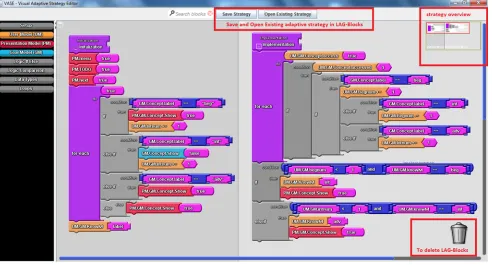
Figure 28: ‘For Each’ Adaptive Strategy in LAGBlocks ... 97
Figure 29: VASE Interaction with external tools... 98
Figure 30: Screenshot of VASE 1.0 ... 99
Figure 31: Dimming Strategy in LAGBlocks in VASE 1.0 ... 100
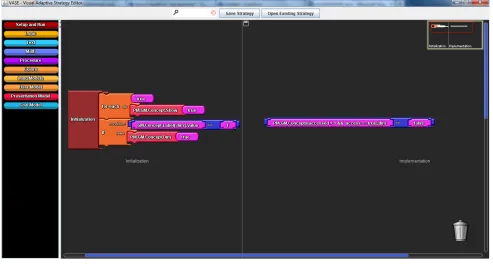
Figure 32: VASE 1.0: the start ... 101
Figure 33: VASE 1.0 Interface - Initialization (on left pane) Implementation (on right pane) ... 101
Figure 34: VASE 1.0 Interface – red boxes to represent various features ... 102
Figure 35: VASE 1.0: To show how compactness works ... 103
Figure 36: VASE 2.0 System Architecture... 105
Figure 37: VASE 2.0 Architecture Diagram ... 106
Figure 38: VASE 2.0 Logic Blocks ... 108
Figure 39: VASE 2.0 Logic Blocks complex usage... 109
Figure 40: VASE 2.0 User Model Blocks ... 110
Figure 41: VASE 2.0 Goal Model Blocks ... 111
Figure 42: VASE 2.0 Presentation Model Blocks 1 of 2 ... 112
Figure 43: VASE 2.0 Presentation Blocks 2 of 2 ... 113
Figure 44: VASE 2.0 Dynamic LAGBlocks ... 114
Figure 45: VASE 2.0 Dynamic LAGBlock addition ... 115
Figure 46: VASE 2.0 Additional LAGBlock options ... 116
Figure 47: VASE 2.0 Collapse block option ... 116
Figure 48: VASE 2.0 Expand Block option ... 117
List of Tables
Table 1: Research Problem mapping to Research Questions and Objectives ... 23
Table 2: Comparison of well-known adaptive hypermedia authoring systems ... 56
Table 3: Raw Data Collected from Users and their interpretations ... 128
Table 4: Authoring System Requirements ... 131
Table 5: Questionnaire mapping onto the research questions ... 134
Table 6: Normality of Answers to Questionnaire for VASE 2.0 and PEAL ... 137
Table 7: VASE 2.0 Results for questions related to user role for H1 ... 140
Table 8: PEAL Results for questions related to user role for H1 ... 142
Table 9: PEAL versus VASE overall results for the questions related to user roles (H1) ... 143
Table 10: VASE 2.0 Results for Benefits questions for H2 ... 144
Table 11: PEAL Results for Benefits questions for H2 ... 147
Table 12: PEAL versus VASE Results for the questions related to benefits (H2) ... 149
Table 13: VASE 2.0 Results for usability questions for H3 ... 150
Table 14: PEAL Results for usability questions for H3 ... 152
Table 15: PEAL versus VASE Results for the questions related to usability (H3) ... 153
Table 16: VASE 2.0 Results for Quality questions for H4 ... 154
Table 17: PEAL Results for Quality questions for H4 ... 155
Table 18: PEAL versus VASE Results for questions related to Quality (H4) ... 156
Table 19: Summary of PEAL versus VASE Results for question related to each category ... 156
Acknowledgements
My research interest in hypermedia originates from a project on hypermedia structures.
In 2010, I visited the Computer Science department at the University of Warwick. There I met my supervisor, Dr. Alexandra Cristea and found our common interest on adaptive hypermedia. She introduced me to the field of adaptive hypermedia by demonstrating the MOT (My Online Teacher) and ADE (Adaptive Delivery Engine) Systems.
They had very basic features; over the course of the following year, MOT was developed iteratively by Jonny Foss. MOT was further developed and enhanced during the GRAPPLE FP7 project.
The MOT system's storage architecture was changed from a tree to a graph based structure, which meant that it could be more flexible in storing adaptations. MOT evaluation revealed that PEAL, the authoring system used by MOT, was not adequate to create adaptive specification, especially for non-computer-savvy authors. This meant that such authors without technical knowledge seriously struggled to use and to create adaptive specifications from scratch.
Declaration
This thesis is submitted to the University of Warwick in support of my application for the degree of Doctor of Philosophy. I hereby declare that, except where acknowledged, the work presented in this thesis has been composed by myself and has not been submitted elsewhere for the purpose of obtaining an academic degree.
Javed Arif Khan
Signature: ___________________________
Publications
Some of the material in this thesis is based on a paper that I have previously published (as first author, with a contribution of over 80%) as described below.
The Introduction presents my own research questions, whilst Chapter 2 describes related research. Chapter 3 describes the research methodology on data collection, analysis and evaluation.
Chapter 4’s description of the functionality matrix and user-roles in adaptive hypermedia is loosely based on the following paper:
Khan, J. A, Cristea, A.I, & Stewart, C. (2011) “Adaptive Authoring of Adaptive Hypermedia towards, Role-based, Adaptive Authoring”, CATE 2011, pp. 734-042. Publication date July 2011.
Chapter 5 presents a visual programming framework (VASE) for the LAG language and it is based on the ideas that were published in the following papers:
Khan, J. A and Cristea, A.I. (2015) "Adaptive Hypermedia: A simple way to create Adaptive Strategies using LAGBlocks". In S. Carliner, C. Fulford & N. Ostashewski (Eds.), Proceedings of EdMedia: World Conference on Educational Media and Technology 2015 (pp. 195-202). Association for the Advancement of Computing in Education (AACE).
Abstract
In a linear hypermedia system, all users are offered a standard series of hyperlinks. Adaptive Hypermedia
(AH) tailors what the user sees to the user’s goals, abilities, interests, knowledge and preferences. Adaptive
Hypermedia is said to be the answer to the 'lost in hyperspace' phenomenon, where the user has too many
hyperlinks to choose from, and has little knowledge to select the most appropriate hyperlink. AH offers a
selection of links and content that is most appropriate to the current user. In an Adaptive Educational
Hypermedia (AEH) course, a student’s learning experiences can be personalised using a User Model
(UM), which could include information such as the student’s knowledge level, preferences and culture.
Beside these basic components, a Goal Model (GM) can represent the goal the users should meet and a
Domain Model (DM) would represent the knowledge domain. Adaptive strategies are sets of adaptive
rules that can be applied to these models, to allow the personalisation of the course for students, according
to their needs.
From the many interacting elements, it is clear that the authoring process is a bottleneck in the adaptive
course creation, which needs to be improved in terms of interoperability, usability and reuse of the
adaptive behaviour (strategies). Authoring of Adaptive Hypermedia is considered to be difficult and time
consuming. There is great scope for improving authoring tools in Adaptive Educational Hypermedia
system, to aid already burdened authors to create adaptive courses easily.
Adaptation specifications are very useful in creating adaptive behaviours, to support the needs of a group
of learners. Authors often lack the time or the skills needed to create new adaptation specifications from
scratch. Creating an adaptation specification requires the author to know and remember the programming
language syntax, which places a knowledge barrier for the author. LAG is a complete and useful
programming language, which, however, is considered too complex for authors to deal with directly.
This thesis thus proposes a visual framework (LAGBlocks) for the LAG adaptation language and an
enables authors to create adaptive specifications with ease and assist authors in creating adaptive
specifications which promote the “separation of concern”. The VASE authoring tool offers code
completeness, correctness at design time, and also allows for adaptive strategies to be used within other
tools for adaptive hypermedia. The goal is thus to make adaptive specifications easier, to create and to
share for authors with little or no programming knowledge and experience.
This thesis looks at three aspects of authoring in adaptive educational hypermedia systems. The first aspect
of the thesis is concerned with problems faced by the author of an adaptive hypermedia system; the second
aspect is concerned with describing the findings gathered from investigating the previously developed
authoring tools; and the final aspect of the thesis is concerned with the proposal, the implementation and
the evaluation of a new authoring tool that improves the authoring process for authors with different
knowledge, background and experience. The purpose of the new tool, VASE, is to enable authors to create
adaptive strategies in a puzzle-building manner; moreover, the created adaptive strategies could be used
within (are compatible with) other systems in adaptive hypermedia, which use the LAG programming
Abbreviations
AEH Adaptive Educational Hypermedia AH Adaptive Hypermedia
AHA! Adaptive Hypermedia for All!
AHAM Adaptive Hypermedia Application Model AHS Adaptive Hypermedia Systems
ALE Adaptive Learning Environment AM Adaptation Model
CAF Common Adaptation Format CAM Concept Adaptation Model CRT Concept Relationship Type DM Domain Model
GAM Generic Adaptivity Model
GAHM Goldsmiths Adaptive Hypermedia Model GAL GRAPPLE Adaptation Language
GAT GRAPPLE Authoring Tool GM Goal and Constraints Model
GRAPPLE Generic Responsive Adaptive Personalized Learning Environment
HTML5 Hypertext Mark-up Language (version 5) LAG Layers of Adaptation Granularity
LAG-XLS LAG XML Learning Styles XXI
LAOS Layered WWW AH Authoring Model and their corresponding Algebraic Operators LMS Learning Management System
LO Learning Object
LOM Learning Object Metadata
PEAL Programming Environment for Adaptation Language PM Presentation Model
PRT Pedagogical Relationship Type UM User Model
1
Introduction
1.1 Background and Motivation
The number of internet users has grown exponentially: it has increased from 738 million in 2000 to 4.012 billion in 2018, up 7% year-on-year increase. The new 2018 Global Digital report from ‘We Are Social’ states that there are now more than 4 billion people around the world using the internet [1]. An increasing number of people, businesses, and establishments are turning to eLearning, as they appreciate its usefulness and its suitability. The global eLearning market is estimated to reach US$325 billion by 2025, with growth of around 7.2% over the next decade [2].
However, current learning management systems (e.g. Blackboard [3], Sakai [4], etc.) still offer a static approach to the delivery of learning materials. This means that every learner is given the same set of learning material. Adaptive Educational Hypermedia (AEH) provides a more personalised and customised approach to the field of eLearning than the out-dated static methods.
AEH enhances the usability of hypermedia, by building a model of various qualities of a learner and applies this information to adapt the content and the navigation to the requirements of the learner. Adaptive strategies are sets of adaptive rules to indicate the conditions under which adaptation behaviours can be applied in AEH [5]. The AEH approach has been shown to be useful, as it displays more relevant content, according to the information stored in various models (user, goal and presentation model.)
1.2 Aims
The research presented in this thesis aims to create a new authoring tool for adaptive hypermedia authors with little or no programming experience1.
Firstly, through analysis of the existing authoring tools, the research aims to generate a set of requirements for a generic Adaptive Hypermedia Authoring System (AHAS). Then, this thesis attempts to address the problems faced by authors in creating adaptive strategies. This is achieved by allowing authors to create adaptive strategies in a puzzle-building manner, via a system called VASE. This thesis implements a visual programming technique to create a visual extension for authoring adaptive strategies in Adaptive Hypermedia.
To evaluate the new environment, the thesis compares a previous generic, complete authoring tool and the new one (PEAL versus VASE) and their authoring paradigms. Additionally, this research also investigates ways of extracting adaptive strategies that have been generated from authoring tools to make adaptive strategies interoperable, to be able to work across different systems.
1.3 Problem Description and Challenges
types. For instance, to create a personalised, rich learning experience for every student, first, the content of the lesson has to be prepared. Different options of the content have to be created for different students, allowing for different paths through the content. Metadata have to be added for the labelling and annotation of the different paths. Lastly, a mechanism must be defined, to guide the student through the different paths. This introduces a complex and convoluted authoring process, if no assistance is provided to the author by the authoring system.
Whilst adaptation specifications are very useful in creating adaptive behaviours, to support the needs of learners, authors often lack the skills needed to create new adaptation specifications from scratch [12]. A wide range of flexible adaptation specifications can only be created by using, as a base, an adaptive programming language, such as LAG [13] (Language for Adaptation Granularity). This poses however additional difficulties, as creating adaptation specifications requires the author to know and remember the programming language syntax [11].
Summarising, this research addresses the following major problems in relation to adaptive authoring;
• The current authoring process is a bottleneck in Adaptive Hypermedia, as demonstrated in the previous literature.
• There is a clear demand for better Adaptive Authoring tools. However:
o Adaptive Strategies are too complex to create, especially for the novice author (non-programming-savvy authors);
o Authors need to learn adaptation languages to perform adaptations.
1.4 Research Questions
provide a structured contribution.
RQ1 - What can be done to simplify and improve the adaptive specification authoring for adaptive
hypermedia?
The research question above led to the following sub-questions.
1.4.1 Refined Research Questions
RQ 1.1 How can an adaptive authoring system render adaptive strategy creation easy for authors with different needs, e.g. knowledge and experience?
RQ 1.2 Are there benefits in using visual programming techniques to create adaptive specifications and if so, what would these benefits be?
RQ 1.3 How can an adaptive authoring system assist authors in an adaptive specification’s correctness and completeness, as well as interoperability?
RQ 1.4 How can the visual programming techniques and technologies be implemented, in order to enhance the adaptive authoring system and adaptation language, and thus provide a high level of effectiveness, efficiency and satisfaction amongst authors?
1.5 Objectives
Conduct a survey which reflects the users’ preferred ways to create adaptive programs {RQ1.1 & RQ1.2}.
Previously developed authoring tools for creating Adaptive Specifications were aimed at the programming-savvy author; this research focuses on creating an authoring tool which is suitable for non-programming-savvy authors - any author without any programming language knowledge. It is believed that this would increase the uptake of adaptive authoring amongst the authors who don't have any knowledge about any programming languages.
Objective 3: - Propose a visual programming framework for implementation, to provide complete and
correct adaptive specifications, and further sustain the “separation of concerns” principles, and
interoperability.
The principle of “separation of concerns” refers to allowing for reusability of the different components created during the (often, very cumbersome, and thus expensive) authoring process. As such, at a minimum, content should be separated from adaptive, personalised behaviour.
LAG [13] (further described in Section 2.4.5) has been chosen as the basis for building the visual framework upon, as it is the language which has been used by many adaptive hypermedia tools, for instance MOT [14], ADE [15], AHA! [16] and PEAL [17]. LAG is also one of the languages which enforces authoring imperative described in the section 2.7, which ensure, arguably, correctness and completeness. Thus, creating a visual framework compatible with LAG would automatically ensure correctness and completeness. This includes research into visual programming techniques to find if the LAG [9] language grammar can be represented visually, while keeping the compatibility with other LAG tools; to design new visual constructs to represent the entire LAG programming language {RQ1.3}. In other words, this means:
• To create the LAG visual Adaptive Specification by using visual programming techniques;
• To represent the entire LAG language grammar in visual programming techniques;
Objective 4 – Implement a visual programming framework to enhance adaptive authoring systems and
adaptation languages.Propose a suitable framework for adaptive authoring, to allow authors to create
visual adaptive specification, by manipulating visual elements to create adaptive specifications, thereby
lowering the programming threshold for authors. {RQ1.4}
The framework should support at least the following, but not be limited by them:
• To be able to create, edit and share existing adaptive specification with other authors;
• To create an authoring tool where visual blocks can be manipulated to create adaptive specifications with little knowledge of programming language;
• The adaptive authoring system based on it should be able to interface with at least one adaptive delivery engine which uses an adaptive programming language to apply adaptations. As a proof of concept, the tool will be interfaced with ADE [15] (Adaptive Delivery Engine), as ADE uses the LAG programming language to apply adaptation. This means that adaptive specifications created in should be able to execute in ADE.
Objective 5 - Conduct a series of experiments that investigate the appropriate approach and
features to design an adaptive authoring system, and to test the practical development of the newly added
features in an adaptive authoring system, addressing the acceptance of the visual form of adaptive
authoring in the evaluations.
• It creates an authoring environment (VASE), in which LAGBlocks can be manipulated, to create adaptive strategies. This adaptive authoring environment allows code completeness and correctness at design, which minimises mistakes in adaptive strategy creation (see Chapter 5 Section 5.5.1).
• It has developed a Functionality Matrix for role-based authoring in Adaptive Hypermedia (see Chapter 4 Section 4.2).
• The work has implemented a LAG Converter – to convert visual the representation of adaptive strategy to text, to make visual strategies interoperable with text based tools, such as ADE [15] (Adaptive Delivery Engine) (see Chapter 5 Section 5.5.3).
The table below summarises at a glance the mapping of the research objectives on the research questions, as well as on the research problem they address.
Table 1: Research Problem mapping to Research Questions and Objectives
Research Problem Research
Question Research Objective
To conduct extensive research into the area to explore the problems faced by the authors in adaptive strategy creation and reuse.
RQ 1.1 Objective 1
To get feedback from the potential users about the preferred
way for adaptive strategy authoring. RQ 1.1, RQ 1.2 Objective 2 Propose a visual programming framework to improve on
adaptive specification authoring. RQ 1.3 Objective 3 To implement a visual programming framework to create an
adaptive authoring tool.
RQ 1.4 Objective 4 To compare the visual authoring tool with a non-visual
authoring tool of equivalent completeness and correctness.
RQ 1.3, RQ 1.4 Objective 5
1.7 Thesis Outline
2
Background and Related Research
2.1 Introduction
Adaptive Hypermedia (AH) [2] enhances the usability of hypermedia, by constructing a model of various characteristics of a user, such as knowledge and preferences, and applies this information to alter the content, to suit, e.g., the needs of a user. In contrast to conventional e-learning systems, where all users are presented the same series of hyperlinks, adaptive hypermedia adapts what the learner sees to the learner's abilities, goals, interests and knowledge [4].
However, although the AH approach has been shown to be beneficial [2], an author faces an array of problems, in order to create an adaptive course and to reuse the material created earlier with different adaptation types. For instance, in order to create a rich learning and personalised experience for every user, firstly, the content of the lesson has to be prepared. Different alternatives of the content have to be created for different users; this leads to different paths through the content. Metadata need to be attached for the annotation and labelling of the different paths. Lastly, a method must be defined to guide the user through the different paths. This introduces an inefficient and convoluted authoring process [10].
Authors may often lack the skills needed to create new adaptation materials from scratch, and hence any improvement in the reusability of adaptation strategies (the adaptive behaviour) is a major help in the authoring process. Several authoring tools have been designed to help authors in adaptive courseware creation. However, most of these tools are designed to address a niche problem in the area and don’t address most of the problems experienced by the majority of authors. This chapter provides a brief introduction to some of the main features offered by the most popular Adaptive Educational Hypermedia systems developed earlier. It also highlights prominent issues surrounding the authoring of adaptive educational hypermedia systems in academia.
solutions for the research problems discussed in Chapter 1, as well as responding to: Objective 1: Conduct an extensive theoretical background research into the area, to find the problems faced by the authors in
adaptive strategy creation and to propose a theoretical framework to improve adaptive authoring for
authors with different needs.
2.2 What is an Adaptive Educational Hypermedia System?
Hypertext” refers to a set of information nodes connected with a set of links in between the nodes, when the information stored in the nodes are not only text, but also graphics, image, audio, animation and video, is known as “Hypermedia”. The main strength of hypermedia systems is that they have a flexible structure and give user great deal of freedom to browse and interact with the information contained within them. It is precisely this freedom that gives rise to many problems; one of the problems that seem inherent within hypermedia systems is that users tend to lose their way in the maze of information within the system. This is commonly referred to as the ‘lost in hyperspace’.
that need to be achieved, often dictated by the institution or the student’s own learning objectives and a
Domain Model (DM) [20] is used to represent the knowledge domain or the subject area, for instance, sports, medical etc. User Model, Goal Model and the Domain Model are manipulated by adaptive strategies [20], to create and deliver an adaptive course for students with different needs and preferences. The adaptive strategy creation, as we shall see, still form the most difficult challenge in the already cumbersome process of authoring of adaptive educational hypermedia, which is considered next.
2.3 Authoring of Adaptive Educational Hypermedia Systems
2.4 Frameworks for Adaptive Hypermedia
Various frameworks have been designed to simplify the design of AH systems. Only relevant frameworks to this research are presented here.
2.4.1 AHAM (Adaptive Hypermedia Application Model)
[image:28.595.44.401.456.733.2]2.4.2 Munich Reference Model
The Munich Reference Model [24] uses UML to specify three separate meta models: the ‘domain meta-model’, the ‘adaptation meta-model’ and the ‘user meta-model’. The Munich model’s meta-models all exists in the ‘Storage Layer’ of the Dexter hypermedia model. Otherwise, this model follows exactly the structure of the AHAM model, and can be used in a similar fashion.
2.4.3 LAOS (Layered Authoring-Model and Operators)
[image:29.595.45.344.291.635.2]LAOS (Layered AHS Authoring-Model and Operators) is an AH authoring model (see [20]).
Figure 2: LAOS framework (5 Layers) [20]
1.Domain Model (the content/media) 2.Goal Model (the objectives)
3.User Model (the users)
4.Adaptation Model (the adaptation) 5.Presentation Model (the presentation).
They are further described in the following sections in greater detail, as it is the main model this work is based on, due to it being on one hand the most expanded framework at the time, as well as being the framework which the LAG language has been built upon.
2.4.3.1 Domain Model (DM)
The Domain Model describes the resources of the hyper-document that are needed for the AHS. These resources represent the content that is usually authored in any learning environment. A hierarchy of knowledge concepts (with attributes) is used to identify the content for the AHS [25].
2.4.3.2 Goal and Constraints Model (GM)
The Goal Model contains information about intentions or objectives of the course. “The goal and constraints model contains all information (resources and links between them) of the adaptive hypermedia system important for a delivery purpose. According to LAOS, within the educational domain, this model filters, regroups and restructures the domain model, with respect to an Instructional goal.” [25]. This model provides the organisational information for the AHS and gives structure to the Domain Model.
2.4.3.4 Adaptation Model (AM)
The Adaptation Model defines the adaptation of the content in the AHS – this is further defined in the LAG model. “The adaptation model is the only part of the LAOS model describing the dynamics of the adaptation process. Whilst the other layers are concerned with the static properties, variables and values required for personalization, the adaptation model brings them together and specifies how they will be used. Hence we can consider that the other sub-models in LAOS specify the ingredients of the personalization process, whilst the adaptation model specifies the recipe. The adaptation model itself is based on the LAG model, the model of three layers of granularity” [25]. This model brings together all the other models and defines their interaction for production of the final AHS.
2.4.3.5 The Presentation Model (PM)
The Presentation Model contains information about adaptation for different devices on which the AHS will be displayed “Presentation has to take into account the physical properties and the environment of the presentation and provide the bridge to the actual code generation for the different platforms. Presentation makes the difference between different devices of display, such as handheld devices, desktops, laptops, etc. This part in the LAOS model is concerned with the formatting so that the information appears nicely in the page…” [25]. This model contains device specific information about the aesthetic display of the AHS.
Combined, these five layers build up a coherent model of the AHS, where variables in the system belong to different models and define factors including the content, user profile, adaptation rules and presentation details. LAOS allows for multi-multi relations of any type; however, the current implemented language only supports the relatedness relations, for compatibility with the MOT authoring environment.
In short, the five semantic layers of LAOS are the following.
2. Goal and constraints model (GM), a constrained version of the domain model. The constraints are based on educational goals and motivations.
3. User model (UM), represents a model of the learner’s educational traits.
4. Adaptation model (AM), a more complex layer that determines the dynamics of the AH system. Traditionally, this layer is composed of IF-THEN rules and therefore the LAOS version also translates such rules at the lowest level.
5. Presentation model (PM), is provided to reflect the physical properties and the environment of the presentation; it reflects choices, such as, the appropriate background contrast to support a learner with poor eyesight.
Each of these semantic layers is composed of semantic elements. LAOS allows flexible composition of the defining semantic elements of the layers, according to each learner’s personalization requirements.
2.4.4 The LAG model
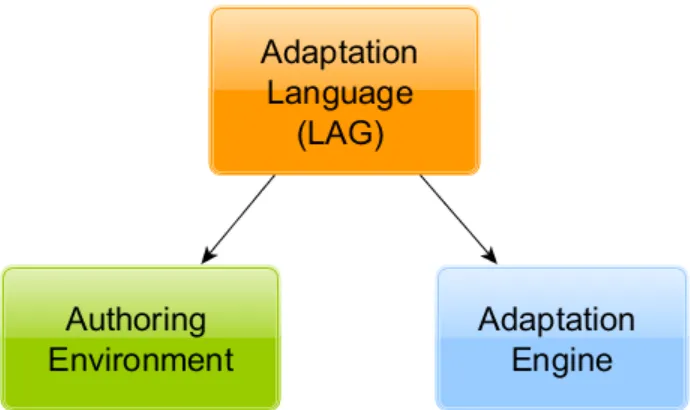
standardised adaptive authoring [13]. LAG is based on the same layered structure as LAOS [26] and provides interaction with all five layers in the form of variables.
This LAG model is also the basis of the LAG adaptation language, which is further described in section 2.4.5.
2.4.5 The LAG language
The LAG language [11] (see also APPENDIX A: LAG Grammar and APPENDIX B: LAG Grammar Semantics) is an authoring language for adaptive behaviour, initially defined at the Technical University of Eindhoven, and further being developed at the University of Warwick. It is based on the LAG model
[13] (see also section 2.4.4), instantiating its second layer: that of an adaptation programming language. The LAG language is described as an adaptation language, since it is a language that is adaptable to the author and it also describes the adaptation of content in adaptive hypermedia. This is the language on the basis of which this project is being developed, due to the fact that it is the most complete adaptation language currently known, besides producing correct adaptation specifications. Thus, if the visual environment to be created can reproduce its power and be converted to it, it will have the same expressivity, with the hope that it will be, however, much more usable by authors.
Each LAG strategy defines the adaptation behaviour for a given set of knowledge concepts (for example, questions and answers or topics and lessons). Each strategy must contain two sections: an initialization and an implementation. The initialization defines the initial state of the AHS, allowing the author to differentiate between users and provide the correct content, objectives and adaptation rules. The implementation defines the inner workings of the AHS. Here is where the adaptation of content is specified, most often through user navigation in the hyper-document.
designed to be content independent, as long as the concepts labels, or titles, remain constant between different versions of the adaptive content. This is particularly useful for AHS where many different versions of the content are required, as well as for reuse of the adaptation behaviour. In the following, the LAG language will be illustrated based on a simple strategy.
2.4.5.1 Beginner-Intermediate-Advanced LAG adaptation strategy
The Beginner-Intermediate-Advanced strategy in LAG strategy shows concepts based on their weights and labels. The idea in the LAOS framework [26] is that weights and labels are added in a separate layer from the domain map (an instantiation of the Domain model), in the goal and constraints map (GM) (an instantiation of the Goal and constraints model), which represents pedagogic knowledge. Thus, a possible pedagogical division is to label concepts as beginner, intermediate, or advanced. Labelling these concepts outside the domain model means that a different labelling is possible for the same domain model concepts, for a different instance of the goal and constraints map. Alternatively, the pedagogical strategy created can be reused for different domain models. A simplification of this strategy (some of the basic rules) is shown below:
IF UM.level == beginner AND GM.Concept.label == beginner THEN PM.GM.Concept.show = true
IF UM.level == intermediate AND GM.Concept.label == intermediate THEN PM.GM.Concept.show = true
IF UM.level == advanced AND GM.Concept.label == advanced THEN PM.GM.Concept.show = true
hand, but they are certainly useful for interfacing. Therefore, export-import into such formats is desired. The good news is that converting the LAG language to an XML specification is relatively straightforward: for each LAG construct, an XML element can be defined, with sub-elements that enforce the grammar. Thus, all the parts of a LAG adaptation strategy need to be converted, i.e.:
<description> the description of the adaptive strategy </description>
<initialization> user’s initial view of the system </initialization>
<implementation> the interaction loop user system </implementation>
To illustrate this conversion, a code snippet containing a more complicated if condition, such as the one using the ‘enough’ construct in a type-based adaptation, is shown below:
IF enough2(UM.GM.showall>3, PM.GM.Concept.type==conclusion, 2)
THEN PM.GM.Concept.show = true
The code states that if the user model showall variable has reached the value 3 or more, the user should be shown the conclusions. The equivalent potential XML code is shown below. Clearly, the XML format is more verbose and shouldn’t be used in direct programming by hand.
<if>
<enough number=”2”> <condition>
<attribute> UM.GM.showall </attribute>
<operator> > </operator> <value> 3 </value> </condition>
<condition>
<attribute> PM.GM.Concept.type </attribute>
<operator> == </operator> <value> conclusion </value> </condition>
</enough> <then>
<attribute> PM.GM.Concept.show </attribute> <operator> = </operator> <value> true </value> </then>
</if>
Other adaptation languages, such as LAG-XLS [19], are represented directly in XML. LAG-XLS suffers however of the same issue as the code illustrated above, in terms of verboseness. Additionally, LAG-XLS supports different learning styles, but would require further development to support more extensive personalisation and collaboration.
Thus, given its generic nature, completeness and correctness, the LAG language is used as basis for the visual system developed further in this thesis (see Chapter 5). In the following, systems aimed at authoring adaptive hypermedia are visited and described.
2.5 Authoring Systems for Adaptive Hypermedia
The authoring systems presented here are the ones that have had a major impact on the research field.
2.5.1 Interbook
during authoring and thus the scope for reuse is limited, as reuse relies on authors changing the adaptation rules. This puts such reuse outside the range of beginner users (non-programmers who are not able to use the LISP programming language) and limits the range of adaptation for novice users.
Figure 3: An example of course material shown in InterBook in the Netscape Browser [28]
2.5.2 AHA! (Adaptive Hypermedia Architecture)
selecting pages, fragments or objects and through link adaptation, by conditionally changing the colour of link anchors and adding icons.
Figure 4: AHA Adaptation Rules Form
2.5.3 Adaptive Course Construction Toolkit (ACCT)
The Adaptive Course Construction Toolkit (ACCT) [30] was created to provide the course developer with tools to design, test and deploy adaptive personalised eLearning, based on pedagogical support and instructional design principles.
2.5.3.1 Narrative Structures in ACCT
ACCT is built on ‘narrative structures’, which are model-based representations of pedagogical principles, which can be further used as templates. For this purpose, an XML format was used:
<concept id=”030” type=”model” xmlns:xlink=”http://..”>
<name lang=”en”> Webquest </name> …
</concept>
2.5.3.2 Subject Concept Space Editor (SMCS) in ACCT
Figure 5: Subject Matter Concept Space Editor (SMCS) in ACCT
2.5.3.3 Narrative Model Builder in ACCT
Figure 6: Narrative Model Builder in ACCT
The ACCT provides the course developer with the ability to verify their course in real-time through the use of an APeLS service interface, which is an important point to mention.
At Trinity College Dublin, the Adaptive Personalised eLearning Services (APeLS) was used for 4 years as a part of undergraduate degree level course. Initial findings from the student evaluation show that despite the majority of students having little or no experience of online learning or the subject matter, the introduction of the personalized SQL course in 2000 had a beneficial effect on students’ performance in the final examinations. Most students felt that the courses generated based on the prior knowledge pretest instrument produced courses they expected and desired, however approximately 40% of students stated that they desired more control over the course content. This was reflected in the comments of a number of students where they stated that they ‘played’ the pre-test instrument to create short personalised courses that could be tackled in short periods of time. They would re-personalize the course for each session with this aim. This finding highlights the innovation some learners can display in utilizing personalized eLearning. In terms of authoring, APeLS followed the model of ACCT, in that it has a Narrative Model, and additionally introduced a terminal model (see Figure 7).
Figure 7: APeLS architecture
<terminal type=”high_spec”>
<browser>
<screen_size>1280x1024</screen_size>
<color>yes</color>
<sound>yes</sound>
<scrollable>yes</scrollable>
<CcppAccept>
<li>text/html</li>
<li>text/plain</li>
<li>image/jpeg</li>
<li>…………. ………..</li>
</CcppAccept>
<browser>
<network> ……… </network> ………
</terminal>
There is no conclusive information on how an author would need to create the information required for all these components. It is possible that it requires authors to create XML snippets, including for (relatively primitive, similar to ACCT) adaptive behaviour specification. What is clear is that there is a modular approach, with separation of concerns.
2.5.5 ACTSim (A Composition Tool for Authoring Adaptive Soft Skill)
Figure 8: ACTSim Composition Tool
Navigational aids were also required by the composition tool to assist the author moving across the dialogue model. These are particularly useful if the simulation becomes large and complex. Navigational aids include a map of the dialogue model, zoom functionality and an ‘arrange’ feature. The results for this were very positive with authors describing the composition tool as “intuitive” and “user friendly”. This approach requires an authoring process to alleviate the complexity of composing the simulations. This authoring process not only needs a methodology for creating the models but also incorporates a pedagogical frame work so as to support educationally sound simulations.
2.5.6 The Generic Responsive Adaptive Personalized Learning Environment (GRAPPLE) and the Grapple Authoring Tool (GAT)
GRAPPLE [33] is an enhanced learning environment that guides learners through the learning experience, automatically adapting to personal preferences, prior knowledge and learning goals, amongst others. GRAPPLE includes authoring tools to create adaptive learning material for the learners. The Grapple Authoring Tool (GAT) [34] has three main components: a Domain Model authoring tool (DM), for creating a conceptual representation of an application domain (or "course"), a Pedagogical Relationship, a Type authoring tool (PRT), for defining types of pedagogical relationships between concepts and their associated adaptation, and a Conceptual Adaptation Model (CAM) authoring tool (also called ‘Course tool’) for defining the pedagogical structure of a course. The GAT toolset is set up to allow for very general types of relationships and adaptation rules. Adaptation should be based on many different aspects, including the user's background, knowledge and goals, but possibly also on the characteristics of the device used for learning.
Summarising, the Grapple Authoring Tool (GAT) has three main components. 1. Domain model authoring tool (DM)
For creating a conceptual representation of an application domain (or “course”). 2. Pedagogical relationship type authoring tool (PRT).
For defining types of pedagogical relationships between concepts and their associated adaptation. 3. Conceptual adaptation model (CAM)
on GAT authors, and, unsurprisingly, evaluations of GAT have shown the difficulty of authoring the behavioural part [35], [8].
2.5.6.1 Authoring pages in GRAPPLE
Authoring in GRAPPLE [36] is flexible in many ways. Figure 9 below shows how the ‘leafs’ of the graphs or hierarchical structures– the ultimate pages – can be authored in GRAPPLE. GRAPPLE introduces the notion of using template pages instead of creating each course page by hand. Figure 9 shows the difference between the two authoring processes:
• On the one hand writing (or importing) individual pages separately is easy, as it only requires basic
knowledge of XHTML (or a web page authoring tool). It requires discipline to ensure that all pages that should have the same layout indeed do, and it involves repetitive work if later that layout needs to be changed (everywhere).
• Using template pages ensures that through a single template all pages that should have the same
layout and presentation are consistent, and any change to the layout automatically applies to all pages based on the same template.
A typical page of a course is shown in Figure 10. This page describes the planet Jupiter. Pages describing other planets look very similar because they are all based on the same template.
Figure 10: Consistency in presentation through Template Pages in GRAPPLE authoring
2.5.6.2 Domain Model authoring in GRAPPLE
To structure the above pages, the GRAPPLE authoring toolkit uses another layer of separation, by introducing domain concepts, bound together in a graph – the Domain Model. The tool for creating such structures, the Domain Model tool, is illustrated in Figure 11.
Figure 11: Creating the ‘Milky Way’ domain model with the GRAPPLE Domain Model tool
2.5.6.3 Pedagogical relationship type (PRT) authoring in GRAPPLE
concepts at once as both the source and target sockets may contain multiple concepts. The (simplified) code is:
%target% { #suitability & !`(${%source%#knowledge}>70)` }
Thus, different authoring roles exist in the GRAPPLE toolkit. Also, as can be seen, the GRAPPLE authoring approach has already introduced the idea of building blocks to create larger structures from in adaptation.
2.5.6.4 Conceptual Adaptation Model (CAM) in GRAPPLE
Figure 12: Adding two PRT relations in the CAM Model of the ‘Milky Way’
A more complex adaptation strategy, as created via the CAM tool, is illustrated in Figure 13. Here, the left side shows the panel of PRTs which have been already created, and can be used to compose the more complex strategies in the main window. Thus, the CAM tool combines the domain concepts created via the DM tool, and the PRTs created via the PRT tools, into a coherent whole.
Figure 13: CAM created in the CAM Model, by dragging PRTs from the left menu
2.5.7 MOT (My Online Teacher) and PEAL
2.5.7.1.1 The PEAL System
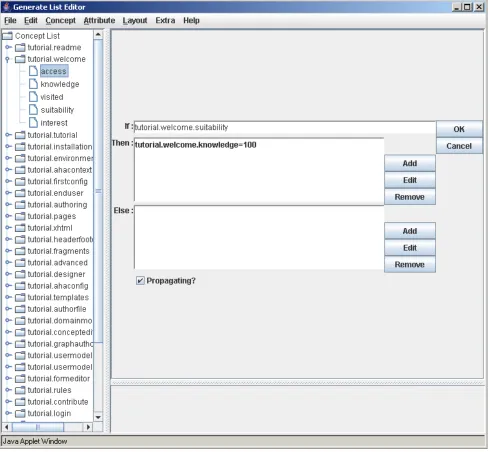
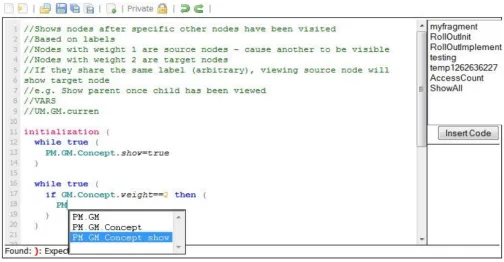
[image:52.595.46.550.227.489.2]PEAL allows for text-based strategy authoring within the LAG adaptation programming language. It uses the text editor called ‘Strategy Editor’ (see Figure 14). It also allows for graphical authoring within a ‘Graphical Editor’ (see Figure 15).
Figure 14: PEAL Adaptive Strategy Editor
Figure 15: PEAL Graphical Editor
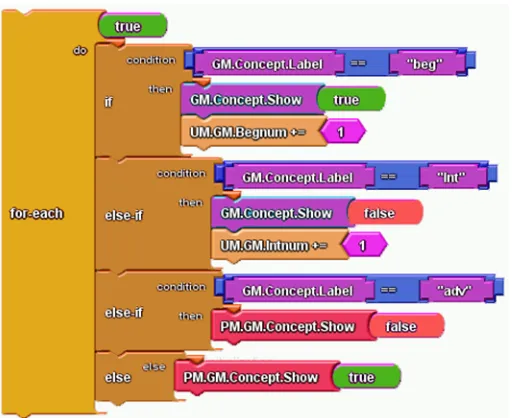
The PEAL Graphical Editor allows for graphical creation of strategies. This editor is aimed at non-technical authors.
2.5.7.1.2 PEAL Modular Architecture
PEAL converts the above visual representation of an adaptive strategy into LAG, by traversing the tree of visual element objects. Each visual element has a toLAG method. This method calls the toLAG function of the child element(s) in its visual element containers, thus returning its own LAG representation and that of its descendants.
The PEAL tool is designed to create directly, or convert thus, adaptation strategies into the LAG adaptation language, and separates adaptation behaviour from content, abiding by the ‘separation of concerns’. Due to the separation of concerns, based, from a theorerical point of view, on the LAOS framework, the adaptation programmer can be a different person from the strategy author.
Finally and importantly, although LAG strategies are not aimed to be written by non-technical authors, any author should be able to use adaptive strategy created by other authors, thus promote reuse.
2.5.7.1.3 Database Design
The PEAL database contains a single ‘Users’ table, where username and password are stored, used only for authentication purpose. To offer more personalised authoring environment for different authors (with different skill level and preferences), the PEAL authoring environment needs a new database to store detailed information about the authors and to be able to update this information as the author progresses with the authoring environment; for instance, a user-role and permissions associated with each author, a stencil set used or available to each author. The authoring system must keep this information updated, so the system-wide changes could be made to cater for better user support.
2.5.7.1.4 PEAL Evaluation
PEAL [17] was evaluated in the past with the help of five programming-savvy persons, as they represent the type of author at which this tool is targeted at. Non-programmers are supposed to be using ready-made, reusable strategies, without getting into the details of programming.
programmers were also asked to state which editor they would prefer to use to edit the LAG language, between regular text editors (used previously for editing the language) and PEAL. Without exception, they all voted for PEAL [17]. This preference for a visual language has motivated also the work in this thesis. However, PEAL had some clear limitations, as described below, which needed addressed.
2.5.7.1.5 Limitations of the PEAL editor
These initial evaluations highlighted that PEAL [17] is an environment which is useful to some degree, and represents a paradigm which is needed. However, the evaluation revealed some major limitations in the editor which were as follows.
• Parsing LAG for visual representation is not scalable, for instance, large strategies get too large and complicated to show on a single screen.
• Changing the drop-target size (and thus resize the potential parent) when an element is dragged and held over a valid parent, e.g., when an attribute is dragged over one of the operand positions of an assignment or comparison element.
• Colouring the Strategy Description tab bright red until a sufficiently verbose strategy is entered, thus enticing the author to create the description for the lay person.
• The context menu (displayed upon right-click on a visual element) should show options to insert any valid children (e.g. assignment action element into the then block of if-then), an option to delete the selected element and all its children, and a ’Help’ option to display contextual documentation were among the recommendations.
The table below (Table 2) compares the most well-known authoring approaches which have been described above, based on desired features related to the current research (as per research questions; see Section 1.4). The first column checks if the particular tool expresses adaptive behaviour, as this is the main target for this research, and so on. All features are of a binary nature (Y for yes and N for no).
System A dap ti ve be havi ou r E as e of u se C om pl et en es s C or re ct ne ss V is ual is at ion In te rop er ab ili ty Se par at e au th or in g r ol es
Interbook Y Y Y Y N N N
AHA!: AMT Y Y N N N N Y
AHA!: Domain Model Tool Y Y N N Y N Y
AHA!: Graph Author Tool Y Y N N Y N Y
AHA!: Concept Editor Y Y N N N N Y
AHA!: strategy editor Y N N N N N Y
AHA!: form editor Y N Y Y Y N Y
ACCT: Subject Concept Space Editor (SMCS) N Y Y Y N N Y
ACCT: Narrative Model Builder Y Y Y Y N N Y
APeLS Y N N N N N Y
ACTSim Y Y N N Y N N
GRAPPLE GAT: DM Y Y Y Y Y Y Y
current research. Thus, the extension of an existing system, or the creating of a completely new system for adaptive authoring became necessary.
Overall, although the AH approach has been shown to be useful, an author faces a multitude of problems in order to create adaptive courseware and to reuse previously created material with different adaptation types. For example, in order to create a personalised learning experience for each user, first, the content of the lesson has to be prepared. Different alternatives of the content have to be created for different users, which leads to different paths through that content. Metadata need to be added for the labelling and annotation of the different paths. Finally, a mechanism must be defined to guide the user through the different paths. This introduces a costly and complicated authoring process [5]. So, summarising, the issues are:
• A bottleneck in adaptation is the authoring process;
• Authoring of adaptive courseware for learners with different needs is difficult; • Adaptive Strategies are complex to create;
• Creation of adaptive courseware remains cumbersome.
Additionally [8], information interchange is very cumbersome between AEH systems. There are many systems available to authors for adaptive educational material but there is no de-facto standard for authoring adaptive content efficiently which could be used across the board to enhance reusability and compatibility between different systems. To add to the problem, authoring remains a daunting task for the ever-busy author, to create adaptive courses to more and more diverse, in most cases, global student audiences with diverse needs.
The following, summarises the main imperatives that result from issues with authoring, inspired by the needs of teachers and authors, and not students.
2.7 Authoring Imperatives
Authors may be unfamiliar with the complexity of the authoring process. It is important that any authoring system caters to the author’s needs. A study [37] on authoring tools proposed a set of generic authoring imperatives to make authoring easier; these include Complexity Imperatives and Support Imperatives, as follows below.
Complexity Imperative:
• Separation of Concerns
• Use of frameworks and Use of standards
Support Imperative:
• Adaptive Functionality
• Simple Access to Content
• Shallow Learning Curve and Familiarity
To apply the authoring imperative, separation of concern must be included in the design, which will allow different authors to work on different parts of the course.
Furthermore, common standards should be followed wherever it is possible to do so. For instance, if a new standard is released by W3C organisation, then it should be utilised by the authoring tool. This will mean that any device which can read the standard will automatically be compatible with the tool which implements the standards. Alternatively, if standards are lacking, frameworks should be used, such as AHAM [13] and LAOS [11].
The support imperatives address the help and support offered to the author: how easy it is for the author to learn to author with the system (with the aim being a shallow learning curve and familiarity), how easy or difficult it is to access content, and if the functionality truly is adaptive to the author.
These imperatives in section 2.7, set out a number of important issues to consider when designing new authoring systems, including for this research.
The additional, important issue of interoperability are visited next.
2.8 Interoperability between Adaptive Educational Hypermedia Systems
Information interchange is very cumbersome between AEH systems. There are many systems available to author adaptive educational material, but there is no single set (de-facto) standard for authoring adaptive content efficiently, which could be used across many adaptive educational systems, to enhance reusability and compatibility. To have a common standard for all adaptive systems might seem ideal, a feasible solution might be to mirror the standards used elsewhere: for instance, learning management systems (LMS) export to and import from various e-learning standards (IMS- QTI, LOM, IMS-CP, etc.). Similarly, adaptive systems might need to be able to export various adaptation languages, in order to be compatible with a wide variety of applications [11].
considered supporting multiple adaptation language outputs as a desirable feature, besides developing new languages targeted at specific levels of access (transformed into wrapping levels).
The aim in this thesis was to develop a methodology which will enable adaptive contents to be moved and reused in another adaptive educational hypermedia system, according to the features offered by the target system. Interoperability, in the sense of plug&play functionality available for any reasonably conceivable environment, was one of the main reasons VASE 2.0 was created from scratch, as a complete re-write of VASE 1.0, by using a framework which offered interoperability features. Interoperability of the authoring system is discussed in Chapter 2 , Section 2.9.1.3 and Chapter 5, Section 5.4.3 and evaluated in Chapter 6.
After understanding the issues with adaptive hypermedia, with specific focus on its authoring, and, based on the objectives, a simple solution (sustained also by the success of PEAL, discussed in section 2.5.7.1.4) is to apply visual programming. The current state of the art in this area is analysed next.
2.9 Visual Programming Systems
• Forgetting - Users do not need to memorize programming syntax. All programming constructs are accessible visually in the Graphical User Interface (GUI).
• Feedback - Graphical constraints and feedback can be used to prevent users from making syntactical errors, rather than simply reporting the syntactical error.
• Real-world Metaphor - Blocks offer stronger real-world metaphors than text. For example, blocks look like puzzle pieces, which allow users to understand which blocks can and cannot fit together, just by looking at the block connector shape.
2.9.1 OpenBlocks Design
OpenBlocks [39] is an open-source Java library for creating user-interface (UI) elements for blocks-based programs. It only requires users to connect puzzle-piece-like objects, called blocks, of varying shapes and colours, to build their program. The Block shapes not only look like puzzle pieces, but also are connected like puzzle pieces, by matching the blocks at their connector shapes.
2.9.1.1 Block Manipulation
These pieces can be dragged and joined with a mouse, with very little knowledge about the specification language. The OpenBlocks framework improves visual feedback via the shape of a construct gives clues on how to use the construct. For instance, if a construct will look like in Figure 16, it is obvious to the user that the construct will only fit a type which is compatible with its connector. Blocks are manipulated directly by the user, via mouse-click and drag-n-drop actions.
Figure 16: CodeBlocks - IF Block
2.9.1.2 User Interface of OpenBlocks
2.9.1.3 OpenBlocks Summary
The main features of OpenBlocks are:
1.Essential programming environment features are provided 2.Multiple ways to configure specific UI elements
3.Customisable programming environment 4.Easy to extend for programmers
5.Easy to understand for authors
While OpenBlocks allows different shapes to be connected like puzzle pieces easily, it lacks other functional features, such as interoperability, robust type checking, and specification validation, amongst others. The solution to these problems was a new framework developed by Google developers, called Blockly (see next section). This block programming framework offered all of the features of OpenBlocks and some new ones. It works in any browser mobile or desktop without any additional plugin, making it fully interoperable between different browsers on different operating systems. This is especially important if a tablet device in used to quickly create an adaptive specification.
2.9.2 Blockly
This framework is an inspiration for the work in the current thesis, and the design of the VASE framework and visual authoring program (see Chapter 5).
2.10 Conclusion
In this chapter, we have discussed languages, models and frameworks for Adaptive Hypermedia and analysed the work done in the area of Adaptive Hypermedia System design. We have presented a wide variety of authoring tools in Adaptive Educational Hypermedia System. Although most tools are designed to make the author’s job easier, they are usually still convoluted to master, and most authors struggle to reap the benefits of the features offered by the systems.
In addition, we have also presented some of the frameworks which were used during the development of the new authoring system. The main reason was to introduce the reader to the frameworks used during the implementation of the new authoring tool.
3
Methodology
One of the fundamental parts of any research is to choose the appropriate methodology. A methodology
is described as guidance in solving a particular problem using suitable tasks, tools and techniques [41].
The research in this thesis includes a range of methodological approaches, employing both quantitative
and qualitative data collection and analysis. In this chapter, the methodological approaches in each section
are outlined.
Outcome of this chapter: This chapter provides general guidance for the whole research approach adopted with this thesis. It explores the approaches, techniques and methods used during the research, and therefore gives useful suggestions to other researchers who would like to follow-up a similar type of research. Furthermore, it discusses the quantitative and qualitative analysis methods that are used in the analysis of the result generated from the experiments. In order to create a coherent understanding of the methodology and its application within this research, it has been grouped as follows. Firstly, the next sub-section deals with the methodology employed in the literature review. Next, the user centric approach taken throughout the work in this thesis is briefly explained. Then, the implementation methodology is sketched. Finally, the experimental methodology is detailed, for all 4 experiments performed for this thesis.
3.1 Literature Review and Background Review
literature in this way – especially the gap regarding the lack of easy to use authoring tools for adaptive hypermedia and e-learning.
3.1.1 Adaptation Language Research
One of the areas that became prominent relatively rapidly, both in terms of research needed of the literature, as well as of systems, frameworks, standards, languages, etc. was that of visual programming. Thus, visual programming frameworks were primary sources of research, as they are used in other areas for their
usability [39], and they inspired here the new proposal of a visual framework for adaptive hypermedia authoring. The visual framework delivered by this thesis needed to be easy to use, as it was evident in the earlier authoring system evaluations which used LAG as the adaptation language, that high-level programming was not fulfilling this goal. As a result of this, in the new framework, each LAG construct was represented in a visual form, to provide affordance to the author. Additionally, extensions to the LAG language were also suggested, to improve the LAG language features; these have been presented in A User Centred Approach.
3.2 User Centred Design and Implementation
Moreover, as the goal of this research is to simplify and improve adaptive specification authoring in adaptive hypermedia (see also the research questions, Section 1.4), this applies to target users. As these end-users are the focus of this research, the user-centred design (UCD) methodology is used throughout the research in design specific experiments, to extract their needs, requirements and constraints [42]. This user-centred design methodology has been used as a research methodology in many researches involving application oriented research in general, and more significantly, users (e.g. [43], [44] and [45]). User centred design implies that users, usability, and user characteristics are taken into account throughout the processing.
and environments. UC is driven and refined by user-centred evaluation; and addresses the whole user experience. The process involves users throughout the design and development process, iteratively, as illustrated in Figure 18.
Figure 18: Phases of user centred process (source www.usability.gov [46])
The following are the general phases of the user-centred process [46]:
![Figure 2: LAOS framework (5 Layers) [20]](https://thumb-us.123doks.com/thumbv2/123dok_us/9434014.449938/29.595.45.344.291.635/figure-laos-framework-layers.webp)
![Figure 3: An example of course material shown in InterBook in the Netscape Browser [28]](https://thumb-us.123doks.com/thumbv2/123dok_us/9434014.449938/37.595.46.413.155.588/figure-example-course-material-shown-interbook-netscape-browser.webp)