© 2019, IRJET | Impact Factor value: 7.211 | ISO 9001:2008 Certified Journal
| Page 2958
PERFORMANCE ANALYSIS OF SPEED CONTROL OF INDUCTION
MOTOR USING PI, SMC & FUZZY LOGIC CONTROLLER
Mahesh Kokare
1, P. A. Kulkarni
21
Mahesh Kokare, Department of Control Systems, M.B.E. Societys College of Engineering, Ambajogai, India
2
Prof. P.A. Kulkarni, Department of Electrical Engineering, M.B.E. Societys College of Engineering, Ambajogai, India
---***---Abstract - Induction Motors are used widely for high performance, variable speed applications due to its low cost, low maintenance, robustness and reliability. IMs perform satisfactory with the vector control strategy for wide range of speed applications and fast torque response. Because of the higher order unmodeled system dynamics and different machine parameters such as rotor speed, stator and rotor resistance variation and load torque variation, different nonlinear controllers are used to increase its robustness and to make the system stable. However, the use of linear controllers such as PI controller does not give satisfactory performance due to the above causes. Sliding Mode Controller and Fuzzy Logic Controller are designed for robust control of IMs. Both controllers performance is satisfactory under different adverse condition. But, the main disadvantage of sliding mode controller is the chattering problem that can be reduced by taking necessary steps. This work is based on investigation and evaluation of the performance of a IMs drive controlled by PI, Sliding mode and Fuzzy logic speed controllers
Key Words: Vector control, Current regulator, sling mode, fuzzy logic.
1. INTRODUCTION
The induction motor is the most widely used motor type in the industry because of its good self-starting capability, simple and rugged structure, low cost and reliability etc. Along with variable frequency AC inverters, induction motors are used in many adjustable speed applications which do not require fast dynamic response. The concept of vector control has opened up a new possibility that induction motors can be controlled to achieve dynamic performance as good as that of DC or brushless DC motors. The technique called vector control can be used to vary the speed of an induction motor over a wide range. In the vector control scheme, a complex current is synthesized from two quadrature components, one of which is responsible for the flux level in the motor, and another which controls the torque production in the motor. Vector control offers a number of benefits including speed control over a wide range, precise speed regulation, fast dynamic response, and operation above base speed.
2. MODELING OF INDUCTION MOTOR IN STATOR REFERENCE FRAME
Generally, an IM can be described uniquely in arbitrary rotating frame, stationary reference frame or
synchronously rotating frame. The required transformation in voltages, currents, or flux linkages is derived in a generalized way. R.H. Park, in the 1920s, proposed a new theory of electrical machine analysis to represent the machine in d – q model. The Equations of the induction motor in stationary reference frame can be represented by using flux linkages as variables. This involves the reduction of a number of variables in the dynamic equations. Even when the voltages and currents are discontinuous the flux linkages are continuous. The stator and rotor flux linkages in the stator reference frame are defined as,
Stator and rotor voltage and current equations are as follows,
Since the rotor windings are short circuited, the rotor voltages are zero. Therefore
By solving above equation we get, the following equations
dt
The electromagnetic torque of the induction motor in stator reference frame is given by
3. VECTOR CONTROL OR FIELD ORIENTED CONTROL (FOC)
Dynamic performance improved from an IM is enabled due to the development of Vector Control analysis. Just like in a dc motor, the torque and flux components can be controlled independently using vector control strategy [15]. In order to analyses vector control, we need to develop a dynamic model of the IM. This is done by converting the 3-ϕ quantities into 2-axes system called the d-axis and the q-axis. Such a conversion is called axes transformation. The d-q axes can be chosen to be stationary or rotating. Further, the rotating frame can either be the rotor oriented or magnetizing flux oriented. However, synchronous reference frame in which the d-axis is aligned with the rotor flux is found to be the most convenient from analysis point of view [8]. A major disadvantage of the per phase equivalent circuit analysis is that it is valid only if the three phase system is balanced.
3.1 Principle of Vector Control
The basic principles of vector control implementation can be explained with the help of fig. 1 where the machine model is represented in a synchronously rotating reference frame. The inverter is not included in the figure, assuming that its current gain is unity. It generate currents and as dictated by the corresponding command currents
and from the controller. The machine terminal phase currents and are converted to
components by transformation.
Fig-1: Vector control implementation principle with machine d-q model.
They are then converted to synchronously rotating reference frame by the unit vector components
before applying to the d-q machine model. The controller makes two stages of inverse transformation so that the control currents correspond to the machine currents respectively. Also the unit vector ensures the correct alignment of current with the flux vector perpendicular to it.
The vector control method is broadly classified into two types-
Direct vector control
Indirect vector control(IFOC)
In direct vector Control strategy rotor flux vector is either measured by using a flux sensor mounted in the air-gap or mathematically by using the voltage equations starting from the electrical machine parameters. In indirect vector control strategy rotor flux vector is estimated using the field oriented control equations (current model) requiring a rotor speed measurement. Due to its implementation simplicity, indirect vector control is more popular than direct vector control and has become the industrial standard [7].
4. INDIRECT FIELD ORIENTED CONTROL (IFOC)
In the indirect vector control method, by using summation of the rotor speed and slip frequency, the rotor flux angle, hence the unit vectors are obtained indirectly. The indirect vector control method is essentially same as the direct vector control except that the rotor angle is generated indirectly using the measured speed and the slip speed .
The phasor diagram explaining indirect vector control is shown in figure 2. On the de axis the stator flux component of current should be aligned and on the qe axis the torque component of current should be aligned.
© 2019, IRJET | Impact Factor value: 7.211 | ISO 9001:2008 Certified Journal
| Page 2960
To achieve vector control the flux component (d-axis component) of stator current is aligned in the direction of rotor flux, and the torque component of stator current is aligned in direction perpendicular to it. At this condition:
For implementation of the indirect vector control strategy, it is necessary to take above equations into considerations.
5. SLIDING MODE CONTROLLER
The sliding mode control technique is developed from Variable Structure Control (VSC). In variable structure control technique, a surface is defined and the system that we need to control is forced to that surface till the system slides to the desired equilibrium point. For sliding mode controller, Lyapunov stability method is applied to keep the nonlinear system under control. Structure of sliding mode controller for induction is shown in figure 3. Steps for designing sliding mode controller for induction motor is given below.
Fig-3: Block diagram of sliding mode control for induction motor.
The mechanical equation of an induction motor is given by,
Electromagnetic torque for vector controlled can be simplified as;
Then the mechanical equation becomes,
Where the parameters are defined as
Previous mechanical Equation with uncertainties as follows
Let us define the tracking speed error as follows
Taking the derivative of the previous equation with respect to time yields:
Where following terms have been collected in the signal u (t),
And, the uncertainty terms have been collected in the signal d(t),
Here the sliding variable S(t) for speed controller is defined with integral component as
Where, k is a constant gain.
Then the sliding surface is defined as:
The sliding mode controller for speed is designed as
where β is switching gain, it must be chosen so that β ≥ d(t) for all time.
Finally, the torque current command , can be obtained directly substituting u (t) in the previous equation
Thus, sliding mode control solves the speed tracking problem for the induction motor.
6. Fuzzy logic Controller
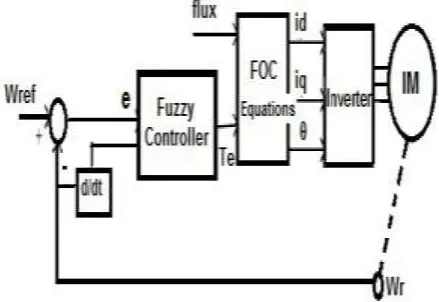
standard model based control techniques are impractical or impossible. The complete block diagram of the fuzzy logic controller is shown and the function of each block and its realization is explained below.
Fig 4. Block diagram of fuzzy logic controlled induction motor drive
The block diagram of fuzzy logic controller for induction motor is given in figure. The first input is error ‘e’ and second is the change in error ‘ce’ at the sampling time `t′s . The two input variables are calculated e(ts) and ce(ts) at every sampling time as.
e(ts) = ωr (ts) – ω*r(ts)
ce(ts) = e(ts) - e(ts - 1)
Where ‘ce’ denotes the change of error ‘e’, ω*r (ts) is the reference rotor speed, ωr(ts) is theactual speed, e(ts-1) is the value of error at previous sampling time. The output variable is thechange in torque ΔT which is integrated to get the reference torque as shown in the equation
[image:4.595.311.559.199.317.2]T*(ts) = T*(ts -1) + ΔT.
Table -1: Sample Table format
Error /Cha nge
Error NB NM NS
Z PS P M PB
NB NB NB NB NM NS NS Z
NM NB NB NM NS NS Z PS
NS NB NM NS NS Z PS PS
Z NB NM NS Z PS PS PM
PS NM NS Z PS PS PM PM
PM NS Z PS PS PM PM PB
PB Z PS PM PM PB PB PB
7. SIMULATION RESULTS
The simulation of indirect field orient controlled induction motor is done using squirrel cage induction motor. The simulation is done with PI controller, sliding mode controller and fuzzy logic Controller. For simulation MATLAB /SIMULINK is used. The reference speed of 100 rad/sec is considered for the drive system.
Fig- 5 shows speed responses of PI, SMC and Fuzzy controllers for No Load
The reference speed of 100 rad/sec is considered for the drive system, with PI, sliding mode controller and fuzzy logic controller and various simulation were carried out and load torque kept at zero. From the figure 6.7, it is clear that in case of sliding mode and Fuzzy logic controller, the speed error of the system comes to zero faster than PI controller. The simulation results show that the sliding mode controller and fuzzy logic controller realizes a good transient behavior of the motor with a rapid settling time, low overshoot and has a better performance than PI controller.
Fig- 6 shows speed responses of PI and SMC controllers for 15 Load applied after 1.5 sec. Initially the motor is started under no load condition and then load is applied after some time. Figure shows that speed response of the PI controller is affected by the torque load.
Figure 6.: Speed responses of PI, SMC and FLC controllers for 15 N-m Load.
[image:4.595.46.276.562.767.2] [image:4.595.318.548.564.694.2]© 2019, IRJET | Impact Factor value: 7.211 | ISO 9001:2008 Certified Journal
| Page 2962
[image:5.595.47.271.146.269.2]by the load torque applied after 1.5 sec. Sliding mode controller gives better response under the load torque conditions
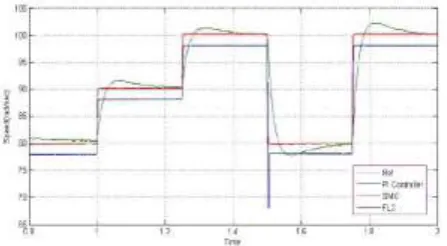
Fig.7 Speed response for step changes of PI, SMC and FLC controllers for 15 N-m Load
Figure 7. Shows the speed response of PI controller, sliding mode controller and fuzzy logic controller for step changes of the reference speed with load torque of 15 N-m. A step change in reference speed with load torque of 15 N-m is used here to study the tracking performance of PI, sliding mode controller and fuzzy logic controller of vector controlled induction motor with load conditions. The command speed is increased linearly at t=1 sec from 80 to 90 rad/sec. It is kept constant at 90 rad/sec till 1.25 sec and increased linearly to 100 rad/sec at 1.25 sec. Then kept constant at 100 rad/sec till 1.5 sec and decreased linearly to 80 rad/sec till 1.75 sec and again increased linearly to 100 rad/sec and during the simulation constant load torque of 15 N-m is applied.
Conclusion
Sensor less control of induction motor using vector control technique has been proposed. Sensor less control gives the benefits of vector control without using any shaft encoder. The mathematical model of the drive system has been developed. Vector controlled induction motor by employing the different speed controllers like PI, sliding mode controller and fuzzy logic controllers is presented. The performance of the sliding mode controller and fuzzy logic controller for the indirect vector controlled induction motor drive has been verified and compared with that of conventional PI controller performance. It can be concluded that the fuzzy logic controllers performance is better in comparison with that of PI and SMC in terms of the transient response. The dynamic performance of SMC is found to be the best out of the three controllers. The robustness of the SMC and Fuzzy logic controller during sudden changes in load has been seen but SMC gives better performance than fuzzy logic controller with load conditions. PI controller is very simple to implement, but its steady state response and dynamic performance are not very satisfactory. Its robustness to load disturbances is also relatively poor.
References
[1] B. K. Bose, Modern Power Electronics and AC Drives, pp.63-70: Prentice Hall, 2002.
[2] H. Haq, M. Hasan Imran, H. Ibrahim Okumus, and M. Habibullah, “Speed Control of Induction Motor using FOC Method.” Int. Journal of Engineering Research and Applications ISSN:2248-9622, Vol.5, Issue 3, pp.154-158, March 2015.
[3] Sunita Jain, F. Sharma and Mukesh Baliwal, “Modeling and Simulation of an Induction Motor.”International Journal of Engineering Research and Development e-ISSN:2278- 067X, Vol.10, Issue 4 , PP.57-61, April 2014.
[4] K.B. Mohanty and Madhu Singh, “Feedback Linearizing Control of Induction Motor Drive by PI Controllers in RTDS Environment. ”Journal of Automation and Control Engineering Vol.1, No.4, December 2013.
[5] Xiang Zhao, Huijuan Liu, J. Zhang, H. Zhang, “Simulation of Field Oriented Control in Induction Motor Drive System.”Telkomnika Indonesian Journal of Electrical Engineering e-ISSN:2087-278X, Vol.11, No.12, pp.7555-7563, December 2013.
[6] M. Sulaiman, F. Patakor and Z. Ibrahim, “DSP based Implementation of field Oriented Control of Three-Phase Induction Motor Drive.” International Journal of Research in Engineering and Technology, pISSN:2321-7308, Vol.02, Issue 09, September 2013.
[7] Jisha L K, A A Powly Thomas, “Robust Speed Control of Vector Controlled Induction Motor Drives Using Sliding Mode Controller.” IJITEE, ISSN: 2278-3075, Vol.4, Issue 11, April 2015
[8] Junhui Zhao, Caisheng Wang, Feng Lin, Le Yi Wang, Zhong Chen, “Novel integration sliding mode speed controller for vector controlled induction machines.” Power and Energy Society General Meeting, IEEE, Vol.1, No.6, pp.24-29, July 2011.
[9] F.A. Patakor, M. Sulaiman, Z. Ibrahim, “Adaptive Sliding Mode for indirect field oriented controlled of induction motor.” IEEE Student Conference on Research and Development (SCOReD), Vol.289, No.293, pp.19-20, December 2011.
[10] Sumit Sunil Rashinkar and Subhash S. Sankeshwari, “Sliding Mode Controller Based Indirect Vector Control Of Induction Motor.” International Journal of Advances in Engineering and Technology , ISSN: 22311963, November 2014.
[12] O. Barambones, P. Alkorta, J.M. Durana and R.J. Antonio, “Position Control For Induction Motors Using The Sliding Mode Control Theory.” 10th Portuguese Conference on Automatic Control, July 2012.
[13] K. Kumar, S. Sasikanth and L. Dinesh, “Simulation Of Sensorless Induction Motor Based On Model Reference Adaptive System (MRAS).”International Journal of Engineering Research and Applications (IJERA), ISSN:2248-9622, Vol.2, Issue 6, pp.255- 260, November-December 2012.