Academic librarians’ perceptions of creative arts students as
learners: a discourse of difference and difficulty
Janice Conway, B.Lib., M.A.
July, 2016
This thesis is submitted in partial fulfilment of the requirements for the degree of Doctor of Philosophy.
Academic librarians’ perceptions of creative arts students as
learners: a discourse of difference and difficulty
Janice Conway, B.Lib., M.A.
This thesis results entirely from my own work and has not been offered previously for any other degree or diploma.
Abstract
Academic Librarians, working in specialist arts universities, create resources, design services and provide information literacy sessions to enhance arts student learning. They work collaboratively as hybrid professionals and play a valuable role in supporting students to navigate the complexities of the information landscape and develop as independent learners.
This research explores librarians‘ perceptions of arts students as learners in the creative arts. It further considers connections between ‗intentions‘, ‗orientations‘ and ‗practice‘, in terms of librarians‘ approaches to enabling student learning. A
qualitative methodology was used to identify variation in understandings about these students and an interpretative analysis is offered which examines a discourse of ‗difference‘ and ‗difficulty‘ which threads through the narratives and connects the categories of description identified through this research.
Contextual factors are explored and the effect the identified beliefs and attitudes might have on librarians‘ practice and on their provision of art library services is examined. Consideration is given to how arts librarians might transition from some of their currently held assumptions about art students as learners to a more complex and complete understanding of art student learning.
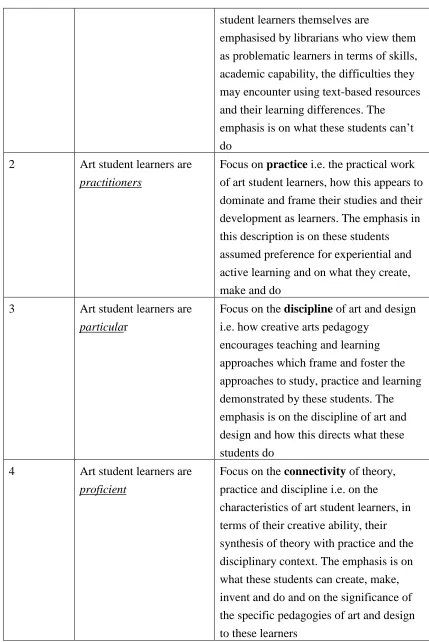
This research finds that academic librarians conceptualise arts students in different ways, namely as problematic learners, practitioner learners, particular learners and proficient learners. Above all they find them to be ‗different‘ to other students and other library users and often ‗difficult‘ to support. The framing of arts student learners in these ways may be indicative of librarians‘ lack of confidence in the effectiveness of student learning strategies and uncertainty as to their own identity, role and purpose.
Contents
Abstract...i
Contents ... ii
Acknowledgements ... v
List of Abbreviations ... vi
List of Tables ... vii
Chapter 1 Introduction and Context ... 1
1.1 Introduction ... 1
1.2 Methodological approach and research focus ... 3
1.3 Research questions ... 7
1.4 Purpose and relevance ... 9
1.5 Context for this study ... 13
1.5.1 Context: learning in the arts ... 15
1.5.2 Context: art librarians ... 17
1.5.3 Context: arts librarianship in Higher Education ... 18
1.6 Outline of thesis structure ... 20
1.7 Summary: Chapter 1 ... 21
Chapter 2 Literature Review ... 22
2.1 Introduction: learning and libraries in the creative arts ... 22
2.2 Teaching, learning, assessment and knowledge in the creative arts ... 23
2.3 Art student practice: activities and learning approaches... 30
2.4 Art schools and specialist arts institutions ... 32
2.5 Art libraries and art library practice in UK Higher Education ... 36
2.6 Academic art librarians: professional identity and professional practice .... 39
2.7 Creative arts students’ information seeking behaviours ... 45
2.8 Summary: Chapter 2 ... 51
Chapter 3 Methods and Methodology ... 53
3.1 Introduction ... 53
3.2 Research aims and objectives ... 54
3.3 Research paradigms and methodological approach ... 56
3.3.1 Qualitative research ... 56
3.3.2 Insider research ... 58
3.3.3 Phenomenography ... 62
3.3.4 Interpretative analysis ... 68
3.4 Ethical considerations ... 72
3.5 Data collection ... 73
3.6 Data analysis ... 76
3.7 Presentation of findings ... 79
3.7 Issues with the chosen methodology ... 81
3.8 Reflection ... 84
3.9 Summary: Chapter 3 ... 86
Chapter 4 Presentation and Discussion of Findings from the Phenomenographic Analysis ... 88
4.1 Introduction ... 88
4.2 Categories of description: meta-summary ... 89
4.3 Categories of description: outcome space ... 92
4.4 Discussion: perceptions of creative arts students as learners ... 94
4.4.1 Art student learners are problematic ... 94
4.4.2 Art student learners are practitioners ... 99
4.4.3 Art student learners are particular ... 102
4.4.4 Art student learners are proficient ... 109
4.5 Summary: Chapter 4 ... 113
Chapter 5 Interpretative Analysis and Discussion ... 116
5.1 Introduction: a discourse of difference and difficulty ... 116
5.2 Summary of meta-finding ... 118
5.3 Student difference and difficulty: disability and dependency, student ‘problems’ and librarians’ teaching identities and approaches to teaching ... 120
5.4 Disciplinary difference and difficulty: art and design as a non-traditional subject of academic study in the academic arts library ... 127
5.5 Art library difference and difficulty: enabling art student learners ... 135
5.6 What do these orientations mean for practice? ... 141
5.7 Summary: Chapter 5 ... 146
Chapter 6 Conclusion ... 149
6.1 Introduction: complexities of librarians’ constructions of creative art students as learners ... 149
6.2 Contribution to new knowledge... 149
6.3 Research questions revisited ... 152
6.4 Implication for theory and research ... 155
6.5 Implication for practice ... 157
6.7 Implication for policy ... 160
6.8 Limitations of this study ... 165
6.9 Future research ... 166
6.10 Reflections on my personal research journey ... 167
6.11 Summary: Chapter 6 ... 168
References ... 171
Appendix One: Participant information sheet and consent form ... 202
Appendix Two: Interview Schedule ... 209
Acknowledgements
I would like to acknowledge the unstinting support of my husband Michael, my children, Sam and Meredith, family and friends and thank them for their patience and encouragement. The contribution of my peers in Cohort 14 of the Doctoral Programme has been invaluable and I am very grateful for the happy memories of times shared at Lancaster.
List of Abbreviations
ARLIS Art Libraries Society UK & Ireland ARLIS/NA Art Libraries Society North America CNAA Council for National Academic Awards CPD Continuing Professional Development HE Higher Education
HEI Higher Education Institution LIS Library and Information Science
NCDAD National Council for Diplomas in Art and Design NSS National Student Survey
PG Post Graduate UK United Kingdom
SpLD Specific Learning Differences
List of Tables
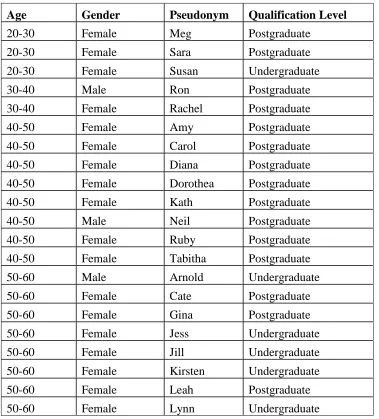
Table 2.1: The Domains of Subject Knowledge in Art & Design Table 3.1: Interview Participants’ Profiles
Chapter 1 Introduction and Context
1.1 Introduction
The motivation for this research has its foundations in earlier studies completed as part of the Doctoral Programme in Educational Research at Lancaster University. These projects explored issues of professional identity and the changing role and territories of librarians working in Higher Education. Engagement with these topics and with other practitioner research during my career working as an academic librarian in specialist arts institutions, led me to consider whether the library profession is asking the right questions when researching its own discipline and practice. Exploring these research topics also made me reflect on the lack of both ‗native‘ theory in the literature of librarianship (Raber, 2003) and the primacy of its focus on problematising the ‗user‘ rather than ourselves as information specialists and teachers.
This thesis examines the experience and understandings of academic librarians working in specialist UK Higher Education Institutions which focus specifically on the provision of courses in the creative arts. The primary purpose of the research is to explore the attitudes and beliefs held by these academic librarians about creative arts students as learners and to establish if there is variation amongst these perceptions.
Ultimately, the critical aim of this research is to enable better learning outcomes for these students by assisting academic art librarians to improve their professional practice. It therefore seeks to explore art librarians‘ conceptual constructions and characterisations of these students and examine the discourse used to describe them and their learning preferences. It further considers what these assumptions and beliefs might mean for art library practice and librarians‘ support for student learning.
The role of the librarian in Higher Education has changed enormously in recent
decades and is continuing to evolve in response to government initiatives, institutional reorganisation, information expansion and technological advances. Research, which might assist academic librarians to contextualise their working environment and which raises their awareness of the needs and expectations of the students they
mean for their professional work and their approach to teaching and learning, now and in the future.
This introductory chapter provides the rationale for this study and presents an overview of the research, an outline of its structure and approach and some initial contextual information in order to position the chapters which follow. The key research questions which underpin the study are noted. This chapter also includes some definitions and describes the overarching design of the study and main areas of focus.
The research was located in three specialist arts Higher Education Institutions (HEIs), each with their own cultures, management structures and approaches to service delivery, but sharing pedagogy derived from the same historical roots. Whilst every university has its own unique identity and it is necessary to be cautious about generalisations, the common focus of specialist arts institutions on creative arts education and the signature pedagogy of art and design (Shulman, 2005a; Shreeve, Sims and Trowler, 2010; Sims and Shreeve, 2012) means that the findings of this research should prove to be of interest and relevance to the sector. The design and completion of the research used a phenomenographic approach for both the collection and the initial analysis of the data.
For the purposes of this research the terms ‗academic art librarian‘, ‗arts librarian‘ and ‗art librarian‘ are used interchangeably and describe an information professional, i.e. a qualified or Chartered Librarian, working in a UK university which specialises in art, design and media education. These librarians may have a number of different job titles and role descriptions and will carry out a variety of specialist functions
including working with students on a one-to-one or group basis to deliver what used to be known as ‗user-education‘ and is now more often referred to as information skills or visual, digital or academic literacy development.
In the context of this thesis the term ‗creative arts‘ is used to describe a group of arts and media disciplines which are practice-based, practice-led, practice-informed or practice-orientated. These include amongst others, architecture, fine art, interior design, fashion, textiles, graphic design, photography, film, television and
collectively and therefore the ‗arts‘ in this context refers to studio-based disciplines, courses, crafts and professions.
Quotes are used throughout this thesis to illustrate and substantiate the research and to expand upon the findings and data analysis being presented to the reader. Lists are also used, derived from my own professional experience or the experience of relevant professional organisations and are offered to provide guiding ideas for this study and to present the reader with information which will enable them to make sense of and contextualise the research data.
The research literature which underpins the theories and conceptions related to arts education and arts librarianship is considered in the literature review which is provided in Chapter 2.
1.2 Methodological approach and research focus
This research uses phenomenographic methods and a phenomenographic
methodology to enable variation in the participant group to be identified as categories of description and articulated into an outcome space, thus offering a hierarchical and ordered grouping of the experiences and attitudes of these Higher Education
professionals.
The overarching qualitative research paradigm for this thesis is constructivist in that this study focuses on meaning-making and is future-orientated. This stance aligns with key theories related to learning and teaching. Biggs (2006, p.60) suggests that there are ‗two main theories of learning within the student learning paradigm: phenomenography, and constructivism‘.
‗Constructivism describes the way that, working within shared meanings and shared objective circumstances, individuals process data in the light of their experiences and mental structures to create meaning….constructivism rejects the structuralism/functionalism which implies that everybody will construct identical meanings. It emphasises the role of individual agency that are similar and different from those of others in a culture‘, (Knight and Saunders, 2010,
p.146).
experience is created between that person and the world (Marton and Booth, 1997; Marton, 2000). It allows a position where the interpretation of the data is the researcher‘s own, and acknowledges that another researcher may reach different conclusions. Phenomenography enables an understanding of different ways of experiencing a common phenomenon and helps to ‗stimulate critical thinking about the deep assumptions which drive thinking, feeling and action‘ (Cherry, 2006, p.62). Phenomenography provides a methodological tool for discovering variation in the conception of a phenomenon amongst a group. It requires an approach to analysis which focuses on the group rather than on individuals.
Phenomenography was chosen to provide the methodological framework for gathering and analysing the research data, because it provides a tested means of ‗surfacing‘ or making variation visible (Åkerlind 2005). Phenomenography is an empirical qualitative research approach which ‗is concerned with the relationships people have with the world around them, the way they experience phenomena and the way they construct concepts about this phenomena‘, (Austerlitz, 2007, p.168). The specific methodological and theoretical approach taken in this research may perhaps be more accurately defined as ‗developmental phenomenography‘ (Bowden and Green, 2005).
It is suggested in the later discussion of the methodology and methodological approach, that an adherence to the methodological principles offered by
phenomenography throughout this study is significant in terms of the rigour of the research. It also enabled me to maintain my awareness of my own role as an ‗insider‘ practitioner-researcher and ensured that there were clearly defined boundaries
between my own experiences as an academic librarian and those being offered to me by the participants.
As a practitioner and researcher exploring an aspect of practice it is essential to clarify both my perspective and what has shaped it and to guard against any pre-conceptions tainting the data. Phenomenographic principles were applied thoroughly to the research in order to mitigate issues related to power, control, assumptions and pre-conceptions. They also provided a structured method for gathering and analysing data. The phenomenographic approach and analysis therefore served to provide a
methodology and a theoretical perspective which framed the design of this study.
to practice are also offered, in order to explore the potential relevance of the
categories of description to the professional work of an art librarian. This application of a social practices approach is based on the view that attitudes and actions cannot be fully understood outside of thesocial context,the habits, processes and thoughts which influence identities and shape people and groups as social entities.
I suggest that the constructivist perspective represented in this study is suited to the research, as the aim of this study was both to understand the beliefs of a staff group who support student learning and also to enable them to change or even transform their practice. Reckwitz (2002) in his exploration of practice theory proposes that ways of understanding are implicit and contextually specific:
‗A specific social practice contains specific forms of knowledge. For practice theory, this knowledge is more complex than ‗knowing that‘. It embraces ways of understanding, knowing how, ways of wanting and of feeling that are linked to each other within a practice. In a very elementary sense, in a practice the knowledge is a particular way of ‗understanding the world‘, which
includes an understanding of objects (including abstract ones), of humans, of oneself‘ (Reckwitz, 2002, p. 252).
This interpretation brings together the practitioner and the practice itself to create group knowledge which will be shared in tacit and explicit ways amongst the
practice-community. Wenger (1999, p.47) suggests that practice includes explicit and tacit understandings and meanings, canonical and non-canonical knowledge resources and also beliefs which are articulated and which are assumed.
The notion of ‗practice‘ implies everyday activities, routines and actions which are linked consciously or unconsciously, directly or indirectly, to theoretical knowledge. Practitioner knowledge may be explicit and implicit. Therefore surfacing tacit practitioner understandings and reflecting on how specific aspects of practice are constructed, including assumptions about students as learners, may enable a repositioning of epistemological and ontological perspectives. This enhanced understanding may in turn translate into new or altered approaches to practice. I suggest that this is important, as practices can either ‗facilitate or impede‘ the learning process (James, N. 2007, p.132).
analysis and exploration of this meta-finding was undertaken and is offered as a synthetic discussion to aid further understanding of what might have encouraged and led to the construction of the assumptions and perceptions represented within this overarching meta-category.
As a qualified librarian with some thirty years of work experience in the profession, the interpretation of the data is mine alone and will have been influenced by my own experiences and understanding of professional identity, the role of academic librarians and of the nature of learning in the creative arts. The underpinning purpose of the research was essentially to understand the experiences and beliefs of a specific community of staff of which I am a professional member and colleague. An ‗insider researcher‘approach therefore appears to be valid for this purpose and in spite of the potential drawbacks, I suggest that it remains a positive aspect of the research design:
‗…insider researchers usually have considerable credibility and rapport with the subjects of their studies, a fact that may engender a greater level of candour than would otherwise be the case‘ (Mercer, 2007, p.7).
However it must be acknowledged there are also potential pitfalls and disadvantages to being an ‗insider researcher‘. The pros and cons of insider research are discussed in more detail in the methods and methodological approaches chapter of this thesis which considers some of the possibilities and limits of an interpretative or reflexive approach during the analysis of the data. Data analysis methods cannot be ‗neutral‘:
‗They reflect, and are imbued with, theoretical, epistemological and
ontological assumptions – including conceptions of subjects and subjectivities, and understandings of how knowledge is constructed and produced‘
(Mauthner and Doucet, 2003, p.413).
The research took place at three, mono-disciplinary universities in the United Kingdom of which one was large in terms of student numbers and two were small. All may be categorised as new, specialist institutions which focus primarily on delivering courses in the creative arts. The data was gathered through twenty-one semi-structured interviews with academic librarians in a range of roles and at different stages of their career journey. All of these librarians had direct experience of
providing library information skills sessions and ‗teaching‘ students. They
1.3 Research questions
Conceptions of learning are complex and are often hidden or tacit. The creative process may also be implicit, emergent and unpredictable (Shumack, 2008). This systematic small-scale study offers a categorical analysis in this focused discipline area, to enable the different ways art librarians experience the phenomenon of arts students as learners to be made explicit.
‗Learning is … a very complex matter, and there is no generally accepted definition of the concept. On the contrary, a great number of more-or-less special or overlapping theories of learning are constantly being developed, some of them referring back to more traditional understandings, others trying to explore new possibilities and ways of thinking‘ (Illeris, 2009, p.1).
This thesis is concerned with perceptions and making tacit assumptions and beliefs explicit. It is also engaged with practice, both in terms of the students and the staff who are at the heart of this study. There are a number of different types of situation where tacit knowledge may be constructed, acquired or used and where practice is developed. These include situations where knowledge is inferred from observation, acquired by implicit learning of which the learner is unaware and through embedded, ‗taken-for-granted‘ activities, codified information, routines and rules (Eraut 2000). Tacit knowledge encompasses tacit understandings of people and situations, as well as tacit actions and codification. The processes involved in constructing tacit knowledge include making sense of the situation, making decisions, taking action and applying intuitive, analytic and deliberative cognition. The processes entailed in constructing practice-knowledge will also be shaped by the time available, the experience of the individual or group concerned and the complexity of the knowledge domain and resources (Eraut, 2000, p.113).
The research questions guiding this study sought to explore the experiences and attitudes of a specific group of Higher Education staff and in addition, enable an interpretation of what these might mean for their practice and for the students they support.
How do academic art librarians perceive, and express their perceptions of art students as learners?
This question focuses on the utterances, constructions and discourse that these librarians use to articulate their ideas about arts student as learners. It concerns how these librarians conceptualise and put together an account of their experiences of student learners in the academic art library.
An analysis of the narratives collected for this study, enabled an exposition of the variation and commonality in the perceptions expressed across the participant group. It also provided a basis for consideration of what meanings might be inferred or construed from these descriptions of how and why students learn in the arts. What these librarians say and what they mean and understand by the conceptual
constructions used, demonstrates subtle and nuanced variation across the participant group. Categories of description emerged from these narratives and the analysis also enabled the identification of a meta-finding or meta-category connected with these perceptions. This led to a further exploration which sought to consider ‗orientations‘ and ‗practice‘.
The principle research question was underpinned by a number of secondary concerns. These are articulated as follows:
What are the differences between these perceptions?
This question relates to the identification of variation or possible alignment amongst this sample group. A phenomenographic analysis yielded a hierarchy of description based on the ‗pool of meaning‘ extracted from the data. The structural and referential elements of the hierarchy are explored and a further interpretation is offered which focuses on librarians‘ intentions to support and enable student learning.
What contextual factors might be associated with these perceptions?
What effect might the variation of perception (librarians‘ different understandings and experiences of arts students as learners) have on librarians‘ approaches to supporting student learning?
This question concerns modes of understanding amongst the group and how these librarians connect their understandings to what they do. It enables a focus on what these librarians do and how their attitudes might be associated with their practice. This study considers what might be inferred about the effect of these perceptions on librarians‘ approaches to supporting and enabling student learning.
1.4 Purpose and relevance
This research considers whether there may be connections between librarians‘ orientations and practice, intentions and strategies and their perceptions of arts students as learners (Trigwell and Prosser, 1996). The relationships between orientations and practice are important because:
‗Just knowing about our subject area helps us to present its content in ways that make it more possible to learn, so, too, can ‗knowing‘ about ourselves as persons help us present ourselves in ways that enhance learning‘ (Lipka and Brinthaupt, 1999, p.211).
Knowing about assumptions, beliefs, orientations and practice may also enable librarians to understand and communicate their practice-identity and their approaches to learning more clearly. Beaty et al.‘s (2005, p.86) research on learning orientations suggests that understanding conceptions of learning can be helpful in establishing the relationship between the individual, the institution and the wider world and in
illuminating the complex nature of aims, attitudes and the purpose of learning.
My professional experience as an academic art librarian leads me to believe that raising and increasing awareness of librarians‘ different attitudes to art students as learners is important for enabling these students to succeed. This belief is based on an expectation that by understanding their experiences and perceptions, practitioners may consciously or unconsciously change their future behaviour and professional
strategies to improve and enhance their practice. This expectation is supported by research which indicates that the espoused theories or theories-in-use (Argyris and Schön, 1974) of teaching staff may positively influence or negatively affect the learning experience which students receive.
‗…espoused theories and theories-in-use can, in principle, be the same, alternatively, they may differ but be compatible and they may differ and be incompatible. Importantly, however, practitioners….may not be aware of incompatibilities or of their own professional ineffectiveness‘ (Greenwood, 1993, p.1184).
The aspects of academic arts librarianship which form the basis of this study have not been researched in this way before. Indeed, the focus of much of the literature of librarianship has been ‗subject-object‘ and ‗process‘ orientated (Bruce 1999) and has concentrated on ‗user‘ or ‗client‘ conceptions, systems, information-seeking
behaviours and information needs, rather than on staff perceptions, the connections between the curriculum and library services and librarians‘ assumptions about learning. It has been argued that much of the research literature of library and information studies are based on positivist epistemologies and one-dimensional paradigms ‗where access to information is linked to uncritical, centrist tropes‘ (Pyati, 2006, p.88).
The literature of academic arts librarianship appears to demonstrate a tendency to focus on the perceptions and practices of students, in order to meet growing demand for student-centred and student-orientated service provision. By so doing, it has perhaps overlooked the importance of the perceptions and practices of library staff who deliver these services. However, Ashwin (2009) notes in his work analysing the relationships between teaching and learning interactions in Higher Education:
particular I argue that the tendency in research in this area to separate the perceptions and practices of students from the perceptions and practices of academics seriously hinders its capacity for accounting for these relations‘ (Ashwin, 2009, p. 29).
It is perhaps debateable, or moot, whether or not we can substitute the term
‗academics‘ in the statement above by the word ‗librarians‘. The working practices of librarians and academics and the focus of their interactions with students are rather different. For example librarians may have as their primary focus and intention, the teaching of information literacy skills and their interactions with students often relate to the development of academic literacies, such as critically examining information and undertaking research. Their interactions with students may be determined by academic colleagues who create, develop and ‗own‘ the curriculum in their
disciplinary area and may act as ‗gatekeepers‘ for librarians‘ access to courses and to students. Whilst librarians and academics will both be concerned with teaching, research and administration, the balance of these activities will vary across and within these professional groups. One area where I contend there is notable difference is in the literature and research available to librarians and academics about how they perceive students. I contend that research into the perceptions held by librarians about students as learners generally, and in particular in art and design, has been a
significant gap in the current literature of library and information studies.
Ashwin (2009) makes a robust case against the separation of the perceptions and practices of students from the perceptions and practices of academics. Whilst this proposition may hold true it is difficult to enact in the context of academic
librarianship and its associated research terrain. Although there is ample literature and research to draw upon which can inform librarians about library-user perceptions of them and their work (Fagan, 2003; Shaw, 2010), much of this research emanates from the United States rather than the UK and there is very little literature which librarians can turn to, which might help them reflect on their own perceptions of the
communities they support and their associated work practices. This study aims to address the absence of such research, within a specific disciplinary context.
draws upon staff utterances and the data collected for this study does not include student narratives i.e. the direct student ‗voice‘. Neither does it include the perceptions of workshop technicians, learning development tutors or others who support student learning in the creative arts.
I suggest that this study is needed as a starting point for ultimately bringing together the perceptions and practices of staff with the perceptions and practices of students. Until this can be accomplished through further, future research I acknowledge that a complete analysis of teaching and learning interactions in this specific disciplinary context may not prove fully possible. However I argue that it is still possible to increase understanding and awareness of such relationships, by focussing on one group (library staff) and not the other (students) and that this has value in a landscape of research literature which is currently lacking in information or explorations of the staff perspective.
The purpose of this research is to probe in detail and depth, the assumptions and beliefs that academic art librarians may have about creative arts students as learners. It is hoped that the outcomes of this study will provide an empirically-derived and theoretically-informed ‗lens‘ which might be used to enable greater understanding of staff perceptions and aid reflection on staff practice. Therefore the principle focus of this thesis will be on librarians, and it is this group of Higher Education staff who form the participant group for this study.
As previously noted, the literature of academic librarianship includes research on student perceptions of librarians and libraries in a number of disciplinary settings (Langridge, Riggi, and Schultz, 2014). However there is very little research which academic art librarians can turn to, which might enable them to understand their own attitudes to and conceptions of the learners they support and none which specifically addresses perceptions of creative arts students as learners. Therefore the research questions which frame this thesis are intended as a first-step on a longer journey which ultimately would seek to include new, additional research on this topic through the involvement of students, academic staff and other colleagues who contribute to the learning and teaching environment of art and design.
(Pettigrew and McKechnie, 2001; Raber, 2003; Jaeger, 2010). This has led to a profession which exhibits ‗tunnel vision and blind spots‘ (Wiegand, 1999) and is ‗trapped in its own discursive formations, where members speak mostly to each other and where connections between power and knowledge…are either invisible or
ignored‘ (Wiegand, 2001, p.3). Indeed most phenomenographic studies within library and information studies have focused on information practices and conceptions of information literacy rather than on librarian‘s approaches to and understanding of teaching and learning.
This thesis seeks to address such gaps in the literature of art librarianship, both by examining a previously unexplored topic and by constructing ‗meaning‘ through the analysis of the data collected, in order to ‗contribute to greater understandings of the complex social environment in which information issues occur‘ (Jaeger, 2010, p.203). This study contributes to the literature of librarianship and adds to the literature of educational research through its attention to pedagogic issues and concerns related to the involvement of librarians in the academic processes of Higher Education.
I propose that dissonance between the learning strategies encouraged by an arts curriculum and used by students and the perceptions and orientations expressed by the librarians who support them, is leading to a position of misunderstanding. This
inhibits effective professional practice which is congruent with student intentions and student learning needs. The motives and actions of these librarians are informed by a lack of confidence in themselves and in arts students as learners. A discourse of ‗difference‘ and ‗difficulty‘ weaves through the participants‘ narratives. This skews their views on the ability of these learners to be successful in ways which are not congruent with their tacit expectations of student aptitudes. This position creates a barrier to learning and may inhibit student success. Vermunt and Minnaert (2003) suggest that redesigning a learning environment in line with the aims of process-orientated instruction causes difficulties for students and teachers alike. These difficulties include misconceptions about learning activities, strategies, orientations and perceptions and if accompanied by a resistance to change, they can lead to a ‗disconnect‘ between curriculum, teaching and assessment (Vermunt and Minnaert, 2003, p.51). By raising awareness of these issues through a contextualized study I hope to enable my fellow-practitioners to reflect more effectively on their
professional work and challenge and question established art library customs and practice.
This thesis seeks to reveal arts librarians‘ understanding of creative arts students as learners. It reflects on the ways in which these perceptions may inform librarians‘ pedagogic approaches to supporting these students and considers the discourse used to describe art student learners in the context of academic art library provision.
In order to situate the analysis of these experiences and attitudes, reference is made to the history and development of art and design curricula, art library services, the changing professional identity and role of academic arts librarians and also to the notion of ‗practice‘. ‗Practice‘, in the context of this study may be described as:
‗…what is said and what is left unsaid; what is represented and what is assumed. It includes language, tools, documents, images, symbols, well-defined roles, specified criteria, codified procedures, regulations, and contracts that various practices make explicit for a variety of purposes. But is also includes all the implicit relations, tacit conventions, subtle cues, untold rules of thumb, recognizable intuitions, specific perceptions, well-tuned
sensitivities, embodied understandings, underlying assumptions, yet they are unmistakable signs of membership in communities of practice and are crucial to the success of their enterprises‘ (Wenger, 1999, p.47).
The engagement of this research with practice, meaning, identity and discourse is indicative of a ‗social practices‘ perspective. Trowler (2005, p.20) proposes that an appropriately developed and applied social practices approach can provide the basis of ‗a sociological theory of teaching and learning in HE‘ and suggests that this is because such an approach acknowledges the importance of:
‗The individual in context: takes into account both the figure and the ground. Social interaction at the meso level and the constructive processes there. Workgroups and teams as open, natural systems
The operation of both agency and structure
The interaction between tools, including learning technologies and their social context
The inter-relationship between social interactions and individual subjectivities The operation of power at the meso level‘ (Trowler, 2005, p.20).
various dates). Social, political and economic factors will all have some influence on the context within which students learn and staff practice. These factors may be complex and are not fixed. National policy, market forces, institutional context, academic territories, disciplinary preferences, user communities and functional
specialisation, may well play a part in shaping librarians‘ conceptions of their purpose and value in a changing academic environment (Gee, 2000; Becher and Trowler, 2001; Barnett and di Napoli, 2008). Academic librarianship is now, more than ever, a client-centred service. Librarians need to fully understand the needs of their clients and to do this and to successfully develop services, they must engage with the academic processes of the university.
Acculturation into practice, philosophical, cultural and pedagogical influences such as the dynamics of power and politics in the workplace, disciplinary-specific or
professional pedagogies and how these might shape or develop this experience, are also relevant as they will influence professional practice (Danvers, 2003; Shulman, 2005). The ‗work‘ context, societal, cultural and organizational, as well as the potential influence of the disciplines supported (Corner, 2005) and the particular belief orientations of individuals, are significant factors which shape both
‗pedagogised identities‘ and conceptions of learning (Atkinson, 2002; Haggis, 2003).
In order to situate this research and its findings within the research fields of academic librarianship and Higher Education, a literature review is provided in the following chapter which focuses in further detail on academic arts librarians‘ practice, i.e. what they do to enable arts students to learn and succeed in their studies. This literature review includes discussion of the role and identity of the academic ‗arts‘ librarian, the construct of the art library and the ‗signature‘ pedagogy of art and design (Donald, 2009: Shulman 2005). It also explores learning approaches which may be encouraged or ‗preferenced‘ by the curriculum of art and design.
1.5.1 Context: learning in the arts
Learning may be perceived as a way of interacting with the world (Biggs, 2006). As we learn, our understanding of a subject or phenomena will change. ‗Thus, education is about conceptual change, not just the acquisition of information‘ (Biggs, 2006, p.60). This may be said to be particularly true in relation to learning in the arts.
degrees has evolved in order to cater for larger student numbers including more international students, increasing incidence of dyslexia or specific learning differences amongst art student cohorts and the drive for increased efficiency and value for
money in a fees-driven Higher Education environment. Debate continues about what is homogenous and what is ‗special‘ about a creative arts degree.
‗The particular ways in which students learn in the creative arts and the outputs they produce have also been delineated by staff and students in the sector. The most familiar defining aspects of this include visual or
kinaesthetic learning preferences, and the use of problem-based or practical learning situations‘ (James, 2007, p.180).
There is a significant body of research on the process of design and design thinking, with recent studies focussing on the kinds of knowledge and methods designers need to solve complex problems. Creative arts students use visualisation, drawing,
prototyping and modelling to support their design cognition (Purcell and Gero 1998; Seitamaa-Hakkarainen and Hakkarainen 2000; Laamanen and Seitamaa-Hakkarainen, 2008; Kuksa 2008). Creative processes take place in a studio or workshop setting where arts students are encouraged to reflect on their ‗practice‘ and to be open to an important interplay between states of ‗confusion and contradiction‘ (Graves 2007, p.17).
Notions of conceptions of learning and approaches to learning derived from research which took place in the early 1970s. Säljö's (1979) study (reported in Marton and Säljö, 1997) of adult learners suggested that learning might be understood as increasing knowledge, memorizing, acquiring facts and also learning as the
abstraction of meaning or learning as an interpretative process aimed at understanding reality. Martin, Dall‘Alba and Beaty (1993) identified a sixth conception – learning as changing or developing as a person. Research into conceptions of learning and particularly ‗surface‘ and ‗deep‘ approaches to learning, was developed further by Kolb (1981) Ramsden and Entwistle (1984), Biggs (1999) and by Prosser and Trigwell (1999) amongst others.
‗…an individual and social element, the latter always reflecting current societal conditions, so that the learning result has the character of an individual phenomenon which is always socially and societally marked‘ (Illeris, 2003, p.227).
Higher Education in the United Kingdom has undergone a period of rapid and continuous change throughout recent decades. These changes have also impacted on the role and work of academic librarians as they have sought to respond to a massive growth in student numbers, the increased accessibility of digital information and the demand for the greater involvement of librarians in curriculum design and learning support.
1.5.2 Context: art librarians
The identity and professional credibility of academic librarians remains a contentious issue in LIS literature and is still being explored (Broady-Preston, 2010; Corrall, 2010; Law, 2010; Shank, Bell and Zabel, 2011). Recent changes in Higher Education, accompanied by fast-paced technological change and an increasingly diverse student population have impacted greatly on librarians‘ traditional roles and responsibilities in academia (Biddiscombe, 2002; Vassilakaki, and Moniarou-Papaconstantinou, 2015). This has led to contradictory and divergent expectations of academic librarians, by others and also from themselves.
Art librarians working in specialist arts institutions form a particular professional group within the wider community of information or library professionals. They design and create knowledge resources and develop and deliver services to enable student learning. They work collaboratively as ‗hybrid‘ professionals (Makin and Craven, 1999) or ‗third space professionals‘ (Whitchurch, various dates) who bridge the academic and non-academic divide in the territories of UK Higher Education. Academic librarians in the creative arts play a valuable role in supporting students to develop as independent learners and to navigate the complexities of the information landscape of their chosen fields of study.
1.5.3 Context: arts librarianship in Higher Education
The role of university libraries and the function and professional domains of academic librarians have shifted as university courses have been re-shaped and re-defined in response to the new ‗market-place‘ for education. In a world of decreasing budgets and unknown future user-demand, approaches to teaching and learning are continuing to develop in response to economic exigencies, technological advances and the needs of an increasingly diverse student population. Support services for students are also changing rapidly, driven by management demands for improved business efficiency and operational effectiveness. The boundaries between traditional roles have blurred as librarians support the enhancement of the student learning experience in more proactive and central ways (Dale et al., 2006, p. xiii).
Librarians in academic libraries have increasingly moved away from the role of ‗gatekeeper‘ and ‗information-intermediary‘ and have begun to provide support to enable students to become better academic writers and readers. These changes have corresponded with wider changes in approaches to teaching and learning such as the move to promote independent and reflective learning and the encouragement of group and social learning. Librarians actively support students in engaging fully with
information as an integral part of their disciplinary studies. Not only will they advise on information resources, they assist with resource discovery both of physical and online content, and provide information and digital literacy programmes to enable the effective management and ethical use of information as well as developing students‘ research skills.
Academic librarians still build their subject knowledge and awareness of the disciplines they support in order to inform their practice, but they now increasingly act as teachers of information skills and providers of learning support. Pedagogical and subject knowledge resides primarily with academic staff. Therefore academic librarians seek to work collaboratively with academic staff and other university colleagues through liaison activities, projects and partnerships, to ensure congruence between library service delivery and staff, student and course needs. They also continue to perform a mediating role to enable access to information for staff and students, delivering information resources and services both within the library walls and beyond. Conceptions of librarians as collaborators in student learning are
understanding of the disciplines they study‘ (Wilder, 2005, p.13). This assumption whilst accurate at one time, may require further scrutiny in the changed professional environment in which most academic librarians now work.
Conceptions of arts librarians as contributors to student learning, may perhaps be better understood through an examination of some of the beliefs articulated by
librarians about art libraries and by reflection on the assumptions they make about the ways in which creative arts students learn. This thesis points towards ways in which library services might be more fully aligned with student, rather than staff, approaches to learning. Bowden and Marten (1998) describe the dialectical relationship between ways of seeing and experiencing the learning situation and ways of acting and handling the learning situation and note that:
‗Differences between approaches to learning are differences in what the learners are focusing on, what they are trying to achieve and how they are going about it‘ (Bowden, Marten, 1998, p.19).
Kreber (2009) suggests that a better understanding of learning in particular disciplinary settings can enable teachers to support students more effectively to acquire the skills, abilities and dispositions they need to succeed.
Art, design and media students have often been labelled in the literature of academic librarianship as ‗anti-literate‘ particularly in terms of information literacy, exhibiting what librarians perceive as ‗random‘ or ‗serendipitous‘ information-seeking
behaviours. Indeed ‗design students have been referred to as ‗pariah‘s‘ of library instruction‘ (Teague, 1987, pp.99 quoted by Fawley, 2010, p.175). Other literature considers how librarians could allow for the ‗idiosyncrasies‘ of the discipline (Rose, 2002) in order to make the student experience more efficient, creative and enjoyable.
Research into library and information studies generally indicates that librarians have frequently ‗problematised‘ student use of libraries and may view student approaches to information use as either ‗right‘ or ‗wrong‘, for example Cowan (2004) notes a tacit assumption amongst art librarians ‗that there is a correct way to use libraries, and a strong thread of belief that artists deviate from this correct usage‘. Stam (1995a, b) concludes that this belief orientation can pose a very real problem amongst librarians in their approach to student learning support. It has also been suggested in the
of learning may construct a negative lens where ‗students are then pathologised against this normative formulation‘ (Haggis, 2003, p.98).
If practice is to be truly inclusive it is necessary to understand how variation in art librarians‘ understanding of students as learners, influences or affects the learning experience which students may receive.
1.6 Outline of thesis structure
Chapter One offers an introduction to the research, its overarching aims and objectives and provides definitions and an overview of the context for the study. It also seeks to signpost the structure of the thesis for the reader.
Chapter Two provides a thematic literature review which focuses on the pedagogy of art and design and the learning approaches that arts curricula encourage and also considers academic arts librarians‘ practice, i.e. what librarians do to support student learning. A review of relevant literature from the domains of academic librarianship and educational research is offered, to assist the contextualisation and substantiation of the findings and to situate the ensuing discussion within the specific disciplinary context of the creative arts.
Chapter Three details the methods and methodological approach used for collecting and analysing the data. It presents the research design in more detail, considers the way the data used in this thesis was gathered and explored and describes how it is presented, along with a consideration of ethical and other issues related to this study. This chapter establishes and defends the research methods used and considers the researcher‘s role as an ‗insider‘, a member of the practitioner community, on which the study is based, and the potential impact and consequences of this position on the research itself. Chapter Three also presents the research paradigms within which this study is located.
Chapter Five, explores a meta-finding or meta-category which is described as a ‗discourse of difference and difficulty‘. It considers ‗orientations‘ and ‗practice‘ using an interpretative approach (Walsham, 1993, 1995; Mauthner and Doucet, 2003) and examines contextual issues related to the practices described by participants in this study. The interpretative analysis offered is informed by a social practices
perspective.
Chapter Six offers a concluding section which presents my reflections on the research journey and points towards potential areas of focus for future, further research.
1.7 Summary: Chapter 1
This chapter has sought to provide an introduction to this research. It has offered some initial definitions, provided a description of the research questions and
commenced a discussion of the context within which the findings of the research will be situated. This thesis suggests that by enabling an exploration of assumptions and building understanding of perceptions, art librarians may have the opportunity to reflect more effectively and meaningfully on their practice and perhaps rebalance their understanding of art students as learners and thereby improve the services they deliver.
An outline of the purpose of the research and the methodological approach was provided which noted that following the phenomenographic analysis, an interpretative approach was undertaken to consider systematically and critically a meta-finding or meta-category identified and the associated professional context.
Chapter 2 Literature Review
2.1 Introduction: learning and libraries in the creative arts
Chapter Two of this thesis provides a selective, thematic literature review to offer a context within which to situate this research and in particular the findings and discussion chapters which follow. It considers literature from the fields of
librarianship and educational research. This review seeks to address two key themes.
Firstly it endeavours to explore approaches to learning in the creative arts. It examines the development of art education, the pedagogy of the creative arts and what
constitutes ‗knowledge‘ in practice-based subjects. It also considers what arts students ‗do‘ to learn in the arts and what learning styles arts curricula might encourage.
The second key theme considers the development of academic art libraries and
explores academic art librarians‘ practice and their support of creative arts students as learners. It discusses these librarians‘ changing roles and their shifting identities and examines what they ‗do‘ to enable and foster student learning.
This review also briefly examines research in library and information studies which relates to arts students‘ information-seeking behaviours.
This literature review does not attempt to review or critically assess the extensive and substantial literature on teaching, learning and assessment in Higher Education within other disciplinary fields. Neither does it consider in depth the vast literature of
information literacy. It also excludes consideration of art library practices for students engaged with courses on the history of art. It is focused instead on learning and library practices in the creative arts.
The reason for this specific focus and the exclusions listed above is to ensure a contextual overview and critical examination of research literature is provided for the reader, which connects directly to the question at the heart of this study. This
research concerns academic art librarians and art students as learners, in the context of practice-orientated creative arts courses in specialist UK Higher Education
2.2 Teaching, learning, assessment and knowledge in the creative arts
Learning may be conceived in many different ways. It can be viewed as a
combination of reflection, meaning and action (Boot and Boxer, 1980) which leads to changing behaviour or discovering new understandings. These elements lie at the heart of learning in the creative arts, which is enquiry-based, highly experiential and singularly individualised. Experiential learning is a key component of practice-based studies. Kolb‘s (1984) cycle of experiential learning proposes a four stage problem-solving process comprising; concrete experience; reflective observation; abstract conceptualisation and active experimentation i.e. having an experience, reviewing it, concluding from it and planning next steps (Sugarman, 1985). These processes mirror the key stages of the design process.
‗At the core of Kolb‘s model is a simple description of how experience is translated into concepts that can be used to guide the choice of new experiences. Kolb perceives immediate experience as the basis for the observation and reflection from which concepts are assimilated and then actively tested. This testing gives rise to a new experience and the whole cycle begins again. Effective or comprehensive learning requires flexibility. Learners must shift from being actors to being observers and from being directly involved to being analytically detached‘ (Sugarman, 1985, p.264).
Learning will also be shaped by and dependent upon context. It will be framed by a particular legacy of disciplinary research and will be socially constructed, as well as being acquired individually (Brew and Boud, 1995). Learning in the arts is viewed by many as a process of transformation where knowledge and abstract ideas are re-shaped by practical experience and through trial (and error) in different contexts and situations.
‗The resulting understandings are a marriage between conceptions of a phenomenon which come from outside the learner and those emanating from within (Boud, 1993 quoted in Brew and Boud, 1995, p.269).
Successful arts practice is centred on creativity and originality. Students develop individual skills and work independently but will also learn in teams and groups. They make and create, they problem-solve and produce new products and designs or
unique practice, their art and the artefacts they produce, will come from within, but will be informed and developed by external stimuli. Learning for these students will be problem-based, collaborative and self and peer-directed.
In the 1960s a series of reports examined art education and its curriculum, leading to a number of government recommendations including a requirement for every course to include an element of ‗academic‘ provision, namely art history (Coldstream, 1960, p.8). Creative arts students will therefore engage with theory or, as it is more often labelled in British Higher Education, critical, cultural or contextual studies. These students will therefore be expected to write and research, as well as make, draw, paint and design.
‗Students contextualise and develop their practice and identities through researching and studying practitioners around them and before them; students theorise their work in crits, sketchbooks and in conversation with peers and tutors; and art practice itself is broader than making and broader than the visual‘ (Rintoul, 2014, p. 346).
In their 2014 study on arts students and the National Student Survey (NSS), Susan Orr, Mantz Yorke and Bernadette Blair noted that the students they interviewed made little reference to ‗theory‘ when discussing their response to questions posed by the NSS. They suggest that this may be because theory is so well embedded in the curriculum it is fully integrated into studio practice, and is therefore a ‗natural background‘ not worthy of further comment or alternatively that it may be because ‗theory‘ and ‗contextual studies‘ were not regarded as either ‗noteworthy or relevant‘ (Orr et. al. 2014, p.37-38). The integration of theory and practice is a contested issue in the discourse of the pedagogy of art and design. There is a tendency in the
literature to either polarise theory and practice as completely separate elements of the curriculum, or to consider this a false division i.e. by those who believe that ‗thinking‘ and ‗making‘ are completely inseparable (Eisner, 2002).
‗Whether delivered in a discrete lecture theatre context, embedded in the art studio or visible in various combinations of both, theory and its relationship with studio practice is an unresolved yet long debated issue in British art education discourse‘ (Rintoul, 2014, p. 346).
studies will also entail creating or acquiring knowledge. Knowledge in the creative arts is developed through personal experiences, self-understanding, reflection and unique ways of thinking and is characterised by creating something new, making innovative connections and working with and through contradictions and confusion. The learner develops their understanding by engaging with ideas from literature, from academic staff, from their peers and though the development of personal experience. Knowledge is characterised as intuitive and unpredictable, as ‗not knowing‘ rather than something which is structured, linear or codified. In the creative arts, perhaps more than many other disciplines, knowledge is permeable and contradictory. Indeed, disciplinary knowledge in the creative arts has been described as ‗explicit islands in a tacit sea‘ in an attempt to describe the extraordinary knowledge flows and the
distinctive experience of ‗knowing‘ in art and design, as linear and non-hierarchical (Hicks, Dattero and Gallup, 2007, p.8).
Shumack (2008, p.63) describes how different forms of knowledge and knowing, experiential, procedural and propositional, may be categorised in art and design. She suggests that propositional knowledge in the context of practice-based or practice-led disciplines may be defined as ‗knowing which can be substantiated by fact or
evidence‘ (Shumack, 2008, p.68). Procedural or ‗operational‘ knowledge may be defined as knowing about the skills and processes required for creative practice. Both propositional and procedural knowledge contribute to and form part of experiential knowledge, both tacit and explicit. Niedderer (2007) suggests that procedural and propositional knowledge provide a tool with which to examine in minute detail the ‗micro-moments‘ of practice.
Lawson (2006) offers a theory of the design process through which new knowledge is formed, which is based on a series of linked ‗action‘ stages or key moments of design decision-making, which is retrospective and forward looking, as students consider the intention and context for developing a design prototype. This view supports an
important principle of learning in the creative arts, which is ‗not-knowing‘ i.e. being comfortable with high levels of uncertainty, being open to multiple research questions and answers and being prepared to wait for knowledge and understanding to be
consensus. This position is further substantiated by Shumack, (2008, p.62) who suggests that by not becoming overly prescriptive, learners can allow creativity to flourish at the ‗margins of practice‘.
‗If we wish to retain the concept of ‗knowledge‘, and many do, it is vital to recognize the many ‗knowledges‘ that exist. This awareness is, fortunately disturbing. A wide epistemology is permeable; it allows one kind of
knowledge to leak into another. Even more important, I think, there are many different ways of acquiring knowledge – deductive reasoning, observation, and intuition‘ (Graves, 2007, p.17).
The concept that many knowledges exist, aligns with the view represented in the literature of art and design pedagogy that there is little or no agreement as to the core ‗content‘ of the curriculum in the creative arts. The idea of a body of knowledge or canon in art and design is as problematic as the relationship between theory and practice. Knowledge in the arts draws upon and applies information and research from multiple disciplines and subjects. In his research into the research-teaching nexus, Griffiths (2004) proposes that knowledge production must be understood in context and describes a mode of producing new knowledge which corresponds to Boyer‘s (various dates) ‗scholarship of application‘. This model is one which characterises the applied, professional and vocational subjects which would include the creative arts, architectural design and media. He notes that:
‗What primarily distinguishes applied fields from others is that they are orientated not towards knowledge and understanding for their own sake, but towards the use of knowledge and understanding in addressing conflicts, tackling problems and meeting the needs of clients and other groupings. In this they all, to a greater or lesser extent, make use of knowledge derived from other modes of knowledge production‘ (Griffith, 2004, pp.715-716).
Constructing knowledge and learning in the creative arts may therefore be considered to be a combination of ‗theoretical, intuitive and material activity‘ (Brighton, 1994, p.34).
‗..encourage student responsibility through ownership, trust and low levels of authoritarianism, providing opportunities for individual attention and
opportunities for independent learning‘ (Dineen and Collins, 20015, p.46).
Students will be set a project brief which ‗sets the student out on a process of discovery‘ (Orr et al. 2014). Rather than testing knowledge, the brief provides
students with an opportunity to develop as learners by responding to the assignment in a variety of highly individualised ways.
‗Project centred learning forces students to take a degree of responsibility for the shape and direction of their studies. One consequence of this is that the course content students experience will vary dependent on the nature of the work they pursue. This results in the students viewing themselves as sharing responsibility for course content and the trajectory of their learning‘ (Orr et al. 2014, p.35).
Assessment in the creative arts can be problematic, given the difficulty of exactly defining creativity. Assessment may be summative and formative, responsive and prescriptive. It is acknowledged that creativity is difficult to quantify and evaluate. Some definitions of assessment in the arts consider the appropriateness or usefulness of the creative outcome or product (Sternberg and Lubart, 1999). Others consider the process and methods which underpin creative practice to be a good foundation for assessment and an indicator of success (Lindström, 2006, p.56). This notion of evaluating intentions, processes and methods is further developed by Gustina and Sweet (2014) who suggest that assessment criteria should usefully consider:
Investigative work, experimentation, challenges and solutions Inventiveness, problem-solving and taking risks
The ability to use models, finding appropriate models to emulate Capacity for self-assessment, reflection on the quality of the work Overall judgement on level of difficulty with which the student works
independently
These criteria align with the proposition made by Danvers (2006) that art should be thought about and evaluated as:
bodies; the perspectival nature of our interpretations of the world; and the particular ways in which we achieve coherence and integration through the making of art‘ (Danvers, 2006, p.77).
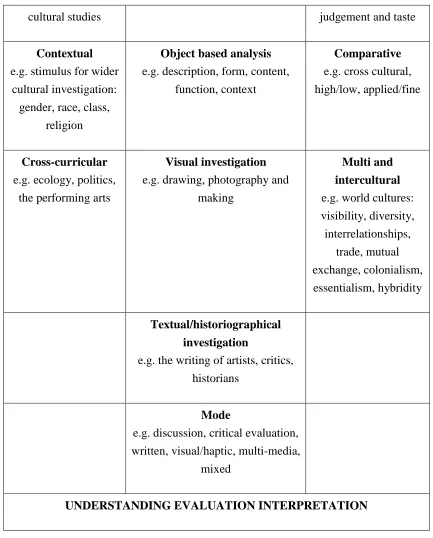
These domains are also reflected in a depiction of the subject areas in art and design offered by Nicholas Addison (2005) which groups aspects of creative arts knowledge and connects them through the application of critical methods and investigative approaches i.e. understanding, evaluation and interpretation.
Thematic and/or issue-based
the seasons, inside/outside demonization of Islam
Homelessness
Technical and/or materials-based
e.g. carving, weaving: plastics, virtual space
Formal and/or aesthetic
e.g. colour theory, spatial systems: beautiful and sublime,
grotesque and abject
Semiotic
e.g. materials as signs, the meaning of represented gesture
Own practice: production
E.g. conceptual, critical, making
Own practice: teaching
e.g. collecting, resourcing, planning, enabling, assessing,
displaying
Historical
e.g. chronology, social history, the artefact as
documentation Functional e.g. why? contemplation, utility, Propaganda, or whom? private/public ideology e.g. 18th/19th Needlework, a means of communication
SUBJECT KNOWLEDGE IN ART CRAFT & DESIGN
APPROACHES AND METHODS OF INVESTIGATION
Art historical
e.g. material evidence of culture: Ancient Egypt, Iconography:
Italian Renaissance, stylistic change and
development
Interdisciplinary
e.g. anthropology, sociology, psychoanalysis,
Sites (real and virtual)
e.g. Studios, Museums, Libraries
Critical
cultural studies judgement and taste
Contextual
e.g. stimulus for wider cultural investigation:
gender, race, class, religion
Object based analysis
e.g. description, form, content, function, context
Comparative
e.g. cross cultural, high/low, applied/fine
Cross-curricular
e.g. ecology, politics, the performing arts
Visual investigation
e.g. drawing, photography and making
Multi and intercultural
e.g. world cultures: visibility, diversity, interrelationships,
trade, mutual exchange, colonialism, essentialism, hybridity
Textual/historiographical investigation
e.g. the writing of artists, critics, historians
Mode
e.g. discussion, critical evaluation, written, visual/haptic, multi-media,
mixed
[image:38.594.99.532.66.604.2]UNDERSTANDING EVALUATION INTERPRETATION
Table 2.1: The Domains of Subject Knowledge in Art & Design
(Nicholas Addison in Hickman, 2005a, p. 189)
As a discipline, art may be perceived as being concerned with ‗life and life issues‘ (Taylor, 2005) and in this way can be all encompassing. Others have claimed it is indistinguishable from science except in its methodological approaches (Read, 1943). As a subject it is multi-faceted and requires teaching, learning and assessment