Changes in child exposure to environmental tobacco smoke
(CHETS) study after implementation of smoke-free
legislation in Scotland: national cross sectional survey
Patricia C Akhtar,
1Dorothy B Currie,
1Candace E Currie,
1Sally J Haw
2ABSTRACT
ObjectiveTo detect any change in exposure to
secondhand smoke among primary schoolchildren after implementation of smoke-free legislation in Scotland in March 2006.
DesignComparison of nationally representative, cross sectional, class based surveys carried out in the same schools before and after legislation.
SettingScotland.
Participants2559 primary schoolchildren (primary 7; mean age 11.4 years) surveyed in January 2006 (before smoke-free legislation) and 2424 in January 2007 (after legislation).
Outcome measuresSalivary cotinine concentrations, reports of parental smoking, and exposure to tobacco smoke in public and private places before and after legislation.
ResultsThe geometric mean salivary cotinine concentration in non-smoking children fell from 0.36 (95% confidence interval 0.32 to 0.40) ng/ml to 0.22 (0.19 to 0.25) ng/ml after the introduction of smoke-free legislation in Scotland—a 39% reduction. The extent of the fall in cotinine concentration varied according to the number of parent figures in the home who smoked but was statistically significant only among pupils living in households in which neither parent figure smoked (51% fall, from 0.14 (0.13 to 0.16) ng/ml to 0.07 (0.06 to 0.08) ng/ml) and among pupils living in households in which only the father figure smoked (44% fall, from 0.57 (0.47 to 0.70) ng/ml to 0.32 (0.25 to 0.42) ng/ml). Little change occurred in reported exposure to secondhand smoke in pupils’own homes or in cars, but a small decrease in exposure in other people’s homes was reported. Pupils reported lower exposure in cafes and restaurants and in public transport after legislation.
ConclusionsThe Scottish smoke-free legislation has reduced exposure to secondhand smoke among young people in Scotland, particularly among groups with lower exposure in the home. We found no evidence of increased secondhand smoke exposure in young people associated with displacement of parental smoking into the home. The Scottish smoke-free legislation has thus had a positive short term impact on young people’s health, but further efforts are needed to promote both smoke-free homes and smoking cessation.
INTRODUCTION
The main source of exposure to secondhand smoke among children is domestic, usually in the home or the car1 2; the levels of exposure correlate with the
preva-lence of parental smoking.3 4In the home, protection
can arise only from voluntary family based restrictions by adults. Children can also be exposed in other con-texts, including public places,2yet this is a little studied
area.
On 26 March 2006 Scotland introduced legislation that prohibited smoking in most enclosed public places.5 6Studies using objective measures have found
that smoke-free legislation is an effective strategy for reducing secondhand smoke exposure in adults.7-9
However, an unintended consequence of smoke-free legislation might be displacement of adult smoking from public places into the home,10 11thus increasing
exposure to secondhand smoke among children living with adults who smoke. Evidence from elsewhere, however, does not support this supposition, as smoke-free legislation has been shown to be associated with an increase in smoke-free homes, a tendency to smoke less, and more successful cessation attempts among adults.12-14
Here we report results from the changes in child exposure to environmental tobacco smoke (CHETS) study. We examined the impact of the smoke-free leg-islation on children’s exposure to secondhand smoke at a population level. In addition, we examined whether any evidence exists for increased parental smoking in the home associated with implementation of the Scottish smoke-free legislation.
METHODS
The CHETS study has a repeat cross sectional design. Two nationally representative class based surveys of children in their final year of primary school in Scotland were done in the same schools one year apart, before (January 2006) and after (January 2007) smoke-free legislation. All primary schools on main-land Scotmain-land were included in the sample frame.
We asked each participating school to select one pri-mary 7 class to take part. Researchers administered the survey in the classroom. Pupils completed a question-naire that included questions on their own smoking
This article is an abridged version of a paper that was published on bmj.com on 10 September 2007. Cite this version as:BMJ10 September 2007, doi: 10.1136/ bmj.39311.550197.AE (abridged text, in print:BMJ2007;335: 545-9)
EDITORIALby Chapman
RESEARCH pp 549, 553
1Child and Adolescent Health
Research Unit (CAHRU), University of Edinburgh, Edinburgh EH8 8AQ
2NHS Health Scotland,
Edinburgh EH12 5EZ
Correspondence to: P C Akhtar [email protected]
BMJ 2007;335:545-9
status and that of their friends and parent figures and recent exposure to tobacco smoke in public and pri-vate locations. Children were also asked to provide a saliva sample for testing for cotinine, a major meta-bolite of nicotine and a sensitive indicator of the absorption of smoke products.15We excluded pupils
who had cotinine concentrations above 15 ng/ml, the accepted cut-off point for active smoking.16
We classified parent figures described by their children as smoking“every day”or“sometimes” as smokers. We used the family affluence scale to mea-sure socioeconomic status, and then split the sample into thirds corresponding to those living in low, med-ium, and high affluence families.17-19
Statistical analysis
We assigned cotinine values below the limit of detec-tion (0.1 ng/ml) an imputed value randomly sampled from the left tail of a truncated log normal distribution. We report geometric mean cotinine concentrations. As individual children within a school class may be more similar with respect to secondhand smoke exposure than randomly selected children, standard methods of variance estimation may underestimate the true var-iance in the population. All analyses reported here take account of stratification and clustering within the survey design.
Changes in exposure to secondhand smoke in pri-vate and public locations were based on the number of pupils reporting someone smoking in a location versus all other responses. We used linear regression to assess the differences in mean cotinine concentra-tions between survey years, adjusting for age and family affluence. We did a separate linear regression analysis to assess the differences in mean cotinine
concentrations before and after legislation by number of parent figures who smoked.
RESULTS Response rates
In total, 116 (68%) of 170 approached schools agreed to take part in the study before the legislation; 111 of the original 116 schools also participated at follow-up in 2007 (65% of originally approached schools). A total of 2559/2991 (86%) pupils completed the self report questionnaire in 2006, and 2424/2836 (85%) pupils completed the questionnaire in 2007. The final data sets contained 2532 pupil questionnaires and 2403 saliva samples in 2006 and 2389 pupil questionnaires and 2270 saliva samples in 2007. Schools that declined to participate did not have significantly different distri-butions from participating schools with respect to denomination, urban/rural classification, school size, and proportion of pupils receiving free school meals. Participating schools were representative of Scottish schools with respect to these indicators.
Sample characteristics
The mean age of pupils, proportion of boys and girls, and proportion of pupils living in each family structure (see bmj.com) and in each family affluence group were not significantly different before and after legislation. Most pupils in both survey years were classified as non-smokers on the basis of self report and cotinine concen-trations below 15 ng/ml.
[image:2.595.146.568.514.734.2]Population change in secondhand smoke exposure Median cotinine concentration fell from 0.3 ng/ml to 0.2 ng/ml after legislation. The proportion of pupils with cotinine concentration below the limit of
Table 1| Exposure to secondhand smoke in private and public locations before and after smoke-free legislation in Scotland. Values are numbers (percentages)
Location Yes, someone was smoking there No-one was smoking there I wasn’t in this location yesterday Don’t know Total
Home (P==0.747*)
2006 668 (27.8) 1550 (64.5) 27 (1.1) 159 (6.6) 2404
2007 622 (27.4) 1461 (64.3) 19 (0.8) 170 (7.5) 2272
Car (P==0.817*)
2006 155 (6.7) 1448 (62.1) 678 (29.1) 49 (2.1) 2330
2007 144 (6.5) 1364 (61.3) 669 (30.1) 47 (2.1) 2224
Someone else’’s home (P==0.029*)
2006 266 (11.6) 599 (26.1) 1319 (57.5) 111 (4.8) 2295
2007 208 (9.5) 632 (28.9) 1236 (56.4) 114 (5.2) 2190
Cafe or restaurant (P<0.001*)
2006 74 (3.2) 96 (4.1) 2125 (91.2) 35 (1.5) 2330
2007 21 (0.9) 183 (8.2) 1982 (89.3) 33 (1.5) 2219
Bus or train (P==0.015*)
2006 36 (1.5) 175 (7.4) 2122 (89.7) 33 (1.4) 2366
2007 13 (0.6) 211 (9.5) 1972 (88.6) 30 (1.3) 2226
Indoor leisure facility (P==0.102*)
2006 60 (2.6) 445 (19.0) 1709 (73.1) 124 (5.3) 2338
2007 41 (1.9) 487 (22.1) 1560 (70.8) 115 (5.2) 2203
detection increased from 20% to 34% after legislation. However, the proportion of pupils with higher cotinine concentrations did not change substantially. The adjusted mean cotinine concentration fell by 39% from 0.36 (95% confidence interval 0.32 to 0.40) ng/ml in 2006 to 0.22 (0.19 to 0.25) ng/ml in 2007.
Self reported exposure to secondhand smoke was higher in private locations than in public locations both before and after legislation (table 1). Exposure in pupils’ own homes, the most reported location (27.8% in 2006 and 27.4% in 2007), or in a car (6.7% in 2006 and 6.5% in 2007) were similar before and after legislation. In contrast, reported exposure in someone else’s home fell after legislation (11.6% in 2006v9.5% in 2007, P=0.029). Exposure to secondhand smoke in public places was reported by relatively few pupils before and after legislation, but a decline in exposure between survey years was reported in cafes or restau-rants (3.2% in 2006v0.9% in 2007, P<0.001) and on buses or trains (1.5% in 2006v0.6% in 2007, P=0.015).
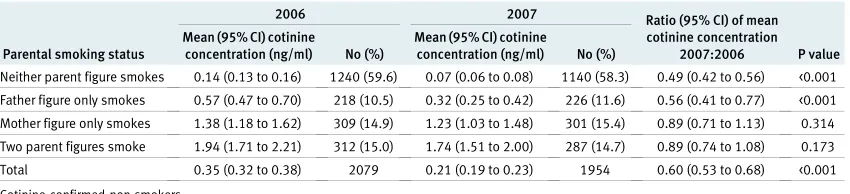
Displacement of parental smoking into the home In each survey year more than 40% of pupils reported living with a parent figure who smoked (table 2). Geo-metric mean cotinine concentration decreased signifi-cantly between survey years, as when all pupils were included (adjusted geometric mean cotinine concen-tration 0.35 (0.32 to 0.38) ng/ml in 2006 and 0.21 (0.19 to 0.23) ng/ml in 2007, P<0.001), and increased significantly across groups (P<0.001) as the number of parent figures who smoked increased. The only inter-action term that reached significance was that between survey year and parent figures in the home who smoked. Within each of the groups, a fall in geometric mean cotinine concentration occurred after legislation. However, this drop was statistically significant only among groups with lower levels of secondhand smoke exposure. Among pupils of non-smoking par-ent figures, geometric mean cotinine concpar-entration fell 51% from 0.14 (0.13 to 0.16) ng/ml to 0.07 (0.06 to 0.08) ng/ml. Among pupils with only a father figure who smoked, mean cotinine concentration fell 44% from 0.57 (0.47 to 0.70) ng/ml to 0.32 (0.25 to 0.42) ng/ml. Among pupils living in households with only a mother who smoked or with both parents who smoked, geometric mean cotinine concentration fell 11%, but this was not statistically significant (table 2).
DISCUSSION Main findings
Our study provides evidence of a population level change in exposure to secondhand smoke among chil-dren in primary school in Scotland after the introduc-tion of smoke-free legislaintroduc-tion. Secondhand smoke exposure fell by 39% between January 2006 and Janu-ary 2007, as shown by a significant fall in geometric mean cotinine concentration. The greatest propor-tional reduction occurred among pupils living in households with lower levels of secondhand smoke exposure. Although a reduction occurred among pupils with higher levels of secondhand smoke expo-sure at home, this was relatively small and not statisti-cally significant. For children with no parents who smoke, we conclude that this reduction must be largely due to lower secondhand smoke exposure in public places outside the home.
Using self report data, we found evidence of a reduc-tion in secondhand smoke exposure in public places covered by the legislation. A fall in reported exposure to secondhand smoke when visiting other people’s homes occurred after legislation. This finding suggests some modification of smoking behaviour in front of non-family members after the legislation.
We found little evidence of a change between survey years in reported exposure in pupils’own homes or in cars. As children were only asked to report on whether smoking took place in the home, rather than the extent of smoking, more subtle changes in smoking levels or practices would not be recorded.
This study provides no evidence that the smoke-free legislation has led to displacement of adult smoking from public places into the home.10 20We found little
difference in the reported proportion of parents who smoke or exposure in pupils’own homes and, regard-less of parental smoking status, no evidence of an increase in secondhand smoke exposure as measured by cotinine concentration.
Information on secular changes in cotinine concen-trations in this age group before legislation is limited. Findings are available for non-smoking 11-15 year olds in England.21 22For this group overall, mean cotinine
[image:3.595.139.564.651.748.2]concentration fell by 52% over a 15 year period between 1988 and 2003. The change in levels in our study, a 39% fall in cotinine concentration in a single year, is an order of magnitude higher than the average
Table 2|Geometric mean cotinine concentrations and 95% confidence intervals by number of parent figures who smoke, adjusted for age and family affluence, before and after smoke-free legislation in Scotland
Parental smoking status
2006 2007 Ratio (95% CI) of mean
cotinine concentration 2007:2006 P value Mean (95% CI) cotinine
concentration (ng/ml) No (%)
Mean (95% CI) cotinine
concentration (ng/ml) No (%)
Neither parent figure smokes 0.14 (0.13 to 0.16) 1240 (59.6) 0.07 (0.06 to 0.08) 1140 (58.3) 0.49 (0.42 to 0.56) <0.001
Father figure only smokes 0.57 (0.47 to 0.70) 218 (10.5) 0.32 (0.25 to 0.42) 226 (11.6) 0.56 (0.41 to 0.77) <0.001
Mother figure only smokes 1.38 (1.18 to 1.62) 309 (14.9) 1.23 (1.03 to 1.48) 301 (15.4) 0.89 (0.71 to 1.13) 0.314
Two parent figures smoke 1.94 (1.71 to 2.21) 312 (15.0) 1.74 (1.51 to 2.00) 287 (14.7) 0.89 (0.74 to 1.08) 0.173
Total 0.35 (0.32 to 0.38) 2079 0.21 (0.19 to 0.23) 1954 0.60 (0.53 to 0.68) <0.001
annual change seen in the English studies. This change in Scotland can arguably be attributed to the introduc-tion of the Scottish smoke-free legislaintroduc-tion.
Strengths of the study
This study evaluates national legislation and is based on a large nationally representative sample, which per-mits population level inference. We used an objective measure of exposure to secondhand smoke. Basing the survey in schools may have encouraged more honest reporting of parental smoking than if the survey had been done at home with parent figures present in the house.23
Limitations of the study
A longitudinal study design with repeat measures is more robust, but we chose a repeat cross sectional design, as with a longitudinal design the effects of the smoke-free legislation could not have been disen-tangled from changes in the likelihood of secondhand smoke exposure associated with behavioural changes owing to pupils maturing. Use of the same schools before and after legislation minimised the variation between years in pupils’characteristics.
The school take-up at baseline was lower than expected given response rates in another national sur-vey among this age group in Scotland.17However, we
detected no systematic bias in the final sample of schools arising from non-participation.
Children were asked only to report exposure to secondhand smoke on the day before the survey. Com-pared with our cotinine validated measures, which reflect secondhand smoke exposure in the previous three to five days, the self report data may underesti-mate secondhand smoke exposure.
Conclusions
The Scottish smoke-free legislation has made progress towards promoting health in children by reducing exposure to secondhand smoke. Nevertheless, little impact has been made on the higher levels of exposure in the home experienced by children whose mother figure or both parent figures smoke. Nineteen per cent of children in our sample were still exposed to secondhand smoke at a level (≥1.7 ng/ml) that has been shown to be harmful to arterial health.24 Our
findings underline the importance of continuing to raise awareness of the health risks of passive smoking, supporting adults to implement smoke-free policies in their homes and cars, and promoting smoking cessa-tion. Communication to adults that even low levels of secondhand smoke exposure can pose substantial health risk to children of all ages is particularly important.
We thank ABS Labs, London, who analysed salivary cotinine; MVA Consultancy for managing the fieldwork; Scottish local education authorities for granting permission to approach schools under their authority; pupils and teachers of all participating schools; Emily Healy, research administrator, Child and Adolescent Health Research Unit (CAHRU) for providing assistance with this paper; Kate Levin (CAHRU), Joanna Todd (CAHRU), and Rebecca Smith (CAHRU) for providing useful comments on drafts of this paper; and independent reviewers for providing comments on this paper.
Contributors:See bmj.com.
Funding:NHS Health Scotland and the Scottish Executive. The study design was developed in discussion with an advisory group that included SJH (NHS Health Scotland). The timing of submission of this paper was agreed with the sponsor, as it would form part of a portfolio of other papers submitted simultaneously. SJH contributed to preparation of the manuscript, but this did not create any conflicts of interest.
Competing interests:None declared.
Ethical approval:School of Education Ethics Committee, University of Edinburgh.
Provenance and peer review:Non-commissioned; externally peer reviewed.
1 Thaqi A, Franke K, Merkel G, Wichmann H-E, Heinrich J. Biomarkers of exposure to passive smoking of school children: frequency and determinants.Indoor Air2005;15:302-10.
2 GTTS Collaborative Group. A cross country comparison of exposure to secondhand smoke among youth.Tob Control2006;15:4-19. 3 Cook DG, Whincup PH, Jarvis MJ, Strachan DP, Pap Acosta O,
Bryant A. Passive exposure to tobacco smoke in children aged 5-7 years—individual, family, and community factors.BMJ 1994;308:384-9.
4 Jarvis MJ, Russell MAH, Feyerabend C, Eiser JR, Morgan M, Gammage P, et al. Passive exposure to tobacco smoke—saliva cotinine concentrations in a representative population-sample of non-smoking schoolchildren.BMJ1985;291:927-9.
5 Smoking health and social care (Scotland) act 2005. Part 1. Smoking: prohibition and control. Edinburgh: Stationery Office, 2005. Available at www.opsi.gov.uk/legislation/scotland/acts2005/ 20050013.htm.
6 ASH Scotland. Smoke-free legislation around the world. www. ashscotland.org.uk/ash/4264.html (accessed 27 Aug 2007). 7 Semple S, Creely KS, Naji A, Miller BJ, Ayres JG. Secondhand smoke
levels in Scottish pubs: the effect of the smoke-free legislation.Tob Control2007;16:127-32.
8 Pickett M, Schober SE, Brody DJ, Curtin LR, Giovino GA. Smoke-free laws and secondhand smoke exposure in US non-smoking adults, 1999-2002.Tob Control2006;15:302-7.
9 Allwright S, Paul G, Greiner B, Mullally BJ, Pursell L, Kelly A, et al. Legislation for smoke-free workplaces and health of bar workers in Ireland: before and after study.BMJ2005;331:1117.
10 O’Dowd A. Smoking ban in public places also cuts smoking at home. BMJ2005;331:129.
11 Hinchliffe D. The government’s public health white paper (Cm 6374): minutes of evidence. London: UK Parliament House of Commons Health Committee, 2005. www.parliament.the-stationery-office.co. uk/pa/cm200405/cmselect/cmhealth/358/5022301.htm (accessed 22 June 2007).
12 Borland R, Yong H-H, Cummings KM, Hyland A, Anderson S, Fong GT. Determinants and consequences of smoke-free homes: findings from the International Tobacco Control (ITC) four country survey.Tob Control2006;15:42-50.
13 Fong G, Hyland A, Borland R, Hammond D, Hastings G, McNeil A, et al. Reductions in tobacco smoke pollution and increases in support for smoke-free public places following the implementation of comprehensive smoke-free workplace legislation in the Republic of Ireland: findings from the ITC Ireland/UK survey.Tob Control 2006;15:51-8.
14 Royal College of Physicians.Going smoke-free: the medical case for clean air in the home, at work and in public places. A report on
WHAT IS ALREADY KNOWN ON THIS TOPIC
Passive smoking poses a significant health risk to adults and children
Smoke-free legislation has been shown to be effective in improving the health and wellbeing of adults
WHAT THIS STUDY ADDS
Exposure to secondhand smoke among children in their final year of primary school in Scotland fell after the introduction of smoke-free legislation
This reduction occurred particularly among groups with lower secondhand smoke exposure in the home
passive smoking by the Tobacco Advisory Group of the Royal College of Physicians. London: RCP, 2005.
15 Jarvis MJ. Application of biochemical intake markers to passive smoking measurement and risk estimation.Mutat Res 1989;222:101-10.
16 Jarvis MJ, Primatesta P, Erens B, Feyerabend C, Bryant A. Measuring nicotine intake in population surveys: comparability of saliva cotinine and plasma cotinine estimates.Nicotine Tob Res 2003;5:349-55.
17 Currie C, Elton RA, Todd J, Platt S. Indicators of socioeconomic status for adolescents: the WHO health behaviour in school-aged children survey.Health Educ Res1997;12:385-97.
18 Boyce W, Dallago L. Socioeconomic inequality. In: Currie CE, Roberts C, Morgan A, Smith R, Settertobulte W, Samdal O, et al, eds. Young people’s health in context: health policy for children and adolescents No 4. Copenhagen, Denmark: WHO Regional Office for Europe, 2004:13-25.
19 Batista-Foguet JM, Fortiana J, Currie C, Villalbi JR. Socioeconomic indexes in surveys for comparisons between countries: an applied
comparison using the family affluence scale.Soc Indic Res 2004;67:315-32.
20 Hetland J, AarøLE.Smokefree restaurants and pubs: air quality, self reported health and job satisfaction. Evaluation of smoking control policies in Norway, 2003-2007. HEMIL/SIRUS report No 4, 2005. 21 Jarvis MJ, Goddard E, Higgins V, Feyerabend C, Bryant A, Cook DG.
Children’s exposure to passive smoking in England since the 1980s: cotinine evidence from population surveys.BMJ2000;321:343-5. 22 Department of Health. Health survey for England. www.dh.gov.uk/
en/Publicationsandstatistics/PublishedSurvey/
HealthSurveyForEngland/index.htm (accessed 22 June 2007). 23 Bromley C, Sproston K, Shelton N. The Scottish health survey 2003.
Volume 3: children. Edinburgh: Scottish Executive, 2005. Available at www.scotland.gov.uk/Resource/Doc/76169/0019732.pdf. 24 Kallio K, Jokinen E, Raitakari OT, Hämäläinen M, Siltala M, Volanenn I,
et al.Circulation2007;115:3205-12.
Accepted:15 August 2007
Changes in exposure of adult non-smokers to secondhand
smoke after implementation of smoke-free legislation in
Scotland: national cross sectional survey
Sally J Haw,
1Laurence Gruer
2ABSTRACT
Objective:To measure change in adult non-smokers’ exposure to secondhand smoke in public and private places after smoke-free legislation was implemented in Scotland.
Design:Repeat cross sectional survey. Setting:Scotland.
Participants:Scottish adults, aged 18 to 74 years, recruited and interviewed in their homes.
Intervention:Comprehensive smoke-free legislation that prohibits smoking in virtually all enclosed public places and workplaces, including bars, restaurants, and cafes. Outcome measures:Salivary cotinine, self reported exposure to smoke in public and private places, and self reported smoking restriction in homes and in cars. Results:Overall, geometric mean cotinine concentrations in adult non-smokers fell by 39% (95% confidence interval 29% to 47%), from 0.43 ng/ml at baseline to 0.26 ng/ml after legislation (P<0.001). In smokers from non-smoking households, geometric mean cotinine
concentrations fell by 49% (40% to 56%), from 0.35 ng/ml to 0.18 ng/ml (P<0.001). The 16% fall in cotinine
concentrations in non-smokers from smoking households was not statistically significant. Reduction in exposure to secondhand smoke was associated with a reduction after legislation in reported exposure to secondhand smoke in public places (pubs, other workplaces, and public transport) but not in homes and cars. We found no evidence of displacement of smoking from public places into the home.
Conclusions: Implementation of Scotland’s smoke-free legislation has been accompanied within one year by a large reduction in exposure to secondhand smoke, which has been greatest in non-smokers living in non-smoking households. Non-smokers living in smoking households
continue to have high levels of exposure to secondhand smoke.
INTRODUCTION
On 26 March 2006 comprehensive legislation was implemented in Scotland to prohibit smoking in vir-tually all enclosed public places and workplaces, includ-ing bars, restaurants and cafés.1A subsequent study of air
quality in a random sample of 41 pubs in Scotland has reported an overall 86% reduction in small airborne par-ticles (PM2.5)—an air marker of secondhand smoke—
two months after implementation of the legislation.2
This is consistent with studies from other countries where similar legislation has been introduced.3 4
Our study is part of a comprehensive evaluation of Scotland’s smoke-free legislation.5It aimed to determine
if a measurable change occurred in exposure to second-hand smoke in adult non-smokers after implementation of the Scottish smoke-free legislation; to assess whether overall changes in secondhand exposure were related to exposure in public or private spaces; and to determine if any evidence existed of increased exposure to second-hand smoke among non-smokers living with smokers, associated with displacement of smoking into the home.
METHODS Survey
Data on adult exposure to secondhand smoke were col-lected as part of the health education population survey, using a repeat cross sectional design before and after implementation of the legislation. This survey has been conducted in most years since 1996 to monitor health related knowledge and behaviour.6Data are collected
twice a year in two waves. For this study, survey waves conducted between 1 September and 20 November 2005 and between 9 January and 25 March 2006
This article is an abridged version of a paper that was published on bmj.com on 10 September 2007. Cite this version as:BMJ10 September 2007, doi: 10.1136/ bmj.39315.670208.47 (abridged text, in print:BMJ 2007;335:549-52).
EDITORIALby Chapman
RESEARCH pp 545, 553
1NHS Health Scotland,
Edinburgh EH12 5EZ
2NHS Health Scotland,
Glasgow G3 7LS
Correspondence to: S Haw [email protected]
BMJ 2007;335:549-52