A Systematic Study and its Implementations of
Wireless Sensor Networks in Real Time
P. J. Shriidhar1, Dr. A. Senthil Kumar2 1
Research Scholar, Department of Computer Science, Bharathiar University, Coimbatore, India
2
Assistant Professor, Department of Computer Science, Arignar Anna Government Arts College, Namakkal, India.
Abstract- Wireless Sensor Networks (WSNs) consist of a large number of Sensors, which are low cost small devices with limited storage, computational capability and power. They can provide low cost solution to verity of real-world problems. They are outfitted with various sensing devices and small non rechargeable batteries. Usually, these sensors are engineered that suddenly active to gather the required data for some times when something is detected, and then remaining largely inactive for long periods of time. Here the study on sensor’s structure, its architecture, its applications and their challenges were pursued. The study on various routing protocols for sensor networks and classification for the various approaches were also pursued. The major classifications of routing protocol reviewed are network structure, path establishment, protocol operation and initiator of communication. Each of the routing schemes and algorithms has the common goal of trying to get better throughput and to increase the lifetime and efficiency of the sensor network. Thus, this work has significant importance, to study and considering while designing a Wireless Sensor Routing protocol
.
Keywords: Wireless Sensor Networks, Routing Protocols, Challenges, Designing issues of WSN.
I. INTRODUCTION
In general, a wireless sensor network consists of large number of homogeneous or heterogeneous sensor nodes from different vendors which collect individual data and carry it to one or more sink(s) that are inherently resource constrained. These nodes have very low storage capacity, limited processing capability, and constrained communication bandwidth due to limited energy and small size of the sensor nodes. Depending on the residency of the sensor nodes, some nodes are not able to exchange information with the sink directly. To overcome this, the network must support routing functionality in order to carry data packets to the sink in an efficient way.
Therefore, the routing algorithms take the current network status into consideration in order to be able to calculate the best possible route towards the sink. It forwards the wireless received data to a wired infrastructure, such as a server or PC, which is in charge for the further processing of the data. The terms base station and sink and are equivalents and together with a server connection a gateway is formed. Various functions are performed on the server such as data pre-processing, data storage, visualization or node configuration.
The ultimate objective of WSN requires developing of tiny sensor nodes that can be embedded in almost every item of our everyday life. While the advances in related technologies have led to tininess of sensor nodes, this tininess and the requirement to build large scale networks imposes great challenges on the design space of WSNs.
II. STRUCTURE AND ITS COMPONENTS OF WSN Wireless Sensor Networks consist of hundreds or thousands of sensor devices with wireless communications capabilities, sensing, and computation. Sensor nodes are tiny, low cost, consuming low power, scattered devices, which are capable of wireless communication [1] and local processing.
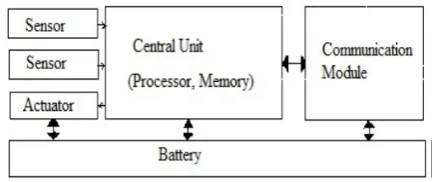
A sensor device combines the abilities to sense, compute and communicate. The objective is to fit all mentioned features in a single chip integrate solution. Here a simple structure of sensor node is given in Figure1.
Figure 1. Structure of sensor node
A sensor node is having a battery attached with it which is the main power supply of a sensor node. Then there exists a central processing unit or micro processor which performs all processing activities. The processor is attached with a small memory unit which is used to store data temporarily [2], [3].
III.PARTICIPANT NODES IN WIRELESS SENSOR NETWORK The common participant nodes in the WSN are:
Sensor Node or Source Node: collects the environmental data and send them to the BS.
A Sink or Base Station: is a node that interfacing the sensor device’s field and the networks via the internet. It acts as a gateway between the WSN and the outside world.
Manager Node or User: displays data for user analysis and enables the network manager to query for sensor nodes.
The interactions of these participant nodes have some frequent patterns, these are:
Event detection: Sensor node(s) should report to the BS(s) once they have data events matching their tasks. For this type of interaction, generally more than one sensor node is required.
Function approximation: In the BS, it may be required to have an approximation mapping of the area defined in the application. Then the sensor nodes are used to approximate a function of location that find out the physical value modifications from one point to another.
Periodic measurement: Sensor nodes can report measured values from time to time, according to the system requirements.
Typical applications of these sensor devices not limited to monitoring, tracking, and controlling [4]. The basic functionality of an operating system is to hide the inner-level details of the sensor device by providing a clear interface to the external world. Processor management, memory management, device management, scheduling policies, multi-threading, and multitasking is some of the inner level operations to be provided by an operating system.
In addition to the services mentioned above, the operating system should also provide services like support for periodically loading and unloading of modules, providing proper concurrency mechanisms enforce proper power management policies and application programming interface (API) to access underlying hardware. Hence a proper operating system is required for WSN to facilitate these functionalities to provide the user in developing applications easily with little knowledge of the low-level hardware details.
Operating Systems classifies based on power management, thread based, architecture, event based, reprogramming and scheduling. Example for WSN operating systems includes TinyOS, SenOS Etc.
IV.HOMOGENEOUS VS.HETEROGENEOUS WSN Wireless Sensor network can be homogeneous or heterogeneous, based on nodes primary energy. In homogeneous networks, all nodes outfitted with same amount of initial energy and in heterogeneous networks, few nodes, which are known as advance nodes have more primary energy than the other normal nodes. Most of the researches in WSN consider it to be homogeneous [11], [12]. But in reality, sensors have various capabilities like
depletion rate, different levels of initial energy etc. Only a small amount of nodes typically having comparatively more energy perform data transport, fusion and filtering.
Thus heterogeneous sensor networks are helpful in real deployments because they are more close to real life situations.
V. WSN COMMUNICATION ARCHITECTURE:PROTOCOL STACK
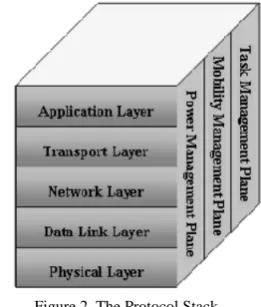
The stack of protocol used by the base station and sensor nodes is shown in Figure 2. This stack of protocol combines power and routing awareness, communicates power efficiently through the wireless medium, integrates information with networking protocols and improves the cooperative efforts of sensor nodes.
Figure 2. The Protocol Stack
The stack of protocol consists of the physical layer, data link layer, network layer, transport layer, application layer, power management plane, mobility management plane and task management plane.
The physical layer should achieve requirements like carrier frequency production, frequency choosing, signal detection, modulation and data encryption, forwarding and accepting mechanisms.
The Data Link Layer should gather the needs for medium access, error control, rejoining of data streams and data frame detection. It also confirms reliable point to point and point to multi-hop connections in the network. The MAC layer in the data link layer should be skilled of collision detection and use minimal power.
The network layer is in charge for routing the information got from the transport layer i.e. finding the most convenient path for the data packet to travel on its way to a destination.
The Transport Layer is wanted when the sensor network intends to be used through the internet. It supports in maintaining the flow of data whenever the application needs it.
V. APPLICATION AREAS AND CHALLENGES IN WSN WSN have a broad range of applications into disaster management, military, health and biomedical research, environmental monitoring, habitat monitoring, industry, tracking and other commercial areas [7], [8]. Several projected applications of WSN are still under research and development.
The most challenging problem in sensor networks is limited and non rechargeable energy source. Due to the various issues, the protocol design for developing performance of WSN faces several issues. Thus while developing a protocol for wireless sensor networks these issues have to be kept in mind. Here the challenges [5], [6] of sensor network are described:
A. Deployment of Ad hoc
Most sensor nodes are deployed in regions which have no infrastructure at all. A normal way of deployment in a forest would be tossing the sensor nodes from an aero plane. In such a situation, it is up to the nodes to finds its working principle.
B. Rapid Death of Sensor Nodes near BS
Most of sensor devices in a WSN transmit their data to the BS by using long multi-hop paths. Therefore in between nodes in a long multi-hop path have to forward their individual data to sink as well as transmitted data from other nodes to sink. These nodes used up energy more quickly than nodes close to the boundary. The situation is bad in case of the sensor nodes which are present close to the sink. These nodes have to transmit sensed data from the whole network to the sink. As these sensor nodes also contain a limited energy source, therefore due to frequent data transmission through these nodes, these nodes die soon.
C. (QoS)Quality of Service
In any application, managing Quality of Service (Qos) is very important. But in WSN it is a problem facing issue. Generally WSN is scalable. But in large scale WSN with sink if a distant node wants to transmit data packet to sink then the packet has to move through a long multi-hop path which cases the possibility of fading and packet loss in a wireless communication medium.
Long multi-hop path also cases high delay for end to end packet transmission which is not suitable for time critical application like disaster management.
The packet loss issue may be controlled by once again transmission of packet using a simple acknowledge scheme. Due to the packet retransmission, the energy required for sending acknowledgement for individual packet is very high. Retransmission also increases the time delay in data delivery.
D. Unattended process
In most cases, once constructed, sensor networks have no human intervention. Hence the nodes themselves are in charge for reconfiguration in case of any alterations.
E. Maintenance of Topology
Sensor nodes may be constructed statically. But due to failure of nodes WSN topology modify frequently. Also additional sensor nodes can be added at any time which leads to a rearrange of topology.
That means, it is needed that a sensor network system can be suitable to changing connectivity as well as changing environmental stimuli. So topology maintenance is a big issue task for WSN.
F. Power constraints for sensor devices
The sensor devices are not connected to any energy production unit. There is only a optimal source of energy, which must be used efficiently for processing and communication.
An important fact is that communication overcomes processing in energy consumption. Thus, in order to make efficiently use of energy, communication should be reduced as much as possible. So it is also a important task for WSN
G. Fault acceptance
Fault acceptance is the other main issue. It is important to know how the scattered wireless system will act if one node failed, especially in systems with low protection possibility.
H. Area of Sensor Region
The range and shape of the responsible area is not similar for all the time. Physical surface characteristics alters with location like mountains, grass, rocks, water etc possess various characteristics. Depending on the area hazards to the sensor nodes are variant. Last of all various locations have different radio environment which creates problem for WSNs.
I. Sensor Nodes and its Constraints
The various constraints of sensor node like heterogeneity, deployment layout, mobility, limited power source, network density all of these causes issues for constructing wireless sensor network.
J. failure in Communication
There should be a continuous communication between sinks. If any problem in communication occurs it may cause loss of data. Presence of the sink relatively to sensor nodes is also important. The major consideration in a wireless sensor network is to increase the system lifetime as well as the effectiveness of system robustness.
Various studies present different ways for handling problems and issues in WSN. Some of them propose energy utilization in sensor nodes using solar panel. Energy efficient MAC protocol, fault tolerant routing, periodic sleeping of nodes and energy efficient routing, deployment of multiple sink are some of such proposals that can be found in studies.
the transmitting of the incoming data. The routing table contain the lists of sensor devices option for any given packet destination. Routing table is the in charge of the routing algorithm along with the assist of the routing protocol for their developing and implementations [9], [10]. The performance of a routing protocol is directly related to the architectural model.
Network dynamics: Majority of the network architectures think that sensor nodes are stationary, because there are very few setups that utilize mobile sensors.
Deployment of Nodes: It is application oriented and affects the working of the routing protocol.
Power considerations: During the construction of an infrastructure, the process of setting up the routes is greatly influenced by power considerations.
Information delivery models: information delivery model to the sink can be constant, event-driven, query-driven and hybrid, depending on the usage of the sensor network.
Capabilities of node: In a sensor network, various functionalities can be implemented with the sensor nodes.
Data aggregation/fusion: Similar data information from multiple sensor devices can be aggregated to reduce the transmission.
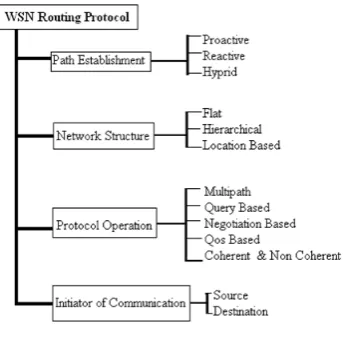
Generally, routing protocols are: Data centric; Capable of aggregating data; Application specific; Capable of optimizing energy consumption [13], [14]. WSN Routing Protocols can be analyzed in four ways, according to the way of routing paths are established, according to the network framework, according to the protocol working and according to the initiator of communications. Figure 3, shows the classification of Wireless Sensor Network routing protocols.
Figure 3. Classification of WSN Routing Protocol
The most optimal results are being achieved with hierarchical based clustering protocols in which the nodes organize themselves into groups known as clusters [11], [12].
VII. DESIGN ISSUES OF ROUTING PROTOCOLS To meet this common trend towards classification, the following important design challenges [8] of the sensor network have to be considered [14].
Fault Tolerance: Some sensor devices may stop working or be failed due to lack of power, have physical damage or environmental interference. Scalability: The number of sensor devices scattered in
the sensing area may be in the order of thousands or more and routing schemes must be working enough to react to events.
Production Costs: Since the sensor device networks consist of thousands or more number of nodes, the cost of a single device is very significant to justify the overall cost of the network and hence the expenditure of sensors is to be kept low.
Operating Environment: We can create sensor network inside of large machinery, at the depth of an ocean, in a biologically or etc.
Power Consumption: Since the routing power of a wireless radio is proportional to distance squared or even higher order in the presence of obstacles, multi-hop routing will utilize less energy than direct communication [14], [15].
Packet Delivery Models: Packet delivery models determine when the packet collected by the node has to be delivered.
Data Aggregation/Fusion: Since sensor devices might create significant redundant data, similar data from multiple devices can be aggregated so that the number of transmissions would be reduced [16].
Quality Of Service (QoS): The quality of service means the quality service required by the application, it could be the energy efficiency, length of life time, the data reliable, and location-awareness, collaborative-processing.
Data Latency and Overhead: These are measured as the important challenges that influence routing protocol design. Multi-hop relays and data aggregation cause data latency [17].
VIII. CONCLUSION
REFERENCES
[1] J. L. Hill. System architecture for wireless sensor networks. Ph.D. dissertation, University of California at Berkeley,Spring, 2003. [2] C. Buratti A. Conti D. Dardari and R. Verdone. An overview on
wireless sensor networks technology and evolution. Sensors, 9(9):6869{6896, August 2009.
[3] M. Tubaishat and S.K. Madria. Sensor networks: an overview. Potentials, IEEE, 22(2):20{23, April-May 2003.
[4] Karl, H.; Willig, A. Protocols and Architectures for Wireless Sensor Networks. John Wiley & Sons: Chichester, West Sussex, UK, 2005. [5] J. A. Stankovic. Research challenges for wireless sensor networks.
ACM SIGBED Review - Special issue on embedded sensor networks and wireless computing, 1(2): 9{12, July 2004.
[6] A.Bonastre J.V. Capella, R. Ors and J.J. Serrano. New challenges in wireless sensor networks:fault tolerance and real time. Industrial Technology,ICIT ,IEEEInternational Conference, pages 1385{1390, December 2005.
[7] J. Lygeros T. Arampatzis and S.Manesis. A survey of applications of wireless sensors and wireless sensor networks. Intelligent Control, Proceedings of the 2005 IEEE International Symposium on, In Proceedings of the 13th Mediterrean Conference on Control and Automation, pages 719{724, June 2005.
[8] S. Narayanan C. Meesookho and C. Raghavendra. Collaborative classification applications in sensor networks. Proc. of Second IEEE Multichannel and Sensor array signal processing workshop, Arlington, VA, pages 370{374, August 2002.
[9] Jian Wan, Daomin Yuan, Xianghua Xu, A review of Routing Protocols in Wireless Sensor Net works, Dec 25, 2008 IEEE Xplore. [10]K. Akkaya and M. Younis. A survey on routing protocols for
wireless sensor networks, ad hoc networks. Ad Hoc Networks, CiteSeerX, 3:325{349, 2005.
[11]N. Chand V. Katiyar and S. Soni. A survey on clustering algorithms for heterogeneous wireless sensor networks. Int. J. Advanced Networking and Applications, 2 (4):745{754, 2011.
[12]S. Jabbehdari R. Sheikhpour and A. Khadem-Zadeh. Comparison of energy efficient clustering protocols in heterogeneous wireless sensor networks. International Journal of Advanced Science and Technology, 36:27{40, November 2011.
[13]S.D. Muruganthan D.C.F. Ma B. Rollyi and A. Fapojuwo. A centralized energy efficient routing protocol for wireless sensor networks. IEEE Radio Communications, 43(3):8{13, 2005.
[14]Q. Nadeem M.B. Rasheed N. Javaid Z.A. Khan Y. Maqsood and A. Din. M-GEAR: Gateway-based energy-aware multi-hop routing protocol for WSNs. Broadband and Wireless Computing, Communication and Applications (BWCCA) of IEEE, pages 164{169, July 2013.
[15]S.K. Mitra and M.K. Naskar. Comparative study of radio models for data gathering in wireless sensor network. International Journal of Computer Applications (0975 {8887), 27(4):49{57, August 2011. [16]Sajid Hussain and Abdul W. Matin Jodrey. Energy efficient
hierarchical cluster-based routing for wireless sensor networks.
Technical Report - TR- 2005-011, 2005. [email protected]. [17]S. Farahani, ZigBee Wireless Networks and Transceivers. Newton,
MA, USA: Newnes, 2008.
[18]K. Pradeepa, W.R. Anne, and S. Duraisamy, “Design and
Implementation Issues of Clustering in Wireless Sensor Networks,”
Int’l J. Computer Applications, vol. 47, no. 11, pp. 23-28, 2012.
A
UTHOR’
SP
ROFILEP. J. Shriidhar received the B.E.S. degree from Periyar University in 2001, MCA degree from Bharathiar University in 2004 and M.E., degree in computer science and engineering from VMKV engineering college in 2012, respectively. He currently works as an Assistant Professor in the Department of Computer Science and Engineering at Vidyaa Vikas College of Engineering and Technology, Affiliated to Anna University. He is a life member in ISTE. His research interest includes wireless sensor networks, routing protocols and network security.