Efficient One-Sided Adaptively Secure Computation
∗Carmit Hazay† Arpita Patra‡
Abstract
Adaptive security is a strong security notion that captures additional security threats that are not ad-dressed by static corruptions. For instance, it captures real-world scenarios where “hackers” actively break into computers, possibly while they are executing secure protocols. Studying this setting is inter-esting from both theoretical and practical points of view. A primary building block in designing adap-tively secure protocols is a non-committing encryption (NCE) that implements secure communication channels in the presence of adaptive corruptions. Current constructions require a number of public key operations that grows linearly with the length of the message. Furthermore, general two-party protocols require a number of NCE calls that dependents both on the circuit size and the security parameter.
In this paper we study the two-party setting in which at most one of the parties is adaptively corrupted, and demonstrate the feasibility of (1) NCE with constant number of public key operations for large message spaces. (2) Oblivious transfer with constant number of public key operations for large sender’s input spaces, and (3) constant round secure computation protocols with an overall number of public key operations that is linear in the circuit size. Our study demonstrates that such primitives indeed exist in the presence of single corruptions without erasures, while this is not known for fully adaptive security under standard assumptions (where both parties may get corrupted). Our results are shown in the UC setting with a CRS setup.
Keywords:Secure Two-Party Computation, Adaptive Security, Non-Committing Encryption, Oblivious Transfer
∗
A preliminary version of this paper appeared in [HP14].
†
Department of Computer Engineering, Bar-Ilan University, Israel. Email:[email protected].
‡
1
Introduction
1.1 Background
Secure two-party computation. In the setting of secure two-party computation, two parties with private inputs wish to jointly compute some function of their inputs while preserving certain security properties like privacy, correctness and more. In this setting, security is formalized by comparing a protocol execution to a protocol executed in an ideal setting where the parties send inputs to a trusted party that performs the computation and returns its result (also known by simulation-based security). Starting with the works of [Yao82, GMW87], it is by now well known that any polynomial-time function can be compiled into a secure function evaluation protocol with practical complexity; see [BDOZ11, LP12, DPSZ12, NNOB12] for a few recent works. The security proofs of these constructions assume that parties are statically corrupted. Meaning, corruptions take place at the outset of the protocol execution and the identities of the corrupted parties are fixed throughout the computation. A stronger notion isadaptive securitywhere corruptions take placeat any pointduring the course of the protocol execution. That is, upon corruption the adversary learns the internal state of the corrupted party which includes its input, randomness and the incoming messages. This notion is much stronger than static security since the adversary may choose at any point which party to corrupt, even after the protocol is completed! It therefore models real world threats more accurately.
Typically, when dealing with adaptive corruptions we distinguish between corruptions with erasures and without erasures. In the former case honest parties are trusted to erase data if they are instructed to do so by the protocol, whereas in the latter case no such assumption is made. This assumption is often problematic since it relies on the willingness of the honest parties to carry out this instruction, even though they know that no other party will be able to verify whether they have carried out the instruction or not. In settings where the parties are distrustful it may not be a good idea to base security on such an assumption. In addition, it is generally unrealistic to trust parties to fully erase data since this may depend on the operating system. Nevertheless, assuming that there are no erasures comes with a price since the complexity of adaptively secure protocols without erasures is much higher than the analogue complexity of protocols that rely on erasures. In this paper we donotrely on erasures.
Adaptive security. It is known by now that security against adaptive attacks captures important real-world concerns that are not addressed by static corruptions. For instance, such attacks capture scenarios where “hackers” actively break into computers, possibly while they are running secure protocols, or when the adversary learns from the communication which parties are worth to corrupt more than others. This later issue can be demonstrated by the following example. Consider a protocol where some party (denoted by the dealer) shares a secret among a public set of√nparties, picked at random from a larger set ofnparties. This scheme is insecure in the adaptive model if the adversary corrupts√nparties since it can always corrupt the particular set of parties that share the secret. On the other hand, in the static setting the adversary can only corrupt the exact same set of parties that share the secret with a negligible probability inn.
Further difficulties arise when proving security. For instance, consider the following protocol for trans-ferring a message: A receiver picks a public key and sends it to a sender that uses it to encrypt its message. Then, security in the static model is simple and relies on the semantic security of the underlying encryption scheme. Nevertheless, this protocol is insecure in the adaptive model since standard semantically secure encryption binds the receiver to a single message (meaning, given the public key, a ciphertext can only be decrypted into a single plaintext). Thus, upon corrupting the receiver after simulating its communication, it would not be possible to “explain” the simulated ciphertext with respect to the real message. This implies that adaptive security is much harder to achieve.
not communicate with any external device. In this case, it makes more sense to study the system’s security in the presence of single corruptions (namely, when at most one party is under attack). This is because we have no security guarantee once both parties are under attack. In this paper we study secure two-party computation with single adaptive corruptions in the non-erasure model. To distinguish this notion from fully adaptive security, where both parties may get corrupted, we denote it byone-sidedadaptive security. Our goal in this work is to make progress in the study of the asymptotic efficiency of secure two-party protocols with one-sided security.
Our measure of efficiency is associated with the number of public key encryption (PKE) operations, where our underlying primitives are parameterized by a public key encryption scheme for which we count the number of key generation/encryption/decryption operations. These operations are captured by the num-ber of exponentiations in several important groups. That is, groups where the Decisional Diffie-Hellman (DDH) assumption is hard, as well as composite order groups where the Decisional Composite Residuosity (DCR) and Quadratic Residuosity (QR) hardness assumptions are believed to hold. Finally, our proofs are given with universal composable (UC) security proofs [Can01] in the common reference string (CRS) set-ting. We note that the reductions of our non-committing encryption and oblivious transfer with one-sided security are tight, whereas the reductions of our general two-party protocols are tighter than proofs in prior works; see more details below. All our theoremsare notknown to hold in the fully adaptive setting.
1.2 Our Results
New one-sided NCE constructions. A non-committing encryption (NCE) scheme [CFGN96] implements a secure channel between two parties in the presence of adaptive corruptions, and is an important build-ing block in designbuild-ing adaptively secure protocols. One-sided NCE (resp. NCE) implies a secure chan-nel where a single (resp. both) parties are adaptively corrupted. Theoretically speaking, one-sided NCE was demonstrated in [DN00] under a strictly weaker hardness assumption than the assumption needed for NCE [DN00, CDSMW09a], where the later assumption is simulatable public key encryption scheme. Nev-ertheless, all known schemes, in both security settings, require a number of PKE operations that grows linearly with the bit representation of the transmitted message. It was unknown whether this bound is tight for one-sided NCE or whether the overhead can be made closer to the overhead of PKE.
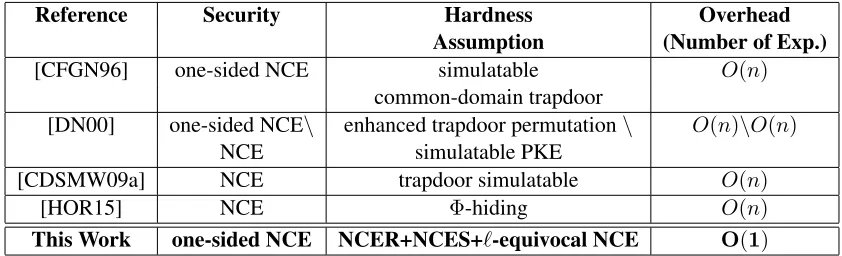
We suggest a new approach for designing NCE with security against one-sided adaptive attacks. Our protocols are built based on two public key building blocks that are non-committing with respect to a single party. We denote these primitives by NCE for the sender and NCE for the receiver. Non-committing for the receiver (NCER) implies that one can efficiently generate a secret key that decrypts a fake ciphertext into any plaintext. Whereasnon-committing for the sender(NCES) implies that one can efficiently generate randomness for any plaintext for proving that a ciphertext, encrypted under a fake key, encrypts this plaintext. A core building block in our one-sided construction is (a variant) of the following protocol, in which the receiver generates two sets of public/secret keys; one pair of keys for each public key system, and sends these public keys to the sender. Next, the sender partitions its message into two shares and encrypts the distinct shares under the distinct public keys. Finally, the receiver decrypts the ciphertexts and reconstructs the message. Our construction is slightly more technical since it must allow the simulator to decide whether to send fake keys/ciphertexts only after corruption takes place. To ensure that, we use an additional tool, denoted by`-equivocal NCE, which is discussed in details below (informally, this primitive improves NCE constructions for small equivocation space) . We note that our protocol is secure as long as either the sender or the receiver are adaptively corrupted, but not both. Informally, we prove that
Reference Security Hardness Overhead Assumption (Number of Exp.)
[CFGN96] one-sided NCE simulatable O(n)
common-domain trapdoor
[DN00] one-sided NCE\ enhanced trapdoor permutation\ O(n)\O(n)
NCE simulatable PKE
[CDSMW09a] NCE trapdoor simulatable O(n)
[HOR15] NCE Φ-hiding O(n)
This Work one-sided NCE NCER+NCES+`-equivocal NCE O(1)
Table 1: Comparisons with prior NCE constructions for message space{0,1}nand security parametern.
Secure realizations of NCER and NCES exist under several concrete assumptions. Specifically, NCER implementations were shown in [JL00, CHK05] under the respective DDH and DCR hardness assumptions, whereas NCES was realized under the DDH assumption in [BHY09]. In this paper we further show how to realize NCES under the DCR assumption. Note that when viewing these primitives as two-round protocols, where the receiver forwards the sender its public key that is followed by a ciphertext sent by the sender, these primitives are equivalent in the sense that it is possible to convert one primitive to another at the expense of one additional round. Specifically, given a two-round NCER protocol, a three-round NCES can be constructed as follows: the sender creates a public key/secret key pair for the NCER and forwards the public key to the receiver. The receiver then encrypts a one-time pad masking under the public key. Finally, the sender uses this pad to mask its message in the third round. An NCER protocol can be constructed from an NCES protocol in a similar way.
Our theorem is also interesting in the sense that it implies one-sided NCE with a number of PKE op-erations that is independent of the message length. Concretely, if the underlying NCER and NCES are implemented using a constant number of PKE operations, that is independent of the message length, then this also holds for our one-sided NCE. In this paper we consider implementations for NCER/NCES that are efficient in that sense which implies efficient DCR-based one-sided NCE with a constant overhead. We further consider DDH-based constructions that achieve the same overhead, but for polynomial size domains. We provide comparison with prior work in Table 1.
Witness equivocal UC ZK PoK for compound statements. A basic tool in constructing maliciously secure protocols that we exploit in this paper is zero-knowledge (ZK) proofs. More specifically, in this work we focus on compound statements (where the statement is comprised of sub-statements for which the prover only knows a subset of the witnesses). We consider a new notion ofwitness equivocalUC ZK proofs of knowledge (PoK) where the simulator knows the witnesses forall sub-statements but not which subset is known to the real prover, and show how to build adaptively secure witness equivocal proofs for a large class ofΣ-protocols. In particular, the security proof for this notion implies that the simulator convinces the adaptive adversary that it knows the exact same subset of witnesses known also to the real prover. We demonstrate that even though this notion is weaker than one-sided security (which requires simulation without any knowledge of witnesses), it is still meaningful in designing one-sided secure protocols.
As a side result, we demonstrate a technique for efficiently generating statically secure UC ZK PoK for the same class ofΣ-protocols. Our protocols use a new approach where the prover commits to an additional transcript which enables to extract the witness in the CRS setting with a constant overhead where previously,
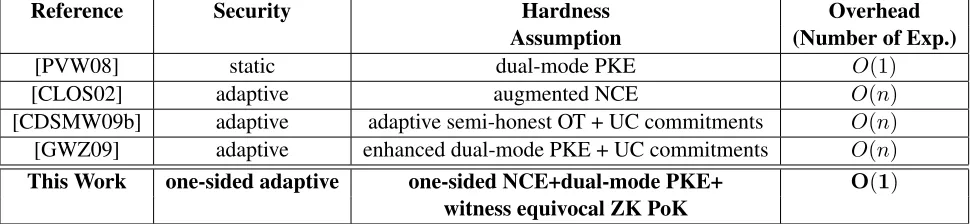
Reference Security Hardness Overhead Assumption (Number of Exp.)
[PVW08] static dual-mode PKE O(1)
[CLOS02] adaptive augmented NCE O(n)
[CDSMW09b] adaptive adaptive semi-honest OT + UC commitments O(n)
[GWZ09] adaptive enhanced dual-mode PKE + UC commitments O(n)
This Work one-sided adaptive one-sided NCE+dual-mode PKE+ O(1) witness equivocal ZK PoK
Table 2: Comparisons with prior malicious UC OT constructions for sender’s message space{0,1}nand security parametern.
One-sided oblivious transfer. In the next step we combine our one-sided NCE and witness equivocal proofs in order to implement one-sided1-out-of-2oblivious transfer (OT). We build our protocol based on the generic framework of [PVW08] with the following modifications. (1) First, we require that the sender sends its ciphertexts via a one-sided non-committing channel (based on our previous result, this only inflates the overhead by a constant). (2) We fix the common parameters in a single mode (whereas the [GWZ09] and [PVW08] proofs need to alternate between the two modes). To ensure correctness with respect to the receiver’s message, we employ a witness equivocal ZK PoK. Informally, we prove that
Theorem 1.2 Assume the existence of one-sided NCE, dual-mode PKE (cf. Definition 4.1; see also [PVW08]) and witness equivocal ZK PoK, then there exist one-sided OT withO(1)PKE operations.
Considering efficiency, our construction requires a number of PKE operations that is independent of the sender’s input space. This is significantly better than all prior work on fully adaptively UC secure OT that requireO(1)such operations for implementing bit OT; see Table 2 for comparison with prior work.
We note that this protocol further serves as the basis for the cut-and-choose OT protocol we design next. In addition, a semi-honest variant of our OT protocol can be considered if the parties mutually generate the CRS using a coin tossing protocol that is UC secure. By plugging-in this one-sided semi-honest OT protocol into the [GMW87] static semi-honest protocol we obtain a one-sided semi-honest adaptively secure protocol, with round complexity that depends on the computed circuit’s depth. This implies the following theorem,
Theorem 1.3 Assume the existence of one-sided semi-honest OT and statically secure UC commitment scheme, then there exists a semi-honest one-sided adaptively secure two-party protocol that requiresO(|C|))
public key operations.
Constant round one-sided secure computation. Notably, in the plain model any statically secure proto-col can be transformed into a protoproto-col with one-sided adaptive security by encrypting the communication of the static protocol using NCE. This approach, taken by [KO04], implies that the number of public key operations grows linearly with the communication complexity of the static protocol. Moreover, currently the overhead of generic protocols using this approach depends on the circuit’s size times the security parameter.1 In this work we revisit the general compiler of [KO04] and design improved generic one-sided constant round protocols tolerating semi-honest and malicious behaviour. This improvement is based on the observa-tion that it is sufficient to employ one-sided NCE rather than NCE (that is fully secure) in order to secure the
1We note that this statement is valid regarding protocols that do not employ fully homomorphic encryptions (FHE). To this end,
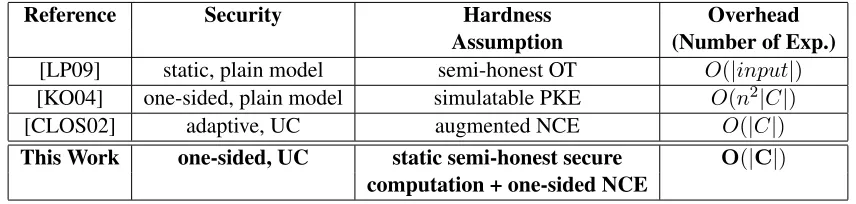
Reference Security Hardness Overhead Assumption (Number of Exp.)
[LP09] static, plain model semi-honest OT O(|input|)
[KO04] one-sided, plain model simulatable PKE O(n2|C|)
[CLOS02] adaptive, UC augmented NCE O(|C|)
This Work one-sided, UC static semi-honest secure O(|C|) computation + one-sided NCE
Table 3: Comparisons with prior generic semi-honest secure protocols fornthe security parameter.
communication. Moreover, by plugging-in our one-sided NCE we obtain a better transformation from static semi-honest/malicious security into the corresponding attack model with one-sided security. It is important to note that this transformation does not hold in the UC setting due to the additional setup. Specifically, the security proof may crucially rely on the fact that the CRS is chosen dependently on the identity of the corrupted party, as for instance in [PVW08]. Nevertheless, since this identity is not known in advance in the adaptive setting, fixing the CRS in one particular mode breaks down the static security proof.
To conclude, in the semi-honest setting (when no trusted setup is required) we prove that our transfor-mation applies even in the UC setting. Informally, we first prove that
Theorem 1.4 Assume the existence of one-side NCE. Then: (1) statically secure semi-honest secure com-putation implies one-sided semi-honest UC comcom-putation, and (2) statically secure malicious secure compu-tation implies one-sided malicious secure compucompu-tation.
As a corollary, we obtain that constant round semi-honest secure computation can be achieved based on the assumptions needed in [LP09] and one-sided NCE. Informally stating,
Corollary 1.5 Under the assumptions of achieving security in [LP09] and one-sided NCE, there exists a constant round one-sided semi-honest UC secure two-party protocol that requires O(|C|)) public key operations, whereCis the computed circuit.
We provide a detailed comparison with prior work for the semi-honest setting in Table 3. Next, in order to obtain one-sided UC security against malicious attacks we adapt the cut-and-choose based protocol from [LP12], which relies heavily on [PVW08] DDH based OT protocol. The idea of the cut-and-choose technique is to ask one party to sends garbled circuits and later open half of them by the choice of the other party. This ensures that with very high probability the majority of the unopened circuits are valid. Proving security in the one-sided setting requires dealing with new subtleties and designing a modified cut-and-choose building blocks, since [LP12] defines the public parameters for these building blocks in a way that precludes equivocation of the parties’ inputs. Informally,
Theorem 1.6 Under the assumptions of achieving static malicious UC security in [LP12], one-sided cut-and-choose OT and simulatable PKE, there exists a constant round one-sided malicious UC secure two-party protocol that requiresO(s|C|)public key operations wheresis a statistical parameter that determines the cut-and-choose soundness error.
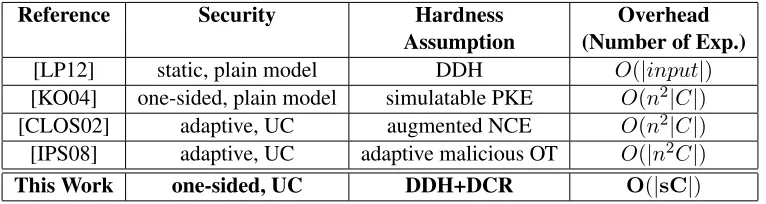
We provide a details comparison with prior work for the malicious setting in Table 4.
Reference Security Hardness Overhead Assumption (Number of Exp.)
[LP12] static, plain model DDH O(|input|)
[KO04] one-sided, plain model simulatable PKE O(n2|C|)
[CLOS02] adaptive, UC augmented NCE O(n2|C|)
[IPS08] adaptive, UC adaptive malicious OT O(|n2C|) This Work one-sided, UC DDH+DCR O(|sC|)
Table 4: Comparisons with prior generic maliciously secure protocols fornthe security parameter.
1.3 Prior Work
We describe prior work on NCE, adaptively secure OT and adaptively secure two-party computation.
Non-committing encryption. (One-sided) NCE was introduced in [CFGN96] which demonstrated its fea-sibility under the RSA assumption. Next, NCE was studied in [DN00, CDSMW09a]. More concretely, the construction of [DN00] requires constant rounds on the average and is based on simulatable PKE, whereas [CDSMW09a] presented an improved expected two rounds NCE based on a weaker primitive. [DN00] fur-ther presented one-sided NCE based on a weakened simulatable PKE notion. The computational overhead of all these constructions depends on the message length. Following that, the relatively new`-euivocal NCE notion was introduced in [GWZ09]. This primitive enables to send arbitrarily long messages at the cost of
log`PKE operations, where`is the equivocality parameter, and improves over NCE for sufficiently small
`’s. In [Nie02] Nielsen proved that NCE must have a decryption key that is at least as long as the transmitted message. Finally, Hemenway et al. [HOR15] presented the first two-round NCE construction under theΦ -hiding hardness assumption where the communication complexity of the second message isO(mlogm+n)
wheremis the message length andnis the security parameter, which improves over all prior constructions.
Adaptively secure oblivious transfer. In [Bea97, CLOS02] semi-honest adaptively secure OT protocols were shown, that were then compiled into the malicious setting using generic ZK proofs. More recently, in a weaker model that assumes erasures, Lindell [Lin09] used the method of [WW06] to design an ef-ficient transformation from static OT to semi-honest composable adaptive OT. Another recent work by Garay et al.[GWZ09] presented a UC adaptively secure OT, building on the static OT of [PVW08] and
`-equivocal NCE. This paper introduced an OT protocol with security under a weaker semi-adaptive notion, that is then compiled into an adaptive OT by encrypting the transcript of the protocol using `-equivocal NCE.2Finally, [CDSMW09b] presented a compiler for UC adaptive OT in the malicious setting based on semi-honest adaptive OT and UC commitment schemes.
Adaptively secure two-party computation. The work by Katz and Ostrovsky [KO04] was the first to study the round complexity of one-sided secure protocols. Their round efficient protocol takes a naive ap-proach of encrypting the entire communication using NCE. Next, the work of [IPS08] provided all-but-one adaptively secure protocols based on honest majority adaptively secure protocols (where their particular in-stantiation uses the constant rounds protocol from [DI05]). Finally, a recent work by Garg and Sahai [GS12] presents adaptively secure constant round protocols tolerating all-but-one corrupted parties using a non-black box simulation approach. Their approach uses the OT hybrid compiler of [IPS08].
2
Adaptive secure computation has been extensively studied as well. In the non-erasure model, the work of [CLOS02] demonstrated the feasibility of adaptive UC security of any well-formed functionality. The followup work of [DN03] showed how to use a threshold encryption to achieve UC adaptive security but required honest majority. A generic compiler from static to adaptive security was shown in [CDD+04] (yet without considering post-execution corruptions). Assuming erasures, which significantly simplifies the problem, one of the earliest works by Beaver and Haber [BH92] showed an efficient generic transformation from adaptively secure protocols with ideally secure communication channels, to adaptively secure protocols with standard (authenticated) communication channels. A more recent work by Lindell [Lin09] presented an efficient semi-honest constant round two-party protocol with adaptive security.
A recent line of works [CGP15, DKR15, GP15] studies constant rounds adaptively secure computation using obfuscation techniques. This approach is different than all prior work on adaptive security since it obfuscates the circuit that computes the next message in the protocol and places the result in the CRS.
2
Preliminaries
We denote the security parameter byn. A functionµ(·)isnegligibleif for every polynomialp(·)there exists a valueN such that for alln > N it holds thatµ(n) < p(1n). We write PPT for probabilistic polynomial-time. We denote the message spaces of our non-committing encryption schemes and the message space of the sender in our OT protocols by{0,1}qforq =n.
We specify the definitions of computational indistinguishability and statistical distance.
Definition 2.1 (Computational indistinguishability by circuits) LetX={Xn(a)}n∈IN,a∈{0,1}∗andY = {Yn(a)}n∈IN,a∈{0,1}∗ be distribution ensembles. We say thatXandY are computationally indistinguish-able, denotedX ≈c Y, if for every family {Cn}n∈IN of polynomial-size circuits, there exists a negligible
functionµ(·)such that for alla∈ {0,1}∗,
|Pr[Cn(Xn(a)) = 1]−Pr[Cn(Yn(a)) = 1]|< µ(n).
Definition 2.2 (Statistical distance) Let Xn andYn be random variables accepting values taken from a
finite domainΩ⊆ {0,1}n. Thestatistical distancebetweenX
nandYnis
SD(Xn, Yn) =
1 2
X
ω∈Ω
|Pr[Xn=ω]−Pr[Yn=ω]|.
We say thatXnandYnare-closeif their statistical distance is at mostSD(Xn, Yn) ≤(n). We say that
XnandYnarestatistically close, denotedXn≈sYn, if(n)is negligible inn.
2.1 Security Definitions
In the following, we formalize the notion of UC one-sided adaptive security [Can01]. Formally, a two-party computation protocol is cast by specifying the participating parties P0 and P1 and a functionf :
{0,1}∗ × {0,1}∗ → {0,1}∗ × {0,1}∗, where f = (f0, f1) mapping pairs of inputs to pairs of outputs
(one for each party). That is, for every pair of inputsx0, x1 ∈ {0,1}n the output pair is a random
vari-able (f0(x0, x1), f1(x0, x1))ranging over pair of strings. The first party with inputx0 wishes to receive
2.1.1 One-Sided Adaptive Security
In the two-party setting, a real execution of some protocolΠf that implementsfis run between two parties
P0andP1in the presence of an adversary ADVand an environment ENV(that is given an inputz, a random
tape rENV and a security parameter n), and is modeled as a sequence of activations of the entities. ENV
is activated first and generates the inputs for the other entities. Then the protocol proceeds by having the parties communicate with each other and ADV exchange messages with ENV. Upon completing the real execution ENV outputs a bit. In the ideal model, the computation involves an incorruptible trusted third
partyFf which receives the parties’ inputs, computes the functionf on these inputs and returns to each party its respective output. The parties are replaced by dummy parties that do not communicate with each other, such that whenever a dummy party is activated it sends its input to the ideal functionality. Upon completing the ideal execution ENVoutputs a bit. We say that a protocolΠf UC realizes functionalityFf if for any real world adversary ADV there is a ideal world adversary SIM such that no ENVcan tell with non-negligible probability whether it is interacting with ADVand the parties runningΠf in a real execution or with SIMand the dummy parties in an ideal execution; details follow.
Execution in the real model. We now proceed with a real world execution, where a real two-party proto-col is executed. Whenever ENVis activated, it first fixes inputxi∈ {0,1}∗for partyPi. Each partyPithen starts the execution with an inputxi ∈ {0,1}∗, a random taperi and a security parametern. Aone-sided adversary ADV is a probabilistic polynomial-time interactive Turing machine that is given a random tape rADV and a security parameternand is allowed to corrupt at most one party. At the outset of the protocol,
ADV receives some initial information from ENV. Then the computation proceeds in rounds such that in each round ADVsees all the messages sent between the parties. At the beginning of each round, ADVmay
choose to corrupt Pi∗ for i∗ ∈ {0,1}. Upon corrupting Pi∗, ADV learns its input and the random tape, and notifies ENV, obtaining back some auxiliary information. In case ADVis maliciousPi∗ follows ADV’s instructions from the time it is corrupted. At the end of the protocol execution the honest parties locally compute their outputs and output the value specified by the protocol, whereas the corrupted party outputs a special symbol⊥. The adversary ADVoutputs an arbitrary function of its internal state that includes,rADV,
the messages received from ENVand the corrupted party’s view. Next, a post-execution corruption process
begins where ENVfirst learns the outputs. Then, ADV and ENVinteract in at most one additional round. If none of the parties is corrupted yet, ENVcan ask ADVto corruptPi∗fori∗ ∈ {0,1}, receiving back the state of this party. At the end ENVoutputs a bit.
Letf be as specified above and Πf be a two-party protocol that computesf. We denote by the vari-able OREALΠf,ADV,ENV(n, x0, x1, z,r) the output of ENV on input z, random tape rENV and a security parameternupon interacting with ADV and partiesP0, P1 that engage in protocolΠf on inputsrADV and
(x0, r0),(x1, r1), respectively, where r = (rENV, rADV, r0, r1). Let OREALΠf,ADV,ENV(n, x0, x1, z)
de-note a random variable describingOREALΠf,ADV,ENV(n, x0, x1, z,r) where the random tapes are chosen
uniformly. LetOREALΠf,ADV,ENV denote the distribution ensemble:
{OREALΠf,ADV,ENV(n, x0, x1, z)}x0,x1,z∈{0,1}∗,n∈IN.
Execution in the ideal model. A one-sided ideal world adversary SIMis a probabilistic polynomial-time interactive Turing machine that is given a random taperSIM and a security parameternand is allowed to
corrupt at most one party. The ideal process is defined with respect to a trusted party that implements functionalityFf as follows:
First corruption phase: SIM receives some auxiliary information from ENV. Next, SIM may decide
Computation phase: In the semi-honest setting, each party forwards its input to the trusted party. In the malicious settings, the corrupted party handsFf the values handed to it by SIM. The trusted party computes(y0, y1) = f(x0, x1)and hands eachPi the valueyi. SIMreceives the output of the cor-rupted party.
Second corruption phase: SIMcontinues to another corruption phase, where it might choose to corrupt
Pi∗fori∗ ∈ {0,1}(in case it did not corrupt any party in the first corruption phase), where this choice is made based on SIM’s random tape and all the information gathered so far. Upon corruptingPi∗, SIMnotifies to ENVand learns the party’s inputxi∗. ENVhands SIMsome auxiliary information.
Output: The uncorrupted partyP1−i∗ outputs y1−i∗ and the corrupted party outputs ⊥. SIM outputs an arbitrary efficient function of its view. ENVlearns all the outputs.
Post-execution corruption phase: After the outputs are generated, SIM proceeds with ENV in at most one round of interaction, where ENVcan instruct SIMto corruptPi∗ fori∗ ∈ {0,1}(if none of the parties are corrupted yet). SIMgenerates some arbitrary answer and might choose to corruptPi∗. The interaction continues until ENVhalts with an output.
We denote by OIDEALFf,SIM,ENV(n, x0, x1, z,r) the output of ENV on input z, random tape rENV and
security parameternupon interacting with SIMand partiesP0, P1, running an ideal process with inputsrSIM
andx0, x1, respectively, where r = (rENV, rSIM). Let OIDEALFf,SIM,ENV(n, x0, x1, z) denote a random variable describing OIDEALFf,SIM,ENV(n, x0, x1, z,r) when the random tapesrENV andrSIM are chosen
uniformly. LetOIDEALFf,SIM,ENVdenote the distribution ensemble:
{OIDEALFf,SIM,ENV(n, x0, x1, z)}x0,x1,z∈{0,1}∗,n∈IN
Then we define security as follows.
Definition 2.3 LetFf andΠf be as defined above. ProtocolΠf UC realizes Ff in the presence of
one-sided semi-honest/malicious adversaries if for every non-uniform probabilistic polynomial-time one-one-sided semi-honest/malicious adversaryADV, there exists a one-sided non-uniform probabilistic polynomial-time ideal adversarySIMsuch that:
{OIDEALFf,SIM,ENV(n, x0, x1, z)}x0,x1,z∈{0,1}∗,n∈IN
≈c {OREALΠf,ADV,ENV(n, x0, x1, z)}x0,x1,z∈{0,1}∗,n∈IN
where|x0|=|x1|.
Composition. In order to simplify our security proofs we consider a hybrid setting where the parties implement some functionalities using ideals calls. We rely on the composition theorem introduced by Canetti [Can01] in the adaptive setting. (Note that we are only interested in cases where the same party is corrupted with respect to all composed protocols.)
2.1.2 Concrete Functionalities
FunctionalityFO SC
FunctionalityFO
SCcommunicates with sender SEN and receiver REC, and adversary SIM. The
function-ality starts with a channel-setup phase after which the two parties can send arbitrary many messages from one to another. The functionality is parameterized by a non-information oracleO.
1. Channel Setup. Upon receiving input(ChSetup, sid,SEN)from SEN, initialize the machineO
and record the tuple(sid,O). Pass the message(ChSetup,SEN)to REC. In addition pass this message toOand forward its output to SIM.
2. Message Transfer. Upon receiving an input(send, sid,SEN, m) from party SEN, find a tuple
(sid,O), and, if none exits, ignore the message. Otherwise, send the message(send, sid,SEN, m)
to REC. In addition invokeOwith(send, sid,SEN, m)and forward its output to SIM.
3. Corruption.Upon receiving message(corrupt, sid, P)from SIMwhereP ∈ {SEN,REC}, send
(corrupt, sid, P)toOand forward its output to the adversary. After the first corruption, stop the execution ofOand give SIMcomplete control over the functionality to let it learn all inputs and specify any outputs.
Figure 1: The message transfer functionality.
Secure communication (SC). We define the functionality FSC for securely communicating a message m from SEN to REC, following the notations from [GWZ09]. To handle the appropriate leakage to the adversary in the ideal setting, the functionality is parameterized using a non-information oracleO which gets the values of the exchanged messages m and outputs some side information to the adversary. The security of this functionality depends on the security properties required for the oracle and thus can capture several notions such as NCE and`-equivocal NCE (see Section 3.1). Specifically, for NCE the oracle only leaks the length of the message, whereas for`-equivocal NCE with equivocality parameter`the oracle leaks an`-length vector such that theith element in the vector depends onm, for somei∈ {1, . . . , `}. In Figure 1 we define the message transfer functionality with respect to oracleO. Next, we define the oracles for the cases of NCE and`-equivocal NCE, starting with the former.
Definition 2.4 LetObe an oracle, which on input(send, sid,SEN, m), produces the output(send, sid,SEN,
|m|), and on any inputs corresponding to theChSetup,Corruptcommands produces no output. We call the functionalityFSCO or justFSCfor brevity, an NCE ideal functionality. A real world protocol which realizes
FSCis called an NCE scheme.
In order to defineOfor`-equivocal NCE, we present the following definitions first.
Definition 2.5 An oracleI is called message-ignoring oracle if, on any input(send, sid,SEN, m), it ig-nores the message value m and processes only the input (send, sid,SEN,|m|). An oracle Mis called message-processing oracle if it has no such restrictions. We call a pair of oracles (M,I) well-matched if no PPT distinguisherD(with oracle access to eitherMorI) can distinguish the message-processing oracleMfrom the message-ignoring oracleI.
Definition 2.6 Let(M,I)be a well-matched pair which consists of a processing and a message-ignoring oracle respectively. LetO`be a (stateful) oracle with the following structure.
– Upon initialization, O` chooses a uniformly random indexi ← {1, . . . , `}. In addition it initializes a
tuple of `independent oracles: (O1, . . . ,O`), where Oi = Mand for j 6= i, the oracles Oj are
FunctionalityFOT
FunctionalityFOTcommunicates with with sender SEN and receiver REC, and adversary SIM.
1. Upon receiving input(sender, sid, x0, x1)from SEN wherex0, x1∈ {0,1}n, record(sid, x0, x1). 2. Upon receiving(receiver, sid, σ)from REC, where a tuple(sid, x0, x1)is recorded andσ∈ {0,1},
send(sid, xσ)to REC andsidto SIM. Otherwise, abort.
Figure 2: The oblivious transfer functionality.
– WheneverO`receives inputs of the form(ChSetup, sid,SEN)or(send, sid,SEN, m), it passes the input
to each oracleOireceiving an outputyi. It then outputs the vector(y1, . . . , y`).
Upon receiving an input(corrupt, sid, P), the oracle reveals the internal state of the message-processing oracleOionly.
For any such oracleO`, we call the functionalityFO`
SC an`-equivocal NCE. For brevity, we will also use the
notationF`
SC to denoteF O`
SC for some such oracleO
`. Lastly, a real world protocol which realizesF`
SCis
called an`-equivocal NCE scheme.
As before, no information about messagesmis revealed during the “send” stage. However, the internal state of the message-processing oracleOi, which is revealed upon corruption, might be “committing”. Nev-ertheless, a simulator can simulate the communication between two honest parties over a secure channel, as modeled byF`
SC, in a way that allows it to later explain this communication as any one of`possibilities.
Oblivious transfer (OT). The1-out-of-2oblivious transfer functionalityFOTis defined in Figure 2.
3
One-sided Adaptively Secure NCE
In this section we discuss our first result regarding one-sided NCE, that is building on the cryptographic primitives NCE for the receiver (NCER), NCE for the sender (NCES) and`-equivocal NCE. Before pre-senting our construction we review the security definitions of these primitives.
3.1 NCER, NCES and`-Equivocal NCE
NCE for the receiver. NCE for the receiver is a secure PKE with an additional property that enables gen-erating a secret key that decrypts a fake ciphertext into any plaintext. Specifically, the scheme operates in two modes. The real mode enables to encrypt and decrypt as in the standard definition of PKE. Whereas the fake mode enables to generate fake ciphertexts that are computationally indistinguishable from real ci-phertexts, such that using a special trapdoor one can produce a secret key that decrypts a fake ciphertext into any plaintext. More formally, an NCE for the receiver encryption scheme with message spacem∈ {0,1}n consists of a tuple of probabilistic algorithms(Gen,Enc,Enc∗,Dec,Equivocate)specified as follows:
• Gen,Enc,Decare as specified in Definition A.4.
• Enc∗, given the public key PK output a ciphertextc∗and a trapdoortc∗.
• Equivocate, given the secret key SK, trapdoortc∗and a plaintextm∈ {0,1}n, output SK∗such that
Definition 3.1 (NCER) NCE for the receiver is a tuple of algorithms defined above that satisfy the following properties:
1. Gen,Enc,Decimply an IND-CPA secure encryption scheme as in Definition A.5.
2. Ciphertext indistinguishability. For anym ∈ {0,1}nthe following distributions are
computation-ally indistinguishable:
{(PK,SK, c, m)|(PK,SK)←Gen(1n), c←EncPK(m)}and
{(PK,SK∗, c∗, m)|(PK,SK)←Gen(1n),(c∗, tc∗)←Enc∗(PK),SK∗ ←Equivocate(SK, c∗, tc∗, m)}.
NCER can be realized under the DDH assumption [JL00, CHK05] for polynomial-size message spaces and under the DCR assumption for exponential-size message spaces [CHK05].
NCE for the sender. NCE for the sender is a secure PKE with an additional property that enables gener-ating a fake public key, such that any ciphertext encrypted under this key can be viewed as the encryption of any message together with the matched randomness. Specifically, the scheme operates in two modes. The real mode enables to encrypt and decrypt as in standard definition of PKE. Whereas the fake mode enables to generate fake public keys and an additional trapdoor, such that the two modes keys are compu-tationally indistinguishable. In addition, given this trapdoor and a ciphertext generated using a fake public key, one can produce randomness that is consistent with any plaintext. More formally, an NCE for the sender encryption scheme with message spacem ∈ {0,1}nconsists of a tuple of probabilistic algorithms
(Gen,Gen∗,Enc,Dec,Equivocate)specified as follows:
• Gen,Enc,Decare as specified in Definition A.4.
• Gen∗generates public key PK∗ and a trapdoortPK∗.
• Equivocate, given a ciphertextc∗computed using PK∗, a trapdoortPK∗and a plaintextm∈ {0,1}n,
outputrsuch thatc∗=Enc(m;r).
Definition 3.2 (NCES) An NCE for the sender is a tuple of algorithms defined above that satisfy the fol-lowing properties:
1. Gen,Enc,Decimply an IND-CPA secure encryption scheme as in Definition A.5.
2. Public key indistinguishability.For anym∈ {0,1}nthe following distributions are computationally
indistinguishable:
{(PK, r, m, c)|(PK,SK)←Gen(1n), c←EncPK(m;r)}and
{(PK∗, r∗, m, c∗)|(PK∗, tPK∗)←Gen∗(1n), c∗←EncPK∗(m0;r0), r∗ ←Equivocate(c∗, tPK∗, m)}.
`-Equivocal NCE [GWZ09]. The idea of`-equivocal NCE is to exploit the fact that it is often unnecessary for the simulator to explain a fake ciphertext with respect toanypotential plaintext. Instead, the simulator is given a set of`messages during the generation of the fake ciphertext and must later be able to plausibly explain the ciphertext as the encryption of any one of those`messages (where `might be as small as 2). Specifically, two parameters are considered here: a plaintext of bit length`0and an equivocality parameter`
which denotes the potential number of plaintexts (namely, the non-committed domain size). The parameter
`further dominates the overhead of the `-equivocal NCE construction from [GWZ09] and thus improves over NCE whenever`is very small, but the plaintext length is large. Specifically, the [GWZ09] construction requiresO(log`)PKE operations. In this paper, we use this primitive to encrypt plaintexts domains of length
nwith constant overhead. `-equivocal NCE is realized in [GWZ09] under the same hardness assumptions that imply NCE.
3.1.1 NCES for Exponential-Size Message Spaces
In what follows, we introduce a new NCE for the sender based on the security of the DCR assumption. Our scheme is based on the PKE from [CHK05], building on earlier work by Cramer and Shoup [CS02]. Let
N =pqbe an RSA modulus, then defineΠDCR
NCES= (Gen,Gen ∗
,Enc,Dec,Equivocate)an NCES as follows.
– Gen, given the security parametern, generate an RSA modulusN =pqwithp= 2p0+ 1andq= 2q0+ 1
where p, q, p0, q0 are primes. Pick g0 ← Z∗
N2 and α ← ZN2/4 and set g0 = g02N modN2 and h0 = gα0 modN2. Choose a randomr ← ZN/4 and computeg1 = gr0modN2, h1 = ((1 +N)·
hr0) modN2. Output PK= (N, g0, h0, g1, h1)and secret key SK =α.
– Gen∗, given the security parametern, generateN, g0, h0as inGen. Choose a randomr←ZN/4and
com-puteg1 =gr0 modN2, h1 =hr0modN2. Output PK∗ = (N, g0, h0, g1, h1)and trapdoortPK∗ =r.
– Enc, given the public key PK = (N, g0, h0, g1, h1)(or PK∗) and a messagem ∈ZN, choose a random
t←ZN/4and output the ciphertext
c←Enc(m;t) = (gm1 g0t) modN2,(hm1 ht0) modN2.
– Dec, given the public key PK = (N, g0, h0, g1, h1), secret key SK = α and ciphertext c = (gc, hc), computemˆ as follows and outputm∈ZN such thatmˆ = 1 +mN.
ˆ
m= (hc/gαc)N+1 = [(1 +N)m]N+1 = (1 +N)m.
– Equivocate, givenΦ(N), the fake key PK∗ = (N, g0, h0, g1, h1), trapdoortPK∗ =r, a ciphertextc∗ ←
EncPK∗(m;t) = (gc, hc)and a messagem0, outputt0 = (rm+t−rm0) mod Φ(N)/4. It is easy to see that
EncPK∗(m0;t0) =
(g1m0gt00), hm10ht00)
=
(g0rm0g(rm+t−rm
0) 0 ),(hrm
0 0 h
(rm+t−rm0)
0 )
=c.
Next, we show that this scheme meets Definitions 3.2.
Proof: Given the public key PK = (N, g0, h0, g1, h1) and two messages m, m0 ∈ ZN, it holds that encryptions of any two messagesm and m0, namely the tuples (1) (gm
1 g0t) modN2,(hm1 ht0) modN2
and (2)
(gm0
1 gt0) modN2,(hm 0
1 ht0) modN2
are computationally close. This follows immediately from the IND-CPA security proof for the modified scheme in [DJ03] (cf. Theorem 2 of [DJ03]). The fact that fake and valid public keys are computationally indistinguishable follows from the IND-CPA security of [CHK05] and [CS02], as the former key is an encryption of zero whereas the latter key is an encryption of one.
3.2 Our Construction
The idea of our protocol is to have the receiver create two public/secret key pairs where the first pair is for NCES and the second pair is for NCER. The receiver sends the public keys and the sender encrypts two shares of its messagem, each share with a different key. Upon receiving the ciphertexts the receiver recovers the message by decrypting the ciphertexts. We stress that this idea only works if the simulator knows the identity of the corrupted party prior to the protocol execution, since the simulator must decide in advance whether the keys or the ciphertexts should be explained as valid upon corruption (as we cannot have both generated in a fake mode). Nevertheless, in the one-sided setting we cannot tell which party will be adaptively corrupted prior to the execution. We thus resolve this issue using`-equivocal NCE in order to commit tothe choiceof having fake/valid keys and ciphertexts (so the simulator can postpone its decision regarding having either fake keys or ciphertexts to the point where corruption occurs). The fact that this choice induces a binary equivocation space enables to design a protocol with a constant overhead. We are now ready to introduce our protocol in theF`
SC-hybrid model (for` = 2). Formally, letΠNCES = (Gen,Gen∗,Enc,Dec,Equivocate) and ΠNCER = (Gen,Enc,Enc∗,Dec,Equivocate) respectively denote
NCES and NCER for message space{0,1}n. Then, consider the following protocol that realizesF
SCwith
one-sided security.
Protocol 1 (One-sided NCE (ΠOSC))
• Inputs: SenderSENis given input messagem∈ {0,1}n. Both parties are given security parameter1n.
• The Protocol:
1. Message from the receiver. RECinvokesGen(1n)ofΠNCESandΠNCERand obtains two public/secret
key pairs(PKS,SKS)and (PKR,SKR), respectively. RECthen forwards (ChSetup, sid,REC) and
(send, sid,REC,PKS)toF`
SC, and the messagePKRtoSEN.
2. Message from the sender. Upon receiving (send, sid,REC,PKS) from F`
SC and PKR from REC,
SEN creates two shares ofm, mS and mR, such that m = mS ⊕mR. It then encryptsmS (resp.
mR) using PKS (resp. PKR), creating ciphertextcS (resp. cR), and forwards(ChSetup, sid0,SEN),
(send, sid0,SEN, cS)and(ChSetup, sid00,SEN),(send, sid00,SEN, cR)toFSC`
3. Output. Upon receiving(send, sid0,SEN, cS)and(send, sid00,SEN, cR)fromFSC` ,RECdecryptscS
(resp.cR) usingSKS (resp.SKR) and outputs the bitwise XOR of the decrypted plaintexts.
Our protocol can be instantiated using DDH based NCES and NCER for polynomial-size message spaces, and using DCR based NCES and NCER for exponential-size message spaces. Note that the message space of our one-sided NCE is implied by the message spaces of the underlying NCES/NCER schemes. Therefore, when instantiated with the above concrete constructions, our protocol can transmitn-bits mes-sages using aconstant number of PKE operations, as opposed to NCE that requiresO(n)such operations. We conclude with the following theorem and the complete proof.
Theorem 3.3 Assume the existence of NCER and NCES. Then Protocol 1 UC realizesFSCin theFSC` -hybrid
Intuitively, security follows due to the fact that the simulator is not committed to either valid keys or valid ciphertexts as it plays the role of functionalityF`
SC. Thus, upon corrupting one of the parties it is able
to explain that party’s internal state while equivocating the communication with respect to messagem.
Proof: Let ADVbe a malicious probabilistic polynomial-time adversary attacking Protocol 1 by adaptively
corrupting one of the parties. We construct an adversary SIM for the ideal functionalityFSC such that no
environment ENVdistinguishes with a non-negligible probability whether it is interacting with ADVin the hybrid setting or with SIMin the ideal setting. We recall that SIMinteracts with the ideal functionalityFSC
and the environment ENV. We refer to the interaction of SIMwithFSCand ENVas the external interaction.
The interaction of SIMwith the simulated ADV is the internal interaction. We explain the strategy of the simulation for all corruption cases.
Simulating the communication with ENV. Every input value received by the simulator from ENVis writ-ten on ADV’s input tape. Likewise, every output value written by ADVon its output tape is copied to
the simulator’s output tape (to be read by the environment ENV).
SEN is corrupted at the outset of the protocol. SIM begins by activating ADV and sends the message (corrupt, sid,SEN) toFSC, receiving back the message (send, sid,SEN,|m|) and the sender’s
in-put m. It then picks two public/secret key pairs (PKS,SKS) and(PKR,SKR). It then emulates functionalityF`
SC and the honest receiver by forwarding ADV the message (send, sid,REC,PKS)
from F`
SC and PKR from REC. Upon receiving (send, sid
0,SEN, c
S) and (send, sid00,SEN, cR) from ADV, SIMextractsm(that may be different than the message received fromFSC) by computing m =DecSKS(cS)⊕DecSKR(cR). In case decryption does not follow correctly, SIMfixesmto be a default value. It then externally forwards(ChSetup, sid,SEN)and(send, sid,SEN, m)to the ideal functionalityFSC. Note that corruption takes place at the outset of the protocol execution and thus the
simulator is able to simulate the transcript exactly as in the hybrid setting.
REC is corrupted at the outset of the protocol. SIM begins by activating ADV and sends the message
(corrupt, sid,SEN)toFSC, receiving back the message(send, sid,SEN,|m|)and the receiver’s
out-putm. SIMinvokes ADVand receives(send, sid,SEN,PKS)(which is the message sent toF`
SC), and
PKR. Next, SIMcompletes the execution playing the role of the honest sender on inputm. Note that it does not make a difference whether REC generates valid or invalid public keys since SIMknowsm
and thus perfectly emulates the receiver’s view.
Otherwise, upon receiving(send, sid,SEN,|m|)fromFSC, SIMemulates the receiver’s message as follows.
It creates public/secret key pair(PKR,SKR)for ΠNCER, a valid public/secret key pair(PKS,SKS)and a
fake public key with a trapdoor(PK∗S, tPK∗S)forΠNCES(usingGenandGen∗, respectively). SIMemulates
the honest receiver by sending PKRto the sender (recall that the other public key is sent viaF`
SC).
SEN is corrupted between Steps 1 and 2. Upon receiving the sender’s input m, SIM completes the
simulation exactly as in the previous case when SEN was corrupted at the outset of the protocol execution, as no message was sent yet on behalf of the sender.
REC is corrupted between Steps 1 and 2. Upon receiving the receiver’s output messagem, SIM ex-plains the receiver’s internal state as follows. Specifically, it reveals the randomness for generating PKS,SKS and PKR,SKR, and explains PKS as the message that was sent toF`
SC. SIMthen
com-pletes the simulation while playing the role of the honest sender with input messagem.
Note that in theF`
SC-hybrid model the simulation and the hybrid executions are identically distributed
If none of the above corruption cases occur, SIM emulates the sender’s message as follows. It first
chooses two random shares m0S, m0R and generates a pair of ciphertexts (c0S, c∗S) for ΠNCES where both
encryptm0S respectively using PKS and PK∗S. It then generates a pair of ciphertexts(c0R, c∗R)for ΠNCER
such thatc0Ris a valid encryption ofm0Runder public key PKR, andc∗Ris a fake ciphertext generated using
Enc∗and PKR. (Recall that the sender’s message is sent viaF`
SCthus it is not part of the transcript seen by
the adversary).
SEN is corrupted after Step 2 is concluded.Upon receiving the sender’s inputmfromFSC, the simulator
explains the sender’s internal state as follows. It first explains PK∗S for being the public key received fromF`
SC. Furthermore, it explainsc ∗
S andc
0
R as the ciphertexts sent to FSC` . Finally, it computes r00←Equivocate(c∗S, tPK∗S, m00S)form
00
Ssuch thatm=m
00
S⊕m
0
R, and presentsr
00as the randomness
used to generatec∗S for encryptingm00S. The randomness used for generatingc0Ris revealed honestly. Consider the adversary’s view which is comprised from three invocations ofF`
SC (one played with
the role of the receiver and two with the role of the sender) and a public key PKRthat was honestly generated. Note that the message received via the first F`
SC invocation is a fake public key PK ∗
S. Moreover, the remaining two invocations are for sending the honestly generated ciphertexts relative to keys PK∗Sand PKR. Now, since the only different between the simulated and hybrid views is with respect to the key for NCES, we reduce the security of this case to the security ofΠNCES.
Specifically, here the difference boils down to the key indistinguishability property ofΠNCES. Given mand a tuple in one of these forms(PK∗, r∗,m, c˜ ∗)or(PK, r,m, c˜ )for an arbitrarym˜, as specified in Definition 3.2, a distinguisher AdvNCES continues as follows. Say it was given(PK0, r0,m, c˜ 0),
thenAdvNCESemulates the role of the honest receiver and forwards the key PK 0toF`
SC and a valid
key PKRto SEN. It then completes the simulation as the simulator would do while plugging-in c0
as the ciphertext that encryptsm˜ under PK0. The distinguisher then explains the sender’s internal state as in the simulation. Clearly, any advantage in distinguishing the hybrid and simulated views can be reduced to breaking the indistinguishability ofΠNCESsinceAdvNCESgenerates a view that is
distributed according to one of these executions.
REC is corrupted after Step 2 is concluded. Upon receiving the receiver’s messagemfromFSC, the
simulator explains the receiver’s internal state as follows. It explains PKS for being the public key sent toF`
SCand presents the randomness for generating(PKS,SKS)and(PKR,SK ∗
R)where SK∗Ris as defined below. It then explainscSandc∗Rfor being the ciphertexts received fromFSC` . Specifically,
SK∗Ris defined such thatm00R←DecSK∗R(c∗R)andm
00
R⊕m
0
S =m.
Security is proven similarly to the case the sender is corrupted at the end. Namely, the receiver’s view is comprised from three invocations ofF`
SC and ciphertextscS, c ∗
R. Security follows due to the security ofΠNCER, where a distinguisherAdvNCER that wishes to distinguish between a fake and a
real ciphertext receives either(PK,SK∗R, c∗R, m00R)or(PK,SK, cR, m00R).
4
One-Sided Adaptively Secure OT
FOT, formally defined in Figure 2, is one of the fundamental functionalities in secure computation. In this
4.1 Dual-Mode PKE
Loosely speaking, a dual-mode PKE is a PKE that is initialized with system parameters that can be defined in two modes. For each mode it is possible to generate public and secret keys that are associated with a branch
σ ∈ {0,1}. Similarly, the encryption algorithm generates ciphertexts with respect to a branchβ ∈ {0,1}. Moreover, if the key branch matches the ciphertext branch (that is, σ = β), then the ciphertext can be correctly decrypted. The security of dual-mode PKE relies on the indistinguishability of the two system parameters modes, which are denoted bymessyanddecryption. In messy mode the system parameters are generated together with a messy trapdoor, which imply that any public key (even malformed keys) can be associated with any branch. Moreover, when the key branch does not match the ciphertext branch then the ciphertext becomes statistically independent of the plaintext. On the other hand, in decryption mode the system parameters allow to generate two secret keys that correctly decrypt the ciphertexts generated for either branch. Formally, a dual-mode PKEΠDUAL with message space {0,1}n consists of a tuple of
probabilistic algorithms(Setup,dGen,dEnc,dDec,FindBranch,TrapKeyGen)specified as follows:
• Setup(1n, µ), given security parameternand modeµ∈ {0,1}, outputs(CRS, t). The CRS is a com-mon string for the remaining algorithms, andtis a trapdoor value that is given to eitherFindBranch
orTrapKeyGen, depending on the mode.
The setup algorithms for messy and decryption modes are denoted bySetupMessyandSetupDecryption, respectively; namelySetupMessy(1n) :=Setup(1n,0)andSetupDecryption(1n) :=Setup(1n,1).
All the remaining algorithms take CRS as their first input. For clarity, we usually omit it from their lists of arguments.
• dGen(σ), given a desired decryptable branch valueσ, outputs(PK,SK)where PK is a public encryp-tion key and SK is a corresponding secret decrypencryp-tion key for messages encrypted in branchσ. For our purpose, the secret decryption key denotes the randomness used bydGenwhich further induces the secret key.
• dEnc(PK, β, m), given a public key PK, a branch value β ∈ {0,1}and a messagem ∈ {0,1}n, outputs a ciphertextcencrypted on branchβ.
• dDec(SK, c), given a secret key SK and a ciphertextc, outputs a messagem∈ {0,1}n.
• FindBranch(t,PK), given a trapdoortand some (possibly even malformed) public key PK, outputs a branch valueβ ∈ {0,1}corresponding to a messy branch of PK.
• TrapKeyGen(t), given a trapdoort, outputs(PK,SK0,SK1), where PK is a public encryption key
and SK0,SK1are corresponding secret decryption keys for branches0and1, respectively.
Definition 4.1 (Dual-mode PKE) A dual-mode PKE is a tuple of algorithms described above that satisfy the following properties:
1. Completeness for decryptable branch. For every σ ∈ {0,1}, every (CRS, t) ← Setup(1n, σ), every (PK,SK) ← dGen(σ), and every m ∈ {0,1}n, decryption is correct on branch σ, i.e.,
dDecSK(dEncPK(m, σ)) =m.
3. Trapdoor extraction of a messy branch (messy mode). For every(CRS, t) ← SetupMessy(1n)
and every (possibly malformed)PK,FindBranch(t,PK)outputs a branch valueβ ∈ {0,1}such that dEnc(PK, β,·)is messy. Namely, for everym0, m1∈ {0,1}n,dEncPK(m0, β)≈s dEncPK(m1, β).
4. Trapdoor generation of keys decryptable on both branches (decryption mode).For every(CRS, t)
← SetupDecryption(1n), TrapKeyGen(t) outputs (PK,SK0,SK1) such that for every σ ∈ {0,1}, (PK,SKσ)≈cdGen(σ).
This notion was introduced by Peikert et al. in [PVW08], which further showed how to instantiate it based on the DDH, QR and Learning with Errors hardness assumptions. We note that our definition is slightly different than the original [PVW08] definition in the sense that algorithmdGenreturns the randomness it uses in order to generate the secret key and the public key. This is required for equivocating the internal state of the receiver upon being adaptively corrupted (and is not required in the static setting). We note that this modification does not effect the former two instantiations in [PVW08] and further arises in [GWZ09].
4.2 Our Construction
We now concentrate on designing our one-sided OT based on the [PVW08] construction. Recall that in PVW protocol [PVW08] the receiver first generates public and secret keys for branchσ. In response, the sender returns the encryptions of x0 with respect to branch 0 and x1 with respect to branch 1. Finally,
the receiver decrypts the ciphertext for branchσ. Our one-sided OT requires the following modifications with respect to [PVW08]. First, we fix the system parameters of the dual-mode PKE in decryption mode (where originally the system parameters are defined in either messy mode or decryption mode). Specifically, fixing the system parameters in decryption mode as we suggest here implies that in the security proof the simulator can extract the sender’s input and equivocate the receiver’s input. In addition, in order to be able to equivocate the sender’s input in the security proof we encrypt its message using our one-sided NCE (see Section 3.1). Finally, in order to extract the receiver’s bit, we ask the receiver to prove its behaviour using a special ZK PoK type for compound statements. In particular, the receiver proves that it knows a secret key for either branch0or1, where the extracted branch value implies the extraction ofσ. We design this proof so that it exploits the fact that the simulator knows the secret keys for both branches. Specifically, the proof allows the simulator to use both secret keys when emulating the receiver’s role and later convince the adversary that it only knows theσth secret key. We denote these type of proofs by witness equivocaland explain them in more details in Section 6.2. More formally, the compound relationRLRwe use in our OT
protocol is combined of the following two relations:
RZERO=
(PK,SK)|(PK,SK)←dGen(CRS,0) ,
where CRS are the system parameters anddGenis the key generation algorithm for the underlying dual-mode system. Similarly, we defineRONE for public keys generated with respect to branch 1. Then, the
compound relationRLRis defined by
RLR=
((PK0,PK1),(SK, σ))|(PKσ,SK)←dGen(CRS, σ) .
In Section 6.2 we consider two instantiations ofRLRbased on the DDH and QR assumptions.
We are now ready to describe our protocol in details. Formally, we denote the dual-mode PKE of [PVW08] by ΠDUAL = (SetupMessy,SetupDecryption,dGen,dEnc,dDec,FindBranch,TrapKeyGen) and describe
our construction in the(FSC,FLR)-hybrid model, whereFLRis the ideal functionality that verifies the
rela-tionRLRand returnsAcceptto the verifier only if the witness provided by the prover meets the definition
Protocol 2 (One-sided OT (ΠOT))
• Inputs: SenderSENhasx0, x1∈ {0,1}nand receiverREChasσ∈ {0,1}.
• CRS:CRSsuch that(CRS, t)←SetupDecryption. • The Protocol:
1. RECgenerates(PK,SK)←dGen(CRS, σ)and sendsPK.RECfurther callsFLRwith(PK,(SK, σ)).
2. Upon receivingAcceptfromFLR andPKfromREC,SENgeneratesc0 ←dEncPK(x0,0)andc1 ←
dEncPK(x1,1).SENsendsFSCthe messages(send, sid,SEN, c0)and(send, sid0,SEN, c1).
3. Upon receiving(send, sid,SEN, c0)and(send, sid0,SEN, c1)fromFSC,RECoutputsdDecSK(cσ).
Note that our protocol implies oblivious transfer with constant number of PKE operations for sender’s input space{0,1}nif the underlying one-sided NCE requires a constant overhead for message space{0,1}n, as holds for our construction from Section 3.1.
Theorem 4.2 Assume the existence of one-sided NCE and dual-mode PKE. Then Protocol 2 UC realizes
FOTin the(FSC,FLR)-hybrid model in the presence of one-sided adaptive malicious adversaries.
Proof: Let ADVbe a probabilistic polynomial-time malicious adversary attacking Protocol 2 by adaptively corrupting one of the parties. We construct an adversary SIMfor the ideal functionality FOT such that no
environment ENVdistinguishes with a non-negligible probability whether it is interacting with ADVin the
hybrid setting or with SIM in the ideal setting. We recall that SIM interacts with the ideal functionality FOT and the environment ENV. We refer to the interaction of SIM with FOT and ENV as the external
interaction. The interaction of SIM with the simulated ADV is the internal interaction. Upon computing
(CRS, t)←SetupDecryption(1n), SIMproceeds as follows:
Simulating the communication with ENV. Every input value received by the simulator from ENVis
writ-ten on ADV’s input tape. Likewise, every output value written by ADVon its output tape is copied to the simulator’s output tape (to be read by its environment ENV).
SEN is corrupted at the outset of the protocol.SIMbegins by activating ADVand emulates the receiver by running(PK,SK0,SK1) ← TrapKeyGen(t). It then sends PK to the adversary on behalf of the
honest receiver and anAcceptmessage on behalf ofFLR. Next, upon receiving from ADVthe
mes-sages(send, sid,SEN, c1)and(send, sid0,SEN, c1), sent toFSC, SIMcomputesx0 =dDecSK0(c0)
andx1 = dDecSK1(c1). It then forwardsFOT the message(sender, sid, x0, x1)and completes the
execution playing the role of the receiver using an arbitraryσ.
Note that, in contrast to the hybrid execution where the receiver uses its real inputσas input todGen
in order to create public/secret keys pair, the simulator does not knowσ and thus creates the keys using TrapKeyGen. Nevertheless, when the CRS is set in a decryption mode the left public key is statistically indistinguishable from the right public key. Furthermore, the keys (PK,SKi) that are generated byTrapKeyGenare statistically close to the keys generated bydGenwith input biti. This implies that the hybrid and simulated executions are statistically close.
REC is corrupted at the outset of the protocol. SIM begins by activating ADV and receives a public key PK and a witness SKσ as the input toFLR. Given SKσ, SIMchecks if PK is the left or the right
key and uses it to extract the receiver’s inputσ. If the adversary’s message is invalid then SIMaborts,
Note that unlike in the hybrid execution, the simulator uses an arbitraryx01−σ instead of the realx1−σ. However, a decryption mode implies computational privacy ofx1−σ. This follows from the same
proof in [PVW08]. Therefore, the hybrid view is also computationally indistinguishable from the simulated view as in the static setting.
If none of the above corruption cases occur SIMinvokes(PK,SK0,SK1)← TrapKeyGen(t)and emulates
the message PK sent to the sender.
SEN is corrupted between Steps 1 and 2.SIMtrivially explains the sender’s internal state since SEN did not compute any message so far. The simulator completes the simulation by playing the role of REC using an arbitrary bitσas in the case when the sender is corrupted at the outset of the execution.
Indistinguishability for this case follows similarly to the prior corruption case when SEN is corrupted at the outset of the execution since the simulator uses the same simulation strategy as above. Namely, the adversary’s simulated view is identically distributed in both simulation cases. This is because this view only contains the public key which is statically independent ofσin a decryption mode.
REC is corrupted between Steps 1 and 2. Upon corrupting the receiver SIMobtains(sid, σ, xσ)from FOTand explains the receiver’s internal state as follows. It first explains SKσ as the witness given to
FLRand PK as the outcome ofdGen(CRS, σ). The simulator then completes the simulation playing
the role of the honest sender withxσ and an arbitraryx01−σ.
Indistinguishability for this case follows similarly to the prior corruption case since the simulator did not emulate the sender’s message yet.
If none of the above corruption cases occur then SIMchooses two arbitrary inputsx00, x01for the sender and encrypts them using the dual-mode encryption. Denote these ciphertexts byc00, c01. SIMemulates the sender
that sends these ciphertexts usingFSC.
SEN is corrupted after Step 2.Upon corrupting the sender, SIMobtains(sid, x0, x1)fromFOT. It then
explains the sender’s internal state as follows. It first computesc0, c1that respectively encryptx0and
x1. It then explainsc0 andc1 as being sent to the receiver usingFSC.
Indistinguishability follows as in the prior corruption case of the sender since the one-sided non-committing channel enables the simulator to “rewind” the simulation back, assuming that the sender is corrupted before simulating its message. Therefore, the same simulation strategy as before, of emulating the sender’s incoming message using an arbitrary bitσworks here as well.
REC is corrupted after Step 2. Upon corrupting the receiver, SIM obtains REC’s input and output
(sid, σ, xσ)fromFOT. It then explains the receiver’s internal state as follows. It first explains SKσas
the witness given toFLRand PK as the outcome ofdGen(CRS, σ). Finally, it explains the output of
FSCasc0, c1, so thatcσ is a valid encryption ofxσunder PK andc1−σis an encryption of an arbitrary input.
Indistinguishability follows similarly to a static corruption case of the receiver.
Concrete instantiations. A DDH-based instantiation implies that the CRS is a Diffie-Hellman tuple
(g0, g1, h0, h1) and the trapdoor is logg0g1. Moreover, the witness equivocal ZK PoK is realized with
the statement and witness relation ((g0h0, gσrhrσ),(g1h1, gσrhrσ)), r
such that PK = (gσr, hrσ), SK = r