Pseudonymous Broadcast and Secure
Computation from Cryptographic Puzzles
Jonathan Katz ∗† Andrew Miller∗ Elaine Shi‡§
Abstract
In standard models of distributed computation, point-to-point chan-nels between parties are assumed to be authenticated by some pre-existing means. In other cases, even stronger pre-pre-existing setup—e.g., a public-key infrastructure (PKI)—is assumed. These assumptions are too strong for open, peer-to-peer networks, where parties do not neces-sarily have any prior relationships and can come and go as they please. Nevertheless, these assumptions are made due to the prevailing belief that nothing “interesting” can be achieved without them.
Taking inspiration from Bitcoin, we show that precise bounds on computational power can be used in place of pre-existing setup to achieve weaker (but nontrivial) notions of security. Specifically, un-der the assumption that each party can solve cryptographic puzzles only at a bounded rate (and the existence of digital signatures), we show that without prior setup and with no bound on the number of corruptions, a group of parties can agree on a PKI with which they can then realizepseudonymous notions of authenticated communica-tion, broadcast, and secure computation. Roughly, “pseudonymous” here means that parties are identified by pseudoynms rather than by their true identities.
Keywords: computational puzzles, distributed systems, consensus, secure multi-party computation
∗
Dept. of Computer Science, University of Maryland. {jkatz,amiller}@cs.umd.edu.
†
Work supported by NSF awards #0964541, #1111599, and #1223623.
‡
Cornell University. [email protected]
§
1
Introduction
Standard models of distributed computing assume authenticated point-to-point channels between parties, where authentication may be provided via some physical property of the underlying network or using keys shared by the parties in advance. When security against a large fraction of corruptions is desired, even stronger pre-existing setup—e.g., a broadcast channel or a public-key infrastructure (PKI) with which broadcast can be implemented— is often assumed.
Such setup may not exist in many interesting scenarios, especially open, peer-to-peer networks in which parties do not necessarily have any prior re-lationships, and can come and go as they please. Nevertheless, such setup is often assumed due to the prevailing belief that nothing “interesting” can be achieved without them (see, e.g., [5, 32]), and in fact there are known impossibility results to this effect. For example, in the setting of multi-party computation, Barak et al. [5] show limits on what can be achieved if authen-ticated channels are not available. Even when authenauthen-ticated channels are available, there are well-known bounds [25, 33] on the fraction of corrupted parties that can be tolerated without some form of setup such as a PKI [13]. The recent phenomenal success of Bitcoin [31] and other decentralized cryptocurrencies, however, has stirred vibrant interest in a new distributed-computing model where parties do not have known identities or pre-existing setup. Bitcoin offers evidence that interesting security properties can be achieved under such conditions. In this paper, we carry out a theoretical study of Bitcoin-like networks and show that, indeed, a wide class of tasks can be realized without setup, but based instead on cryptographic puzzles and precise bounds on an attacker’s computational resources.
1.1 Results and Contributions
We make the following contributions.
Interactive set consistency and pseudonymous PKI. We consider
obtain a pseudonymous PKI rather than a true PKI because there is no binding between public keys and (external) identities.
In designing a protocol achieving the above, we face several challenges. Because there is no authentication, and no bound on the number of messages the attacker can send, the adversary can try to introduce fake identities (“Sybils”) to overwhelm the honest parties. Intuitively, we defeat this by using computational puzzles to throttle the number of identities that can be claimed. Since the attacker can send different messages to different honest parties, the attacker can try to cause honest parties to reach inconsistent decisions. We defeat this sort of attack using techniques reminiscent of the Dolev-Strong protocol for authenticated Byzantine agreement [13]. We combine these ideas in a nontrivial way to construct our final protocol.
With a pseudonymous PKI in place, we can use protocols that rely on a (standard) PKI to achieve pseudonymous versions of various goals. For ex-ample, we can obtain pseudonymous authenticated communication by hav-ing parties sign the messages they send.1 More interestingly, we can use the Dolev-Strong protocol [13] to realize pseudonymous broadcast. Coupled with our protocol for establishing a pseudonymous PKI in the first place, this shows that pseudonymous broadcast can be achieved without authen-ticated channels or prior setup in the presence of an unbounded number of corruptions, in contrast to known impossibility results for (standard) broad-cast [25, 33].
Pseudonymous secure computation. Finally, we consider the more gen-eral task of secure multiparty computation. In a Bitcoin-like model where parties do not have well-known identities a priori, traditional notions of secure computation are not attainable. We are the first ones to formally definepseudonymous notion of secure computation in which, roughly speak-ing, inputs and outputs are bound to pseudonyms rather than parties’ true identities. Pseudonymous secure computation can be realized in our model by using existing protocols (e.g., [20, 6]) and substituting pseudonymous authentication and broadcast for their standard counterparts.
Scope of our work. We stress that our work isnot intended to model Bit-coin itself, but rather, to attain a basic theoretical feasibility understanding
1
about Bitcoin-like distributed systems. Such systems (whose security prop-erties rely on computational resource allocation) have been to some extent overlooked by the traditional distributed systems and cryptography litera-ture.
We readily admit that in our initial attempt to provide a clean, formal treatment we have made several simplifying assumptions. For example, we assume that the network guarantees (bounded-delay) delivery of messages to every party and that the number of parties is fixed. Based on these simplify-ing assumptions, we are able to rigorously formalize intuitions attained from Bitcoin-like cryptocurrencies, i.e., distributed-computation models based on assumptions about computational resources rather than authenticated iden-tities can lead to non-trivial security guarantees. Our work poses numerous exciting directions for future research, including how to relax our assump-tions to be more realistic, and how to design more efficient protocols.
1.2 Related Work
Cryptographic puzzles (also calledproofs of work) have been analyzed and proposed for a variety of other purposes, including timed-release cryptogra-phy [34, 7], spam prevention [4, 15, 26], DoS resistance [22, 23], and defense against Sybil attacks [8]. Many proof-of-work puzzles (e.g., [10, 27, 4]) re-semble variations of Merkle’s hash trees, which are typically used for message authentication [28, 14]. In both applications, a pseudorandom function is used to determine a subset of branches that must be revealed; thus these constructions can often be used simultaneously as a puzzle and a signature. Aspnes et al. [3] studied Byzantine agreement without a PKI in a model where computational puzzles can be solved at some bounded rate. That work assumes authenticated channels between honest parties; moreover, their feasibility results do not extend to an unbounded number of corrup-tions. Miller and LaViola, Jr. [30] and Garay et al. [19] present formal models in which the core Bitcoin protocol can be shown to achieve relaxed notions of consensus based on proof-of-work puzzles, but again under the assumption that a majority of the network is honest.
inappli-cable in our model. Similarly our communication model is related to (but weaker than) the models considered in [11, 12].
Our positive result for pseudnoymous secure computation are most closely related to the prior work of Barak et al. [5], who show that a weak form of se-cure computation can be realized without authenticated channels. Roughly speaking, secure computation in their setting means that an adversary can partition the honest parties into disjoint sets and then run the protocol with each of those subsets, in each case substituting inputs of its choice for the inputs of the other honest parties. We provide stronger security guarantees, albeit under a stronger assumption regarding the existence of cryptographic puzzles. Specifically, our notion of pseudonymous secure com-putation ensures that all honest parties’ inputs are incorporated into asingle computation; moreover, it ensures unanimous abort and, in the case of an honest majority, guaranteed output delivery. We also show how to achieve pseudonymous broadcast even with an unbounded number of corruptions.
Broadcast and secure computation without a PKI, but when 1/3 or more of the parties can be corrupted, is also studied in [17, 18, 21]. Some of these works achieve secure computation with unanimous abort, but none realize broadcast (with guaranteed output delivery) in the sense we do here. More importantly, all these works assume pre-existing authenticated channels.
Concurrent and independent work. Concurrently with our work, Andrychow-icz and Dziembowski [2] show related results in a model that is similar to ours; however, we identify several differences. At a technical level, our mod-els are incomparable. We assume the adversary cannot pre-compute puzzle solutions (in practice, this would be achieved using a random beacon to en-sure that puzzles are now known until the protocol starts); they do not make this assumption, but instead assume a bound on the number of messages an adversary can send in each round. They consider puzzles for which finding solutions can be parallelized (called parallelizable puzzles in our work); we consider parallelizable puzzles as well assequential puzzles for which parallel speedup is impossible. The round complexity of their protocol for establish-ing a pseudonymous PKI isO(κ2·f), whereκis a security parameter andf
a bound on the number of corruptions, which is incomparable to the round complexity of our protocol based on parallelizable puzzles. Finally, they do not consider the notion of pseudonymous secure computation.
puz-zles, whereas we construct protocols using either parallelizable or sequen-tially hard puzzles, and in either case obtain better fault tolerance. They also do not make an effort to formalize secure computation in this model (which requires defining pseudonymity); nor do they show the feasibility of pseudonymous secure computation in a Bitcoin-like model.
2
Our Model
Our basic underlying model is derived from a standard setting for secure computation (namely the stand-alone model from Canetti [9]). However, our model fundamentally differs in that we do not assume authenticated channels between the parties. In addition, we work in a hybrid world where the parties can access a functionality that models their ability to solve a bounded number of computational puzzles per round—here, assumed for simplicity to be one. We provide further details in what follows.
Network model. Our underlying model consists of n parties in a fully connected, synchronous network. Since we do not assume authenticated channels, however, some aspects of the model bear explanation. The fact that there are no authenticated channels means that when a party receives a message, it cannot tell from which other party that message originated, or whether a message it receives in one round is from the same party as some other message it received in a different round. The only thing we assume is that any message sent by an honest party in some round is received by all other parties (including the sender itself) at the end of that round. Honest parties cannot send a message to any specific receiver, since we do not wish to assume that parties have any prior knowledge of each others’ identities. The fact that an honest party’s message is diffused throughout the entire network is reminiscent of flooding protocols as well as how Bitcoin works.
to that party) at the end of that round.
The sequential puzzle functionality, Fpuz. We consider two types of cryptographic puzzles in this work. In the main body of the paper we focus on so-called sequential puzzles. In the appendix, we also consider what we call parallelizable puzzles. We refer to Section 2.1 and Appendix B for further discussion regarding the latter.
We wish to model the existence of computational puzzles that are cheap to verify but expensive (i.e., time-consuming) to solve and, in particular, can only be solved at some bounded rate. Each puzzle is tied to a specific value which must be presented along with a solution in order to enable verification. Puzzle solutions are assumed to be uniform random strings for simplicity, though we only need them to be unpredictable. We model this by working in a hybrid world where there is a reactive functionality Fpuz
that all parties can access twice per round. The first call toFpuz models the
assumption that puzzles can be solved only at a bounded rate (namely, once per round, per party). The second call represents the (idealized) assumption that verification is “free.”
Formally, let λ be a (statistical) security parameter. Fpuz maintains a set T (initially empty) of puzzle/solution pairs (x, h), with x∈ {0,1}∗ and
h ∈ {0,1}λ; if (x, h) ∈ T at some moment in time then we say that h is a solution for x. The functionalityFpuz does as follows in each round:
1. Receive from each party Pi an input (solve, x(i)). For i = 1, . . . , n,
check if a pair (x(i), h(i)) has been stored in T, and if so return h(i)
toPi; otherwise, choose uniformh(i) ∈ {0,1}λ, return h(i) toPi, and
store (x(i), h(i)) in T.
2. Receive from each partyPian arbitrary-length vector (check,(x1(i), h(1i)), . . .).
Return to each partyPi the vector of values (b(1i), . . .) where b (i) j = 1
iff (x(ji), h(ji))∈T.
Parties may send messages to each other in between these two calls to the functionality. As in [9], we assume synchrony in the hybrid world. This means that if a corrupted party does not provide input to Fpuz by the end of the next “clock tick,” the functionality still returns output to those parties who did provide input.
We stress that this functionality requires all parties to submit theirsolve
2.1 Discussion
We briefly discuss several aspects of our formal model.
Remarks on our model. We have aimed for the simplest (reasonable) model of cryptographic puzzles that captures their features of interest. Yet our model (and results) can be easily adapted or generalized. The assump-tion that the communicaassump-tion rate is equal to the puzzle-solving rate (i.e., that exactly one puzzle can be solved by each party in each communica-tion round) is without much loss of generality, since the puzzle difficulty can be adjusted so this is the case. Alternately, as long as the number of puzzles that can be solved per round is bounded, our protocols can be easily modified so they continue to provide the claimed guarantees.
Seemingly more worrisome is the assumption that all parties have the same computational ability, and so solve puzzles at the same rate. This, too, is not an essential feature if we simply view nas the total available “units of computational power” in the network, rather than as the total number of parties.
We make puzzle verification “free” in our model (i.e., we allow verifica-tion of an unbounded number of puzzles in each round) to prevent denial-of-service attacks in which the adversary overwhelms an honest party with (incorrect) puzzle solutions. An alternate way to deal with such attacks would be to change our network model and assume some fixed bound on the number of messages the adversary can send to honest parties.
Instantiation. An essential characteristic of the puzzles modeled byFpuz
is that they cannot be solved any faster by the adversary than by a single honest process, even though the adversary can corrupt many parties and therefore solve more puzzles in total. This captures puzzles that require an inherently sequential computation to solve. A simple instantiation of a puzzle having this property is given by setting h := Ht(x), where H is a hash function modeled as a random oracle andtis a parameter determining the difficulty of the puzzle. In practice, however, this puzzle is useless since verifying a solution takes as long as finding a solution. If a trusted party can be relied on to generate puzzle instances, then the puzzles considered by Rivest et al. [34] could be used; however, we do not wish to assume that such a trusted party is available.
Some cryptographic puzzles (e.g., [4, 10]) do not satisfy this property. Recently, Mahmoody et al. [27] construct puzzles in the bounded-rate random-oracle model that come closest to realizing Fpuz; however, there
constant factor of parallel speed-up with better-than-negligible probability (something not possible withFpuz), and verifying a solution requires nonzero work (in contrast to Fpuz, where verification is free). In this work we use theFpuz model (rather than directly using a bounded-rate random-oracle)
in order to abstract the properties we need and thus simplify the protocol description (and analysis). We leave for future work the problem of ex-panding our protocol to account for this gap; even in the worst-case, our
Fparpuz-based protocol applies.
Other notions of puzzles. The sequential puzzles modeled by Fpuz are one form of proof-of-work puzzle; however, several other notions have been discussed in the literature. Here we discuss a two alternatives and how they relate to our model.
In Appendix B, we present an ideal functionality intended to model parallelizable proof-of-work puzzles. Here, a puzzle requires some number
N of computational steps to solve; however, these steps can be performed in parallel, implying that an adversary controlling f processors can solve puzzles at a f-times faster rate. (Alternatively, this can be viewed as an adversary whose processors run faster than honest processors by a factor of f.) A good example of puzzles that match this abstraction are those developed by Coelho [10].
The cryptographic puzzles used in Bitcoin are not only parallelizable, but can in fact be solved by any number of concurrent processes without com-munication. The probability with which a given process produces a puzzle solution is proportional to its computational power; hence, regardless of the distribution of computing resources, puzzle solutions are found according to a Poisson process. Miller et al. [30] point out that this property is essential to the operation of Bitcoin, since it guarantees that independent participants do not duplicate much work; in [29], it is argued that this process is integral to Bitcoin’s incentive structure, since it ensures that even weak participants have a proportional chance of finding the next puzzle solution and thereby earning a reward.
3
Interactive Set Consistency in the
F
puz-Hybrid
Model
We first define Interactive Set Consistency (ISC).
corrupted partiesif the following holds with all but negligible probability (in an associated security parameter) in the presence of any adversary controlling up tof parties:
Boundedness Each honest party Pi outputs a (multi)set Vi containing at mostn values.
Agreement Each honest party Pi outputs the same (multi)set V. Validity For each honest partyPi, it holds thatvi ∈Vi.
ISC is related to Interactive Consistency (IC) [33], with the difference being that the latter has a stronger validity requirement: all honest parties agree on avector V~ (rather than a multiset), withV~[i] =vi for each honest
partyPi. ISC can be viewed as a pseudonymous version of IC.
We now describe a protocol for realizing ISC in the Fpuz-hybrid model. First we introduce some useful terminology.
Definition 2. Asigned message is a tuple(pk, σ,msg) where σ is a valid signature on msg with respect to public key pk.
Ifs= (pk, σ,msg) is a signed message, then we definemsg(s) =msgand
pk(s) =pk.
Definition 3. A puzzle graph is a tuple (sol,pk,children), where sol ∈ {0,1}λ is a puzzle solution,pk∈ {0,1}∗ is an identity string, andchildren is a (possibly empty) set of puzzle graphs. A puzzle graphg= (sol,pk,children) is recursively defined to bevalidifsolis a solution for the puzzlepkk {sol(c)|
c ∈ children} (where the latter are ordered lexicographically), and either
children=∅ or else every graph in children is valid.
Ifh= (sol,pk,children) is a puzzle graph, then we definepk(h) =pk.
Definition 4. We define that puzzle graph h is at depth ` > 0 in puzzle graph g according to the following inductive rules:
• A puzzle graphg is at depth 1 in itself.
• A puzzle graph h is at depth(`+ 1) in g if for somec∈children(g),h
is at depth `in c.
Definition 5. A puzzle graphg isheight-` iff`is the greatest integer such thatg contains a depth-` subgraph.
Lemma 1. If a party receives a puzzle graph g in round r, then the height of that graph is at most r. Furthermore, any depth-r subgraph in g must contain a solution output by theFpuz functionality in round 1.
Proof. A puzzle graph contains a solution sol that must have been output by the functionalityFpuzin some round; if the graph has children, then each of those children must contain a puzzle solution output byFpuz in an earlier round. From this observation, the lemma follows by induction. A height-1 graph received in round height-1 must contain a single node with no children, computed in that round. A height-(r + 1) graph received in round r+ 1 must contain a child obtained during round r at the latest.
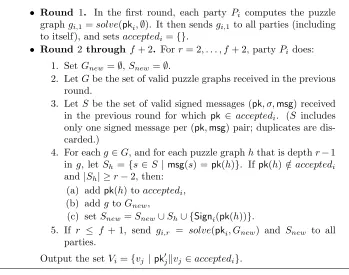
Intuition behind our protocol. Our protocol is inspired by the Dolev-Strong protocol for broadcast (which works by assuming a pre-established PKI) but we integrate computational resources in a nontrivial manner. In each round r, a party accepts a value if it has received a collection of r
signatures on that value; the party then adds its own signature to the col-lection and relays it to all other parties. However, since in our setting we do not have a PKI and parties do not know each others’ public keys, we must add an additional constraint (using theFpuz functionality) that prevents the
adversary from utilizing more than one public key per corrupted party. Our constraint is based on the observation in Lemma 1, that a depth-rsubgraph of a puzzle graph received in round r must have been solved in round 1. Thus in our protocol, a correct party only considers a public key “valid” if it comes along with a puzzle graph containing that public key at sufficient depth.
Our protocol is defined in Figure 1. Note that the protocol only usesf+1 communication rounds, though we include a final “computation round” for convenience in the description. We now prove that the protocol realizes ISC.
Lemma 2. For every honest party Pi, after round 2 it holds that pki ∈
acceptedj for every honest Pj.
Proof. In the first round, each correct party Pi broadcasts its own depth-1
puzzle graph, and in the next round each correct party Pj accepts any key
with a depth-1 puzzle graph.
We say that an honest party Pi accepts pk in round r if Pi adds pk to
acceptedi at the end of roundr. We say itacceptspkby round rif it accepts
pk in roundr0 ≤r.
An ISC Protocol for the Fpuz-Hybrid Model
Initially, each partyPi generates a keypair (ski,pk0i) for a digital signature
scheme. We set pki=pk0ikvi, wherevi is the input ofPi, and refer topki
as theidentity of partyPi.
The subroutine solve(pk,children) returns the puzzle graph g = (sol,pk,children), wheresolis the solution returned from querying theFpuz
functionality with (solve,pkk {sol(c)|c∈children}) (where the latter are in lexicographic order).
We defineSigni(msg) to return (pki, σ,msg), whereσis a signature onmsg
computed usingski.
• Round 1. In the first round, each party Pi computes the puzzle
graphgi,1=solve(pki,∅). It then sends gi,1to all parties (including
to itself), and setsacceptedi ={}.
• Round 2 throughf + 2. Forr= 2, . . . , f+ 2, party Pi does:
1. SetGnew=∅,Snew=∅.
2. LetGbe the set of valid puzzle graphs received in the previous round.
3. LetS be the set of valid signed messages (pk, σ,msg) received in the previous round for which pk ∈ acceptedi. (S includes
only one signed message per (pk,msg) pair; duplicates are dis-carded.)
4. For eachg∈G, and for each puzzle graphhthat is depthr−1 in g, let Sh ={s∈S |msg(s) =pk(h)}. If pk(h)∈/ acceptedi
and|Sh| ≥r−2, then:
(a) add pk(h) toacceptedi,
(b) addgto Gnew,
(c) setSnew=Snew∪Sh∪ {Signi(pk(h))}.
5. If r ≤ f + 1, send gi,r = solve(pki, Gnew) and Snew to all
parties.
Output the setVi={vj |pk0jkvj ∈acceptedi}.
Figure 1: Our ISC protocol for theFpuz-hybrid model.
Proof. The proof is by induction on r ≥2. For the base case, when r = 2, observe that by Lemma 2, each honest party Pi accepts the key of every
other honest party in round 2.
Suppose the lemma holds at roundr−1 (wherer−1≥2) and suppose honest partyPi acceptspkin roundr. We know thatPi must have received
distinct public keys; furthermore, none of those public keys can be equal to pki because Pi only signs pk after accepting it. Applying the inductive
hypothesis, every other honest party must have accepted thoser−2 public keys by roundr. From Lemma 2, we also know that every honest party has already acceptedpki in round 2. SincePisends all the signed messages it has
received, plus its own signature onpk, it follows that in roundr every other honest party Pj receives at least r−1 signed messages swith msg(s) =pk
and pk(s)∈acceptedj.
Next, observe that ifPiacceptspkin roundr, then it must have received
a puzzle graphgcontaining a depth-(r−1) subgraphhsuch thatpk(h) =pk. By solving an additional puzzle,Pi obtains a puzzle graphgi,r in whichh is
at depthr and sends gi,r to all other parties in round r.
It follows from both the above that every other honest party will ac-ceptpk by roundr+ 1.
Lemma 4. Each honest party accepts at mostn distinct keys.
Proof. If an honest party acceptspkin some roundr≥2, then it must have received a height-(r−1) puzzle graphgin the previous round. By Lemma 1, any height-(r−1) graph received in roundr−1 must contain a puzzle solved during round 1; since at mostnsuch puzzles in total can be computed in a round, at mostndistinct keys can be accepted.
Theorem 1. Assuming secure digital signatures, for any 1 ≤ f < n there is a polynomial-time ISC protocol in the Fpuz model with f + 1 rounds of communication, secure againstf corrupted parties.
Proof. Validity follows from Lemma 2, and boundedness follows from Lemma 4. To prove agreement, we must show that if an honest partyPi acceptspk in
roundf+ 2, then every honest party acceptspkbythat same round (f+ 2). So, sayPiacceptspkin roundf+2. ThenPimust have receivedf signatures
on pk from distinct previously-accepted keys. Observe that among these f
previously-accepted keys, at least 1 must belong to some honest party Pj:
by Lemma 2, at leastn−f keys from correct parties are accepted by Pi in
round 2, and by Lemma 4 at most n keys in total are accepted among all the correct parties. Since a correct party only signspkafter accepting it,Pj
must have acceptedpk in round f + 1 or earlier. Therefore, by Lemma 3, every correct party accepts pk in roundf+ 2 or earlier.
solutions are solved in total, any puzzle graph can be represented using only
O(λnf) bits (i.e., the graphs should be represented in a way that avoids duplicating shared children). Therefore since each party accepts at most n
keys, it publishes at mostO(λn2f) message bits. As a further optimization, each party may keep track of which subgraphs it has already published (e.g., after accepting a key in an earlier round) and avoid publishing duplicates. This reduces the worst case message cost toO(λnf) bits per party.
3.1 A Lower Bound on the Round Complexity
Our ISC protocol is round-optimal for deterministic2 protocols:
Theorem 2. Sayn−f ≥2. (Otherwise, ISC is trivial.) Any deterministic ISC protocol in the Fpuz-hybrid model that tolerates f faults must have at least f+ 1 rounds of communication.
A proof of the above is given in Appendix A. The proof is inspired by the lower bound on the round complexity of broadcast with a PKI [13, 1], but requires several modifications.
4
Pseudonymous MPC from Sequential Puzzles
In the previous section, we showed a protocol for ISC in the Fpuz-hybrid
model. This protocol allows the participating parties to agree on a set of public keys, with honest parties’ public keys guaranteed to be included; thus, this effectively bootstraps a (pseudonymous) PKI.
In this section, we show that ISC can be used to achieve (pseudony-mous) secure computation of general functionalities. We first show that the standard Dolev-Strong algorithm [13] can be run following ISC in order to implement a pseudonymous version ofsecure broadcast; this, in turn, can be used as part of standard protocols for secure multi-party computation (e.g., the GMW protocol) [20]) to implement pseudonymous secure computation. In general, any other multi-party computation protocol (such as BGW [6], for example) could be used in place of BGW; the fairness and resilience properties would carry over from such protocol, since our ISC protocol pro-vides the best possible resilience (f < n) and fairness condition (guaranteed termination).
2
4.1 Definition of Pseudonymous Security
We motivate the need to define a relaxed, pseudonymous notion of security by pointing out that the standard notion of security [9] cannot be achieved in a setting where the underlying network does not offer authenticated com-munication. Intuitively, the issue is that there is nothing distinguishing the parties from each other; thus, it is not even clear which of the n parties should play the role ofP1, which the role of P2, etc. As a consequence, we
must either restrict attention to functions that treat each of theirn inputs symmetrically, or else we must allow the attacker to arbitrarily choose the order in which the parties’n inputs are entered into the computation. We choose the second approach, which is in fact more general than the first.
The relaxed notion of pseudonymous secure computation that we con-sider may still be useful in many circumstances. First, many functions of interest (such as majority, average, etc.) are invariant under permutations of the input values, and are therefore unaffected by the relaxation. Also, in many scenarios the ordering of the inputs may be irrelevant; for example, in a game of online poker against anonymous opponents, each party might only be concerned with having the game played honestly and correctly.
The formal definition. To define pseudonymous secure computation, we define an appropriate ideal world which is a relaxation of the one normally considered when defining secure computation. (We have already defined our real world in Section 2, and as usual [9] we will define a real-world protocol to be secure if the actions of any adversary attacking the protocol can be simulated by an adversary in the ideal world.) The main relaxation is that in pseudonymous MPCwe allow the adversary to choose an arbitrary permutation on the inputs.
Our execution model is formally defined in Figure 2, but we describe the main points below: Let f : ({0,1}∗)n → ({0,1}∗)n be a function to evaluate. Each party Pi holds input xi ∈ {0,1}λ, where λ is the security
parameter. The ideal-world adversary S is an interactive Turing machine that controls a set C ⊂ {1, . . . , n} of corrupted parties, and we denote the set of uncorrupted parties by I = [n]\C. The adversary S receives the inputs of the corrupted parties, as well as an auxiliary input z. Execution in the ideal world proceeds as follows:
• Input substitution: Each honest party Pi ∈I sends its input xi to
denote the input values sent by thenparties.3
• Permutation: S chooses a permutation π on {1, . . . , n}.
• Computation: Let ~x0 be the vector obtained by applying the per-mutation π to the entries of ~x; i.e., x0π(i) = xi. The trusted party
computes (y1, . . . , yn) =f(x01, . . . , x0n), and returnsyπ(i) to partyPi.
• Output: Each honest Pi outputs the value given to it by the trusted
party. In addition,S outputs an arbitrary function of its view.
4.2 Protocol for Pseudonymous Multi-party Computation
The GMW protocol for multi-party computation makes use of two com-munication primitives: private authenticated channels, and broadcast. We will need to emulate (the pseudonymous version of) these in theFpuz-hybrid
model. The basic idea is for each party to generate a public encryption/sign-ing keypair, and then run the ISC protocol so that all the parties agree on a set of public keys. This effectivey amounts to bootstrapping a pseudony-mous PKI that includes a pseudonym for each honest party and at most f
pseudonyms for the adversary. Thereafter, standard encryption and signing techniques can be used to realize (pseudonymous) authenticated and pri-vate channels between the parties; the Dolev-Strong algorithm can be used to give pseudonymous broadcast.
In more detail, the protocol for evaluating a function f proceeds as follows:
1. First, each partyPigenerates a signing and encryption keypairpki,ski.
Next, each party executes the ISC protocol 1, using pki as its input value. At the end of the protocol, each party obtains a set of public keys which it can order lexicographically to give a vector (pk01, . . . ,pk0n). We remark that this effectively defines a permutation of the parties, and that each party can determine its permuted index.
2. Next, each party Pi executes the GMW protocol [20]. Note that the
GMW protocol uses both broadcasts and private messages. When the protocol calls for a broadcast, the Dolev-Strong algorithm is executed using pk~ 0 as the PKI. When the protocol calls for a private message, the signing and encryption keys are used as described above.
3
Theorem 3 (Pseudonymously Secure SFE). In the Fpuz-hybrid model, we achieve SFE for general functions while ensuring pseudonymous security against a non-adaptive adversary. Specifically, input completeness and guar-anteed termination can be achieved with honest majority, i.e., f < n/2. In the presence of an arbitrary number of corruptions, we ensure security with unanimous abort.
Proof. First we prove that the protocol described above satisfies the case for honest majority. Since the underlying GMW protocol is executed intact, the existing simulator for this protocol, S0, can be reused, with the permuted player indices substituted for the correct indices. The main thing for us to show is that the real-world execution of the ISC protocol in the first phase can indeed be simulated.
Our simulator S first generates keypairs pki and ski for each simulated
party. The view of the real-world adversary consists of the messages sent by the honest parties in each round; this communication pattern can be simu-lated perfectly. According to theagreement property of the ISC definition, if a corrupted party does not complete the protocol, its public key may be replaced with⊥; in any case, all uncorrupted parties arrive at a consistent vectorpk~ with high probability. Since the ISC protocol sorts this vector in lexicographical order, the simulatorS instructs the trusted party T to use this permutation.
After completing the ISC phase, our simulator S executes the GMW simulator S0 in a sandbox, placing each party P
i with the corresponding
permuted index. Note that sinceS0 is intended for a model with broadcast and private channels, we must be able to simulate the protocols used to implement these channels. It is trivial to simulate the broadcast protocol since the simulator already knows the signing keys; the private channel can be trivially simulated by encrypting random strings.
Finally in the case without honest majority (i.e., n > f > bn/2c) the GMW [20] protocol guarantees privacy but not fairness.
5
Conclusion and Future Work
achieve (pseudonymous) notions of broadcast and secure computation. Al-though our work does not directly apply to the actual Bitcoin protocol, our results show that distributed-computation models resembling Bitcoin can lead to rich applications with non-trivial security guarantees.
In our work we have made several simplifying assumptions, and relaxing any of them is an important next step. For example, we have assumed that there is a fixed numbern of parties that is public knowledge at the outset of the protocol. Is anything achievable ifn is unknown? Alternately, what can be said in apartially synchronousnetwork where the maximum commu-nication delay is unknown? In a different direction, it would be interesting to explore a model in which parties were not malicious orhonest, but are instead onlyrational. Here, we could assign some “cost” to solving puzzles rather than assuming a strict upper bound on how many puzzles a party could solve per round. This is the direction taken in other work analyzing Bitcoin [16, 24]. It would be useful to reconcile this with approaches to modeling rationality in secure multi-party computation.
References
[1] Marcos Kawazoe Aguilera and Sam Toueg. A simple bivalency proof thatt-resilient consensus requirest+ 1 rounds. Information Processing Letters, 71(3):155–158, 1999.
[2] Marcin Andrychowicz and Stefan Dziembowski. Distributed cryptog-raphy based on proofs of work. Cryptology ePrint Archive, Report 2014/796, 2014.
[3] James Aspnes, Collin Jackson, and Arvind Krishnamurthy. Expos-ing computationally-challenged Byzantine impostors. Technical report, Computer Science Dept., Yale University, 2005.
[4] Adam Back. Hashcash—a denial of service counter-measure. http:
//www.hashcash.org/papers/hashcash.pdf, 2002.
[5] Boaz Barak, Ran Canetti, Yehuda Lindell, Rafael Pass, and Tal Ra-bin. Secure computation without authentication. In Advances in Cryptology—CRYPTO 2005, pages 361–377. Springer, 2005.
[7] Dan Boneh and Moni Naor. Timed commitments. In Advances in Cryptology—Crypto 2000, volume 1880 of LNCS, pages 236–254. Springer, 2000.
[8] Nikita Borisov. Computational puzzles as sybil defenses. InSixth IEEE International Conference on Peer-to-Peer Computing, pages 171–176. IEEE, 2006.
[9] Ran Canetti. Security and composition of multiparty cryptographic protocols. Journal of Cryptology, 13(1):143–202, 2000.
[10] Fabien Coelho. An (almost) constant-effort solution-verification proof-of-work protocol based on merkle trees. In Progress in Cryptology– AFRICACRYPT 2008, pages 80–93. Springer, 2008.
[11] Jeffrey Considine, Matthias Fitzi, Matthew Franklin, Leonid A Levin, Ueli Maurer, and David Metcalf. Byzantine agreement given partial broadcast. Journal of Cryptology, 18(3):191–217, 2005.
[12] Carole Delporte-Gallet, Hugues Fauconnier, Rachid Guerraoui, Anne-Marie Kermarrec, Eric Ruppert, et al. Byzantine agreement with homonyms. InProceedings of the 30th annual ACM SIGACT-SIGOPS symposium on Principles of distributed computing, pages 21–30. ACM, 2011.
[13] Danny Dolev and H. Raymond Strong. Authenticated algorithms for Byzantine agreement. SIAM Journal on Computing, 12(4):656–666, 1983.
[14] Shlomi Dolev, Nova Fandina, and Ximing Li. Nested merkles puz-zles against sampling attacks. In Mirosaw Kutyowski and Moti Yung, editors, Information Security and Cryptology, volume 7763 of Lecture Notes in Computer Science, pages 157–174. Springer Berlin Heidelberg, 2013.
[15] Cynthia Dwork and Moni Naor. Pricing via processing or combat-ting junk mail. InAdvances in Cryptology—Crypto ’92, volume 740 of LNCS, pages 139–147. Springer, 1993.
[17] Matthias Fitzi, Nicolas Gisin, Ueli M. Maurer, and Oliver von Rotz. Un-conditional Byzantine agreement and multi-party computation secure against dishonest minorities from scratch. InAdvances in Cryptology— Eurocrypt 2002, volume 2332 ofLNCS, pages 482–501. Springer, 2002.
[18] Matthias Fitzi, Daniel Gottesman, Martin Hirt, Thomas Holenstein, and Adam Smith. Detectable Byzantine agreement secure against faulty majorities. In 21st Annual ACM Symposium on Principles of Distributed Computing (PODC), pages 118–126. ACM Press, 2002.
[19] Juan A. Garay, Aggelos Kiayias, and Nikos Leonardos. The Bitcoin backbone protocol: Analysis and applications. Eurocrypt 2015, to ap-pear.
[20] O. Goldreich, S. Micali, and A. Wigderson. How to play any mental game, or a completeness theorem for protocols with honest majority. In 19th Annual ACM Symposium on Theory of Computing (STOC), pages 218–229. ACM Press, 1987.
[21] Shafi Goldwasser and Yehuda Lindell. Secure multi-party computation without agreement. Journal of Cryptology, 18(3):247–287, 2005.
[22] Bogdan Groza and Bogdan Warinschi. Cryptographic puzzles and DoS resilience, revisited. Designs, Codes and Cryptography, 2013.
[23] Ari Juels and John G. Brainard. Client puzzles: A cryptographic coun-termeasure against connection depletion attacks. In NDSS, volume 99, pages 151–165, 1999.
[24] Joshua A Kroll, Ian C Davey, and Edward W Felten. The economics of bitcoin mining or, bitcoin in the presence of adversaries. In Workshop on Economics in Information Security (WEIS), 2013.
[25] Leslie Lamport, Robert Shostak, and Marshall Pease. The Byzantine generals problem. ACM Trans. Programming Languages and Systems (TOPLAS), 4(3):382–401, 1982.
[26] Ben Laurie and Richard Clayton. Proof-of-work proves not to work. In Workshop on Economics and Information Security, 2004.
[28] Ralph C Merkle. Secure communications over insecure channels. Com-munications of the ACM, 21(4):294–299, 1978.
[29] A Miller, A Juels, E Shi, B Parno, and J Katz. Permacoin: Repurpos-ing bitcoin work for long-term data preservation. IEEE Security and Privacy, 2014.
[30] Andrew Miller and Joseph LaViola, Jr. Anonymous byzantine con-sensus from moderately-hard puzzles: A model for Bitcoin. Technical Report CS-TR-14-01, University of Central Florida, 2014. Availale at
http://tr.eecs.ucf.edu/78.
[31] Satoshi Nakamoto. Bitcoin: A peer-to-peer electronic cash system.
http://bitcoin.org/bitcoin.pdf, 2008.
[32] Michael Okun.Distributed Computing Among Unacquainted Processors in the Presence of Byzantine Failures. PhD thesis, Hebrew University of Jerusalem, 2005.
[33] Marshall Pease, Robert Shostak, and Leslie Lamport. Reaching agree-ment in the presence of faults. J. ACM, 27(2):228–234, 1980.
[34] Ronald Rivest, Adi Shamir, and David Wagner. Time-lock puzzles and timed-release crypto. Technical report, Massachusetts Institute of Technology, 1996.
A
Lower Bound on Round Complexity in the
F
puzModel
Dolev and Strong first showed that assuming authentication, any determin-istic Byzantine agreement protocol tolerating f faults (where n > f + 1) must have at leastf + 1 messaging rounds [13].
Our lower bound proof is inspired a simple bivalency-based proof of this theorem [1]. We basically must show that having the additional puzzle functionality does not change this lower bound, even though this additional functionality can be used to further restrict behavior of the adversary, since the adversary can only solve a limited number of computational puzzles per round.
itself is randomized and our positive results make use of digital signature algorithms.
Definition 6. A compliant protocol in the Fpuz-hybrid model must ignore the security parameter and treat the public/private keys, digital signatures, and puzzle solutions as opaque strings. Protocols may transmit opaque strings along communication channels and include them as input to oracle queries and digital signature algorithms, but cannot otherwise inspect or modify their bits.
This definition in particular rules out protocols that use the signature algorithm or interaction withFpuz in order to perform coin flips.
Theorem 2. Sayn−f ≥2. (Otherwise, ISC is trivial.) Any deterministic ISC protocol in the Fpuz-hybrid model that tolerates f faults must have at least f+ 1 rounds of communication.
Proof. For the purpose of proving our lower bound, we limit ourselves to constructing adversaries that are also compliant in the same sense, and in fact only need tocrash processes (rather than induce Byzantine behavior). Furthermore, our adversaries crash at most one process per round.
We will state a lemma that given these constraints, the same reasoning used in deterministic models applies equally to compliant protocols in our model with high probability. 4 First we define some notation useful for describing executions in our model.
Apartial run is a finite sequence of system configurations (including the input values to each process and the internal state of each process and the adversary) that transition according to our model. The last element in an
r-round partial runis the system configuration at the end ofr rounds. Note that since our execution model is randomized (due to coin flips taken by the puzzle functionality and digital signature scheme), given an initial con-figuration our model defines a probability distribution overr-round partial runs.
We define an equivalence relation among partial runs in our model. Two partial runs are equivalent if they are equal up to a bijective transformation of keys, signatures, and puzzle solutions. A partial runscan be represented as a pair (state,{oi}), where {oi,} is the sequence of every occurrence of
4
an opaque string in a configuration and state is the sequence of system configurations with each occurrence of an opaque string taken out (and replaced with a symbol opaque). Another partial run s0 is equivalent to s
if s0 = (state,{F(oi)}) for some bijective function F : {0,1}∗ → {0,1}∗.
This implies that two partial runs are equivalent if their initial conditions are the same, any decisions made by correct processes are the same, any processes that have crashed did so at the same time, and the content of the internal states of each process and messages delivered differ only in the representation of the opaque strings associated with signatures and puzzles.
Lemma 5. Consider a compliant protocol and compliant adversary (as per Definition 6). Then for each round r, there exists a single equivalence class of r-round partial runs (which we call the canonical partial run) such that with high probability, a partial run sampled from the distribution ofr-round partial runs belongs to this equivalence class.
Proof. As the protocols make only a (polynomially) bounded number of queries (to Fpuz or to digital signature routines), with high probability the processes do not generate colliding keys or puzzle solution strings, nor does any process “guess” a puzzle solution it has not received from Fpuz or the
communication channel.
Hereafter, we are only concerned with the canonical partial runs (rather than partial runs that involve some unlikely string collision), and therefore the termpartial run should be taken to mean the class of canonical partial runs.
Let sr be an r-round partial run. We say that sr+1 is a one-round
extension of sr if there exists some adversary A such that sr and sr+1 are
respectively the canonicalr-round and r+ 1-round partial runs given A. A partial runsis anextensionofsrif it is a partial run obtained by extending
sr one round at a time and in which all processes have decided.
Having established a basis for applying deterministic reasoning to our model, the lower bound proof can be carried out with simple modifications to the bivalency proof in [1]. We describe these necessary modifications and then refer the reader to the text of [1] for the remainder of the proof.
The lower bound of [13, 1] applies to binary consensus, a somewhat different problem than ISC in which processes must decide on a single bit). We can imagine that each process decides on 2λ bits, one for each possible input value (at most nof these may be set to 1). The proof in [1] relies on a notion of valences, which we now define in our setting. A partial run sr
decide on a setS wherev∈S, andv-valent if in all extensionsv /∈S. When
vis clear from context, we abbreviatev-valent with 1-valent andv-valent in order to more closely match the notation in [1]. A partial run is univalent (with respect to v) if it is either v-valent or v-valent, and bivalent if it is neitherv-valent norv-valent.
The proof in [1] involves constructing pairs of executions that are in-distinguishable to some of the processes in the network. We next prove a lemma that guarantees that these constructions remain indistinguishable, even in our setting where the processes may additionally interact withFpuz.
Lemma 6. For r < f, let sr be an r-round partial run in which at most
r processes have crashed. Consider the following two one-round extensions of sr: sr+1, in which one process crashes before delivering its message to
some processp, ands0r+1 in which the same process crashes after delivering its message to p. Let s0 and s denote the runs extending s0r+1 and sr+1
respectively in which p crashes at the beginning of the next round (before sending any messages). (Note that in the special caser+1 =f, the processes terminate so the crash is unnecessary.) Let p0 (distinct fromp) be a correct process. Processp0cannot distinguish between runssands0 (i.e., its behavior in both runs is the same).
Proof. In the case of an ordinary message passing network, this is immediate, sincep is the only process that observes any difference in round r+ 1 and
p crashes before it can communicate to any other process. However in our setting we must prove this holds in spite of the additionalFpuzfunctionality, since in round r+ 1, process p may affect Fpuz by solving a puzzle before
crashing. Without loss of generality, assume that in runs,p solves a puzzle
puz and in s0 solves a puzzle puz0. However, note that a) Fpuz records a puzzle solutionsolrandomly sampled from a space of size 2λ, b) the recorded solution is returned only to processp, which crashes before it can transmit any information about it to another process, and c) the other processes may only observe the difference through interaction withFpuz by calling sending
(check,puz,sol) or (check,puz0,sol) (i.e., by correctly guessing the puzzle solution). As the processes only make a polynomial number of queries, this occurs with negligible probability.
Now that we have defined the notions of (canonical) partial runs and va-lences in our setting and established conditions under which indistinguisha-bility holds despite the additionalFpuz, our theorem follows from the proof
B
ISC in the Parallelizable Proof-of-Work Model
While in our main result we have considered inherently sequentially puzzles (i.e., puzzles that take the adversary an entire round to solve, even with all
f corrupted processes working together in parallel), we are also interested in modeling puzzles that the adversary can solve faster using its parallel resources. Equivalently, we may be interested in modeling an adversary that can compute sequentiallyf times faster than a corrupt process.
We can model this via a modified functionality Fparpuz, which differs fromFpuz in that it allows the adversary to make multiple rounds of
inter-action with the functionality within a single communication round.
• Receive from eachuncorrupted party Pi an input (solve, x(i)). (Note
that only a single value is allowed.) For i = 1, . . . , n, first check if a pair (x(i), h(i)) has been stored in T, and if so return h(i) to Pi;
otherwise, choose uniform h(i) ∈ {0,1}λ, return h(i) to P
i, and store
(x(i), h(i)) in T.
• For up tof iterations, a single corrupted partyPimay request (solve, xi),
and the input is processed immediately as above.
• Receive from each partyPian arbitrary-length vector (check,(x(1i), h (i) 1 ), . . .).
Return to each partyPi the vector of values (b(1i), . . .) where b (i) j = 1
iff (x(ji), h(ji))∈T.
As before, we allow parties to call Fparpuz with a checkinstruction any
(polynomial) number of times. Each of the honest parties is allowed to callFparpuz with a solve instruction only once per communication round;
moreover, all of thesolveinstructions for a round must be sent before any honest party receives its puzzle solution. However, the corrupted parties can callFparpuz, one after another in sequence, up to a total of f times within
an overall communication round.
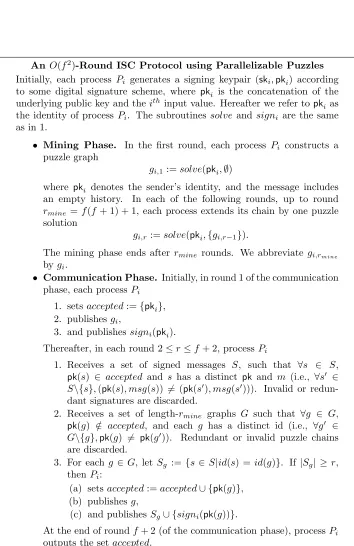
Intuitively, the protocol works because every correct process is able to create a valid puzzle chain for its own key, yet the corrupt processes are only able to create at most f puzzle chains before the protocol terminates.
Definition 7. A length-`puzzle chain is defined inductively as follows:
• A puzzle graphg is a length-1 puzzle chain if children(g) =∅.
• A puzzle graph g is a length-(`+ 1) puzzle chain if children(g) = {s},
pk(s) =pk(g), and sis a length-` puzzle chain.
The protocol is defined in Figure 3.
Lemma 7. For every correct processPi, its identitypki is accepted by every other correct process in round 2.
Proof. This follows immediately from the protocol definition. In round 1 of the communication phase, each correct processPi broadcasts its own puzzle
chain and signature onpki, and every other process receives these messages and acceptspki in the next round.
Lemma 8. If a correct process Pi accepts a key pk in round r < f + 2 (of the communication phase), then every correct process accepts pk in round
r+ 1 or earlier.
Proof. The proof is by induction on the round numberr ≥1. For the base case, whenr = 1 observe that each correct process Pi only accepts its own
key pki, and by Lemma 7 every other correct process accepts pki in round 2.
Suppose the lemma holds at round r, and suppose a correct process Pi
acceptspk in roundr.
First, note that in round r + 1, every other correct process receives at least r signatures over pk from distinct previously-accepted keys (see the proof of Lemma 3).
Second, observe thatPi publishes a length-rmine chaing forpkin round
r, and therefore every other correct party receivesg in round r+ 1. Thus, every correct process accepts pk in round r + 1, completing the proof by induction.
Proof. Each accepted key requires a length-rminechain, and each node in the
chain must be associated with a consistent key. Each uncorrupted process only solves puzzles associated with its own key. Since the corrupted processes can solve (in total) at most f puzzles per round, they can solve at most
f(rmine+f+ 1) puzzles before the protocol terminates. Therefore, at most
bf(rmine+f + 1)/rminec=f +bf ·(f + 1)/rminec=f length-rmine chains
can be computed by corrupt processes. Therefore, length-rmine chains are
found corresponding to at mostndistinct keys.
Theorem 4. There exists a polynomial-time ISC protocol withO(f2)rounds of communication, secure againstf < n number of corrupted parties.
Real-world (Fpuz-hybrid) Execution with adversaryA
1. (a) Each party Pi starts with the security parameter λ, input xi,
and random inputri.
(b) The adversary A starts with λ, random input r0, input z that
includes a set C ⊂ [n] of corrupted parties and their inputs
{xi|i∈C}, and additional auxiliary input.
2. Initialize a round counter, l:= 0.
3. As long as there exists an uncorrupted party that did not halt, repeat:
(a) Each uncorrupted party Pi, i /∈ C, performs a compute phase
during which it may interact with an instance ofFpuz using its oracle tape, subject to the constraint that it may make at most one oracle query of the form (solve, x) in this round. Note that the responses to these queries are not delivered until every query for this round has been made.
(b) Each uncorrupted partyPi, i /∈C, generates{mi,l}, where each
mi,l ∈ {0,1}∗ is a (possibly empty) message intended to be
published during this round.
(c) The adversary A learns {mi,l|i∈[n]}, and generates {m†j,l|j /∈
C}, a set of messages to be delivered just to Pj. During this
phase, the adversary may make up to|C|oracle queries of the form (solve, x).
(d) Each uncorrupted party Pi, i /∈ C, receives the messages
sort(m†i,l∪ {mj,l|j /∈C}).
(e) l:=l+ 1.
4. Each uncorrupted partyPi, i /∈C, as well asA, generates an output.
The output of the corrupted parties is set to⊥.
An O(f2)-Round ISC Protocol using Parallelizable Puzzles
Initially, each process Pi generates a signing keypair (ski,pki) according
to some digital signature scheme, where pki is the concatenation of the underlying public key and theithinput value. Hereafter we refer topk
i as
the identity of process Pi. The subroutines solveand signi are the same
as in 1.
• Mining Phase. In the first round, each process Pi constructs a
puzzle graph
gi,1:=solve(pki,∅)
where pki denotes the sender’s identity, and the message includes
an empty history. In each of the following rounds, up to round
rmine =f(f + 1) + 1, each process extends its chain by one puzzle
solution
gi,r :=solve(pki,{gi,r−1}).
The mining phase ends after rmine rounds. We abbreviate gi,rmine
bygi.
• Communication Phase. Initially, in round 1 of the communication phase, each process Pi
1. setsaccepted:={pki}, 2. publishesgi,
3. and publishessigni(pki).
Thereafter, in each round 2≤r≤f+ 2, processPi
1. Receives a set of signed messages S, such that ∀s ∈ S,
pk(s) ∈ accepted and s has a distinct pk and m (i.e., ∀s0 ∈ S\{s},(pk(s), msg(s)) 6= (pk(s0), msg(s0))). Invalid or redun-dant signatures are discarded.
2. Receives a set of length-rmine graphs G such that ∀g ∈ G, pk(g) ∈/ accepted, and each g has a distinct id (i.e., ∀g0 ∈ G\{g},pk(g) 6= pk(g0)). Redundant or invalid puzzle chains are discarded.
3. For each g ∈G, let Sg :={s∈ S|id(s) =id(g)}. If |Sg| ≥ r,
thenPi:
(a) setsaccepted:=accepted∪ {pk(g)}, (b) publishesg,
(c) and publishes Sg∪ {signi(pk(g))}.
At the end of roundf+ 2 (of the communication phase), processPi
outputs the setaccepted.