Available Online atwww.ijcsmc.com
International Journal of Computer Science and Mobile Computing
A Monthly Journal of Computer Science and Information Technology
ISSN 2320–088X
IJCSMC, Vol. 4, Issue. 8, August 2015, pg.177 – 187
RESEARCH ARTICLE
Improved Energy Efficient AODV
Routing using K-means Algorithm for
Cluster Head Selection
Arthur Ndlovu
1¹
Computer Science and Engineering, Delhi Technological University, IndiaAbstract— A Mobile adhoc network is a collection of wireless mobile nodes which can provide scalability and independence for mobile topologies. These wireless mobile nodes are battery powered hence the need for energy conservation in order to allow an increase in network lifetime. Energy conservation is very important in applications such as Military operations and Emergency Rescue operations where network infrastructure is not readily available. In this research we developed an improved energy efficient algorithm which uses K-means algorithm as the Clusterhead head selection method that is aimed at improving the network performance of AODV (adhoc on-demand distance vector) routing protocol. The improved energy idea uses the concept of drain count in sensor nodes which works as follows:
Each node is set with an initial energy value which basically determines how long it’s going to last in a network and to make sure our network has the highest lifetime possible we set up a threshold energy value. If a particular path has a single node with its energy lesser than that of the set threshold, then the drain count of that particular path is incremented by a factor of one (1). The drain count will serve as the parameter on which we can choose the path that is most likely to prolong the network lifetime. The path with the least drain count will be the one that is chosen because it has few nodes with energy below the energy threshold. We then introduce K-means algorithm in the energy efficient system for the formation of clusters in our system and again this will help in shortening the transmission path. The proposed strategy is compared with the traditional AODV routing protocol and performance evaluations are done with respect to network lifetime, throughput, end-to-end delay, packet delivery ratio using Ns2 simulator.
Keywords— Network lifetime, energy efficiency, Drain count, Ns2
I. INTRODUCTION
a) Fixed Network Infrastructure- This is also known as the Cellular network, mobile hosts communicate with each other through a fixed and wired gateway (access point) within the network. In this infrastructure Handoff is the main problem because it is difficult to transfer a connection from one base station to another without compromising the packets or without a risk of disconnection. It is depended on the existence of the infrastructure.
b) Adhoc-Network Infrastructure/Infrastructureless- These types of networks have no fixed routers
like the case of fixed infrastructure networks. All nodes are capable of movement and can be connected dynamically in arbitrary manner. The responsibilities for organizing and controlling the network are distributed among the terminals themselves. The entire network is mobile and the individual terminals are allowed to move at will relative to each other. In this type of network some pairs of terminals may not be able to communicate directly to each other due to some transmission distance restrictions of individual terminals and relaying of some messages is required so that they are delivered to their destinations. The nodes of these networks also function as routers which discover and maintain routes to other nodes in the networks. Our proposed system looks at wireless sensor networks which fall in this category. Energy conservation in MANET has always been a critical issue because the desire is to have a network that can last as long as possible in terms of lifetime. Sensor nodes are tiny devices and hence they have small battery power and this calls for innovative ways of communication in order to utilise the energy of these network devices effectively.
II. RELATEDWORK
Several researches have been carried out particularly on the performance evaluation of the AODV routing protocol against other traditional protocols like DSDV and DSR routing protocols [2], [4] and [6]. However
none of these researches have attempted to borrow algorithms from other fields to improve network operations of AODV routing protocols. Some research has been done however to optimize the network using multipath routing [7], [8], [9]. The proposed work is aimed at developing energy efficient AODV routing protocol that uses K-means algorithm to create clusters in the network. This section documents some of the many energy efficient schemes based on AODV developed by researchers in the field. In [7], Jin-Man Kim and Jong-Wook Jang proposed an enhanced AODV routing protocol which is a modified version of AODV which uses an algorithm called Energy mean value algorithm to improve the network lifetime by considering energy aware in node selection for route discovery. Increase in the number of applications which use Ad hoc network has led to an increase in the development of algorithms which consider energy efficiency as the cost metric.
In [8], Yumei Liu, Lili Guo, Huizhu Ma and Tao Jiang propose a multipath routing protocol for mobile ad hoc networks, called MMRE-AOMDV, which extends the Ad Hoc On-demand Multipath Distance Vector (AOMDV) routing protocol. The key idea of the protocol is to find the minimal nodal residual energy of each route in the process of selecting path and sort multi-route by descending nodal residual energy. Once a new route with greater nodal residual energy is emerging, it is reselected to forward rest of the data packets. It can balance individual node’s battery power utilization and hence prolong the entire network’s lifetime. In [9], Zhang Zhaoxiao, Pei Tingrui and Zeng Wenli propose a new mechanism of energy-aware routing named EAODV which aims to improve the classical AODV protocol. EAODV adopted the backup routing strategy in case the chosen route fails.
III. METHODOLOGY A. Traditional Routing Protocols for MANETs
B. AODV Routing Protocol
AODV is a packet routing protocol designed for use in mobile ad hoc networks (MANET).
The route discovery mechanism is invoked only if a route to a destination is not known. UDP is the transport layer protocol and Source, destination and next hop are addressed using IP addressing. Each node maintains a routing table that contains information about reaching destination nodes. Each entry is keyed to a destination node. AODV allows nodes to respond to link breakages and changes in network topology in a timely manner.
The operation of AODV is loop free, and by avoiding the Bellman-ford “counting to infinity” problem it offers quick convergence when the topology changes. When links breaks, AODV causes the affected set of nodes to be notified so that they are able to invalidate the routes using the lost link.
Its distinguishing feature is its use of a destination sequence number for each route entry. This number is created by the destination node and is included along with any route information it sends to the requesting node. Using this number ensures loop freedom, the node with the greatest sequence number is selected at all times.
Sequence numbers for both destination and source are used. Managing the sequence number is the key to efficient routing and route maintenance.
1. Sequence numbers are used to indicate the relative freshness of routing information. 2. Updated by an originating node, e.g., at initiation of route discovery or a route reply. 3. Observed by other nodes to determine freshness.
The basic message set consists of: 1. RREQ – Route request 2. RREP – Route reply 3. RERR – Route error
4. HELLO – For link status monitoring
C. Energy efficiency in AODV Routing Protocol
Every node in the initial stages is given an energy value which is basically the battery status at the start of the network. As activity happens in the network the nodes will spent their energy in transmitting and reception of control and data packets. Depending with path selection some nodes will have more energy than the others within the network because not every node is used in transmitting or reception. Therefore for total energy consideration there are basically four modes of energy consumption that must be considered and these include:
1. Transmission mode- this is the energy spent in transmitting the packet and is actually dependent
on packet size.
Where is the transmission energy. – This is the transmission power.
– This is the time taken to transmit data packet
-this is the length of the data packet in bits.
2. Reception mode – this is the energy that is spent in receiving a packet.
Where is the reception energy.
– This is the reception power.
– This is the time taken to receive data packet -this is the length of the data packet in bits.
3. Idle mode- this is a mode where the node is either neither transmitting nor is it receiving but some
considerable energy will be used in hearing. Nodes have to listen to the network activity in case there is incoming packets directed to it. In that case it is imperative that the particular node moves from being in idle state to reception mode. The power consumed in this mode is as follows:
Where is the actual power that is consumed while the node is in idle mode and is the power that is consumed in reception mode.
4. Overhearing mode- sometimes nodes may receive packets that do not belong to them and that is
called overhearing. Some energy is actually lost because of that.
Where P is the power consumed in overhearing mode and is the power that is consumed in reception mode.
The above four modes are key to an efficient energy aware system as they cover all node energy usage areas.
IV. PROPOSEDSYSTEM
The work is divided into two parts, with the first part being the K-means clustering algorithm and the second part being the Improved Energy efficient AODV routing protocol (IEE_AODV). The K-means
clustering algorithm approach will create clusters and enable the selection of cluster heads in the network.
Why K-means Clustering 1. K-means is simple to use
2. If variables (nodes) are huge, then K-Means is computationally faster than hierarchical clustering, if we keep k smalls.
3. K-Means produce tighter clusters than hierarchical clustering, especially if the clusters are globular
FIG.1K-MEANS CLUSTERING FLOWCHART
IMPROVED ENERGY EFFICIENT ROUTING PROTOCOL AODV(IEE_AODV)
The main purpose of introducing the IEE_AODV was to improve the network lifetime as wireless sensor nodes have a constraint in power due to their limited battery power. The lifetime of the network in this proposed system will be determined by the drain count energy metric.
Drain rate is the consumption rate of energy by each node within a wireless sensor network. The key to a
successful realization of maximum network lifetime is to choose the path with the least drain rate.
Start
Input cluster size
K-(2-12), i=1
Specify K centroids
Assign node i to the closest
centroid
i=i+1
i= number
of nodes?
Calculate the sum of distances
between each node and its centroid
in the each cluster
Clustering based on
minimum distances
Any node
changes its
Proposed Algorithm
1. Calculate the residual energy of each node
a. Let be the amount of energy consumed in transmitting one packet, therefore
=
- This is the transmission power.
– This is the time taken to transmit data packet
Therefore the remaining energy of a node will be calculated as:
b. Let be the amount of energy consumed in receiving one packet, therefore
=
Therefore the remaining energy of a node will be calculated as:
2. Use the residual energy calculated in step 1 to get the energy status of each node as follows:
If (residual node battery < 20% of the node’s initial energy) then
Set
Else if (20% of the node’s initial energy < residual node battery < 60% of the node’s
initial energy) then
Set
Else (residual node battery > 60% of the node’s initial energy) then
Set
3. Then calculate drain count as follows:
If ( ) Then
(Node energy below energy threshold value)
4. Choose the path with the least drain count:
If (path1) > (path2) then
Path 2 is the better path
5. Finish
Modified AODV route request packet header
Type Reserved Hop Count
RREQ ID
Destination IP address
Destination Sequence Number
Originator IP Address
Lifetime
Remaining Energy
Drain Count
Record
Figure 2: Modified AODV route request packet header
The record field tracks the path that is traversed by the control packets and helps in updating the routing
table along a chosen path. The remaining energy is determined at every node and is compared to the set threshold value. The implementation methodology that is being used to simulate this protocol on MANETs is NS2 and is simulated for networks of different sizes from 10 to 50 nodes.
V. TESTING AND RESULTS
The proposed system was simulated together with the conventional AODV routing protocols in similar simulation environment. In order to cover a number of scenarios node density is going to be varied from 10,20, 30,40 and 50 nodes with node density 10 and 20 representing low node density network and 40 and 50 nodes representing high node densities. It is however important to note that in this research we varied node densities to monitor if our main research modifications can handle scalability and at the same time improve the network lifetime on the network.
Network Scenario for simulation
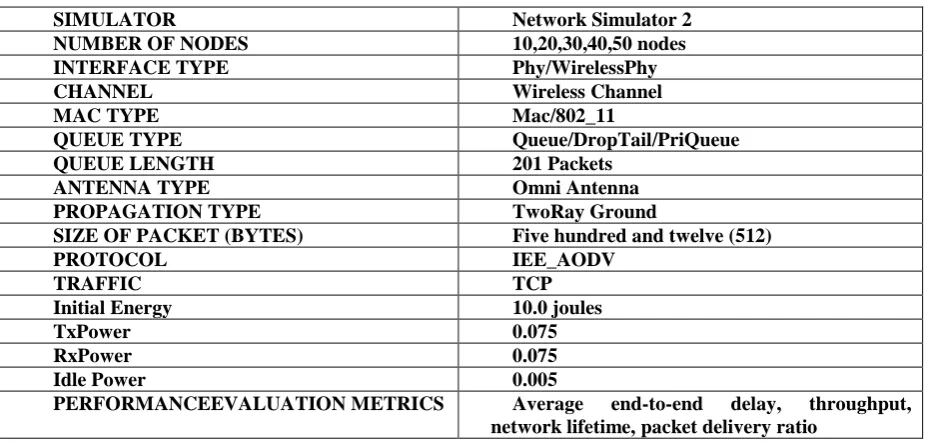
The network scenario for the proposed system is outlined in the following table:
SIMULATOR Network Simulator 2
NUMBER OF NODES 10,20,30,40,50 nodes
INTERFACE TYPE Phy/WirelessPhy
CHANNEL Wireless Channel
MAC TYPE Mac/802_11
QUEUE TYPE Queue/DropTail/PriQueue
QUEUE LENGTH 201 Packets
ANTENNA TYPE Omni Antenna
PROPAGATION TYPE TwoRay Ground
SIZE OF PACKET (BYTES) Five hundred and twelve (512)
PROTOCOL IEE_AODV
TRAFFIC TCP
Initial Energy 10.0 joules
TxPower 0.075
RxPower 0.075
Idle Power 0.005
PERFORMANCEEVALUATION METRICS Average end-to-end delay, throughput,
network lifetime, packet delivery ratio
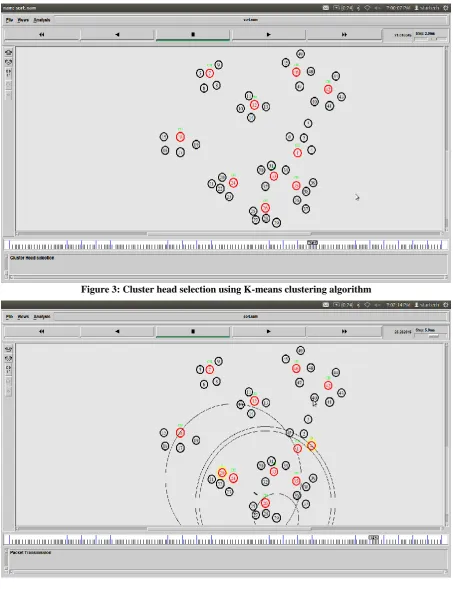
Simulation Screenshot
Figure 3: Cluster head selection using K-means clustering algorithm
Figure 5: results of delay vs. no. of nodes
Figure 7: results of pdr vs. no. of nodes
Figure 8: results of throughput vs. no. of nodes
systems because an increase in node density would imply more connections to be made and hence this extra addition will introduce some delays compared to lesser node density network. Also to note is that the reduction in delay for our proposed system has also been caused the creation of a strong virtual backbone in our proposed system.
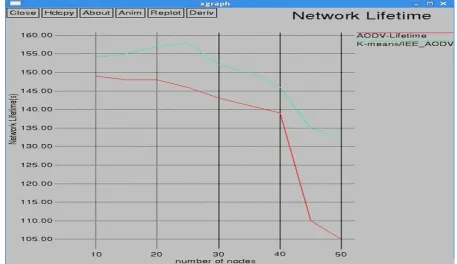
From the graph shown in figure 6 it can be noted that when there is low node density in the network the lifetime of the network is high for both the K-means/IEE_AODV and the AODV routing protocols. This is attributed to the fact that there are fewer connections for both networks when the network size is low and hence fewer energy usage is realized. There is less traffic running around the network therefore nodes will be saving power. Energy is consumed when nodes transmit or receive packets during packet transmission. It is observed the
K-means/IEE_AODV strategy has the best network lifetime for the most part of the network life compared to
AODV routing protocol for all node densities and this is so because our proposed approach select the most energy efficient path to transmit packets from the source node to the destination node. AODV’s energy consumption depreciates drastically as the node increases in the network mainly because there are more connections and hence more energy is going to be spent in making sure that packets are received by the intended destination node.
The graph in figure 7 clearly shows that the proposed system has a better edge than the AODV routing protocol. In fewer number of nodes the PDR is really high for both approaches because there are less connections in these networks therefore packet delivery is almost guaranteed. As the nodes increase it can be noted that the packet delivery ratio will decrease as well because more connections means that there will be an increase in the likelihood of packet failing to reach to their destinations. Packets are likely to drop if the multihop network size is increased. However the K-means/IEE_AODV strategy has optimized routes cutesy of the K-means algorithm and therefore its packet delivery ratio is greater than that of AODV routing protocol for the most part of the network life.
In figure 8 it can be noted that the throughput of AODV routing protocol is higher than that of the proposed system in most situations. AODV routing has consistently better values of throughput and this is caused by the fact that K-means/IEE_AODV has a lot of control packets exchange before the actual transmission of data packets. Furthermore K-means/IEE_AODV computations of drain count occurs on each and every node in the network. The calculations to determine the amount of energy each node has (residual energy) and the incrementing of drain count has to be performed on each and every node and this introduces extra overheads that will affect the network’s throughput in our proposed network. Overall it can be noted that in less dense networks the network throughput is high in all system but will drop as the number of nodes increase due to an increase in network connections. AODV has slightly higher throughput because of the extra control packets that K-means/IEE_AODV has but the difference is negligible.
VI. CONCLUSION
In this research we have implemented an improved energy efficient AODV routing (IEE_AODV) protocol with
K-means as a network optimization technique, these two techniques where chosen to address critical aspects of
mobile adhoc networks. IEE_AODV routing protocol was chosen in order to have a network which is energy efficient that is a network which is mostly likely to have a longer network lifetime by using the route that has nodes with the highest energy levels. K-means on the other hand was used to create clusters in the network and optimize them in such a way that the nodes within a cluster have shortest path to their cluster head. This optimization will ensure that the path or route chosen will achieve packet delivery in the shortest time.
It is observed from the results that the battery life of our nodes in the K-means/IEE_AODV techniques will be fully utilized because the system chooses the path with the maximum energy. Therefore it’s been proved that the amount of remaining energy of each node will be important in probabilistically determining the efficient path. This system will avoid link failures due to power issues in the network because routes chosen will have maximum energy.
We also evaluated our system using other performance metrics like packet delivery ratio, throughput, average end-to-end delay and results show that our proposed system has improved in all this regard and of particular importance is the packet delivery ratio. Some recent researches have shown that AODV routing protocol has better PDR than IEE_AODV because not all the energy efficient paths are reliable, some routes might even be longer and hence packet loss will be prone in that regard. It is however clear that the problem has been addressed in this research by the introduction of K-means algorithm. This algorithm will optimize the nodes in the network so that a minimum number of nodes are traversed if data packets are to be transmitted for the source node to the destination node.
Future work
ACKNOWLEDGEMENT
The author thanks Mr Vinod Kumar for his constant guidance, encouragement and support. His valuable guidance has provided the author with a deep insight into the topic.
REFERENCES
[1] Patil, Annapurna P., et al. "An improved energy efficient AODV routing protocol for MANETs." Wireless and Optical Communications Networks (WOCN), 2014 Eleventh International Conference on. IEEE, 2014. [2] Lijuan Cao, Teresa Dahlberg and Yu Wang, “Performance Evaluation of Energy Efficient Ad Hoc Routing Protocols”, IEEE 2007.S. Zhang, C. Zhu, J. K. O. Sin, and P. K. T. Mok, “A novel ultrathin elevated channel low-temperature poly-Si TFT,” IEEE Electron Device Lett., vol. 20, pp. 569–571, Nov. 1999. [3] C. Siva Ram Murthy, B. S. Manoj, “Ad Hoc Wireless Networks Architecture and Protocols”, 2nd ed,
Pearson Education, 2005.
[4] Ioanis Nikolaidis, Michel Barbeau, Evangelos Kranakis, “Ad-Hoc, Mobile, and Wireless Networks”, Third International Conference, ADHOC_NOW 2004.
[5] M. Pushpalatha, Revathi Venkataraman, and T. Ramarao, “Trust Based Energy Aware Reliable Reactive Protocol in Mobile Ad Hoc Networks”, World Academy of Science, Engineering and Technology 2009. [6] G.Vijaya Kumar, Y.Vasudeva Reddyr and Dr.M.Nagendra, “Current Research Work on Routing Protocols
for MANET: A Literature Survey”, (IJCSE) International Journal on Computer Science and Engineering 2010.
[7] Jin-Man Kim, Jong-Wook Jang, “AODV based Energy Efficient Routing Protocol for Maximum Lifetime in MANET”, IEEE 2006.
[8] Liu, Lili Guo,Huizhu Ma,Tao Jiang, “Energy Efficient on–demand Multipath Routing Protocol for Multi-hop Ad Hoc Networks”, IEEE 2008.
[9] Zhang Zhaoxiao, Pei Tingrui, Zeng Wenli, “Modified Energy-Aware AODV Routing for Ad hoc Networks”,IEEE 2009.