CONTINUOUS VARIATION IN LEVEL OF PARAMUTATION AT THE R LOCUS IN MAIZE1
K. S. McWHIRTER2 AN D R. ALEXANDER BRINK Department of Genetics, Uniuersity of Wisconsin, Madison, Wisconsin
Received April 2.4, 1962
XPRESSION of the standard R' allele in maize invariably is altered in the
E
direction of reduced aleurone-pigmenting effect in heterozygotes with either of the aleurone-spotting factors, stippled ( R S t ) , or marbled ( R m b ) (BRINK 1956;BRINK and WEYERS 1957). BRINK (1958) has proposed the term paramutation to describe the genetic process underlying the regularly occurring change in R* action.
The present report is concerned with paramutation of this R' gene (colored aleurone, red seedling) in heterozygotes with a series of self-colored (R8") mu- tants from stippled. The Rsc mutants, which give completely colored aleurone and green seedling, were isolated in this laboratory by ASHMAN (1960). The general result shows that there was wide variation in the level of paramutation of R' in heterozygotes with the various RsC mutants.
The different levels of paramutation were distinguished by quantitative differ- ences in the mean aleurone-pigmenting effect of the R' paramutants extracted from the several RrRgC heterozygotes. The observed levels of paramutation formed a continuous series, paramutant forms of R' ranging from a near-colorless effect to the darkly mottled phenotype characteristic of unchanged R'. Thus the R' gene has the capacity to respond to paramutagenic alleles in a wide variety of ways.
The differential paramutation of the single R' gene used in this study was a
consequence both of the specific property of the gene to undergo differential alteration and of inherent differences among the group of R8c mutants in capacity to promote paramutation of R'. Characterization of the several Rsc mutants on
the basis of paramutagenic action shows that the mutation of stippled (R") to self-colored ( R s c ) results, in a high proportion of instances, in a simultaneous alteration in the paramutagenic property associated with stippled. Coincident with the mutation of RSt to Rsc the paramutagenic property may be unchanged, quantitatively reduced, or lost entirely.
MATERIALS A N D METHODS
The experimental procedures followed were similar to those used in previous investigations on paramutation at the R locus in maize (BRINK 1960).
1 Paper from the Department of Genetics, College of Agriculture, University of Wisconsin,
2 Present address: C.S.I.R.O., Division of Tropical Pastures, Cunningham Laboratory, Mill Madison, No. 872.
Road, St. Lucia, Queensland, Australia.
1054 K. S. MCWHIRTER A N D R. A. BRINK
The various R alleles were incorporated, by backcrossing, in the uniform in- bred dent-type strain, W22. A single R' gene, long maintained in local stocks, and referred to subsequently as standard R', was used throughout these experi- ments.
The stippled allele (Rst), in W22 background, is characterized by a densely spotted aleurone, green coleoptile and colorless roots and anthers. The scutellum tissue in the embryo is characteristically colorless; or occasionally it is very lightly spotted with pigment. The self-colored mutants give complete pigmenta- tion (self-color) of the aleurone layer of the endosperm in all dosages; slight pigmentation of the coleoptile; colorless roots and anthers. The scutellum tissue in the embryo is conspicuously colored. The mutation of stippled to self-colored thus leads to phenotypic changes in aleurone, scutellum, and coleoptile pigmen- tation.
No differences in aleurone or plant color could be detected among the groups of Rsc mutants. The degree of coleoptile pigmentation of seedlings of RscRsc or R s r r g genotype is somewhat variable, but is always substantially less than that characteristic for R' and rr (red seedling) alleles. The Rsc alleles may be con- sidered as belonging, therefore, to the Rg phenotypic class in EMERSON'S (1921) terminology. They differ from typical Rg alleles in pigmentation of the coleoptile and the scutellum tissue of the embryo, and so the designation Rsc is used in this report to distinguish the mutants from Rg alleles from other sources.
All the R"" mutants from stippled were found to be nonparamutable in RsLRst heterozygotes.
The level of paramutation of Rr was determined by evaluating the R'rgrg kernels from testcrosses of the type r g r g 0 x RrRsc 8 for degree of aleurone pigmen-
tation. The W23 r g r g (colorless aleurone, green seedling) inbred strain was used
throughout as the pistillate parent in these matings. Individual kernels (R'rgrg endosperm) from the testcross ears were scored for degree of aleurone pigmen- tation by reference to a set of six standard kernels. The latter kernels were of graded pigmentation level, and defined seven classes ranging from 1 (colorless) to 6 (dark mottled) and 7 (self-colored). A random sample of 100 R'rgrg kernels was scored from each testcross ear, and a mean aleurone color score per kernel for the ear was calculated from the resulting distribution. The testcross ears were coded prior to scoring.
The Rrrgrg kernels from the W23 r g r - 9 9 x W22 RrRsc 8 matings usually could
be readily distinguished from the P ' r V kernels on the basis of degree of aleurone pigmentation. If the kernel phenotypes overlapped, the classes were separated definitively by germinating the seeds after scoring. R'rgrg kernels give seedlings with red roots, whereas RsrrYrg kernels give seedlings with green roots, with a low frequency of exceptions due to heterofertilization.
EXPERIMENTAL RESULTS
PARAMUTAGENIC ACTIVITY 1055 the respective RrRsc heterozygotes on I - s r g females. Three mutants in this group
were not used because seed from the appropriate matings was not available. The RSc mutants tested, therefore, were not selected on the basis of any prior knowl- edge of their paramutagenic action.
The R'R"" individuals testcrossed on W23 rorg pistillate parent plants were derived, in the case of each mutant, from a mating of the type Rscrg? X R'rg8, since each Rsc allele was represented at this initial stage, by a single R"rg plant grown from the original mutant kernel. A single W22 subfamily of the genotype Rrrg was employed in the preparation of these stocks. Thus it may be assumed that there was no difference in paramutability of the R' gene used from one R'R"" heterozygote to another.
The experimental material comprised testcrosses of 533 plants in 87 families representing the 83 Rsc mutants and four control families. Two families of F, RrRst heterozygotes were included. The mean aleurone color score for the R'rgrg kernels from these testcrosses provided a basis for comparison of the paramuta- genic action of each Rsc mutant with that of the parent stippled allele. The remaining control families were single ear progenies of the standard R'R' stock. These r g r g ? x RrRr8 testcrosses establish the aleurone-pigmenting effect of the
standard
R'
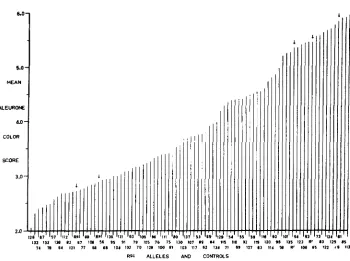
gene in unchanged form. The aleurone-pigmenting effect of the standard R' gene also was determined for testcrosses of 20 Rrrg plants. These Rrrg male testcrosses were taken at random from among the families containing RrRsc heterozygotes, since the mating used ( Rscrg? x R'rg8 ) provided both R'R"" and R'rg plants in each case.The data obtained have been summarized in the form of a diagram (Figure 1 )
,
in which the mean aleurone color scores for the R'rgi-9 kernels from the 87 test- cross families are arranged in ascending order of magnitude. The family mean score in each case is identified in Figure 1 by the pedigree number of the R"" mutant involved. (The entry for Rsc72 was inadvertently omitted in preparing Figure 1. The mean score for the R'rgr-Q testcross kernels in this instance was 2.69.)
Since 100 kernels were scored per testcross ear each family mean plotted in Figure 1 is based on 100n kernels, n being the number of plants testcrossed from the family in question. The number of RrRSc plants tested was not uniform from family to family, since the RrRSc and Rrro segregates within these families could not be identified until harvest. Only three RrRsc&I plants were testcrossed, and a further 18 Rsr mutants were characterized for paramutagenic action on the basis of testcrosses of four RrRsc plants in each family. For the remaining families the number of RrRsc plants testcrossed ranged from 5 to 11.
The numerical data upon which Figure 1 is based (on file at GENETICS Editorial Office) were examined by analysis of variance. The differences between family means were highly significant = 36.26). Duncan's new multiple range test, as modified for unequal family size (STEEL and TORRIE 1960, page 114) was used to determine the significance of differences between individual mean scores.
1056
6.0
COLOR
SCORE
I
K. S. MCWHIRTER AND R. A. BRINK
I l l 1
A
3.0
2.0
131 133 IM el 67 108 56 95 91 7<
I
75, I
9 m4
, , I
5 c
59 ~ ..
92 11
FIGURE 1.-Family mean aleurone color scores for the Rrrgrg kernels from W23 r g r g 0 X
RrRsc 8 matings, arranged in order of increasing magnitude to show the continuous variation
in level of paramutation of the standard Rr gene. Mean Rr scores for the control matings,
( R r R S t , RrRr and Rrrg plants testcrossed on W23 rgrg females) are indicated by arrows.
in effect on the pigment-producing potential of the R' gene in RrRsc heterozygotes. Moreover, the mean scores form a continuous array from near-colorless (mean
= 2.06) through a series of intermediate values, up to the high level of aleurone pigmentation characteristic of unchanged standard R'.
At the upper extreme a group of Rsc mutants may be distinguished as non- paramutagenic. This group includes 16 alleles, from Rsc58 through R"'114 in Figure 1. The mean scores obtained for testcrosses of the RrRsc heterozygotes involving these mutants do not differ significantly from the mean scores obtained for unchanged standard
R',
in testcrosses of R'R' and R'rg plants. These Rsc mutants represent instances in which the mutation of Rt to Rsr has been accom- panied by apparent loss of the paramutagenic property.Additional data, not included in Figure 1, from testcrosses of sib Rrrg males enabled a valid distinction to be made between paramutagenic and nonpara- mutagenic Rsc mutants. Testcrosses of five R'Rsc96 plants gave a mean aleurone color score of 5.01 f 0.20, and this mean was significantly lower than the mean
PARAMUTAGENIC ACTIVITY 1057 fore, a paramutagenic allele. The next highest mean score was 5.24 rt 0.10, ob- tained for testcrosses of five R'Rsc 58 plants. The latter mean is not significantly different from the mean of 5.26 2 0.03 obtained for two Rrrg sib plants. RXc58 is
classified, therefore, as nonparamutagenic.
Sixty-seven Rsc mutants from R"126 through Rsc96 in Figure 1 are shown by these data to be paramutagenic alleles. The mean aleurone color scores obtained
for testcrosses involving them range from 2.06 to 5.01 and, collectively, the data show a continuous series of levels of paramutation of the single R' gene employed in the tests. An equivalent statement, since a common Rr gene was used through- out, is that the several R8c mutants show continuous variation in level of para- mutagenic action.
The 67 paramutagenic Rsc mutants may be partitioned, somewhat arbitrarily, into three categories on the basis of the testcross results. These categories are not discontinuous groups but they serve to illustrate the general nature of the differ- ences in paramutagenic action among the Rsc mutants.
The first group comprises 36 mutants which are paramutagenic at, or near, the level characteristic of stippled. The upper limit of mean aleurone color scores set for this group is dictated by the significance test, which shows that all means greater than 3.41 are significantly higher than the mean of 2.73 obtained for testcrosses of F, R R s t plants. These mutants are strongly paramutagenic; and the mutation of stippled to self-colored has not resulted, in these instances, in detectable alteration of the paramutagenic property.
Of the 67 paramutagenic RaC mutants recognized, 31 were characterized by mean scores ranging from 3.42 to 5.01. All were paramutagenic, since the pig- ment-producing action of R' was significantly reduced in comparison with that of the standard
R'
control in each test. Furthermore, the extent of alteration in the pigment-producing action of R' was quantitatively less than that produced by stippled when similarly tested. Two groups may be recognized among these 31 RaC mutants. Sixteen mutants, characterized by mean scores in the range 4.22 to 5.01, are not significantly different from each other, and comprise a group which may be described as very weakly paramutagenic. Fifteen mutants, charac- terized by mean scores in the range 3.42 to 4.22, comprise a residual group described as weakly paramutagenic. These two groups are not discontinuous, but the interesting fact is that the 31 Rsc mutants represent instances in which the mutation of stippled to self-colored has been accompanied by a significant quanti- tative alteration of the paramutagenic property in the direction of reduced para- mutagenic action.Concomitantly with the mutation of stippled to self-colored, therefore, the paramutagenic property may be unchanged, quantitatively reduced, or lost. Fifty-seven percent of the group of 83 Rsc mutants studied differed detectably from the parent allele, RSt, in paramutagenic action.
1058 K. S. M C W H I R T E R A N D R. A. B R I N K
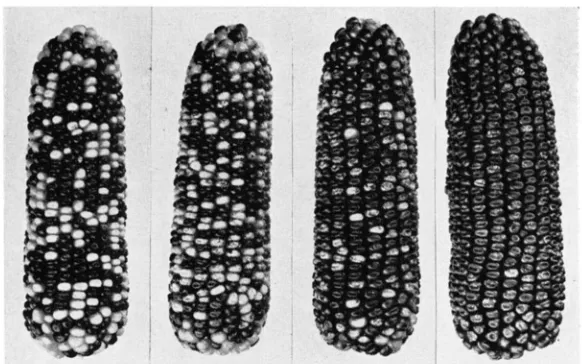
FIGURE 2.-Ears produced by testcrosses on W23 rgr7 females of four different RrRnC plants, showing different levels of paramutation of R r . From left to right, the levels of paramutation are:
ear 1 strong paramutation (RrR"C326 8 )
ear 2 weak paramutation (RrFPr69 8 ) ear 3 very weak paramutation (RrRnt99d )
ear 4 no paramutation (RrRnr83 6 ).
The R a P r g r g kernels are fully pigmented, and the R r f l r g kernels range from very lightly pig- mented (ear l ) , to dark mottled (ear 4).
order of decreasing level of paramutation (and hence in order of increasing level of aleurone pigmentation of the Rrr+g kernels) from left to right.
Coincidence of alteration in paramutagenicity with mutation of stippled to self-colored: Certain of the self-colored mutants provide evidence suggesting that, in the mutation of R S f , the alterations in aleurone phenotype and paramuta- genicity are coincident changes consequent upon a single mutational event. ASH- MAN (1960) showed that the rate of mutation of stippled to self-colored is rela-
tively high (19.9 x lo-,'). It was not surprising to find, therefore, that in the present group of 83 RRc mutants there were 15 instances in which a single parent stippled ear bore two or more independent self-colored mutants. Thirteen paren- tal ears each bore two independent mutations, and two parental ears each bore three independent mutations. Comparison of the R"" mutants derived from a common parental ear showed that in 12 of the 15 comparisons available there were differences in paramutagenic action.
This result is illustrated by the data obtained for the R"" mutants belonging to four of the 15 groups of R"" mutants with this origin (Table 1 )
.
A
particularly clear example is provided by Group 3, comprisingR""
mutants 125,126 and 127. R""125 was nonparamutagenic, R"'126 was strongly paramutagenic, and R"'127 was very weakly paramutagenic.In
this case three mutants independently de- rived from a single parental ear differed from each other in paramutagenic action.PARAMUTAGENIC ACTIVITY 1059
TABLE 1
Mean aleurone color scores of Rrrgrg kernels from the W23 rgrg 9 x RrRsC 8 matings involving R S C mutants established from a common parental ear
Pedigree number of Group R'C mutant
Number of R V R a C
dants tested Mean aleurone color score
Level of paramutagenic
action
1 64
65
2 89
90
3 125
126 127
4 130
131 132
8 7
9
7 4 7 8 4 5 1 1
2.69kO. 12 5.6120.08 3.79e0.21 4.9020.19 5.82?0.04 2.0620.05 4.5220.12 3.61e0.26 3. WeO.28 2.3320.08
Strong Nonparamutagenic
Weak Very weak Nonparamutagenic
Strong Very weak
Weak Strong Strong
action among the R8" mutants reflect prior differences between parental stippled plants in paramutagenic action. If the latter condition obtained then all RaC mutants from a single parental ear would be expected to exhibit the same level of paramutagenic action. The alteration in level of paramutagenic action, or loss of paramutagenicity, observed for a majority of the RSc mutants studied must have occurred coincidentally with the mutation of stippled to self-colored. It appears, therefore, that alteration in aleurone phenotype and paramutagenicity are consequences of a single mutational event.
Innate variability of paramutation in R'R"" heterozygotes: Most €Pc mutants proved to be relatively uniform in paramutagenic action from plant to plant. Five of the 83 mutants tested, however, regularly exhibited high variability among sibs in the progenies derived from matings which precluded undetected cross contamination with other Rsc mutants. These mutants were R 9 3 , R"c84, R s c l l l , RSc117, and Rsc120.
Data showing the variable paramutagenic action of RSc mutants 53, 111, and
117 are entered in Table 2; and the high variability characteristic of R"111 is illustrated in Figure 3 by representative testcross ears, whose mean aleurone color scores were 3.84, 4.13 and 5.12, obtained by testcrossing three sib R'R"111 plants on W23 rgrg females.
The high variability within families was not a general characteristic, however, of very weakly, and weakly paramutagenic RSc mutants. As shown in Table 2,
other families within these classes, 820 (R'R"99) and 994 (R'R*"9), for ex- ample, gave relatively uniform scores from plant to plant.
The R'rgrg kernels from testcrosses on rgrg females of either standard R'R' or
1060 K. S. MCWHIRTER A N D R . A. BRINK
TABLE 2
Frequency distributions and mean aleurone color scores for the Rrrgrg kernels from testcrosses on W 2 3 rgrg females of W 2 2 RrRsC plants
Aleurone color classes
Staminate Parent - Mean Type of
plantno. genotype 1 2 3 4 5 F 7 score R s a mutant
831-1
-4
-7 -13
-1 7 994-12 -28 -30 -42 -48 820-3 -4 -6 -8
-1 3 813-4
-5 -12 -13 -1 6 63 7 4 -5 -6 -1 1
-1 7
793-2 -3 -9
-1 0 -12 698-1
-5 -8 -1 1
-1 6
RrRsC126 3
RTRsC6Y 3
1
RrRsCYY
RrRse83
R'RIC53 1
RrRSCf 11
1
RrRsC117 . .
2 1 91 76 81 90 90 7 2 2 4 1 3 18 46 2 3 39 1 25 5 6 1 16 19 7 24 18 10 10 61 31 35 37 42 3 6 41 43 48 30 21 4 52 19 54 33 41 9 33 10 60 1 1 23 59 50 46 41 23 21 30 44 26 1 21 6 44 55 9 9 8 67 21 36 37 17 28 40 16 6 8 13 13 15 70 77 54 12 68 19 14 2a 19 66 17 22 20 73 58 13 25 16 51 17 48 4 4 2 10 6 81 86
70 2
81 33 2 1 18 29 1 22 4 2 2.08 2.24 2.20 2.10 2.10 3.22 3.73 3.74 3.68 3.68 4.75 4.81 4.68 3.65 4.80 5.81 5.86 5.74 5.81 5.32 3.35 2.60 3.92 3.95 5.09 5.12 2.67 3.92 2.96 3.84 3.63 4.84 3.54 4.42 3.03 Strrongly paramutagenic Weakly pa ramut agenic
Very weakly paramutagenic Non- paramutagenic Weak and variable in paramutagenic action Weak and variable in paramutagenic action Weak and variable in paramutagenic action
hand, characteristically gave a wide spectrum of R'rQr-0 phenotypes on each test- cross ear even though the mean scores differed little from ear to ear. Examples of such Rsc mutants are R""69 and Rsc99, as the data for families 994 and 820 in Table 2 show. An extreme case is the distribution from plant 698-8 (R'RsC"17) in Table 2 in which six classes, in terms of aleurone pigmentation, are repre- sented on a single testcross ear.
PARAMUTAGENIC A C T I V I TY 1061
FIGURE ?.-Ears proclucrtl by testcrosses on W23 rqrg femalos of R r R s r l l l sib plants (family
Mc793). illustrating the weak and variable paramutagenic action of the R X P l l l mutant. The
Rxrrf'rfl kernels are fully pigmented, and the Rrrgrfl kernels range from light to dark mottled. The phenotype of the Rrrr'ru kernels reflects differences between the three sib plants in level of
paramutation.
TABLE 3
Frequrnc?. distributions and mean aleurone color scores for the Rrr+r+ kernels from testcrosses on W23 r'rg females of R r R S ' and R r R r plants. Control matings for
comparison with the data in Table 2
Aleiironr w l ~ i r
- Mean
> % .& 4 (i i score
StaiiBiniik I'iirriit
plilrlt t i t # . grrioLyru- I
783-1 -2 -3 -4 -5 803-2 -3 -5 -7 -10
RrRX' 90 10
15 63 20 2 76 24
68 32 83 1 7
R rR r 14 86
9 91
8 92 9 91 28 72
2.10 3.09 2.24 2.32 2.17 5.86 5.91 5.92 5.91 5.72
In the first experiment
R e
mutants distributed over all the levels of para- mutagenic action disclosed by the initial test were again made heterozygous with standard R". and then were retested for paramutagenic action. The R'R"' prog- enies involved in the second test were derived from either the mating RnrrgO x RrRrd or R"rrP x R r R r 6 . The RRr+ and R r r r pistillate parent plants used were from backcross sublines of theR"'
mutants, developed from the original R s r r g P X1062 K . S. MCWHIRTER A N D R. A. B R I N K
The results of the two series of tests are compared with each other in Figure 4. I n interpreting the data allowance should be made for seasonal effects and level of incorporation in W22 inbred background, as well as possible changes in para- mutagenic action of the Rsc mutant tested.
The correlation diagram (Figure 4) shows, however, that there was close correspondence between the results of the two independent tests. Seemingly the extraneous factors mentioned had little influence on level of paramutation. There are minor differences, however, between the results of the two tests, the most significant being with respect to Rsc73. This mutant was initially classified as nonparamutagenic, but in the second test it yielded a mean score for five RrRsc73 plants of 4.83
*
0.06, which was significantly lower than the mean of 5.38 2 0.106.0
e' U) p5.0
n
z
0
U
w U)
4.0
ou
U)
a
2
Uw
2
0
a
4
z
4
w
I
3.0
2 . 0 I I I
30 4.0 1 0 f
MEAN ALEURONE COLOR SCORE. INITIAL TEST.
0
FIGURE 4.-Correlation diagram relating the mean aleurone color scores obtained for the R'rgrg kernels from WW r g r g 0 x R r R s c $ matings in two independent tests of the para- mutagenic action of R s c mutants. The numbers at each of the experimental points identify the
PARAMUTAGENIC ACTIVITY 1063
obtained for testcrosses of five Rrrr sib plants. Rsc73, therefore, may be very weakly paramutagenic, rather than nonparamutagenic as first concluded. Minor differences are apparent also with certain other Rsc mutants (e.g., R"126 and R"69) but, in general, results of the second test do not significantly alter the classification initially arrived at.
It is noteworthy that the difference in aleurone color score between the weakly paramutagenic and very weakly paramutagenic groups of Rsc mutants was observed in both tests. Rsc mutants 69, 76,111 and 128 (weakly paramutagenic) and Rsc mutants 63, 99, 110, 129 and 134 (very weakly paramutagenic) form nonoverlapping and significantly different groups in the second test, and both groups gave significantly higher mean scores than the F, RrRst control. The general significance of this fact, and of the data in the correlation diagram as a whole, is that the seriation of Rsc mutants on the basis of paramutagenic action is remarkably similar in the two tests. The results show unequivocally that there are innate differences among the Rsc mutants in level of paramutagenic action. All 16 members of the nonparamutagenic group of Rsc mutants were included in both tests. Each, with the exception of Rsc73, was again found to be non- paramutagenic in the second test. The numerical scores for five of these Rsc mutants are included in Figure 4; the remainder were evaluated by visual examination of the intact testcross ears.
The second experiment had the dual objectives of examining the reproducibility of paramutagenic action and of determining whether paramutagenic action of the mutants was depleted by maintaining the latter in heterozygotes with R'. The progenies testcrossed were obtained by backcrossing R'Rsc F, plants with R'R' or Rg5 rr male parents. Rg5 is a colored aleurone, green plant-color mutant derived from standard R', and is closely comparable to standard R' in aleurone- pigmenting action and paramutability ( BRINK, BROWN, KERMICLE and WEYERS 1960). Remnant seed from the ear which produced the RrRsc F, progenies and seeds from the various backcross matings were grown out, and the resulting plants were then testcrossed on W23 r g r g pistillate parent plants. The Rsc
mutants tested in this experiment were R"99 (very weakly paramutagenic), R"126 and R"132 (strongly paramutagenic), and RSc111 (weak and variable in paramutagenic action). The results are given in Table
4.
The data for each of the four groups of progenies were examined by analysis of variance; and the Fvalue was found to be nonsignificant in each case. Thus it was again observed that a particular level of paramutation is a specific and reproducible property of a given RrRsc (or Rg5 R s c ) heterozygote. Moreover, the property of paramuta- genicity, even though it may initially be very weak ( R s c 9 9 ) , was found not to be depleted by virtue of maintenance of the RrRsc ( RgRsc) heterozygous condition for two generations.
The R"111 mutant was previously cited as weak and variable in paramuta- genic action (see Figure 3). Families Mc797 and Mc798 in Table 4 formed part
1064 K. S. MCWHIRTER A N D R. A. BRINK TABLE 4
Mean aleurone color scores for the Rrrgrg and R W r g kernels from the matings W23 rgfi0 X
RrRSC 8 and W23 r g r g 0 x RgRSC 8 involved in tests for depletion of parmutagenic action
-
Staminate parent
Family no. Genotype Derived from mating:
Mc767 Rr Rae99 F, Rsc99 rQ 0 x RrRr8
Mc751 RQ5 RsC99 RrRsc99 F, 0 x RQ5 rr 8
Mc769 Rr RSC99 RrRsc99 F, 9 x RrRr 8
Mc770 R r RsC99 RrRsc99 F, 0 x RTRr 8
Mc771 Rr RSc126 F, Rsc126 r r 0 X RrRr 8
Mc773 Rr RSY26 RrRsC126 F, 0 X RrRr 8
Mc746 R95 R s c i 26
Mc774 Rr RSC132 F, Rs'132 r r 9 x RrRr 8
Mc775 RQ5 RsC132
Mc776 R* Rscf 32 RrRSC132 F, 0 x RrRr 8
Mc796 Rr R s C I I i F, R s C l l l rr 0 x RrRr 8
Mc797 RQ5 R~CCIII RrRsCill F, 0 x RQ5 r r 8
Mc798 RQ5 RScllI RrRsClll F, 9 x RQ5 rr 8
RrRsci 26 F, 0 x RQ5 r' 8 RrRsci 32 F, P x RQ5 rr 8
No. of
plants tested mean score Family
8
5
8 8
6
8 8 8 8 8
6
10 10
4.66-CO.06 4.60.0.22 4.83C0.06 4.78.0.05 2.96k0.18 2.79-CO.22
2.48 -C 0.08
2.56k0.07 2.9520.12
2.75 f 0.1 7
3.46-CO.20
3.26.0. 18
3.3820.19
W23 rQrQ0 x R r R c l l l 8 testcross ears with mean aleurone color scores of 2.99 and 4.41, respectively. That this form of selection was ineffective in altering the level of paramutation is shown by the fact that the mean aleurone color scores in the resulting Rg5Rsc111 progenies were 3.26 f 0.18 and 3.38
*
0.19, re- spectively. Both families, Mc797 and Mc798, exhibited wide variability between sib plants in level of paramutation, as in the parent family also. Five other progenies, of RrRcI1I genotype, showed similar variability between sib plants within families. This evidence leads to the conclusion that a weak and variable paramutagenic action is a n inherent property of the Rc111 mutant.Since testcrosses using pollen from different tassel branches of the same plant occasionally give unlike results, BRINK (1960) suggested that some RrRsc plants are chimeras, in which paramutation had proceeded to varying levels in different parts of the staminate inflorescence. H. B. COOPER, JR. demonstrated that certain RrRsc117 plants (see Table 2) were chimeras of the anticipated kind. (See
PARAMUTAGENIC ACTIVITY 1065 testcrosses of RrRsc heterozygotes, are not a consequence of prior differences in the paramutability of Rr.
Rr:sC/RSt plants in which Rr:"" was derived directly from an RrRsc heterozygote were testcrossed on W23 r g r g females. Rr:sc alleles from RrRsc heterozygotes
involving weakly, very weakly, and nonparamutagenic Rsc mutants, were repre- sented. The data obtained are reported in Table 5. Also included in Table 5 are
TlLBLE 5
Mean aleurone color scores for the R r : s c r g r g and Rrrgrg kernels from testcrosses on W2? rgrg females of W22 Rr:Sc/RSt, RrRsc, Rr:Sc/rg, Rrr and RrRst plants, demonstrating
the uniform paramutability of Rr:sc alleles
Mc233 Mc233 Mc234 Mc234 Mc398 Mc399 Mc399 Mc390 Mc390 Mc426 1-24 Mc210 Mc239 Mc24Q Mc200* McU)O* Mc780t Mc781t Mc204* Mc204* Mc782f Mc793f ~ ~~ ~
Staminate parent No. of
plants Mean Si nificance
Family no. Genotype Derived from mating: tested score of %iRerences
A. Rsc99-very weakly paramutagenic'
RrRSC99 F, P X Rstrg 6 6 3.24
6 4.94
Rsc99 rg 0 x Rrrg 8 7 4.33
8 5.54
B. RSCll0-very weakly paramutagenic*
RrRScllO F, 0 X RStrg 6 4 3.16
R s c l l O r g 9 x RrRr 6 7 4.74
6 5.72
C. Rsc89-weakly paramutagenic'
RrRsc89 0 x Rstrg 6 5 3.01
4 4.79
RrRsC128 0 x Rstrg 6 5 2.29
Rae128 r r Q x RrRr 8 4 3.40
RrRsC106 0 x R s t r g 6
RrR8clO6 0 x RrRr 6
RrRsC106 0 X RstrV 8 3 5.54
D. R8c128-weakly paramutagenic*
E. RsCl06--nonparamutagenic*
E1
6
5
F. R~c65-nonparamutagenic
R*C65 rr P x RrRr 8 4 5.96
4 5.861
RrRSc65 F, 9 x RStRSf 6 8 2.85
R r r r Q x RStRst 6 8 2.981
G. RscS?-nonparamutageniic
5 4
10 10
;::1
Rsc83 rr 0 x RrRr 8
2.59
RrRsC83 F, 0 x RstRSt 8
Rrrr 9 x RSfRSt 8
All differences significant at one percent level3
All differences significant at one percent level$
Significant at one percent level
t', = 8.04
Significant at
one percent level
t', = 5.85
Difference significant at one percent level
t', = 7.7
Difference significant at five percent level
Difference not significant
t,, = 0.78
t, = 3.7
Difference not significant
Difference significant at one Dercent level
t, = 0.9
J
t.
-
= 3.90* 1959 data.
t 1960 data.
1066 K . S. MCWHIRTER A N D R. A. BRINK
the results of testcrosses of (1 ) RrRsc plants which serve to establish the level of the initial alteration in R' phenotypic effect, ( 2 ) Rr.sc/rg plants, showing the level of phenotypic effect of the paramutant Rr'Ac alleles and ( 3 ) R'r plants which provide for a comparison with the pigment-producing action of unchanged standard Rr.
The data in Table 5 show that the Rr;sc alleles extracted from the heterozygotes R7Rsc65, RrRsc83, R'Rsc106, RrRsc99, RrRsc89, R'Rscl10 and R'RSc1228, were reduced to a fairly uniform, low level of pigment-producing action by subsequent passage through a heterozygote with R S t . Initially, in the RrRsc heterozygotes, R' was either not altered, or was only slightly reduced, in pigment-producing action. Thus the initial differential behavior of R' in various RrRsc heterozygotes was not reflected by differences in the paramutability of the R'"' alleles in R""/ RSt descendants. Since there were no differences in paramutability these data show that paramutation of R' in a given instance is not necessarily terminal, in the sense that weak paramutation does not preclude a strongly paramutagenic allele such as stippled from subsequently further reducing the pigment-producing potential of R' in an R r : g C / R S t heterozygote. A direct comparison of the paramu- tability of R':sc alleles extracted from nonparamutagenic RrRsc heterozygotes with standard Rr is provided by the data in sections F and G of Table 5. R'R""65 and Rrrr sibs, and also R'R"'83 and R'r' sibs, were crossed with RstRst plants from a common subfamily. The respective R' s r / R 9 t and RrRSt progenies were then testcrossed on W23 rgrg females. It is apparent from the results that there was no paramutation of R' in either of the R'RSc heterozygotes. Testcrosses of R r : 3 C / R S t plants, however, showed that R':sc in both instances was sensitive to paramutation. Rr'sc and R' (control) were equally paramutable in the case of Rr'8c extracted from an RrRsc65 plant.
The result entered i n section G in Table 5 with Rr.s" extracted from an R'Rsc83 plant is noteworthy in that the highly significant difference between the scores for testcrosses of R T ' S C / R S t and RrRst plants suggests that the paramuta- bility of R' sqc was slightly reduced by virtue of prior association of R' with the
nonparamutagenic Rsc83 mutant. Reproducibility of this result, however, has not been tested. The only clearly established fact is that R' sc extracted from the nonparamutagenic RrRsc83 heterozygote was paramutable to a high degree. Re- duced paramutability was clearly not characteristic of all R'.sc alleles extracted from P R Y " heterozygotes involving nonparamutagenic Rsc mutants, as the data in Table 5 for R' s c alleles extracted from RR"65, and R'R""lO6 heterozygotes show. Moreover, there was no suggestion of reduced paramutability of Rr:sc alleles extracted from heterozygotes with eight additional nonparamutagenic R"" mutants similarly tested, but not scored in detail. Without direct, confirma- tory data, therefore, it cannot safely be concluded that the Rsc83 mutant tends to make R' somewhat refractory to paramutation in RrRsc heterozygotes.
T h e heritable nature of paramutation in RrRsc heterozygotes: Transmission through subsequent sporophytes of the changes in Rr arising in W R S t and R'Rmb heterozygotes has been well established earlier (BRINK 1958, 1960; BRINK and
P A R A M U T A G E N I C ACTIVITY 1067
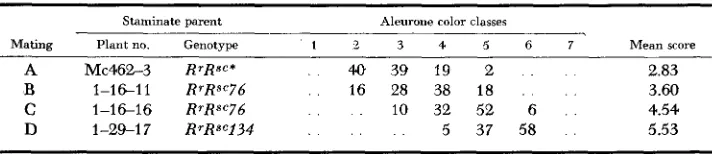
made to determine whether (1) paramutation in these cases was similarly heritable, and (2) the considerable diversity of R'rgl-9 kernel phenotypes observed in individual rgrg? x RrRsc 8 matings persisted through the next following sporo- phyte generation.
The tests were based on the progeny from four ears resulting from different
W22 r V P
x
W22 RrRsc 8 matings. That is, both parents in the first testcross were W22 inbred strains. The distributions and mean scores obtained for the R'rgrg kernels from these matings are given in Table 6. Kernels from the several color classes in each mating subsequently were grown out, and samples of the resulting group of R':""/rg plants were then testcrossed on W23 rgrg females for evaluation of the pigment-producing action of the respective Rr:sc alleles in the second generation. The data obtained from scoring the Rr:sc/rgrg kernels from the latter W23 rgrQ ? X Rr:sc/l-8 8 testcrosses are entered in Table 7.A complicating factor in interpreting the results is the partial reversion of a paramutant allele toward the standard R' level of pigment-producing action that occurs after the first testcross generation, provided Rr:sc is heterozygous with a nonparamutagenic R allele. This phenomenon, which is an established feature of Rr:St and Rr:mb paramutants (BRINK 1958) is in evidence with R':"" paramutants also, and leads to more overlapping of phenotypes in the second than in the first, testcross genera tion.
The results in Table 7 show that the changes in R' pigment-producing action arising in RrRsc heterozygotes, like those in RTRst plants, persist in some degree through the immediately following sporophytic generation. Ten R'rg control plants, derived from the mating W22 l-8rg9 x R'R'8
,
used in testcrosses on W23rgrQ females gave a mean aleurone color score of 5.91 2 0.03 (Table 7). All the
Rr:8C/rQ progenies gave values significantly lower that this figure when the data were tested by Dunnett's procedure, with adjustment for unequal family size (STEEL and TORRIE 1960, page 114). Thus, in the case of the initial matings on
W22 rgrg females, disclosing weak or very weak levels of paramutation all, or nearly all, of the Rr:sc alleles involved reacted in the W23 rQrg? X Rr:sc/rg8
testcrosses as paramutants. The data are not sufficiently extensive to prove, however, that paramutation invariably occurs in all such instances.
TABLE 6
Distributions of Rrrgrg kernels in aleurone color classes and mean aleurone color scores for four W22 rgy% 0 x W22 RpRSC 8 matings
Staminate parent Aleurone color classes
Mating Plant no. Genotype 1 2 3 4 5 6 7 Mean score
A Mc462-3 RrRsc* 4.0. 39 19 2 2.83
B 1-16-11 RrRSC76 16 28 38 18 3.60
C 1-16-16 RrRsC76 10 32 52 6 4.54
D 1-2%17 RrRSCI34 5 37 58 5.53
1068 K . S. MCWHIRTER A N D R. A. BRINK
TABLE 7
Mean aleurone color scores for the Rlrsrg kernels from t-ustcrosses on W23 r g r g females of Rr'scrZ
plants derived from the W22 r g r g 0 x RrRsc 8 matings described in Table 5, and
Rrrg plants (control) deriued from the mating W22 r g r g ? X RrRr 8
R r : 8 C p 7
staminate parents derived froni mating
Aleurone color class of parental R'':*Cror! keniels
> 3 4 3 F
No. plants tested 6
Mean score 3.54
Significance test* 20.32
(five percent level)
No. plants tested 8
Mean score 3 80
Significance test' e0.14
(one percent level)
No. plants tested
Mean score Significance test'
(five percent level)
No. plants tested Mean scosre Significance test
No. plants tested
6 6
4.55 4.44
20.20 20.14
8 8 8
4.35 4.94 4.97
20.14 e0.08 0.04.
5 5 5
4.49 4.5 1 4.74
k0.15 20.32 20.17
4
5.10 e0.08
10
4.87 20.11 t,s = 2.55 P 0.05
10
5.22
20.08
10
E (control) Mean score 5.91?0.03+
* Means undersroi-ed are not signifirantly different by Duncan's multiple range test.
-I- All R r : b c r o progeny mean scores were significantly lower than the control by Dunnctt's procedure
Comparison of groups of R' s c / r g sib plants within the progeny of individual
W22 rgrg? xR'R" 8 matings shows that in three of the four sets of data in Table 7
there were significant differences between groups. The mean scores for the group of Rr.s(/rg progeny are in the same relation as the aleurone phenotypes of the parental R'rQrg kernels. T h i s result shows that the R' sc alleles from an individual
W22 rqrg? x RrRsc 8 mating are not homogenous with respect to pigment-produc- ing action Thus at least part of the diversity of phenotypes of R'rgrg kernels in the W22 rQrg9 xR'R""8 matings was due to differential alteration of R' in each of the respective RTRsc male plants.
Comparison of the data from the coordinate matings A to D in Tables 6 and 7
shows that the differences in level of
RT
paramutation observed when RrRsc plants carrying particular R" mutant alleles are directly testcrossed on r g r gfemales are also detectable when the R' sc/rg progeny possessing the respective
PARAMUTAGENIC ACTIVITY 1069
disclosing different levels of paramutation than are direct tests of the respective RrRsc heterozygotes.
DISCUSSION
The most significant observation in the present studies is that the
R'
allele, in heterozygotes with a series of self-colored mutants from stippled, gives rise to paramutant forms varying continuously over a wide range in level of pigment- producing action. This variation in the single R' gene under test was primarily disclosed by quantitative differences in aleurone-pigmenting effect between the R' paramutants extracted from different RrRsc heterozygotes. The variation clearly relates to the degree to which R' aleurone color expression is altered, and not to the frequency with which a given single kind of change OCCUTS. This is evident from the distributions of kernels according to aleurone phenotype re- corded in Table 2.The differences in level of paramutation of R' in the various
R R s c
heterozy- gotes, likewise, were found to be gametically transmissible. This is shown by the data in Table4
and Figure 4, and by the data in Table 2, which demonstrate that RrZsc alleles extracted from RrRsc heterozygotes were heritably altered in pig- ment-producing potential to varying degrees. Moreover, the differential behavior of R' in the various RrRSc heterozygotes was not due to inherent initial differences in paramutability of Rr (Table 5 ) .Thus the evidence shows that the Rr allele has the capacity to respond to para- mutagenic factors in a wide variety of ways. A corollary of this result is that the R8c mutants in question vary continuously in paramutagenic action.
BRINK, BROWN, KERMICLE and WEYERS (1960) inferred that when paramuta- tion occurs a chromosome component affecting Rr expression located at, or near, the Rr locus is altered. The present studies show that the alteration is not of an all-or-none kind, but can vary continuously in magnitude. The degree of altera- tion that occurs in a given case is a specific reflection of the level of para- mutagenic action characteristic of the particular Rsc mutant with which
Rr
is associated in an RrRSc heterozygote.Paramutation of Rr to some intermediate level of pigment-producing action does not alter the sensitivity of R' to further heritable change in the direction of reduced pigment-producing potential. This fact is evident from the data in Table 5 , which show that weakly paramutant Rr:sc alleles, extracted from various RrRsc heterozygotes, were rather uniformly reduced to a low level of pigment- producing action when subsequently tested in heterozygotes with the strongly paramutagenic stippled factor. Maintenance of Rr heterozygous with a single Rsc mutant through successive generations similarly has been found to result in an increase in the degree of alteration of R' ( MCWHIRTER 1961 )
.
The latter experi- ments, in which testcrosses of F,, F,, and F, R'RSc heterozygotes were examined, showed that maintenance of the R' allele heterozygous with Rsc99 (very weakly paramutagenic) for three sporophytic generations led ultimately to a level of paramutation approximately equal to that observed after one generation of1070 K . S. M C W H I R T E R A N D R. A. BRINK
of F, RrRSr69 heterozygotes showed a level of paramutation of R' about equivalent to that produced by F, R'Rsc126 plants, R"126 being a strongly paramutagenic allele. These results suggest that the paramutagenic action on R' of different R"" mutants derived from R S t is qualitatively the same, and that the differences be- tween them is in the rate at which a common kind of change in R' is produced. Since paramutation occurs in vegetative tissues (BRINK 1960; MCWHIRTER 1961) this may mean that the differences between R'" mutants in net para- mutagenic action in RrRsc plants is referable to differences in the extent of altera- tion of R' that occurs in each somatic cell generation. It is also possible that all paramutagenic Rac mutants, and R S t , produce the same degree of alteration in R' per somatic cell generation, and that the differences are referable to the number of somatic cell generations in which the paramutagenic component is active in a
given case. The effects are averaged, however, over an entire sporophytic genera- tion by the restriction that only the male inflorescence at the apex of the mature plant may be sampled in measuring the progress of the alteration in R'. Neither the materials nor the techniques are available at present, however, for ascertain- ing the course of R paramutation during vegetative development of the plant, SO that such a possibility cannot be examined in detail.
The 83 R'" mutants studied for paramutagenic action were derived from the uniformly highly paramutagenic stippled allele. Comparison of the Rsc mutants with stippled shows that coincidentally with the mutation of stippled to self- colored the paramutagenic property associated with stippled may be unchanged, quantitatively reduced, or lost entirely. Mutation of RSt to Rsc without apparent alteration in the paramutagenic property shows that paramutagenicity is sepa- rable from the stippled phenotype at the R locus. Paramutagenicity at a high level may be associated with an unstable R allele (stippled) or a stable one (self- colored). A S H M A N ' S (1960) derivation of paramutagenic rg and r' mutants from
RrRat plants earlier provided evidence of separability of paramutagenicity from the colored aleurone phenotype.
A significant fact of additional interest evident in the present data is that in a high proportion of instances, mutation of R s t to Rsc was accompanied by alteration of the paramutagenic property. A detectable reduction, or apparent loss, of para- mutagenicity was found for 57 percent of the group of 83 RsC mutants studied. The coincidence of alterations also appeared to be a consequence of a single mutational event (Table 1 ) . The possibility that alteration in paramutagenicity may occur subsequently to the mutation of stippled to self-colored is discounted by the evidence that paramutagenicity of Rar mutants was not depleted by suc- cessive passages through heterozygotes with R9 or Rg (Table 4 ) .
PARAMUTAGENIC ACTIVITY 1071 following R"KlO/rg? x rrrr8 matings, all of which proved to be noncrossovers, RSCKIO/rr. Significantly, three of the R"KI0 mutants (of four tested) proved to have reduced paramutagenic action as compared with the parent RstKIO stock. Attempts have been made also to separate paramutagenicity from the stippled allele by crossing-over in the regions proximal and distal to R in the absence of
mutation of stippled. These attempts, which involved recovering several hundred crossovers between RSt and the outside markers, and subsequently testing them for paramutagenic action, have been unsuccessful. The possibility was not ex- cluded, however, that paramutagenicity and the aleurone spotting pattern charac- teristic of stippled sometimes may be partially separated by crossing-over in the K region (H. B. COOPER, JR., and R. A. BRINK, unpublished). However this may be, it is clear from the present evidence that paramutagenicity of the RSt allele, and of Rsc mutants from RSt, is intimately associated with the R locus, and may vary independently of detectable crossing-over in that region.
The coincident alterations in aleurone pigmentation and paramutagenicity can be formally explained in terms of a transposable, nonspecific inhibitor as- sumed to be a regular component of the stippled allele. It might be supposed that stippled consists of an Rg gene (self-colored aleurone, green seedling) in conjunc- tion with an inhibitor,
ZR,
that suppresses Rg pigment-producing action. Mutation of Rst to RsC, on this hypothesis, arises by transposition ofZR
from RSt to one or another site elsewhere in the genome, thus permitting full color expression of the Rg gene. ASHMAN (1960) reported that gametically transmissible mutations of Rst to RSt occurred at the rates of 17.0 x in two different experiments. The densely spotted aleurone pattern characteristic of stippled endosperm is assumed to reflect a high frequency of transpositions ofZR
in this tissue. Except in the endosperm, however, the postulatedZR
factor transposes in- frequently, although at a rate still within the known range of other elements ofthis kind in maize (BRINK 1954; MCCLINTOCK 1961 )
.
Paramutagenicity of an R S t chromosome may be assumed to depend upon an element distinct from, but very closely linked with, the Rg component of stippled. The paramutaqenic element is unaffected by
ZR
in an Rst chromosome, and so is fully active. When, however,ZR
transposes from R S t , the new chromosome site at which it is inserted in many instances may be that of the paramutagenic element. In such a caseZR
may be supposed to act as a suppressor, not of aleurone color, but of paramutagenicity.A precedent for the postulate of short-distance transpositions of
ZR
is afforded by Modulator ( M p ) in variegated pericarp of maize. VAN SCHAIK and BRINK(1959) found that of 83 independently occurring M p transpositions from the P locus, 25 were to points within approximately one crossover unit of the initial position.
Three general classes of consequences may be visualized with reference to suppression of paramutagenicity after
ZR
transposes from Rst to give the self- colored ( R s c ) aleurone phenotype. (1) The new site ofZR
is distinct from that of the chromosomal component concerned with paramutagenicity. Paramuta- genicity is then unaltered by the mutation of RSt to R"". Thirty-six of the1072 K. S. MCWHIRTER A N D R. A. BRINK
83 RRc mutants tested in the present study would be in this category. (2) The new site of Z R is either adjacent to, or so close to, that of the paramuta- genic factor, that the action of the latter in RrRsc heterozygotes is completely suppressed. This consequence of the transposition of Z R would be represented by the group of nonparamutagenic mutants, comprising 16 of the Rsc alleles. ( 3 ) Transposition of Z R is to sites adjacent to that of the paramutagenic com- ponent, but with a different consequence to that occurring in ( 2 ) , such that partial expression of paramutagenicity occurs in W R s c heterozygotes. Z R may either form a stable association with the paramutagenic factor, resulting in partial suppression of paramutagenicity, or the association of Z R with the para- mutagenic factor may be unstable. In the latter event, partial suppression of paramutagenicity would be the apparent result, since paramutation would occur only in cell lineages in which retransposition of Z R restores full expression of paramutagenicity. The 31 Rsc mutants of weak and very weak paramutagenic action belong in this category.
The properties attributed to the postulated transposable element, Z R , arid the subsequent interpretation of the variation in paramutagenic acion of different
R c
mutants from Rat is reasonable by analogy with the known properties of other transposable factors in maize (MCCLINTOCK 1956, 1961 ; BRINK 1960; PETERSON
1961). Direct evidence validating it in the case of stippled, however, is lacking. A present handicap in testing the hypothesis is that no criterion, other than paramutation itself, has been found whereby the putative transposable
ZR
factor is recognizable except when situated at the R locus.The hypothesis leads, however, to certain predictions. By analogy with the behavior of Modulator in variegated pericarp ( ORTON 1960) it would be expected that stippled would be reconstituted occasionally in Rsc plants by transposition of Z R back to the position characteristic of stippled. MCWHIRTER (1961) has tested this possibility on a rather large scale, but with essentially negative results. None of the 17 mutants from 1,138,569 R x c gametes tested gave the stippled phenotype, although certain of them phenotypically resembled the near-colorless mutants (ASHMAN 1960) which have been obtained directly from stippled plants. Addi- tionally, it might be expected that coincident alteration of a stable marker gene and of stippled might occur occasionally if a suitable marker was situated close to R". No such marker is at present available, but a useful test system might be synthesized by the use of a reciprocal translocation. Finally, it may be possible to duplicate the present results by means of first obtaining a transposition of M p from the variegated pericarp locus to the Rg component of an Rsr mutant of strong paramutagenic action. In the meantime, however, the chromosomal basis of the coincidence in alterations of aleurone phenotype and paramutagenicity remains unknown.
S U M M A R Y
PARAMUTAGENIC ACTIVITY 1073 heterozygotes (all containing standard R': colored aleurone, red seedling) on rgrg females (colorless aleurone, green seedling).
The Rsc mutants were found to vary continuously in level of paramutagenic action from high levels not significantly different from that of the parent Rst factor (strongly paramutagenic) to no detectable effect on the pigment-producing action of R" (nonparamutagenic)
.
There were 16 mutants of the latter class, and36 of the former. Each of the remaining 31 Rae alleles was paramutagenically active at one or another intermediate level. The level of paramutation for a given RrRsc combination was highly reproducible, and was not altered when the Rsc allele was maintained in heterozygous condition by successive backcrosses to R'R' or Rg5 r" plants.
The results show that the aleurone pigment-producing potential of standard R' may be reduced to any one of a graded series of levels, each of which is then gametically transmissible.
The pigment-producing potential of Rr is reduced i n two steps when the allele is first passed through a heterozygote carrying a weakly paramutagenic Rsc mutant and then through a heterozygote with the strongly active RSt factor.
The occasional occurrence on single ears from RStRSt 0 x f r " 8 matings of two or more independent self-colored mutants from stippled that are subsequently found to differ significantly in level of paramutagenic action suggests that change in aleurone pigmentation and paramutagenicity are coincident events. Crossing-over in the vicinity of the R locus as the basis of the coincident changes was excluded.
The simultaneous alteration in aleurone pigmentation and paramutagenicity in mutation of Rst to R e may be formally interpreted in terms of transposition of an assumed component of the stippled allele that inhibits aleurone color when in one position and paramutagenic action in variable degree when at one or another particular site nearby. An attempt to verify this hypothesis by screening more than a million gametes from RscRsc plants for back mutations to stippled (i.e., transpositions of the assumed inhibitor from its new site back to old position) gave a negative result. Seventeen mutations of R y e were observed, but none condi- tioned the stippled phenotype.
ACKNOWLEDGMENTS
1074 K. S. M C WHIRTER AND R. A. B R I N K
LITERATURE CITED
ASHMAN, R. B., 1960
BRINK, R. A., 1954
Stippled aleurone in maize. Genetics 45: 19-34.
Very light variegated pericarp in maize. Genetics 39: 724-741).
1956 A genetic change associated with the R locus in maize which is directed and potentially
Paramutation a t the R locus in maize. Cold Spring Harbor Symp. Quant. Biol. 23:
Paramutation and chromosome organization. Quart. Rev. Biol. 35: 120-137
reversible. Genetics 41 : 872-899.
379-391. 1958
1960
BRINK, R. A., and W. H. WEYERS, 1957 Invariable genetic change in maize plants heterozygous
BRINK, R. A., D. F. BROWN, J. KERMICLE, and W. H. WEYERS, 1960 Locus dependence of the
EMERSON, R. A., 1921 The genetic relations of plant colors i n maize. Cornel1 Univ. Agr. Exptl.
MCCLINTOCK, BARBARA, 1956 Intranuclear systems controlling gene action and mutation.
Brookhaven Symp. Biol. 8 : 58-74.
Some parallels between gene control systems in maize and in bacteria. Am. Naturalist
95: 265-277.
Paramutation studies with self-colored mutants from the stippled allele in maize. Ph.D. thesis. Univ. of Wisconsin Library. Madison, Wisconsin.
Reconstitution of the variegated pericarp allele in maize by return of
Modulator to the P locus. P h D . thesis. University of Wisconsin Library. Madison,
Wisconsin.
for marbled aleurone. Pmoc. Natl. Acad. Sci. U.S. 43: 1053-1060.
paramutant R phenotype i n maize. Genetics 45: 1297-1312.
Sta. Mem. 39: 1-156.
1961
MCWHIRTER, K. S., 1961
ORTON, E. R., JR., 1960
PETERSON, P. A., 1961
STEEL, R. G. D., and J. H. TORRIE, 1960
VAN SCHAIK, NANCY W., and R. A. BRINK, 1959
Mutable a, of the En system in maize. Genetics 46: 759-771.
Principles and Procedures of Statistics. McGraw-Hill,
Transpmitions of Modulator, a component of New York.