SHORT COMMUNICATION
Cognitive specialization for learning faces is associated with shifts
in the brain transcriptome of a social wasp
Ali J. Berens1,*, Elizabeth A. Tibbetts2and Amy L. Toth3,4
ABSTRACT
The specialized ability to learn and recall individuals based on distinct facial features is known in only a few, large-brained social taxa. Social paper wasps in the genus Polistesare the only insects known to possess this form of cognitive specialization. We analyzed genome-wide brain gene expression during facial and pattern training for two species of paper wasps (P. fuscatus, which has face recognition, and
P. metricus, which does not) using RNA sequencing. We identified
237 transcripts associated with face specialization in P. fuscatus, including some transcripts involved in neuronal signaling (serotonin receptor and tachykinin).Polistes metricusthat learned faces (without specialized learning) and P. fuscatus in social interactions with familiar partners (from a previous study) showed distinct sets of brain differentially expressed transcripts. These data suggest face specialization in P. fuscatus is related to shifts in the brain transcriptome associated with genes distinct from those related to general visual learning and social interactions.
KEY WORDS: Individual facial recognition,Polistes, Brain gene expression, Memory, Transcriptomics, RNA sequencing
INTRODUCTION
Individual facial recognition, the ability of an organism to remember a conspecific based on individually distinctive facial characteristics, is critical for appropriate social interactions in some animals including humans, macaques and sheep. This complex behavior is so important for human social interactions that we possess a cognitive specialization–that is, our ability to learn faces is better than any other visual stimuli–and specific regions of the brain are dedicated to this task (Haxby et al., 2000; Parvizi et al., 2012). However, little is known about the underlying mechanisms controlling face specialization and information is fairly limited to brain region activity associations (reviewed in Tate et al., 2006). One study in sheep provides preliminary evidence that brain gene expression, e.g. neuronal activity-dependent genes, may help regulate this behavior (da Costa et al., 2004). Overall, the genetic mechanisms underlying face specialization, and whether these depend on shifts in brain transcriptional activity, remain an important open question.
There are logistical and ethical limitations with vertebrate models of individual facial recognition. Although the model invertebrate, the honey bee, has been demonstrated to discriminate human face-like
patterns (Avargues-Weber et al., 2010), this form of learning is not truly a face specialization ability, but rather is a form of complex visual pattern recognition. In this study, we evaluate the genetic mechanisms of face specialization in a highly experimentally tractable invertebrate system–Polistespaper wasps. While most paper wasps have little variation in facial coloration, facial markings and the ability to use them for individual recognition evolved independently at least five times in the genusPolistes(Tibbetts, 2004).
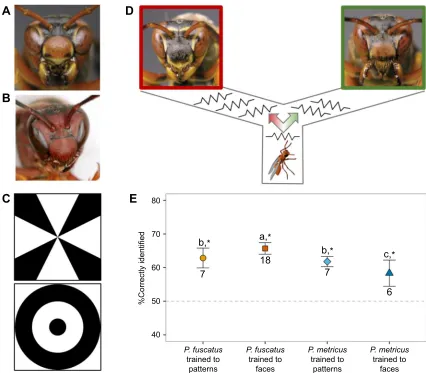
Polistes fuscatusis a particularly interesting model to measure the genetic underpinnings of facial recognition because these wasps, like humans, have variable faces (Fig. 1A; Sheehan and Tibbetts, 2011; Tibbetts, 2002) and demonstrate face specialization, i.e. they learn faces better than other visual information (Sheehan and Tibbetts, 2011). This appears to be an adaptation to facilitate fast and accurate recognition of other wasps in the context of reproductive competition during nest founding. Polistes metricus wasps can be a useful comparison toP. fuscatusbecause they do not have variable faces or learn conspecific faces during social interactions (Fig. 1B). Polistes metricus do not possess face specialization; nevertheless, they can be trained to distinguish faces and non-face patterns (Sheehan and Tibbetts, 2011). Comparisons of brain molecular states betweenP. fuscatusandP. metricus present a valuable opportunity to study the genomic mechanisms of face specialization because of the close evolutionary relationship and contrasting abilities of these two species.
The main objective of this study was to investigate the molecular basis of face specialization by conducting the first genome-wide analysis of facial learning-related gene expression. Using RNA sequencing, we identified brain transcript expression differences during face learning compared with pattern learning in both P. fuscatusandP. metricus. This comparative approach afforded us the opportunity to determine unique expression associated with face specialization inP. fuscatus. The inclusion of wasps naive to face learning, i.e.P. metricus, allowed us to uncouple face specialization from face learning. We also compared these data with our previous study on social recognition-related gene expression inP. fuscatus (Berens et al., 2016) to examine whether some of the same genes identified in that study – specifically, genes related to calcium signaling in the context of social recognition–were also associated with face specialization.
MATERIALS AND METHODS Visual training experiments
Training assay
We collected 42P. fuscatus(Fabricius 1793) and 20P. metricusSay 1831 foundresses near Ann Arbor, MI, USA, in early spring 2012. Foundresses have many social interactions with conspecifics before and after nest foundation (Roseler, 1991). Foundresses were reared in isolated individual cages using established methods (Daugherty et al., 2011) for 1–3 weeks prior to visual training. We used a negative reinforcedT-maze ( previously described in Sheehan and Received 20 December 2016; Accepted 3 April 2017
1School of Biological Sciences, Georgia Institute of Technology, Atlanta, GA 30332,
USA.2Department of Ecology and Evolutionary Biology, University of Michigan,
Ann Arbor, MI 48109, USA.3Department of Ecology, Evolution, and Organismal
Biology, Iowa State University, Ames, IA 50011, USA.4Department of Entomology,
Iowa State University, Ames, IA 50011, USA.
*Author for correspondence ([email protected])
A.J.B., 0000-0002-1579-4777
Journal
of
Experimental
Tibbetts, 2011) to train wasps on two different sets of stimuli: simple patterns (Fig. 1C;n=12 forP. fuscatus,n=10 forP. metricus) orP. fuscatusfaces (n=30 forP. fuscatus,n=10 forP. metricus). We trained both species to highly variableP. fuscatusfaces, because P. metricusfaces are not sufficiently variable for learning. Although simple patterns are not biologically relevant, we used this control because previous research indicated that wasps discriminate these patterns and biologically relevant prey images at the same rate and accuracy (Sheehan and Tibbetts, 2011). An electric current (∼2–4 V) ran throughout the entire length of theT-maze except for a safety chamber associated with one of two images, which the wasp had to learn to avoid being shocked (Fig. 1D). Learning was measured by recording the first chamber that an individual wasp entered. Each wasp was trained in 40 sequential trials performed on the same day. Thirty minutes after the 40th test, the wasp was freeze-killed in liquid nitrogen and stored at−80°C.
Statistics
Prior to statistical analysis, we removed individual wasps that showed directional bias (favoring one chamber by greater than 10%) or had not learned the visual stimulus (incorrectly identifying
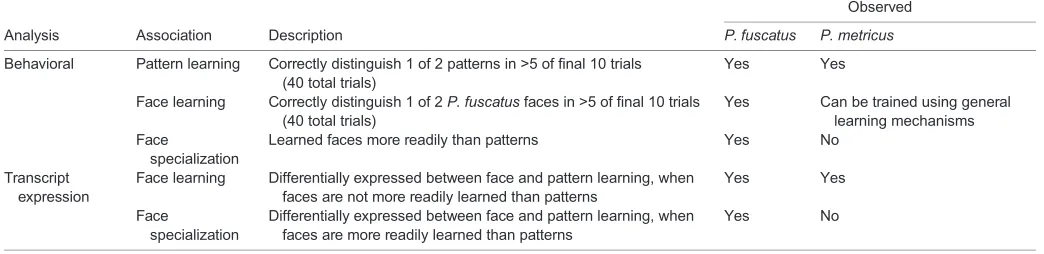
five or more stimuli during the last 10 trials). Approximately 60% of the wasps learned and were directionally unbiased for each visual stimulus: simple patterns (n=7 per species) or faces (n=18 for P. fuscatus,n=6 forP. metricus). We tested for species and stimuli differences in the total number of correct chamber choices (out of all 40 trials) using the‘HSD.test’function from the‘agricolae’package in R (v3.0.1, http://www.R-project.org/). For the Tukey HSDpost hoctest, we modeled the total correct by species, stimuli and their interaction using a generalized linear model with a Poisson family link function. Table 1 describes behavioral contrasts between species.
RNA extraction
We extracted total RNA from individual whole wasp brains using an RNeasy Mini Kit with DNase I treatment (Qiagen). To verify the quality of the extracted RNA, we analyzed the samples using a spectrophotometer (NanoDrop 2000) and Bioanalyzer (RNA 6000 Nano Kit, Agilent). We selected representative wasps for RNA sequencing based on concentration, integrity number (RIN) and training score (≥50% total visual stimuli correctly identified;n=3 per visual stimulus per species, exceptn=2 forP. fuscatuspattern trained).
P. fuscatus
trained to patterns 80
A
B
C
D
E
70
60
50
40
b,*
7
18
7
6 a,*
b,* c,*
P. fuscatus
trained to faces
%Correctly identified
P. metricus
trained to patterns
P. metricus
[image:2.612.90.516.58.431.2]trained to faces
Fig. 1.Polistes fuscatusis specialized for face learning (face specialization), whilePolistes metricusis not.(A,B) Examples of colorful facial markings (which vary between individuals) inP. fuscatus(A) and plain faces (which do not vary between individuals) inP. metricus(B). (C) Wasps were trained to discriminate eitherP. fuscatusfaces or simple patterns, as shown here. (D) Schematic representation of the training approach where the wasp learns the correct image through association with a safety chamber to avoid an electric shock. (E) Percentage (±s.e.m.) of total visual stimuli correctly identified for the two wasp species during all 40 trials. Sample size is given below each data point. Asterisks indicate greater learning than expected by chance (dashed line; one-tailedt-test,
P<0.05); different letters indicate a significant difference (Tukeypost hoc).
Journal
of
Experimental
Transcriptome assemblies
BGI Americas (Cambridge, MA, USA) prepared bar-coded mRNA sequence libraries with TruSeq RNAseq Sample Prep Kit (Illumina, San Diego, CA, USA). Before transcriptome assembly, we removed extraneous adapter sequences and filtered for quality using Trimmomatic (v0.32; Bolger et al., 2014). For each species, we assembled the groomed reads de novousing Trinity (r20140717; Grabherr et al., 2011) to produce separateP. fuscatusandP. metricus transcriptomes. To assemble the most complete P. metricus transcriptome, we included 16 additional P. metricus libraries previously described in Berens et al. (2015a, b). After assembly, the final Trinity-produced Transcriptome Shotgun Assemblies (TSA) were filtered for chimeric and contaminated sequences with the mRNAmarkup protocol as previously described in Berens et al. (2015a). We assessed quality and completeness of the cleaned-up transcriptomes using CEGMA (v2.5; Parra et al., 2007).
Transcript expression
For each species, we aligned paired-end reads to the corresponding TSA using Bowtie2 (v2.2.4; Langmead and Salzberg, 2012) and quantified transcript abundance using eXpress (v1.5.1; Roberts and Pachter, 2013). We tested each species separately for differential brain transcript expression between pattern- and face-trained groups (false discovery rate, FDR<0.1; Benjamini and Hochberg, 1995) using DESeq2 (v1.6.3; Love et al., 2014). Transcripts with low read counts (less than one read per sample on average;P. fuscatus: 74.6% of assembled transcriptome; P. metricus: 70.0%) or outlier transcripts (Cook’s distance >99% quantile; P. fuscatus: 0.4%; P. metricus: 0.3%) were removed from the differential expression analyses. Yet, almost all reads (P. fuscatus: 96.2%; P. metricus: 97.6%) mapped to the remaining transcripts included in the differential expression analyses. Resulting differentially expressed transcripts (DETs) between face and pattern groups are hereafter referred to as face specialization DETs for P. fuscatusand face learning DETs for P. metricus. Table 1 explains transcript expression pattern interpretation.
Gene ontology
We used Blast2GO (Conesa et al., 2005) to assign gene ontology (GO) terms to each transcriptome based on best BLASTx hit (E-value <1×10⁻³) toDrosophila melanogasterprotein sequences. For each
species, we performed gene set enrichment analysis using Babelomics 5 (Alonso et al., 2015). This threshold-free approach uses an ordered list of transcripts based on differential expression FDR to identify the GO terms associated with the lowest values on the list. With REVIGO (Supek et al., 2011), we summarized and visualized GO terms based on semantic similarity and relative significance.
RESULTS AND DISCUSSION Visual training experiments
Learning was greater than expected by chance for all experimental groups (one-tailed t-tests, P<0.05). Polistes fuscatus wasps were better able to distinguish faces versus non-face pattern stimuli in the negatively reinforced T-maze (Tukey post hoc test, HSD=0.75,
α=0.05; Fig. 1E), which agrees with previous studies on face specialization forP. fuscatus(Sheehan and Tibbetts, 2011). We also confirmed thatP. fuscatushas better facial recognition abilities than P. metricus(Sheehan and Tibbetts, 2011), asP. fuscatustraining scores were significantly higher than those of P. metricus. We observed no difference in the general pattern learning between species. Amongst training stimuli, P. metricus wasps correctly identified more patterns than faces.
Overall, training scores were lower than previously documented (Sheehan and Tibbetts, 2011), which may be the result of using a less conductive floor matting for theT-maze (E.A.T., unpublished data). The expression differences we describe forP. fuscatusare still valid as candidates for face learning (see Table 1 for transcript expression interpretation), but some expression differences associated with strong face specialization may have been missed.
Transcriptome assemblies
The finalP. fuscatusTSA consisted of 157,691 transcripts with an N50of 1982 base pairs. Quality assessment of theP. fuscatusTSA
suggests a very complete representation of expressed genes as 87.50% and 93.15% of the core eukaryotic genes (CEGs) mapped fully and partially to the transcriptome, respectively (Parra et al., 2007). The finalP. metricusTSA consisted of 127,674 transcripts with anN50of 1829 base pairs, and was also very complete with
84.27% of the CEGs mapping completely and 94.35% mapping partially. Based on reciprocal best BLAST hit (E-value <1×10⁻³),
there were 82,726 homologous transcripts between wasp species.
Gene expression and ontology
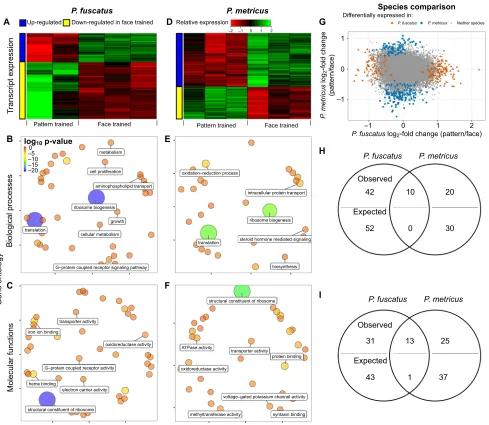
[image:3.612.46.568.73.200.2]We identified 237P. fuscatusface specialization DETs, of which 34% (80 transcripts) were up-regulated in the face-trained group (Fig. 2A; Table S1). Twenty-six DETs were also previously implicated in honey bee visual learning, including a few neurotransmitter-related genes such as serotonin receptor and tachykinin (Qin et al., 2014). At the level of gene functional categories (based on GO terms), 52 biological processes and 44 molecular functions such as signal transduction and translation were significantly enriched in theP. fuscatusface specialization DETs. Table S2 lists complete GO results, while Fig. 2B,C highlights some significant biological processes and molecular functions, respectively. Comparison with a previous study related to honey Table 1. Behavioral and transcript expression comparisons between wasp species
Analysis Association Description
Observed
P. fuscatus P. metricus
Behavioral Pattern learning Correctly distinguish 1 of 2 patterns in >5 of final 10 trials (40 total trials)
Yes Yes
Face learning Correctly distinguish 1 of 2P. fuscatusfaces in >5 of final 10 trials (40 total trials)
Yes Can be trained using general learning mechanisms Face
specialization
Learned faces more readily than patterns Yes No
Transcript expression
Face learning Differentially expressed between face and pattern learning, when faces are not more readily learned than patterns
Yes Yes
Face
specialization
Differentially expressed between face and pattern learning, when faces are more readily learned than patterns
Yes No
Journal
of
Experimental
bee learning (Lutz et al., 2012) revealed some overlap in GO categories between P. fuscatus face specialization-related GO functions (i.e. protein kinase activity) and those related to increased honey bee foraging experience. This suggests face specialization may be associated with some conserved learning genes, but there are also many non-canonical learning transcripts related to face specialization.
InP. metricus, there were 317 differentially expressed transcripts related to face learning. Of these, 62% (198 transcripts) were up-regulated in the face-trained versus the pattern-trained wasps (Fig. 2D). Thirty-two DETs, such as ligand-gated channel (Rdl) and syntaxin-binding (tomosyn) genes, have also been shown to be associated with visual learning in honey bees (Qin et al., 2014).
Polistes metricusface learning DETs were significantly enriched for 30 biological processes and 38 molecular functions (see Fig. 2E,F for featured categories), including GO terms related to hormone-mediated signaling and ribosomal biosynthesis. Some functions, including ATP-dependent helicase activity, are also important for honey bee foraging (Lutz et al., 2012).
None of theP. fuscatusface specialization DETs andP. metricus face learning DETs overlapped. Overall, there was a low, yet significant correlation for all putative homologs between wasp species (P<2.2e−16), which suggests global similarity in transcript abundance levels. However, this pattern did not hold when only considering DETs (P=0.25; Fig. 2G). Despite different DETs for each species, we found significant overlap in the GO categories P. fuscatus
Up-regulated
A D G
H
I E
F B
C
T
ranscript expression
Biological processes
Gene ontology
Down-regulated in face trained
Pattern trained
log10 p-value
Pattern trained Face trained
metabolism
oxidation–reduction process
intracellular protein transport
ribosome biogenesis
steroid hormone mediated signaling
biosynthesis
structural constituent of ribosome
transporter activity iron ion binding
oxidoreductase activity
G–protein coupled receptor activity
heme binding
electron carrier activity
structural constituent of ribosome
ATPase activity
transporter activity protein binding oxidoreductase activity
voltage–gated potassium channel activity
methyltransferase activity syntaxin binding translation
cell proliferation
aminophospholipid transport
ribosome biogenesis growth translation
cellular metabolism
G–protein coupled receptor signaling pathway
Face trained
P. fuscatus
Expected Observed
42 10
0
20
30 52
P. metricus
P. fuscatus
Expected Observed
31 13 25
37 1
43
P. metricus 1
0
–1
–2 –1 0 1 2
P. fuscatus log2-fold change (pattern/face)
P.
metricus
log
2
-fold change
(pattern/face)
Differentially expressed in:
P. fuscatus P. metricus Neither species
Relative expression
P. metricus Species comparison
0 –5 –10 –15 –20
Molecular functions
1 0
[image:4.612.66.555.56.481.2]–1 2
Fig. 2. Different brain transcript expression between wasp species yet similar functions during face learning.(A–C)Polistes fuscatusface specialization-related transcript expression and gene ontology. (A) Heat map of the relative expressions (sample read counts scaled by library size then across each transcript) for the 237P. fuscatusface specialization differentially expressed transcripts (DETs) [DESeq2, false discovery rate (FDR)<0.1]. Patterns of differential expression were consistent across all replicates in each treatment. (B,C) Enriched gene ontology (GO) terms for biological processes (B) and molecular functions (C) ofP. fuscatusface specialization DETs. The position of the circle is based on semantic similarity. The size and color of circles indicates the relative significance of the GO term. (D–F)Polistes metricusface learning-related transcript expression and GO. (D) Robust expression pattern found in a heat map of the
317P. metricusvisual learning DETs. (E,F) Enriched GO terms for biological processes (E) and molecular functions (F) duringP. metricusface learning.
(G–I) Comparison of transcript expression betweenP. fuscatusandP. metricus.(G) log-fold expression changes for face specialization versus face learning for putative homologs betweenP. fuscatusandP. metricus, respectively. (H,I) Observed and expected overlap in significant GO terms between the species for (H) biological processes and (I) molecular functions.
Journal
of
Experimental
represented by the DETs (χ2tests with Yates’corrections,χ2=200.9
for biological processes and χ2=141.6 for molecular functions,
P<0.0001; Fig. 2H,I). Table S2 includes all shared GO functions for face specialization/face learning between P. fuscatus and P. metricus including oxidoreductase activity and G-protein coupled signaling. These results suggest different genes, but some of the same biological processes, may be associated with face learning inP. metricusand face specialization inP. fuscatus.
Face specialization is a complex behavior that requires multiple components. In this study, we assayed the face pattern learning component of recognition – the point when individuals learn to discriminate between face images. Previously, we looked at gene expression during social recognition (Berens et al., 2016), which may involve not only recognition of facial features but also other social information like relative dominance. Previous results from Berens et al. (2016) suggest that calcium signaling may be important for individual recognition in P. fuscatus; however, we did not observe any brain transcript expression differences in these calcium signaling candidate genes during visual training (Table S3). Additionally, there was no enrichment of calcium signaling-related GO terms from the P. fuscatus face specialization DETs. This suggests genes related to calcium signaling may be more relevant for other aspects of social recognition rather than face specialization, as examined in this study. The previous candidate genes were selected based on known associations with dominance behavior, so it seems likely these results captured brain gene expression patterns associated with social aspects of individual identity rather than facial features. Thus, the combined results from the two studies suggest that different components of social recognition, such as face specialization and individual assessment based on dominance or olfactory cues, may utilize different molecular mechanisms.
Conclusions
This work represents the first genome-scale study of the mechanisms of face specialization in any animal. This form of cognitive specialization has previously evaded mechanistic analysis at the molecular level; thus, we provide valuable first clues on the molecular correlates of this complex behavior. Our results suggest that specific neural expression changes during facial learning differ from those occurring during visual pattern learning, including transcripts that function in neural signaling and signal transduction. These transcripts represent strong candidates for follow-up studies to assess whether there are causal associations with face specialization. This work highlights the power of the Polistes system as a comparative model for elucidating the molecular underpinnings of individual facial recognition.
Acknowledgements
Cassie Vernier collected the wasps and Andrew Madagame performed the training assays. Adam Dolezal, Ashley St Clair and Erica Teixeira provided helpful comments that greatly improved the manuscript.
Competing interests
The authors declare no competing or financial interests.
Author contributions
Conceptualization: A.J.B., E.A.T., A.L.T.; Methodology: A.J.B.; Formal analysis: A.J.B., E.A.T.; Investigation: A.J.B.; Writing original draft: A.J.B., A.L.T.; Writing -review & editing: A.J.B., E.A.T., A.L.T.; Funding acquisition: A.J.B., A.L.T.
Funding
This research was supported by the National Science Foundation (Division of Integrative Organismal Systems) through a Doctoral Dissertation Improvement Grant (IOS-1311512) to A.J.B. and A.L.T.
Data availability
Data are publicly available at NCBI SRA (P. fuscatus: PRJNA287145 and
P. metricus: PRJNA287152), DDBJ/EMBL/GenBank (P. fuscatus: GDFS00000000.1 andP. metricus: GDHQ00000000.1) and NCBI GEO (P. fuscatus: GSE70964 and
P. metricus: GSE70963).
Supplementary information
Supplementary information available online at
http://jeb.biologists.org/lookup/doi/10.1242/jeb.155200.supplemental
References
Alonso, R., Salavert, F., Garcia-Garcia, F., Carbonell-Caballero, J., Bleda, M., Garcia-Alonso, L., Sanchis-Juan, A., Perez-Gil, D., Marin-Garcia, P., Sanchez, R. et al.(2015). Babelomics 5.0: functional interpretation for new generations of genomic data.Nucleic Acids Res.43, W117-W121.
Avargues-Weber, A., Portelli, G., Benard, J., Dyer, A. Giurfa, M. (2010). Configural processing enables discrimination and categorization of face-like stimuli in honeybees.J. Exp. Biol.213, 593-601.
Benjamini, Y. and Hochberg, Y.(1995). Controlling the false discovery rate - a practical and powerful approach to multiple testing.J. Roy. Stat. Soc. B Met.57, 289-300.
Berens, A. J., Hunt, J. H. and Toth, A. L.(2015a). Comparative transcriptomics of convergent evolution: different genes but conserved pathways underlie caste phenotypes across lineages of eusocial insects.Mol. Biol. Evol.32, 690-703. Berens, A. J., Hunt, J. H. and Toth, A. L.(2015b). Nourishment level affects
caste-related gene expression in Polistes wasps.BMC Genomics16, 235.
Berens, A. J., Tibbetts, E. A. and Toth, A. L.(2016). Candidate genes for individual recognition in Polistes fuscatus paper wasps.J. Comp. Physiol. A Neuroethol. Sens. Neural Behav. Physiol.202, 115-129.
Bolger, A. M., Lohse, M. and Usadel, B.(2014). Trimmomatic: a flexible trimmer for Illumina sequence data.Bioinformatics30, 2114-2120.
Conesa, A., Gotz, S., Garcia-Gomez, J. M., Terol, J., Talon, M. and Robles, M. (2005). Blast2GO: a universal tool for annotation, visualization and analysis in functional genomics research.Bioinformatics21, 3674-3676.
da Costa, A. P., Leigh, A. E., Man, M.-S. and Kendrick, K. M.(2004). Face pictures reduce behavioural, autonomic, endocrine and neural indices of stress and fear in sheep.Proc. Biol. Sci.271, 2077-2084.
Daugherty, T. H. F., Toth, A. L. and Robinson, G. E.(2011). Nutrition and division of labor: effects on foraging and brain gene expression in the paper wasp Polistes metricus.Mol. Ecol.20, 5337-5347.
Grabherr, M. G., Haas, B. J., Yassour, M., Levin, J. Z., Thompson, D. A., Amit, I., Adiconis, X., Fan, L., Raychowdhury, R., Zeng, Q. et al.(2011). Full-length transcriptome assembly from RNA-Seq data without a reference genome.Nat. Biotechnol.29, 644-652.
Haxby, J. V., Hoffman, E. A. and Gobbini, M. I.(2000). The distributed human neural system for face perception.Trends Cogn. Sci.4, 223-233.
Langmead, B. and Salzberg, S. L.(2012). Fast gapped-read alignment with Bowtie 2.Nat. Methods9, 357-359.
Love, M. I., Huber, W. and Anders, S.(2014). Moderated estimation of fold change and dispersion for RNA-seq data with DESeq2.Genome Biol.15, 550. Lutz, C. C., Rodriguez-Zas, S. L., Fahrbach, S. E. and Robinson, G. E.(2012). Transcriptional response to foraging experience in the honey bee mushroom bodies.Dev. Neurobiol.72, 153-166.
Parra, G., Bradnam, K. and Korf, I.(2007). CEGMA: a pipeline to accurately annotate core genes in eukaryotic genomes.Bioinformatics23, 1061-1067. Parvizi, J., Jacques, C., Foster, B. L., Witthoft, N., Rangarajan, V., Weiner, K. S. and Grill-Spector, K. (2012). Electrical stimulation of human fusiform face-selective regions distorts face perception. J. Neurosci. 32, 14915-14920.
Qin, Q.-H., Wang, Z.-L., Tian, L.-Q., Gan, H.-Y., Zhang, S.-W. and Zeng, Z.-J. (2014). The integrative analysis of microRNA and mRNA expression in Apis mellifera following maze-based visual pattern learning. Insect. Sci. 21, 619-636.
Roberts, A. and Pachter, L.(2013). Streaming fragment assignment for real-time analysis of sequencing experiments.Nat. Methods10, 71-73.
Roseler, P. F.(1991). Reproductive competition during colony establishment. InThe Social Biology of Wasps(ed. K. G. Ross and R. W. Matthews), pp. 309-335. London: Comstock Publishing Associates.
Sheehan, M. J. and Tibbetts, E. A.(2011). Specialized face learning is associated with individual recognition in paper wasps.Science334, 1272-1275.
Supek, F., Bošnjak, M., Škunca, N. and Šmuc, T.(2011). REVIGO summarizes and visualizes long lists of gene ontology terms.PLoS ONE6, e21800. Tate, A. J., Fischer, H., Leigh, A. E. and Kendrick, K. M.(2006). Behavioural and
neurophysiological evidence for face identity and face emotion processing in animals.Philos. Trans. R. Soc. Lond. B Biol. Sci.361, 2155-2172.
Tibbetts, E. A.(2002). Visual signals of individual identity in the waspPolistes fuscatus. Proc. Biol. Sci.269, 1423-1428.
Tibbetts, E. A.(2004). Complex social behaviour can select for variability in visual features: a case study in Polistes wasps.Proc. Biol. Sci.271, 1955-1960.