Article
1
Offset policy in the process of technology transfer: an
2
analysis in the context of Brazilian public health
3
Myller Gomes 1,*, João Kovaleski 2, Regina Pagani ² and Gilberto Zammar ²
4
1 State University of Midwest; [email protected]
5
2 Federal University of Technology-Paraná; [email protected]
6
*
PR 153, KM 07, CEP 84450-000, Irati, PR, Brazil: [email protected]; Tel.: +55-042-34213042
7
8
Abstract:This research aimed, within the scope of the anthropotechnological approach, analyze the
9
technology transfer, performed via the offset policy in the field of public health, called the
10
Radiotherapy Expansion Plan, from the Health Ministry. The objective of this policy is to create and
11
improve accredited organizations, concerning the oncological treatment, specifically in the insertion
12
of radiotherapeutic equipment. This process is divided into two stages: the insertion of the
13
radiotherapy equipment, and the compensations provided for in the commercial agreement. To
14
meet this purpose, the research started from understanding the theoretical and methodological
15
approaches of the fields of study of anthropotechnology, technology transfer and offset policy. In
16
this sense, there was used the methodological strategy of the case study, supported by applied
17
research, with a qualitative and exploratory approach. External and internal environments of a
18
specific situation were analyzed, located in the State of Paraná, which received the radiotherapy
19
equipment. It was verified that the initiatives of insertion of radiotherapeutic equipment in the
20
context of the Expansion Plan have undergone numerous confrontations, inserted in the contextual
21
and organizational particularities that affect its development and effectiveness. There are challenges
22
that require responses from a set of organizations involved, in order to implement the trade
23
agreement established by the offset policy, highlighting the first stage as a process of technology
24
transfer. Thus, the situation located in the State of Paraná consistently consolidated the insertion of
25
the radiotherapy equipment. It allowed its disclosure as a reference situation, and based on the
26
dimensions and indicators analysis provided by anthropotechnology, made possible the
27
comprehensionof the technology transfer involved in the process
.
28
Keywords: technology transfer; anthropotechnology; offset policy.
29
30
1. Introduction
31
The Many countries are facing a double challenge, from two transformation groups, due to the
32
modernization process: first, a social restructuring, and second, the economic conditions. It is
33
imperative for the countries to participate in an increasingly globalized international economy in
34
terms of technology [1, 2].
35
Emerging from public policies, government programs represent initiatives of the State apparatus
36
in specific segments such as security, health, education, economics and agriculture, with the purpose
37
of assuring citizenship rights through access to public services.
38
Public procurement laws represent a mechanism to stimulate governmental action. First, these
39
laws place specific rules to make the practice effective. Initially in an informal context, the emergence
40
of trade, industrial or technological offset in the Brazilian context first occurred within the armed
41
forces, where technologically advanced military equipment was sought abroad. On the other hand,
42
it supplied developed countries with commodities, among other means of payment.
43
With the modernization of the practice, not only the military segment, but several other
44
segments of the state began to use the offset practice, in order to increase the efficiency of their
45
services. Consequently, around this practice emerges another phenomenon: technology transfer [3].
46
The processes of technology transfer in offset practices represent a complex theme, due to the
47
divergences between different populations and the methods that are used. That is, the cultural
48
aspects and characteristics of the industry are elements that may determine the success or failure of
49
the process [2]. In this perspective, the concern about the adaptability of the technology in different
50
environments from the original one, promotes the discussion about necessary reflections in critical
51
aspects, in order to obtain satisfactory results [4].
52
In this context, there is the rise of anthropotechnology as a field of study, where the matter has
53
the objective to promote the understanding of influencing factors within the technology transfer
54
process, from the perspective of ergonomic problems at macroorganizational levels, aiming at the
55
success of the transference through an adaptation process [5, 6, 7, 4, 8].
56
Based on the assumption that the offset policy represents mechanisms that promote the process
57
of international technology transfer between different population contexts, and recognizing that, in
58
this scenario, there is a need to analyze the process in the face of organizational and institutional
59
changes, the research question is formulated: Is anthropotechnology, as a field of study, able to
60
understand the resource-based improvements promoted by offset policies in hospital institutions
61
inserted in the radiotherapy expansion plan?
62
2. Theoretical Background
63
2.1. International Technology Transfer (ITT)
64
Considered as a way to access international markets, and to stimulate local economic growth,
65
ITT has represented an important field of research, constituted of opportunities for production
66
expansion, and as a means of infusing advanced technology in divergent contexts, especially for
67
developing countries, dependents of the ITT from developed countries.
68
Concerning the way technology is transferred between nations, there is a general consensus that
69
the most important mechanisms for technology transfer are international trade and the direct foreign
70
investment [9]. For [10], the definition of ITT is described as the process by which the technology
71
holder transmits the technology through several channels to the recipient, across national boundaries.
72
Still, this process is not represented as a singular event, and the sequence of the process consists in
73
identifying the needs and demands of technology, the event of the transfer process itself, and the
74
implementation of the technology. Finally, there is the assurance that the technology was acquired
75
by the recipient according to the plans.
76
The basic ITT model was developed in the 1970s to the 1980s. Four factors were identified, that
77
determine the effectiveness of the technology transfer: (i) the objectives of the entity administering
78
the technology; (ii) proficiency in mastering technology transfer; (iii) objectives of the technology
79
recipient and their capacity to incorporate new knowledge and (iv) their organizational learning
80
organizations, are becoming significant in determining the most efficient management model in
82
dealing with cross-border organizations [12].
83
In [13], the author presents his work around the impact of technology transfer efficiency, by
84
presenting a contingent model, and the significant point of the model is the impact of ITT and its
85
representations on factors such as political market, personnel involved, available resources and
86
scientific technical objectives. In the case of the learning environment inserted in the ITT process, it is
87
strongly linked to the communication process between the holder and the receiver. In this
88
perspective, the cultural aspects and the distance between the owner of the technology and the
89
receiver is a relevant concern to be considered in the international technology transfer management
90
process [14].
91
The institutional perspective is a useful approach to processes of technology
92
internationalization. In this perspective, the distance between organizations is reduced and the
93
approach is exalted above differences [15]. Thus, when a foreign organization has an interest in
94
moving technology to developing countries and in absorbing spaces in internal markets, the
95
processes of formulating alternative strategies are strengthened, in order to achieve the effectiveness
96
of the process [16].
97
Local, efficient absorptive capacity represents the central challenge of the international
98
technology transfer process [17], including the absorptive capacity, as a prerequisite from the
99
organizational learning perspective. It allows the recipient organization to recognize, assimilate and
100
apply the new technologies and technology sources, for the end-activity bounded to the technology
101
transfer process [18].
102
The failure of ITT processes demonstrate the significant existence of social and cultural
103
organizations coupled with economic characteristics that may hinder or make it impossible to
104
replicate the technology developed and used in developed countries in developing ones. Then it is
105
necessary to adapt the holistic approach in ITT studies [19]. A comprehensive study on ITT analysis,
106
coming from the open system perspective, allows to include not only technical aspects but
107
environmental factors associated with the phenomenon in question [19].
108
According to the proposed context, the environmental variables allow to carry out an extended
109
analysis of the ITT process. However, it must be recognized that, in the case of machines and
110
equipments, the ITT irruptive process occurs in a disorderly manner, requiring adaptations
111
concerning its usability and preservation of the professionals involved.
112
2.2. Anthropotechnology
113
To obtain the prospect of satisfactory results in the perspectives of productivity and worker
114
health, it is fundamental to understand the behavior of the socio-technical dimensions involved in
115
the process of technology transfer between countries. With the variation of determinants, such as
116
geographical, industrial, social fabric, financial, economic and environmental factors, and from the
117
need to understand these elements, emerged the science of Anthropotechnology [4].
118
A concept formulated by Alain Wisner, this new field of study, anthropotechnology, is described
119
by [4], as the adaptation of the technology to be transferred to a certain population, taking into
120
account the influence of geographic, economic, sociological and anthropological factors.
121
Its definition makes an analogy with ergonomics, i.e., the concerns of anthropotechnology lies
122
in the analysis of difficulties of geographic, economic and anthropological origin [4, 7]. The
123
anthropotechnology. In other words, the adaptation of technology to the reality of the local
125
population [7, 4, 20, 6].
126
With a body of knowledge that supports the study of active man, anthropotechnology has its
127
theoretical bases in disciplines capable of approaching ergonomic problems in the
128
macroorganizational dimension. [5] presents in a schematic form, the disciplines and their relations,
129
history of the techniques, ergonomics, cognitive psychology, human geography, economics,
130
sociology and anthropology, thus forming the theoretical basis of anthropotechnology.
131
The confrontation between man and technology are precepts of the anthropotechnological
132
approach. Then, it is natural that it presents emerging difficulties coming from this confrontation,
133
which are related to social, geographical, historical and anthropological aspects of the population
134
context where technology is inserted. In this perspective, it is important to take into account the
135
activities performed by workers [20, 21].
136
2.3. Offset: The Policy of Commercial, Industrial and Technological Compensation – an alternative to
137
investments in hospital infrastructure
138
Considered a global phenomenon, characterized by reciprocity involving interactions between
139
organizations from different countries, the counterpart practice has been presented as a tool for
140
commercial, industrial and technological import operations. Such phenomenon demands an
141
international business behavior from the organizations involved [22]. From the point of view of
142
operations, if a country decides to carry out an upgrade on its technical capacity, or to acquire
143
equipment with embedded technology, and promoted through technology transfer used by the
144
developed country, the operation represents one of the main conditions for the compensated trade
145
[23, 22].
146
Latent benefits are embedded in countertrade practices, in addition to the motivating factors
147
that can enhance social and economic growth [24]. About the motivating factors, the main reason for
148
the emergence of the practice is the representativeness of a response to the borrowing capacity of
149
developing countries [23].
150
Inserted in the context of offset trade, which is defined by an industrial or technological
151
compensation practice, where the reward mechanism is not only monetary values, the offset modality
152
creates means and conditions for the purchase of goods or services through possible counterparts.
153
In the understanding of [25], the offset policy negotiates an agreement, in which the buyer
154
includes within the contract the condition that the seller has to perform certain activities that benefit
155
the buyer, and its modalities are adopted according to the appropriate criteria.
156
A relevant feature of the offsetting practice is present in specific sectors of the industry, where
157
unit sales prices are significant. It also appears for buyers, when the regulatory role of the State in the
158
international business processes is intense, particularly in bureaucratic aspects and in the valorization
159
of the national industry [26, 27].
160
The aerospace industry is a pioneer in offsetting, but in 1944 Bretton Woods began its activities:
161
with the emergence of the World Bank and the International Monetary Fund, allied countries looked
162
for alternatives in seeking sources of financial resources and mechanisms for re-establishing order in
163
the post-war period [22, 27]. Compensation mechanisms, in particular offset, presented advantages
164
in the theoretical perspective: reduction of compliance costs, extension of the price signal outside the
165
The practice was initially conceived in developed countries, and the offset represented, for some
167
nations, the ideal mechanism to emerge from economic traps provoked by them, where the
168
accentuated economic and industrial development began to create problems of scarcity of raw
169
materials. As a consequence, the allied countries began to participate in the compensatory practice,
170
like the Marshall Plan, which transferred 13 billion dollars in US aid to Western Europe, and in the
171
years 1951 to 1973, agricultural surpluses were exchanged with allied countries [29].
172
In the research done by [26], outside the aeronautics and defense industry, little is known about
173
other sectors that use offset policies. Industrial machinery and equipment represent basic capital
174
goods that all nations must exploit in their development process. These practices are not closely
175
monitored by the government. However, the risk to national industry, the discovery of new
176
competitiveness factors, as well as the defense readiness, can be significantly affected.
177
On the other hand, many technology transfer possibilities may be more substantial than the
178
current estimates suggest, when related to the negotiation process and the displacement of goods and
179
services [26, 28].
180
As part of the international trade, the offset trade usually involves forms of production sharing
181
which are often represented by the subcontracting process [26]. With typologies identified as direct
182
compensation, that represents the process of production sharing, the technology transfer, worker
183
training, and indirect compensation that includes other forms of compensatory trade, such as the
184
practice of bartering [26].
185
The challenge of the offset practice is not in the process of defining typologies or categorizations
186
of actions, but in the internalization of the new goods, services, knowledge and techniques that the
187
selected population will receive. In this way, observing this phenomenon from an
188
anthropotechnology perspective, it becomes fundamental to understand the impacts of ITT
189
(International Technology Transfer) and its activities in the recipient population context.
190
3. Methodology
191
This essay was based on previously published materials, composed of articles from the Science
192
Direct, Web of Science and Scopus databases, with no time limit. The combinations of keywords in
193
the search process within the databases were: “technology” + “transfer” + anthropotechnolog* +
194
offset*. However, the combination did not find any results. As an alternative strategy, we chose three
195
groups composed of two key words each: “technology transfer” + anthropotechnolog*, “technology
196
transfer” + offset* and anthropotechnolog* + offset*. The results found with the present
197
combinations showed 144 published articles. However, the attention was focused on verifying if the
198
publications answer the context of the research question, as well as the phenomenon of study.
199
Without a time limit, 85 articles were ranked, according to Methodi Ordinatio, developed by
200
[30]. This ranking occurs according to the Scientific relevance of the articles, through a process of
201
equalization of the following variables: impact factor, year of publication and citation numbers.
202
Furthermore, there were also used books, theses and dissertations available on the internet, and
203
focused on the subject.
204
Concerning the articles, a systematic literature review was carried out, presenting who are the
205
most cited authors within the articles found by the keyword combinations, that is, “technology
206
transfer” + offset* and isolated anthropotechnolog*, as well as the countries which are developing
207
located, and the universities that carry out research on technology transfer within the offset policy,
209
with emphasis on the United States and Sweden, followed by England, Australia, Switzerland,
210
Taiwan and other nationalities.
211
212
Source: Elaborated by the authors.
213
(Graph 2) shows that the search for bibliography was based on a systematic methodology, and
214
that the keyword anthropotechnolog* was used in an isolated way, in order to facilitate the process
215
of research selection and filtering of works. It also presents the nationalities that develop researches
216
that are presented in this study chain:
217
218
219
Source: Elaborated by the authors.
220
Concerning the most cited authors, with the proposed systematic literature review developed
221
by [30], it was possible to identify, with the combinations of key words, the most cited authors, its
222
intention is to demonstrate the period of the publications and the numbers of citations based on the
223
systematic review of the literature used, since it is a contemporary practice, making the TT as the
224
offsets policies present themselves slowly in relation to developed studies. who are presented on
225
tables 1 and 2:
226
227
0 2 4 6 8 10 12 14 16
Table 1. Most cited authors in Technology Transfer and offset*
Authors Number of citations
1. Autken and Harrison (1997). 4628
2. Mencinger (2003). 380
3. Thurow (1997). 347
4. Maskus and Reidman (2004). 290
5. Bidaut and Cummings (1994). 214
6. Anderson (2005). 182
7. Vishwasrao (1994). 156
8. Muller (2007). 101
9. Branstetter and Saggi (2011). 92
10. Macpherson and Pritchard (2003). 53
Source: Elaborated by the authors.
228
229
230
231
232
233
Source: Elaborated by the authors.234
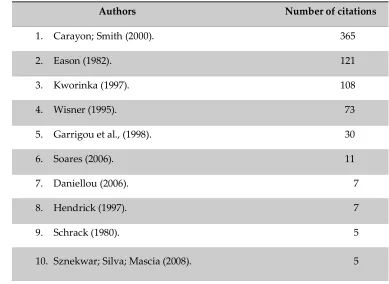
With a smaller scope, due to the delimitation and combination of keywords, and the most cited235
authors by the combination TT + offset *, and anthropotechnolog*, the latter separately, the emphasis236
was placed on the ten most cited of each combination, aiming to highlight the relevance of these237
works. After a systematic review of the literature, it was possible to establish a framework of238
Table 2. Most cited authors in Anthropotechnolog* Authors Number of citations 1. Carayon; Smith (2000). 3652. Eason (1982). 121
3. Kworinka (1997). 108
4. Wisner (1995). 73
5. Garrigou et al., (1998). 30
6. Soares (2006). 11
7. Daniellou (2006). 7
8. Hendrick (1997). 7
9. Schrack (1980). 5
dimensions and indicators inserted in the context of anthropotechnology, allowing its application in
239
a given situation contemplated by the governmental initiative, our intention is to understand how
240
the interference of dimensions and indicators occurs in the enterprise, replicating in other
241
contemplated contexts and allowing in-depth analysis.
242
3.2. Dimensions and indicators of analysis
243
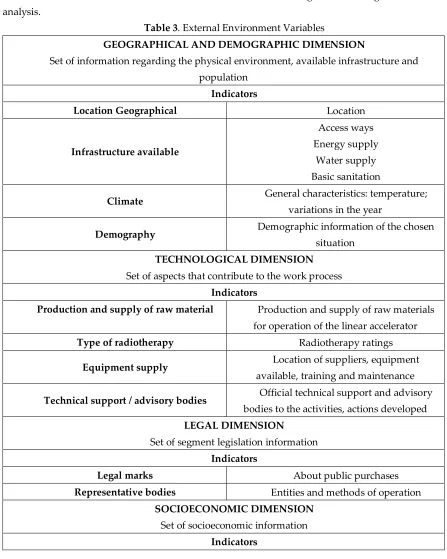
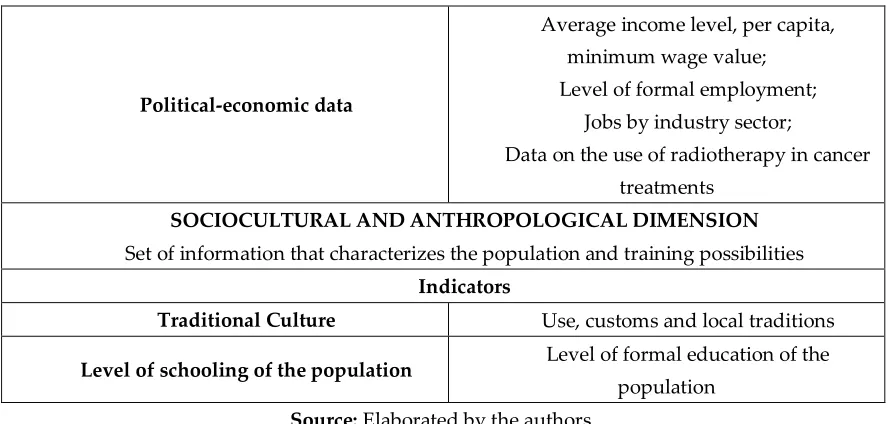
3.2.1. External Environment Variables
244
The set of dimensions and indicators represents the variables for analysis of the external
245
environment. They are presented in Table 3, which report the environmental, technological, social
246
and anthropological contexts. all variables derived from the systematic review of the literature,
247
where he considered the contextual elements that could be investigated, revealing a scenario of
248
analysis.
249
Table 3. External Environment Variables
250
GEOGRAPHICAL AND DEMOGRAPHIC DIMENSION
Set of information regarding the physical environment, available infrastructure and
population Indicators
Location Geographical Location
Infrastructure available
Access ways
Energy supply Water supply
Basic sanitation
Climate General characteristics: temperature;
variations in the year
Demography Demographic information of the chosen
situation
TECHNOLOGICAL DIMENSION
Set of aspects that contribute to the work process
Indicators
Production and supply of raw material Production and supply of raw materials
for operation of the linear accelerator
Type of radiotherapy Radiotherapy ratings
Equipment supply Location of suppliers, equipment
available, training and maintenance
Technical support / advisory bodies Official technical support and advisory bodies to the activities, actions developed
LEGAL DIMENSION
Set of segment legislation information
Indicators
Legal marks About public purchases
Representative bodies Entities and methods of operation
SOCIOECONOMIC DIMENSION
Set of socioeconomic information
Political-economic data
Average income level, per capita, minimum wage value;
Level of formal employment;
Jobs by industry sector;
Data on the use of radiotherapy in cancer
treatments
SOCIOCULTURAL AND ANTHROPOLOGICAL DIMENSION Set of information that characterizes the population and training possibilities
Indicators
Traditional Culture Use, customs and local traditions
Level of schooling of the population Level of formal education of the population
Source: Elaborated by the authors.
251
3.2.2. Internal Environment Variables
252
The variables related to the context of the internal environment report the general and
253
organizational characterizations of the chosen work situation. The dimensions are presented in Table
254
4, described below:
255
Table 4. Internal Environment Variables
256
DIMENSION OF GENERAL CHARACTERISTICS
Identification of the work process and determinants of the work process
Indicators
General features
Work process
Materials needed for the process
Recommendations adopted
Organizational characteristics
Functional framework Hierarchical structure
Ways of hiring staff Main activities
DIMENSION OF ORGANIZATIONAL CONDITIONS
Characteristics of the organization related to the work situation and factors of the work
activity Indicators
Organizational Aspects of the Work
Process
Time and division of labor
Organization and structuring of work
Control over the performance of tasks Capacity of daily attendance.
Technical Factors Facilities available
Maintenance procedures.
Source: Elaborated by the authors.
257
In order to identify and understand the dimensions and indicators proposed, we used
258
documentary research on the situation contemplated and participant non-observational observation.
259
radiotherapy expansion plan located in the State of Paraná, from June 2016 to October 2017. The
261
researcher participated in the process of insertion and first operation of the linear accelerator
262
equipment and, the process of selection of external radiotherapy for oncological treatment.
263
Participating in the flow of daily care, whether consultations or in radiotherapy applications, the
264
researcher realized the adequacy of the organization in question in the management of installed
265
capacity, before the official inauguration of the linear accelerator, and the organization in question
266
already used it to compose a scope to the patients coming from the Unified Health System (SUS).
267
Approaches have occurred within the key sectors for the equipment management process, such
268
as the engineering sector, radiotherapy sector, people management sector and general coordination.
269
The intention was to understand how the organization was inserted in the expansion plan of
270
radiotherapy, the established gains, what were the difficulties and how anthropotechnological factors
271
contribute to the enterprise
272
4. Radiotherapy expansion plan
273
Established by the Ordinance No. 931, of May 10th, 2012 of the Ministry of Health, The
274
radiotherapy expansion plan of the Brazilian Unified Health System (SUS - Sistema Único de Saúde),
275
represents the largest worldwide investment in the acquisition of linear accelerators, with the aim of
276
expanding the treatment network in the therapeutic modality of radiotherapy. This plan was
277
executed with the use of the mechanisms of the offset policy, to the commercial purchase contract.
278
Composed of 80 (eighty) solutions in radiotherapy, it can be comprehended as the creation and
279
expansion of radiotherapy centers. For the process of operationalization of the plan, the Ministry of
280
Health divided the process into two stages, as explained in, 1st stage, acquisition of the basic
281
architectural and executive projects; services to support the fiscalization and supervision of the
282
stage execution; equipments and the effective technological compensation, 2nd stage, contracting of
283
services to the building of the planned structure, according to a basic project and execution of the
284
previous stage, to receive the acquired equipment.
285
It deals with the acquisition of linear accelerators, an equipment used in the external
286
radiotherapy modality, that allows the professionals to control the intensity and directionality of the
287
ionizing rays. The linear accelerators are a consistent evolution of modern radiotherapy, which seeks
288
to develop reliable and controllable means for the radiation process, being considered the greatest
289
reference in radiotherapy treatments. However, the determinant factor for the use of this equipment
290
lies in the anatomical precise location of the malignant cells [31].
291
In addition to the acquisition of the equipment, the plan in the commercial agreement provides
292
for a technology compensation agreement, which aims to build the industrial environment of linear
293
accelerators, qualification of local suppliers for the production of components, accessories and
294
software. In addition to the qualification of professionals, the Varian Medical Systems Co. must
295
qualify suppliers selected by it; and establish agreements with scientific and technological institutions
296
for the technology transfer focused on the software development. For the partnership with the
297
scientific institutions selected in the previous stage, the selected company must keep a place to train
298
engineers, physicists, technicians and related professionals focused on qualification about linear
299
There is a great concern about the final result, since the synchronization between stages is
301
fundamental to the effectiveness of the plan. There are different institutions and people involved,
302
such as the Ministry of Health, Varian Medical Systems Co., State Secretaries of Health, the hospitals
303
covered by the plan and the contractors responsible by the planned work, as well as the scientific and
304
technological institutions participating in the public call for technology transfer. Consequently, the
305
institutional efforts are fundamental for the solution in radiotherapy to be made available. But
306
currently, the evolution scenario of the plan is slow since 2012. According to data collected from June
307
2017, the current status of the plan was presented: only 3 solutions were delivered; 6 are in
308
execution; 1 project is halted; 6 in bidding process; 1 in elaboration of the reference term; 8 with
309
executive projects under analysis; 3 executive projects in the Varian company; 26 with basic
310
architecture and engineering projects in reanalysis processes; 1 basic design of architecture and
311
engineering in analysis; 21 projects were suspended by determination of the executive committee and
312
4 projects were excluded by the managing committee.
313
Concerning the three solutions delivered, the current situation is as follows: the first solution
314
was delivered in November 2016 in the State of Paraíba; the second solution delivered in May 2017
315
in the State of Bahia; and the third solution in June 2017 in the State of Paraná. So, compared to the
316
first schedule, it is clear that the inefficiency of the contextual analysis represent the main problem or
317
obstacle in the insertion of the solutions in hospitals accredited for the oncological treatment.
318
5. Discussion of ITT in a situation contemplated by the Radiotherapy Expansion Plan
319
The inefficiencies of theoffsetpolicyincluded in the radiotherapy expansion plan make it
320
evident that the problems of population contexts and organizational characteristics directly influence
321
the efficiency of the enterprise in question.Several stages of the governmental initiative represent the
322
ITT due to theinterorganizationalrelationsestablished by theoffsetpolicy, that is, the receiving
323
organization, organization that holds the technology in the equipment and the mediating
324
organizations that establish the relationship through the practice of commerce.This assertion is
325
supported by [13, 21, 32].
326
In the scenario of the organizations involved in the flow of steps, these do not identify this phase
327
as a ITT process, however, within the commercial agreement, the existence of the technological
328
compensation provided for the scientific and technological institutions selected through specific call,
329
the establishment of ITT is explicit, where the focus will be on making improvements on the software
330
made available along with the linear accelerator.The development of the insertion process depends
331
on the articulations established at each stage, highlighting thedifficultiesintroduced in the first
332
phase of the plan, especially in the achievement of the basic and executive projects by the
333
organizations contemplated.Only the acquisition of the equipment and its auxiliaries is a simple
334
process, however, to develop infrastructure for conditioning the equipment and establish symptoms
335
among the organizations involved depends on several factors such as the competence and abilities of
336
the construction organization, the spaces of the receiver structure of the enterprise, besides to
337
consider contextual elements such as labor, suppliers, transportation and road structures that allow
338
the mobility of resources necessary for the enterprise.
339
Taking the analysis from the first dimension of the situation chosen to be investigated, the city
340
privileged location in relation to the company VarianMedical Systemslocated in the capital of the State
342
of São Paulo, in these terms, there is a favorable situation.In terms of radiotherapeutic treatment, the
343
city of Curitiba offers a range of hospitals that allow the availability of various therapeutic modalities.
344
In the city of Curitiba, there are companies that specialize in hospital construction and
345
infrastructure for radiological protection such asbanker.In the case of the organization in question,
346
the company that developed thebankerwas the company RAC Engenharia, also located in the city
347
of Curitiba, facilitating the development of the enterprise.With respect to the available infrastructure,
348
modalities of transport such as road and air transport facilitate the mobility of patients, professionals,
349
suppliers, equipment and components, presenting a constant flow of mobility, it can be inferred that
350
the aspect involved in the enterprise, in the organization, allowing to establish time of construction
351
with precepts of economicity.
352
The use of energy by the organization in question is intense, however, the main concern is in the
353
energy stability in case of a drop in supply, thus, substations and generators ensure the safe operation
354
of the equipment inserted in the electric grid.
355
Regarding water supply, basic sanitation and solid waste collection, due to health, hygiene and
356
environmental issues, the concern is continuous, several obstacles to overcome.To encourage urban
357
development and productive activity with sustainability precepts, the population and organizations
358
must establish improvements capable of becoming engaged for the common good.
359
Regarding the indicators related to the climatic aspect, it is necessary to stay equipment in an
360
infrastructure where its temperature is controllable, the external climatic aspects do not impact on
361
the operations, but, they influence other equipment, besides the energy consumption necessary for
362
the thermal control.In addition to these concerns, there are heat islands in the location of the
363
organization in question, zoning process, proximity to expressways that promote a high flow of
364
vehicles.
365
Demographic aspects represent the concern about new cases of cancer in the population, with
366
an increasing number of outpatient consultations, the average number of new cases discovered by
367
the cited organization is about 470 new cases per month.These numbers demonstrate that cancer is
368
a public health problem and needs specific policies that can promote diagnosis and treatment
369
accurately.
370
Thus, all the variables inserted in the geographic-demographic dimension directly influence the
371
operation of the creation and improvements of the sectors of radiotherapy inserted in the Radiation
372
Therapy Expansion Plan.
373
In this sense, in addition to using criteria of selection of organizations, it is necessary to consider
374
the environment in which it is inserted, projecting possible positive and negative risks that, when
375
measured, can support the development of the project, as well as bring a greater effectiveness to the
376
governmental initiative.
377
Analyzing the technological dimension inserted in the industrial context, the peculiarity of the
378
by the Ministry of Health obtained only one participant, who has institutional and strategic interests
380
aligned with the contractual requirements imposed by the public purchase.
381
While the production of the linear accelerator occurs in the United States, the functioning of the
382
production chain is maintained constant by the relations already established, however, as the trade
383
agreement establishes counterparts, such as the installation of the manufacturing process in Brazilian
384
soil, with a percentage of productive components by national companies within a five-year
385
timeframe, relations need to be developed in advance to ensure and preserve the industry and trade
386
agreement.
387
On the necessary raw material, the development ofBankerand the supply of electricity and
388
water are the basic elements for running the linear accelerator.All of these details are embedded in
389
the basic and executive designs, however, developing them in each contemplated organization needs
390
to be uniquely established, as structural elements can directly affect the functioning and risk of
391
damage to equipment and patients.It is evident that external radiotherapy is the most used by the
392
organization in question, due to its participation in the radiotherapy applications that revolve around
393
70%,consequently, to possess in its technological park the necessary equipment as a linear
394
accelerator allows to increase its capacity of treatment and decrease the waiting time for the
395
radiotherapy sections.
396
In the world, there are five suppliers of linear accelerators that have the peculiarity of the
397
segment.However, the counterparts provided in the trade agreement will allow the production of
398
the linear accelerator in Brazilian soil, being the pioneer factory in Latin America.But, from the
399
manufacturing process, it will be necessary to establish the production chain, as mentioned above.
400
Regarding the technical, support and advisory bodies, at operational levels, it is important that
401
federal authorities authorize operations, either in the construction and insertion of the linear
402
accelerator, or in the licensing for continuous operations with a renewal process, according to the
403
norm.To prepare the institutions about the initiatives is to establish relationships that allow the
404
governmental initiative to meet the regulatory requirements and allow the processing time to be
405
optimized, in the sense of making the hospital organization available for the care of patients from the
406
SUS.What can not be accomplished is to deprive the role of the regulatory agencies and federal
407
autarchies, but to enhance their work.
408
In the legal dimension, it is evident that the use of theoffsetpolicyhas a youthful normative
409
support that many organizations that could be used do not know, but only in 2011, a specific
410
regulation for the policy occurred.Previously, organizations such as the Brazilian Air Force and the
411
Brazilian Navy used this practice to obtain military technology, and their regulations are specific to
412
the process of TT acquisition in maintenance aspects.
413
Procurement processes and contracts in public administration need to be reformed, in line with
414
new market dynamics, even with concern for local markets.It is necessary to expand the possibilities
415
to get lower price, better product, better negotiation and possible counterparts.This process is not
416
simple, the commercial, industrial and technological compensation measures known in the literature
417
asoffsetpolicydepend exclusively on CI-CP's strategic political positioning that analyzes and
418
gives it a normative and institutional limitation to full use of this device in commercial trading
420
relationships.
421
Regarding the representative bodies of the sector, specifically on cancer, the activities of the
422
National Cancer Institute (INCA) and non-profit organizations highlight the concern with the disease
423
thatrepresents a public health problem. Observing the activities of the organizations in the context
424
of the plan for the expansion of radiotherapy, INCA promotes several courses of improvement for
425
professionals working in the oncological context, in order to optimize the labor and therapeutic
426
practices in SUS.It also plays a role in social control, but remotely.
427
Patients who are depending on the Unified Health System (SUS) for treatment need the
428
informational input, be it from hospitals, or from palliative care, forms of prevention, diagnosis and
429
treatment.In society, there are numerous non-profit organizations that are concerned with this
430
informational support, especially theOncoguiaInstitute initiativewith the Maria Curie operation
431
that informs the development of the expansion plan in hospitals with social control precepts, that is,
432
control carried out by the organized society on the governmental initiative.What the inference
433
shows, is that the local management pact, foreseen in the first phase of the plan, is not acting in a
434
consistent way to understand the difficulties of the process of insertion of the linear accelerator in the
435
hospital environment.It is understood, therefore, that the pact existed only to articulate the process
436
of selection, authorization and licensing, not the process of operationalization of the infrastructure
437
and necessary adjustments of the hospital context, demonstrating the non-effectiveness of the plan
438
and explaining the local problems of each city, not establishing the necessary adaptations.
439
TheAnthropological Social Contextanalyzed the indicators presented in the macro context
440
(Curitiba city), where it shows the socioeconomic and cultural conditions and the importance that it
441
assumes in relation to the project proposed by the plan to leverage the modality of radiotherapy and
442
to value knowledge and traditions.
443
With a recent past and marked evolution, the oncological context represented by hospitals
444
authorized by the Ministry of Health in the city of Curitiba, configures the importance of this activity
445
in the sectors of the economy, mainly in the service sector.Being a context that provides employment
446
and income, with high recognition from its performance and contribution to the economic context,
447
there are still socioeconomic and cultural disparities that directly impacted the enterprise.
448
The enterprise in the organization in question passed through three construction companies,
449
according to information from the engineering sector, the factors that led the other construction
450
companies to give up their execution were delays in the payment of measurements.Even with a
451
targeted resource, the budget financial constraints carried out by the government have impacted the
452
project's development time.Faced with these problems, the engineering sector acted with rationality
453
and dynamism allowing the completion of the project according to the proposed schedule.
454
Other challenges are related to the training opportunities for action in the area, interacting
455
knowledge from practice andwith the explicit and systematized forms generally provided by the
456
academy or technical schools. Developing continuing education and establishing partnerships with
457
the academy and specialized technical schools, present themselves as important advances in the
458
In an expansive movement in the training of professionals in the segment of radiotherapy, it is
460
necessary to deal with the diversity of aspects for theformationalacceptance, to highlight the
461
credibility of the training institution.For this, strategies are needed that, associated with the cultural
462
characteristics of the city of Curitiba, can provide the diffusion, in this case, for the recognition of the
463
properties of replicated, developed and absorbed knowledge, a condition that the organization in
464
question can build.
465
5.1 Dimensions and indicators of the internal environment
466
The dimensions of the general characteristics and organizational conditions of the chosen work
467
situation are discussed, where the linear accelerator insertion and its contribution to the context of
468
the organization in question were investigated.
469
Developing the analysis on the proposed indicators, the organization contemplated by the
470
radiotherapy expansion plan was inserted as an alternative to the selection and accreditation
471
problems found in other hospital units, and also presents differentials inserted in the management
472
process that, due to its characterization as a non-profit organization, ends upoutsourcingin its
473
institutional actions.With a clear mission and systematization about the origin of the patients, the
474
organization provides, throughits infrastructure, professionals and partnerships to attend to its
475
mission, as well as its objectives as an organization.
476
Specifically in the radiotherapy sector, the existence of a technological park reveals the diversity
477
of technological resources used to perform radiotherapy.Aligned with the objective of the plan, this
478
organization presented all the necessary requirements for the expansion of existing services;
479
however, the radiotherapy sector, through its clinical body, positions itself in a divided way: in
480
participant asystematic observation, in dialogue with professionals, some of them are in favor of these
481
acquisitions, as it increases the availability of equipment for the SUS;others, however, report that
482
this type of technology for the treatment of cancer lags behind that in the technology park, and that
483
the ideal is to increase the diversity of specialties and develop surgical capacity.For them, and that
484
the government ended up tidying up, there were 80 (eighty) new problems for public health.
485
In the face of these discussions, it is evident that the growing demand for new cases of cancer
486
suggests preventive measures to fight directly, however, most of the new cases appear, on average,
487
at an early stage for the intermediary, requiring the hospital structure, means of treatments to
488
mitigate the inevitable impacts that the disease causes.In a context with historical lag of investments
489
in equipment, the plan comes as an attempt to jointly respond with other measures to strengthen SUS
490
in the care of oncological cases.
491
Another aspect is in the process of insertion of the linear accelerator that, in this organization,
492
by its competences and abilities, the insertion in the treatment process occurred in an efficient and
493
simplified way in the presence of the clinical body, due to its already consolidated experience, to the
494
over time, in working with this type of equipment and the need for professional training for its use.
495
It is a fact that the capacity of radiotherapy applications with the arrival of the linear accelerator
496
has increased considerably in response to the demand of care that the organization in question
497
expansion of specializations, however, to have the technological infrastructure to increase the
499
capacity of attendance, evidently, the service provided improves.
500
In the next point of analysis, the organizational conditions respecting the general characteristics
501
and the working environment of the productive system of patient care, are presented in a
502
systematized way, through steps that allow a dynamic management from the process
503
variabilities.Stages considered critical are steps 2 and 5. Step 2 is responsible for the planning process
504
and involves the medicalradio-oncologist, medical physicist, anddosimetrist.The time required for
505
articulation of the participants is about 15 days to effectively begin treatment, and step 5 involves the
506
post-treatment reevaluation process.
507
Criticality in both steps is in the execution time and in the waiting time of the patient, it is
508
advisable to increase the number of professionals to decrease the waiting time between the first
509
consultation and the treatment process.The existing systematization, together with procedures
510
adopted validated from the practice, can contribute to the ITT process, that is, to stimulate the
511
professionals to provide subsidies that can be used in the future proposal to upgrade the embedded
512
computer systems foreseenin theITT.
513
Failure to consider the first phase of the radiotherapy expansion plan as a ITT process obfuscates
514
the perception of existence and contribution.In this context, it is necessary to reflect on the wealth of
515
information and subsidies arising from divergent contexts inserted in the plan, which allows to
516
discover potentialities that can be inserted in the linear accelerators optimizing the process of
517
radiotherapeutic treatment.Observing the infrastructure management practices and patients as of
518
the organization in question, for other hospital units serves as reference, because in view of the
519
absorbed demand and the geographic, demographic, cultural, anthropological context and the
520
organizational characterization favorable to the effectiveness of institutional actions, are clear and
521
objective.
522
Despite the divergent contexts where the solutions provided for in the plan are included, it is
523
necessary to understand the external and internal environments of each situation, since the
524
transhipments can occur from thesevariables and it is up to those involved to promote adequacies
525
so that, increasingly, the breadth of SUS service is optimized.
526
6. Conclusions
527
This research aimed to discuss anthropotechnology as a field of study, to understand the
528
improvements based on resources promoted by the offset policy in hospital institutions. For that, a
529
survey was made, allowing to observe the phenomenon in international journals, in order to
530
subsidize arguments necessary for the discussion. The reference terms used were offset*,
531
anthropotechnolog* and "technology transfer".
532
The relevant findings found in the research demonstrate that the studies on offset policy are
533
broad and complex. However, countries in the process of technological and industrial development
534
show an emphasis in the use of this policy, to have access to technologies superior to the technologies
535
they already possess. In such decision, some determinant factors in technology transfer are present.
536
These factors need to be analyzed and understood, so that the articulated proposal developed by the
537
offset policy be effective. However, these factors are not generalizable, due to the peculiarity of each
538
Not only observing the policies in certain segments, such as aerospace and defense, the offset
540
policy has had its scope expanded in some nations, due to government strategic objectives, such as
541
the case of Brazil. And that has happened despite the high initial investment, because the gains
542
throughout the contractual relations transaction are significant in terms of economic, social and
543
technological development. But caution is needed, when inserting technologies in society, because
544
the impacts are generated from the point of view of workers' health and their productivity, together
545
with the potential failure of the technology transfer process.
546
The irruptive technological process, inserted in the context of the offset policy, disrupts the work
547
situations, in consequence of the speed and increment that the potential efficiency is developed, in a
548
way incompatible with the real efficiency, that is, with the people. Anthropotechnology may
549
represent the most appropriate field of study able to analyze the new technology embedded in
550
machines and equipment in divergent population contexts. Under these conditions, and from the
551
systematic literature review made, it was observed that there was no model capable of analyzing the
552
efficacy and the impacts of the process. It can be highlighted the need of anthropotechnological
553
studies in environments that received resource-based improvements through offset policy. The
554
studies must be focused in understanding the ergonomic impact on professionals; the optimization
555
of performance in procedures, as well as in the enhancement factors in the operational competence
556
of hospital institutions, in order to absorb these new technologies.
557
From the social point of view, the gains can be seen as the balance of work situations, when
558
compared to the scenario in which they belong to a single project. From the economic point of view,
559
it is to ensure the productivity and effectiveness of the ITT in concluding the process. When analyzing
560
management, it is the work optimization and its performance improvement, which comes from
561
underlying elements identified in the contribution of the workers. Thus, the feasibility of using
562
anthropotechnology in the proposed phenomenon is convincing, allowing and leading to future
563
studies focused on the accurate analysis of the organization and the workers environment.
564
In the situation defined to establish the case study, it was explicitly stated that the success of the
565
linear accelerator insertion process in the chosen situation occurred due to the somatization of the
566
geographical, demographic, technological, legal, socioeconomic, socio-cultural and anthropological
567
perspective of the city of Curitiba, along with the general characteristics and organizational
568
characteristics.
569
With the specific objectives established, it is conclusive through a case study that the processes
570
of technology transfer in the implementation of the commercial agreement between the Ministry of
571
Health and the Varian Medical Systems Company "was attended, since a specific situation was
572
analyzed due to its reference in cancer treatments to SUS patients, making it possible to expand this
573
analysis to other scenarios established by the radiotherapy expansion plan.
574
Regarding the ITT processes inserted in the offset policy, they initially seem to be in the
575
background, since the acquisition and the commercial relationship become the main focus, however,
576
the effective and positive overflow of ITT can contribute to the technological development of the
577
receiving organizations, economic growth and intensify international relations with a focus on
578
marketing, ITT, product research and development and know-how formation, and the negative
579
overflow is the non-implementation of ITT, the equipment upgrade does not happen and the
580
the arrival of the equipment. In this way, the improvement can occur in advance and not observe the
582
ITT only as a counterpart to the trade agreement.
583
The behavior of the process is linear, where the technology inserted in the acquired equipment
584
is transferred. The study on the public health offset policy revealed the complexity of the activities
585
developed with dependence on interorganizational relationships, where structured activities and
586
centralized decision making end up making procedures slow and unstable. The initiative is valid,
587
however, to consider the process of insertion of equipment as ITT and to reflect on the environmental
588
contexts with a view to adaptations can represent strategic and operational gains for the institutions
589
involved.
590
Author Contributions: M.A.S.G developed the research framework and wrote the paper structure, J.L.K
591
contributed the theoretical support, R.N.P proposed the instrument of systematic literature review, G.Z revised
592
and improved the interpretation of the results.
593
Funding: This research received no external funding.
594
Conflicts of Interest: The authors declare no conflict of interest.
595
References
596
1. Webster, A. Technologies in transition, policies in transition: foresight in the risk society. Technovation. 1999,
597
19, 413-421, https://doi.org/10.1016/S0166-4972(99)00031-0.
598
2. Hertzfeld, H. R. Technology transfer in the space sector: An international perspective. The Journal of
599
technology transfer, 2002, 27, 307-309, https://doi.org/10.1023/A:1020222521994
.
600
3. Baranowska-prokop, E. Direct offsets in international trade as a remedy for asymmetric information.
601
Journal of International Trade Law and Policy, 2009, 8, 202-212, https://doi.org/10.1108/14770020910990614.
602
4. Wisner, A. A inteligência no trabalho: textos selecionados de Ergonomia. São Paulo: Fundacentro, 1994.
603
5. Santos, N.; Dutra, A.; Righi, C.; Fialho, F.; Da Costa, R. Antropotecnologia: a ergonomia dos sistemas de produção.
604
Curitiba: Genesis Publishing Co, 1997.
605
6. Geslin, P. Le politique et le scientifique dans la pratique anthropotechnologique. Travailler, 2006, 149-163,
606
https://doi.org/10.3917/trav.015.0149.
607
7. Wisner, A. Vers une anthropotechnologie. Paris: CNAN, 1981.
608
8. Wisner, A. Understanding problem building: ergonomic work analysis. Ergonomics, 1995, 38, 595-605,
609
https://doi.org/10.1080/00140139508925133.
610
9. Wang, E. C. Determinants of R&D investment: The Extreme-Bounds-Analysis approach applied to 26
611
OECD countries. Research Policy, 2010, 39, 103-116, https://doi.org/10.1016/j.respol.2009.11.010.
612
10. Nahar, N.; Lyytinen, K.; Huda.; Muravyov. Success factors for information technology supported
613
international technology transfer: Finding expert consensus. Information & Management, 2006, 43, 663-677,
614
https://doi.org/10.1016/j.im.2005.02.002.
615
11. Liefner, I.; Bromer.; Zeng. Knowledge absorption of optical technology companies in Shanghai, Pudong:
616
Successes, barriers and structural impediments. Applied Geography, 2012, 32, 171-184,
617
https://doi.org/10.1016/j.apgeog.2011.01.012.
618
12. Letchumanan, R.; Kodama, F. Reconciling the conflict between the pollution-haven'hypothesis and an
619
emerging trajectory of international technology transfer. Research policy, 2000, 29, 59-79,
620
https://doi.org/10.1016/S0048-7333(99)00033-5.
621
13. Bozeman, B. Technology transfer and public policy: a review of research and theory. Research policy, 2000,
622
29, 627-655, https://doi.org/10.1016/S0048-7333(99)00093-1.
623
14. Waroonkun, T.; Stewart, R. A. Modeling the international technology transfer process in construction
624
projects: evidence from Thailand. The Journal of technology transfer, 2008, 33, 667-687,
625
https://doi.org/10.1007/s10961-007-9043-1.
626
15. Malik, T. H. National institutional differences and cross-border university–industry knowledge
627
transfer. Research Policy, 2013, 42, 776-787, https://doi.org/10.1016/j.respol.2012.09.008.
628
16. Saikawa, E.; Urpelainen, J. Environmental standards as a strategy of international technology