Developing an Assistive Aid for Blind People
Using IOT
M.Rajeswari1, G.Geetha Lakshmi2, B.Samburna Rubavathy3, G.Sharmila4
Assistant Professor, Department of Information Technology, Panimalar Institute of Technology, Chennai, India1 Student, Department of Information technology, Panimalar Institute of Technology, Chennai, India2, 3&4
ABSTRACT:This paper is targeted to develop a Raspberry Pi based helpful aid for visually impaired users using haar-cascade and LBP algorithm. People who are visually impaired struggle daily in acting actions that may be as straightforward as moving from one purpose to a different while not falling down or sound against obstacles. An Electronic Travel Aid (ETA) could be a sort of helpful technology having the aim of face identification, MRP detection, controls electrical appliances, location identification further as reading newspapers and books. The most advantage of using haar-cascade methodology is it’s extremely detection accuracy and also used to detect the face of the person. The advantage of using LBP methodology is its shorter training time and is used to analyse the face. A prototype at the low cost is developed to the issues being long-faced by the visually impaired while interacting with their environment.
KEYWORDS: Raspberry Pi, Local binary pattern algorithm (LBP), Haar-cascade, Electronic travel aid.
I.INTRODUCTION
According to the World Health Organization (WHO), there square measure 285 million visually impaired individuals within the world, thirty-nine million of that square measure blind and 246 million have an occasional vision. Nowadays, technologies dominate and build people’s tasks straightforward in several domains. With 7.8 million blind individuals in Asian nation, the country accounts for twenty exploit the thirty-nine million blind population across the world, of that sixty two you're on account of cataract, nearly twenty you'll need refractive error, 5.8 % disease and customary fraction membrane disablement. On the opposite hand, once the Asian nation wants twenty five thousand given eyes each year, the country's 109 eye banks (five in Delhi) manage to gather at most of simply twenty five thousand eyes, of that half-hour cannot be used. Ageing populations and life style changes result in chronic glaring conditions like diabetic retinopathy that rises exponentially. While not effective major intervention, the amount of blind individuals worldwide has been projected to increase to seventy six million by 2020 if this trend continues.
The motion of a blind person in an unknown surroundings is somewhat just like that of a mobile mechanism. Both have the physical ability to perform the motion, but they depend on a sensory system to detect obstacles in the surroundings, and relay the information to the control system (human brain or motion control computer).
The goal of the rule represented in this paper is to localize text-like image regions and pre-process those in a way that will make OCR work more reliably. The approach described in the paper is offers satisfactory detection rate and we propose a camera based assistive text reading to help a blind person in reading the text present on the captured image. This paper is an effort to minimize the dependence of the user on the people around him while carrying out chores on a daily basis. The concept of a wearable device, which supports the general human tendency of pointing at objects to interact with the environment.
II.RELATEDWORK
An Enhanced Obstacle Avoidance Method for the Visually Impaired using Deformable Grid is proposed byMun-Cheon Kang, Sung-Ho Chae, Jee-Young Sun, Sung-Ho Lee, and Sung-Jea Ko.The concept of a wearable device, which supports the general human tendency of pointing at objects to interact with the environment. A prototype to a low cost solution to the problems faced by the visually impaired while interacting with their environment
A Wearable Ultrasonic Obstacle Sensor for Aiding Visually Impaired and Blind Individuals is proposed by V.DianaEarshia, S.M.Kalaivanan, K.BalaSubramanian.The aim of this paper is to provide an obstacle identifier to blind persons, so that they can able to cross through the obstacles easily without their walking stick. They are provided with spectacles to wear on, which are embedded with ultrasonic distance measurement scale equipment and a camera with a headphone.
Smart Guiding Glasses for Visually Impaired People in Indoor Environment is proposed by Jinqiang Bai, Shiguo Lian, Zhaoxiang Liu, Kai Wang, Dijun Liu.This paper presents a novel ETA (Electronic Travel Aids)-smart guiding device in the shape of a combine of eyeglasses for giving these individuals steerage with efficiency and safely.It is a client device for serving to the visually impaired individuals to travel safely.
III. PROPOSED WORK
For folks that lost the optical ability to interpret their surroundings, way-finding that needs the person to navigate indoor or out of doors to the destination is commonly a frightening task. Recent advances in personal mobile devices capable of finger reader area unit used for reading newspaper. Switches area unit accustomed management the devices. Solely obstacle detection is enforced and conjointly face identification and site detection modules area unit individually obtainable in market. It’s troublesome for them to hold totally different modules with them.
In this project face identification, location detection, newspaper reader and rate detection module is integrated in a very single wearable device. Use of finger for reading the text is overcame by the camera module.
A.FACE IDENTIFICATION:
In today's world, face recognition is a crucial half for the aim of security and police work. Thus there's a desire for associate economical and value effective system. Our goal is to explore the feasibleness of implementing Raspberry Pi primarily based face recognition system mistreatment standard face detection and recognition techniques like Haar detection and LBP
FACE DETECTION USING HAAR CASCADE:
1. HAAR FEATURE:
It is a machine learning based approach where a cascade operate is trained from heaps of positive and negative pictures. it is then want to discover objects in different pictures.here we'll work with face detection OpenCV's algorithm is currently using the following Haar-like features which are the input to the basic classifiers[6]:
Figure 1.1 Basic classifier
2.CASCADE OF CLASSIFIERS:
Instead of applying all the 6000 options on a window, cluster the options into totally different stages of classifiers and apply one after another. (Normally 1st few stages can contain terribly less range of features). If a window fails the primary stage, discard it. we do not take into account remaining options on that. If it passes, apply the second stage of options and continue the method. The window that passes all stages may be a face region.
3.OPENCV'S PRE-TRAINED CLASSIFIERS:
OpenCV already contains many pre-trained classifiers for face, eyes, smile etc.
LOCAL BINARY PATTERN (LBP)
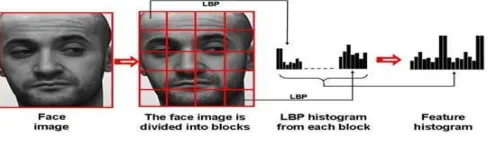
left middle, left bottom, right top, etc.). Follow the pixels on the circle, i.e. clockwise or opposite clockwise direction. where the center pixel's worth is larger compared to neighbour, write "1 " else write "0 ".This gives academic degree 8-digit binary vary (which is typically reworked into decimal for convenience) cypher the chart, on the cell, of the frequency of each "number" occurring (i.e., each combination of that pixels area unit smaller which area unit larger compared to center). Optionally normalize the chart. Concatenate normalized histograms of major cells. This is supply to all cell. The characteristic vector of the window.The local binary pattern (LBP) was originally designed for texture description.
Figure 1.3 Face Identification
B.TEXT RECOGNITION:
This model has been built around raspberry pi processor board. It’s dominant the peripherals like Camera, speaker associate degree alphanumeric display that act as an interface between the system and therefore the user. Optical Character Recognition or OCR is enforced during this project to acknowledge characters that area unit then scan out by the system through a speaker. As shown within the project setup, the camera is mounted on a fill in such an edge that if a paper is placed in between the world marked by angular braces, it captures a full read of the paper into the system. Also, once the camera takes the photo of the paper, it's ensured that there's smart lighting conditions. The content on the paper ought to be written in English (preferably Times New Roman) and be of fine font size (preferably twenty four or additional as per MS Word). Once of these conditions area unit met the system takes the picture, processes it and if it acknowledges the content written on the paper it'll announce on the speaker that the content on the paper has been with success processed. Once this it speaks out the content that was regenerate in to text format within the system from process the image of the paper. during this method Raspberry Pi primarily based Reader for Blind helps a visually handicapped person to scan a paper while not the assistance of any human reader or while not the assistance of tactile writing. The OCR suggests that Optical Character Recognition. This algorithm is used for converting captured image into readable codes.
C.MRP DETECTION:
The MRP detection system undergoes the following process, 1. Capture the image.
2. Localize the text region. 3. Text is cropped from the image. 4. Recognize the price.
5. Converting the text to speech by e-Speak tool.
D. LOCATION IDENTIFICATION MODULE:
E.ELECTRICAL APPLIANCE CONTROL:
Using voice commands user can able control the electrical appliance like fan, lamp etc. This module converting the voice signal into binary code .This generated binary code is given to the microcontroller as input. The microcontroller generate the output according to the voice input. Thus using this module we will control switch relay corresponding to the voice command.
IV.ARCHITECTUREDIAGRAM
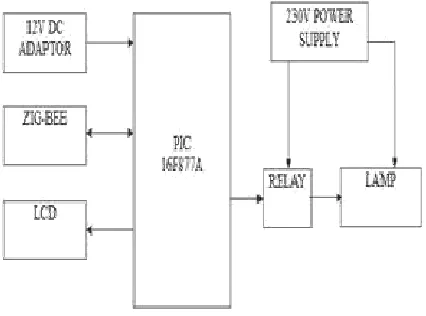
BLOCK DIAGRAM DESCRIPTION:
In this paper, ARM11 processor is interface to the camera, microphone and speaker. Camera is mainly used five purposes. First, detect the MRP rate, and second, detect the GPS location. Third, Face recognition. Fourth one is road sign recognition and reading newspaper.
Microphone is used to control the 230V devices using voice commands. When voice command is matched that time control signal send to the Pic16f877a micro controller through zig-bee, so 230V device is activate through relay.
Speaker is used to tell the MRP rate, Road signs information, news present in paper and GPS location and known person or not. Switches are used to changing the mode of operation in this device. Relay act as a switch when voice commands are matched switching the 230V supply into Lamp.
V.COMPONENTS USED
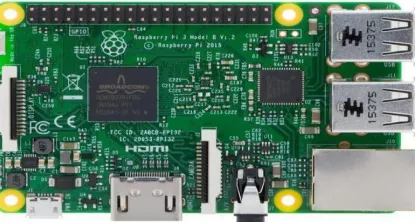
1. BCM 2837
This is the Broadcom chip used in the Raspberry Pi 3, and in later models of the Raspberry Pi 2. The underlying architecture of the BCM2837 is identical to the BCM2836. The only significant difference is the replacement of the ARMv7 quad core cluster with a quad-core ARM Cortex A53 (ARMv8) cluster. The ARM cores run at 1.2GHz, making the device about 50% faster than the Raspberry Pi 2. The Video Core IV runs at 400MHz.
Figure 1.6 Raspberry pi processor board
2. MICRO CONTROLLER
Figure 1.7 PIC16F87XA Microcontroller
3 .RELAY
Relays are switches that open and shut circuits electromechanically or electronically. Relays management one circuit by gap and shutting contacts in another circuit.
4. ZIG BEE
The distances which will be achieved transmission from one station to subsequent extend up to concerning seventy metres, though considerably larger distances is also reached by relaying information from one node to subsequent in a very network.
VI.EXPERIMENTAL RESULTS
1.MRP DETECTION:
(c) Output image for MRP detection
2.FACE IDENTIFICATION:
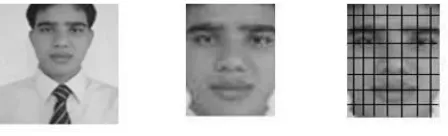
(a) Face detection using haar cascade (b) Face identification using LBP algorithm
VI. CONCLUSION
The main challenge of the proposed work is an effort to minimize the dependence of the user on the people round him while carrying out chores on a daily basis. The concept of a wearable device, which supports the general human tendency of pointing at objects to interact with the environment. A prototype to a low cost solution to the problem faced by the visually impaired while interacting with their environment. This device will help the blind people to do their work independently. Reduce manual work and it is more efficient and reliable.
REFERENCES
[1] D. Dakopoulos and N. Bourbakis, “Wearable obstacle avoidance electronic travel aids for blind: a survey,” IEEE Tran. Syst. Man Cybern. C, Appl. Rev., vol. 40, no. 1, pp. 22-35, Jan. 2010.
[2] J. A. Brabyn, "New Developments in Mobility and Orientation Aids for the Blind," IEEE Trans. Biomed. Eng., vol. 29, no. 4, pp.285-289, Apr. 1982. [3] S. Shraga, J. Borenstein, and Y. Koren, “The Navbelt-A computerized travel aid for the blind based on mobile robotics technology,” IEEE Trans.
Biomed. Eng., vol. 45, no. 11, pp. 1376-1386, Nov. 1998.
[4] T. Ifukube, T. Sasaki, and C. Peng, “A Blind Mobility Aid Modeled After Echolocation of Bats,” IEEE Trans. Biomed. Eng., vol. 38, no. 5, pp.461-465, May 1991
[5] T. Ojala, M. Pietikainen and D. Harwood, “Acomparative study of texture measurewith classification based on feature distributions” Pattern Recognition vol. 29, 1996.
[6] Face Recognition using Local Binary Patterns (LBP) By Md. Abdur Rahim, Md. Najmul Hossain, Tanzillah Wahid & Md. Shafiulazan. [7] https://docs.opencv.org/3.3.0/d7/d8b/tutorial_py_face_det ection.html
[8] Manoj Badoni and Sunil Semwal, "Discrete Distance And Water Pit Indicator Using Avr Atmega8 In Electronic Travel Aid For Blind", International Journal of Disaster Recovery and Business Continuity Vol. 2, November, 2011.
[9] S. Mann, J. Huang, R. Janzen et al., “Blind navigation with a wearable range camera and vibrotactile helmet,” in Proceedings of the 19th International Conference on Multimedia (MM '11), pp. 1325–1328, ACM, December 2011.