University of Windsor University of Windsor
Scholarship at UWindsor
Scholarship at UWindsor
Electronic Theses and Dissertations Theses, Dissertations, and Major Papers
1987
A Comparative Study of Language Structure and Its Significance
A Comparative Study of Language Structure and Its Significance
for Intercultural Communication: Japanese and American
for Intercultural Communication: Japanese and American
Communication Patterns in the Translation of First and Second
Communication Patterns in the Translation of First and Second
Person Pronouns
Person Pronouns
Chieko Nabetani
University of Windsor
Follow this and additional works at: https://scholar.uwindsor.ca/etd
Recommended Citation Recommended Citation
Nabetani, Chieko, "A Comparative Study of Language Structure and Its Significance for Intercultural Communication: Japanese and American Communication Patterns in the Translation of First and Second Person Pronouns" (1987). Electronic Theses and Dissertations. 8005.
https://scholar.uwindsor.ca/etd/8005
A COMPARATIVE STUDY OF LANGUAGE STRUCTURE
AND ITS SIGNIFICANCE FOR INTERCULTURAL COMMUNICATION
Japanese and American Communication Patterns in the
Translation of First and Second Person Pronouns
by
Chieko Nabetani
A thesis
presented to the University of Windsor in partial fulfillment of the thesis requirement for the degree of
Master of Arts in
Communication Studies
Windsor, Ontario, Canada, 1987
UM I Number: E C 548 17
INFO RM ATIO N TO USERS
The quality of this reproduction is dependent upon the quality of the copy submitted. Broken or indistinct print, colored or poor quality illustrations and photographs, print bleed-through, substandard margins, and improper alignment can adversely affect reproduction.
In the unlikely event that the author did not send a complete manuscript and there are missing pages, these will be noted. Also, if unauthorized copyright material had to be removed, a note wilt indicate the deletion.
UMI Microform E C 5 4 8 1 7 Copyright 2010 by ProQuest LLC
All rights reserved. This microform edition is protected against unauthorized copying under Title 17, United States Code.
ProQuest LLC
789 East Eisenhower Parkway P.O. Box 1346
I hereby declare that I am the sole author of this thesis.
I authorize the University of Windsor to lend this thesis to other institutions or individuals for the purpose of scholarly research.
Chieko Nabetani
I further authorize the University of Windsor to reproduce this thesis by photocopying or by other means, in total or in part, at the request of other institutions or individuals for the purpose of scholarly research.
ABSTRACT
The purpose of this thesis is to analyze comparative data from
novels in both Japanese and English to demonstrate the obstacles to
accurate translation of personal pronouns.
The differences in language structure which create difficulties
in translation are due to cultural differences. The effects of
background culture on the pronoun systems are considered at length in
this study. There are many varieties of forms of first and second
person pronouns in the Japanese language, which imply various
relationships between the speaker and the addressee, whereas in
English, there is only one form of first and second pronouns.
As a result of the textual analysis, it can be said that
translating Japanese into English distorts characteristics of Japanese
interpersonal communication by collapsing them into a one-dimensional
pronoun framework. Conversely, translating English into Japanese
distorts American interpersonal communication patterns by expanding
them into a multi-dimensional pronoun framework which reflects
characteristics of Japanese society.
Pronouns are obstacles to translation. Translators are forced to
eliminate distinctions (Japanese to English) or to create them
(English to Japanese). All they can do is to minimize these problems
as much as possible by taking the cultural context into account.
Finally, an effort is made to stress the importance of the role
DEDICATION
ACKNOWLEDGEMENTS
I would like to express my deepest gratitude to
Professor Christopher King whose guidance, supervision and support
assisted in the completion of this study. I am also indebted to
Professor Marlene Cuthbert for her warm support and encouragement, and
to Professor Adolf Ehrentraut for his helpful suggestions and his
knowledge of Japanese society. As well, I am grateful to
Professor Kalyan Kumar Sarkar for providing useful information about
previous works in the field, and to Mrs. Titia Ehrentraut and
Mrs. Pamela Floyd Ogawa for proof-reading. Mrs. Carol Armour deserves
thanks for her excellent and sometimes rushed typing jobs.
In the Department of Communication Studies, Sheila Labelle and
Ann Gallant have always made things easy and comfortable for me, and
Karen Kaus has helped to reduce ray fear of Wordstar.
I also gratefully acknowledge Professor Bob Whitehurst and his
wife Jean for introducing me to many cultural events. Thanks as well
to the Perichs, for warmly involving me as a part of their family.
And, I wish to acknowledge all of my friends, especially June Degia
and Graham Thompson for helping with my English at short notice, and
to John Hamilton for his continued encouragement.
I wish to express special thanks to my parents who have always
supported and encouraged me to make use of all opportunities, and to
my sister Naomi and my friend Toraoko for sending me many books from
Financial support during this study was provided by the Rotary
International, Takaoka Rotary Club (Japan), and Windsor Rotary Club
(Canada).
To all of you, again,
(Dorao arigato gozai masu.) — "Thank you very much."
Chieko Nabetani
PREFACE
It is from my personal experiences with so-called autistic
children in 1982 that I began seriously questioning the concepts of
'language' and 'communication.' — Why do these children not speak?
Why do we label them as 'handicapped' just because they are not using
language as a tool of communication? Most autistic children cannot
speak because of psychological, rather than physical, problems. I
finally recognized that they are very sensitive towards communication.
Body language is their primary way of communication, and once they
trust and become willing to communicate with someone they begin,
little by little, to use oral language.
'The way I speak is only the right way of communicating with
others7 this concept which had dominated ray mind was totally
revolutionized by my experiences with autistic children. Through
them, I have become aware of how much variety exists in interpersonal
communication, and how important it is to be sensitive to other
people's methods of communicating, even within the oral language that
each of us use in his or her own way.
My two-year stay in Canada has brought me to more deeply
understand about 'language' and 'communication,' by putting myself in
the circumstance in which I could not use my primary tool of oral
of how 'culture7 is related to ray primary interest of language and
communication, and how culturally unique every language and way of
communication can be.
This study arises from my personal interest towards enhancing
communication, which includes all varieties of communication in my
life. Also, if possible, I hope people in this world become more
aware of intercultural communication, and more sensitive to every form
CONTENTS
ABSTRACT Iv
DEDICATION v
ACKNOWLEDGEMENTS vi
PREFACE viii
LIST OF TABLES xii
LIST OF FIGURES xiii
page
CHAPTER I. INTRODUCTION 1
1. Purpose 3
1.1 The Study of Translation 3
1.2 The Study of Translation between
Japanese and English 4
2. Method 4
3. Perspective 7
CHAPTER II. APPROACHES TO TRANSLATION AND MEANING 9
1. Language, Self and Socialization 9
2. Translation and Meaning 11
3. Important Considerations for Translators 12
4. Translation Difficulties between
CHAPTER III. JAPANESE AND ENGLISH FIRST AND SECOND PERSON PRONOUNS 15
1. Japanese First and Second Person Pronouns 15
2. English First and Second Person Pronouns 17
3. Cases of Personal Pronouns 18
4. Different Usages of Pronouns; Japanese and
English 19
4.1 Power Relationships 19
4.2 Functions of Pronouns 20
CHAPTER IV. TEXTUAL ANALYSIS 26
1. The Sound of the Mountain 26
1.1 A Synopsis of the Novel 27
1.2 The Ogatas' Family Unit in the Novel 28
1.3 The Style of the Novel 29
1.4 First Person Pronouns 29
1.5 Description of Usage 32
1.6 Second Person Pronouns 33
1.7 Description of Usage 34
1.8 First and Second Pronouns in the
Selected Relationships 40
1.9 The Special Usages of Pronouns in the Novel 44
1.10 Translation Difficulties from Japanese into
English 46
!he Grapes of Wrath 48
2.1 A Synopsis of the Novel 49
2.2 The Joads' Family Unit in the Novel 50
2.3 The Style of the Novel 50
2.4 First Person Pronouns 51
2.5 Description of Usage 52
2.6 Second Person Pronouns 59
2.7 Description of Usage 60
2.8 First and Second Pronouns in the
Selected Relationships 74
2.9 The Special Usages of Pronouns in the Novel 78
2.10 Translation Difficulties from English into
Japanese 81
CHAPTER V. CONCLUSION 85
1. Translation Difficulties and their Relation
to the Background Cultures 85
2. The Inevitable Distortions in Translations 88
3. Suggestions for Further Studies 92
4. Intercultural Implications 93
LIST OF TABLES
Table Page
1-1 Different Forms of the First Person Pronouns in
Yama no Oto (The Sound of the Mountain) 31
1-2 Different Forms of the Second Person Pronouns in
Yama no Oto (The Sound of the Mountain) 35
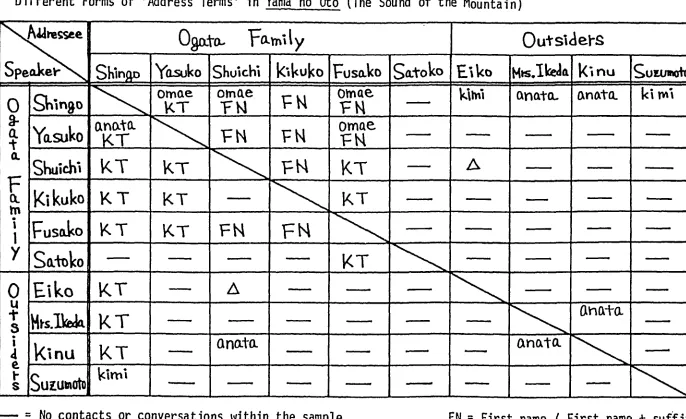
1-3 Different Forms of 'Address Terms' in Yama no Oto
(The Sound of the Mountain) 38
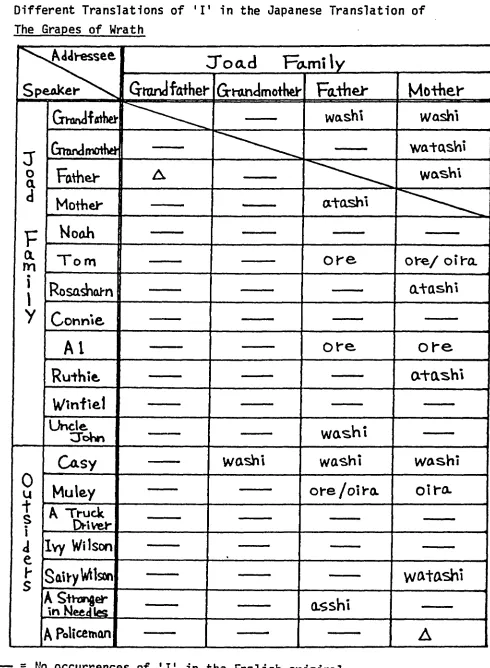
2-1 Different Translations of 'I' in the Japanese
Translation of The Grapes of Wrath 53
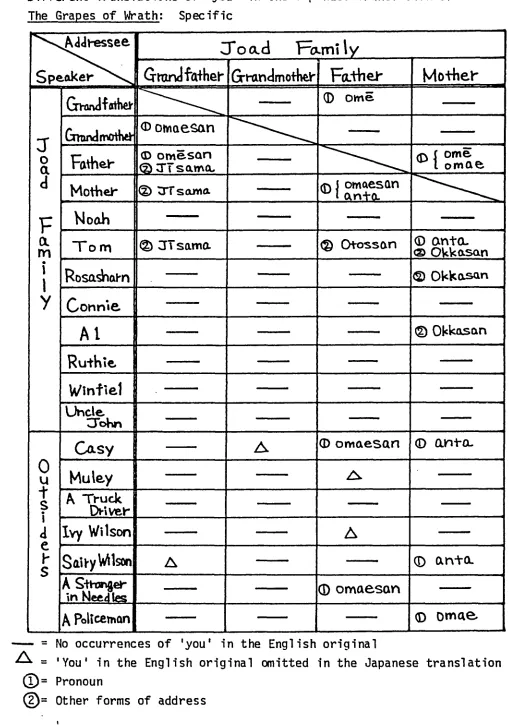
2-2 Different Translations of 'you' in the Japanese
Translation of The Grapes of Wrath: Specific 61
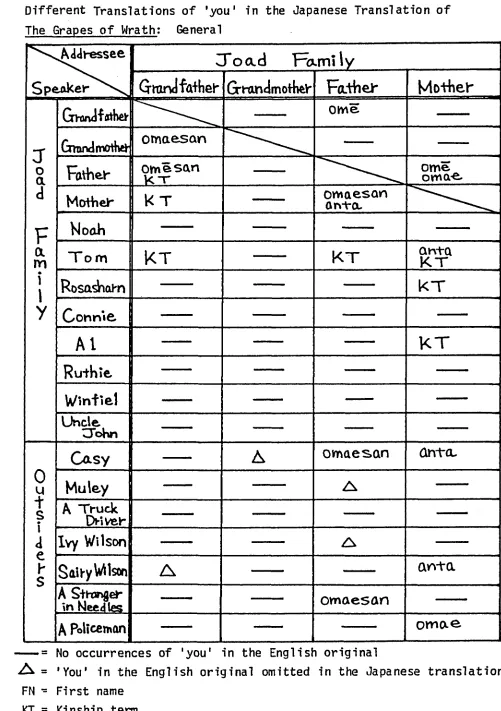
2-3 Different Translations of 'you' in the Japanese
LIST OF FIGURES
Figures
1-1
1-2
2 -1
2 - 2
Page
The first and second person pronouns used by Shingo
in Yama no Oto (The Sound of the Mountain) 46
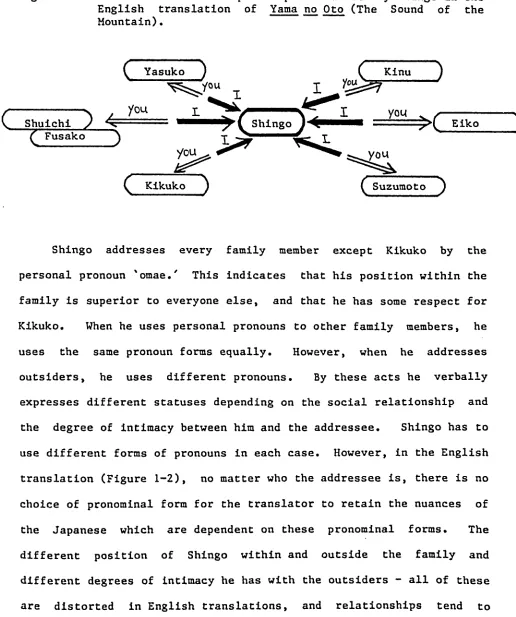
The first and second person pronouns used by Shingo in the English translation of Yama no Oto
(The Sound of the Mountain) 47
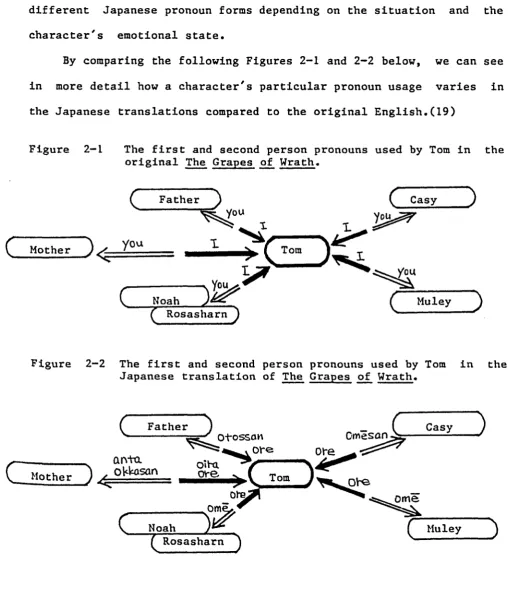
The first and second person pronouns used by Tom in
the original The Grapes of Wrath 82
The first and second person pronouns used by Tom in
CHAPTER I
INTRODUCTION
The following dialogue comes from the original Japanese The Sound
of the Mountain (1):
When Fusako asked "Rusubanwa?"
Shuichi said,
"Boku ga suru yo." ---(I)
Fusako said,
"lie, watashi ga suru w a . " --- (II)
(Kawabata 1957:317)
A published English translation of this scene is:
"Who will watch the house?" asked Fusako.
"I_ w i l l ," said S h u i c h i . --- (I')
(Fusako said,)
"No,
I
w i l l . " ---(II')Both (I) "Boku ga suru yo." and (II) "Watashi ga suru wa." are
translated into the same English phrase, "I will." In Japanese 'boku7
is a first person pronoun used by rather young men as a standard
usage, and by older men only in informal situations. On the other
hand, 'watashi7 is a first person pronoun used by all women and only
older men as a standard usage, but by younger men only in formal
situations.
The fact that Shuichi uses 'boku7 in (I) and Fusako uses
'watashi7 in (II) rather than any of a variety of first person
pronouns in Japanese, suggests that the scene is quite an informal
situation and that Shuichi is rather young. Instead of the two
different words 'boku7 and 'watashi,7 and all that they imply, both
pronouns can be only translated into 'I7 in English, since English has
only one personal pronoun for this use.
There are many varieties of forms of first and second person
pronouns in the Japanese language. The speaker has to choose from
these various forms depending on his or her relationship with the
addressee, and also depending on the situation. On the other hand, in
English only one form of first and second person pronouns is used.
As the above example shows, it is very difficult to express the
subtle meaning of Japanese personal pronouns in an English
translation. In the reverse situation, in order to translate from
English into Japanese the translator is obliged to guess at subtle
1 . P U R P O S E
The purpose of this thesis is to analyze comparative data from
novels in both Japanese and English to demonstrate the obstacles to
accurate translation of personal pronouns. An effort will be made to
show different interpersonal communication patterns of Japanese and
Americans which cause difficulties in intercultural communication.
1.1 The Study of Translation
In this internationalized world, people rely heavily on
translations such as academic journals, news, movies, literature etc.
Studying about translations is not only an important part of the
linguistic field, but also an important part of studying
communication. People deal with large amounts of translated
literature sometimes without recognizing they are translations. The
reliability of translation itself is usually taken for granted.
However, translations necessarily involve many difficulties which deal
with meaning.
To translate a text is to transfer life patterns from a specific
culture, which are mirrored in the linguistic system of that culture,
into a receptor culture and restructure them by using the linguistic
system of the receptor culture. Untranslatable or mistranslatable
elements are mostly related to the cultural differences between the
source culture and the receptor (target) culture.
The connection between a culture and its language is important
1.2 The Study of Translation between Japanese and English
In today's world the need for translation between Japanese and
English has been increasing rapidly. Up to World War II translated
information was mainly one way, that is, from English into Japanese.
After the war this trend intensified as Japan tried hard to catch up
economically as well as technologically to the Western world
especially the United States.
Today, however, Japan has grown to one of the most highly
economically and technologically advanced countries. Now it has
become increasingly necessary for other countries to get firsthand
information - usually in Japanese - about Japan. This is the era,
therefore, when more emphasis is needed on the study of Japanese and
English translation problems.
2. METHOD
These translation difficulties will be displayed by textual
analysis of translations of two novels. How Japanese communication
patterns are translated into the native English speaker's
communication patterns, and how English communication patterns are
translated into the native Japanese speaker's communication patterns
will be investigated by examining the same dialogues in both the
From among many possible forms of interpersonal communication in
daily life, this study focuses on the family unit, both Japanese and
American, since the family is the most fundamental social unit for
most human beings.
Comparisons of Japanese and American interpersonal communication
patterns within the family unit will center around Japanese and
English first and second person pronouns. Examining the usage of
first and second person pronoun systems allows us to examine the
.relationship between the speaker and the addressee.
The sources chosen for this analysis are the Japanese novel The
Sound of the Mountain by Yasunari Kawabata and its English
translation, and the English novel The Grapes of Wrath by
John Steinbeck and its Japanese translation.
These two novels were selected because both portray aspects of
the family unit very well, and are full of dialogues between family
members. These two features are not found in many books available in
both languages. Moreover, both Kawabata and Steinbeck received Nobel
Prizes in literature, were admired by the public, and portrayed the
1930's. These important similarities mean that valid comparisons can
be possibly made.
These two novels do not cover all possible samples of
interpersonal communication patterns within the family unit. The
purpose of this research, however, is not to cover all the different
obstacles to accurately translating Japanese and English pronouns as
they occur in different interpersonal communication patterns within
the family. Thus, an effort will be made to show how difficult it is
to translate pronouns without distortion, and how elements of such
difficulties are easily found in ordinary conversations in everyday
life. For these reasons, these two novels provide sufficient quality
and quantity to predict and show the essential difficulties which
create distortions in translating interpersonal communication
patterns.
The research conducted here is organized into four chapters.
Chapter II deals with approaches to translation and meaning. In order
to make clear that the differences in language structure which create
difficulties in translation are due to cultural differences, the
sociology of language will also be discussed.
In Chapter III, a comparison of the pronouns of both Japanese and
English will be made. The different syntactical functions of pronouns
are stressed, and the effects of background culture on the pronoun
systems will be investigated further.
Chapter IV is devoted to comparing each original novel with its
translated version through examples of pronoun usage found in
dialogues. The variety of relationships among family members can be
found by tracing the different pronouns used in the Japanese version
of The Sound of the Mountain, and then comparing them with their
translation. In both novels, the change of relationships through time
as shown in pronoun usage will be investigated.
Finally in Chapter V, some contrasts can be made between the
Japanese family unit and the American family unit by analyzing the
translation problems discovered through comparisons made in the
previous chapter. The social structure embedded in the pronoun
systems will be considered. An effort will be made to interpret
translation as a means of enhancing intercultural communication.
3. PERSPECTIVE
Since this study deals with the subtle usage of language and its
nuances in the background culture, it is difficult to quantify. A
phenomenological perspective will be employed to investigate language
structure. From the phenomenological perspective, the social world is
the product of human thought and activity. Therefore, explorations of
general principles should be carried out in accordance with the way
one's daily life organizes his/her experiences, especially the social
world (Schutz 1967). This is a way to look at the 'phenomena' that
are made available to a person by using the epoche.(2) Thus, my
personal knowledge will be an important source for this study. In
addition, a micro focus on everyday life is highly emphasized. As a
bilingual student of English and Japanese I will make extensive use of
both English and Japanese sources. Through my personal experiences of
and deepened my understanding of my background culture, Japan, as well
as of North American culture. These experiences will provide
CHAPTER II
APPROACHES TO TRANSLATION AND MEANING
1. LANGUAGE, SELF AND SOCIALIZATION
The existence of language implies the creation of a universe of
discourse for individuals by enabling understanding through
communication. Thus, language is fundamental to all social processes,
and to the persistence and maintenance of all social structures; it is
involved in almost every act of social behavior. It is the one
institution that every human being must master in order to function in
any of the other institutionalized areas of social life (Hertzler
1965:19).
Hertzler also points out that language plays a significant part
not only In the consciousness of self, but also in the closely related
development or construction of self (Hertzler 1965:396).
George H. Mead maintained people communicate mostly by sharing
significant symbols. Through interaction, the process of
socialization begins. The early stage of socialization is an
important time for learning the skills necessary for societal living
the idea of self. Therefore, language and self develop together in
social situations (Mead 1934).
The individual is not born a member of society. By using
language he/she becomes aware of his/her 'self' as well as social
structure. Language, self and socialization are inseparable. In Geza
Revesz's memorable words: "Man made language, and language fashioned
man and made him human" (quoted in Herzler 1965:21). This means that
language itself is not only a unique human social product, but also
the basic tool in human socialization.
Through language the essential knowledge for social behavior is
gained. Also, by means of language, social values, attitudes, ideas,
traditions and ideologies are made conceivable for the human and at
the same time internalized by him/her. The cultural contexts of
languages differ widely making communication tremendously difficult
between those who employ different mother tongues.
Benjamin Whorf argued that because people can conceptualize their
world only through language, language is prior to thought (Whorf
1956). For example, the way people whose mother tongue is a Western
European language think about the world is different from the way
2. TRANSLATION AND MEANING
Translation is one of the most common ways of communication
between those who use different languages. Therefore, difficulties of
translation will be inherent in the of cultural differences which are
embedded in language.
The essence of translation lies in the preservation of meaning
across two different languages (Brislin 1976). To translate text X
from one (source) language into another (target) language is to
transfer the meaning of that text from the source language and
reproduce it in the target language. This should be done as
faithfully as possible.
Linguistic theory, which is the foundation of translation theory,
has traditionally had a place within anthropology. Nevertheless,
relatively little research recognizes language as a social phenomenon
or the connection between linguistics and anthropology; the methods
and insights of the social sciences and those of linguistics have not
integrated well (Fishman 1971). The translation problems stemming
from the different perceptions of people who employ different
languages, suggest that anthropological research needs to be
integrated with linguistic theory.
Thus Eugene Nida, a leading scholar of translation, has
introduced sociolinguistic approaches to translation (Nida 1964).
This approach to translation deals with the author, the historical
background of the text, the circumstances involved in producing the
these elements figure in the social setting of communication (Brislin
1976).
One important aim of translation is to explicate the cultural
context of the source language and the target language. With this as
the goal, translators have to be sensitive to the ways in which words
are used and must know how the words fit into the cultures that use
the source and the target language. Therefore, the approach to
translation which I am emphasizing in this study is a sociolinguistic
approach.
3. IMPORTANT CONSIDERATIONS FOR TRANSLATORS
There are no systematic charts which infallibly help translators
to make perfect translations. There always remain untranslatable
passages. All that translators can do is to transfer the meaning as
faithfully as possible.
To reduce translation problems as much as possible, the 'etic'
view and the 'emic' view should be considered. These are two methods
for making discoveries about cultural differences which must be
considered when using the sociolinguistic approach. Kenneth Pike
coined the words 'etic' and 'emic' from the linguistic terras
'phonetic' and 'phonemic' (Pike 1967).
The 'etic' approach looks at behavior from the outside for the
purpose of comparing cultures. Categories of behavior are imposed on
study, i.e., the comparison of the kinds of events or behaviors
occurring in different cultures.
The 'emic' approach, on the other hand, attempts to discover how
a system looks from the inside, so ordinarily only one culture can be
studied at a time. Comparison is not a method of study, and the
categories and rules of behavior are derived from the user's point of
view.
While the 'etic' approach and the 'emic' approach are sometimes
combined, this study intends to suggest an appreciation for the emic
approach in understanding intercultural communication. Using the emic
approach, the translator can better understand linguistic and
cultural contexts. This approach is essential for translating a text
into another language, especially since certain words, situations,
idiomatic expressions, grammatical and rhetorical styles have
different meanings and implications in various cultures. Therefore,
language equivalencies based on an 'emic' knowledge of both cultures
must be used in translation in order to accomplish an accurate
interpretation.
4. TRANSLATION DIFFICULTIES BETWEEN JAPANESE AND ENGLISH
Donald Keene, who has translated much Japanese literature into
English writes: "The intricacies of the Japanese language prevent all
but a handful of foreigners from approaching the literature in the
the enthusiasm of the most adventurous-minded reader to cool" (Keene
1955:1). Having studied Japanese since 1941, and struggled to
overcome translation difficulties, he suggests that knowledge of the
general cultural background of the language is the first qualification
for the translator, rather than proficiency in the language (Keene
1971).
As previously mentioned, difficulties of translation are inherent
in the cultural differences which are embedded in language. Thus,
many translation difficulties between Japanese and American English
stem from the cultural differences between Japan and the United
States. The next chapter describes first and second person pronoun
usages in both Japanese and English, and provides insight into the
CHAPTER III
JAPANESE AND ENGLISH FIRST AND SECOND PERSON PRONOUNS
1. JAPANESE FIRST AND SECOND PERSON PRONOUNS
An English sentence, such as 'I saw you' can be used at any time,
in both formal and informal situations. In Japanese, however, this
simple sentence can be changed in many ways to express the speaker's
attitude or relationship to the addressee, and the situation when the
conversation takes place. Various examples follow:
~ A conversation between a husband and wife who have been married for
several years:
The husband would say to his wife,
"Ore wa omae o mita."
(I you saw)
In contrast to this, the wife would say to her husband.
"Watashi wa anata o mita."
- A conversation between university students:
A male student would say to his male friend who is the same age,
"Boku wa kimi o mita."
(I you saw)
In contrast to this, a female student would say to her female
friend who is the same age,
"Atashi wa anata o mita."
(I you saw)'
These examples show that pronouns clearly vary from conversation
to conversation in Japanese. In addition, the same speaker would use
different pronouns depending on the power relationship between him/her
and the addressee and also the situation in which he/she is involved.
The first person pronouns commonly used in Japanese are:
'watakushi,' 'watashi,' 'atashi,' 'washi,' 'boku,' 'ore,' and 'ora.'
Brief characterizations of the circumstances under which each of these
forms may be used follow (3):
watakushi: very formal for men, less so for women
watashi: slightly formal for men, less so for older men,
standard for women, also for girls
atashi: mainly by women, slightly more informal than
'watashi'
washi: usually rural dialect, used mainly by men and
regarded as characteristic of an older generation
boku: almost exclusively used by men, informal for
ore:
ora:
exclusively used by men, relatively
generation in casual situations
rural dialect, exclusively used by men.
younger
The second person pronouns commonly used in Japan are:
'anatasama,' 'anata,' 'anta,' 'kimi,' 'omae,' and 'ome.' Brief
characterizations of the circumstances under which each of these forms
may be used follow (4):
anatasama: very polite and formal
anata: standard and polite, more formal for men
anta: informal
kimi: mainly used by men to refer to a person who is
equal or of lower status
oraae: informal, mainly used by men to refer to a person
who is equal or of lower status, slightly
pejorative
ome: rural dialect of 'oraae,' pejorative.
2. ENGLISH FIRST AND SECOND PERSON PRONOUNS
In English, 'I' is the only first personal pronoun. No matter
who he/she is, no matter what the situation is, the speaker can only
use 'I' co refer to himself/herself as the subject. It is the same
with the second person pronoun. No matter to whom the speaker is
speaking, no matter what the situation is, the speaker can only use
3. CASES OF PERSONAL PRONOUNS
Both Japanese and English first and second person pronouns have
separate cases. Japanese personal pronouns are expressed in the
nominative, possessive, accusative and dative case with case markers
attached to pronouns. 'I,' 'my,' 'me' and 'mine' are the cases of
English first person pronouns. There are no separate case markers in
English. In Japanese 'wa' is used as a subject marker, 'no' is used
as a possessive marker, 'o' is used as a direct object marker and 'ni'
is used as an indirect object marker.
Case Japanese English
nominative (watakushi) wa I
possessive (watakushi) no my
accusative (watakushi) o me
dative (watakushi) ni to me
(Yoshida 1976:16)
Each one of the various Japanese pronouns previously introduced
can form all these cases with case markers. All of the various levels
of Japanese first person pronouns can be in the nominative case with a
subject maker 'wa.' Likewise, by using other case makers with the
various first person pronouns, other cases are easily employed. Thus,
each case has various levels in Japanese, which are determined by the
usages of the various first person pronouns and their nuances. In
4. DIFFERENT USAGES OF PRONOUNS; JAPANESE AND ENGLISH
4.1 Power Relationships
In Japanese, the first and second person pronouns are one of the
main mediums for expressing the relationship between the speaker and
the addressee. Pronoun usage also implies the speaker's social class,
his/her kind of family life, his/her level of education as well as
his/her personal character.(5) Besides these implications, pronouns
also indicate the speaker's feelings in various situations.
On the other hand, in English, the first and second person
pronouns are reciprocal. The speaker can only employ 'I' to refer to
himself/herself and 'you' to refer to the addressee. Therefore, it is
not necessary for the speaker to consider his/her social status, age,
sex, emotional situation or other factors. Not only that, neither 'I'
nor'you' show the relationship between the speaker and the addressee.
Differences in social class, seniority, kinship, intimacy, age, and
sex cannot be implied by these pronouns.
As one scholar has observed:
The most 'notable' of all the varieties of special language in Japanese is without question the extremely involved system for categories of speech levels generally referred to as 'honorific language' (Hiller 1967:269).
In Japanese, 'honorific language' appears on nouns, pronouns and
verbs, which are used to show formality, politeness, and respect.
This usage is an important aspect of the Japanese language, and is
determined by the power relationships between the speaker and the
The existence of the various forms of first and second person
pronouns in Japanese is also an important part of honorific
language.(6) The presence of honorific forms in Japanese pronouns of
Japanese and their absence in English pronouns is the key to the
analysis of the differences of the background culture of both pronouns
systems.
Yoshida points out that one of the most important factors in a
Japanese conversation is the awareness of the speaker that he/she is
superior, inferior or equal to the addressee (Yoshida 1976:43). When
speaking to an older person, who is usually considered superior to the
speaker, honorific language has to be carefully used to show
politeness in the right way. If the speaker does not know whether the
addressee is older or younger, he/she is usually confused about
which second person pronoun - 'kimi,' 'anata' or 'anatasama' to use.
The power relationship reflected in Japanese pronoun systems is clear,
whereas the English pronoun system has no equivalents.(7)
4.2 Functions of Pronouns
One characteristic of Japanese second person pronouns, pointed
out by Suzuki, a Japanese linguist, is that second person pronouns are
used less when speaking with 'superiors' (Suzuki 1973:132). They are
used more often in speaking to 'equals' or 'inferiors,' as well as to
new acquaintances about whom the speaker knows little or nothing.
Other forms of address such as occupation, position in an
Thus 'sense!/ (teacher) is used to address professional people
such as doctors, lawyers, politicians, writers, teachers, and other
professionals. Although 'sensei' literally means 'teacher,' it is
applied as a title to anyone belonging to one of the professions and
marks the addressee as superior to the speaker. 'Kochosensei'
(principal) is used to address the principal of his/her school. A
'sensei' also calls the principal 'kochosensei.' Within business
organizations, second person pronouns are replaced by one's title:
'shacho' is used to address the company president, 'bucho' (the
department supervisor), and 'kacho' (the section supervisor).
In families, second person pronouns are replaced by kinship terms
when younger members address elder members. The following kinship
terras are standard forms used as substitutes for second person
pronouns for elder persons(8):
one's grandfather ojTsan
one's grandmother obasan
one's father otosan
one's mother okasan
one's elder brother onisan
one's elder sister onSsan
(Yoshida 1976:27)
Superior (elder) members use second person pronouns as well as first
names or first names with suffixes to address inferior (younger)
According Co Che Cheory of Takeo Suzuki, Chep are five rules for
forms of address among family members (Suzuki 1973:151-153). These
are:
1. A person rarely addresses superiors wich personal pronouns,
buC he/she can address inferiors wich pronouns.
2. A person usually calls superiors by kinship Cerms, buC
he/she cannoC address inferiors by kinship Cerms.
3. A person cannoC address superiors by Cheir firsC names, buC
he/she can do so wich inferiors.
4. A person can refer Co himself/herself using his/her firsC
name when speaking Co superiors, buC he/she cannoC do so
when speaking Co inferiors.
5. When a person speaks Co inferiors, he/she can refer Co
himself/herself by his/her kinship Cerra in Che family,
buC cannoC do so when he/she speaks Co superiors.
These five normal behaviors are observed in all conversacions
among family members. To address non-family members, Suzuki
(1973:154-157) proposes Che following five rules as a summary of
normal behavior for forms of address Co persons ouCside Che family:
1. Generally one cannoC address one's superiors, such as
2. One can call these social superiors by titles such as
'kacho' (section chief) and 'sensei' (teacher). This
cannot be done when speaking to inferiors. For example,
just as one can address one's elder brother as 'onisan'
(elder brother), but cannot call one's younger brother
'ototo' (younger brother), a teacher cannot call his
students 'seito' (student), although they can call the
teacher 'sensei' (teacher).
3. A person cannot address his/her superiors by their family
names only, but this is rather common when speaking with
inferiors. When using someone's family name, a title must
be added. For example, we can say 'Yoshida-sensei' or
'Yamada-kacho.'
4. A person can refer to himself/herself by using his family
name when he/she speaks to his/her superiors in some
special cases, but he/she cannot do so when he speaks to
his/her inferiors.
5. Though it is possible in some special situations for a
person to refer to himself/herself by using a title when
he/she speaks to inferiors, it is impossible for him/her to
do so when he/she speaks to superiors. For example, a
teacher can refer to himself/herself as 'sensei' (teacher)
when he/she speaks to his/her students, but a student cannot
refer to himself/herself as 'seito' (student) when speaking
Suzuki's theories show clear and striking parallels between rules
of address within and outside the family. Each set of rules echoes
the other. Elsewhere, Suzuki also suggests that the category of
'pronouns' common in Indo-European languages is not really appropriate
for use in Japanese. Suzuki's rules of address can be better
explained by setting up two new categories which include titles,
personal names, kinship terms and personal pronouns, all of which can
be used for the same 'pronoun' functions (Yoshida 1976:30-31). These
new categories can be called 'terms for self' and 'address terms'
(Suzuki 1973:146).
Up to now I have been discussing the characteristics of Japanese
pronoun usage. It seems clear that there will be great distortions
when translating these various Japanese pronouns into English 'I' or
'you.' Most or all of the characteristics of Japanese interpersonal
communication patterns implied by Japanese pronominal forms and usages
will be eliminated. Similarly, there will be great difficulties when
translating 'I' or 'you' into one of the various Japanese forms,
especially in view of Suzuki's theory about the functions of 'terras
for self' and 'address terms,' which include other forms of address
besides pronouns, such as titles, names, kinship terms and so on. The
translator is obliged to create a new dimension of interpersonal
relationships by choosing one of 'terras for self' or 'address terms'
these distortions and difficulties have occurred in translations of
two major novels dealing with family life, one Japanese and the other
CHAPTER IV
TEXTUAL ANALYSIS
1. THE SOUND OF THE MOUNTAIN
The main purpose of this section is to investigate how first and
second person pronouns used in the Japanese original The Sound of the
Mountain are translated into English. The Japanese first and second
person pronouns are traced within the dialogues, and then compared
with their English translation.(9)
There are three possible approaches to translations from Japanese
to English pronouns:
< Original > < English Translation >
Japanese
first and second personal pronouns
(I) I / you
(II) other forms of address
(III) omitted
Most Japanese pronouns are translated into the English pronouns, 'I'
and 'you7 (Type I). There are also examples of the Japanese pronouns
kinship terras (Type II). In other examples, Japanese pronouns are
dropped in the English translation (Type III).
We will investigate all three types of translations. In each
case we will carefully examine the relationship between the speaker
and the addressee, as well as the situation.
1.1 A Synopsis of the Novel
The protagonist, Shingo, has a secret longing for a beautiful
woman who was his wife Yasuko's older sister. Although she is dead,
Shingo still has a beautiful image of her in his mind. It is not that
he is dissatisfied with his wife, but rather disturbed by his
unsuccessful love for her sister.
Shingo's family is surrounded by a gloomy atmosphere. His son,
Shuichi, frequently stays with a woman who is a war widow. Shuichi's
older sister, Fusako, has left her husband and stays with her parents
and her two little daughters, Satoko and Kuniko.
Kikuko, Shuichi's wife, reminds Shingo of a window looking out of
a gloomy house — she brings him relief. Additionally, there is
something about the delicate figure of Kikuko that makes Shingo think
of Yasuko's sister. Shingo's feelings toward Kikuko are the main
theme of this novel. The story is not about the love between a man
and a woman, but rather about the love of an old man for beauty, the
beauty of a naive and chaste young woman. Kikuko is a symbol of
Shingo's family structure is traditionally Japanese; a young
couple lives with their parents. Fusako's return complicates the
relationships within the household of these two couples. Before she
returns to her parents' home, the relationships within the family are
simple and clear cut: the parent couple versus the young couple.
Fusako's arrival changes the balance of these two dynamic
relationships within the family. It clarifies the following
individual relationships: parent and child, husband and wife, sister
and brother, daughter and parents-in-law, and sister and
sister-in-law. Each relationship is a necessary element of the entire family
structure. The author emphasizes the relationship between Shingo and
Kikuko, which is the relationship between a father and a
daughter-in-law, which becomes the focus of the story.
1.2 The Ogatas' Family Unit in the Novel
Yasuko Shingo
Fusako Kikuko
Aida Shuichi
1.3 Style of the Novel
There are sixteen chapters, each of which was first published
separately in various magazines. Therefore, each chapter sounds alone
like an independent short story, and at the same time forms a very
important element of the entire story line of The Sound of the
Mountain.
The chapters are full of conversations, each of which displays
subtle nuances about the feelings between members of the family. The
stresses and strains of a traditional Japanese family structure
adapting to social changes are emphasized throughout the story.
Besides the family members, the character of Eiko, a woman in the
office where both Shingo and Shuichi work, and the character of
Mrs. Ikeda, a roommate of Shuichi's mistress Kinu, as well as
Mr. Suzumoto who is Shingo's old friend are important in the novel.
The dialogue of these characters is also used in the textual analysis
in order to contrast it with the dialogue which takes place between
Shingo's family members.
1.4 First Person Pronouns
The following are excerpts from Shingo's dialogues with other
persons. The English translation is given below each sentence.
- Shingo to Kikuko:
"Watashi wa kono aida kara miteita." (J : 60) (10)
- Shingo to Suzumoto:
"Boku mo nobotta koto ga nainda." (J : 94)
"Neither have I_." (E: 82)
- Shingo to Kinu:
"Watakushi ga oaisuruno wa mySna mono desu ga ... " (J : 267)
"It must seem strange that 1^ should be calling on you."
(E: 232)
Shingo uses three different first person pronouns to three
different persons to whom he is speaking: 'watashi' to Kikuko, 'boku'
to his old friend Mr. Suzumoto and 'watakushi' to his son's woman
Kinu. The use of 'watashi' by Shingo to Kikuko, as well as to other
family members, signifies his position as head of a traditional
upper-middle class family. 'Boku' used by Shingo to his old friend
indicates their informal and close relationship. By using the
extremely polite form, 'watakushi' to Kinu, Shingo is very formal and
wants to apologize about his son. At the same time Shingo tries to
keep a distance from Kinu. However, all of these different first
pronouns are translated into 'I' in English.
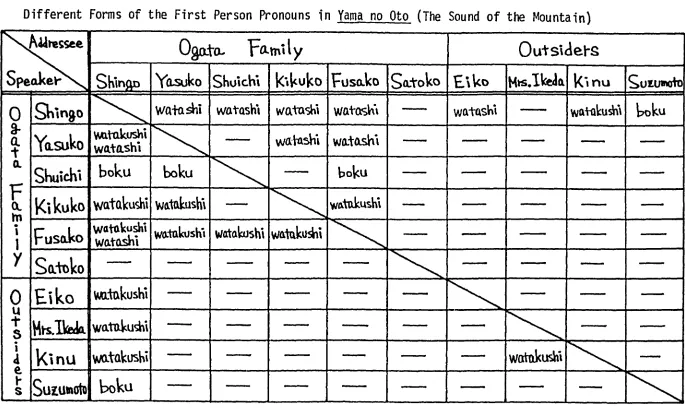
Which character of the novel uses which first person pronoun to
Reprod uc ed w ith pe rm is si o n of th e co py ri gh t o w ne r. Fu rthe r rep roduction p ro h ib it e d wi th ou t p e rm is s io n .
Table 1-1
Different Forms of the First Person Pronouns in Yama no Oto (The Sound of the Mountain)
x A i t a s s e e
O g a t a -
F a m i l y
O u t s i d e t S
S p e a k e r ' s ^
S h i n g D
Y a s u k o
S h u i c h i
k i k u k o
F u s a k o
S a t o k o
E l k o
M v s . l k & l a
k i n u
S u i u m o t o
0
S h ' m g o
\
w a t a s h i
w a t a s h i
w a t a s h i
w a t a s h i
- -
w a t a s h i
w a t a k u s h i
b o k u
&•
a
+
Y a s u k o
w a t a k u s h i
w a t a s h i
w a t a s h i
w a t a s h i
---- --- --------a.
T—
S h u i c h i
b o k u
b o k u
's \
----b o k u
----F
OL
hi
•
■
K i k u k o
w a t a k u s h i w a t a k u s h i
—w a t a k u s h i
F u s a k o
w a t a k u s h i
w a t a s h i
w a t a k u s h i
w a t a k u s h i w a t a k u s h i
--------y
S a t o k o
---- ---- ---- ---- ---- -------0
E i k o
w a t a k u s h i
---- ---- -------u
+
s
M t s i W a w a t a k u s h i
---- ---- ----
----* 1
a
K i n u
w a t a k u s h i
---- ---- --- ----w a t a k u s h i
—t
s
Si i £ U t t o t o | b o k u
---- ---- ---- ----1.5 Description of Usage
All the Japanese first person pronouns in this story are
translated into the English first person pronoun 'I,' the first
approach (Type I) discussed earlier in this chapter. The following
examples are summarized in Table 1-1.
Shingo: He uses 'watashi' to all his family members equally, but he
uses different forms to outsiders. The extremely polite form,
'watakushi,' is used to Kinu, and the casual form, 'boku,' is used to
Suzumoto.
Yasuko: She mainly uses the formal form 'watakushi' to her husband,
Shingo. The women's standard form, 'watashi' is used after a rather
long conversation with him. She consistently uses 'watashi' to all the
younger family members.
Shuichi: He uses the younger men's standard form, 'boku' to every
family member.
Kikuko: She regularly uses the formal polite form, 'watakushi' to
each member of her family. As a person who originally comes from
outside of the family, she consistently shows politeness to every
other family member.
Fusako: She usually uses the formal form 'watakushi' to her family
members. When she is upset at her father she uses the standard form,
Eiko, Mrs. Ikeda, Kinu: They also regularly use the formal polite
form, 'watakushi' to Shingo. Kinu uses 'watakushi' to Mrs. Ikeda,
too.
Suzumoto: He uses 'boku' to Shingo. 'Boku' is used by an older male
only in informal situations to a person who is of lower or equal
status.
The regular use of 'watakushi' by female family members indicates
their upper-middle class status and traditional family relations
(Kakutani 1978:49). Each family member uses a different first person
pronoun, but they keep using the same form when addressing all family
members. However, as in example in 1.4, Shingo differentiates pronoun
usage clearly between family members and outsiders. Even among
outsiders, he differentiates forms 'boku,' 'watashi' and 'watakushi'
depending on who is the addressee. In spite of what are implied by
these Japanese pronouns in the original work, all of them are
translated into the one-level English pronoun 'I.'
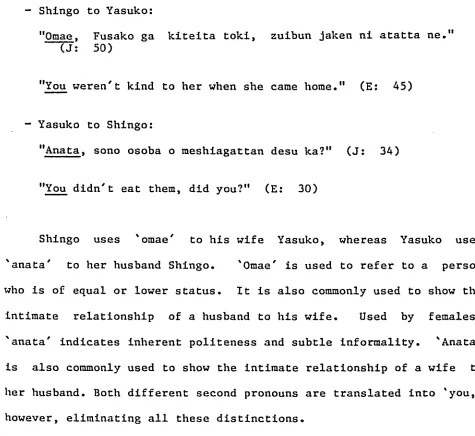
1*6 Second Person Pronouns
The following are excerpts from dialogues between Shingo and
Yasuko which suggest some of the subtleties of mean i n g conveyed by
- Shingo to Yasuko:
"Omae, Fusako ga kiteita toki, zuibun jaken ni atatta ne." (J: 50)
"You weren't kind to her when she came home." (E: 45)
- Yasuko to Shingo:
"Anata, sono osoba o meshiagattan desu ka?" ( J : 34)
"You didn't eat them, did you?" (E: 30)
Shingo uses 'omae' to his wife Yasuko, whereas Yasuko uses
'anata' to her husband Shingo. 'Omae' is used to refer to a person
who is of equal or lower status. It is also commonly used to show the
intimate relationship of a husband to his wife. Used by females,
'anata' indicates inherent politeness and subtle informality. 'Anata'
is also commonly used to show the intimate relationship of a wife to
her husband. Both different second pronouns are translated into 'you,'
however, eliminating all these distinctions.
Table 1-2 shows which character uses which second person pronoun
to whom.
1.7 Description of Usage
Our sample includes no cases where Japanese second person
pronouns are translated into other forms of address in English (Type
II in Section 1). There are, however, a few cases where the pronouns