MANAGEMENT OF EDUCATIONAL INNOVATION: THE CASE OF
COMPUTER-AIDED ADMINISTRATION
by
Alexander Chi-wah Fung
A thesis submitted in fulfilment of the requirements for the degree of Doctor of Philosophy
m
ABSTRACT
This thesis is concerned with the process of managing an
educational innovation - computer-aided administration (CAA) for
schools. From literature reviews in the areas of management of change and computer assisted school administration, together with findings from an observer case study in the United Kingdom, a
model was generated for the CAA innovation process as a contribution to theory. The model was then put into practice as the
framework for the CAA innovation process in a secondary school
in Hong Kong. The innovation was successfully assimilated by the school in a period of about three years with the researcher acting as the change facilitator, and the model of the innovation process was subsequently refined. This refined "SIX-A" model it is hoped will
be a contribution to practical change management. Before making conclusions, findings about the process of innovation as well as findings specific to CAA from the case school are compared and
contrasted to data collected from three other schools' CAA innovations in Hong Kong.
ACKNOWLEDGMENTS
In the epilogue to the thesis, I use the analogy of an exploratory adventure for managing an educational innovation. It seems equally appropriate to use the same analogy to describe the research for a PhD. I was never alone throughout the whole journey and was greatly privileged to have my supervisor Dr. Pamela Young guiding and advising me all along. Her critical comments were inspiring and made me stretch my mind. The support and encouragement that she gave me were most needed to complete the thesis.
I am also indebted to Dr. John Welton for his supervision of my study during the period 1985 to 1986 when he was with DEAPSIE of the London University Institute of Education. He helped me much to lay a firm foundation for the whole thesis. I deeply appreciate his support not just for my research work but for making my stay in London both a happy and memorable one.
During my research I was fortunate to meet many dedicated professionals, school principals, teachers, and have made many friends. I am most grateful to them for their assistance and contribution to the research. Although I cannot mention all names, I must specially thank Peter Watts for his openness and kind acceptance for my participatory ILEA case study. I must also thank my good friends Dr. David Lancaster and Adne Visscher for sharing their valuable reference materials as well as expert opinions on CAA.
Typing, editing, and printing of a thesis used to be a tough job. I did them all by myself and found it to some extent even enjoyable - with my microcomputer. ]E am grateful to the many anonymous people who have contributed to the development of the technology.
CHAFFER 2. CHAFFER 3. 9 11 12 15
TABLE OF CONTENTS
PME
ABSTRACT
ACKNOWLEDGMENTS U
TABLE OF CONTENTS 'U
LIST OF FIGURES vi
GLOSSARY vu
CHAFFER 1. PURPOSE & ORGANISATION OF THE THESIS 1
1.0 INTRODUCTION
1.1 PURPOSE OF THE STUDY 1
1.2 CAA & INFORMATION MANAGEMENT 5
1.3 ORGANISATION OF THE THESIS 6
REVIEW OF LiTERATURE I - SYSTEMS THEORY 2.0 INTRODUCTION
2.1 SYSTEMS AND ORGANISATIONS 2.2 SOME PROPERTIES OF SYSTEMS 2.3 CLASSIFICATION OF SYSTEMS
2.4 DELIMITATIONS ON SYSTEMS AJ'PROACH
REVIEW OF LITERATURE
II-EDUCATIONAL CHANGE & INNOVATION 3.0 INTRODUCTION
3.1 EDUCATIONAL CHANGE AND INNOVATION 3.2 ORIGIN/SOURCE OF EDUCATIONAL CHANGE 3.3 INHERENT NATURE OF CHANGE
3.4 WHY INNOVATIONS FAIL
3.5 A TYPOLOGY OF INNOVATION FACTORS 3.6 MODELS OF CHANGE
3.6.1 GENERAL MODFLS
3.6.2 PROCEsS-ORIENTED MODELS
PME
3.7 STRATEGIES OF IMPLEMENTATION 33
3.8 TYPES OF EDUCATIONAL INNOVATION 36
3.9 CAA AS AN EDUCATIONAL INNOVATION 38
3.10 THEORIES OF CHANGE, OR OF CHANGING? 39
3.11 CURRENT PERSPECTIVES ON CHANGE 42
311.1 CHANGE AND EXCELLENCE 3.11.2 CHANGE ISA LEARNING PROCESS 3.11.3 CHANGE AND PEOPLE
3.11.4 CHANGE AND CULTURE 3.11.5 CHANGE AND LEADERSHiP
3.12 WHOLE SCHOOL APPROACH IN EDUCATIONAL CHANGE 56
CHAPTER 4. COMPUTERS IN EDUCATIONAL ADMINISTRATION
-TEChNICAL KNOWLEDGE 62
4.0 INTRODUCTION
4.1 THE INFORMATION AGE 63
4.2 BENEFITS OF COMPUTERJSATION 64
4.3 COMPUTERS IN SCHOOL ADMINISTRATION
-A SHORT HISTORY 71
4.3.1 THE U.S.A. SCENARIO 4.3.2 THE BRITISH SCENARIO 4.3.3 THE HONG KONG SCENARIO
4.4 CM APPLICATIONS AND APPROACHES 86
4.4.1 THE TASK—ORIEtdTED APPROACH 4.4.2 THE FUNCTIONAL APPROACH 4.4.3 THE JWIEGRA TED APPROACH
4.5 THE FUTURE SCENARIO: A SYSTEMS PERSPECTIVE
FOR CM IN HONG KONG 91
4.5.1 LESSONS FROM OTHER COUj'TfRIES
CHAFIER S. RESEARCH DESIGN & METHOD 95
5.0 INTRODUCTION
5.1 TWO PARADIGMS IN EDUCATIONAL RESEARCH 96
5.1.1 RATIONALiSTIC VERSUS NATURALISTIC 5.1.2 NATURALISTIC INQUIRY INTO RFALTI7ES 5.1.3 SYSTEMS APPROACH & ACTIONAPPROACH
5.3 STAGES OF THE RESEARCH 103
5.3.1 INFORMATION GATHERING STAGE 5.3.2 CASE STUDY!
5.3.3 CASE STUDYIJ
5.4 VALIDITY & CRITICAL SUBJECTIVITY 111
CHAPTER 6. A REGIONAL CAA INNOVATION CASE IN LONDON:
ESTABLISHING A TENTATIVE MODEL 113
6.0 INTRODUCTION
6.1 THE ILEA CAA INNOVATION 114
6.1.1 CONTEXT FOR THE INNOVATION 6.1.2 CHARACTERiSTICS OF LEA
6.1.3 CONTEXT FOR CAA IN LEA SCHOOLS
6.2 THE INNOVATION CHANGE PROCESS 119
6.3 CAA POLICY DEVELOPMENT IN ILEA 132
6.4 CONCLUSIONS FROM ILEA'S CAA CASE 140
6.5 ESTABLISHING A TENTATIVE MODEL FOR INNOVATION 145
6.5.1 1NNOVATJONASA WHOLE
6.5.2 A FOUR-SYSTEM FRAMEWORK OF iNNOVATiON 6.5.3 TARGET OF CHANGE
6.5.4 iLLUMINATiONS FROM THE LEA CASE
6.6 A TENTATIVE MODEL FOR CAA INNOVATION 154
6.6.1 THE INiTIATION PHASE 6.6.2 THE IMPLEMENTATION PHASE 6.6.3 INSTITUTJONALISA TION
6.7 RESEARCH QUESTIONS FORMULATED FOR CAA
IN HONG KONG 161
CHAPTER 7. A SCHOOL CAA INNOVATION CASE IN HONG KONG 162
7.0 INTRODUCTION
7.1 CONTEXT FOR EDUCATIONAL RESEARCH
IN HONG KONG 162
7.1.1 CONTEXT & BACKGROUND TO THE STUDY 7.2 THE USER SYSTEMS
-CHARACTERISTICS OF THE SCHOOLS 165
7.3 FEATURES OF THE INNOVATION SYSTEM
-THE TECHNICAL ASPECT 169
7.6 THE INNOVATION PROCESS 184
7.6.1 THE INITIATION PHASE 7.6.2 THE IMPLEMEiVrATION PHASE
7.6.3 THE 'SJX-A'MODEL OFANLWNOVATJON
7.7 MANAGEMENT CONCERNS IN CAA 204
7.7.1 TASKS& OBJECTiVES OF CAA 7.7.2 RESOURCE & TECHNOLOGY FOR CAA 7.73 STRUCTURAL CHANGES & CU 7.7.4 PEOPLE&CAA
CHAFFER 8. CONCLUSIONS AND DISCUSSIONS 219
8.1 IMPLICATIONS FOR CAA IN HONG KONG 219
8.1.1 FORESEEABLE PROBLEMS 8.1.2 RECOMMENDATiONS
8.2 IMPLICATIONS FOR EDUCATIONAL INNOVATIONS
& RESEARCH 227
8.3 EPILOGUE 230
ANNEX A FRAMEWORK FOR CASE STUDY IN ILEA CAA
ANNEX B LISTS OF CAA APPLICATIONS
ANNEX C INTERVIEW GUIDE FOR DATA COLLECTION IN HONG KONG SCHOOLS
ANNEX D FUNCTIONS AND FEATURES OF MODULES IN HKSAS
BIBLIOGRAPHY
LIST OF FIGURES
Figure 3.1 Change as a Transition
Figure 6.1 Four Subsystems of an Organization
Figure 6.2 Target of Change & Organizational Subsystems
Figure 6.3 Ten tath'e Model of an Innovation Process
Figure 6.4 Merging of Innovation Goals
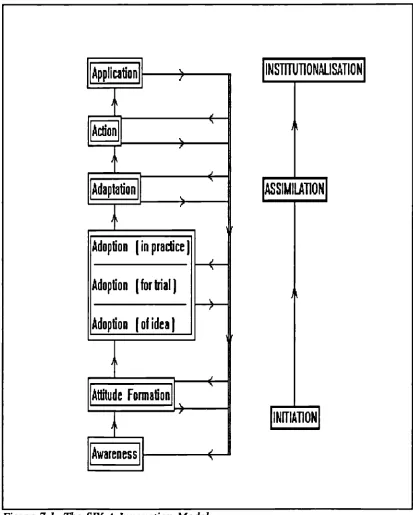
Figure 7.1 The 'SIX-A' Innovation Model
-vi-GLOSSARY
AEDS Association of Educational Data Systems, U.S.A.
BCSSC British Computer Society Schools Committee
CAA Computer Aided Administration
CASA Computer Aided School Administration
CET Council for Educational Technology, U.K.
ED Education Department, H.K.
EMB Education & Manpower Branch
EMLE Education Management Information Exchange, U.K.
FEMIS Further Education Management Information System, U.K.
FEROS Further Education Record of Students
JSEA Junior Secondary Educational Assessment, H.K.
HKSAS Hong Kong School Administration System
HMI Her Majesty's Inspectorate, U.K.
ILECC Inner London Education Computing Centre, U.K.
JIJPAS Joint University & Polytechnic Admission Scheme
LAMSAC Local Authority Management Services & Computer Committee,
U.K.
LMS Local Management of Schools, U.K.
MEP Microelectronics Education Programme, U.K.
NYSSCSS New York State School Computer Services System
RDMS Relational Database Management System
-vi'-SCAMP School Computerised Administration & Management Project, Scotland
SCHOLIS School Information System, The Netherlands SIMS School Information Management System, U.K.
SM! School Management Initiative, H.K.
SSPA Secondary School Place Allocation, H.K.
SSRC Social Science Research Council, U.K.
-vi"-CHAFFER 1
PURPOSE & ORGANISATION OF
THE THESIS
1.0 INTRODUCTION
The technological information explosion that took place during the past two
decades has directly influenced almost every aspect in our society universally. Every
organisation, together with the people in it, has experienced the impact to a greater
or lesser extent. In the field of education, the question of how schools can enhance
their management information systems and administrative work using computers has
become a more recognised issue in the late 1980's. This particular issue has been
clearly identified both in the United Kingdom according to the policy of Local
Management of Schools (LMS, 1988), and in Hong Kong following the School
Management Initiative (SM!, 1991).
1.1 PURPOSE OF THE STUDY
This thesis addresses the administrative use of microcomputers in schools and
the process of successfully managing this innovation. For simplicity, the acronym
'CAA' which stands for 'Computer Aided Administration' is used. The use of this
term is certainly not universal and Visscher et al. (1991) use 'CASA' (Computer
Assisted School Administration), for instance, in the special issue of the Journal of
Research on Computing in Education (September, 1991) for this topic. Other
acronyms commonly used in the U.K. have their origins either from the software
system developed (like 'SIMS' which stands for the School Information Management
System) or from the project undertaken (like 'SCAMP' for the School Computerised
The acronym CAA originated from the Inner London Education Authority
(Watts, 1985), and there are several reasons to use it in this thesis. Firstly CAA has
a similarity to other common acronyms that stands for computer-aided activities; like
CAL (Computer Aided Learning), CAl (Computer Aided Instruction), and CAD
(Computer Aided Design). Furthermore, CAA is a discipline which should also
cover many aspects in management and does not denote just a software developed or
a project. In the writer's view, the software and hardware for administrative use is
only the 'innovation sub-system' and does not represent the whole subject (see Section
6.5.2 for more details). Moreover, CAA has a broader perspective than CASA
without limiting the administrative use of computers to the school level alone. As
will be discussed in the concluding Chapter 8, the efficient and effective use of
computers in administration and management of schools in Hong Kong unavoidably
involves the central level education office. A holistic vision of CAA thus includes
both schools and the central education office in its user sub-system.
The purpose of this study was to develop a model for managing the CAA
innovation process in Hong Kong schools. This intention was derived partly from the
personal background of the writer as a secondary school principal with experience in
using computers to aid administration and he was almost certain that schools would
have to adopt computers eventually in their administrative procedures. The problem
for research was to explore how this change could be managed effectively. Why the
writer was interested was that from observations in informal professional
circumstances, some Principals in Hong Kong were likely to underestimate the
difficulties and complexities of the implementation process. Findings from the study
showed that this was in fact the case (see Section 7.6). When the writer studied the
ILEA CAA innovation as an observer in 1986 during the first part of the research,
there were also problems noted in the education authority getting to the policy stage
prior to implementation. These reasons together prompted the writer to decide in the
later part of the research to develop a model for change management (see Section 6.7)
to enable practitioners to have a clear understanding of CAA in practice and possibly
The need for better understanding and management of educational change is
of particular relevance to Hong Kong schools in the 1990's now that the Government
has taken the lead to start the 'School Management Initiative' (SM!, 1991). When
this research work began in 1985, CAA was new phenomenon in schools in Hong
Kong and the U.K. Overtaken by events during the past six years, CAA is now a
commonplace phenomenon in the U.K. with the arrival of LMS (1988) and becoming
so in Hong Kong with SM! (1991). (See Section 4.5).
In Hong Kong, since the introduction of compulsory education in 1979 for all
youngsters up to the age of fifteen, it is no exaggeration to say that secondary
schooling has been one of continual turbulence (Fung, 1989). Issues have been
arising like waves one after another. Continually and incessantly over the past ten
years, schools have had to deal with increasing demands and changes initiated
externally by the Hong Kong Education Department as well as by higher education
institutions. There are plenty of such examples: the floating-class system, the pupil
record card system, the text-book assistance scheme, attainment tests, remedial
teaching, school social work, expansion of extra-curricular activities and guidance
work, revision and introduction of new curricula in sixth form, and JUPAS (Joint
University & Polytechnic Admission Scheme). It is remarkable to note that Hong
Kong schools can absorb so much without showing apparently signs of demand
overload.
In the 1990's there are more challenges awaiting local educators: the issue of
medium of instruction; the sixth form education reform; the vast expansion in tertiary
education; the shortage of teachers; all of which are related in some sense to the
unique and critical political question of 1997 when Hong Kong will be returned to
China. All of these signify the need for schools to become more adaptive and skilful
in problem-solving, managing change, and maintaining the status quo.
To be successful in their mission, schools will have to be more efficient and
effective in the management of information, and computerisation is a requirement
as soon as they can. Another reason to encourage the CAA innovation in Hong Kong
schools is that it can provide a good opportunity to learn about managing school
innovations.
The majority of Hong Kong schools, in the writer's opinion and spealdng from
the experience of twelve years as a principal, are not innovative. The culture in most
Hong Kong schools can be generally described as conforming. Rules and regulations
from the Education Department, in administrative as well as curriculum matters, leave
little flexibility for schools to be creative. Linkages or joint ventures between schools
and higher education institutions for research are rare. School-based researches,
school-based curriculum-development, and school-based staff-development are only
known by name in many schools today. Very often schools are simply reluctant to
supply data for educational studies, and teachers seldom welcome researchers into
their classrooms (see Section 7.1). Lam (1991:75) shares a similar view. Lack of
an open, learning attitude on the part of most teachers is one common obstacle to
improving the quality of education. Lack of resource and time, on the part of
teachers and principals in general, is undoubtedly also a major problem. More
significantly perhaps is the lack of recognition by central authority that schools need
to be more innovative for effectiveness (see Section 3.11.1).
In the writer's view, CAA can be taken as a stepping-stone for local schools
to become more innovative. Comparatively speaking, CAA is a relatively easier
school innovation to manage successfully than other school innovations, say in
curriculum or organisational development (see Section 3.12). There are two reasons
for this opinion: 1) CAA is task-oriented, systematic, and structured; and 2) CAA is
less threatening to teachers because there is no direct conflict with other issues like
curriculum or classroom procedures (unless the CAA system is designed to control
rather than support staff, see Sections 7.7.1 & 7.7.4). Furthermore, from the
experience gained in implementing the CAA innovation, schools can learn and
understand more about key factors for innovation success. Such factors include, for
example, knowledge about the process of an innovation; the people factor; the cultural
addition, the writer thinks that the CAA innovation can contribute to initiate a
learning attitude among school staffs which is an important criterion of innovation
success as Fullan (1982, 1991) has pointed out. This has been confirmed as a finding
in the study (Section 7.7.1). This has contribution to setting a climate for innovation
in the school where people are allowed to experiment and fail without disgrace, and
to go on to other activities or changes with confidence but increased experience.
Schools should then be better prepared to attempt more educational innovations - in
addition to the tangible time-savings (see Section 7.7.1) for their staff made as a
result of CAA over time.
1.2 CAA & INFORMATION MANAGEMENT
The spiralling effect of the dramatic increase in the amount of information
being stored on computers is, in a sense, self-fulfilling in the writer's opinion.
Hirschheim (1985:21) has expressed a similar view about the spiralling office
equipment market. As the need for more information grows, the information
technology industry has expanded to meet the demand. As the industry grows, it has
in turn created more capacity for information to be stored in and retrieved from
computers. Thus advances in computer technology -- expansion of capability on the
one hand and miniaturisation on the other -- bear a close relationship to the explosion
of information.
In the business sector, management information systems (MIS) on computers
are a necessity for competition and survival in the 1990's. In contrast, schools in
Hong Kong are lagging behind in the development of MIS. Although social and
economic developments of information technology had made it possible for the
introduction of computers into the school curriculum in the past decade, CAA in
Hong Kong schools is only at the experimental stage (see Section 4.3.3).
Justification for support and funding computers in the school curriculum, in
the U.K. as well as in Hong Kong, was not difficult compared to the support for
1980) in Britain that cost eighteen million sterling pounds at the time suffices to speak
for itself: "to help schools prepare children for life in a society in which devices and
systems based on microelectronics were commonplace and pervasive" (Fothergil,
1981 in SSRC, 1983: 10). No specific provision was made for CAA then in the
U.K., nor in Hong Kong when the subject of Computer Studies was introduced into
secondary schools in 1982. However, once schools were provided with computers
for teaching purposes, the possibility of using the machines in administrative areas
was soon recognised. The opportunity to self-develop software for CAA was taken
up in some schools both in the U.K. and in Hong Kong.
1.3 ORGANISATION OF THE THESIS
This chapter sets out the purpose of the thesis. A review of the literature
follows in Chapters 2 to 4. Three different fields of theoretical relevance are
examined including the literature on systems theory; writings and research on
educational change and innovation; and literature on the administrative use of
computers in education, especially microcomputers in secondary schools. Reasons
for incorporating each of these areas of literature are given in the introduction of the
respective chapters.
The exploration of the literature in Chapters 2 to 4 contributed significantly
to the planning of the research as well as to the formulation of a theoretical
framework with which to examine CAA in Hong Kong schools. This is why these
chapters are presented before the research design.
In Chapter
5,
the research design and method for the study are discussedtogether with limitations. A qualitative case-study approach was the basic method
adopted, and two cases of CAA innovation were studied. The first case was about
the Inner London Education Authority's ([LEA) innovation in the U.K. studied with
an observer role when the researcher spent a year in London between 1985 and 1986,
1987 and 1990 with a 'semi-participant-consultancy' approach (a shorthand used in the thesis to represent different roles of the researcher, see Sections 5.3.4 and 7.4 for the meaning of this term). Negotiations for entry to research and ethical considerations are also discussed in this chapter.
Chapter 6 describes the first case study of the ILEA CAA innovation. A tentative model for the innovation process was proposed as a result of this part of the study in U.K. Illuminations from the case of ILEA's attempt on CAA in the period between 1985 to 1986, in conjunction with major contributions found in the literature on educational change, form the basis of the tentative model established for practising the CAA innovation in schools. From the experience gained in observing the ILEA case, research questions were formulated for the CAA innovation in Hong Kong Schools (Section 6.7). The tentative model developed to manage the CAA innovation process was then put to work in one school in Hong Kong between 1987 to 1990 during which the school went through the change process from initiation to institutionalisation in CAA (see Section 7.4). The writer acted as a 'semi-participant-consultant' (explained in Section 5.3.4) to the school during the whole process of change. The details of this field work are presented in Chapter 7, together with the findings from interviews with three other local schools already using CAA to counter-check their management of the innovation against the proposed model. Management problems and concerns specific to CAA that were identified are discussed in this chapter too.
CHAFFER 2
REVIEW OF LITERATURE I
-SYSTEMS THEORY
2.0 INTRODUCTION
Changes do not take place in the void. They impact on either objects, people,
organisations, or a combination of these. In other words, they are targeted on some
'systems'. The word 'system' has come into such common usage in all disciplines
that it is difficult sometimes to pin down what exactly one means in using the term.
It would be close to impossible to fmd this word omitted from a book on organisation
or change.
The words 'systems' and 'sub-systems' are frequently used in the thesis.
Some major concepts from systems theory do contribute to this piece of empirical
work: including holism, synergy, open systems, and cybernetics (feedbacks). It must
be clarified though that the thesis is not one based on what is commonly called
systems analysis approach using an input-output model. There is much controversy
between the approach of systems analysis and the phenomenological approach (which
views events through the meanings that the actors involved give to them). Howell &
Brown (1983), for example, took a positive view of systems analysis in applying the
Eastonian model in their study of educational policy making. The writer, however,
considers systems analysis as a subset only within the general systems theory and sees
no conifict in using the phenomenological approach in managing change within a
general systems perspective (see Sections 5.1.3, 6.5.2 & 6.5.3).
From the literature review on current perspectives of managing change
model proposed in the thesis for managing the CAA innovation in schools (Sections
6.6 & 7.6.3), much emphasis is put on the subjective meanings of the actors about
the innovation (Fullan, 1982, 1991). It is possible, or even necessary in the opinion
of the writer, to manage change with a holistic vision through cybernetic phases (a
systems view) using an 'action approach subroutine' (Section 6.6.1). As Fullan
(1991) has written,
"Neglect of the phenomenology of change - that is, how people actually experience change as distinct from how it might have been intended - is at the heart of the spectacular lack of success of most social reforms." (Fullan, 1991:4)
More is discussed in Section 5.3.1 about this phenomenological approach, or 'action
approach' according to Silverman (1970), to clarify the writer's use of the term
'action approach subroutine'.
2.1 SYSTEMS & ORGANISATIONS
There is in fact such a plurality of systems approaches that Lockett & Spear
(1980) refrain from defining what is, or is not, a 'genuine' systems approach in the
book they edited -- "Organizations as Systems". They attempt instead to extract the
underlying factors in systems thinking which include (1) holism; (2) open systems;
(3) inter-disciplinary approach; and (4) applied emphasis.
Following is a list of defmitions on 'system' as extracted from the literature:
1. "A system may be simply defined as a complex of elements in mutual interaction." (Griffiths, 1964, in Miles (ed.), 1964:428)
3. "A system is a set of objects together with relationships between the objects and between their attributes." (Hall & Fagen, 1956:18)
4. "A working definition (of system) for our purposes might be: a bounded collection of interdependent parts, devoted to the accomplishment of some goal or goals, with the parts maintained in a steady state in relation to each other and the environment by means of (1) standard modes of operation, and (2) feedback from the environment about the consequences of system actions." (Miles, 1964:13)
5. "A thing is called a system to identify the unique mode by means of which it is seen. We call a thing a system when we wish to express the fact that the thing is perceived/conceived as consisting of a set of elements, of parts, that are connected to each other by at least one discriminable, distinguishing principle...A system is therefore an interaction between what is 'out there' and how we organize it 'in here'. 'System' denotes an interaction between the objective world and how it is looked at or thought about; it denotes a mode of perceptuo-cognito organization." (Jordan, 1968, in Emery (ed.),
1981:24)
6. "A system is an organized or complex whole: an assemblage or combination of things or parts forming a complex or unitary whole." (Kast & Rosenzweig, 1970, in Open Systems Group (ed.), 1985:44)
Within the social system, therefore, the educational system is a part; and
within the educational system there would be different educational institutions,
legislations and regulations, various structures, people, and the like considered as
subsystems. At the institutional level, Leavitt's consideration of an organisation as
a multivariate system consisting of four elements (or subsystems) is a handy and
useful one (Leavitt, Dill & Eyring, 1973:9). The four subsystems being tasks,
technology, structure, and people (see Section 6.5.3). Thus the school's subsystem
of tasks would include aims and objectives, both long-term and short-term ones as
well as many sub-tasks. Its subsystem of technology would range to include things
like premises and equipment to methodologies of teaching. The subsystem of
structure would entail systems of work flow, communication channels, patterns of
decision-making, co-ordination mechanisms, etc. Finally, the 'people' subsystem
would include not only people within the school, obviously pupils and teachers, but
2.2 SOME PROPERTIES OF SYSTEMS
A major emphasis in systems approach is the holistic perspective, and the most
commonly known concept concerning holism of a system is -- "The whole is more
than the sum of its parts." To distinguish a whole clearly from an aggregate, Angyal
(1941) elaborated on this principle and suggested that it be modified in the following
way:
"... aggregation and whole formation are processes of an entirely different order. ... in an aggregation the parts are added, in wholes the parts are arranged in a system. The system cannot be derived from the parts; the system is an independent framework in which the parts are placed." (Angyal, 1941, in Emery (ed.) 1981a:37)
Thus in a system of interrelated, interdependent parts, not only do the
properties of individual subsystems matter, of more significance are the interactions
among the subsystems totally contributing to the function of the whole.
A second property of a system is its constituency. While any system is a set
of parts, itself is but a subset of a larger system. Griffiths puts it this way:
"All systems except the smallest have sub-systems, and all but the largest have supra-systems which are their environments." (Gnffiths,
1964, in Miles 1964:428)
A third property of a system is its degree of 'openness', which depends on
how permeable the system boundary is to its surroundings. This distinguishes an
'open system' from a 'closed system'. It was this rigorous distinction of L. von
Bertalanffy (1950) between open and closed systems that led to the widespread
interest and development of the General Systems Theory. According to Bertalanffy,
open and closed systems are distinguished in the following way:
The distinguishing criterion between open and closed systems is thus existence
of exchanges with the environment. The concept has been extended to cover social
systems. While an open social system is related to and communicates with its
environment, a closed system does not make exchanges with what is external to it.
Closed systems are in effect 'isolated' systems. In a sense, systems can be 'closed'
only to the effect that their internal structures and activities are opaque to the external
observer because they are enclosed by impenetrable boundaries. In the realm of
social systems, it would be quite impossible to find totally closed systems. It is more
appropriate to talk about the 'degree of openness' for such systems like organisations
and schools.
In other words, totally isolated systems do not exist. Any humanly known
system would have to be interacting with its environment, exhibiting its influence and
demonstrating its function. Thus the commonly cited 'input-process-output' model
of a system can be interpreted simply as a description of (i) external interactions with
the environment -- input and output; and (ii) internal interactions among the
subsystems -- process.
2.3 CLASSIFICATION OF SYSTEMS
In natural sciences, where the concept of systems originates, there are two
general classes of systems: mechanistic and organic. When the idea is transferred to
social settings, analogies are made quite naturally based on the same distinction. The
input-process- output model is very often applied to organisations, such as factories,
and even to schools. This simplistic model has its merits in focusing the area for
attention, and is helpful in particular for activities like problem-solving, monitoring
and evaluation. In practice, of course, social systems are much less predictable and
controllable in contrast to simple physical or biological entities. The fact that people
are an important subsystem in all social organisations necessarily complicates any
Pointing out that "there are many different kinds of connectivity which enable
man to group entities together to form a system", Jordan (1968) proposes a possible
taxonomy for social systems basing on three bipolar dimensions:
(a) Structural vs functional (or static vs dynamic):
Structural (static) phenomena are those aspects that do not change within a
defined and delimited time span, while functional (dynamic) ones do. A
system would be considered as static during a given period if the connection
between the elements comprising the system can be reflected by the system's
state at any one instant within that time, On the contrary, if at least two
instances within the period are necessary for the connectivity to be
demonstrated, the system is dynamic.
(b) Purposive vs non-purposive:
What characterises the pattern of action described as 'purposive' is the
convergence to a terminal state that is called the 'goal'. As Jordan explains,
this convergence seems, to a considerable degree, to be independent of the
vicissitudes of the external environment. The growth of man's knowledge
about its environment makes it possible for him to contrive purposive systems
of increasing complexity. Jordan identifies the characteristics of such systems
by (1) an input to the system, (2) a processing of the input by the system, and
(3) a consequent output that consists of the input as modified by the system.
This output is the goal which man desired to achieve by the system. Whereas
non-purposive actions of physical objects obey the second law of
thermodynamics resulting in an increase of entropy, goal-directed activities do
not. Furthermore, purposive actions can either be directed towards the
environment, or towards the system itself.
(c) Mechanistic vs organismic:
Jordan distinguishes mechanistic from organismic systems by considering the
effect of changing, removing, or extirpating system entities and/or the
"A system in which the remaining elements, and their connections, undergo no change with removal or extirpation is perceived as being intrinsically different from a system in which they do. In the former case I will call the system 'mechanical'; in the latter case I will call it 'organismic'." (Jordan,
1968, in Emery (ed.), 1981:26-29)
Jordan's taxonomy of systems resulting from a combination of the
above-suggested dimensions is thus a block with eight categories:
1. Structural, Purposive, Mechanical; 2. Structural, Purposive, Organismic; 3. Functional, Purposive, Mechanical; 4. Functional, Purposive, Organismic; 5. Structural, Non-purposive, Mechanical; 6. Structural, Non-purposive, Organismic; 7. Functional, Non-purposive, Mechanical; 8. Functional, Non-purposive, Organismic.
Since social organisations are all established supposedly for some purposes,
they would fall only into one of the above first four categories.
An understanding of Jordan's classification is helpful in the case of CAA,
particularly for the appreciation of the software design. Since the programs written
for CAA will be targeted for some specific purposes, whether administrative or
managerial, only the first four categories are applicable. In the opinion of the writer,
whether the software system is structural (static) or functional (dynamic) is dependent
on the stage of development of the CAA innovation system (see Section 6.5.2 for
details of the four systems in an innovation). During the initial stage of software
system development, the software will be unavoidably dynamic in the sense that user
feedbacks should be taken into account for adjustment and/or enhancement. The
software system can be described as static only when the innovation as a whole has
been institutionalised (see Section 6.6.3) and no further change is necessary.
The concept of mechanistic versus organismic system is also of importance in
the software design. In the language of computer programming, this may be
interpreted as the degree of integration of the software produced. A software system
depending on the architecture of its design. The ideal of having an integrated CAA
system (single-entry multiple-use) should be based on a modular (mechanistic in
Jordan's term) structure such that certain tasks are not inhibited unnecessarily by the
dysfunction of others.
2.4 DELIMITATIONS ON SYSTEMS APPROACH
The development of systems ideas in social science is not without flaws.
Lockett & Spear, for instance, (1980:11) have pointed out two major drawbacks in
the historical development of certain systems concepts within the structure of our
economic and political system. The first criticism is the over-extension of the
'organic analogy' between complex biological organisms and organisations on their
apparent similarities. "Most notable", as these writers have said, "has been the
neglect of meaningful human action as a valid theoretical category in favour of
structural and/or functional analyses, although this neglect has been recognised
amongst more recent writers." (Lockett & Spear, 1980:11). David Silverman (1970)
is one such writer, whose alternative 'action approach' i also one of the main
structures to be used in this thesis to be discussed later in Chapter 5.
The other criticism is that applied systems approaches have often led to a
rather uncritical identification with the currently dominant centres of power in society.
While not implying that many systems ideas are 'conservative', it has been rightly
pointed out that the development of applied systems approaches has tended to have
a managerial bias. Lockett & Spear illustrated this tendency with the example of the
attention often given to management information systems in contrast to workers'
information system in organisations. A parallel can be drawn here also with the
danger of having a managerial bias in planning change as Fullan (1982) explains:
Some school policy-makers often overlook the fact that there are many
incongruent versions of what should be done, with each subsystem viewing their
version as the right one. And even if the conflict of values can be resolved, there
still remains the problem of which set of procedures to be adopted. A bias of focus,
not only on the managerial component but on any one subsystem, does not at all
address real problems in change. It is a violation of the holistic view of systems
thinking in doing that.
A possible cause leading to the two off-tracked paths in systems approach has
to do with the concept of the boundary of a system. Bertalanffy made a great step
in advancing from closed systems to open systems, but the idea of organisms with a
boundary - though permeable and allowing exchanges with the environment - needs
further extension when applied to social settings. In the case of a biological body,
it 'owns' what is within its enclosure; whether that is a membrane, a shell, or an
envelop in the form of skin. A social body, in contrast, does not have such total
ownership. Organisations in our society can have only 'shared' members who may
belong to many different social systems at any one time.
The concept of boundary for a social system is therefore a difficult one. For
a physical system, we commonly identify its boundary at the extremities of its
material extension. However, depending on the problem in mind, there is difficulty
sometimes in defining boundaries even for physical systems. For instance, consider
the case of turning a piece of soft iron into a magnet. The boundary of the magnetic
field it now possesses is more difficult to define. We can only roughly define this
boundary in terms of the 'span of influence'; and, provided we know the
inverse-square law, we satisfy ourselves at the point where the magnetic field is too weak to
have any significance for some purpose.
For open social systems like schools, 'boundaries' are more fictitious and
artificial rather than real. The boundary concept is then useful only because when we
cannot study or manage everything simultaneously in a social system, we can draw
analysis. In other words, a system is defined with its boundary by a situational
decision related to the purpose of the study (or of the undertaldng, such as a change),
and may vary over time. Boundaries are thus being drawn and redrawn around
subsystems or entities, according to their 'span of influence' as relevant to the
subject.
A fluid, dynamic systems view is taken in this thesis of managing change.
The target subsystems to be changed are defined only situationally pertinent to the
innovation as well as to the different stages of the change process (see Section 6.6.1
CHAPTER 3
REVIEW OF LITERATURE
II-EDUCATIONAL CHANGE & INNOVATION
3.0 INTRODUCTION
The intention of the thesis in its infancy in 1985 was limited in scope to the
study of computer applications in school administration. While such an objective
could contribute undoubtedly to the knowledge base of how computers are being used
or can be used to aid administration in schools, it is nevertheless a technological more
than a managerial issue. Given the proper hardware and software system for CAA,
does it by default mean that any school can implement the innovation successfully?
This was the leading question that drove the writer to study the management of
change and innovations in schools, with particular emphasis on the managerial issues
during the process of 'implementation'.
Before stepping into the field of educational change, the writer needed an
in-depth understanding of what other writers and prominent researchers have done in
the area. This helped not only to prepare the research plan but also the formulation
of the process model of innovation in the study.
This chapter covers a wide range of literature about change and innovation.
The first sections review major concepts about educational change between the 1960s
and 1970s. Studies and research on educational change of such times were mainly
analytical. Efforts then concentrated mainly on identifying factors pertinent to
change, on categorising different change models, and on implementation strategies.
In the 1980s a number of studies on excellence and success in business firms (see
U.K.), has shifted the emphasis to the instrumental side of managing organisational
changes. These current perspectives are reviewed in the last two sections of this
chapter and their relevance to educational institutions is clearly reflected. An
understanding about the 'classical' theories of change, together with the modern
concepts of changing, helps much to shape and guide the researcher's approach in
managing the CAA innovation case in this study.
3.1 EDUCATIONAL CHANGE & INNOVATION
In the opinion of the writer, an ultimate goal in the world of physical as well
as social sciences is in the search for 'rules' of change. In the realm of the former,
the major concern is on the behaviour or reaction - that is, change -- of objects or
matter under certain environments. Such events of change which scientists seek to
understand are usually predictable and are expressible in mathematical terms and
concrete formulas. In social sciences where the subjects of study are human beings,
organisations or social structures, changes are much less quantifiable and controllable.
Research in educational change and innovations belongs to this category.
Educational change has a broad scope. Studies in this area have a wide range
from the macroscopic countrywide policy-making (e.g. Dalin et a!., 1973) to the
microscopic teaching in the classroom (e.g. Hall & Hord, 1987). Issues can cover
curriculum, teaching methods, technology, roles and people, as well as organisation
and administration. In the writer's view, all current studies tend to be directed at one
main objective -- improving schools.
To discuss 'change' and/or 'innovation', and their management in education,
it is appropriate to start by distinguishing the meanings of these two terms as found
in the literature on the subject.
A generally accepted definition of 'change' is a simple one given by Guba
"There are some perceptible differences in a situation, circumstance or a person, between some original time and some later time t1. (Guba, 1968:1)
In other words, we can picture a change as the transition from a certain state s0 to a different state s 1 over time marked by and t 1 as follows:
so--->sl
>---. ---> t0 TIME
Figure 3.1 Change as a Transition
With more specific reference to organisations, Griffiths (1964) considers any alteration in an aspect related to the organisation to be a change. To him,
"The word change is used to mean an alteration in the structure of the organization, in any of its processes, or in its goals or purposes." (in Miles (ed.), 1964:428).
To make this definition complete, any alteration in the people aspects in the organisation should also be included.
'Innovation', on the other hand, is often viewed as one special kind of change (Miles (1964) called it a species of the genus 'change'). Marklund (1972) made a clear distinction between educational innovation and change:
The study focus for educational innovation varies much. While some
researchers concentrate on the 'quality' aspect, others emphasise 'operationalisation';
some concern themselves with 'barriers' and 'resistance', leaving others adhering to
a 'process' view. These varieties can be observed from the various definitions
collected that follow.
Barnett (1943), thinking about the 'quality' aspect, defines 'innovation' in the
following way:
"Innovation is any thought, behaviour or thing that is new because it is qualitatively different from existing forms." (in Dalin, 1973: 34)
Other definitions, focusing on the 'operationalisation' of innovation rather than
the quality, include that given by Beal and Bohien:
"A change which involves not only a change in materials but also a complex of changes with regard to their use." (Beal & Bohien, 1968:
55)
Other writers describe innovation as a process. For example, Neihoff
considers innovation as:
"A process that begins with an idea on the part of a change agent and ends in its adoption or rejection by the potential recipients." (Neihoff, 1966: 40)
Similarly, Richiand, with a process view of innovation, defines it as:
"A creative selection, organisation and utilisation of human material resources in new and unique ways which will result in the attainment of a higher level of achievement for the defined goals and objectives." (Richiand, 1965:32)
Brickell, in his process definition of educational innovation, also implies a
goal-directed or value-directed improvement in the use of the term:
Goal or objective oriented definitions of innovation appear to have a firm
stance especially in education. Thus Miles notes that:
"Generally speaking it seems useful to define innovation as a deliberate, novel, specific change, which is thought to be efficacious in accomplishing the goals of a system." (Miles, 1964:14)
Dalin et al. in their international case studies of educational innovations, use
the term innovation to mean:
"A deliberate attempt to improve practice in relation to certain desired objectives." (Dalin, 1973: 36)
This simple and concise definition of Dalin's clearly identifies three important
characteristics of an educational innovation, that
(1) it is a deliberate and planned activity or process;
(2) it is goal-oriented;
(3) it is intended for improvement over existing practice.
3.2 ORIGIN/SOURCE OF EDUCATIONAL CHANGE
In the management of change, context or environment is an important factor.
The question of whether the scene has been properly set for an innovation
undoubtedly affects the chance of success. In the case of the CAA innovation, Shaw
& Lancaster (1986) differentiate the concept of 'technology-push' (i.e. environmental
in origin) from that of 'needs-pull' (i.e. internal in origin). These authors have
recommended that schools should identify objectives and the areas of administration
for computerisation to avoid 'technology-push' administrative change (Shaw &
Lancaster, 1986).
In studies and research on educational changes, some early writers (e.g.
Levin, 1974; Stiles & Robinson, 1973; Coleman 1973) tended to identify the origin
or source of the change. Probably the logic was that once the origin was located, an
approaches. A distinction is generally made in the cause of a change between
'external' and 'internal'. The former asserts the environment as the source of change
stimulus, while the latter assumes origination from within the educational system
itself.
Fullan (1982), supporting the view of Levin (1974), considers three broad
ways in which major external and internal forces over time create pressures for
educational change:
(1) through natural disasters such as earthquakes, floods, famines, etc.;
(2) through external forces such as imported technology and values, and
immigration; and
(3) through internal contradictions, such as when indigenous changes in
technology lead to new social patterns and needs, or when one or more groups
in a society perceive a discrepancy between educational values and outcomes
affecting themselves or others in whom they have an interest, i.e. educational
changes are often political in origin. (Fullan 1982:13)
Zaltman, Florio, and Sikorski (1977:53) have remarked that it has been widely
acknowledged that most changes in education are externally generated (Stiles and
Robinson 1973; Coleman 1973; Levin 1974; Carlson 1965) while others disagree with
this position (Giles, (3atlin, and Cataldo 1974).
In the opinion of the writer, there can be no settlement on this either/or type
of argument. Even if one side has 'won', there still remains the more fundamental
question of "what then?" to be pursued. In other words, one still has to attend to the
more important question of implementation. To quote Zaitman et a!.,
"It is somewhat fruitless to attempt to distinguish between the chicken and egg of social and institutional change. We are a society of groups, organizations, and interlocking systems. To argue that one system is always or nearly always relegated to a reactive status in relationships with others and with the broader social system is to neglect the reciprocal nature of social change among institutions. Systems thinking highlights the interaction among subsystems." (Zaltman et al.,
In summary of the previous discussion, it is the writer's view that in the
management of change, a systems perspective (see Chapter 2) can be adopted. A
holistic view is to consider a system under change be embedded in a suprasystem (the
environment) with mutual interaction between them, and with internal interactions
within the system itself amongst its subsystems. Interaction between a system and its
environment can be furthermore distinguished as reactive and proactive. It is
important to point out the capacity of human systems to proact as well as react. This
is to realise the ability of man changing society as well as society changing man.
It is necessary to distinguish between changes that come about as a result of
environmental demands in which the organisation or system seeks to adapt for
equilibrium, and self-initiated changes (i.e. innovations) where there is a deliberate
move towards some desired future state chosen by people representative of the
system. The management of change, as Beckhard puts it, is the managing of this
change process - "the transition state" - moving from today's condition to some
desired future state. (Beckhard & Harris, 1977: ix).
In the case of CAA in Hong Kong schools, for instance, there is neither
pressure nor support from the central education office for the change. Schools that
have started CAA, including the schools serving as cases in this study, can be
considered as innovating proactively. Needless to say, such schools are also subject
to demands from the environment, in terms of say the increasing amount of work-load
imposed on teachers nowadays in Hong Kong, and their CAA innovation might as
well be considered as a kind of reactive change in that sense.
3.3 INHERENT NATURE OF CHANGE
To manage change with success in an organisation, one inevitably needs an
understanding of the inherent nature of change. With such knowledge the change
manager will be better prepared to identify and solve problems that might arise during
the change process. Three key concepts about change are identified in this section:
change and so the provision of as much information as possible will guarantee a better
chance of success, especially during the initiation phase (see Section 6.6.1); and (iii)
remember the importance of people concerned.
Havelock (1971), in discussing the inherent nature of innovations in education,
gives a clear view of the value of such activities:
"There is no inherently valuable or good in innovation, as such. We innovate whenever we try anything new, when we inhale a cigarette for the first time, when we first teach a class without bothering to prepare for it, or when we discover that we can cheat on a test and get away with it. Usually, of course, when we use an expression like
'innovation in education' we think we are talking about something more positive, a change for the 'better', or something that is both new and beneficial. Even so, we may have a tendency to slip into the assumption that something is good because it is new or different from what we have done before. Many observers have noted that education (in the United States) is prone to this sort of faddism, the mass adoption of one innovation after another without regard to either its demonstrated value or its potential consequences, positive or negative." (in Dalin, 1973:35)
It is clear from the above that what matters is the meaning and purpose that
we, as human actors, give to innovative attempts in education to make them of value.
A phenomenological approach is thus necessary in the management of change
according to this classical line of thought. This concurs also with the emphasis on
'people' in the current perspective of change (see Section 3.11.3).
Another aspect inherent in change or innovation is very well agreed upon by
most theorists and practitioners of change -- risk and uncertainty. It is sufficient just
to quote a few here to clarify the point.
"Change typically involves risk and fear", says W.G. Bennis, "any significant change in human organization involves rearrangement of patterns of power, association, status, skills, and values. Some may benefit, others may lose. Thus change typically involves risk and fear.
Schon has developed essentially the same theme. All real change involves
Ispassing through the zones of uncertainty ... the situation of being at sea, of being
lost, of confronting more information than you can handle." (Schon, 1971:12)
Similarly, innovative activities as risky activities is an observation made by
Fullan (1973) in the Thornlea case study:
"This is another way of saying that innovation is a risky business and must be recognised as such. We think that the people at Thornlea have shown this recognition. The short history of the school has reflected an approach to education in which promising ideas are seen as worth trying. The problems encountered along the way are seen as a natural part of the pursuit of better ways of doing things. We think that any innovative organisation must have this ability to recognise that problems are inevitable and that growth can only occur by treating problems openly and with respect as experiences to be learned from." (Fullan, 1973:190)
Risk, fear, and confusion are all related to the uncertainty that change causes
to the people concerned. People feel insecure when they are not clear about what is
to happen. It is worth diverting here to look closer at what brings about uncertainty.
Galbraith (1973:5) identifies very clearly the relation between 'uncertainty'
and 'information lacking'. To quote him,
"Uncertainty is defined as the difference between the amount of information required to perform the task and the amount of information already possessed by the organization. Thus the greater the uncertainty of the task, the greater the amount of information that has to be processed between decision makers during its execution. If the task is well understood prior to performing it, much of the activity can be preplanned. If it is not understood, then during the actual execution of the task more knowledge is acquired which leads to changes in resource allocations, schedules, and priorities. All these changes require information processing during task performance. Therefore the greater the task uncertainty, the greater the amount of information that must be processed among decision makers during task execution in order to achieve a given level of performance."
It sounds a circular way to say that risk and fear are caused by uncertainty
In fact it is not, for at least we are clearly led to the necessity of searching for
situational information if we want to reduce uncertainty when undergoing a change.
The need for relevant information is recognised more and more these days by
managers and administrators in any organisation, both in their daily maintenance
function and in forward planning and decision making.
Information management is therefore one significant aspect in the management
of the transitional process from the present to the desired future state in any
innovation.
3.4 WHY INNOVATIONS FAIL
Fear of the unknown, as indicated in the previous section, is one major reason
why change is not a welcoming activity. This is because of the intrinsic human
nature of detesting failures. Ironically, however, past experience of failures can
contribute to future success. An often quoted Chinese saying is that "Failure is the
mother of success". People with a positive mind learn from mistakes and this section
reviews some of the failing factors in educational innovations as pitfalls to be
avoided.
Dalin has remarked that "since innovations are seldom 'good' for everyone it
would be easy to find 'failures' in any innovation" (1973:232).
It is indeed very true that innovations, being complex processes over time in
an ever-changing setting, are liable to failure at every possible stage from start to
end. Literature abounds on why innovations fail, with different writers picking up
faults where they please along the tricky route of any innovation. Some put the
blame on 'climates', others complain about the ingredients not being 'ready'. While
still others focus on 'adoption', there are many who concentrate on 'delivery' or
Following is a list of quotations as pointers to reasons of innovation failures
drawn from just two writers on educational change, but enough to show the
multifarious state of
affairs:-* "Failure to develop an adequate design for implementation" -- (Fullan, 1982:15)
* "Technical problems in the management of change and questions about the development soundness of the innovations themselves" -- (Ibid.: 15)
* "Assumed without any reflection that 'progressive innovations' were good, and that only problems of delivery interfered" -- (Ibid. :15)
* "Educational changes are adopted piecemeal without any thought as to whether the sum total of what is expected can feasibly be implemented" -- (Ibid. :21)
* "Understanding why most attempts at educational reform fail goes far beyond the identification of specific technical problems such as lack of good materials, ineffective in-service training, or minimal administrative support. In more fundamental terms, educational change fails partly because of the assumptions of planners and partly because some 'problems' are inherently unsolvable." -- (Ibid. :81)
* "Usually the cause is a lack of understanding of political, legal, administrative and financial constraints, including the in-built reward and punishment structure, all of which have been created to maintain the existing system and not to serve an innovative function." -- (Dalin,
1973:19)
Another way of looking at causes of failures in innovation is to consider
"barriers" in the change process. An innovation will fall flat naturally if any of these
barriers cannot be removed or hurdled over. For example, some major barriers to
innovation identified by Havelock & Huberman (1977) include:
- Underestimating the process
- Personalities and personal motivation
- Underdevelopment (Inadequate resources & capacities) - Financial problem
Dalin (1973) has also discussed a number of barriers to change and remarks
that "it has been said that most innovations fail because they are not good enough.
We do not know if this statement can be verified, but many barriers can be traced
back to relatively 'simple' practical problems", these include:
1. Time 2. Knowledge
3. Level of Organisational Development 4. Integration of Incentives
5. Multiplicity and Specificity of Objectives 6. Resources
7. System Implications. (Dalin, 1978:30-35)
Understanding of failures and barriers of innovation does help in the managing
of change. It is important for the administrator or the change agent to have as clear
a picture as possible of what constraints to work 'within' and what barriers to 'work
over'.
3.5 A TYPOLOGY OF INNOVATION FACTORS
The complexity and difficulty involved in an innovation process can be easily
recognised simply by looking at the diversity and large number of related factors.
There are factors identified as barriers to change, factors which are conditions for
adoption, and factors related to the process of change. As Hurst has remarked after
his review of literature,
"Researchers have discovered a very large number of factors which are apparently or allegedly correlated with the process [of innovation]. There are at least 60 extant examples of one type of correlation alone, and Zaltman et al.(1977) refer to some 300 variables as being potentially involved." (Hurst, 1983:5)
It would be difficult enough for a change agent just to remember such a large
number of factors in an innovation, not to say manage them. A more practicable
alternative is to use a typology instead and one is suggested here which hopefully can
serve as a kind of map-guide for a change agent to gain a broad perspective of major
In this typology, factors pertaining to an innovation are broadly classified into
one of the following three categories:
(1) Knowledge & Skill factors;
(2) Resource & Support factors;
(3) Human & Social factors.
The management of an innovation may be interpreted as a deliberate attempt
to deal with the interactions among the user system, the innovation system, and the
change agent system with regard to these three categories of Ifactors to achieve certain
objectives. (See Section 6.5.2 for a more detailed exIanation of the systems
involved in an innovation).
Innovation factors identified by various writers discussed earlier can possibly
be fitted into one of these three categories. The essence of this typology rests on the
understanding of the relationships of the three major constituents (knowledge and
skill; resource and support; and 'people' attributes) regarding the user; the innovation;
and the change agent systems. In the writer's opinion, any implementation of change
is working, consciously or unconsciously, within this typology.
3.6 MODELS OF CHANGE
The term 'model' is used in a loose sense in this cor text, including different
approaches to innovation or change as found in the literature. Contributors to this
area include Bennis (1963), Chin (1967), Lippitt et al. (1958), Havelock (1969),
Bolam (1974), Dalin et al. (1973), and other more current writers like Turrill (1986),
Hall & Hord, (1987), and Fullan (1982).
In this section only the classical models are presented, and the more current
views are left for discussion in Section 3.11 about the current perspectives on change.
The classical models of change have been broadly distinguished into two classes
-general models and process-oriented models. These are discussed in the following
Sections 3.6.1 and 3.6.2 respectively and followed by Section 3.7 on the classical
3.6.1 GENERAL MODELS
Bennis (1963) identified three general classes of change models:
i) Equilibrium models: The target system is being considered as a
defensive social structure. Utilising strategies involving tension release
through anxiety reduction, the goal is to attain a conflict-free social
structure.
ii) Organic models: The target system is being considered as a
problem-solving entity. Power redistribution and conflict resolution
are the strategies involved and the goal is team management.
iii) Development models: The target system is the people in the system.
By developing personal and interpersonal competence and
transformation of norms and values, the goal is to achieve
co-ordination with authentic relationships. (Bennis, 1963:144)
Chin (1967) also has identified four different classes of change models three
of which are much the same as those discussed by Bennis, namely 'systems and
component models', 'organic system models' and 'development models'. His fourth
category called 'inter-system models' refers specifically to changes that do not aim
at a new equilibrium, but rather at a state of dynamic dialogue between interest
groups. (Chin, 1967:336-338)
3.6.2
PROCESS-ORIENTED MODELSA number of authors have developed process-oriented models for change in
social systems. Many models focus on the relationship between a change agent and
the clientiuser system, as well as employing a problem-solving strategy. For
instance, the Lippitt-Watson-Westley model has the following seven stages:
(1) the development of a need for change; (2) the establishment of a change relationship;
(3) the clarification or diagnosis of the client system's problem;