A LONGITUDINAL STUDY OF
THE DEVELOPMENT OF PUPILS' ALGEBRAIC THINKING IN A LOGO ENVIRONMENT
Rosamund Sutherland
Thesis submitted in fulfilment of the requirement for the Ph.D. degree of the University of London
TABLE OF CONTENTS
Abstract
Acknowledgements List of Tables List of Figures
Page No. CHAPTER 1: INTRODUCTION
1.1. BACKGROUND TO THE RESEARCH 1
1.2 TEACHING AND LEARNING MATHEMATIC S:
A THEORETICAL PERSPECTIVE 2
1.3 PUPILS' DIFFICULTIES WITH ALGEBRA:
A REVIEW OF THE LIIERATURE 9
1.3.1 The Gap between Algebra and Arithmetic 10 1.3.2 Pupils' Acceptance and Understanding of the Algebraic Object 12
1.3.3 Summary 18
1.4 OVERVIEW OF THE STUDY 18
1.4.1 The Longitudinal Study 19
1.4.2 The Pre-algebra Study 19
1.4.3 Summary 19
CHAPTER 2: THE COMPUTER AND THE LEARNING OF MATHEMATICS
2.1 THE ROLE OF PROGRAMMING 21
2.1.1 Programming as an Algorithmic Activity 22 2.1.2 Programming as a Problem Solving Activity 23 2.1.3 The Cognitive Demands of Learning Programming 24 2.1.4 Programming and the Learning of Mathematics 26 2.2 THE LOGO COMPUTER ENVIRONMENT:
RESULTS FROM THE LOGO MATHS PROJECT 29
2.2.1 Problem Solving Strategies Used by Pupils 29 2.2.2 Pupils' Use of Structured Programming Ideas 32 2.2.3 The Nature and Consequences of Teacher Intervention 33
2.2.4 The Role of Collaboration 34
CHAPTER 3: LOGO AND VARIABLE
3.1 OVERVIEW OF THE PROGRAMMING LANGUAGE 37
3.2 THE USE OF VARIABLE IN LOGO 39
3.3 THE CONCEPTUAL FIELD OF VARIABLE IN LOGO 41
3.3.1 Set of Problem Situations 43
3.3.2 Categories of Variable Use 46
3.4 SUMMARY 49
CHAPTER 4: OVERVIEW OF THE CASE STUDY RESEARCH
4.1 RESEARCH METHODOLOGY 51
4.1.1 A Theoretical Perspective 51
4.1.2 The Author's Preconceptions 53
4.1.3 Description of the Classroom Setting 54
4.1.4 Choice of Case Study Pairs 55
4.1.5 The Role of the Researcher as Participant Observer 56
4.2 OVERVIEW OF DATA COLLECTED 57
4.2.1 Classroom Transcript Data 57
4.2.2 Pupil Profiles 57
4.2.3 Function Machine Data 58
4.2.4 Individual Laboratory Tasks 58
4.2.5 The "Arrowhead" Task 58
4.2.6 Structured Interview Data 58
4.2.7 The Comparison Group 59
4.3 TIMETABLE OF DATA COILFCTION 59
4.4 PHASES OF DATA ANALYSIS 60
CHAPTER 5: CASE STUDY PUPILS' USE AND UNDERSTANDING OF VARIABLE IN LOGO
5.1 INTRODUCTION 61
5.2 LONGITUDINAL CASE STUDY: SALLY AND JANET 61
5.2.1 General Polygon 62
5.2.2 Clown's Face 67
5.2.3 Starbuster 68
5.2.4 General Hexagon 69
5.2.5 Variable Letters 70
5.2.7 Patterns of Squares 77
5.2.8 Row of Pines 84
5.2.9 Spirals 87
5.2.10 Spiral Extension 91
5.2.11 General Butterfly 92
5.2.12 Arrowhead 95
5.3 LONGITUDINAL CASE STUDY: GEORGE AND ASIM 104
5.3.1 Pythagorean Triangle 104
5.3.2 Battlements 109
5.3.3 Circular Spiral 110
5.3.4 Nested Circles 114
5.3.5 War Games 116
5.3.6 Variable Letters 117
5.3.7 Patterns of Squares A 121
5.3.8 Patterns of Squares B 126
5.3.9 Spirals 129
5.3.10 Arrowhead 132
5.4 LONGITUDINAL CASE STUDY: LINDA AND JUDE 138
5.4.1 General Polygon 139
5.4.2 Nested Circles 141
5.4.3 Variable Letters 1 143
5.4.4 General Square 1 147
5.4.5 Row of Pines 149
5.4.6 Variable Letters 2 153
5.4.7 Whynot 155
5.4.8 General Square 2 157
5.4.9 Arrowhead 158
5.5 LONGITUDINAL CASE STUDY: SHAHIDUR AND RAW 165
5.5.1 Variable Letters 1 166
5.5.2 Line and Cross 171
5.5.3 Row of Pines 172
5.5.4 Variable Letters 2 174
5.5.5 Arrowhead 177
5.6 OVERVIEW OF THE ARROWHEAD TASK 180
5.7 INDIVIDUAL LABORATORY TASKS 182
5.7.1 Logo Programming Tasks 182
5.7.2 "Paper and Pencil" Tasks 192
CHAPTER 6: CASE STUDY PUPILS' USE AND UNDERSTANDING OF THE FUNCTION MACHINE MATERIAL
6.1 OVERVIEW 203
6.2 COMPUTER BASED ACTIVITY 206
6.2.1 Description of Materials Used 206
6.2.2 Analysis of Pupils' Use and Understanding of Function Materials 207
6.3 "PAPER AND PENCIL" BASED ACTIVITY 221
6.3.1 Description of Materials 221
6.3.2 Analysis of Pupils' Responses to "Paper and Pencil" Tasks 222
6.4 DISCUSSION OF RESULTS 224
CHAPTER 7: THE STRUCTURED INTERVIEWS: CASE STUDY ANALYSIS
7.1 DESCRIPTION AND RESULTS OF QUESTIONS IN STRUCTURED
INTERVIEW 227
7.1.1 The General Polygon 228
7.1.2 Formalising a Generalisation 228
7.1.3 Interpretation of Variable 230
7.1.4 Function Machine Question 236
7.2 DISCUSSION OF CASE STUDY PUPILS' RESPONSES TO
STRUCTURED INTERVIEW 239
7.3 THE COMPARISON GROUP'S RESPONSES TO STRUCTURED
INTERVIEW 241
7.4 HYPOTHESES DERIVED FROM RESULTS OF STRUCTURED
INTERVIEW 244
CHAPTER 8: PRE-ALGEBRA PUPIL STUDY
8.1 OVERVIEW AND AIMS OF THE STUDY 247
8.1.1 Classroom Based Work: November 1986-June 1987 248 8.1.2 Choice of Pupils for Pre-algebra Study 249 8.2 DESCRIPTION AND RESULTS OF STRUCTURED INTERVIEW 251 8.2.1 The General Square: Procedure Writing Task 251 8.2.2 Interpretation of Procedure: Variable Operated On 252
8.2.3 Interpretaion of Variable 253
8.2.6 Interpretation of Variable Name 259
8.3 DISCUSSION OF RESULTS 261
CHAPTER 9: OVERALL CONCLUSION AND IMPLICATIONS
9.1 THE LEARNING ENVIRONMENT 266
9.1.1 Factors Which Inhibit Task Involvement 266
9.1.2 The First Introduction of a New Idea 267
9.1.3 The Crucial Role of the Teacher 267
9.2 NEGOTIATING A GENERALISED METHOD 267
9.3 ACCEPTING THE IDEA OF VARIABLE AND UNDERSTANDING THAT A VARIABLE REPRESENTS A RANGE OF NUMBERS:
THE ROLE OF THE "SCALING LETTERS" TASK 269
9.4 EXTENDING PUPILS' UNDERSTANDING OF VARIABLE 270
9.4.1 Naming the Variable 271
9.4.2 Understanding that Different Variable Names can Represent
the Same Value 271
9.4.3 Acceptance of "Lack of Closure" in a
Variable Dependent Expression 272
9.4.4 Understanding the Nature of the Second Order Relationship
Between Two Variable Dependent Expressions 273 9.5 THE ROLE OF THE FUNCTION MACHINE MATERIALS
IN HELPLNG PUPILS MAKE LINKS BETWEEN LOGO
AND "PAPER AND PENCIL" ALGEBRA 273
9.6 FACTORS CONTRIBUTING TO PUPILS' SYNTHESIS
OF VARIABLE USE 274
9.7 IMPLICATIONS FOR FURTHER RESEARCH 275
9.8 SUMMARY 277
REFERENCES 278
APPENDIX 1 Concepts in Secondary Mathematics and Science (C.S.M.S.)
Algebra Test. 286
APPENDIX 3.1 Overview of Logo Commands 291
APPENDIX 3.2 The "Scaling Letters" Task 293
APPENDIX 3.3 The "Arrowhead" Task 293
APPENDIX 3.4 The "Row of Pines" Task 294
APPENDIX 4.1 SMILE Curriculum 295
APPENDIX 4.2 Interviews for Pupil Profiles 296
APPENDIX 4.3 Categories of Teacher Intervention 298 APPENDIX 4.4 Case Study Pupils: Record of School Mathematics Work 299 APPENDIX 5.1 Structured Task: Pattern of Squares 300
APPENDIX 5.2 Handout on Variable 301
APPENDIX 5.3 Individual Laboratory "Paper and Pencil" Tasks 302
APPENDIX 6.1 Computer Based Function Material 306
ABSTRACT
This thesis is based on research to investigate the hypothesis that programming in Logo will provide pupils with a conceptual basis of algebraic ideas which will enhance their work with "paper and pencil" algebra. The aims of the research were to:
• trace the development of the use and understanding of algebra related concepts within a Logo programming context by reference to the work of four case study pairs of pupils during their first three years of secondary schooling (11-14 years)
• develop and test out materials designed to help pupils link the conception of variable derived within a Logo to a non-Logo context
• relate the pupils' understanding of variable in Logo programming to their understanding in "paper and pencil" algebra
The research consisted predominantly of a three year longitudinal case study of pupils programming in Logo during their "normal" secondary school mathematics lessons. The data collected for this longitudinal study included video recordings of the pupils' Logo work together with their spoken language (which was subsequently transcribed for analysis). Initially it was found that the case study pupils did not naturally choose to use variable in Logo as a problem solving tool but it was possible to develop teacher devised tasks which provoked its use. Previous research suggests that pupils often use informal methods which cannot easily be generalised and formalised in algebra. However in the Logo context pupils were able to negotiate a generalisation by interacting with the computer and discussing with their partner to the point where they could then write a Logo procedure to formalise this generalisation.
ACKNOWLEDGEMENTS
First and foremost I must thank my supervisor, Celia Hoyles, whose positive support, advice and encouragement has helped to bring this thesis to fruition. My research stemmed from the Logo Maths Project and the many project discussions which I had with Celia Hoyles and Joan Evans formed an invaluable basis from which the ideas presented in this thesis grew. I have been fortunate in working amongst a very supportive group of colleagues at the Institute of Education and my thanks go to them all.
I am particularly indebted to the eight case study pupils from North Westminster school who may never realise how much attention I have paid to them. I also wish to thank the two mathematics teachers, Julie-Anne Edwards and Keith Jones who allowed me into their class over the three year longitudinal study and who were always willing to spend time discussing the case study pupils with me. I also wish to thank Beryl Dobney from Ickleford School and her junior class who took part in the final pre-algebra study.
Anyone who has worked with computers knows that technical support is crucial and I am indebted to Lindsay Whittome at the Institute of Education for so capably supplying this support.
LIST OF TABLES
3.1 Overview of Case Study Pupils' Engagement in Variable Related Problems
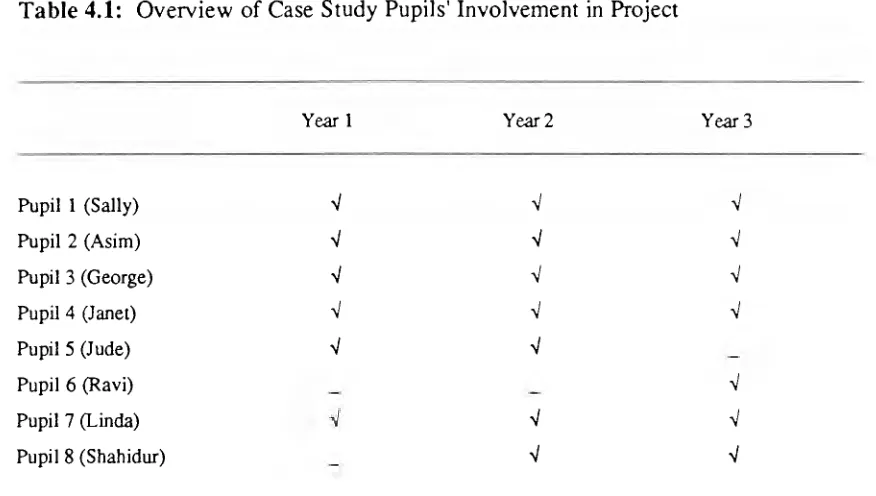
4.1 Overview of Case Study Pupils' Involvement in Project 4.2 Timetable of Longitudinal Case Study Data Collection
5.1 Case Study Pupils' Solutions to "Hands On" Individual Laboratory Logo Programming Tasks
5.2 Classification of Case Study Pupils' Solutions to Individual Laboratory Logo Programming Tasks
5.3 Case Study Pupils' Solutions to Individual Laboratory "Paper and Pencil" Tasks 5.4 Overview of General Procedures Written by Case Study Pupils
7.1 Categorisation of the Case Study Pupils' Responses to Formalising a Generalisation" Questions
7.2 Case Study Pupils' Responses to C.S.M.S. Algebra and Related Logo Questions
7.3 Case Study Pupils' Responses to Function Machine Questions
7.4 Classification of Case Study Pupils' Responses to Structured Interview 7.5 SMILE Levels for Case Study and Comparison Pupils at end of Three Year
Logitudinal Study
7.6 Comparison Pupils' Responses to Algebra Structured Interview Questions 7.7 CSMS % Correct Responses on Algebra Questions (14-15 year olds) and
Predicted Likelihood of Pupils being able to Answer Items Correctly. 7.8 Proportion of Correct CSMS ALgebra Item Responses for Case Study and
Comparison Pupils by Quartiles
8.1 Overview of Pre-algebra Pupils' Logo Experience
8.2 Pre-algebra Pupils' Involvement in Pre-planned Logo Tasks
8.3 Analysis of Pre-algebra Pupils' Responses to General Square Question 8.4 Analysis of Pre-algebra Pupils' Responses to Interpretation of Procedure
Task: "Variable Operetad On"
8.5 Pre-algebra Pupils' Responses to Question 3a 8.6 Pre-algebra Pupils' Responses to Question 3b 8.7 Pre-algebra Pupils' Responses to Question 3c 8.8 Pre-algebra Pupils' Responses to Question 3d
8.9 Pre-algebra Pupils' Responses to Area of rectangle Question
8.10 Pre-algebra Pupils' Responses to General H Procedure Writing Task 8.11 Overview of Pre-algebra Pupils' Understanding of Variable According to
LIST OF FIGURES
2.1 Noss's "Marbles" Item
2.2 Classification of Pupil Goals in Logo 2.3 Categories of Programming Activity 3.1 The Letter "F"
3.2 Hillel and Samurcay's "Conceptual Field of Logo Programming" 3.3 Simple Graphical object
3.4 Composed Graphical Object 3.5 Recursive Graphical Object 3.6 Logo Function
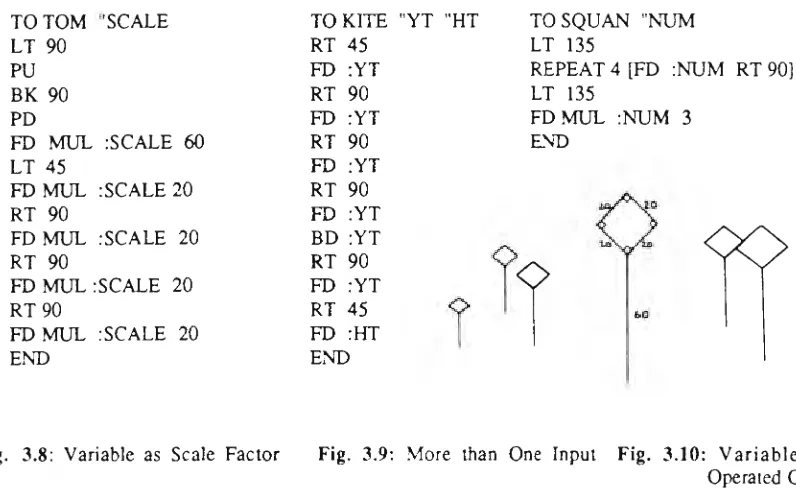
3.7 Procedure with One Variable Input 3.8 Procedure with Variable as Scale Factor 3.9 Procedure with More than One Input 3.10 Procedure with Variable Operated On 3.11 General Superprocedure
3.12 Recursive Procedure
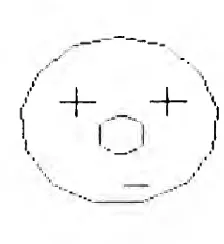
5.1 Sally and Janet - General polygon 5.2 Sally and Janet - Clown's Face 5.3 Sally and Janet - Starbuster 5.4 The Scaling Letters Task 5.5 Sally and Janet -LONG
5.6 Sally and Janet - A General Flower 5.7 Sally and Janet - Patterns of Squares (1) 5.8 Sally and Janet - Patterns of Squares (2) 5.9 Sally and Janet- Patterns of Squares (3) 5.10 Sally and Janet - Pine Tree
5.11 Sally and Janet - Row of Pines Task 5.12 Sally and Janet - The Spiral Task 5.13 Sally and Janet - Part of a Spiral 5.14 Sally and Janet - Spiral Procedure 5.15 Sally and Janet - Spiral Extended 5.16 Sally and Janet - Butterfly (1) 5.17 Sally and Janet - Butterfly (2) 5.18 Sally and Janet - Arrowhead (1) 5.19 Sally and Janet-Arrowhead (2 and 3 ) 5.20 Diamond Within a Square
5.22 George and Asim - General Triangle procedure 5.23 George - Castle Project
5.24 Circular Spiral Task
5.25 George and Asim - Spiral Pattern
5.26 George and Asim - Multiple Spiral Patterns 5.27 George and Asim - Nested Circles
5.28 George and Asim - Variable Letter S 5.29 George and Asim - Planning for 3D STAR 5.30 George and asim - 3D STAR
5.31 Jude and Asim - Pattern of squares (A)
5.32 Jude and Asim - Patterns of Squares (B) - Final Procedure 5.33 George and Asim - Patterns of Squares (A)
5.34 George and Asim - Patterns of Squares (B) 5.35 George and Asim-Spiral and Spiral Extended 5.36 George and Asim - Arrowhead in Direct Mode 5.37 George and Asim - Final Arrowhead Procedure 5.38 Linda and Jude - General Polygon Procedure 5.39 Linda and Jude - Variable Letter E
5.40 Linda and Jude-Variable Letter T
5.41 Linda and Jude - General Square Procedure (1) 5.42 Linda and Jude - Pine Tree
5.43 Linda and Elaine - Variable Letter q
5.44 Linda and Elaine-Procedures for Partytime 5.45 Linda and Elaine-Partytime
5.46 Linda and Elaine - Why 5.47 Linda and Elaine - Whynot
5.48 Linda and Elaine-General Square (2)
5.49 Linda and Elaine- Arrowhead in Direct Mode 5.50 Linda and Elaine - General Arrowhead Procedure 5.51 Ann and Shahidur-Variable Letter L
5.52 Shahidur and Ann - Variable Letter I
5.53 Shahidur and Ann - Planning for General E Procedure 5.54 Shahidur and Ann - Variable Letter E
5.61 Shahidur and Ravi - General Arrowhead Procedure 5.62 The Variable Square Task
5.63 The Row of Decreasing Squares Task 5.64 The Lollipop Task
5.65 Sally's Planning for Row of Decreasing Squares Task 5.66 Asim's Planning for Row of Decreasing Squares Task 5.67 George's Planning for Row of Decreasing Squares Task 5.68 Janet's Planning for Row of Decreasing Squares Task 6.1 Function Representations
6.2 Composite Functions 6.3 Inverse Functions
7.1 Formalising a Generalisation-Algebra Test Questions for Case Study Structured Interview
7.2 Function Machine Questions
CHAPTER 1
INTRODUCTION
1.1 BACKGROUND TO THE RESEARCH
For many pupils algebra forms a barrier to engaging in and understanding secondary school mathematics. Research into children's understanding of algebra has highlighted the problems children have with interpreting the meaning of letters and with formalising and symbolising a generalisable method (Kiichemann, 1981; Booth, 1984). Vergnaud has pointed out that "algebra is a detour: students must give up the temptation of calculating the unknown as quickly as possible, they must accept operating on symbols without paying attention to the meaning of these operations in the context referred to" (Vergnaud & Corte, 1986, p. 320). He quite rightly says that we must find problems which provoke the use of algebra. This is not an easy task in "traditional" school mathematics. However the computer programming context does provide situations in which variable is a meaningful problem solving tool. The increasing availability of computers in schools over the last few years has been remarkable and there is no reason to suppose that this increase will not continue. It seems appropriate therefore to consider the ways in which the computer can enhance the learning of mathematics, and in particular, as far as this study is concerned, the learning of algebra.
This thesis is based on research to investigate the hypothesis that certain programming experiences in Logo will provide pupils with a conceptual basis of algebraic ideas which will enhance their work with "paper and pencil" algebra.
The aims of the research were to:
• trace the development of the use and understanding of algebra related concepts within a Logo programming context by reference to the work of four case study pairs of pupils during their first three years of secondary schooling (11-14 years)
• develop and test out materials designed to help pupils link the conception of variable derived within a Logo context to a non-Logo context
Some of the research data for this thesis was collected as data for the Logo Maths Project (Sutherland and Hoyles, 1987). This project investigated the potential of Logo in a wider range of contexts than the "algebra" related context of this thesis: the issues of the role of the teacher, the role of the pupil collaboration and the problem solving strategies developed by the pupils within a Logo programming environment were all addressed. The categories and hypotheses derived within the Logo Maths Project have provided a framework for this thesis.
1.2 TEACHING AND LEARNING MATHEMATICS: A THEORETICAL PERSPECTIVE
"Our job as researchers is to understand better the processes by which students learn, construct or discover mathematics so as to help teachers, curriculum and test devisers and other actors in mathematics education, to make better decisions.... Theory is essential, and it is also our burden to organise our knowledge on mathematics education in coherent descriptive and powerful conceptual systems" (Vergnaud, 1987, p. 43).
In this theoretical review, links will be made between developments in cognitive psychology, devlopmental psychology, social psychology, artificial intelligence and mathematics education in order to provide a theoretical framework for the present research into pupils' use and understanding of algebra related ideas within Logo.
situation. Accomodation takes place when the existing schema (or schemas) are adapted to the new situation. "In any given equilibration, there will be a greater or lesser degree of assimilation and accomodation, though both will always be present to some extent" (Dubinsky & Lewin, 1986, p. 60). Equilibration is the central mechanism which drives cognitive growth. Equilibration is also the process by which conflicting schemas can be integrated into new structures. "It is a series of active compensations on the pan of the subject in response to external disturbances and an adjustment that is both retroactive (loop systems or feedback) and anticipatory, constituting a permanent system of compensations" (Piaget & Inhelder, 1968, p. 157).
As a consequence of this theory of equilibration Piaget put forward the idea that children develop through different stages, each stage being characterised by a cognitive structure which is qualitatively different from the cognitive structure of the preceeding stage. The essence of this theory is that as people grow older they do not just acquire more knowledge, they develop new cognitive structures. It is this stage theory which is the most controversial aspect of Piaget's work although he himself maintained that his stage theory was developed as a way of categorising and organising his data for analysis. Writing about his stages he said "I would compare them to zoological or botanical classification in biology which is an instrument that must precede analysis" (Piaget, 1977, p. 817). Higginson has pointed out that "for educational purposes, this emphasis on stages is unfortunate it is one of the parts of the overall theory which now appears most vulnerable preoccupation with stages has blinded educators to rather more fundamental aspects of the theory. In other words if NA e reject Piaget's stage theory we do not also have to reject his theory of the child actively constructing her own reality" (Higginson, 1980, p. 232).
that it is essential to analyse them in mathematical terms. The pupil uses these "theorems in action" implicitly; they are embedded within action and cannot be made explicit by the use of a representational system. "But one must never forget that concepts are rooted in the experience of students with different kinds of situations, and in schemas they use to deal with these situations. Before being objects, concepts are cognitive tools, and many theorems should be "theorems in action" before being explicit theorems, especially at the primary and early secondary level" (Vergnaud, 1987,
p.
52). More recently the idea of a tool-object dialectic has been developed by Douady "We say that a mathematical concept is a tool when our interest is focussed on the use to which it is put in solving problems. By object we mean the cultural object, which has a place in the body of scientific knowledge, at a given time, and which is socially recognised" (Douady, 1985,p.
35). The idea of a concept being first of all a "cognitive tool" to solve certain problems is an attractive one. This tool will also need a name and one or more symbolic representations. Vergnaud has elaborated on the idea of a concept into one of a conceptual field" a set of situations, the mastering of which requires a variety of concepts, procedures and symbolic representations tightly connected with one another" (Vergnaud, 1982, p. 36). This conceptual field is more precisely defined as a triplet (S,I, §) in whichS is a set of situations that make the concept meaningful I is a set of invariants that constitute the concept
§ is a set of symbolic representations used to represent the concept, its properties and the situations it refers to
Vergnaud stresses that "The epistemological analysis of the subject matter must take place within a problem setting. Epistemology is first of all concerned with a problem of functionality. By this I mean that mathematical concepts, mathematics, procedures and mathematical representations are answers to problems that we must identify and analyse to understand how students deal with them and eventually discover or understand these answers" (Vergnaud, 1984, p. 18).
Within Piagetian theory "the origin of conceptualisation lies in the formulation of schema from the internalisation of action upon objects. In Piaget's terms the production of the sign happens in terms of grafting of signifiers onto existing concepts" (Walkerdine, 1982, p. 130). Vergnaud however stresses the importance of the set of symbolic representations because "the analysis of the isomorphic properties of signifiers and signified is inescapable" (Vergnaud, 1984, p. 20).
of mathematics within a classroom situation. "The didactics of mathematics is the study of the pupils acquisition of mathematical knowledge. The objective is the study of the situations and the processes which have been provoked with the intentions of giving the pupils a sound knowledge of mathematics" (Brousseau, 1981). They stress that theories of learning cannot fully be realised until the whole classroom situation is taken into consideration. Some of the most important ideas within this theory relate to the pupils' behaviour which result precisely because he/she is a member of a classroom and not a learner in some other setting. They stress that what is taught in the classroom is knowledge transposed for the classroom."Didactical transposition refers to the adaptive treatment of the mathematical knowledge to transform it into a knowledge to be taught" (Chevellard, 1980). They put forward the idea of a "didactical contract" which is the implicit expectations about learning which exist between the teacher and the pupils and between the pupils themselves within the classroom setting. Brousseau says that "We know that the only way to "do" mathematics is to search for and solve certain specific problems, and while doing so raise new questions. Thus what the teacher has to manage is not the communication of knowledge, but the devolution of a good problem. If this transfer works, the pupil enters the game, and if he ends up winning, learning has occurred" (Brousseau, 1984, p. 111). Brousseau describes the paradoxes caused by the nature of the didactical contract. From the teacher's perspective "Everything he does to make the pupil produce the behaviours he expects tends to deprive the latter of the conditions necessary for understanding and learning the notion concerned: if the teacher says what he wants, he can no longer obtain it" (Brousseau, 1984, p. 113). From the pupil's perspective "if he accepts that the teacher, according to the contract, teaches him the results, he will not attain them himself and thus will not learn mathematics, i.e. he will not really make mathematics his own...to learn for him, implies to reject the contract, and to accept being himself engaged in the problem. In fact, learning will not be based on the correct functioning of the contract, but rather on breaching it" (Brousseau, 1984, p. 113).
appearance seems to be relatively independent of the curriculum and the teaching methods "(Byers & Erlwanger, 1985, p. 214). It would seem that the existence of pupil errors supports the claim that pupils actively construct their own learning. "Typically children's errors are based on systematic rules...children's faulty rules have sensible origins. Usually they are distortions or misinterpretations of sound procedures" (Ginsburg, 1977, p. 128). Research in Artificial Intelligence, with its aim of modelling human capabilities by a computer has also concerned itself with pupil errors. "Contrary to the assumptions of earlier structuralist theories modern organisation theory suggests that the learner may organise the mathematics she is learning in her own way so that she remembers some things that she has not been taught. The resulting structures may improve her understanding but they may also produce distortions and misconceptions" (Byers & Erlwanger, 1985, p. 271).
The information processing model of the mind has certain similarities with the theory of Piaget in that in both the learner actively constructs knowledge. Information processing models of the mind however describe not only the way knowledge is structured but also how that knowledge is accessed. Originally theorists put forward the model that there exists a central processing mechanism in the mind. More recently there has been a development away from the idea that there is one organising structure. As explained by Kilpatrick "Theorists are challenging the idea that the mind is composed of all-purpose mechanisms...instead they are turning to the idea that there is a society of mind...In such a view the mind is a collective of partially autonomous smaller minds, each specialised to its own purpose, that operates in parallel rather than in sequential fashion" (Kilpatrick, 1985, p. 11). Many information processing models offer potential for modelling the learning process (Lawler, 1985; DiSessa, 1987; Papert, 1980; Minsky, 1977).
partly by one's current goal and partly by information attached to the frame; the frames carry terminal markers ...This frame can be imagined to have a certain number of "slots", the top level of which is filled with invariants which are always true about the situation and the bottom level can be thought of as variable "slots" (Minsky, 1977, p. 218). Each individual's frame for the same situation is considered to be different. In this theory a frame will make a default evaluation of a variable "slot" if no input can be found from the situation under examination. This input will be derived from previous situations and may be inappropriate. Davis relates this process to Piaget's concepts of assimilation and accomodation. "When the judgement is made that the instansiated frame is an acceptable match to the input data, we can say that "assimilation" occurs. If the judgement is made that the match is unacceptable, we have a precondition for "accomodation" to take place" (Davis, 1984, p. 65). Davis provides an example of the "Symmetric Subtraction" frame. "At first, subtraction problems are of the form "5 - 3", but are never of the form "3 - 5". Hence following the "Lave of Minimum Necessary Discriminations", students synthesise a frame that inputs the two numbers "3" and "5" and outputs "2". The frame ignores order since a consideration of order has never been important. In later years of course the student will need to deal with both "7 3" and "3 -7", and will need to discriminate between them. Such discrimination capability has not been built into the frame (which is why it is called symmetric). Consequently in later years certain specific errors are easily predicted and are, in fact, precisely what one observes" (Davis, 1983, p. 270).
Within the scope of this thesis it is not possible to relate the theories derived from artificial intelligence to the theories of developmental psychology influenced by Piaget. Boden however has suggested that "Piaget's commitment to cybernetics, his formalism, his structuralism, and his semiotic mentalism all predisposed him to sympathy (which he occasionally expressed) for a computational approach to theoretical psychology" (Boden, 1982, p. 169). She argues however against an overall organised structure of mind". Work in artificial intelligence has suggested that knowledge may be modular, with limited opportunities for coordination between the various modules, and that potential contradictions can exist within a knowledge system without prejudicing its functioning" (Boden, 1982, p. 170). She does stress however that computational models are still very restricted and that "despite its vagueness, and the unclarity of its research implications, Piaget's theory of equilibration merits attention" (Boden, 1982, p. 172).
inability to take account of the role of language are probably a reflection of the over simplification which still seems to be still a necessary part of any computer-based model of human intelligence. Whereas it has been argued by Light that "Piaget's rejection of any fundamental role for language in the genesis of concrete-operational thought seems to have been premised on a view of language as consisting largely of a collection of conventional signifier-signified relationships" (Light, 1983, p. 77 ).
For Piaget language was "grafted-on" (Walkerdine, 1982) to the child's existing mental structures. Piaget considered social interaction to be important in providing the child with a source of conflict to enable the child to reconstruct his or her knowledge or to "decentre" his or her thinking. He put forward the idea that egocentricism is the main obstacle in a child's progress. Cognitive conflict was seen as the key factor in encouraging the child to "decentre". Conflict is envisaged as the key to progress, whether it arises from differences in subjects' approaches to the same task or from deliberately created differences in their perspectives on the task" (Light, 1983, p. 72). Whereas there is some support for this view (Doise, 1975; Mugny, 1978; Glachan & Light, 1982), Russell suggests that conflict can only be productive if the child already posseses an "objective propositional attitude" to the task in which she is engaged (Russell, 1982). Conflict is seen as provoking a move from the subjective to the objective, thus allowing the learner to use knowledge which he already possesses.
metonymic axis. "Teachers manage in very subtle ways to move the children from utterance to text by a process in which the metonymic form of the statement remains the same while the relations on the metaphoric axis are successfully transformed, until the children are left with a written metonymic statement in which the same metaphors exist only by implication. It is this process which is crucial to the process of abstract thinking" (Walkerdine, 1982, p. 153 ).
This emphasis on the role of the adult or teacher is also reflected in the theory of Vygotsky. He stresses the need for the adult to structure the learning environment in such a way that the child can reach his or her zone of proximal development "the distance between the actual development as determined by independent problem solving and the level of potential development as determined through problem solving under adult guidance or in collaboration with more capable peers" (Vygotsky, 1978, p. 86). Forman and Cazdan have compared the role of peer collaboration from both a Piagetian and a Vygotskian perspective "A Piagetian perspective on the role of social factors in development can be useful in understanding situations where overt cognitive conflicts are present. However if one wants to understand the cognitive consequences of other social interactional contexts, Vygotskys ideas may be more helpful. In tasks where experimental evidence was being generated and where managerial skills were required, by assuming complementary problem solving roles, peers could perform tasks together before they could perform them alone" ( Forman & Cazdan, 1985, p. 343 ).
1.3 PUPILS' DIFFICULTIES WITH TRADITIONAL ALGEBRA : A REVIEW OF THE LI1ERATURE
algebraic concepts has gained a vantage from which he sees arithmetic concepts in a broader perspective" (Vygotsky, 1934, p. 115).
Before considering the computer programming context, it is important to take into account previous work on pupils' conceptions of variable in algebra in order to provide a background for interpreting and understanding pupils' conceptions in Logo. There is a considerable amount of algebra research related to the manipulation of algebraic objects within the context of solving equations (for example Herscovics & Kieran, 1980; Kieran, 1984) but most of this work is not relevant for the present study because it is not suggested that programming in Logo will help pupils to solve algebraic equations. The author believes that pupils difficulties in algebra arise from both their informal methods in arithmetic and their lack of acceptance and understanding of the algebraic object. These are important issues which programming in Logo could help to address. This section will present the background research in these areas.
1.3.1 The Gap Between Algebra and Arithmetic
Filloy and Rojano in Mexico maintain that it is only through re-encountering the history of the development of algebraic thought and relating this to the teaching of algebra in the classroom that we can begin to understand some of the conceptual obstacles which pupils have at the beginning stages of learning algebra. They say that in the history of algebra the most significant change in symbolism is the step from the mathematical concept of the unknown to the mathematical concept of the variable. "Theoretical and historical considerations seem to indicate that there is a didactical cut in the evolution line that goes from an arithmetical to an algebraic thought" (Filloy & Rojano, 1984, p. 51) Filloy and Rojano have developed teaching sequences which are related to the historical development of algebraic thought and the epistemological obstacles overcome during the historical development. Their work has mainly focussed on children's solutions of problems of the form:
Ax + B =Cx + D
in teaching algebra it does not in the author's opinion provide any clear help on how to restructure the teaching of algebra.
Other researchers, although not attempting to relate pupils' diificulties with beginning algebra to the historical development of algebra, have pointed out that a substantial part of the problem which pupils have with formalising generalisations in algebra is caused by their use of informal methods when solving arithmetic problems (Booth, 1981; Booth, 1984; Ginsburg, 1977; Pettito, 1979). This means for example that pupils might find it difficult to express the area of a rectangle in the form A = WxL (where A,L and W are the respective area, length and width of the rectangle) because their informal method for solving area of rectangle problems in arithmetic is counting the number of squares in the rectangle and not to multiply the length of the rectangle by the width of the rectangle. It appears that often teachers expect pupils to use a formal method in algebra which does not match the pupils normal method for solving the problem. It is suggested that in the Logo context there does not have to be a gap between pupils' informal method and the formal representation of this method.
Pettito (1979) investigated the relationship between pupils' use of formal and non-fornal (intuitive) methods for solving algebraic equations. She presented nine ninth grade students with algebraic equations which were similar in structure but which increased in structural difficulty. The following is an example of two algebraic equations which are identical in structure:
1= 2 14 = 56
3 (x + 1) 23 (x + 2)
Both equations are identical in form but not in the numerical relationships embedded within them. She maintains that success on the first type of problem is based on a more intuitive approach whereas success on the second type of problem required the pupil to use a more formal "taught" method. She also concluded that the successful "equation solver" was more likely to combine a strategy of formal and non-formal approaches than use either approach on its own.
is considered as the use of letters to represent general statements in arithmetic then the non-use of formal structures in arithmetic could have serious consequences on pupils' ability in algebra.
1.3.2 Pupils' Acceptance and Understanding of Algebraic Objects.
The meaning of Letters Substantial past research has shown that pupils have condsiderable difficulties in accepting and using the idea of a letter as representing a variable in algebra (Collis, 1974; Booth, 1984; Ktichemann, 1981; Wagner, 1981). In addition, the idea that the same letter can represent different numbers and that different letters can represent the same number is not often understood by pupils. These findings are particularly relevant because in Logo pupils encounter variables as a means of solving certain problems and the aim of this research is to investigate their conceptions and misconceptions in this area. Of course in algebra a letter can be used to represent a specific unknown of which the following equation is an example:
x+ 5 = 10
or to represent an indeterminate of which the following identity is an example: 6x + 2 = 3x + 1
School algebra has usually first introduced pupils to a letter as representing a specific unknown and Freudenthal (1973) presents a valuable discussion on the relative merits of the different approaches to the teaching of algebra. He suggests that it is the ambiguous nature of the use of letters in algebra which is problematic for pupils. "The didactically weak spot of the ambiguous algebraic names is that their meaning, that is the sort of things they name, must again and again be mentioned explicity" (Freudenthal, 1973, p. 296). He points out that in natural language names also have ambiguous meanings but that unlike algebra, the name itself helps to clear up the ambiguity.
Kiichemann has carried out research in which he analysed the meaning which pupils attach to letters. His research, as part of the Concepts in Secondary Mathematics and Science project (C.S.M.S) tested five thousand pupils within the age range 11-16 from 50 secondary schools throughout England (see appendix 1). In addition 27 children aged from 13-15 were interviewed on an individual basis. This reaseiach will be reviewed in depth because it provides a framework for the present thesis.
Letter evaluated. This category applies to a response where the letter is assigned a numerical value from the outset.
Letter not used. Here the child ignores the letter, or at best acknowledges its existence but without giving it a meaning.
Letter as object. The letter is regard as a shorthand for an object or as an object in its
own right.
Letter as specific unknown. The child regards a letter as a specific but unknown
number, and can operate upon it directly.
Letter as generalized number. The letter is seen as being able to take several values rather than just one.
Letter as variable. The letter is seen as representing a range of unspecified values,
and a systematic relationship is seen to exist between two such sets of values.
"Generally the first three categories indicate a low level of response, and it can be argued that for children to have any real understanding of even the beginning of algebra they need to be able to cope with items that require the use of a letter as a specific unknown at least when the structure of such items is simple" (Kiichemann, 1981, p. 105).
He also reported that very few children in their survey reached the level of understanding which interpreted a letter as a variable. Ktichemann found that many pupils were able to successfully answer some of the questions by interpreting a letter as an object (for example 2a + 5a = can be interpreted as 2 apples + 5 apples and answered correctly). However this technique breaks down as soon as it is essential in order to solve the problem to distinguish between the object itself and the number of the object. For example in response to the following question:
Blue pencils cost 5 pence each and red pencils cost 6 pence each. I buy some blue and some red pencils and altogether it costs me 90 pence. If b is the number of blue pencils bought and if r is the number of red pencils bought, what can you write down about b and r?
problem:
Write an equation using the variables S and P to represent the following statement "At this university there are six times as many students as professors". Use S for the number of students and P for the number of professors.
Thirty seven percent of the group were unable to write the correct equation, S = 6P and the most common error was the reversed equation 6S = P (Rosnick, 1981). A modified form of this question was given to a further 119 university students studying a calculus course for social sciences. The results of both experiements led Rosnick to suggest that the common error is caused by the students interpreting S as standing for student (the object) and not for the number of students and similarly P as standing for Professor (the object) and not for the number of professors.
Many of the C.S.M.S. items were answered correctly by the students treating the letter as a specific unknown. The question:
Add 4 onto n + 5
is an example of this. Pupils can successfully answer this question by thinking of n as representing just one specific value.
Whenever a letter is thought of as a generalised number it is able to take on more than one value. An example of a C.S.M.S. question which requires the pupil to perceive a variable in this way is:
What can you say about c if c + d = 10 and c is less than d?
Kiichemann maintains however that it is not until a child views a "letter as variable" that the full potential of the use of letters in algebra is realised. An item of the C.S.M.S. which, he maintains, cannot be answered correctly unless pupils regard a letter as a variable is:
Which is larger 2n or n + 2? Explain
between 2n and n + 2, that is by accepting the idea that the relationship between one set of values is dependent on the changes in another set of values.
He suggests that one reason pupils why may have problems with the idea of letter as representing a variable is that so many of the questions which they normally encounter in algebra can be answered by interpreting the letter at one of the lower levels of his categories. If this is the case it is not surprising that he found that "On the algebra test the majority of 13, 14 and 15 year olds were not able to cope consistently with items that can properly be called algebra at all" (Kiichemann, 1981, p. 118). Kiichemann used his six categories of letter use, together with the structural complexity of items to identify four levels of understanding with respect to pupils' interpretation of letters in algebra. These were linked to Piagetian sub-stages (below late concrete, late-concrete, early-formal, late-formal). Although Kiichemann is very cautious about linking these levels to particluar ages in the child there is an implicit message in their work which is that 1) pupils need to develop through the stages and 2) that most 14 and 15 year olds are still at a stage of concrete operations, and cannot therefore work within formal algebraic systems. In the author's opinion this has had an unfortunate repercussion in the educational system as it is now widely accepted in the U.K., that it is inappropriate to teach pupils any formal alegbra in the early years of secondary school. Hardly any account appears to have been taken of the relationship between the ways in which pupils learned algebra and their performance on the C.S.M.S. tests.
Wagner (1981a & b) has also carried out extensive work on pupils' understanding of the variable name in algebra. She points out that "the role of a variable may be described as that of a name, a placeholder, an index, an unknown, a generalised number, an indeterminate, an independent or dependent variable, or a parameter. Adding to this complexity is the fact that, generally speaking, different literal symbols can be used to represent the same thing, and the same literal symbol can be used to represent different things. At the same time, certain letters have acquired fixed connotations relative to particular contexts. It is no wonder that students have so much difficulty working with literal variables" (Wagner, 1981a, p. 165). In a study which investigated whether or not students were able to conserve equation and function under alphabetical transformations of variable names she carried out clinical interviews with 30 pupils aged between 10 and 15. She presented students with the two following identical equations and probed to find out if they thought they were identical.
From this study she reported two common misconceptions about variables "a) that changing a variable symbol involves changing the referent and b) that the linear order of the alphabet corresponds to a linear ordering of the number system" (Wagner 1981b, p. 116).
She also points out that the context in which a variable appears again affects its meaning in the pupils' view. She explains that it is only in mathematics that the context and the referent determine "the mathematical role of the variable" (Wagner, 1981a, p. 166). Whereas a change in the symbol does not usually effect the meaning of the variable, a change in the context or the referent could affect the role of the variable. So for example if we compare two algebraic expressions:
x+ 2 =2 +3x (1) x+ 2 = 2+x (2)
In the first expression x is a specific unknown and in the second expression x is a generalised number.
Booth has carried out a more detailed analysis of some of the C.S.M.S. algebra errors as part of a project which investigated the reasons for the most persistant errors identified by Kiichemann. Booth's findings were consistent with Kiichemann's in that she also found that "Children have difficulty in grasping the notion of letters as generalised numbers" and their "natural tendency is to interpret letters as standing for specific numbers" (Booth, 1984, p. 85).
letter as constant, letter as parameter, letter as specific unknown, and letter as "variable".
Acceptance of an "Unclosed" Algebraic Expression as an Algebraic Object Many pupils cannot accept that an unclosed algebraic expression is an algebraic object (Booth, 1984; Collis, 1974; Jensen & Wagner, 1982). So for example pupils are unable to accept that an expression of the form X + 3 could possibly be the solution of a problem. Again this finding needs to be investigated in the Logo context because pupils can more naturally encounter situations in Logo in which these "unclosed" expressions occur as objects during a problem solving process.
Collis (1974) linked pupils' ability to tackle algebra problems to the Piagetian idea of concrete and formal thinking (Inhelder & Piaget, 1958). Collis suggested that the ability to accept lack of closure (ALC) linked to the pupils' cognitive level (Collis 1974). The level of "closure" with which the child is able to work depends on his ability to regard the outcome of an operation (or series of operations) as unique and "real". He suggests that it is not until the pupil reaches the final stage of development (at about 15+) that he is able to consider "closure" in any formal sense because he is able to work on the operations themselves and does not need to relate either the elements or the operations to a physical reality. He now becomes capable of dealing with variables as such because he can hold back from drawing a final conclusion until he has considered various possibilities, an essential strategy for obtaining a relationship as distinct from obtaining a unique result" (Collis, 1974, p. 6). Collis maintains that when the pupil can accept the idea of an unclosed operation he can then work with complex systems (or Multiple Interacting Systems (MIS)) where "complex systems are those where more than one system of co-variation is involved and any meaningful solution of a set of problems depends on working with the interaction of the two (or more) systems" (Collis, 1974, P.7).
Thompson and Dreyfus suggest that if algebra is regarded as generalised arithmetic then "instruction in arithmetic might be adapted so as to anticipate operations of thought that students can readily generalise in their initial experiences in algebra" (Thompson & Dreyfus, 1985, p. 1). They stress that one of the aspects of algebra which beginning students find difficult is the substitution of expressions for variables possibly because they cannot conceive of an expression as being a single unit. Certainly if students perceive a variable as representing an object then how could the variable y (misconceived as one object) represent an expression a + b (misconceived as two objects).
1.3.3 Summary
This review of past literature related to pupils' conceptions in algebra has highlighted the main issues which effect pupils' use and understanding of variable in algebra. These can be summarised as:
• lack of understanding that a letter can represent a generalised number
• lack of understanding that a systematic relationship exists between two variable dependent expressions
• inability to accept an "unclosed" expression in algebra (for example a + 6) which relates to the inability to operate on these expressions
• the gap between arithmetical and algebraic thinking which relates to the use of informal methods in algebra.
1.4 AN OVERVIEW OF THE RESEARCH
This section will present an overview of the chapters which form this thesis.
Chapter 2 discusses the background rationale for using the computer, and more specifically the computer programming language Logo, as a basis for providing pupils with a conceptual basis of algebraic ideas. This chapter also presents some results of the Logo Maths Project (Sutherland & Hoyles, 1987) which provided a framework for this present research.
In Chapter 3 an overview of Logo as a programming language is presented and a detailed analysis is made of the conceptual field of variable under study.
mathematics class, and a follow up study of a group of pre-algebra primary school pupils (aged 10-11).
1.4.1 The Longitudinal Study
Chapter 4 provides a description of the research methododology used for the longitudinal study, including descriptions of the classroom setting and the role of the researcher. This chapter also describes the data collected throughout the longitudinal case study, and provides a timetable of this data collection.
The first aim of this study was to investigate the nature of pupils' understanding of algebra related ideas in Logo in order to establish whether or not pupils have similar difficulties when programming in Logo as they have been found to have in "paper and pencil" algebra. The analysis of the data collected as part of the longitudinal study is presented in Chapter 5. At the end of this chapter a summary is made of each individual case study pupil's developing use and understanding of variable in Logo.
The nature of the materials developed to help pupils make links between algebraic ideas developed within a Logo environment and those used in a "paper and pencil" algebra context are presented in Chapter 6. This chapter also analyses the effect of the pupils' enkagement with the "Function Machine" materials.
Chapter 7 presents the results of the structured interview, administered individually to the case study pupils at the end of the three year longitudinal study. This interview was aimed at probing both the pupils' understanding of variable in Logo and their understanding of variable in "paper and pencil" algebra.
1.4.2 The Pre-algebra Study
At the end of the three year case study a subsidiary one year study of a group of primary school pupils (aged 10-11) was carried out. These pupils were chosen because they had not been introduced to any formal algebra during their "normal" school mathematics. The Logo environment for these pupils was structured in order to overcome some of the obstacles to the understanding of variable which had arisen as a result of the longitudinal case study. The rationale and results of this study are presented in Chapter 8.
1.4.3 Summary
CHAPTER 2
THE COMPUTER AND THE LEARNING OF MATHEMATICS
2.1 THE ROLE OF PROGRAMMING
There is no doubt that computers will be part of the mathematics classrooms of the future. The interactive nature of the programming activity itself stimulates exploration, investigation and discussion, all activities encouraged in the Cockcroft Report (Cockcroft et al., 1982) and it has been observed that "Pupils in surprisingly large numbers are finding a joy and zest in some aspects of mathematics which they did not find before" (Fletcher, 1983, p. 2). Very little research exists on this subject and much of the rationale for computer programming stems from experiences derived from classroom practice. However although the readily observable motivational and attitudinal effects of computer programming must not be underestimated it is also important to justify the programming activity from the point of view of learning.
This chapter will review literature related to the role of computer programming, and more specifically programming in Logo, to the learning of mathematics. Past research on the cognitive effect of programming can be roughly divided into the following areas:
• work which attempts to demonstrate that the algorithmic nature of computer programming is crucial to the learning of mathematics (Johnson 1986; Johnson & Anderson, 1985; Knuth, 1974)
• work which attempts to link programming to the development of general problem solving skills (Clements, 1986; Clements, 1987; Clements & Gullo, 1984; DeCorte & Verschaffel, 1985; Pea & Kurland, 1984b; Salomon & Perkins, 1987)
• work which aims to describe the cognitive demands of learning a programming language (Hoc, 1977; Hillel & Samurcay 1985a; Leron, 1983; Mendelsohn, 1986; Papert, Watt et al, 1979; Pea & Kurland, 1984a; Rouchier & Samurcay, 1985; Rogalski, 1985; Rouchier, 1986; Samurcay 1986)
• work which aims to show that programming activity can help with the learning of mathematical content (Feurzig et al, 1969; Finlayson, 1985; Hart, 1981b; Hartley, 1980; Hillel, 1984; Howe, O'Shea & Plane, 1980; Kieran, 1985; Leron & Zaskis, 1986; Milner, 1973; Noss, 1986; Thomas & Tall, 1986).
2.1.1 Programming as an Algorithmic Activity
writing an algorithm (computer program) to generate prime numbers the pupil will develop an enhanced understanding of the concept of a prime number. This author believes that in focussing too heavily on algorithrnics many of the crucial aspects and benefits of learning programming may be overlooked.
2.1.2 Programming as a Problem Solving Activity
beyond the computer-learning environment, it is absolutely necessary to teach for transfer " (De Cone & Verschaffel, 1985, p. 13).
Much of the past research can be criticised on the basis of attempting to measure transfer of general problem solving skills without either taking into account the possible content specific nature of problem solving or without having analysed the nature of the Logo activity, from a problem solving perspective, in which the pupils have engaged.
2.1.3 The Cognitive Demands of Learning Pogramming.
A review of the literature on the cognitive demands of learning to program highlights the fact that very little is yet known. Pea and Kurland stress that it is nonsense to treat programming as a "unified homogeneous activity" saying that "what one needs in order to program will depend in fundamental ways on one's programming goals" (Pea and Kurland, 1984a, p. 4). It is likely that many of the computer programming demands will be language specific and all the research points to novice programmers developing many incorrect representations concerning the computer's functioning. From the perspective of this thesis the most relevant research is that which concerns the cognitive demands of learning certain aspects of programming which have particular relevance for the learning of mathematics. Mathematics educators in France for example have recently carried out studies on the cognitive demands of learning Logo. They quite rightly maintain that until these demands have been identified we will not be able to harness the potential of Logo within the Mathematics classroom. "Many researchers (Mendelsohn, 1986; Pea & Kurland, 1984a; Samurcay, 1985a) show that even at a simple level programming is a complex task and its learning implies acquisition of some specific concepts like variable, iteration and recursion. Although these concepts can be considered in conception (in terms of conceptual field) with the mathematical concepts of variable, they present complex relationships with them, in terms of acquisition" (Samurcay, 1985b, p. 76). As this thesis is concerned with the learning of algebra related ideas within Logo two studies by Samurcay and Hillel and Samurcay related to the cognitive demands of learning about variable in programming will be reported in detail.
programming concepts of variable, assignment and loop-construction" (Samurcay, 1985a, p. 42). This research suggests that the difference in meaning between the equality sign in Pascal and algebra creates an obstacle for pupils. From this respect the programming language Logo has a distinct advantage over both Pascal and Basic.
Samurcay in collaboration with Hillel have carried out some important research into pupils' understanding of variable in Logo which as they quite rightly point out is a precursor to any potential algebra understanding. "We see clearly that aside from difficulties in defining a general procedure, there is more basically, a lack of an immediate sense of the necessity to define such procedures" (Hillel & Samurcay, 1985a, p. 8). In a study in which they observed two pairs of nine year olds as they worked with the variable concept they found several levels of conceptual difficulties in "identifying what is actually varying, understanding what the variable-name signifies, operating on the variable within a procedure and dealing with an input-dependent "interface". They identified three different types of variable activity:
1) Trying out specific instances of an already written general procedure. This involves assigning an initial value to the variable input which they reported did not present any conceptual difficulty to the children. They report that pupils might use a general procedure without necessarily identifying what is varying, and that this is particularly likely to occur when pupils have not defined the procedure for themselves.
2) Using general procedures as building blocks in more complex problems. In this instance pupils do need to identify what is varying and assign appropriate values to the variable. They may also need to construct a variable dependent interface in order to create their superprocedure.
3) Defining new general procedures. In this activity they need to identify what is varying, name and declare their variable and operate on the variable within the procedure (when operating on the variable means passing the variable to primitives or procedures and the action of modifying the variable within the procedure).
strongly that pupils understanding of variable in Logo is inextricably linked to their understanding of procedure and modularity.
2.1.4 Programming and the Learning of Mathematics
Most of the reviewed research related to the learning of mathematical content has expected too much in terms of the learning of specific mathematical ideas without either clearly analysing these ideas or clearly analysing from which programming ideas these might derive. In the Logo Maths project for example it was quite naively expected that pupils would learn about angle from programming in Logo. Analysis of the data indicated that some pupils never worked on problems which required reflection on turtle turn and its synthesis with angle and so did not learn anything about these concepts throughout their three years of programming in Logo (Hoyles & Sutherland, 1986). This study is concerned with the learning of algebra related ideas within a programming environment and so the research related to this area will be reviewed in depth.
Programming and Learning Algebra Before Logo became widely available in schools Basic was the language most often used in the mathematics classroom. Several studies have attempted to use this programming experience to help pupils learn certain algebra related ideas. In the Nottingham Programming Project about three hundred 11-12 year old secondary school pupils learned to program in Basic before learning any algebra. The following is an example of a problem posed to the pupils after about four or five lessons. "Count how many times your heart beats in one minute, store this number in the computer and use this to make the computer calculate how many times it beats in one hour, one day, one week, one year and since you were born" (Hart, 1985). Hart reported the following typical solution:
10 LET X = 78 20 LET H = X*60 30 LET D = H*24 40 LET W = D*7 50 LET Y = D * 3 65
60 LET T = 11*Y + 15* W + 3*D 70 PRINT H,D,W,Y,T
Thomas and Tall worked with 42 mixed ability 12 year olds with no previous experience of algebra. The aim of their research was to test whether or not a computer based teaching programme devised by them had any effect on the pupils' understanding of the use of letters in algebra. These pupils were divided into matched pairs using results of the C.S.M.S algebra test (appendix 1). The experimental group were given an introduction to simple basic programming . An example of the type of problem worked towards would be for pupils to compare the output from the following two programs for different values of a and b.
10 INPUT a 20 INPUT b 30 c= 2*(a+b) 40 PRINT c 50 GOTO 10
10 INPUT a 20 INPUT b 30 c=2*a+2*b 40 PRINT c 50 GOTO 10
The pupils were also introduced to a "Maths Machine " (software developed for the project) in which they were asked to find solutions to problems of the form
For what value of x is 2x +1 > 5?
"This was achieved by inputting the formula 2x+1 as a function and then choosing values of x to input. The 'machine' displayed the value of the function for this value of x and so values giving a result greater than 5 could be recorded" (Thomas & Tall, 1986, p. 316). The experimental pupils were given a test based on the C.S.M.S test as a post-test and a delayed post-test. The results of their research showed that the experimental group performed "significantly better than the control group on questions requiring an understanding of the use of letters as a specific unknown and as a generalised number or variable (Thomas & Tall, 1986, p. 317).
any formal algebra, the possibility of contructing their own formalisation and notation during the process of solution. During the previous period of Logo research no attempt had been made to show these pupils the links between their Logo work and algebra. One of the items presented to the children is given below:
Peter has some marbles Jane has some marbles.
What could you write for the number of marbles Peter and Jane have altogether?
Fig. 2.1: Noss's "Marbles" Item
From this research Noss found that as far as the concept of variable was concerned some of the pupils were able to construct variable names for unknowns in order to solve the problems presented to them and that the two pupils who were not able to construct names had not used the idea of variable in Logo. He gives an example of Nicola who when presented with the "marbles" problem (Fig. 2.1) said:"You could use the input
again" (although she had not previously referred to the word input). When Noss asked
her how she wrote down:
:PETER + :JANE = all the marbles
saying "Peter plus Jane equals all the marbles. You use those two as the inputs, with as
many marbles as you want". Noss then asked her what the dots in front of PETER and
JANE were and she said " They're to represent that it's an input." When prompted about the meaning of input she said:" That you can type in however size you want it or how
many you want it. How ever many they want. How many they want Peter to have and how many they want Jane to have" (Noss 1985, p. 412-415).
p. 424).
Noss concludes from his study that "The interpretation of the data offered here (and it should be emphasised that it is one possible interpretation), is that children may - under the appropriate conditions - make use of the algebra they have used in a Logo environment, in order to construct algebraic meaning in a non-computational context" (Noss, 1986, p. 354).
2.2 THE LOGO COMPUTER ENVIRONMENT: RESULTS FROM THE LOGO MATHS PROJECT
The Logo Maths Project was concerned with a wider range of issues than this thesis (Hoyles, Sutherland & Evans, 1985; Hoyles & Sutherland, 1986; Sutherland & Hoyles, 1988). In particular it investigated: the problem solving strategies used by pupils within the Logo programming environment; the nature and consequences of the teacher interventions in the learning process and the nature and extent of the collaboration between pupil pairs. Many of the results derived from the Logo Maths Project have provided a theoretical framework from which to analyse the results of this thesis and consequently this section will summarise these results. The results will be presented in the form of extended citations from the recent report of the Logo Maths Project (Sutherland & Hoyles, 1987).
2.2.1 Problem Solving Strategies Used by Pupils,
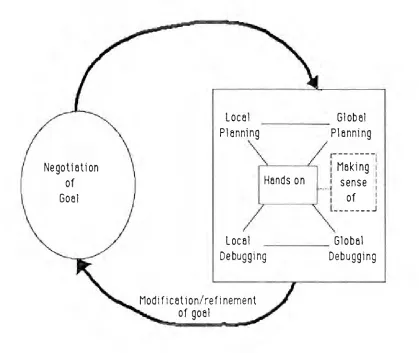
"At the beginning of the project pupils were given the freedom to choose their own goals and develop their own problem solving and programming strategies. Although our interventions were often focussed on process in the form of encouraging the pupils to reflect, we did not impose any "idealised" problem solving strategies on the pupils since the computer is a new problem solving tool and we wished to investigate the problem solving strategies developed by the pupils for themselves. We have identified from the transcript data categories of programming activity which provide a framework for analysis. These categories are:
provoked to think about the processes involved in their work and this tends to be detrimental to their learning.
"Making Sense of" This is exploratory activity in which pupils are trying out a new idea or procedure and reflecting on what is happening. Sometimes such activity is completely non-goal directed, sometimes it takes place within goal directed activity and sometimes a goal emerges from the activity. If pupils are to develop an understanding of the processes involved in Logo programming we would suggest that it is important that pupils are encouraged to "take time out" from working towards predefined goals to explore how a new process works.
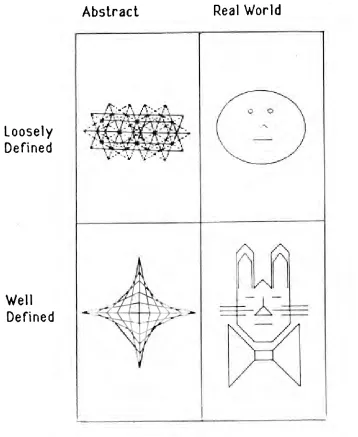
Goal Directed This is activity aimed at achieving an outcome. From the research data two separate dimensions along which turtle graphics goals can be classified have been identified:
a) Loosely defined Well defined
b) Real World Abstract
It is hypothesised that the 'position' of the goal with respect to these two dimensions will affect pupil interaction and behaviour.
a) Loosely Defined Well Defined
This dimension is concerned with the extent to which the pupils have defined and planned the final outcome of their work. On the one hand, loosely defined goals are characterised by a lack of detailed preplanned structure: they evolve out of exploratory "making sense of activity. It is important here to separate out global from local structure. Within loosely defined goals at a local level, individual modules can be well defined given the modular nature of Logo; in other words the global looseness of the goal does not imply that a local subgoal need not be tightly structured by the pupils.