IJEDR1602327
International Journal of Engineering Development and Research (www.ijedr.org)1860
Design And Analysis Of Composite Leaf Spring In
Heavy Vehicle Machine
Mr.Nagabhushana.N
Senior Asst professor, Department of Mechanical Engineering, New horizon College of Engineering, Bangalore, India
________________________________________________________________________________________________________
Abstract - Leaf spring is a kind of spring used in automobiles and off highway vehicles suspension systems. The advantages of a leaf spring over a helical spring is that the ends of the spring may be guided along a definite path as it deflects to act as a structural member in addition to energy absorber device. The leaf spring is not only to support the vertical load but also avoids road induced vibrations. Leaf spring is one of the oldest suspension components. In my project describes FE modelling and analysis of laminated composite leaf spring. Truck vehicle leaf spring considered for our analysis with three different materials namely, steel, E-glass/Epoxy, and Carbon/Epoxy subjected to the same load as that of a steel spring. The design constraints were stresses and deflections. Static analysis of a 3-D model has been performed using ABAQUS 10.0.
Index Terms - Truck vehicle leaf spring, static analysis, E-Glass/Epoxy, Carbon/Epoxy.
________________________________________________________________________________________________________
I. INTRODUCTION
Multi leaf spring are used in automobile and rail suspensions. The leaves are held together by a U-bolts. Rebound clips are provided to keep the leaves in alignment and prevent lateral shifting of plates during the operation.
The longest leaf, called as master leaf, is bent at both the ends to form the spring eye. At the center, the spring is fixed to the axle of the truck. Multi-leaf springs are provided with one or two extra full length leaves in added to master leaf. These extra length leaves are stacked between the master leaf and the graduated length leaves. These extra full length leaves are added to support the transverse shear force.
The leaf springs are mainly used in suspension to absorb shock loads in automobiles like light motor vehicles, heavy duty truck and off highways vehicles, and rail systems. It carries lateral loads, brake torque, driving torque. According to studies made a material with maximum strength and minimum modulus of elasticity in the longitudinal direction is the most suitable material for a leaf spring.
In present days weight reduction has been the main focus of automobile manufacturers. The replacement of steel with optimal designed composite leaf spring can provide 92% weight reduction. Moreover the composite leaf spring has lower stresses compared to steel spring. This results in fuel saving.
A composite material is nothing but permutation of two materials that produce an effect so that the combination produces combined properties that are different from any of those of its constituents. This is done purposefully intoday’s scenario to achieve different design, manufacturing as well as service advantages of product.
When leaf spring deflects, the upper side of each leaf tips slides or rubs to against the lower side of the leaf above it. Which produces some damping which reduces spring vibrations, but since available damping may change with time, it is not preferred to avail of the same. And it produces to squeaking sound. If moisture is also present, such inter-leaf friction will cause fretting corrosion which decreases the fatigue strength of the spring, phosphate paint may reduce this problem fairly.
II.LITERATURE REVIEW
The review mainly focus on replacement of steel leaf spring with the composite leaf spring made of glass-fibers reinforced polymer (GFRP) and majority of the published work applies to them.
Mouleeswaran et al. [1] describes Static and fatigue analysis of steel leaf spring and composite multi leaf spring made up of glass fiber reinforced polymer using life datanalysis. The dimensions of an existing conventional steel leaf spring of a light commercial vehicle are taken and are verified by design calculations. Static analysis of 2-D model of conventional leaf spring is also performed using ANSYS 7.1 and compared with experimental results.
Al-Qureshi et al. [2] has described a single leaf, variable thickness spring of glass fiber reinforced plastic (GFRP) with similar mechanical and geometrical properties to the multi leaf spring, was designed, fabricated and tested.
Rajendran I, et al.[3] investigated the formulation and solution technique using genetic algorithms (GA) for design optimization of composite leaf springs. GulurSiddaramanna et al. [4] explain the automobile industry has shown interest in the replacement of steel spring with fiberglass composite leaf spring due to high strength to weight ratio.
IJEDR1602327
International Journal of Engineering Development and Research (www.ijedr.org)1861
III.SPECIFICATION OF THE PROBLEMThe objective of the project is to analyze the composite leaf spring for the truck system for different materials. IV. LEAF SPRINGS:
The leaf springs are also called as flat spring are made up of flat plates. Leaf springs are designed by two ways: 1. Multi leaf and 2. Mono leaf.
The importance of leaf spring is to carry road bump loads due to irregularities, break, torque and driving torque etc... In a ddition to shock.
The multi-leaf spring is made up of several steel plates of different length stacked together, while mono-leaf spring is made up of single steel plate. Suring normal operation, the spring compresses to absorb road shock. The leaf spring bend and slide on each other allowing suspension movement.
Materials For Leaf Springs
The material used for leaf springs is usually a plain carbon steel having 0.90 to1.0% carbon. The leaves are heat treated after the forming process. After the heat treatment steel leaf springs get good strength and therefore greater load carrying capacity, high range of deflection and better fatigue properties.
Carbon/graphite fibers: Advantages are high specific strength and modulus, low coefficient of thermal expansion and high fatigue strength. Graphite has low impact resistance. Disadvantage are high cost, low impact resistance and high electrical conductivity.
Construction of Leaf Spring:
Glass fibers: Advantages over other materials are, it’s a low cost. High strength, high chemical resistance and good insulating properties. Disadvantages are low elastic modulus poor adhesion to polymers, low fatigue strength and high density, which increase leaf spring weight and size. And also a crack detection is difficult.
1. All Nonlinear effects are excluded.
2. The stress strain relationship for composite material is linear and elastic; hence hook’s law is applicable to composite material.
3. The leaf spring has uniform cross section.
V.COMPOSITE MATERIALS
A composite material is defined as a material composed of two or more constituents combined on a macroscopic scale by mechanical and chemical bonds.
Composite materials are combinations of two materials in which one of the material is called the matrix phase, is in the form of fibers, sheets, or particles and is embedded in the other material called the reinforcing phase.
So many composite materials offer a combinations of strength and modulus that are either comparable to or better than any traditional metallic metals. Because of their low gravities, the strength to weight-ratio and modulus to weight-ratios of these composite materials are markedly superior to those of metallic materials.
The fatigue strength weight ratios as well as fatigue damage tolerances of many composite laminates are excellent. For these reasons, fiber composite have emerged as a major class of structural material and are either used or being considered as substitutions for metal in many weight critical components in aerospace, automotive and other industries.
Another unique characteristic of many fiber reinforced composites is their high interval damping capacity. This leads to better vibration energy absorption within the material and results in reduced transmission of noise to neighboring structures.
High damping capacity of composite materials can be beneficial in many automotive applications in which noise, vibration, and hardness is a critical issue for passenger comfort.
VI.DESCRITION OF THE PROJECT
The suspension leaf spring is one of the potential item for weight reduction in automobiles. The history of composites helps us for better suspension system with better ride quality if it can be achieved without much increase in cost and decrease in quality and reliability. Ability to store and absorb more amount of strain energy ensures the comfortable suspension system. Hence the strain energy of the material becomes a major factor in designing the springs.
The work focus on the application of FEA concept to compare the different materials for leaf spring and propose the one having higher strength to weight ratio. The materials usedfor comparisons are; conventional steel, composite E-Glass/Epoxy and carbon epoxy. In the present work deflection and bending stresses induced in the leaf springs are compared. The solid modelling of leaf spring is done in hypermesh11.0 andanalyzed using ABAQUS 10.1.
The commonly used fibers are carbon, glass, etc.The material used for the leaf spring is mostly a plain carbon steel having 0.90% to 1.0% carbon. The leaf springs are heat treated after the forming process. The heat treatment of leaf spring steel products greater strength and therefore greater load carrying capacity, greater range of deflection and better fatigue properties.
VII. INTRODUCTION OF FINITE ELEMENT SOFTWARE
The basic procedure in FEA is that the body or structure is divided into smaller elements of finite dimensions called “Finite elements”.
IJEDR1602327
International Journal of Engineering Development and Research (www.ijedr.org)1862
In the present work, multi-leaf springs are modeled as solid elements. For modelling the steel spring, the dimensions of a conventional leaf spring a truck vehicle are chosen.ELEMENT TYPE:
SOLID: C3D8 structural solid
CONTACTS: 3D 8Node surface-to-surface contact
Solid element, type C3D8 modeled. The element is defined by eight nodes having three DOF at each node: translations in the nodal x, y and Z directions. The element has plasticity, creep, swelling, stress stiffening, large deflection, and large strain capabilities.
Contacts is an 8node element that is intended for general rigid-flexible and flexible contact analysis. Contact is surface to surface contact element.
Figure2: Solid model of leaf spring created in hypermesh11.0.
VIII. GEOMETRY DIMENSIONS:
Figure3: Geometry dimensions for leaf spring. IX.MATERIAL PROPERTIES:
The ability to absorb and store more amount of energy ensures the comfortable operation of a suspension system. However, the problem of heavy weight of spring is still persistent. This can be remedied by introducing composite material, in place of steel in the conventional leaf spring. From several studies it is found that the E-glass/Epoxy is better material for replacing the conventional steel as per strength and cost factor. The E-glass fiber is a high quality glass, which is used as standard reinforcement fiber for all the present systems well complying with mechanical property requirements.
1. STEEL:
Young’s modulus: 2e5MPa Density: 7.85e-9
Poisson’s ration: 0.3
2. E-GLASS EPOXY: Young’s modulus: 6500MPa Density: 2.000e-06
Poisson’s ration: 0.06
3. CARBON EPOXY:
Young’s modulus: 10600MPa Density: 1.600e-06
IJEDR1602327
International Journal of Engineering Development and Research (www.ijedr.org)1863
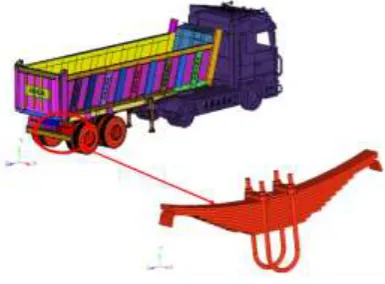
This project demonstrates how to conduct static structural analysis on leaf spring. Here the main intent is todemonstrate the boundary conditions and the loading of the leaf spring, hence the whole assembly of the leaf spring is simplified to single part. In computer aided design, geometric modelling is concerned with computer compatible mathematical description of the geometry of an object.Figure4: ABAZA truck vehicle, considered leaf spring for the analysis. XI.STRESS ANALYSIS:
Stress calculations are performed to estimate the reduction in strength in the spring resulting from cracks existing before the accident and the mid-plane segregation.
The finite element stress analysis was used to study the existence of transverse tensile stresses at the location of the fracture. The leaf spring was secured directly to the vehicle frame at the forward end and through a shackle assembly at the end.
Static analysis has been performed using ABAQUS10.0, figures in results plots shows the von misses stresses for composite leaf springs. In the current work, a steel leaf spring was replaced by a mono composite leaf spring due to high strength to weight ratio for the same load carrying capacity and stiffness.
The dimensions of a leaf spring of a truck vehicle are chosen and modelled using hypermesh11.0 and simulation is performed using ABAQUS 10.0.
XII. SPECIFIC DESIGN DATA Weight of vehicle= 8000 kg
Maximum load carrying capacity= 12000 kg Total weight= 8000 + 12000 = 20000 kg; Taking factor of safety (FS) = 2
Acceleration due to gravity (g) = 9.81 m/s2 Therefore;
Total Weight = 20000*9.81 = 196200
Since the vehicle is 8-wheeler, in vehicle total there are 4leaf springs are there, a single leaf spring corresponding to one of the wheels takes up one 4th of the total weight. 196200/4 = 49050N,Considered 50KN.
XIII. THEOROTICAL RESULT:
We calculated load on each leaf spring of vehicle, now bending stress in leaf spring is given by;
TABLE 1: Specifications of Leaf Spring A. S.No
B.
C. Parameters D. Value
E. 1 F. Total length of the spring(2L)(Eye to Eye) G. 1256mm H. 2 I. No.of full length leave (Master Leaf) J. 01
K. 3 L. Thickness of leaf M.14mm
N. 4 O. Width of leaf spring P. 100mm
Q. 5 R. Free Camber (At no load condition) (mm) S. 94mm
Where,
W-Load on vehicle (N) 50000/2 L- Length of spring (mm) n- No. of spring
E-Young Modulus (MPa) b- Width of leaf spring (mm) t- Thickness (mm)
IJEDR1602327
International Journal of Engineering Development and Research (www.ijedr.org)1864
σ = 6*25000*62810*100*(14)2
σ = 480.6MPa For 70KN load σ = 6*37500*628 10*100*(14)2
σ = 720.9MPa
TABLE 2: Calculation of stress for different values of loads T. Sl.No U. Parameter V. Steel for
50KN
W. Steel for 70KN
X. 1 Y. Weight (kg) Z. 84.1 AA. 17.1
BB. 2 CC. Stress
(N/mm2)
DD. 480 EE. 720
With reference to stress equation, the values of stress are calculated for conventional leaf spring andcomposite leaf spring for different values of load and these are as tabulated above in table2. For composite materialthe values of young’s modulus and thickness of spring will be different. Rest all the values will be same as stated.
XIV.RESULTS
Displacement plot
The maximum displacement along the bonded adhesive layer for steel as shown in figure6.
VONMISES STRESS PLOT
The maximum stress along the bonded adhesive layer for steel as shown in figure7.
Below tables are ABAQUS results of stress for different values of loads.
Table 3.Comparative Analysis of mono leaf steel spring and laminated composite mono leaf spring. Applied 70KN load FF. SL.No GG. Parameter HH. Steel II. E-glass/Epoxy JJ.Carbon/Epoxy
KK. 1 LL.Weight (kg) MM. 84.1 NN. 21.4 OO. 17.1
PP. 2 QQ. Stress
(N/mm2)
RR. 653 SS.296 TT.396
Table 4.Comparative Analysis of mono leaf steel spring and laminated composite mono leaf spring. Applied 50KN load UU. S.No VV. Parameter WW. Steel XX.
E-glass/Epoxy
YY.Carbon/Epoxy
ZZ.1 AAA. Weight (kg) BBB. 84.1 CCC. 21.4 DDD. 17.1
EEE. 2 FFF. Stress
(N/mm2)
GGG. 467 HHH. 249 III.326
IJEDR1602327
International Journal of Engineering Development and Research (www.ijedr.org)1865
Stress distribution in adhesive for E-GLASS/EPOXY leaf spring.Stress distribution in adhesive for CARON/EPOXY leaf spring.
XV.CONCLUSION
The comparative study has been done between composite leaf spring and steel leaf spring with respect to weight, stiffness and strength.
Acomposite leaf spring for the same load carrying capacity, there is a reduction in weight of 72to 80%.
Based on the results, it was inferred that carbon/epoxy composite leaf spring has superior strength and stiffness and lesser in weight compared to steel and other composite materials considered in this study. Therefore, it is concluded that composite leaf spring is an effective replacement for the existing steel leaf spring in automobile.
From the results, it is observed that the composite leaf spring is lighter and more economical than the conventional steel leaf spring with similar design specifications.
XVI.REFERENCES
[1] Hawang, W., Han, K. S. Fatigue of Composites – Fatigue Modulus Concept and Life Prediction Journal of Composite Materials, 1986.
Daugherty, R. L. Composite Leaf Springs in Heavy Truck Applications. K. Kawata, T.Akasaka (Eds). Composite Materials Proceedings of Japan-US Conference Tokyo,1981.
[2]. R.S.Khurmi and J.K.Gupta Machine Design chapter 23.
[3]. U. S. Ramakant & K. Sowjanya, “Design and analysis of automotive multi leaf springs using composite material”, IJMPERD 2249-6890 Vol. 3, Issue 1,pp.155-162, March 2013,
[4]. Rajendran I., Vijayarangan S., “Design and Analysis of a Composite Leaf Spring”Journal of Institute of Engineers, India ,vol.-8,2-2002
IJEDR1602327
International Journal of Engineering Development and Research (www.ijedr.org)1866
[6]. Mr. V. Lakshmi Narayana, “Design and Analysis Of Mono Composite Leaf Spring For Suspension in Automobiles” IJERT 2278-0181, Vol. 1 Issue 6, August – 2012[7]. Shishay Amare Gebremeskel, “Design, Simulation, and Prototyping of Single Composite Leaf Spring for Light Weight Vehicle”, Global Journals Inc. (USA) 2249-4596, Volume 12 Issue 7, 21-30, 2012