Analyzer to Identify Phrases and the Functional Roles in Sentences: Its
Architectural Aspects
∗Yukiko Sasaki Alam
Department of Digital Media, Hosei University 3-7-2 Kajino-cho, Koganei, Tokyo 184-8584, Japan
Abstract. This paper presents the architectural aspects of the phrase analyzer that attempts to recognize phrases and identify the functional roles in the sentences in formal Japanese documents. Since the object of interest is a phrase, the current system, designed in an object-oriented architecture, contains the Phrase class, and makes use of the linguistic generalization about languages with Case markers that a phrase, whether a noun phrase, a verb phrase, a postposition (or preposition) phrase or a clause phrase, can be separated into the content and the function components. Without a dictionary, and drawing on the orthographic information on the words to parse, it also contains a class that identifies the types of characters, a class representing grammar, and a class playing the role of a controller. The system has a simple and intuitive structure, externally and internally, and therefore is easy to modify and extend.
Keywords: Phrase analyzer, Morphological analyzer, Functional roles of phrases, Japanese
1.
Introduction
This paper describes the architecture of the small-scale phrase analyzer that attempts to parse into phrases texts transcribed wherever applicable in Joyo Kanji (frequently used Chinese characters), and to identify the functional roles of the phrases in the sentences. Such texts are found in articles in newspapers, professional magazines and journals, and government documents. Because there are no spaces between words in Japanese texts, word-breaking is not a straight-forward task. In the past there have been several morphological analyzers: notably, Juman (Kurohashi and Nagao, 2003) and Chasen (Matsumoto et al., 2000). The two large-scale analyzers parse Japanese texts into morphemes such as prefixes, suffixes, inflections, Case markers, particles and the components of compound words. The main task of the proposed system, however, is to parse sentences into phrases (not morphemes), and identify the functional roles of the phrases, because the objective is to understand sentences in terms of the functional roles of the phrases.
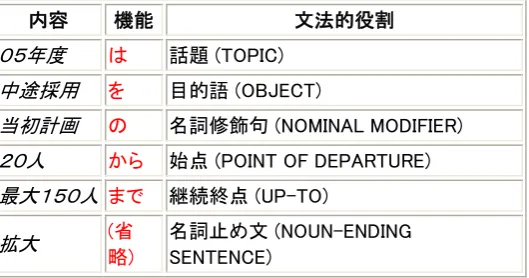
The second difference of the current system is that it is not intended to parse into phrases per se, but to identify the functional roles of the phrases. To recognize phrases, it resorts to a general characteristic of phrases in sentences found in formal documents. The general feature is that the component representing the content of a phrase is transcribed in Kanji (Chinese characters) or/and Katakana (phonetic characters used for transcribing words of foreign origin), and that the component expressing the function in Hiragana (phonetic characters used for transcribing words or morphemes of Japanese origin). There have been developed such morphological analyzers that exploit the orthographic difference between the content and
Figure 1: A simplified state chart diagram for the current system.
Below comes a more detailed description of each class in the current system.
2.1. The MorphAlgorithm class
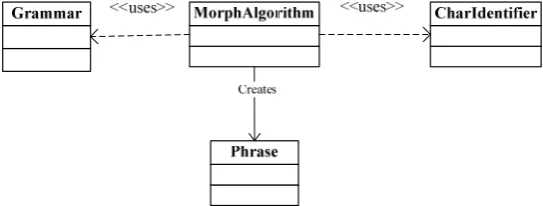
The MorphAlgorithm class1 is the main class of the present system that controls the process of recognizing phrases and identifying the functional roles played in the sentences of the text. The target texts are articles in newspapers, magazines, professional journals and public documents that are transcribed wherever applicable by using so called Joyo Kanji (frequently used Chinese characters). In such texts, the content parts of phrases are likely to be transcribed in Kanji (Chinese characters) or/and Katakana (phonetic characters used for transcribing words of foreign origin). At the same time most parts that indicate the functions of phrases are written in Hiragana (phonetic characters for transcribing words of Japanese origin). The system utilizes these orthographic features to recognize phrases, and identify the content and the functional parts. In addition, it resorts to another feature characteristic of Japanese (a head-final language) that the functional part is located at the end of a phrase.
The MorphAlgorithm class first cleans up the sentences to parse, for instance, by removing a tab stop and a new line characters. All the sentences in the text are appended into a StringBuffer instance, and are dealt with one sentence at a time. The algorithm that makes up the backbone of the MorphAlgorithm class (illustrated on Appendix A in this paper) is discussed in detail in Alam (2007). The following is a synopsis of the algorithm.
The algorithm first looks for a character or characters that are unacceptable at the beginning of a phrase. Such a character or characters are a period, a comma, a parenthesis and characters indicating a complementizer.2 After examining these elements, the algorithm yet has to look for another irregular situation before going on to find a typical phrase with the content section consisting of Kanji or/and Katakana, followed by the functional Hiragana part. The irregular case is that a phrase, in particular, the content part begins with a Hiragana character. When it finds only one Hiragana character followed by a Kanji or a Katakana, it checks if the Hiragana is an honorific prefix. If not, and followed by another Hiragana, it keeps reading Hiragana characters until it hits a character that is not a Hiragana. Then the Hiragana sequence is assumed to be a phrase, and sent to the procedure in order to find the functional role of the phrase by its ending part.
When the algorithm does not find a Hiragana at the beginning of the phrase, but a Kanji or a Katakana, it keeps reading it until it meets a character that is not a Kanji or a Katakana. It
1 The current system is written in Java programming language, in which a software system consists of many sets of programs called classes. Each class is a model that is a collection of procedures (called methods) and data (called data fields) used in the procedures. A class can be instantiated, and the instance can be used by another class. Some classes (often called utility classes) may never be constructed as instances, but the methods may be called and utilized by other classes.
2 A
complementizer is an element similar to that in I think that many people like the movie. と
2.3. The Grammar class
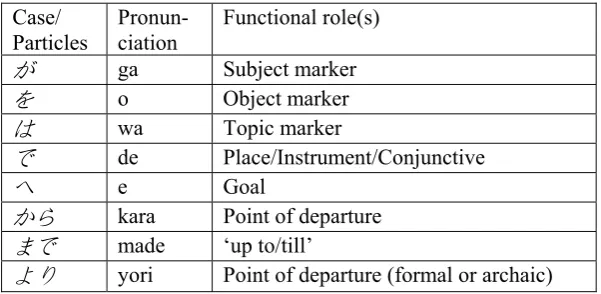
The Grammar class provides the MorphAlgorithm class with information on the functional roles of the function parts of phrases. For instance, Table 3 lists Case markers registered in the Grammar class.
Table 3: Case markers.
Case/ Particles
Pronun-ciation
Functional role(s)
が ga Subject marker
を o Object marker
は wa Topic marker
で de Place/Instrument/Conjunctive
へ e Goal
から kara Point of departure
まで made ‘up to/till’
より yori Point of departure (formal or archaic)
In addition, the Grammar class registers information on particles denoting conjunction (such as a particle denoting ‘and’), clause particles that make up various clauses by immediately following sentences and propositions (such as a particle indicating ‘because’), and particles denoting approximation (such as a particle indicating ‘about’). See Alam (2007) for the list of all the grammatical information contained in the Grammar class.
Table 4 shows the names of the data fields (or data used in the methods) and the methods listed in the Grammar class. The prefix + indicates that the data field is a public data field while the prefix – a private one that is used only inside the Grammar class.
As the names of the data fields in Table 4 indicate, the functional particles, suffixes and inflections are first recognized by the number of Hiragana characters that make them up, and then are examined for the grammatical roles by calling the getGrammaticalRole method.
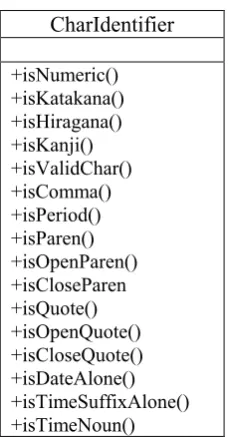
2.4. The CharIdentifier class
Suzuki, Hisami, Chris Brockett, and Gary Kacmarcik. 2000. Using a Broad-Coverage Parser for Word-Breaking in Japanese. Proceedings of the COLING, pp. 822-828.
Uchimoto, Kiyotaka, Masaki Murata, Satoshi Sekine and Hitoshi Isahara. 2000. Dependency Model Using Posterior Context. Proceedings of the Sixth International Workshop on Parsing Technologies, pp. 321-322.