Table 1. Tag set of the NE corpus
DIFF Difficult
problem
PER Person
name
LOC Location
name
ORG Organization
name
LAO
Location as Organization
OAL
Organization as Location
3.1 Difficult problem - DIFF
Diff (Difficult problem) is designed to identify problems such as nested, ambiguous, or poorly defined NEs. It addresses controversial items in Chinese named entity identification.
In our opinion, DIFF is essential for identifying ambiguous cases. Named entities that are difficult to classify are isolated from others for data cleansing to ensure that the content of the corpus is clear. DIFF entities will become the future expansion direction of our NER processing domain.
3.2 Person name - PER
Traditionally, the structure of Chinese person names follows the principle that the surname (one or two characters) is placed before the person’s chosen names (one or two characters). In our research, the annotation of person names follows this principle. But some entities with “person” meaning as Diff tagsuch as nicknames, incomplete Chinese person names, foreigners’ names and pronouns, are marked as Diff. These exceptions are discussed below.
3.2.1 Nicknames
Nicknames are not only given to people, but are sometimes given to pets or even objects like toys and vehicles. Because of their uniqueness, we mark nicknames as DIFF within a context, as the following example shows.
[ <DIFF>] [ <DIFF>] [xiao-bing<DIFF>] loves his daughter [yang-yang<DIFF>]
3.2.2 Incomplete Chinese person names
Following the full name principle, an incomplete Chinese person name indicates that the surname or chosen name may be omitted. For instance, “Shin, Cheng-Wei” is a full person name, but we sometimes only use the chosen name “Cheng-Wei” to address the person. Another example of an incomplete person name is a surname that follows a title or an appellation such as “ (Mr. Lee)”. Both of these cases are tagged as DIFF.
[ <DIFF>]
[President Chen<DIFF>] went to Hokaido for sightseeing this morning.
3.2.3 Foreigners’ names
Chinese NER has difficulty dealing with foreigners’ names because of the following name constructions: direct translation, Japanese person names, and Korean person names. First, direct translation cannot normally meet the principle of Chinese person names. For example, the Chinese translation of “Mel Gibson” is “
and Junichiro is his first name. These names don’t match the Chinese person naming principle. Finally, we treat Korean person names as PER because most of them match the Chinese naming rules, e.g. “
/Lee-Ying-Ai”.
As most foreigners’ names may cause confusion in Chinese NER, we use DIFF tag as a temporary solution in CNEC 1.0 to solve the problem.
[ <DIFF>]
[Mel Gibson<DIFF>] has achieved both fame and wealth by directing the movie “The Passion of the Christ.”
3.2.4 Pronouns
Some NER researchers claim their systems can handle pronouns as named entities for person names. However, because of the “uniqueness” of NEs, pronouns are beyond our scope and we do not annotate them as NE tags.
3.3 Location names - LOC
Basically, a location name pinpoints a place’s geographical position on an accurate map or in other reference material. Proper names like “Hyde Park”, “New York Art Theater” or “Berlin Wall” are suitable for NER, but terms like “a park”, “a theater”, or “a wall” are not. So the main purpose in tagging location names is to recognize an existent location in geographic.
A location name included in another compound word such as “ ”(Spanish seafood rice) is an issue in NE annotation. In Chinese, a term’s noun and adjective forms are the same, In this case, “Spanish” and “Spain” are translated as the same Chinese word( ). Therefore, we suggest a syntactic frame: insert “de
” between a possible location name and the other words close to (A de( ) B) to solve such cases.
Chinese Word 1:
In English: Spanish seafood rice [A de B] in Chinese: [ ][ ][ ] In English: [Seafood Rice] [of] [Spain]
Maximum and minimum semantic unit selection (section 2.3) is regarded as a Chinese segmentation problem. For example, in the phrase “ (United States) (Texas) (Austin)”, there are no spaces between the words in written Chinese. Location follows minimum semantic unit matching to tag the example as [ (United Sate)<LOC>] [ (Texas)<LOC>] [ (Austin)<LOC>]. In addition to the basic tagging rule, several location types have to be labeled
3.3.1 Roads, sections, and addresses
Address’ location information should be marked from country name, state, city, road (Boulevard, avenue, street, etc.,) to section. Other information in an address is excluded.
[ <LOC>] 100
[Zhong-Xiao East Road, Section 4<LOC>], No. 100
Sometimes a road section can be described in a city-section or area-section. In this case the road name and its description should be tagged separately.
[ <LOC>] [ <LOC>]
3.3.2 Location abbreviations
Location abbreviations are terms composed of two or more place names in a single entity. The other type of location abbreviation is multi-name expression containing conjoined modifiers. For instance, (Taichung) (Changhua) (Nantou) (area) is a common way to describe the location of three neighboring cities in Taiwan. We suggest that such cases should be tagged as DIFF.
[ <DIFF>]
[Tao-Chu-Miao<DIFF>] area it has been raining torrentially for a couple of days. # Tao-Taoyuan; Chu: Hsihchu; Miao: Miaoli
3.3.3 World place names
World place names can be divided into two sets: locations written in a foreign language and translated location names (written in Chinese). A translated name such as “ /New York” can be considered as a location name in CNEC 1.0. But an original name, like Tokyo, should be tagged as DIFF. The following two sentences demonstrate the criteria we set.
[ (Missouri State)<LOC>] [ (St. Louis City)<LOC>] [Missouri<DIFF>] [St. Louis City<DIFF>].
#[St. Louis City<LOC>] in [Missouri State<LOC>]
3.4 Organization names - ORG
In general, organizations include companies, government bodies, institutes, and other organized groups. We define an organization as having the ability to execute plans and projects. The tagging of ORG has to apply maximum semantic unit matching. A typical case is shown below.
[ (Yulon Motor Sanyi plant)<ORG>]
The maximum semantic unit is used because this entity cannot be separated into “ (Yulon Motor)” and “ (Sanyi plant)”. “Sanyi plant” cannot be tagged as a LOCATION according to the uniqueness characteristic of an NE. Like location names, some ambiguity may occur in the following cases.
3.4.1 Organization abbreviations
Organization abbreviation tagging follows the rules for location abbreviations described in Subsection 3.3.2. For example,
[ (Guo-Qin-Xin)<DIFF>] [ (BNHI)<ORG>]
Guo-Qin-Xin councillors went to the Bureau of National Health Insurance this afternoon. # Guo: Kuomintang; Qin: People First Party; Xin: New Party
3.4.2 Foreign organization names
As in Section 3.3.3, an original organization name is regarded as DIFF in CNEC 1.0, but a translated name is tagged as a location name.
[ <ORG>] [ <ORG>]
3.4.3 Groups, bands, crowds, and teams
Through the tagging process, we have found that most Chinese people have a problem tagging similar concepts like groups, bands, crowds and teams as organizations. Hence, we give a definition of an organization to help annotators determine if a term is an ORG. “An organization has five fundamental parts: a founder, capital, structure (departments, section, class, etc.,), a hierarchy (chief, director, dean) and employees.” According to this definition, we do not mark a term as an organization if it doesn’t have an organized structure.
3.5 LAO and OAL
Location as Organization (LAO) and Organization as Location (OAL) are proposed for semantically meaningful NE in Chinese NEC. In some cases, “location” represents an organization-like role to make decisions or to perform some duties. Compare the following two examples from the China Times news corpus:
1. “[ <ORG>] [ <OAL>] ”
[Taipei municipal government<ORG>] agreed to the protest in front of the [presidential plaza <LOC>]. 2. [ <ORG>]
[Presidential Office <LAO>] announced “one China, one Taiwan policy”.
The above examples show that the term “ (presidential plaza / presidential office)” has a double meaning in Chinese: location and organization. The first term “ ” is obviously a place name, but, the second “ ” is an organization. This use of the same term to indicate a place name and an organization name, we call it “borrowing”, is common in Chinese. Sometimes we cannot sure if a location entity is a real location name or just a borrowing. In order to avoid confusion, we separate the LAO tag and OAL tag in location and organization names.
Differentiating between a borrowing and a true NE depends on an entity’s category., By deciding which category an entity belongs to in common usage, we can tell whether it is a borrowing, or not. For example, a country’s name can refer to its geographical position, but it may also be used as an organization name, as in: “
/China warned the United States yesterday to stop selling advanced arms to Taiwan.” Obviously, in this case we can tell the country names are borrowings and should be annotated as LAO as follows:
[ <LAO>] [ <LAO>] [ <LAO>]
[China<LAO>] warned the [United States<LAO>] yesterday to stop selling advanced arms to [Taiwan<LAO>]
OAL can be identified in the same way:
[ <OAL>] This bus goes by [the Executive Yuan<OAL>]
4 Manual Annotating Process
Fig. 1. Original corpus
We chose high school students as annotators and gave them basic training before they performed the annotations. The training process was:
1. All the students attended courses about the project, including an introduction to named entity recognition, segmentation, and parts-of-speech tagging.
2. Students took a qualifying test to select participants for the tagging task.
3. Participants had to acquaint themselves with the annotating criteria we suggest ed and the operation of the tagging tool program. (Figure 2 shows the interface of the tagging tool.) The participants were then divided into three groups.
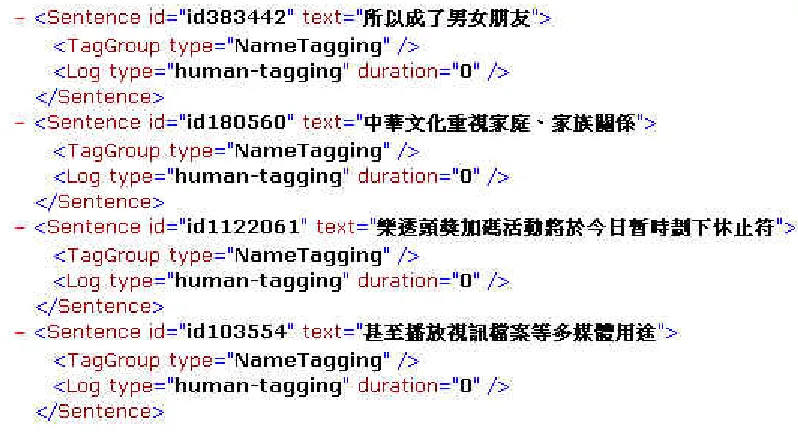
Each group was given the same sentence set containing 21,000 randomly extracted sentences; 13,208 from the UDN and 8,892 from the China Times. Table 2 shows the distribution of sentences. Participants were asked to finish the tagging task with the tagging tool program in two weeks. Figure 3 shows a tagged XML file in which the annotations are marked. Tagging results were then collected from each group and checked for consistency.
Table 2. Raw sentences count for each domain
638 1362
226 1019
143 848
883 1662
791 2305
2987 608
318 2303
672 519
868 598
647 1332
719 652
Fig. 3. Tagged corpus. The marked area shows the annotations the participants made: “pos” means the named entity’s starting location in the sentence and “len” is the length of the NE. The label “name” indicates what kind
of NE the word is.
5 Conclusion and Future work
In this paper we describe the construction of a tagged corpus for Chinese NER. We define the criteria of Chinese NE tagging, and design a standard tagging procedure for NE corpus annotation. We also demonstrate an annotator training procedure and the statistics of the corpus. The resulting corpus, CNEC 1.0, can be used to improve the performance of Mencius, our Chinese NER system. We do not use some ambiguous entities, labeled as DIFF, that involve issues such as abbreviations, cross-language loanwords and borrowings for training the NER model. As these entities need to be re-classified, advanced annotation will be executed in the next version of CNEC.
References
[2] M. Asahara and Y. Matsumoto: “Japanese Named Entity Extraction with Redundant Morphological Analysis”, HLT- North American Chapter of the Association for Computational Linguistics, Edmonton, Canada, 2003,
[3] A. Borthwick, J. Sterling, E. Agichtein, R. Grishman, “Exploiting Diverse Knowledge Sources via Maximum Entropy in Named Entity Recognition”, Sixth Workshop on Very Large Corpora, 1998.
[4] S. Sekine, R. Grishman, H. Shinnou “A Decision Tree Method for Finding and Classifying Names in Japanese Texts”, Sixth Workshop on Very Large Corpora, 1998.
[5] F. Erik Sang T.K., "Introduction to the CoNLL-2001 Shared Task: Language-Independent Named Entity Recognization", Proceeding of the 6th Conference on Natural Language Learning 2002 (CoNLL 2002), pp. 155-158
[6] F. Erik Sang T.K., Meulder, F.D., "Introduction to the CoNLL-2003 Shared Task: Language-Independent Named Entity Recognition", Proceeding of the 7th Conference on Natural Language Learning 2003 (CoNLL 2003)
[7] R. Grishman, B. Sundheim, “Message Understanding Conference - 6: A Brief History”, Proceedings of the 16th International Conference on Computational Linguistics, Copenhagen, June 1996.
[8] N. Chinchor, "MUC-7 Named Entity Task Definition(Version 3.5)" The 7th Message Understanding Conference (MUC), 1998