GE-International Journal of Management Research
Vol. 5, Issue 6, June 2017 Impact Factor- 5.779 ISSN(O): 2321-1709, ISSN(P): 2394-4226© Associated Asia Research Foundation (AARF)
Website: www.aarf.asiaEmail : [email protected] , [email protected]
AUTHENTIC LEADERSHIP: THE MISSING LINK TO EFFECTIVELY
MANAGE AGRICULTURAL CO-OPERATIVES’ CHANGES AND
TRANSITIONS IN AFRICA
Jared Mark Ochieno Matabi
Phd Student At Pan Africa Christian University, Nairobi, Kenya.
ABSTRACT
The co-operative organisations play a significant role in Africa’s socio-economic development,
which has prompted their promotion and development in various countries. Since the structural
adjustment programmes in the continent, the agricultural co-operatives have been faced with
political, funding and organisation changes. These changes requires management through
appropriate leadership approaches. This paper’s objective was to theoretically analyse the
impact of authentic leadership on change management in agricultural co-operatives, since the
introduction of the structural adjustment programme by World Bank and International Monetary
Fund. With the help of literature-review, the author has established that authentic leadership
has positive effect on the change agent’s views and abilities to undertake transitional strategies,
confidently, hopefully, optimistically, and resiliently; which eventually lead to effective and
successful change management. This paper may help co-operative promoters, followers and
leaders understand that authenticity is the missing link in the leadership of the agricultural
co-operatives in African context. Future empirical study may be conducted to authenticate the
proposed conceptual framework, particularly among the agricultural co-operatives in Africa.
Key words: Authentic Leadership, Change And Transition Management, Agricultural
1.0 Introduction and background information
1.1 Introduction
The co-operative societies are acknowledged across Africa as key development strategies, thus
their promotion. Agricultural co-operatives are playing in an important role in such specific areas
as filling input and output market gaps (Royer, 2014). They contribute significantly to rural
economic development (Dondo, 2012; Bello, 2010) whilst building social capital (Richards &
Reed, 2015; Poole & Donovan, 2014). In many African countries, co-operatives, being regulated
by stakeholder principle, belong to the social economy, characterised by production of goods,
services and knowledge; while pursuing both economic and social aims and fostering solidarity.
Co-operatives seek to primarily create both economic, social and societal benefits; rather than
maximising profits. They share common values of democratic control, voluntary participation,
flexibility, self-reliance, self-help, solidarity, and community ownership (Schwettmann, 2014).
In fact, seven percent of Africa‘s people, including children and the aged, are co-operative
members (Develtere, Pollet & Wanyama, 2008).
Co-operatives in Africa do provide essential services to a large portion of the population,
primarily the self-employed in rural areas and the urban informal economy. Further, the
co-operatives have exhibited extraordinary resilience, despite recurring changes in policies and
legislation, fluctuating donor viewpoints and inclinations, enormous external meddling and
unsuitable interventions; and severe turmoil created by conflicts, civil strives, natural disasters
and climate change, and dictatorial regimes, nepotisms and corruption (Schwettmann, 2014). The
impact of co-operatives on the continent cannot be overemphasised.
1.2 Co-operatives development in Africa
The promotion of Africa‘s co-operative movement has undergone various phases of
development. The colonial era to early 1960s as colonial tools, post-colonial era in the 1960s to
the mid-1990s characterised by stringent government control and monopolies, and liberalisation
era from mid 1990s (Wanyama, Develtere & Pollet, 2009; Develtere, 2008). The significant
change for co-operative movement was the introduction of structural adjustment programme
(SAPs) in 1990s – for the political and economic liberalisation – by World Bank and
International Monetary Fund.
The SAPs pointed out the requirement for the inefficient and the habitually corrupt
reforms. Secondly, SAPs unvaryingly presented neoliberal economic policies which demanded
the withdrawal of monopolies, privileges and subsidies. Thirdly, the wave of multipartyism that
demanded free democratic elections that would be replicated to co-operative organisations.
Finally, the disappointed and frustrated development partners had almost completely abandoned
co-operative development as a target and instruments of their aid policies, and directed efforts to
the promotion of individual-owned small enterprises (Schwettmann, 2014; Wanyama, 2013). In
summary, the changes in co-operative landscape since the introduction of SAPs can be
categorised as political, funding and organisational changes.
According to Schwettmann (2014), the three categories of changes in Africa‘s
co-operative movement are as a result of: minimally reduced role of state in relation to co-co-operative
development; demand for optimally sized co-operative - big enough to reach the economic
break-even point, and small enough to allow individual members to meaningfully participate;
rapid urbanisation and mushrooming informal enterprises such as middlemen; increasing
fragility and national crises to cope with; coping with manifestation of new forms of
co-operatives.
1.3 Effect of changes in Africa’s co-operative movement
Before economic and political liberalisation, agricultural marketing co-operatives formed the
largest category of the Africa‘s co-operative movement, a position that has since been taken by
the Savings and Credit Co-operatives (Schwettmann, 2011). What happened? Since the African
countries went through SAPs and democratisation from early 1990s, the co-operatives‘
environment has been turbulent and competitive – leading to more heterogeneous and less
structured co-operatives; where the formal co-operatives co-exist with informal self-help groups,
and cannot count on state support because they are free from state control.
Due to election cycles that came with political democratisation, changes in the
co-operative landscape was inevitable (Schwettmann, 2014). The political change have impacted
co-operatives development in Africa in many ways. For instance, the elected leaders may not
have the strategy for development of co-operatives, or cause conflicts in the co-operatives.
Secondly, the elected leaders may have limited resources for projects - for instance, agricultural
projects in their areas of jurisdiction – that would promote co-operatives efforts. Thirdly, the
deployed government officers, rules and processes may be inflexible and cumbersome in
environment. Finally, because of democracy, there are high level requirements for transparency
and accountability on part of co-operatives to various stakeholders including.
With the removal of state support and state control, the abolition of monopolies and other
privileges, democratic reforms and the withdrawal of external assistance; agricultural
co-operatives in Africa have faced triple crises. According to Schwettmann (ibid), these crises are:
identity crisis, where especially agricultural co-operatives exist by name only, and not by nature;
environmental crisis, where the legal, institutional and administrative context was preventing, are
not supporting, needing the advent of genuine, self-managed co-operatives; and, management
crisis, where the existing agricultural co-operatives are unable to survive without subsidies, state
protection and government control.
Internally, therefore, the agricultural co-operatives are largely characterised by free-rider,
horizon, portfolio, and control problems; and need to be transformed to ―new generational co-operatives‖ (Ortmann & King, 2007). There is inadequate information and assistance related to
addressing change and sustaining co-operative efforts, and as such co-operatives are
characterised by uncertainty, instability, and disjointed efforts. In this regard, leaders in the
agricultural co-operatives are challenged more than ever to have and effectively apply extensive
range of both internal and external skills, competencies, and capacities in their daily roles. From
membership and internal management and budget oversight, resource mobilisation and
partnerships management, production and collective marketing and processing, to name a few. Therefore, in today‘s co-operatives‘ leaderships, ―leaders require a mix of business skills,
political acumen and management competence as well as vision and conviction‖ (Schwettmann,
2011), because their roles are diverse and demanding.
As if mastering these skills and leadership capabilities are not enough of a challenge,
today‘s co-operative leaders are additionally faced with leading respective co-operatives amid
ever-changing political and regulatory frameworks, marketing structures and financial streams,
organisational and membership structures, and partners environment. Whether change involves
establishing a relationship with new development partner or government officials, re-organizing
or integrating programme areas, shifting gears with a new grant opportunity or sustaining efforts
when there is a gap in funding, co-operative leaders today are juggling the responsibility of
leading co-operative changes on one hand, while having to manage internal and external change
To be effective, therefore, these leaders need confidence, hope, optimism, and resilience
to effectively and successful manage changes and transitions in the respective co-operatives and
co-operative movements; which have been eminent since the introduction of SAPs in Africa.
1.4 Chapter conclusion
This conceptual paper puts into perspective, the impact of authentic leadership on change
management, specifically in agricultural co-operatives since the introduction of SAPs in Africa.
The question is, is the authentic leadership approach appropriate to manage the emerging
changes in co-operative movement in Africa?
Therefore, this paper bridges the gap in information and awareness on the change
management in co-operative movement that need to be understood by every followers and
promoters to elect and support leaders who can manage change, while enforcing corporate
governance. Moreover, this study may help in providing information to researchers who may
wish to further their research on this topic or scholars who may require information on the
authentic leadership in Africa‘s co-operatives. Thus, the paper reviews various literature and
makes a relational conceptual framework and conclusion on authentic leadership and change
management.
2.0 Authentic leadership and change and transition management
2.1 Understanding and managing change and transition
2.1.1 Definition of change
Change has been viewed differently by different authors. According to Oreg, By and Michel
(2013), change is any adjustment or alteration in an organisation that has the potential to
influence the organisation‘s stakeholders‘ physical and psychological experience. Dawson
(2003) views change, as an opportunity to make or become different through new ways of
organising and working. Generally, change is the shift in the external situation.
Change can be evolutionary – planned, proactive, intentional, deliberate, anticipatory –or
revolutionary – unplanned, reactive, unintentional, random, emerging - (Benn, et. al., 2014;
Yang, Zhou, & Yu, 2009; George & Jones, 2007; Walker et al., 2007; Petersen, et al., 2004). The
majority of available resources provide detailed information and frameworks about how to
manage and lead evolutionary (planned) change. Evolutionary change in agricultural
restructuring an organisation to facilitate membership mobilisation and education, or launching a
new agricultural production method. While leading evolutionary change is not without
challenges, there are many well-established systematic approaches that co-operative leaders can
draw on, to assist with this type of change. However, there are also situations in which
co-operative leaders are confronted with revolutionary (unplanned or unexpected) change. While
evolutionary change typically has an expected result of leading to some type of improvement,
unplanned change can be chaotic and lead to unknown results - positive or negative situations or
direction.
Whether organisational change is evolutionary or revolutionary, it is happens to people,
whether they agree with it or not. Moreover, regardless of the change scenario, there is a
transition period that people go through before moving into either the expected improvement or
new (positive or negative) situation (Bridges & Bridges, 2009). Change may occur quickly, but
transition occurs more slowly. Thus, change should be understood from a ‗changing organisation‘ perspective, which places multiple, simultaneous adaptive demands upon
individuals (leaders and followers) from many forces within the organisation, which in
themselves may be planned or possibly unplanned (Caldwell, 2013). To labour and capitalise on
the impact of change, organisations must therefore not just manage change but provide the
leadership to transition through change.
2.1.2 Stages of change and the transition model
In organisations, significant change can cause the same type of response that one experiences in
the grieving process. These responses may include shock, defensive retreat (i.e., defying change),
acknowledgement, and finally acceptance and adaptation (Luecke, 2003). It is notable that, these
responses to change are progressively linear, and people‘s response are at different rates.
Strategies these responses to change are significant. Bridges and Bridges (2009), through
―Three-Stage Transition Model‖, suggest strategies for helping people transition through each
stages of change. The first stage of change, is the ―ending, losing, and letting go‖ stage. The duo
argues that, this is the stage in which one enters once he/she is presented with change. The stage
is usually characterised by emotional disturbance and resistance, since people have to let go or
give up something that they are comfortable with or that is routine. Moreover, some people may
get stuck in this stage for some time, and may even exhibit active resistance all through the
under this stage are to listen and communicate. If people are initially resistant to change in stage
one, it is important to understand their emotions and allow them time to let go. One should
therefore listen intently, communicate openly, and assure people that they will have the support
they need to work in the new situation. Given that people often fear what they do not understand,
the leader should educate the followers about the positive aspects of the change and
communicate how their knowledge and skills are going to be an essential part of it.
The second stage of change, is the neutral stage. The scholars argue that people that are
affected by the change are often confused and uncertain during this stage. In fact, at this stage,
people may experience a higher workload as they work to get used to new systems and new ways
of working. This is the bridge phase between the old and the new, which will result in mixed
emotions. While this can be an extremely trying time, it can also be a time of great creativity,
innovation, and renewal. The transition strategy at this stage, is support and guide. They state
that, because of the higher workload and possible new processes, people may feel unproductive
during this time and feel as though progress is not being made. To move through this stage, it is
important to provide solid direction, frequent feedback, and short-term goals for a few quick
wins. It may also be important to deprioritize some work or provide extra assistance to staff to
help manage the increased workload.
The third stage of change is, the ―new beginning‖ – the last transition stage of acceptance
and new energy. Here, they say, people have started to embrace the change initiative because
they have begun to build skills to work in a new way and they are starting to see some wins from
their efforts. Most importantly, at this stage, people experience a new commitment to the group
or role. The transition strategy here is to celebrate and commit. The scholars expound that, being
able to sustain the renewed commitment during this phase is essential. The leader should take
time to celebrate the change that everyone has gone through, and reward groups for their hard
work. It is also important for a leader to remember that, not everyone will reach this stage at the
same time, and that there is the possibility that people will slip back in stages if he/she does not
continue to embrace the change and provide support.
It is worthwhile to note that, the transition model is relatively outlined to manage internal
transition. However, the concepts and strategies of each stage can also be applied to the work
that leaders do in leading and managing change with external partners. According to Kania and
Kramer (2011), creating and managing effective multisector collaboration requires a dedicated
2.1.3 Transitioning through changes
Transition strategies for successful political, organisational and funding changes are applicable in
both public and private organisations including co-operatives.
2.1.3.1 Transition through political changes.
In order to protect, advance, and sustain co-operative performance in the face of local political
changes, leaders must develop competence to facilitate, negotiate, and collaborate through these
changes and sometimes volatile political environments by: communicating and telling your
co-operative success story; talking about the co-co-operative in a new way without political undertone; ―buffer‖ the co-operative members from politicians; diagnose the internal and external political
landscape (values, loyalties, losses at risk and hidden risks), by thinking politically in terms of
stake in the adaptive challenge at hand, desired outcomes, level of engagement, and degree of
power and influence (Heifetz, et. al., 2009); learning to better understand the position of partners
and mutual interests (Lientz & Rea, 2004); and prioritise stakeholder management by using the
power/interest grid to manage closely (high power and high interest), keep satisfied (high power
and less interest), keep informed (lower power and high interest), and monitor (lower power and
less interest).
2.1.3.2 Transition through funding changes.
Given the capacity issues that many co-operatives face, it is understandable that they may not
elevate the importance of the funding issue until the situation becomes serious. Leaders should
therefore take a more proactive stance regarding funding in co-operatives, by engaging the
following strategies: understanding and leveraging resources; incorporating elements of
sustainability; and create resource development and sustainability plan.
2.1.3.3 Transition through organisational changes.
Change that is typically used to improve organisational performance in some capacity may
involve targeting one or more of four categories (Thompson, 2010): a) structural change, which
involves reconfiguring areas to achieve greater overall performance (e.g. restructuring
sub-committees to facilitate collaborations and communication between co-operative organs); b)
cost-cutting or saving factors, which may include identifying and eliminating nonessential
produce transportation services that owning a truck for short distances); c) process change, which
focuses on improving or making functions more effective and reliable (e.g. installation of system
to reduce number of office employees and improve services); and, d) cultural change, which focuses on the ―human‖ side of the organisation (e.g. regular direct extension services for
farmers). All of these change scenarios can exhibit new opportunities, and also potential
challenges for co-operative leaders.
In organisational change, the transition strategies may include: using and adapting change
models to guide organisational changes, transitioning from planning to implementing change,
and using change management competencies.
Once the co-operative leader, the change agent, has determined that some type of change
is needed or desired, there are several well-established models that can be used to guide the
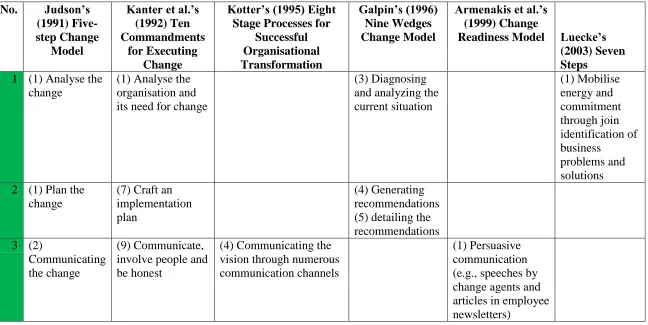
planning and implementation of the change effort. This study paper identifies the common steps
of six widely cited change models of Judson‘s Five-step Change Model (1991), Kanter et al.‘s Ten Commandments for Executing Change (1992), Kotter‘s Eight Stage Processes for
Successful Organisational Transformation (1995), Galpin‘s Nine Wedges Change Model (1996), Armenakis et al.‘s Change Readiness Model (1999), and Luecke‘s Seven Steps (2003); as
Table 1: Comparison of Six Change Models
No. Judson’s (1991) Five-step Change
Model
Kanter et al.’s (1992) Ten Commandments
for Executing Change
Kotter’s (1995) Eight Stage Processes for
Successful Organisational Transformation Galpin’s (1996) Nine Wedges Change Model
Armenakis et al.’s (1999) Change
Readiness Model Luecke’s (2003) Seven Steps
1 (1) Analyse the change
(1) Analyse the organisation and its need for change
(3) Diagnosing
and analyzing the current situation (1) Mobilise energy and commitment through join identification of business problems and solutions 2 (1) Plan the
change
(7) Craft an implementation plan
(4) Generating
recommendations (5) detailing the recommendations
3 (2)
Communicating the change
(9) Communicate, involve people and be honest
(4) Communicating the vision through numerous communication channels
(1) Persuasive communication (e.g., speeches by change agents and articles in employee newsletters)
No. Judson’s (1991) Five-step Change
Model
Kanter et al.’s (1992) Ten Commandments
for Executing Change
Kotter’s (1995) Eight Stage Processes for
Successful Organisational Transformation Galpin’s (1996) Nine Wedges Change Model
Armenakis et al.’s (1999) Change
Readiness Model Luecke’s (2003) Seven Steps
4 (3) Gaining acceptance of new behaviour (4) Changing from the status quo to a desired state
(8) Develop enabling structures
(5) Empowering others to act on the vision by changing structures, systems, policies, and procedures in ways that will facilitate
implementation
(8) rolling out the recommendations
(3) Human resource management practices (e.g., selection, performance appraisal, compensation, and training and development programs) (7) Formal activities that demonstrate support for change initiatives (e.g., new organisational structures and revised job descriptions)
5 (6) Planning for and creating short-term wins by publicising success, thereby building
momentum for continued change
(4) Symbolic
activities (e.g., rites and ceremonies)
(4) Focus on short term results, not on activities
6 (5) Consolidate and
institutionalise the new state
(10) Reinforce and institutional change
(8) Institutionalising the new approaches by publicising the
No. Judson’s (1991) Five-step Change
Model
Kanter et al.’s (1992) Ten Commandments
for Executing Change
Kotter’s (1995) Eight Stage Processes for
Successful Organisational Transformation Galpin’s (1996) Nine Wedges Change Model
Armenakis et al.’s (1999) Change
Readiness Model Luecke’s (2003) Seven Steps
7 (2) Create a shared vision and a common direction
(3) Creating a vision to accomplish the desired end-result
(2) Developing and disseminating a vision of a planned change
(2) Develop a shared vision of how to organize and manage for competiveness 8 (4) Create a sense
of urgency
(1) Establishing a sense of urgency by relating external environmental realities to real and potential crises and opportunities facing an organisation
(1) Establishing the need to change
9 (5) Support a strong leader role (6) line up
political sponsorship
(2) Forming a powerful coalition of individuals who embrace the need for change and who can rally others to support the effort
(2) Active
participation by those affected (e.g., vicarious learning, enactive mastery, and participative decision making)
(3) Identify the leadership
10 (7) Consolidating
improvements and changing other structures, systems, procedures, and policies that are not consistent with the vision
(5) Diffusion practices (e.g., best practice programs and transition teams)
(5) Start change at the periphery, then let it spread to other units without pushing it from the top
11 (3) Separate from the past
No. Judson’s (1991) Five-step Change
Model
Kanter et al.’s (1992) Ten Commandments
for Executing Change
Kotter’s (1995) Eight Stage Processes for
Successful Organisational Transformation
Galpin’s (1996) Nine Wedges Change Model
Armenakis et al.’s (1999) Change
Readiness Model Luecke’s (2003) Seven Steps
12 (6) Pilot testing
the
recommendations
13 (7) Preparing the
recommendations for rollout
14 (6) Management of
internal and external information
(7) Monitor and adjust strategies in response to problems in the change process.
Key
Common stages
As illustrated across these models, the essential components of change management include the
following: understanding the need for change; establish the sense of urgency; encourage people
to join a guiding coalition to lead the change; develop a vision and common goals; plan the
change; communicate the change; empower others to act on change; create short term wins;
reinforce and refine change; and, consolidate gains and produce more changes.
However, it is important to note that while these models are well established,
organisations may struggle to effectively implement change and transition efforts (due to
short-cutting steps or neglecting processes), and may fall short of achieving the desired outcome.
Kotter (2011) notes that, even though successful change efforts adhere closely to the steps and
processes outlined in these models, they are still messy and full of surprises. Therefore, the
critical factor for being able to implement the changes effectively is leadership.
People desire success of the change. But, the organisational members should be
positively ready and willing for change (Herron & Hicks, 2008; Jones, Jimmieson & Griffiths,
2005). A significant role in creating readiness for change is played by the leadership – process of
influencing others to achieve a common goal. These leadership roles tend to cascade down the
hierarchy of an organization. They include the roles of Sponsor, Implementer (or Target), Agent and Advocate (O‘Neil, 2000; Conner, 1993).
The leadership should therefore endeavour to undertake transition activities from
planning to implement change (Walker et al., 2007). This is possible when the leadership
effectively and honestly communicate the change that will be implemented for successful
adoption (Walker et al., 2007; Fernandez & Rainey, 2006). According to Saunders (1999), this
can be done by: specifying the nature of change; explaining the reasons for change and its scope;
develop graphic presentation of change so that the people can understand it better and hold in
their heads; explain the criteria for success and how it will be measured; repeat, repeat and repeat
the purpose of change and planned actions; use diverse communication strategies to
communicate change; and make the communication a two-way proposition.
In this regard, the leadership should nurture change management competencies.
According to Luecke (2003), change management competencies include: becoming a change
agent and embrace change; enlisting support from key people; address resistance to change;
providing meaningful ―anchors‖; recruiting staff with change management mentality; and, using
2.1.4 Leading through transition
Today, as co-operative leaders work to manage the many forces of change coming at them in
their co-operatives‘ environment, many of which are out of their control like globalisation, they
are also charged with leading change at the co-operative level. To manage these challenges and
lead change effectively, co-operative leaders must become more adept at recognizing change,
more aware of the issues that come with creating change, and more proactive in providing the
leadership necessary to transition through these change periods.
One of the most important initial steps that a co-operative leader must take, is to develop
and nurture abilities to recognize critical change situations as they present themselves. According
to Riordan (2008), a leader‘s ability to navigate transition points occurs on three levels: a)
staying ahead, when recognising transition points and navigating those changes in advance. This
enables them to maintain a high level of performance and lead others effectively through these
transition points; b) keeping up, when recognising transition points, as the change is happening;
such that even with slight adjustments and dips in performance, they are able to respond on time;
and, c) falling behind, when being unprepared and thus failure to recognise critical change or
transition points and therefore, not responding appropriately. The scholar argue that, although
some leaders in this role are shifted out of their position, generally, the organisational structure
and leadership is not able to keep up with the change in landscape. Hence, this affects the ability
of the organisation to move forward effectively. If the situation continues for a period of time, it
may result in significant damage to partnerships and commitment to the overall effort.
Irrespective of the level of response to change, leaders are advised to determine how to
tackle these issues in order to move forward the co-operative objectives. According to Stevens
(2008), practical strategies to help leaders transition through change more effectively are: a)
communicate, communicate, then communicate even more honestly; b) encourage agility by
making processes and procedures temporary or trial-based; c) match your actions to the current
state of transition; d) deal with emotion consistent with transition; e) make time for discussions;
f) mark major change and celebrate milestones; and, g) find right and meaningful metaphor such
as encouraging followers to feel that they are ―on a proud ship making a final voyage‖ that
thinking that they are ―on sinking ship‖.
In essence, a leader in transition phase, even in co-operatives, should balance between
leadership – ―doing the right thing‖ – and management – ―doing things right‖ (Bennis, 1989).
leadership and management is critical for successfully achievement of a change or
transformation initiative. While short-term results are feasible with either effective leadership or
management, long-term transformational success cannot happen without a combining the both
concepts. This is because, any change programme needs: thoughtful design; careful recruitment
and development of personnel; and close integration between the change agent team and the
organisational areas, targeted for change (Arrata, et. al., 2007). With such change processes,
there may be cases of dwindling confidence or self-efficacy, hope, optimism and resilience
among the stakeholders; which are required for successful change management. Thus, the
necessity of learning and practicing authentic leadership.
2.2 Authentic leadership
On the preceding accounts, authentic leadership is a leadership style worth analysing in relation
to effective and successful change management in agricultural co-operatives since the
introduction of SAPs in Africa since 1990s.
2.2.1 Definition of authentic leadership
According to Avolio and Gardner (2005), authentic leadership concept is the root construct that
serves as the base for all form of positive leadership. This is a build-up of Luthans and Avolio‘s (2003) view that authentic leadership is a ―root construct‖ that ―could incorporate charismatic, transformational, integrity and/or ethical leadership‖ (p.4). But, they also argue that these
constructs are distinct from each other.
In the above light, Walumbwa, et. al. (2008), views authentic leadership as an ethical,
genuine and transparent form of leadership approach which is identified as a positive
development in organisational research. Thus, the scholars defines authentic leadership as ―a
pattern of leader behaviour that draws upon and promotes both positive psychological capacities
and a positive ethical climate, to foster greater self-awareness, an internalized moral perspective,
balanced processing of information, and relational transparency on the part of leaders working
with followers, fostering positive self-development‖ (ibid, p. 94).
2.2.2 Factors that define authentic leadership
Authentic leadership comprises of four components i.e., self-awareness, balanced processing,
relational transparency, and an internalized moral perspective (Walumbwa, et. al., 2008).
In self-awareness, leaders understand their own values, weaknesses and strengths and
impact on other leaders and followers (Gill & Caza, 2015; Ilies, et. al., 2005). The factor refer to
the world (Kernis, 2003). It can be assumed that the way leaders will lead change in their
co-operative organisation is dependent on the perception they have about the world.
In relational transparency, leaders expresses their genuine selves to others and
responsively share information (Gill & Caza, 2015; Gardner, et. al., 2005). It refers to how a
leader relate to those around them. This creates an element of trust between the leader and their
followers (Walumbwa, et. al., 2008). Because followers are the ones who experience the leader‘s
authenticity during the change process, trust is a critical factor between them. Leaders need to be
open and honest.
In balanced processing, leaders objectively analyse all relevant information before any
decision-making (Walumbwa, et. al., 2008). In spite the fact that leaders may consider others‘
ideas objectively, their decision are not based on what other think or expect of them (Diddams &
Chang, 2012), nor any form of pressure (Gardner & Avolio, 2005).
In internalised moral perspective, leaders conduct is guided by internal morals and align
their behaviour with these values (Gill & Caza, 2015; Walumbwa, et. al., 2008). This refers to a leader‘s form of self-regulation, which is built on their values. One‘s behaviour is regulated by one‘s internal moral standards (Diddams & Chang, 2012). To sum up, the base of these four
components of authentic leadership is authenticity – the self-awareness and presentation of one
true self by expressing what an individual genuinely think and believes (Caza, et. al., 2010;
Kernis, 2003; Harter, 2002).
In essence, authentic leaders ―don‘t fake their leadership; they don‘t lead for status,
honour, or other personal rewards; they are not copied but are original and they are leaders
whose actions are based on values and convictions‖ (Shamir & Eilam, 2005). They are
―individuals who are deeply aware of how they think and behave and are perceived by others as
being aware of their own and others' values/moral perspective, knowledge, and strengths; aware
of the context in which they operate; and who are confident, hopeful, optimistic, resilient, and
high on moral character‖ (Avolio, Luthans, & Walumbwa, 2004, p. 4). Authentic leaders ―act in
accordance with deep personal values and convictions, to build credibility and win the respect
and trust of followers‖ (Avolio, et. al., 2004, p. 806). The authentic leaders, perfect positive
attributes such as confidence, hope, optimism, and resiliency. This makes them to judge
equivocal ethical issues, observing them from different viewpoints, and aligning choices with
However, ―being authentic does not mean being perfect; rather, it means owning and
accepting oneself with whatever talents and whatever limitations and imperfections one has. It also means being ‗up-front‘ in one‘s relationships, being present to the other person, being there in the now of the moment‖ (Starratt, 2011, p. 91). George (2003), argue that authentic leaders are
unselfish but motivated for the welfare of their followers, colleagues and organisations; have
moral values and ethics upon which when they do mistakes, they accept their mistakes as to
avoid such mistakes in the future.
2.2.3 Impact of authentic leadership on change management
Authentic leaders exhibit post-conventional views. They have high sense of personal identity,
tolerant towards self and others (Vincent, et. al., 2015), appearing awareness of inner conflicts
(Vincent, et. al., 2015; Divecha & Brown, 2013) and paradoxes, values relationships over
achievements (Vincent, et. al., 2015), interested in unique expressions of self and others
(Divecha & Brown, 2013), communicates well with people who have other action logics (Rooke
& Torbert, 2005), feedback is considered necessary for self-knowledge (Cook-Greuter, 2004).
Thus, in managing change effectively and successfully, authentic leaders have the
following tasks: First, they target followers‘ confidence (self-efficacy). Confident followers will
work well under pressure or stress in accepting and implementing change. Further, personal
confidence helps authentic leaders to know themselves and restrict themselves to their firm
beliefs about the change they are undertaking (Luthans & Avolio, 2003). Authentic leaders will
help others to recognize their capabilities during the change for acceptance and adoption of the
same.
Secondly, authentic leaders create hope among their followers or colleagues. This can
help the latter to set their objectives and make decisions on how to realise them, thus motivating
themselves to achieve them. According to Synder (2000), hope is comprised of the agency (the
will) and the pathways (the ways). During change process, some people may be well aware of
their path or even multiple paths to their objectives but they lack the willpower to reach over
there. According to Luthans (2002) work, it can be concluded be asserted that a more hopeful
change agent will have effectively manage organisational change.
The third task that an authentic leader is raising the optimism. During the change process,
the change agents need to exercise their positive emotional states, such as happiness, pride,
satisfaction, and enthusiasm – a character of authenticity (Gardner, John & Shermerhorn, 2004)
Fourthly, the authentic leader is tasked with strengthening resilience. Sometimes, there
may be negative reaction to change, such that the change agents may have difficulties to
withstand or recover quickly from such situation. If they have developed authenticity, they are
able to emerge even more strongly and with more committed passion rather with un-defeatable
passion. According to the McGregor (2005), positive expectations make a significant difference
for individual performance, when they are leading change. High expectations equals high
performance. In other words, your expectation will enhance your performance. The person with
high expectation will outperform the person with low expectations (Gardner, John &
Schermerhorn, 2004).
Moreover, having the post-conventional views, the authentic leaders: First, they are able
to think systemically (Boiral, et. al., 2009; Baron & Cayer, 2011; Brown, 2012; Schein, 2015).
Systems thinking indicates that one is aware of the interconnectedness between and
interdependence of systems (Schein, 2015) in your thinking, experiencing and actions. It also
comprises of seeing the ‗bigger picture‘ and recognizing that you are part of a system, which
influences you as well as you influence it (Anderson & Johnson, 1997). Secondly, they are
tolerant towards indecision (Vincent, et. al., 2015). Through relational transparency, the
authentic leaders as change agents question and subsequently challenge accepted assumptions
and also reframe issues. Thirdly, they are carriers of a long-term vision (Baron & Cayer, 2011;
Lynam, 2012; Schein, 2015) and with an open-mind, thinking liberally (Schein, 2015; Vincent,
2014), thus being able to institutionalise change.
In conclusion, authentic leader, while displaying post-conventional views, is more
effective and successful in accomplishing organisational change (see Brown, 2012; Boiral, et. al.,
2009). This is because, the authentic leader will: through internalised moral perspective exhibit
broader stages of consciousness for wider ranges of response (Boiral, et. al., 2009); through
balanced processing deal with complexities, integrate different viewpoints, come up with an
integrated vision and promote transformational organisational change (ibid); and, through
self-awareness think more deliberately, collaborate more, seek feedback, tend to be better at conflict
resolution and actively seek to develop their followers (Brown, 2012). Therefore, authentic
leadership has a positive influence on change management, to greater extent on the views and
2.3 Relationship between authentic leadership and change management
Authentic leadership contributes to effective and successful change management. The model in
Figure 1 shows that, authentic leadership hinges on – self-awareness, balanced process, relational
transparency and internalised moral perspective (Walumbwa, et. al., 2008) – such that, authentic
leader or follower need to exhibit confidence, resilience, hope and optimism (Gardner et al.,
2005; Avolio, et. al, 2004; May, et. al., 2003; Luthans & Avolio, 2003; George, 2003) in
themselves and other stakeholders. These enhances the change agents‘ ability to stay ahead, keep
up and avoid falling behind (Riordan, 2008) the essential change strategies during change
management process.
Further, the model show that effective change management comes by implementation of
key political, organisational and funding strategies during transition. Implementation of such
strategies hinges on the change agent‘s views and abilities to do so. The appropriate change agent‘s views (post-conventional) and abilities, are rooted in authentic leadership constructs. The
views include: self-reflection (self-awareness including awareness of inner conflicts and capacity
to reconcile or integrate them); managing complexity (Capacity to think in longer time frames,
challenge and reframe tolerate ambiguity, and enhance systems consciousness); and, broadening
Authentic leadership
Self-efficacy
Hope
Optimism
Resilience
Leaders’ ability in transition
Effective change management Stay Ahead
Avoid falling behind
Keep up
Transitioning strategies
Political
Organisational
Funding
Factors: self-awareness, balanced processing, relational transparency & internalised moral perspective
[image:20.612.70.543.225.485.2]Post-conventional views: self-reflection, managing complexity &broadening focus
focus (awareness of conflicting viewpoints, capacity to understand, interact or communicate with
people holding conflicting viewpoints, open mindedness, liberal thinking, openness to feedback
or suggestions and ideas of others, capacity to handle or resolve conflicts, and increasingly
integrative focus on sustainability). This model need to be empirically investigated to determine
the influence of authentic leadership on effective change management, particularly among the
agricultural co-operatives in Africa.
3.0 Conclusion and future research
This study establishes that co-operatives have been key development strategy for African
countries, leading to their massive promotion across nations, especially for the enhancement of
agricultural sector since colonial era. But with the introduction of SAPs in 1990s, the agricultural
co-operatives have been overtaken by the savings and credit co-operatives. The changes brought
about by SAPs to affect agricultural co-operatives can be categorised as political, funding and
organisational changes. Given the sudden introduction of SAPs, co-operatives and co-operative
movements on the continent were disorganised, and to date the SAPs‘ ‗tremor‘ is still felt across
many agricultural co-operatives in Africa, as many of them have collapsed or are dormant.
Leadership of this co-operatives have come under research, but not to the extent of examining
co-operative leadership approaches and current deteriorating status of agricultural co-operatives
in Africa since introduction of SAPs. It is on this basis, that this conceptual study paper was
authored. The paper established that, authentic leadership constructs have a positive impact on the change agent‘s views and ability, to implement change strategies for effective and successful
change management. Authentic leadership for the effective change management can be achieved,
since it can be accessed by leaders as change agents, to mobilise, develop and educate
stakeholders before, during and after the changes and transitions in co-operative organisations.
However, future empirical research is needed in this connection, to examine the
authenticity of operative leaders who may act as change agents. The status of agricultural
co-operatives across Africa‘s nations (such as activeness, dormancy or collapsed) should be
explored further to check the significance of authentic leadership influence on effective and
successful change management in co-operatives since 1990s. Further, the empirical research
should be explored and tested in comparison with other forms of co-operatives‘ activeness
References
Anderson, V., & Johnson, L. (1997). Systems thinking basics. Cambridge, MA: Pegasus Communications
Armenakis, A., Harris, S., & Feild, H. (1999). Paradigms in organisational change:
Change agent and change target perspectives. In R. Golembiewski (Ed.), Handbook of
organisational behaviour. New York: Marcel Dekker.
Arrata, P., Despierre, A., & Kumra, G. (2007). Building an effective change agent team.
McKinsey Quarterly, 4, 39.
Avolio, B., Luthans, F., & Walumbwa, F. O. (2004). Authentic Leadership: Theory
Building for Veritable Sustained Performance. Working paper. Lincoln: Gallup
Leadership Institute, University of Nebraska.
Avolio, B.J., & Gardner, W.L. (2005). Authentic leadership development: Getting to the
root of positive forms of leadership. The Leadership Quarterly, 16(3), 315-338.
Avolio, B
.J., Gardner, W.L., Walumbwa, F.O., Luthans, F., & May, D.R. (2004), Unlocking the mask: A look at the process by which authentic leaders‘ impact follower attitudes and
behaviours. The Leadership Quarterly, 15(6), 801-823.
Baron, C., & Cayer, M. (2011). Fostering post-conventional consciousness in leaders:
why and how? Journal of Management Development, 30(4), 344-365.
Bello, D. A., (2010). The Role of Co-operative organisations in Economic Development.
Munich Personal RePEc Archive. MPRA Paper No. 23161.
Benn, S., Dunphy, D., & Griffiths, A. (2014). Organisational change for corporate
sustainability. London: Routledge.
Bennis, W. (1989). Why Leaders Can’t Lead. Jossey-Bass.
Boiral, O., Cayer, M., & Baron, C. M. (2009). The action logics of environmental
leadership: A developmental perspective. Journal of Business Ethics, 85(4), 479-499.
Bridges, W., & Bridges, S. (2009). Managing transitions. Philadelphia, PA: DeCapo
Press.
Brown, B. C. (2012). Leading complex change with post-conventional consciousness.
Caza, A., Bagozzi, R.P., Woolley, L., Levy, L., & Caza, B.B. (2010). Psychological capital and authentic leadership: Measurement, gender, and cultural extension.
Asia-Pacific Journal of Business Administration, 2(1), 53-70.
Conner, D. (1993). Managing at the Speed of Change. New York, Villard.
Cook-Greuter, S. R. (2004). Making the case for a developmental perspective. Industrial
and commercial training, 36(7), 275-281.
Dawson, P. (2003). Organisational Change: A processual approach. London, Paul
Chapman
Develtere, P. (2008). Co-operative Development in Africa up to the 1990s. In P.
Develtere, I. Pollet & F. Wanyama (eds.), Cooperating out of Poverty: The Renaissance
of the African Co-operative Movement. ILO, Geneva.
Develtere, P., Pollet, I. and Wanyama, F., (2008). Cooperating out of Poverty: The
Renaissance of the African Co-operative Movement. ILO, Geneva.
Diddams, M., & Chang, G.C., (2012). Only human: Exploring the nature of weakness in
authentic leadership. The Leadership Quarterly, 23(3), 593-603.
Divecha, S., & Brown, B.C. (2013). Integral sustainability: Correlating action logics
with sustainability to provide new insights into the dynamics of change. Meta Integral.
Dondo, M. A., (2012). The co-operative model as an alternative strategy for rural
development: A policy analysis case study of Kenya and Tanzania 1960-2009. ETD
Collection for AUC Robert W. Woodruff Library. Paper 283.
Fernandez, S., & Rainey, H. G. (2006). Managing successful organisational change in the
public sector. Public Administration Review, 66(2), 168-176.
Fincham R, and Rhodes P (2005). Principles of Organisational Behaviour (5th ed). New York; Oxford University Press
Galpin, T. (1996). The human side of change: A practical guide to organisation redesign.
San Francisco: Jossey-Bass.
Gardner, W.L., Avolio, B.J., Luthans, F., May, D.R., & Walumbwa, F., (2005). Can you
see the real me? A self-based model of authentic leader and follower development. The
Leadership Quarterly, 16(3), 343-372.
Gardner, W.L., John, R., & Schermerhorn, J.R., (2004). Unleashing individual potential:
Performance gains through positive organisational behaviour and authentic leadership.
George, B. (2003). Authentic leadership. CMA Management, 77(8), 6.
George, W. (2003). Authentic leadership: Rediscovering the secrets to creating lasting
value. San Francisco Jossey-Bass.Gill, C., and Caza, A. (2015). An investigation of authentic leadership‘s individual and group effects on follower responses. Journal of
Management. [In Press].
Harter, S. (2002). Authenticity in C. R. Snyder, & S. Lopez (Eds.), Handbook of positive
psychology (pp. 382–394). Oxford UK Oxford University Press.
Heifetz, R., Grashow, A., & Linsky, M. (2009). Diagnose the political landscape—
Understanding political relationships in the organisation will help you lead adaptive
change. In, The practice of adaptive leadership: Tools and tactics for changing your
organisation and the world. Boston, MA: Harvard Business Press.
Herron, C., & Hicks, C. (2008). The transfer of selected lean manufacturing techniques
from Japanese automotive manufacturing into general manufacturing (UK) through
change agents. Robotics and Computer-Integrated Manufacturing, 24(4), 524-531.
Ilies, R., Morgeson, F. P., & Nahrgang, J. D. (2005). Authentic leadership and eudemonic
well-being: understanding leader–follower outcomes. The Leadership Quarterly, 16,
373–394.
Jones, R. A., Jimmieson, N. L., & Griffiths, A. (2005). The impact of organisational
culture and reshaping capabilities on change implementation success: The mediating role
of readiness for change. Journal of Management Studies, 42(2), 361-386.
Judson, A. (1991). Changing behaviour in organisations: Minimizing resistance to
change. Cambridge, MA: Basil Blackwell.
Kania, J., & Kramer, M. (2011). Collective Impact. Stanford Social Innovation Review.
Winter, 36–41.
Kanter, R., Stein, B., & Jick, T. (1992). The challenge of organisational change. New
York: The Free Press.
Kernis, M.H., (2003). Toward a conceptualisation of self-esteem. Psychological Inquiry,
14(1), 1-26.
Kotter, J. (2011). Leading change: Why transformation efforts fail. In On change
management. Boston, MA: Harvard Business Review Press
Kotter, J. (1996). Leading Change. Boston, MA: Harvard Business School Press.
Lientz, B. & Rea, K. (2004). Breakthrough IT change management: How to get enduring
change results. Burlington, MA: Elsevier Butterworth-Heinemann.
Luecke, R. (2003). Managing Change and Transition: 7 Practical strategies to help you
lead during turbulent times. Boston, MA: Harvard Business School Press.
Luthans, F. (2003). The need for and meaning of positive organisational behaviour.
Journal of Organisational Behaviour, 23, 695–706.
Luthans, F., & Avolio, B. J. (2003). Authentic leadership: A positive developmental
approach. In K. S. Cameron, J. E. Dutton, & R. E. Quinn (Eds.), Positive organisational
scholarship (pp. 241–261). San Francisco, Barrett-Koehler.
Lynam, A. (2012). Navigating a geography of sustainability worldviews: A
developmental map. Journal of Sustainability Education, 3, 1-14.
May, D.R., Chan, A., Hodges, T., & Avolio, B.J., (2003). Developing the moral
component of authentic leadership. Organization Dynamics, 32,247–60.
Moran, J.W., & Brightman, B.K. (2001). Leading organisational change. Career
Development International, 6(2), 111–118.
O‘Neil, M.B., (2000). Executive Coaching: With Backbone and Heart. San Francisco:
Jossey-Bass Publishers
Oreg, S., By, R.T., & Michel, A., (2013). Introduction, in the psychology of
organisational change. Cambridge: Cambridge University Press
Ortmann, G.F., & King, R.P. (2007). Agriculture Co-operatives I: History, Theory and
Problems. Agrekon, 46, 40-68.
Petersen, A. H., Boer, H., & Gertsen, F. (2004). Learning in different modes: the
interaction between incremental and radical change. Knowledge and Process
Management, 11(4), 228-238.
Poole, N., & Donovan, J., (2014). Building co-operative capacity: the specialty coffee
sector in Nicaragua. Journal of Agribusiness in Developing and Emerging Economiesz
4(2), 133 – 156
Richards, A., & Reed, J., (2015). Social capital‘s role in the development of volunteer-led
Co-operatives. Social Enterprise Journal, 11(1), 4 – 23.
Riordan, C. (2008). Navigating through leadership Transitions: Making it past the twists
Rooke, D., & Torbert, W. R. (2005). Seven transformations of leadership. The Harvard
business review, 83(4), 66-76.
Royer, J.S., (2014). The Neoclassical Theory of Co-operatives: Part II. Journal of
Co-operatives, 28, 20–35.
Saunders, R. (1999). Communicating change: A dozen tips from the experts. Harvard
Management Communication Letter.
Schein, S. (2015). A new psychology for sustainability leadership. The hidden power of
ecological worldviews. Sheffield: Greenleaf Publishing.
Schwettmann, J. (2014). Co-operatives in Africa: Success and Challenges. Paper
presented at an International Symposium on Co-operatives and Sustainable Development
Goals. Berlin, German, 2 September, 2014, PARDEV, ILO.
Schwettmann, J. (2012). Co-operatives – A Global Vision. Paper presented at a
Symposium organized by the Friedrich Ebert Stifftung on Perspectives for Co-operatives
in Southern Africa, Lusaka, Zambia, 20-21 August
Schwettmann, J. (2011). Capacity building for Africa’s co-operatives and social economy
organisations. Paper presented at a Working Group Presentation on Co-operative in
Social development Beyond 2012, Ulaanbaatar, Mongolia, 3-6 May, 2011.
Schwettmann, J., (2014). Co-operatives in Africa: Success and Challenges. A
Contribution to the International Symposium on Co-operatives and Sustainable
Development Goals: The Case of Africa. PARDEV, ILO
Starratt, R.J. (2011). Refocusing School Leadership: Foregrounding Human Development
Throughout the Work of the School. New York: Routledge.
Stevens, T. (2008, July). 7 Actions to Manage Transitions. Retrieved November 22,
2016, from http://www.thinkleadershipideas.com/index_files/archive-2008.php
Snyder, C. R., (2000). Handbook of hope: Theory, measures, and applications. San
Diego: Academic Press.
Thompson, J. (2010). Understanding and managing organisational change: Implications
for public health management. Journal of Public Health Management and Practice,
16(2), 167–173.
Todnem, R. (2005). Organisational change management: A critical review. Journal of
Vincent, N. C. (2014). Evolving consciousness in leaders: Promoting late-stage
conventional and post-conventional development (Doctoral dissertation). University of
Adelaide.
Vincent, N., Ward, L., & Denson, L. (2015). Promoting post-conventional consciousness
in leaders: Australian community leadership programs. The Leadership Quarterly, 26(2),
238-253.
Walker, J.H., Armenakis, A. A., & Bernerth, J. B. (2007). Factors influencing
organisational change efforts: An integrative investigation of change content, context,
process and individual differences. Journal of Organisational Change Management,
20(6), 761-773.
Walumbwa, F. O., Avolio, B. J., Gardner, W. L., Wernsing, T., & Peterson, S. J. (2008).
Authentic leadership: Development and validation of a theory-based measure. Journal of
Management, 34, 89–126.
Wanyama, F.O., (2013). Some positive aspects of neo-liberalism for African
development: The revival of solidarity in co-operatives. International Journal of Arts and
Commerce, 2(1), 126-148
Wanyama, F. O. (2009). Surviving Liberalization: The Co-operative Movement in Kenya.
(COOPAFRICA Working Paper No. 10). International Labour Organisation, Dar es
Salaam.
Wanyama, F. O., Develtere, P., & Pollet, I. (2009). Reinventing the Wheel? African
Co-operatives in a Liberalized Economic Environment. Annals of Public and Co-operative
Economics, 80(3), 361-392.
Yang, R. S., Zhuo, X. Z., &Yu, H. Y. (2009). Organisation theory and management:
cases, measurements, and industrial applications. Taipei:
Yeh-Yeh.George, J. M., & Jones, G. R. (2007). Understanding and Managing