Modified Developed Distributed
Energy-Efficient Clustering Protocol for
Heterogeneous Wireless Sensor Networks
Sonam Jat*1, Dr. Prabhat Patel *2
P.G. Student, Department of ECE, Jabalpur Engineering College, Jabalpur, Madhya Pradesh, India1
Associate Professor, Department of ECE, Jabalpur Engineering College, Jabalpur, Madhya Pradesh, India2
ABSTRACT: Wireless Sensor Networks is consist of a large number of low-cost, small-power and multi-functional sensing devices called sensor nodes. Each sensor node is equipped with sensing, data processing and communication capabilities. In WSN energy efficient protocol routing is important, to save battery power. Recently, Developed Distributed Energy-Efficient Clustering (DDEEC) For Heterogeneous Wireless Sensor Networks is proposed. In this protocol for information forwarding, residual energy of nodes is taken into account to increase throughput. In this paper, a modification is suggested to further enhance the throughput, by considering dissipated energy of the nodes instead of residual energy. Finally, simulation results are presented to obtain results.
KEYWORDS: Throughput, Residual Energy and Dissipated Energy.
I. INTRODUCTION
Since a few years ago, Wireless Sensor Network technology has been developed. Many research communities give their attention on developing Wireless Sensor Network for many purposes. Advances in Micro-Electro-Mechanical Systems (MEMS), Digital Electronics and Wireless Communications have developed Wireless Sensor Networks (WSN’s) [1, 4]. The introduction of the Wireless Sensor Network has become a new paradigm in information-gathering method. This is because the Wireless Sensor Network is consists of many self-organized sensing nodes that cooperate with each other to gather the information. Each node is equipped with devices which are used to monitor and collect the data, process the collected data and then transmit the data to the adjacent nodes. Finally the data is send to the base station (BS), from which it is send to the user through the satellites or internet.
It is quite unfortunate that still there is requirement depth study in this domain; although numerous authors have given their personal efforts in this field restricting their work discovering appropriate routing protocols that can be used for a particular surveillance application. At this point, information that is related to any moving object or any event that’s triggered is detected and collected by these nodes. The network that carries this information makes use of a simple protocol stack which performs the normal transmission procedure without having any concentration for energy efficiency factor [5-9].
II. RELATED WORK
(Developed Distributed Energy-Efficient Clustering), permits to balance the cluster head selection overall network nodes following their residual energy.
2.1 RADIO MODEL
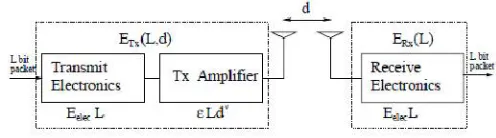
Figure 1 Radio Model representation
According to the radio energy dissipation model illustrated in Figure .1, in order to achieve an acceptable Signal-to-Noise Ratio (SNR) in transmitting an L−bit message over a distance d, the energy expended by the radio is given by:
2
0
4
0
.
.
.
if
( , )
.
.
.
if
elec fs
TX
elec mp
L E
L
d
d
d
E
l d
L E
L
d
d
d
(1)where Eelec is the energy dissipated per bit to run the transmitter or the receiver circuit,
fsand
mp depend on thetransmitter amplifier model we use, and d is the distance between the sender and the receiver.
2.2 DDEEC DETAILS
DDEEC implements the same strategy like DEEC en terms of estimating average energy of networks and the cluster head selection algorithm which is based on residual energy where:
The average energy in the rth round is
1
( )
1
av Total
o
round
E
t
E
N
R
(2)where R denote the total rounds of the network lifetime and is defined as
Total o Round
E
R
E
.ERound is the total energy dissipated in the network during a round, is equal to:
4 2
(2 )
o o
Round elec DA amp t BS fs t CH
E L NE NE kE d NE d (3)
where k is the number of clusters, EDA is the data aggregation cost expended in the cluster heads, dtoBS is the average
distance between the cluster head and the base station, and
o
t CH
d
is the average distance between the cluster members and the cluster head.Assuming that the nodes are uniformly distributed, it can be shown that:
2
2 2 2
(
) ( , )
2. .
toCH
M
E d
x
y
x y dxdy
k
(4)where ρ(x, y) is the node distribution because the average distance from a cluster head to the sink is given by [3]:
2 2
1
(
) ( , )
0.765
2
toBSM
E d
x
y
x y
dA
A
(5)0 2
2
fs opt
t BS mp
E
M N
k
t
E
(6)The difference between DDEEC and DEEC is localized in the expression which defines the probability to be a cluster head for normal and advanced nodes:
( )
for normal nodes (1 ) ( )
(1 ) ( )
for advanced nodes (1 ) ( )
opt i
av i
opt i
av
p E r
am E r
p
a p E r
am E r
(7)
In this expression we observe that nodes with more residual energy - Eav at round r- are more probable to be a clusters
head. Although, DEEC continues to penalize just the advanced nodes, this case is not the optimal way, because these nodes will be continuously a clusters head, then they will die quickly than the others [10].
Then, at each iteration the residual energy is decreased by:
4
[
/
]
AN
dis TX mp optBS RX DA opt
E
L E
E d
E
E
n K
(8)Where
E
disAN is the Energy dissipated by an Advanced Node by round. Then, the number of iterations possible for aCH,
Nb
CH with a initial energy equal to(1
a E
)
0is0
(1
)
CH AN disa E
Nb
E
(9)The Energy dissipated by a Normal Nodes
E
disNN in each round0 2
[
]
NN
dis TX fs t CH
E
L E
E d
(10)We can define the number of iterations possible for a normal node
Nb
NNwithE
0 initial energy by:0 NN NN dis
E
Nb
E
(11)So, the equation 3.7 which represents the nodes average probability pi to be a cluster head will change as fellow:
( )
for normal nodes ( )
(1 ) ( )
(1 ) ( )
for advance nodes ( )
(1 ) ( )
(1 ) ( )
for normal and advance nodes ( )
(1 ) ( )
opt i i av opt i i i av opt i i av
p E r
E r Th am E r
a p E r
p E r Th
am E r a p E r
c E r Th
am E r
(12)
In above,
1
0NN dis NN AN dis dis
aE
Th
E
E
E
[11].Defining
Th bE
0 then the theoretical value of b can be obtained as1
NN dis NN AN dis disaE
b
E
E
(13)III. PROPOSED METHOD
In previous section DEED protocol is discussed. In this protocol, cluster-heads are elected by a probability based on the ratio between residual energy of each node and the average energy of the network.
Where,
1
( )
1
av Total
o
round
E
t
E
N
R
(14)Therefore, nodes having higher residual energy will be used more frequently for packet transfer, and their residual energy will diminish at a faster rate. In the proposed method, energy is defined as
1
( )
c Total o
round
E t
E
N
R
(15). In the calculation, the original protocol is nominated as P1 while the proposed one is defined as P2.
Table I: Radio Characteristics Used In Our Simulations
Parameters Value
Eelec 5 nJ/bit
Efs 10 pJ/bit/m2
Eamp 0.0013 pJ/bit/m4
E0 0.5 J
EDA 5 nJ/bit/message
Message size 4000 bits
Popt 0.1
b 0.3
c 0.02
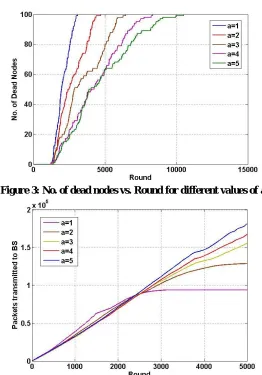
As discussed above, there are two types of nodes; normal and advance nodes. The advance nodes have higher energy as compared to normal nodes. The energy of advanced nodes is (1+a) times higher than normal nodes. The ratio of advance and normal nodes is defined by m. Generally the value of m is 0.1 or 0.2. In our experiment we have taken m to be 0.1. As 90% of the nodes are normal nodes and only 10% of the total nodes are advanced nodes. As shown in figure 3, the death of first node starts at nearly same round, this happens as normal nodes die firsts. However, as the value of a increases curves start to shift towards right, and for larger values of a network stay alive for longer duration. However, how long will network survives depend on the protocols, as if advanced nodes are used more frequently than they will lose their energy fast and start dying. However, as the energy of the advance nodes increases, network time increases.
Figure 3: No. of dead nodes vs. Round for different values of a
Figure 4: Packet transmitted to BS vs. Round for different values of a
Main aim of the protocol is to transmit more number of packets to the BS. As in figure till 2,500 rounds packets transmitted to the BS remains the same. Thus, for 2,500 rounds all the nodes behave like normal nodes, or in other words advanced nodes are not used so frequently till 2,500 rounds.
Comparison of Protocols
at the round 308, and all the nodes die at 9,871 rounds. Thus at the first end the performance of the protocol P1 seems to be perform better. But the performance of protocol P2 is better than P1 in the round range from 1952 to 5328.
Figure 5: No. of dead nodes vs. Round for a equals 5 for both the protocols
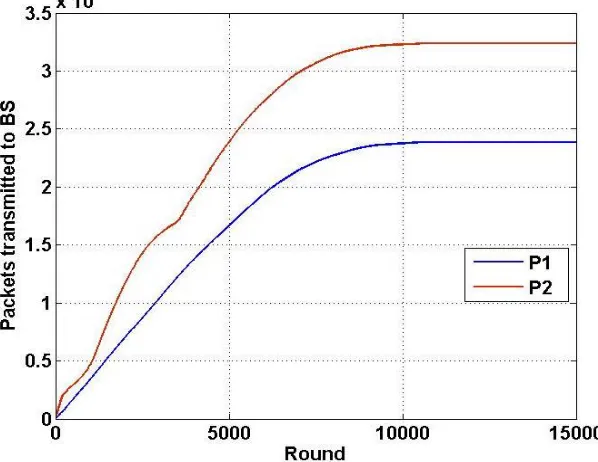
This is very important period as most of the nodes are alive for longer duration in P2, thus more number of nodes will send packets to the base station. In figure 6, packets transmitted to the base station are plotted with number of rounds. The number of transmitted packets in case of P1 protocol is 2.387×10⁵ while in case of P2 protocol is 3.234×10⁵. Thus, improvement is nearly 39% which is huge in terms of throughput.
IV.CONCLUSIONS
This paper discusses the results for old and proposed protocol. In both the protocols as the energy of the advanced nodes increases, packets transmitted to BS also increases.
On the basis of the obtained results following conclusions can be made:
1. The performance of heavily depends on the energy of the normal and advance nodes. 2. The number of nodes remains alive for longer duration in P2 protocol.
3. The chosen value of c has significant affects on protocol P2. 4. The performance of protocol P2 is much better in comparison to P1
5. The proposed protocol is based on dissipation of energy, rather than residual energy.
REFERENCES
[1] F. Akyidiz, Y. Sankarasubramaniam W. Su, and E. Cayirci, ”A survey on sensor networks”, IEEE Commun, August 2002.
[2] J. N. Al-Karaki and A. E. Kamal, ”Routing techniques in wireless sensor networks: a survey,” IEEE Wireless Communications, vol. 11, no.
6, pp. 6-28,Dec. 2004.
[3] D. Estrin, L. Girod, G. Pottie, and M. Srivastava, ”Instrumenting the world with wireless sensor networks,” In Proceedings of the
International Conference on Acoustics, Speech and Signal Processing, (ICASSP 2001), Salt Lake City, Utah, USA, vol. 4, pp. 2033- 2036, May 2001.
[4] M. J. Handy, M. Haase, and D. Timmermann, Low energy adaptive clustering hierarchywith deterministic cluster-head selection, In
Proceedings of the IEEE International Conference on Mobile and Wireless Communications Networks, (MWCN 2002), Stockholm, Sweden, pp. 368-372, Sept. 2002.
[5] P. , N.H. Vaidya, M. Chatterjee, D. Pradhan, A cluster-based approach for routing in dynamic networks, ACM SIGCOMM Computer
Communication Review 27 (2) (1997) 4965.
[6] B. McDonald, T. Znati, Design and performance of a distributed dynamic clustering algorithm for Ad-Hoc networks, in: Proceedings of the
Annual Simulation Symposium, 2001.
[7] Sze-yao Ni, Yu-chee Tseng, Yuh-shyan Chen, Jang-ping Sheu, The broadcast storm problem in a mobile Ad Hoc network, in: Proceedings
of the Annual ACM/IEEE International Conference on Mobile Computing and Networking (MobiCom99), August 1999, pp. 151162.
[8] D. Estrin, R. Govindan, J. Heidemann, S. Kumar, Next century challenges: scalable coordination in sensor networks, in: Proceedings of the
5th Annual ACM/IEEE International Conference on Mobile Computing and Networking (MobiCom99), August 1999, pp. 263270.
[9] L. Qing, Q. Zhu, M. Wang, ”Design of a distributed energy-efficient clustering algorithm for heterogeneous wireless sensor networks”. In
ELSEVIER, Computer Communications 29 (2006) 22302237.
[10] W.R. Heinzelman, A.P. Chandrakasan, H. Balakrishnan, ”An application- specific protocol architecture for wireless microsensor networks”,
IEEE Transactions on Wireless Communications 1 (4) (2002), 660-670.
[11] B. Elbhiri, R. Saadane, S. El Fkihi, and D. Aboutajdine, "Developed Distributed Energy- Efficient Clustering (DDEEC) for heterogeneous