ISSN(Online): 2320-9801
ISSN (Print): 2320-9798
I
nternational
J
ournal of
I
nnovative
R
esearch in
C
omputer
and
C
ommunication
E
ngineering
(An ISO 3297: 2007 Certified Organization)
Vol. 4, Issue 9, September 2016
Fog Computing: New Approach in the World
of Cloud Computing
Uttam A. Deshmukh 1, Dr. Sunanda A. More, 2
MSc CS, PGDCL. PhD Research Fellow, School of, Science and Technology, Yashwantrao Chavan Maharashtra Open
University, Nashik, Maharashtra, India
MSc (SC- Electronics), MBA HR. Associate Professor,School of, Science and Technology, Yashwantrao Chavan
Maharashtra Open University Nashik, Maharashtra, India
ABSTRACT: Fog computing is the pattern that extends cloud computing and services to the edge of the network. This
is similar to cloud computing. Fog provides data compute storage and application services to end users. The motivation of fog computing lies in a series of real scenarios such as smart grid, smart traffic lighters in vehicular networks and software defined networks. This paper discusses the new emerging technologies that lie within cloud computing. We can see many differences between cloud computing (CC) and the fog computing (FC). These two emerging technologies have similarities, differences, drawbacks, etc. and this paper elaborates on the advantages and disadvantages of both fog computing and cloud computing, how fog computing will overcome cloud computing in the future, and how Internet of things (IoT) is flexible with fog computing. Finally this paper suggests the future scope of fog computing in the both smart grid and in the computing based SDN (software defined networking).
KEYWORDS: Fog computing, Cisco, cloud computing, Edge, Internet of Things, software defined networking, smart
Grid; cloud Service Provider.
I. INTRODUCTION
Fog computing is a term created by Cisco that refers to extending cloud computing to the edge of an enterprise's network. It is also known as Edge Computing or fogging. Fog computing facilitates the operations like compute, storage and networking services between end devices (Edges) and cloud computing data centres [1]. Fog computing, also known as fogging/edge computing, is a model in which data, processing and applications are concentrated in
devices at the network edge rather than existing almost entirely in the cloud [2].The concentration means that data can
be processed locally in smart devices rather than being sent to the cloud for processing. Fog computing is one approach to dealing with the demands of the ever-increasing number of Internet-connected devices sometimes referred to as the Internet of things (IoT). Cisco recently delivered the vision of fog computing to run applications on connected devices that would run directly at the network edge. Customers can develop, manage, and run software applications on the Cisco framework of the networked devices. This includes the difficult routes and switches. Cisco brought this new innovation where they combined the open source Linux and network operating system together in a single network device. [3]
II. EXISTING CLOUD COMPUTING SYSTEM
ISSN(Online): 2320-9801
ISSN (Print): 2320-9798
I
nternational
J
ournal of
I
nnovative
R
esearch in
C
omputer
and
C
ommunication
E
ngineering
(An ISO 3297: 2007 Certified Organization)
Vol. 4, Issue 9, September 2016
electricity network.[4] Cloud computing provides many opportunities for the enterprises by offering their customers a range of computer services like Pay-As-You-Go (PAYG), flexible computing, data insurance, etc.
The cloud computing model is an efficient alternative to owning and running private data centers for customers using web applications. The private cloud gives you free space from 10 GB to 20GB. If the user wants extra storage, they have to pay only $1USD/67rs per month; this is very cost- effective. According to the cloud computing model, the more data you use, the cheaper it will be. If you are a regular and trusted customer they might give you a data insurance facility as well.
Fig 1.Existing cloud computing system
III. CLOUD COMPUTING SERVICES
Cloud computing services are useful for students as well as teachers. These are virtual machines (VM) that are changing the whole world of education in a good way. We use cloud computing for the education infrastructure, application, platform, and Software as a Service (SaaS). This service is helping to build Education as a Service (EaaS). EaaS is a specially designed service for online education (synchronized/unsynchronized). Cloud computing services are managing all the infrastructure, study services, study material and inventory. The services can be designed according to the machine the service is able to run on like the laptop, mobile, palmtop, personal computers or servers without internet connectivity. The service can also run from school/college servers, a data centre or third party servers that are accessed via the Internet. EaaS provides the updated tools that are useful for short operations like editing, inserting, deleting, etc. A private cloud can be best for establishing the EaaS at very low cost. EaaS is designed especially for education; that’s why the purpose of this service is to be cost -effective, secure, reliable and flexible. The institution can totally rely on this service; everything is designed under the institution’s circumstances. EaaS stores lesson plans for various subjects (as data storage) in private clouds that allow teachers and students to access the files anywhere and at anytime.
A. SOFTWARE AS A SERVICE (SAAS)
Software as a Service is a software licensing and delivery model in which software is licensed on a subscription basis and is centrally hosted [5]. Software as a Service is needed for computer laboratories. For educators, teaching materials are accessed via a web browser and are available on a paid basis (monthly/annually) according to the Cloud Service Provider (CSP). SaaS is different from the traditional model where the educational institute buys a license and ownership which requires installation and maintenance by the institute. SaaS is faster than the traditional way (Cluster Computing) and is a cost–effective option. Also, SaaS vendors provide the recent updates of software services.
B. PLATFORM AS A SERVICE (PAAS)
ISSN(Online): 2320-9801
ISSN (Print): 2320-9798
I
nternational
J
ournal of
I
nnovative
R
esearch in
C
omputer
and
C
ommunication
E
ngineering
(An ISO 3297: 2007 Certified Organization)
Vol. 4, Issue 9, September 2016
associated with developing and launching an app.[6]It is another variation of SaaS and delivers developmental
environment as a service. Students and teachers can build their own application that is connected to the vendor’s server. You can define your own data limit and make your own software too.
C. INFRASTRUCTURE AS A SERVICE (IAAS)
Infrastructure as a Service (IaaS) is a form of cloud computing that provides virtualized computing resources over the Internet. [7] This service of cloud computing provides the whole setup and infrastructure. The Consumer owns his/her own appliances like a server, machines, cooling equipment, etc. An organization is responsible for housing, running and maintaining it. The client typically pays on a per-use basis.
IV. TYPES OF CLOUDS
A. PRIVATE CLOUD
A private cloud is a data center owned by a single company for their own purpose, and the main purpose is to create their own network and to provide flexibility, scalability, provisioning, and automation and monitoring. The work of a private cloud is not to sell “as-a-service” offerings to external customers but instead to gain the benefits of cloud architecture without giving up the control of maintaining your own data center. A private cloud is more expensive compared to other clouds. The private cloud is not the best option for SMEs (small medium enterprises) or small businesses, startups, schools, or institutions. The maintenance of the private cloud is very high compared to other private clouds which are driven by concerns around security and compliance, and keeping assets within the firewall.
B. PUBLIC CLOUD
The public cloud is basically the Internet. Everyone can use it and it is free. Some companies are offering the free data usage limit of 10GB to 20GB. The public cloud is also known as Software as a Service (SaaS). Examples of public clouds include: Amazon Elastic Compute Cloud (EC2), IBM’s Blue Cloud, Sun Cloud, Google AppEngine and Windows Azure Services Platform. These services are for common users. CSPs provide value for money offers to end/common users. This service is manageable because the user pays nothing for hardware, maintenance, and all is covered under the provider itself. The public cloud works under the pay-as-you-go (PAYG) model. You can pay only for what you use, including for extra storage. But in the public cloud, there are some limitations. It might not be the right fit for organizations because the public cloud has low security. It is hard to secure your valuable data in the public cloud because of the security.
C. HYBRID CLOUD
The hybrid cloud is the median cloud type of both private and public cloud services. Organizations rely on hybrid clouds when they use the private cloud during peak time. Public clouds die because of traffic. During that time, hybrid clouds help both the private and public clouds which is why they are called as the emergency cloud. The hybrid cloud is also beneficial during predictable outages, hurricane, warnings, scheduled maintenance windows and rolling brown/blackouts. The ability to maintain an off- premises disaster recovery site for organization is impossible due to cost. That’s why most cloud customers rely on this hybrid cloud computing system.
IV. ADVANTAGES AND DISADVANTAGES OF CLOUD COMPUTING
Advantages
a) Reduced IT costs. With the help of cloud computing, the IT infrastructure cost is reduced.
b) People don’t need too many servers...
c) The cost of system upgrades, new hardware and software may be included in your contract. d) No longer need to pay wages for expert staff.
e) Energy consumption costs reduced. f) Fewer time delays.
g) Scalability of business: Institution scaled up and down.
h) Cloud computing is always flexible and easily adjusts itself for any situation.
ISSN(Online): 2320-9801
ISSN (Print): 2320-9798
I
nternational
J
ournal of
I
nnovative
R
esearch in
C
omputer
and
C
ommunication
E
ngineering
(An ISO 3297: 2007 Certified Organization)
Vol. 4, Issue 9, September 2016
j) Access to automatic updates about schools and institutions. It can be automatically updated with their new features
and be bug-free.
Disadvantages
a) Downtime cloud computing systems are dependent upon the Internet. When there is no Internet your system won’t
work.
b) The security and privacy is a big issue for the cloud computing in these days. The AWS EC2 console was hacked
and its all data deleted. This is enough reason for closing the company because of pressure. By leveraging a remote cloud based infrastructure, a company basically outsources everything it has.
c) Limited Control and Flexibility: cloud users have very limited control on their function infrastructure. Cloud provider EULAs and management policies might impose limits on what customers can do with their deployments.
V. HOW DOES FOG WORK?
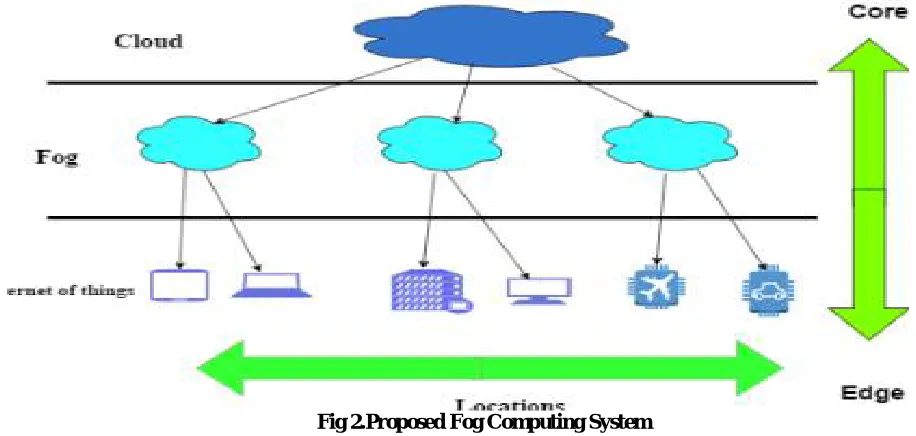
Many times sensitive data is analyzed on the nearest fog node (near to any appliance) to generate the data in Cisco smart grid distribution network. For example, the most time urgent requirement (requirement is very sensitive and private) is to verify that the protection and the control loops are working properly or not. Therefore, fog nodes are close to them. Look for this particular sign problem and then prevent them by sending rescue (control) commands to that.
a) The data that need seconds or minutes to do action is passed through to the cluster node for analysis and action. In
the smart grid example, each substation might have its own cluster node that tracks and reports the operational status of each downstream feeder
b) Data that is less time sensitive (normal data) is sent to the cloud (Historical analysis, big data analytics, and
long-term storage).
Fig 2.Proposed Fog Computing System
The above figure shows that each smart device (mobile phone, laptop, car, CPU etc.) Is connected with the fog devices, which are interconnected to the cloud.
A. WHAT IS THE NEED OF FOG COMPUTING?
ISSN(Online): 2320-9801
ISSN (Print): 2320-9798
I
nternational
J
ournal of
I
nnovative
R
esearch in
C
omputer
and
C
ommunication
E
ngineering
(An ISO 3297: 2007 Certified Organization)
Vol. 4, Issue 9, September 2016
a. Disadvantages to overcome in fog computing
Reduction in data movement across the network resulting in reduced traffic problem.
Obliteration of bottlenecks resulting from centralized computing systems.
Improved security of encrypted data as it stays closer to the end user.
B. WHAT HAPPENS IN THE FOG AND THE CLOUD?
Fog nodes
Receive data from IoT devices using any protocol, in real time.
Run IoT-enabled applications for real-time control and analysis,
In nanosecond response time.
Provide erratic storage, continually for 1–2 hours.
Send periodic data summaries to the cloud.
Cloud platform
Receives and aggregates data summaries from many fog nodes.
Performs analysis on the IoT data and data from other sources to gain business insights.
Cloud computing can send new application rules to the fog nodes based on these insights.
The following table shows that difference between Fog Computing and Cloud Computing.
C. FOG VS. CLOUD
Fig3. Fog Computing vs. Cloud Computing.
Service Cloud Computing Fog Computing
Latency High Low
Delay jitter High Very Low
Location of server nodes With in internet At every edge of the local network
Distance between the die and server One or more Hops One hop
Security Undefined Can be defined and it’s good
Attack on Data Encounter High possibility Less possibility
Geographical distribution Centralized Distributed
Num of Server Nodes Less More
Support for Mobility Limited More Supported
Real time Interactions Supported More Supported
ISSN(Online): 2320-9801
ISSN (Print): 2320-9798
I
nternational
J
ournal of
I
nnovative
R
esearch in
C
omputer
and
C
ommunication
E
ngineering
(An ISO 3297: 2007 Certified Organization)
Vol. 4, Issue 9, September 2016
D. SECURITY ISSUES IN FOG COMPUTING
The main security issues are authentication at different level of gateways as well as at the smart meters installed in the customer’s home. Each smart meter and smart appliance has an IP address.
A malicious user can tamper with its own smart meter, repeat false readings, or spoof an IP addresses.
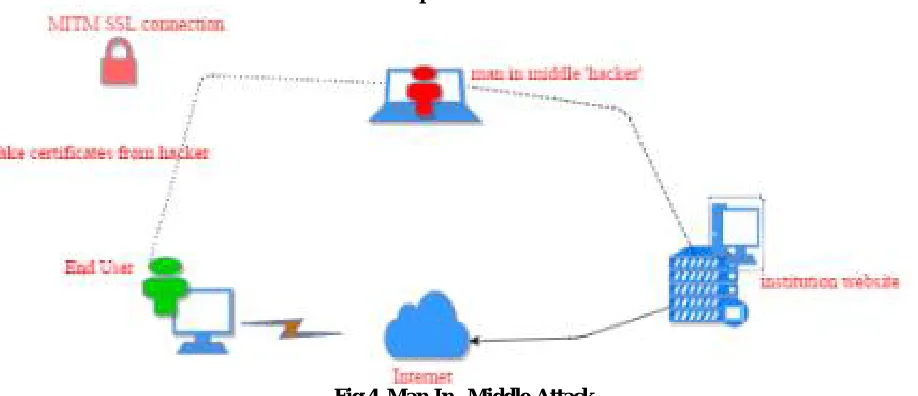
Let’s take one example of Man-In –Middle-Attack
Fig 4. Man-In –Middle-Attack
This paper overlooks the security of fog computing, for that purpose, we take the example of MAN-IN-THE-MIDDLE-ATTACK. This is the security problem of gateways services of fog devices. Fog edges are decrypted or one can change edges with fake devices. In this attack, gateways serving as fog devices are compromised or replaced by fake ones.
E. PRIVACY ISSUES IN FOG COMPUTING
In smart grid computing, the issues are related with privacy. Secured information in the grid system such as appliances and priorities (which the fog machine is used for the allocation of time) get stolen often, because it isn’t private. These privacy issues occur with the allocation of a specific task for a specific appliance, and then the machine’s information is not safe. This privacy issue still remains.
VI. IOT TODAY
ISSN(Online): 2320-9801
ISSN (Print): 2320-9798
I
nternational
J
ournal of
I
nnovative
R
esearch in
C
omputer
and
C
ommunication
E
ngineering
(An ISO 3297: 2007 Certified Organization)
Vol. 4, Issue 9, September 2016
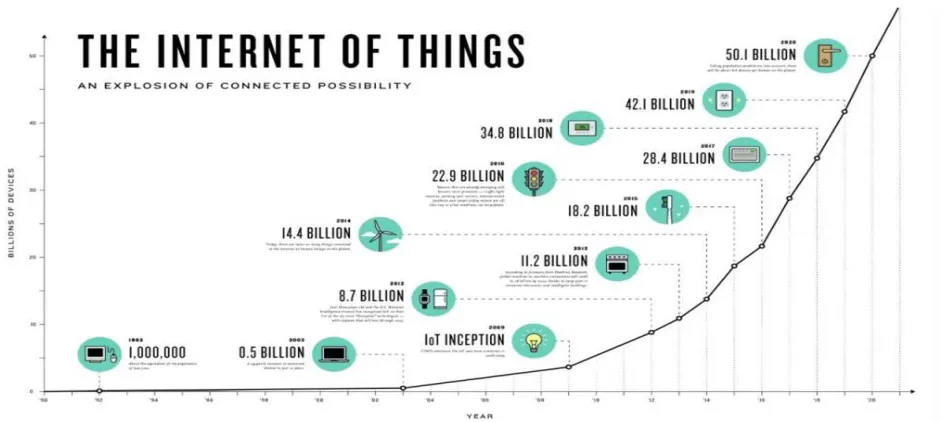
Fig 5. The Internet of Things, users in billions. (Info graphic The Connectives based on Cisco data)
VII. CONCLUSION
Fog computing advantages for services are in several domains, such as Smart Grid, wireless sensor networks, Internet of Things (IoT) and software defined networks (SDNs).This paper examined the general security issues and main privacy issues in fog and cloud computing.
Fog computing has a great future ahead partly because of its flexibility and reliability. However, the security issues, like internet distribution, are still big in fog computing compared to cloud computing.
VIII. FUTURE SCOPE
Future work will concentrate on the fog computing paradigm in the smart grid. In this case, two models for the fog devices can be developed. Separate fog devices can communicate with each other directly. They can share information and regulate with each other for the periodic updates on economical things like price, demand, etc.
Also, fog computing based SDN (software defined networking) in transportable or movable (vehicular) networks needs more attention.
REFERENCES
1. Andrei Zuzin, (2011), Cisco and/or its affiliates. Research at Cisco, (2011), 1-9.
2. Cisco the network in review http://newsroom.cisco.com/featurecontent?type=webcontent&articleId=1365576
3. From how to geek website http://www.howtogeek.com/185876/what-is-fog-computing/
4. Ziff Davis, Paul, Gil. (2014). What Is 'SaaS' (Software as a Service). PC Magazine Encyclopedia,(2014),
5. Brandon Butler, (2013). PaaS Primer: What is platform as a service and why does it matter? Network World,(2013) 6. The definition of IaaS http://searchcloudcomputing.techtarget.com/definition/Infrastructure-as-a-Service-IaaS
7. Cisco White paper https://www.cisco.com/c/dam/en_us/about/ac79/docs/innov/IoT_IBSG_0411FINAL.pdf
8. Guidelines on Security and Privacy in Public Cloud Computing, National Institute of Standards and Technology, US department of commerce, Wayne Jansen, Timothy Grance, December 2011
9. Computer Security Division, Information Technology Laboratory, National Institute of Standards and Technology, Gaithersburg, MD 20899-8930, January 2011 10. The Education Cloud: Delivering Education as a Service, WHITE PAPER, Intel® World Ahead Cloud Computing, 2010
11. http://us.gmocloud.com/company/thinkcloud/2011/12/15/moving-cloud-servers-into-education/ Article published in December 15, 2011 12. http://www.itslearning.eu/8-reasons-education-is-moving-to-the-cloudArticle published in 31st May 2011
13. MASTER IN CLOUD COMPUTING,(2014), Rajkumar Buyya, Christian Vecchiola, S Thamarai Selvi.(2014), Tata McGraw Hill Education Private Limited,1-5 14. Defination from Wikipedia https://en.wikipedia.org/wiki/Computer_cluster
15. http://www.answers.com/Q/Comparison_Grid_computing_and_cluster_Computing