EFFECT OF STRUCTURED PHYSICAL ACTIVITY PROGRAMME ON GROSS MOTOR FUNCTION OF ADOLESCENCE WITH CEREBRAL PALSY
Ceby George
Research Scholar, SPESS, MG University, Kottayam Dr.Binu George Varghese
Secretary, Kerala State Sports Council, Thiruvanathapuram Dr. T. I. Manoj
Dy. DSW, Kerala Agricultural University, Vellanikkara,Thrissur, Kerala, India,
ABSTRACTS
The purpose of the study was to find the effect of a carefully structured, moderate physical activity program on gross motor function of children with cerebral palsy. To achieve this purpose 16 (all male only) children with cerebral palsy between age group of 13-18 years with GMFCS levels I and II were selected as subjects for the study. They were randomly assigned to control and experimental groups of eight each. A structured moderate physical activity programme was implemented to control group thrice in a week for 16 weeks. The participants of control and experimental groups were administered with GMFM 88 by the scholars before the start of training programme and after implementation of the programme. The MANOVA results shows that, there was a statistically significant main effect in Gross Motor Function Measure Dimensions based on control group performance, F (1, 16) = 609.213, p < .000; Wilk's Λ = 0.002, partial η2 = .998. It can be conclude that, 16 week structured moderate physical activity programme can make significant improvement in GMFM dimensions: lying and rolling, sitting and walking, running and jumping of adolescent male with cerebral palsy.
Key Words: Physical activity, gross motor function, exercise, Cerebral palsy,
1. Introduction
Cerebral palsy (CP) describes a group of disorders of the development of movement and posture, causing activity limitation, that are attributed to non-progressive disturbances that occurred in the developing fetal or infant brain. The motor disorders of CP are often accompanied by disturbances of sensation, cognition, communication, perception, and/or behavior, and/or by a seizure disorder (Bax M, Goldstein M, Rosenbaum P, et al., 2005). Because of the impairments, many children and adolescents with CP have at least difficulty with activities such as walking independently, negotiating stairs, running, or navigating safely over uneven terrain (Styer-Acevedo J, 1999. Improving one’s ability to walk or to perform other functional activities are often the primary therapeutic goals for children with CP (Shepherd R., 1995).
drawing, painting, dance, music, sports, craft and indoor games. In fact, signs and symptoms of cerebral palsy, such as spastic muscles, poor balance and gross motor delays, will get worse without treatment/exercise. Physical activity programme is concerned, no definite or integrated programme was planned. To cope with the social necessity, children with C P needs appropriate public education to take place in the ‘Least Restrictive Environment.’ Child needs to be experienced with a highly individualised educational plan (Karande & Kulkarni, 2008).
The process of developing an individualised educational plan for a child with C P begins with an assessment of the child’s needs. After the assessment as per the guidelines the school has to work with the parent and others involved in the child’s education and treatment to develop individualised educational plan. This plan must develop with the cooperative effort of a team of educational experts consisting professionals, regular teachers, special education teachers, different therapists, counsellors, psychologists, experts in developmental screening and experts in teaching children with special needs. Parents also should be given enough opportunity to participate in the planning, execution and evaluation of the individualised educational plan (Sankaranarayanan, 2010).
Structured physical activity programs are those where the activity is conducted either in a group or individualised program format, under the supervision of a trained exercise leader or therapist. Structured physical activity is usually led by a qualified professional and adults, including sports organizations, guide play, school sports programs. The program is to improve or maintain the fitness level of the individual by keeping the intensity above of the daily activity of the reference to a structured action plan related to repeated muscle movement occurs and energy consumption. Exercise in children with CP has often been avoided because of the concern about the negative effect of such effort on muscle spasticity and children’s movement pat- terns (Bobath K., 1971). Several factors have contributed to a recent shift in perspective about the use of exercise in children with CP. Studies evaluating the effect of exercise on children with CP reported no adverse effect on patterns of movement, flexibility, or spasticity (Verschuren O, Ketelaar M, Takken T, Helders PJM, Gorter JW., 2007). These findings have influenced current practice.
Most exercise programs for children with CP are primarily designed for the lower extremity. The most common functions of the lower extremity tend to be gross motor activities that involve repetitive, reciprocal, coordinated motions of both extremities to move through space and that often require little conscious effort once under way (Damiano DL.,2006). There has been an increased interest in developing and implementing exercise programs that improve the cardiovascular fitness (aerobic and anaerobic capacity) and/or lower-extremity muscle strength of children with CP. A structured physical activity programme systematically integrates the aerobic and anaerobic activities. The purpose of the study was to find the effect of a carefully structured, moderate physical activity program on gross motor function of children with cerebral palsy.
2. Materials and Methods
2.1 Instrumentation
The Gross Motor Function Measure (GMFM) (Dianne Russell and Peter Rosenbaum, 2013) is a standardized observational instrument designed and validated to measure change in gross motor function over time in children with cerebral palsy. GMFCS level is a rating of severity of motor function. The scoring key is meant to be a general guideline. However, most of the items have specific descriptors for each score. It is imperative that the guidelines contained in the manual be used for scoring each item. The expanded GMFCS (2007) includes an age band for youth 12 to 18 years of age and emphasizes the concepts inherent in the World Health Organization’s International Classification of Functioning, Disability and Health (ICF). General headings for each level includes: LEVEL I - Walks without Limitations LEVEL II - Walks with Limitations LEVEL III - Walks Using a Hand-Held Mobility Device LEVEL IV - Self-Mobility with Limitations; May Use Powered Self-Mobility LEVEL V - Transported in a Manual Wheelchair. GMFM 88 has five dimensions as follows: A – Lying and rolling, B- Sitting, C- Crawling and kneeling, D- Standing and E- Walking, running and jumping. Between 12th and 18th birthday, Level I: Youth walk at home, school, outdoors, and in the community. Youth are able to walk up and down curbs without physical assistance and stairs without the use of a railing. Youth perform gross motor skills such as running and jumping but speed, balance, and coordination are limited. Youth may participate in physical activities and sports depending on personal choices and environmental factors. Level II: Youth walk in most settings. Environmental factors (such as uneven terrain, inclines, long distances, time demands, weather, and peer acceptability) and personal preference influence mobility choices. At school or work, youth may walk using a handheld mobility device for safety. Outdoors and in the community, youth may use wheeled mobility when travelling long distances. Youth walk up and down stairs holding a railing or with physical assistance if there is no railing. Limitations in performance of gross motor skills may necessitate adaptations to enable participation in physical activities and sports. These dimensions will measure on four point system ranging from 0-3 was executed.
3. Results
The important characteristics of the data on pretest and postest on different dimensions of control and experimental groups are presented below in Table 1.
Table. 1 Descriptive Statistics of Post test scores of Dependent Variables (GMFM Dimensions)
Dimensions Group Mean Std. Deviation N
Lying & Rolling Control 20.63 6.368 8
Experimental 30.38 8.052 8
Sitting Control 26.25 8.828 8
Experimental 36.75 6.861 8
Crawling & Kneeling Control 16.50 7.211 8
Experimental 21.63 6.255 8
Standing Control 17.75 3.240 8
Experimental 22.13 5.866 8
Walking, Running & Jogging
Control 26.00 5.707 8
Experimental 40.37 7.269 8
Total GMFM Control 21.43 5.63 8
Table 2. ANCOVA for Adjusted Posttest Score on Dependent variables
Dimensions Type III Sum of Squares
df Mean Square
F Sig.
(p-value)
Partial Eta Squared
Lying & Rolling- A 10.934 1 10.934 15.96* .003 .639
Sitting- B 38.819 1 38.819 59.92* .000 .869
Crawling & Kneeling- C .006 1 .006 .011 .920 .001
Standing-D 1.007 1 1.007 .610 .455 .063
Walking, Running & Jogging-E 3.889 1 3.889 5.18* .049 .365
Total GMFM 6.187 1 6.187 12.31* .007 .578
*
Significant at 0.05 levels
The MANOVA results shows that, there was a statistically significant main effect in Gross Motor Function Measure Dimensions based on control group performance, F (1, 16) = 609.213, p < .000; Wilk's Λ = 0.002, partial η2 = .998. Analyses of Covariance (ANCOVA) were carried out for the posttest scores of five dimensions and Total GMFM scores separately to find out any differences in the adjusted posttest means scores on selected dimensions between control and experimental groups. The results on table 2 shows that, An ANCOVA showed statistically significant treatment effects on GMFM dimensions; Lying and rolling (F (1, 16) = 5.96, p = .003), Sitting (F (1, 16) = 59.92, p = .000), Walking, Running & Jogging (F (1, 16) = 59.92, p = .000) and Total GMFM (F (1, 16) =12.31, p = .007) at the same time GMFM dimensions Crawling & Kneeling (F (1, 16) = 0.011, p = .920) and Standing (F (1, 16) = 0.610, p = .455) were found not statistically significant. Moreover, as per the Cohen effect size (Cohen, 1992) the dimensions A and B’s Partial Eta Squared is larger than 0.40, which means that, the treatment made 63.9% and 86.9% variability in posttest scores.
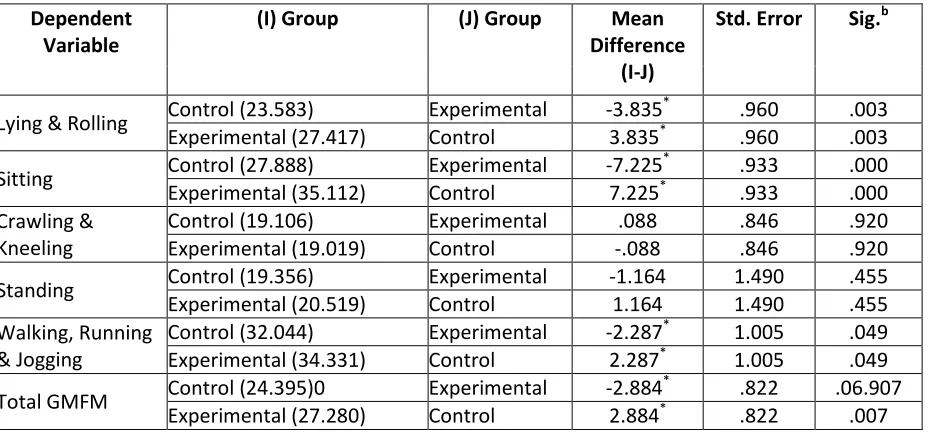
Table. 3 Pair-wise comparison of dependent variables adjusted post test means between control and experimental groups
Dependent Variable
(I) Group (J) Group Mean
Difference (I-J)
Std. Error Sig.b
Lying & Rolling Control (23.583) Experimental -3.835
*
.960 .003
Experimental (27.417) Control 3.835* .960 .003
Sitting Control (27.888) Experimental -7.225
*
.933 .000
Experimental (35.112) Control 7.225* .933 .000
Crawling & Kneeling
Control (19.106) Experimental .088 .846 .920
Experimental (19.019) Control -.088 .846 .920
Standing Control (19.356) Experimental -1.164 1.490 .455
Experimental (20.519) Control 1.164 1.490 .455
Walking, Running & Jogging
Control (32.044) Experimental -2.287* 1.005 .049
Experimental (34.331) Control 2.287* 1.005 .049
Total GMFM Control (24.395)0 Experimental -2.884
*
.822 .06.907
Experimental (27.280) Control 2.884* .822 .007
Based on estimated marginal means
*. The mean difference is significant at the .05 level.
The pairwise comparison of the control and treatment groups shows that, there is statistically significant mean gain on GMFM dimensions; lying & rolling (MD=3.835), sitting (MD=7.225), walking, running & jogging (MD=2.287) and Total GMFM (MD=2.884). Graphical representation of the control and experimental groups pre and posttest adjusted means was presented in Figure 1.
Figure 1. Control and experimental groups’ pre and posttest adjusted means with standard error
L&R = Lying and rolling, C&K= Crawling and kneeling, W, R & J = Walking, Running and jumping, Total GMFM = Total gross motor function measure.
4. Discussion
The analysis of the results revealed that in the case of experimental group, significant changes were seen in dimensions of GMFM 88 except in dimension C (crawling and kneeling) and D (standing) following a 16 week structured moderate physical activity programme. Statistically significant improvement was seen in dimensions A, B and E. This may probably due to the fact that exercises involving the trunk, back extensors during the conditioning activities. The lower limp muscles which are repeatedly stressed during the activities like walking, high knee action, squatting would have resulted in an increase in the strength of the muscles thus leading to an improvement in sitting.
limb strength would have less effect on the performance of activities such as sitting or lying and rolling than on activities such as walking, running, and jumping. It is difficult to draw from the literature conclusions about the effects of strength training on mobility in the CP population. With respect to walking speed, a positive effect after strengthening (Damiano DL, Abel MF., 1998), whereas another study detected no change (MacPhail HE, Kramer JF., 1998). The tailored nature of the training program may explain these disparate findings. In contrast to MacPhail and Kramer’s program, which involved strengthening of the quadriceps and hamstrings regardless of each individual’s assessment findings, Damiano and Abel’s program targeted training of each participant’s weakest lower-limb muscles. This finding suggests that strength-training programs that are tailored to individual needs may result in better functional outcomes than do less individualized programs.
It can be suggested that a training program for a minimum of 16 wks, with a frequency of three training sessions a week, may be sufficient to improve the gross motor function dimensions in CP. This finding supports the findings of Dodd et al., (2002) and Pippenger et al, (2004). They conclude that there is evidence supporting the view that progressive resistance exercise can increase the ability to generate muscle force in children with CP. This conclusion was supported by another systematic review of seven studies (Darrah J, Fan JS, Chen LC, Nunweiler J, Watkins B, 1997).
5. Conclusions
The following conclusions were drawn on the basis of the investigation of effects of structured physical activity programme for adolescents with Cerebral palsy on gross motor function measure dimensions. Based on the results obtained in the study, it can be conclude that, 16 week structured moderate physical activity programme can make significant improvement in GMFM dimensions: lying and rolling, sitting and walking, running and jumping of adolescent male with cerebral palsy.
In the light of conclusions drawn, structured physical activity programme must be included in the syllabi of students special education programme. In future research the effect of exercise programs on the participation level in children with CP needs to be studied. Overall, only a few studies have measured the effects of an exercise program on activity in children with CP. Future studies should be conducted find effect increase in children participation in school, leisure, social and family events after undertaking an exercise program. It is surprising that no studies found examined the effects on the participation level, especially, because participation of children with CP in everyday activities is a goal shared by parents, service providers and organizations involved in children’s rehabilitation (Law M, King G, King S, et al., 2006).
References
Bobath K: The normal postural reflect mechanism and itsdeviation in children with cerebral palsy.
Physiotherapy 1971;57:526-32
Bax M, Goldstein M, Rosenbaum P, et al: Proposed definition and classification of cerebral palsy, April 2005. Dev Med Child Neurol 2005;47:571-6
Cohen, Jacob (1992) A Power Primer Psychological Bulletin [PsycARTICLES]; July 1992; 112, 1; PsycARTICLES pg. 155
Damiano DL, Abel MF. Functional outcomes of strength training in spastic cerebral palsy. Arch Phys Med Rehabil 1998;79:119-25.
Damiano DL: Activity, activity, activity: rethinking our physical therapy approach to cerebral palsy. Phys Ther 2006; 86:1534-40
Dodd KJ, Taylor NF, Damiano DL: A systematic review of the effectiveness of strength-training programs for people with cerebral palsy. Arch Phys Med Rehabil 2002; 83: 1157-64
Darrah J, Fan JS, Chen LC, Nunweiler J, Watkins B: Review of the effects of progressive resisted muscle strenghtening in children with cerebral palsy: a clinical consensus exercise. Ped Phys Ther 1997;9:12-7
Fowler EG, Ho TW, Nwigwe AI, Dorey FJ: The effect of quadriceps femoris muscle strengthening exercises on spasticity in children with cerebral palsy. Phys Ther 2001;81: 1215-23.
Holland LJ, Steadward RD: Effects of resistance and flexibility training on strength, spasticity/muscle tone and range of motion of elite athletes with cerebral palsy. Paleas- tra Summer 1990:27-480
Healy A: Two methods of weight training for children with spastic type of cer0ebral palsy. Res Q
1958;29:389-95-
Karande, S & Kulkarni, M (2008), Impact of an Educational Programme on Parental Knowledge of Cerebral palsy. Indian Journal of Paediatric, Mumbai, September- 2008, , Vol 75(9), No. Sep 22, P 901-6.
Law M, King G, King S, et al: Patterns of participation in recreational and leisure activities among children with complex physical disabilities. Dev Med Child Neurol 2006; 48:337-42
MacPhail HE, Kramer JF. Effect of isokinetic strength-training on functional ab99ility and walking efficiency in adolescents with cerebral palsy. Dev Med Child Neurol 1995;37:763-75.
Palisano et al. (2008). Developmental Medicine & Child Neurology. 50:744-750 and in the GMAE-2
scoring software. 44-750 and in the GMAE-2 scoring software.
http://motorgrowth.canchild.ca/en/GMFCS/resources/GMFCS-ER.pdf
Pippenger WS, Scalzitti DA: What are the effects, if any, of lower-extremity strength training on gait in children with cerebral palsy. Phys Ther 2004;84:849-58
Sankaranarayanan Paleeri., (2010) Educational Programmes for Children with Cerebral Palsy: Parents’ and Teachers’ Dilemma, Journal of Education and Practice, Vol 1, No 3, 2010.
Stedman’s Electronic Medical Dictionary, version 4.0. Baltimore, Williams & Wilkins, 1998
Styer-Acevedo J: Physical therapy for the child with cerebral palsy, in: Pediatric Physical Therapy, ed 3. Philadelphia, Lippincott Williams & Wilkins, 1999