Article
1
Consumer perception of the quality of lamb and
2
lamb confit
3
Guillermo Ripoll*, Margalida Joy, Begoña Panea
4
1 Centro de Investigación y Tecnología Agroalimentaria de Aragón (CITA). Instituto Agroalimentario de
5
Aragón – IA2 (CITA-Universidad de Zaragoza). Avda. Montañana 930, 50059 Zaragoza, Spain.;
6
7
* Correspondence: [email protected]; Tel.: +34-976-716-452
8
9
Abstract: The patterns of food consumption in general and those of meat, in particular, are
10
constantly changing. These changes are due not only to socio-economic and cultural trends that
11
affect the whole society but also to the specific lifestyles of consumer groups. Due to the importance
12
of consumer lifestyle, the objectives of this study were i) to identify the profiles of lamb meat
13
consumers according to their orientation toward convenience, as defined by their eating and
14
cooking habits; ii) to characterize these profiles according to their socio-economic characteristics and
15
their preferences regarding the intrinsic and extrinsic quality signals of lamb meat; and iii) to
16
analyze the willingness to pay for lamb confit. In this study, four types of consumers have been
17
differentiated according to their lifestyles related to lamb consumption. These groups, due to their
18
characteristics, could be called "Gourmet", "Disinterested", "Conservative" and "Basic". The Gourmet
19
group has characteristics that make it especially interesting to market a product such as lamb confit;
20
however, this group is unaware of this product. Therefore, a possible strategy to expand the
21
commercialization of light lamb and the confit product would be guided marketing to this niche
22
market.
23
Keywords: cluster; intrinsic; extrinsic; oil; meat confit; lamb
24
25
1. Introduction
26
The patterns of food consumption, in general, and those of meat, in particular, are constantly
27
changing. These changes are due not only to socio-economic and cultural trends that affect the whole
28
society but also to the specific lifestyles of consumer groups, which are increasingly diversified.
29
Lifestyle defines the activities of people in terms of how they spend their time, their interests, their
30
opinions and their views of themselves and the world around them [1], and this makes the consumer
31
respond differently to everyday stimuli such as consumption. In the field of food marketing research,
32
Brunsø and Grunert [2] established as a methodological framework the food related lifestyle (FRL)
33
as a mediator between consumer values and their behavior. In this framework, a FRL is composed of
34
five elements or interrelated aspects: how to make purchases, quality aspects for the evaluation of
35
food products, cooking methods, consumption situations and the reasons for purchase [3]. Bernués,
36
et al. [4] used the methodology of FRL to perform a consumer segmentation regarding fresh lamb
37
meat as convenience food. These convenience foods are increasingly demanded due to the greater
38
incorporation of women into the labor market, the proliferation of small, parent or
single-39
person families, individualistic and impulsive consumer behavior, and lack of interest or skill in the
40
kitchen [5]. The four groups of consumers detected were those with a traditional profile, middle-aged
41
people who like traditional foods and exhibit great concern for the intrinsic quality attributes of lamb;
42
people little involved with food but who are aware of its importance and its relationship with health
43
and who are concerned that lamb is easy to cook; the adventurers, with a very open attitude regarding
44
innovation in their diet and a lot of interest in both intrinsic and extrinsic quality of lamb; and finally,
45
the carefree, who are not interested in anything related to food and who are not interested in any
46
particular characteristic of lamb [5]. However, these authors did not conduct any study regarding
47
lamb products with a clear orientation toward convenience purchases, as is the case of light lamb
48
confit and meat that is ready to be consumed after brief and minimal handling. Traditionally, the
49
process of confit is applied to fruits and other products that are cooked in a syrup at low temperature
50
over long cooking times. In recent years, the concept of confit has been extended to cooking in oil at
51
low temperature for long periods, unlike frying, which involves cooking at high oil temperatures for
52
a very short time. An internationally known example is duck confit, in which duck meat confits in its
53
own fat. Light lamb confit is prepared in olive oil at low temperature and is presented as canned in
54
oil. With the production of light lamb confit, which is currently not on the market, the breeders of
55
light lamb would diversify the production and overcome seasonality in the sale of lamb. The
56
diversification of lamb products are interesting due to the constant decrease of fresh lamb in Spain,
57
especially in Aragon [6]. Aragón is an utmost region in the light lamb production and that decrease
58
of meat from light lam consumption is quite harmful. In addition, Ojinegra de Teruel breed is one of
59
the important breeds raised in Aragon. This breed had an early deposition of fat [7]which difficult
60
the commercialization as fresh meat
61
Light lamb confit has a flavor somewhat different from lamb cooked by other means and is a
62
product that must simply be heated before serving. As the characteristic flavor of lamb and the
63
difficulty of cooking it are two of the factors that have caused the consumption of lamb to decrease
64
in Spain [8], it is possible that this presentation of light lamb confit, canned with oil, will increase
65
consumption. Currently, the convenience of cooking and consumption is increasingly perceived as a
66
key factor in the marketing of any meat product and, especially for light lamb meat, is closely linked
67
to the manners in which it is cooked and consumed. Therefore, it can be deduced that the future
68
consumption of light lamb meat, or its subsequent replacement by other meats, will depend to a great
69
extent on these two elements: the manners in which it is cooked and consumed. Therefore, the present
70
study has focused on these two aspects to establish consumer orientation toward convenience. This
71
approach is consistent with the "supply, perception and demand for quality" model of food
72
established by [3,4] for the segmentation of consumers.
73
The objectives of this study were i) to identify the profiles of light lamb meat consumers
74
according to their orientation toward convenience, as defined by their eating and cooking habits; ii)
75
to characterize these profiles according to their socio-economic characteristics and their preferences
76
regarding the intrinsic and extrinsic quality cues of light lamb meat; and iii) to analyze the willingness
77
to pay for light lamb confit.
78
2. Materials and Methods
79
An online survey was conducted using forms from Google, Inc. (California, USA) during the
80
months of May and June 2014. The geographical scope of the survey was restricted to Spain, ruling
81
out the responses of consumers from other countries. This study was conducted according to the
82
Declaration of Helsinki for studies on human subjects.
83
The survey consisted of four blocks (Table 1): A) socio-demographic variables (sex, age, level of
84
income per capita, level of schooling, etc.); B) variables related to lifestyle, specifically regarding
85
habits related to eating and cooking; C) the importance of extrinsic quality attributes of lamb meat;
86
and D) the importance of the intrinsic quality attributes of lamb meat at the time of purchase, scored
87
according to a 4-point Likert-type scale (1: not at all important; 2: not very important; 3: fairly
88
important; 4: very important). For the statements in B) and C), the respondent had to express his/her
89
degree of agreement or disagreement on a 4-point Likert-type scale (1: strongly disagree; 2: disagree;
90
3: agree; 4: strongly agree).
91
Table 1. Questionnaire about consumer habits when cooking and eating and the importance of
93
extrinsic and intrinsic attributes of lamb meat.
94
B) Habits of the consumer at the time of cooking and eating1
I like to cook
I like foreign food
At home, we prefer informal dinners
I like going to restaurants with friends and family
At home, everyone cooks
I spend a lot of time cooking
I like to eat
I like changes in food
Planning food is important for family nutrition
Traditional recipes are best
C) Importance of extrinsic quality attributes of lamb1
Lamb meat with a mark of quality is better
Lamb is easy to cook
The best lamb is grass-fed
The Ojinegra de Teruel breed is better than others
The price of lamb is very important
The lamb from Aragon is better than others
Organic lamb is better than others
The best lamb is fed cereals
D) Importance of the intrinsic quality attributes of lamb meat at the time of purchase2
Appearance of freshness
Lamb category
Light lamb category
Light colored meat
Age
Breed
Low fat
E) Other issues related to lifestyles
Are you vegetarian? 3
Do you have any food restrictions for your religion? 3
Would you like to lose weight? 3
Is your cholesterol level high? 3
Do you live in a city? 3
Have you heard about the Ojinegra de Teruel breed? 3
Have you heard about lamb confit? 3
Have you ever eaten lamb confit? 3
If you have eaten lamb confit, where did you eat it? 4
How much would you be willing to pay for a can for four people of lamb confit preserved in ... 5
- Olive oil
- Sunflower oil
14-point Likert scale, Strongly disagree, Disagree, Agree and Strongly agree.
95
2 4-point Likert-type scale, Not important, A little important, Quite important, Very important.
96
3 Yes/No
97
4 I cooked it myself, In a restaurant, I bought it made, Other answer
98
5 Less than 10 euros, Between 10 and 15 euros, More than 15 euros
99
100
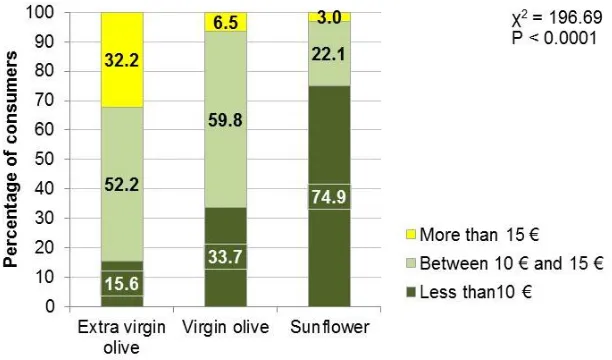
In addition to the questions related to the place of residence and health (“Would you like to lose
101
weight?” and “Is your cholesterol level high?”), respondents were asked about the price they would
102
be willing to pay for a can of light lamb confit for four people that was preserved in three different
103
types of oil (extra virgin olive, virgin olive or sunflower oil). The options were as follows: less than
104
10 euros, between 10 and 15 euros and more than 15 euros. In the absence of such a product on the
105
market, these proposed prices are based on confit meats of other types of lamb and other meats in
106
general. Due to not having a closed interval as a price reference, the lower and upper ends were left
107
open.
108
Except for the variable Age, which was continuous, all the questions in the survey were closed
109
and of an ordinal type (blocks B, C and D) or nominal.
110
Once the survey was available online, the access link was disseminated via email to both
111
individuals and institutions and groups (housewives, consumers, cultural associations, etc.). Social
112
networks such as Facebook, Twitter and personal blogs were also used. At the end of the two-month
113
duration of the survey period, 659 surveys had been collected, of which 200 surveys were complete
114
and corresponded to Spanish consumers.
115
The study of the consumer sample was performed by means of relative frequencies. The analysis
116
of the variables was performed using the χ2 test, taking a probability less than 0.10 as significant.
117
When one of the cells had a frequency less than five, which makes the use of the χ2 statistic
118
unadvisable, the likelihood ratio statistic was used at the same probability level. To interpret the
119
pattern of association between the variables studied, the corrected standardized residual between the
120
observed and expected cases within each cell greater than |1.96| was considered. The corresponding
121
percentage associated with these residuals is specified in bold in the tables.
122
To group consumers into homogeneous groups (clusters or conglomerates), hierarchical cluster
123
analysis was performed using the Ward method. In this analysis, the variables of the B blocks were
124
included, following the theoretical framework of FRL proposed by Brunsø and Grunert [2] and
125
developed by Grunert [9]. The number of clusters or groups of consumers by affinity of their chosen
126
responses was a compromise solution using Ward's distance from the dendrogram that would
127
maximize the distance between one division of the dendrogram and the next, so as to not obtain a
128
number of clusters too great to be discussed. Subsequently, the relationships between the different
129
groups were analyzed using the test χ2 test or the likelihood ratio under the conditions discussed
130
above.
131
3. Results
132
3.1. Characterization of the sample
133
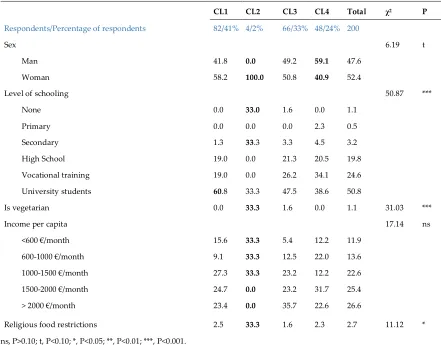
The data for the general sample are presented in Tables 2 through 6. The sample (Table 2) had
134
5% more women, and there was a bias in the level of studies because 50% of the respondents had
135
university studies. Regarding the level of income per capita, less than 25% earned less than
136
€1,000/month, and the rest of the sample had income distributed similarly among the three upper
137
strata. Although the survey was initially disseminated throughout Spain and responses were even
138
received from other countries, by not requesting the region of origin of the applicant, we cannot
139
confirm a geographical bias within Spain.
140
Table 2. Socio-demographic characteristics of the general sample and by consumer group.
142
CL1 CL2 CL3 CL4 Total χ2 P
Respondents/Percentage of respondents 82/41% 4/2% 66/33% 48/24% 200
Sex 6.19 t
Man 41.8 0.0 49.2 59.1 47.6
Woman 58.2 100.0 50.8 40.9 52.4
Level of schooling 50.87 ***
None 0.0 33.0 1.6 0.0 1.1
Primary 0.0 0.0 0.0 2.3 0.5
Secondary 1.3 33.3 3.3 4.5 3.2
High School 19.0 0.0 21.3 20.5 19.8
Vocational training 19.0 0.0 26.2 34.1 24.6
University students 60.8 33.3 47.5 38.6 50.8
Is vegetarian 0.0 33.3 1.6 0.0 1.1 31.03 ***
Income per capita 17.14 ns
<600 €/month 15.6 33.3 5.4 12.2 11.9
600-1000 €/month 9.1 33.3 12.5 22.0 13.6
1000-1500 €/month 27.3 33.3 23.2 12.2 22.6
1500-2000 €/month 24.7 0.0 23.2 31.7 25.4
> 2000 €/month 23.4 0.0 35.7 22.6 26.6
Religious food restrictions 2.5 33.3 1.6 2.3 2.7 11.12 *
ns, P>0.10; t, P<0.10; *, P<0.05; **, P<0.01; ***, P<0.001.
143
Cells in bold had the corrected standardized residual between the observed and expected cases within each cell greater than
144
|1.96|.
145
We found that 1.1% of respondents defined themselves as vegetarians (Table 3) and 2.7% held
146
religious beliefs with certain types of food restrictions. Approximately one-third of the sample knew
147
of the Ojinegra de Teruel breed and lamb confit. A large percentage (70.9%) did not know whether
148
they had ever eaten confit, and 12.5% had never tasted it. Only 16.6% answered that they knew of it,
149
of which 72.7% knew it because they had eaten it in a restaurant (Table 3).
150
Table 3. Other questions related to lifestyle.
151
CL1 CL2 CL3 CL4 Total χ2 P
Respondents/Percentage of respondents 82/41% 4/2% 66/33% 48/24% 200
Are you Vegetarian? 1 0.0 33.3 1.6 0.0 1.1 8.11 *
Do you have any food restrictions for your religion? 1 2.5 33.3 1.6 2.3 2.7 3.86 ns
Would you like to lose weight? 1 67.1 66.7 76.7 65.9 69.8 2.00 ns
Is your cholesterol level high? 1 21.5 66.7 26.2 22.7 24.1 2.91 ns
Do you live in a city? 1 81.0 100.0 82.0 77.3 79.4 1.67 ns
Have you heard of the Ojinegra de Teruel breed? 41.8 66.7 21.7 31.8 34.2 7.83 t
Have you heard of lamb confit? 1 27.8 33.3 24.6 31.8 29.1 0.71 ns
Have you ever eaten lamb confit? 1, 2 54.5 100.0 46.7 71.4 16.6 3.06 ns
I cooked it myself 30.0 0.0 0.0 0.0 16.0 10.14 ns
In a restaurant 66.7 100.0 85.7 90.0 72.7
I bought it made 0.0 0.0 14.3 10.0 6.1
Other answers 13.3 0.0 0.0 0.0 15.2
1Percentage of affirmative responses
152
2 The percentage of Do not know/No answer was 70.9%
153
3 Percentage of respondents who claimed to have eaten lamb confit
154
Cells in bold had the corrected standardized residual between the observed and expected cases within each cell greater than
155
|1.96|.
156
157
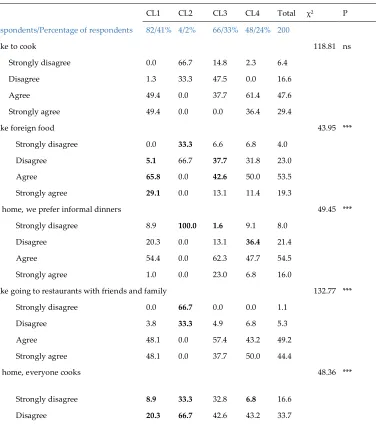
Table 4 presents the degree of agreement with statements that define consumer lifestyle. Most
158
respondents like to eat (96.8%), eat foreign food (72.8%), and prefer informal dinners (70.5%) and
159
variety in food (74.4%), showing great interest in food and an open attitude to different foods and
160
variety. There is a great agreement (greater than 93%) in terms of both the preference to eat at
161
restaurants with friends and family and the importance of dietary planning for family nutrition.
162
Table 4. Habits of the consumer at the time of cooking and eating for the general sample and by
163
groups of consumers.
164
CL1 CL2 CL3 CL4 Total χ2 P
Respondents/Percentage of respondents 82/41% 4/2% 66/33% 48/24% 200
I like to cook 118.81 ns
Strongly disagree 0.0 66.7 14.8 2.3 6.4
Disagree 1.3 33.3 47.5 0.0 16.6
Agree 49.4 0.0 37.7 61.4 47.6
Strongly agree 49.4 0.0 0.0 36.4 29.4
I like foreign food 43.95 ***
Strongly disagree 0.0 33.3 6.6 6.8 4.0
Disagree 5.1 66.7 37.7 31.8 23.0
Agree 65.8 0.0 42.6 50.0 53.5
Strongly agree 29.1 0.0 13.1 11.4 19.3
At home, we prefer informal dinners 49.45 ***
Strongly disagree 8.9 100.0 1.6 9.1 8.0
Disagree 20.3 0.0 13.1 36.4 21.4
Agree 54.4 0.0 62.3 47.7 54.5
Strongly agree 1.0 0.0 23.0 6.8 16.0
I like going to restaurants with friends and family 132.77 ***
Strongly disagree 0.0 66.7 0.0 0.0 1.1
Disagree 3.8 33.3 4.9 6.8 5.3
Agree 48.1 0.0 57.4 43.2 49.2
Strongly agree 48.1 0.0 37.7 50.0 44.4
At home, everyone cooks 48.36 ***
Strongly disagree 8.9 33.3 32.8 6.8 16.6
Agree 43.0 0.0 19.7 45.5 35.3
Strongly agree 27.8 0.0 4.9 4.5 14.4
I spend a lot of time cooking 72.17 ***
Strongly disagree 2.5 0.0 29.5 1.7 11.8
Disagree 20.3 0.0 59.0 38.6 36.9
Agree 55.7 66.7 8.2 47.7 38.5
Strongly agree 21.5 33.3 3.3 9.1 12.8
I like to eat 143.40 ***
Strongly disagree 1.3 100.0 0.0 2.3 2.7
Disagree 0.0 0.0 1.6 0.0 0.5
Agree 26.6 0.0 72.1 47.7 46.0
Strongly agree 72.2 0.0 26.2 50.0 50.8
I like changes in food 73.34 ***
Strongly disagree 0.0 0.0 6.6 11.4 4.8
Disagree 3.8 0.0 19.7 54.5 20.9
Agree 43.0 33.3 54.1 31.8 43.9
Strongly agree 53.2 66.7 19.7 2.3 30.5
Planning meals is important for family nutrition 62.06 ***
Strongly disagree 2.5 66.7 1.6 0.0 2.7
Disagree 1.3 33.3 3.3 2.3 2.7
Agree 39.2 0.0 39.3 34.1 37.4
Strongly agree 57.0 0.0 55.7 63.6 57.2
Traditional recipes are best 77.19 ***
Strongly disagree 6.3 66.7 9.8 0.0 7.0
Disagree 51.9 33.3 54.1 11.4 42.8
Agree 41.8 0.0 27.9 47.7 38.0
Strongly agree 0.0 0.0 8.2 40.9 12.3
ns, P>0.10; t, P<0.10; *, P<0.05; **, P<0.01; ***, P<0.001.
165
Cells in bold had the corrected standardized residual between the observed and expected cases within each cell greater than
166
|1.96|.
167
168
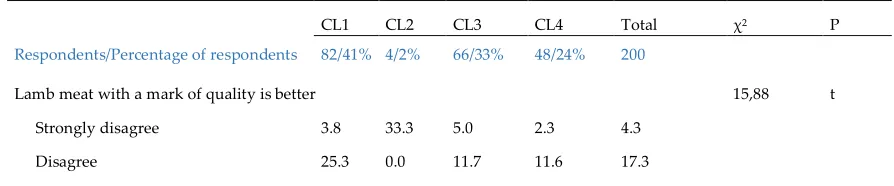
Regarding extrinsic quality attributes (Table 5), the respondents agreed or strongly agreed that
169
lamb meat with some mark of quality is better (78.4%). More than half thought that the lamb of
170
Aragon (51.9%) or organic lamb (57.5%) is better than others, whereas only 32.1% agreed that the
171
Ojinegra de Teruel breed is better than others; 70.4% believe that grass-fed lamb is better, whereas
172
29.9% think that cereal-fed lamb is best. The price of lamb is very important for 80.1% of respondents,
173
and 68.7% think that lamb is easy to cook.
174
Table 5. Importance of the extrinsic attributes of lamb quality.
175
CL1 CL2 CL3 CL4 Total χ2 P
Respondents/Percentage of respondents 82/41% 4/2% 66/33% 48/24% 200
Lamb meat with a mark of quality is better 15,88 t
Strongly disagree 3.8 33.3 5.0 2.3 4.3
Agree 54.4 66.7 70.0 60.5 61.1
Strongly agree 16.5 0.0 13.3 25.6 17.3
Lamb is easy to cook 48.19 *
Strongly disagree 1.3 100 8.3 2.3 4.9
Disagree 29.1 0 28.3 20.5 26.5
Agree 55.7 0 50 50 51.9
Strongly agree 13.9 0 13.3 27.3 16.8
The best lamb is grass-fed 10.58 ns
Strongly disagree 7.6 33.3 5.0 2.3 5.9
Disagree 20.3 66.7 23.3 27.3 23.7
Agree 48.1 0.0 48.3 50.0 47.8
Strongly agree 24.1 0.0 23.3 20.5 22.6
The Ojinegra de Teruel breed is better than others 13.85 ns
Strongly disagree 8.9 33.3 10.9 9.8 10.1
Disagree 65.8 33.3 56.4 46.3 57.9
Agree 22.8 0.0 29.1 34.1 27.0
Strongly agree 2.5 33.3 3.6 9.8 5.1
The price of lamb is very important 25.20 **
Strongly disagree 1.3 33.3 1.6 2.3 2.2
Disagree 17.7 33.3 24.6 7.0 17.7
Agree 55.7 0.0 54.1 76.7 59.1
Strongly agree 25.3 33.3 19.7 14.0 21.0
The lamb from Aragon is better than others 14.550 ns
Strongly disagree 2.5 0.0 5.3 4.7 3.9
Disagree 51.9 0.0 47.4 27.9 44.2
Agree 25.3 50.0 36.8 37.2 32.0
Strongly agree 20.3 50.0 10.5 30.2 19.9
Organic lamb is better than others
Strongly disagree 11.4 33.3 16.7 4.5 11.8 7.72 ns
Disagree 30.4 33.3 23.3 40.9 30.6
Agree 43.0 33.3 46.7 40.9 43.5
Strongly agree 15.2 0.0 13.3 13.6 14.0
The best lamb is fed cereals 9.52 ns
Strongly disagree 11.4 33.3 6.8 11.6 10.3
Disagree 60.8 0.0 67.8 51.2 59.8
Agree 25.3 66.7 20.3 32.6 26.1
Strongly agree 2.5 0.0 5.1 4.7 3.8
ns, P>0.10; t, P<0.10; *, P<0.05; **, P<0.01; ***, P<0.001.
176
Cells in bold had the corrected standardized residual between the observed and expected cases within each cell greater than
177
|1.96|.
178
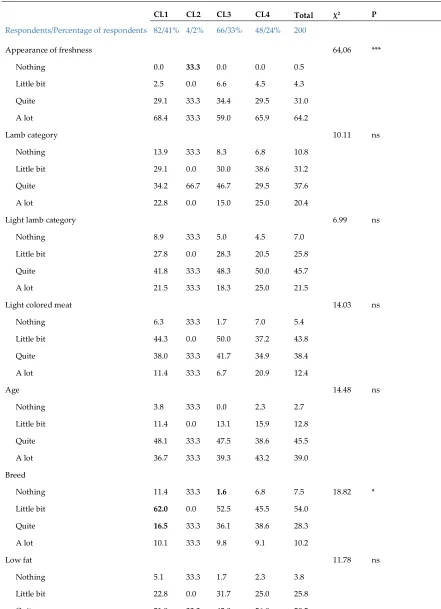
The importance given to the intrinsic attributes of lamb at the time of purchase is listed in Table
180
6. The attributes valued as the most important were freshness (95.2%), age (84.5%), low fat content
181
(70.4%) and categorized as light lamb (67.2%). However, 58% of the respondents gave importance to
182
the lamb category, 50.8% preferred lamb to have light-colored meat, and only 38.5% rated the breed
183
as quite or very important at the moment of purchase.
184
Table 6. Importance of the intrinsic quality attributes of lamb meat at the time of purchase.
185
CL1 CL2 CL3 CL4 Total χ2 P
Respondents/Percentage of respondents 82/41% 4/2% 66/33% 48/24% 200
Appearance of freshness 64,06 ***
Nothing 0.0 33.3 0.0 0.0 0.5
Little bit 2.5 0.0 6.6 4.5 4.3
Quite 29.1 33.3 34.4 29.5 31.0
A lot 68.4 33.3 59.0 65.9 64.2
Lamb category 10.11 ns
Nothing 13.9 33.3 8.3 6.8 10.8
Little bit 29.1 0.0 30.0 38.6 31.2
Quite 34.2 66.7 46.7 29.5 37.6
A lot 22.8 0.0 15.0 25.0 20.4
Light lamb category 6.99 ns
Nothing 8.9 33.3 5.0 4.5 7.0
Little bit 27.8 0.0 28.3 20.5 25.8
Quite 41.8 33.3 48.3 50.0 45.7
A lot 21.5 33.3 18.3 25.0 21.5
Light colored meat 14.03 ns
Nothing 6.3 33.3 1.7 7.0 5.4
Little bit 44.3 0.0 50.0 37.2 43.8
Quite 38.0 33.3 41.7 34.9 38.4
A lot 11.4 33.3 6.7 20.9 12.4
Age 14.48 ns
Nothing 3.8 33.3 0.0 2.3 2.7
Little bit 11.4 0.0 13.1 15.9 12.8
Quite 48.1 33.3 47.5 38.6 45.5
A lot 36.7 33.3 39.3 43.2 39.0
Breed
Nothing 11.4 33.3 1.6 6.8 7.5 18.82 *
Little bit 62.0 0.0 52.5 45.5 54.0
Quite 16.5 33.3 36.1 38.6 28.3
A lot 10.1 33.3 9.8 9.1 10.2
Low fat 11.78 ns
Nothing 5.1 33.3 1.7 2.3 3.8
Little bit 22.8 0.0 31.7 25.0 25.8
A lot 20.3 33.3 21.7 15.9 19.9
ns, P>0.10; t, P<0.10; *, P<0.05; **, P<0.01; ***, P<0.001.
186
Cells in bold had the corrected standardized residual between the observed and expected cases within each cell greater than
187
|1.96|.
188
189
3.2. Types of consumers
190
Once the general sample was characterized, 4 types of consumers were identified based on their
191
lifestyle related to their cooking and eating habits (Table 2). The first group (CL1) included 82
192
respondents (41%), group 3 (CL3) included 66 respondents (33%), and group 4 (CL4) accounted for
193
48 respondents (24%); the second group (CL2) was the minority, representing only 2% of the sample
194
population including 4 respondents. The different groups of consumers did not differ in terms of
195
level of income or place of residence (P > 0.10).
196
Socio-demographic characteristics and lifestyles related to cooking and eating are presented in
197
Tables 2 and 3, respectively. CL1 was made up of both women and men, most of them with university
198
education. This group was distinct because the percentage of respondents who knew of the Ojinegra
199
de Teruel breed was higher than the general average. In terms of their lifestyle, this group is
200
consumers who love cooking and eating, they live in homes in which everyone cooks, and they spend
201
a lot of time cooking. In addition, they like foreign recipes and variety, and accordingly, they do not
202
believe that lifelong recipes are better. Regarding the importance given to the extrinsic attributes of
203
the quality of lamb meat, this group of consumers exhibited greater disagreement than the general
204
sample regarding which lamb meat with a mark of quality is better, and few strongly disagreed with
205
the ease of cooking lamb. Although this group knew of the Ojinegra de Teruel breed, it did not have
206
a different perception from the other groups regarding this breed having better quality. This response
207
was in accordance with the fact that breed, as an intrinsic attribute of quality, seems to be an
208
unimportant factor.
209
CL2 is a minority group, but it has a lifestyle very different from the other groups of consumers;
210
it is formed by women with secondary education or without formal education. One-third of the
211
consumers in this group are vegetarians, and another third have food restrictions because of their
212
religious beliefs. Consumers belonging to this group have a clear disinterest in everything related to
213
cooking and food habits. They do not like foreign food, but they do not think that traditional food
214
recipes are better than modern recipes. They also stand out because they do not like dinners, and they
215
do not cook at home. Compared to the general sample, a significantly greater fraction of this group
216
strongly disagreed that branded lamb is better. All the respondents in this group disagreed strongly
217
with the statement that lamb is easy to cook and that the price of lamb is important. They also
218
considered the appearance of freshness, the age of the lamb and the light color of the meat as
219
significant characteristics.
220
The third group (CL3) does not like to cook or devote time to cooking, but almost everyone likes
221
to eat; at home, not everyone cooks equally. They do not prefer foreign food because they think that
222
lifelong recipes are best. This group declared mostly not knowing of the Ojinegra de Teruel breed.
223
This group does not stand out from the general sample in terms of the importance assigned to quality
224
attributes, both intrinsic and extrinsic.
225
CL4 had a higher proportion of men than the other groups. They like to cook but without making
226
changes, and 88.6% agree or strongly agree that traditional recipes are best. This group of consumers
227
also do not like informal dinners. A total of 27.3% of these consumers agreed that lamb meat is easy
228
to cook. Additionally, those that think that price is very important predominate, and there are fewer
229
that disagree with the lamb from Aragon being better than the rest. This group assigned high
230
importance to light-colored meat, although they do not assign more importance to the category (lamb
231
or light lamb) than the other groups or the sample.
232
3.3. Willingness to pay
There was no relationship between the consumer group and the willingness to pay for lamb
234
confit in any type of oil. Of the general sample, almost 32% would pay more than € 15 for a can of
235
lamb confit preserved in extra virgin olive oil, and 52% would pay between € 10 and € 15 (Figure 1).
236
The remaining 15.6% would only pay less than € 10. The level of studies, income, sex and all other
237
socio-demographic questions did not have a significant relationship with the willingness to pay for
238
lamb confit (P > 0.05) (data not shown). A significant relationship was found (P = 0.0362) between
239
consumers with high cholesterol and their willingness to pay. A total of 64.6% of consumers willing
240
to pay between 10 and 15 € and 6.3% of those willing to pay less than € 10 had high cholesterol.
241
Consumers who would pay more than € 15 would do so regardless of whether they had high
242
cholesterol. Consumers who previously knew of lamb confit had a greater willingness (44.4%) to pay
243
more than € 15 for lamb confit (P = 0.052).
244
245
Figure 1. Willingness to pay depending on the type of oil used in the lamb confit.
246
Regarding questions related to consumer habits when cooking and eating, only the frequency
247
with which the consumer eats outside the home (P < 0.011) and how important it is to plan meals for
248
family nutrition (P < 0.062) affected willingness to pay. Consumers who eat away from home were
249
less willing to pay for lamb confit. Regarding food planning, consumers who agree more about the
250
importance of planning are more willing to pay. In fact, 67.2% of consumers who would pay more
251
than € 15 strongly agree about the importance of planning.
252
The importance assigned by the consumers to most extrinsic quality attributes did not determine
253
the price that he or she would be willing to pay. It did affect the price that would be paid for the lamb
254
to be of Aragonese origin (P < 0.01) and for organic lamb (P < 0.01); therefore, consumers who do not
255
consider these two attributes important tend to be those who would pay less than € 10 for the lamb
256
confit. Consumers who value as important that the lamb they eat is categorized as light lamb (P =
257
0.017) are willing to pay more than € 15, whereas consumers who do not give importance to this
258
categorization are only willing to pay up to € 10.
259
4. Discussion
260
According to Cotes [10], the multiple factors that affect the consumption decisions of an
261
individual can be grouped based on his or her demographic characteristics. However, as seen in the
262
results of this work, the behavior of the food consumer does not differ so much based on
socio-263
demographic characteristics, but it does depend on their lifestyles [11]. The so-called psychographic
264
characteristics include all the perceptions or beliefs of the individual, such as beliefs regarding the
265
quality of a brand and propensity to value natural products. Thus, the opinion that each consumer
266
has about the nutritional characteristics or the composition of a product or its safety, brand or price
267
In short, consumers relate a group of products to a group of values through a system based on
269
cognitive categories and actions that are embodied in a lifestyle [2].
270
4.1. Types of consumers
271
It is possible to define numerous consumer groups; however, when these are framed regarding
272
the lifestyle related to lamb consumption, the number of consumer segments in Spain is usually
273
between three and five [4,13]. Although there are methodological differences in studies, the present
274
work highlights the existence of four groups of differentiated consumers. These groups, due to their
275
characteristics, could be called "Gourmet" (CL1), "Disinterested" (CL2), "Conservative" (CL3) and
276
"Basic" (CL4). When Bredahl and Grunert [14] studied food lifestyles in Spain, they found five
277
segments of consumers. The "Conservative" and "Uninvolved" segments of Bredahl and Grunert [14]
278
are homologous to those found in this work and are called "Conservative" and "Disinterested",
279
respectively. Consumers in the Conservative group like to cook but without making changes or
280
innovations in the kitchen, which agrees with their opinion that traditional recipes are best. Another
281
segment that the previous authors [4,14] called "Adventurers" would coincide with the gourmet
282
group defined in this work, in that they are very fond of cooking, they use new recipes, and the whole
283
family participates in culinary tasks. The segment called "Rational" by Bredahl and Grunert [14]
284
would be comparable in many of its facets with our "Basic" segment. However, in the case of
285
"Rational", the social role of food is particularly important, whereas for the "Basic" group, this facet is
286
important but not more so than for other groups. Other studies have also found segments in other
287
countries partially comparable with our results [15-17]. Of these recurrent segments in the literature,
288
the one that represents the lowest percentage of the population is the Disinterested, which is formed
289
mostly by women. Buckley, Cowan and McCarthy [15] found a group comparable to the
290
Disinterested, consumers who were primarily women who exhibited great individualism in their
291
style of consumption. They do not plan meals or purchases, tend to consume snacks between meals
292
and do not easily accept new products. The fact that women declare that they like exotic foods less
293
agrees with the female gender being positively related to consumer ethnocentrism [18,19]. Thus,
294
consumers with high ethnocentrism prefer to eat and buy products exclusively known and related to
295
their culture. The low consumption of meat is generally a feminine phenomenon [20], and women
296
have a greater number of food restrictions, especially regarding the consumption of red meat [21]. In
297
fact, in a survey in Norway and Sweden, 72.5% of people who consumed little meat were women
298
[22].
299
4.2.Importance of intrinsic and extrinsic attributes
300
Regarding the importance of the attributes of fresh meat, among the most important according
301
to the results of this study and others are low fat content, freshness and a defined brand or category
302
[4,23,24], all of which are assessed visually. In contrast, breed and organic production are the least
303
valued [4]. Low fat content is an important attribute for all consumers without differences between
304
segments [4]. However, meat with a mark of quality, such as Denomination of Origin or Protected
305
Geographical Indication, can be highly valued or valued very little depending on the consumer group
306
[4], as observed in the present study. The region of origin of the product determines the importance
307
given to some characteristics, even within a certain country. For example, within Spain, consumers
308
in Castilla and León prefer ovine meat from lamb [25], whereas consumers in Aragon [4,26] prefer
309
ovine meat categorized as light lamb. Although it has been seen that breed is not one of the important
310
factors for the consumer, positive value has been given to meat that has been produced in the region
311
where the consumer lives [3,9,26]. However, in our study, the lamb or light lamb category is
312
considered important, but it is not considered that the Ternasco de Aragón PGI (light lamb) or the
313
Ojinegra breed are better than other marks of quality or breeds. As seen in this study, price is a very
314
important factor in general but also for some groups of consumers more than others. Thus, regular
315
lamb consumers perceive higher quality due to marks of quality, diet or ecology. All this information
316
associated with quality makes the price less relevant to the consumer than when there is less
317
4.3. Willingness to pay
319
The process of perception of quality by consumers consists of two phases: the first is based on
320
the perception of extrinsic and intrinsic attributes formed at the point of purchase, and the second is
321
based on the experience formed during the preparation and consumption of the product [28,29]. This
322
is when the expectations formed during the purchase are confirmed or rejected. These two stages are
323
less important when a product is unknown (as may be the case of lamb confit because only a small
324
part of the sample knew of it) or when the consumer does not know whether he or she has tasted it.
325
In this case, the willingness to pay and even the decision to purchase the unknown product are
326
probably based largely on the type of consumer. Thus, an "adventurous" consumer may pay more to
327
try a product that he or she does not know, unlike more conservative or traditional consumers.
328
However, in the scope of this work, there was no differential behavior between groups of consumers
329
for willingness to pay for lamb confit. On the other hand, when the consumer is given information
330
about the quality of the oil used in cooking, which is also a known product, perception of quality and
331
price are positively related [27]. Moreover, although lamb confit is not a known product, olive oil is
332
a well-known and traditional Mediterranean product, and prior knowledge of the product is
333
important when buying food ([30,31]. In addition, the appreciation of the different oils includes
334
factors that take into account health [28]. The perception of a food as healthy (as is the case of virgin
335
olive oil), natural, organic or respectful of the environment leads to a greater willingness to pay for
336
the product [31,32], as can be clearly seen in the results of this study. However, when the consumer
337
is not willing to pay a certain price, the conclusion is that the product does not have perceived net
338
value [27], which would be the case of lamb confit preserved in sunflower oil, whose price is limited
339
to a maximum of € 15.
340
5. Conclusions
341
Market segmentation is a necessary requirement to ensure the creation of relationships between
342
products and consumers. In this study, four types of consumers have been differentiated according
343
to their lifestyle related to lamb consumption. One of these groups of consumers (gourmet) has
344
characteristics that make it interesting to market a product such as lamb confit, considering they are
345
unaware of this product. Therefore, a strategy to expand the commercialization of light lamb and the
346
confit product would guide marketing to this niche market. To make the product known, a price
347
strategy could be followed because although price is a clear indicator of perceived quality, when a
348
consumer buys a product repeatedly, he or she gains experience, and the price has a lower weight as
349
a key factor for the purchase. In fact, when the buyer is habitual, he or she values other factors, such
350
as meat with a mark of quality, even though it has a higher cost associated with it. Because there is a
351
direct relationship between the type of oil used in the processing of lamb confit and willingness to
352
pay for the product, a range of products can be made based on this oil and the sale price. In the meat
353
market, there is a range of opportunities that must be exploited with several strategies. In the case of
354
lamb confit, it may be the promotion of the breed as an extrinsic attribute to transmit a higher-quality
355
product.
356
Author Contributions: Conceptualization, Guillermo Ripoll. and Begoña Panea; Methodology, Guillermo Ripoll
357
and Begoña Panea; Formal Analysis, Guillermo Ripoll; Writing-Original Draft Preparation, Guillermo Ripoll,
358
Margalida Joy and Begoña Panea; Writing-Review & Editing, Guillermo Ripoll, Margalida Joy and Begoña
359
Panea; Funding Acquisition, Margalida Joy.
360
Funding: This research was funded by Investment Fund in Teruel (FIT) of the Government of Spain (333). B.
361
Panea and G. Ripoll Authors are members of the MARCAME network, funded by CYTED (ref. 116RT0503).
362
Acknowledgments: The authors are grateful for the collaboration with Agroji and Cenro.
363
Conflicts of Interest: The authors declare no conflict of interest.
364
References
365
2. Brunsø, K.; Grunert, K.G. Development and testing of a cross-culturally valid instrument: Food-related
367
life style. Advances in Consumer Research 1995, 22, 475-480.
368
3. Bernués, A.; Olaizola, A.; Corcoran, K. Extrinsic attributes of red meat as indicators of quality in europe:
369
An application for market segmentation. Food Qual Prefer 2003, 14, 265-276.
370
4. Bernués, A.; Ripoll, G.; Panea, B. Consumer segmentation based on convenience orientation and
371
attitudes towards quality attributes of lamb meat. Food Qual Prefer 2012, 26, 211-220.
372
5. de Boer, M.; McCarthy, M.; Cowan, C.; Ryan, I. The influence of lifestyle characteristics and beliefs
373
about convenience food on the demand for convenience foods in the irish market. Food Qual Prefer 2004,
374
15, 155-165.
375
6. MERCASA. Alimentación en españa 2015. Producción, industria, distribución y consumo. Madrid, España,
376
2016; p 552.
377
7. Ripoll-Bosch, R.; Ripoll, G.; Álvarez-Rodríguez, J.; Blasco, I.; Panea, B.; Joy, M. Efecto del sexo y la
378
explotación sobre la calidad de la canal y de la carne del cordero lechal de raza ojinegra.
ITEA-379
Información Técnica Económica Agraria 2012, 108, 522-536.
380
8. MARM. Estudio de mercado observatorio del consumo y la distribución distribución alimentaria. Monografico
381
cordero. Informe primer trimestre.; MARM: 2008; p 109.
382
9. Grunert, K. Future trends and consumer lifestyles with regard to meat consumption. Meat Sci 2006, 74,
383
149-160.
384
10. Cotes, A. Modelos de comportamiento del consumidor de productos alimenticios con valor agregado.
385
Universidad de Salamanca, Salamanca, 2010.
386
11. Gracia, A. Consumers' attitudes towards designation of origin lamb meat: Segmentation and profiles.
387
ITEA-Información Técnica Económica Agraria 2005, 101, 25-44.
388
12. Arcia, P.L. Influencia de las caracteristicas sensoriales y la información nutricional en la respuesta de
389
los consumidores a alimentos funcionales. CSIC, Valencia, Spain, 2012.
390
13. Gracia, A. Comportamiento del consumidor de carne de cordero con igp en aragón. Zaragoza, 2005; p 132.
391
14. Bredahl, L.; Grunert, K.G. Identificación de los estilos de vida alimenticios en españa. Investigación
392
Agraria: Economía 1997, 12, 247-263.
393
15. Buckley, M.; Cowan, C.; McCarthy, M. The convenience food market in great britain: Convenience food
394
lifestyle (cfl) segments. Appetite 2007, 49, 600-617.
395
16. Grunert, K.G.; Perrea, T.; Zhou, Y.; Huang, G.; Sorensen, B.T.; Krystallis, A. Is food-related lifestyle (frl)
396
able to reveal food consumption patterns in non-western cultural environments? Its adaptation and
397
application in urban china. Appetite 2011, 56, 357-367.
398
17. Nie, C.; Zepeda, L. Lifestyle segmentation of us food shoppers to examine organic and local food
399
consumption. Appetite 2011, 57, 28-37.
400
18. Good, L.K.; Huddleston, P. Ethnocentrism of polish and russian consumers: Are feelings and intentions
401
related. International Marketing Review 1995, 12, 35-48.
402
19. Sharma, S.; Shimp, T.A.; Shin, J. Consumer ethnocentrism: A test of antecedents and moderators. Journal
403
of the academy of marketing science 1995, 23, 26-37.
404
20. Worsley, A.; Skrzypiec, G. Teenage vegetarianism: Prevalence, social and cognitive contexts. Appetite
405
1998, 30, 151-170.
406
21. Forestell, C.A.; Spaeth, A.M.; Kane, S.A. To eat or not to eat red meat. A closer look at the relationship
407
22. Larsson, C.L.; Klock, K.S.; Nordrehaug Åstrøm, A.; Haugejorden, O.; Johansson, G. Lifestyle-related
409
characteristics of young low-meat consumers and omnivores in sweden and norway. Journal of
410
Adolescent Health 2002, 31, 190-198.
411
23. Bello, L.; Calvo, D. The importance of intrinsic and extrinsic cues to expected and experienced quality:
412
An empirical application for beef. Food Qual Prefer 2000, 11, 229-238.
413
24. Dransfield, E.; Ngapo, T.M.; Nielsen, N.A.; Bredahl, L.; Sjödén, P.O.; Magnusson, M.; Campo, M.M.;
414
Nute, G.R. Consumer choice and suggested price for pork as influenced by its appearance, taste and
415
information concerning country of origin and organic pig production. Meat Sci 2005, 69, 61-70.
416
25. Bernabéu, R.; Tendero, A. Preference structure for lamb meat consumers. A spanish case study. Meat
417
Sci 2005, 71, 464-470.
418
26. Panea, B.; Ripoll, G.; Campo, M.M.; Albertí, P.; Bernués, A. Percepción del consumidor aragonés sobre
419
los métodos de producción y la calidad intrinseca y extrínseca de la carne de cordero. In XXXVIII
420
Congreso nacional de la Sociedad Española de Ovinotecnia y Caprinotecnia, SEOC: Málaga, 2013; pp 322-328.
421
27. Dodds, W.B.; Monroe, K.B.; Grewal, D. Effects of price, brand, and store information on buyers' product
422
evaluations. Journal of Marketing Research 1991, 307-319.
423
28. Banovic, M.; Grunert, K.G.; Barreira, M.M.; Fontes, M.A. Beef quality perception at the point of
424
purchase: A study from portugal. Food Qual Prefer 2009, 20, 335-342.
425
29. Steenkamp, J.B.E.M.; Van Trijp, H.C.M. Quality guidance: A consumer-based approach to food quality
426
improvement using partial least squares. European Review of Agricultural Economics 1996, 23, 195-215.
427
30. Verbeke, W.; Vackier, I. Profile and effects of consumer involvement in fresh meat. Meat Sci 2004, 67,
428
159-168.
429
31. Xue, H.; Mainville, D.; You, W.; Nayga Jr, R.M. Consumer preferences and willingness to pay for
grass-430
fed beef: Empirical evidence from in-store experiments. Food Qual Prefer 2010, 21, 857-866.
431
32. Gil, J.M.; Gracia, A.; Sánchez, M. Market segmentation and willingness to pay for organic products in
432
spain. International Food and Agribusiness Management Review 2000, 3, 207-226.