34
International Journal in Management and Social Science http://ijmr.net.in, Email: [email protected] An overview of adverse effects of demonetisation on micro and small scale enterprises: withspecial reference to Pune City
Prof. Pralhad Prakash Joshi
Research Scholar, VMV Commerce JMT Arts & JJP Science College,Wardhaman nagar
ABSTRACT
A historical decision of demonetisation of currency notes of Rs. 1000 and Rs. 500, taken by
government of India on 8th November 2016. After demonetisation, several adverse effects come
into existence in various sectors in the country. Demonetisation policy has brought many negative
implications particularly on micro and small enterprises sector, banking sector, financial
institutions and socio-economic activities of people working in unorganised or informal sector.
Through the study attempts have been made to focus on the various adverse effects on these
sectors, with the help of primary and secondary information. The result of the study indicates that,
majority of problems faced by micro-small entrepreneurs and businessmen in unorganised sector.
Banking sector and financial institutions are also suffered by several problems due to
demonetisation.
Keywords: demonetisation, unorganised sector, micro-small entrepreneurs, banking
sector/financial institutions.
1] INTRODUCTION
On 8th November 2016 Government of India has declared that currency notes of Rs. 1000 and Rs.
500 would not be valid for any business transaction. Post demonetisation period, many negative
effects; consequences on different economic sectors of India came into existence. The policy of
demonetisation has brought several negative impacts not only on economic sectors, but also
badly effected on the socio-economic functions of the common citizens. The main effect of
demonetisation is on the economy of the country because it gives highly negative or positive
effects on the different economic sectors like industrial sector, service sector, agricultural sector,
construction sector and so on. In future, it is expected to witness the considerable level of
deflation, in the sectors like real estate, construction, unorganised sector, micro-small and
medium scale enterprises, banking sector etc. Demonetisation represents much more than
destabilisation, it has struck a body blow on the economic functions. Indian economy was
35
International Journal in Management and Social Science http://ijmr.net.in, Email: [email protected]the production, slowdown in business, slowdown in employments etc, due to demonetisation.
Small-micro industries, banking sector hit badly. The informal or unorganised sector, which
conducts 40% to 50% of India's total manufacturing activities and service providing activities are
nearly collapsed.
With the implementation of demonetisation and considering the government's agenda to
improve economy, financial inclusion the present study makes an attempt to focus on the
adverse effects of demonetisation on the micro-small enterprises, banking sector, financial
institutions and unorganised or informal sector of India. That is, through this study attempts have
been made to focus on the adverse effects of demonetisation from the perspectives of
micro-small entrepreneurs, micro-small unorganised businessmen and bank officials.
2] REVIEW OF LITERATURE
i. D. K. Parmar and S. K. Dave (2017), have stated that, cancellation of legal tender money is
likely to impact on various sectors of the Indian economy. Through the study authors have
explained the term demonetisation and highlighted the causes of demonetisation. Authors
have highlighted the various impacts of demonetisation on the agricultural and related
sectors, auto and auto ancillary industries, real estate, banks etc. Authors have concluded
that, although the comprehensive long-term effects of demonetisation measures cannot
be ascertained right now, the overall economy is expected to benefit from degrees in
unaccounted cash transactions and removal of counterfeit currency notes, leading to more
efficient and effective tax collection and transparency in transactions. Authors have opined
that, they are short-term implications for cash-intensive sectors like real estate,
construction and consumption etc.
ii. S. M. Hasan, (2017), has pointed out that, demonetisation has adversely effected on job
creation by hurting micro-small and medium scale enterprises. The study paper based on
the secondary data collected from various newspapers, online journals etc. To assess the
effects of demonetisation on micro-small and medium scale enterprises, and to study the
effects of demonetisation on development and growth of small-medium scale enterprises
in India. Author has also focused on the fact that, how demonetisation effects on the
technological advancement of SMEs. Author has concluded that, the booming economy of
India, has now ground to a halt due to the demonetisation. In the opinion of author, all
indicators sales, traders income, production and employment are down small enterprises
lacking capital for running their business, are already closed down their business.
36
International Journal in Management and Social Science http://ijmr.net.in, Email: [email protected]The study covers the banks in Veraval City of Gujrat. Through the study author has
explained the concept of demonetisation. To understand the impacts of demonetisation in
terms of positive or negative is the major aim of the study. Apart from this author has
identified those accounts which are highly affected due to demonetisation, and focus on
the otherness of online banking process among the bank consumers. Author has opened
that, as compared to previous two demonetisation, the present demonetisation is
successful. Author has further opened that, still as compared to short-terms more positive
impacts can be seen in long run on the Indian banking sector. Through the study author
has observed that, there are positive effects on the banking sector due to demonetisation,
and positive effects on the online banking transactions.
iv. S. M. Jaysudha and M. Thangavel, (2017), have stated that, due to demonetisation there
are any indications that had to be faced by the people engaged in the unorganised sector
enterprises. Through the study authors have attempted to focus on the various problems
faced by small-scale retailers, vegetable sellers, rickshaw drivers, grocery shop keepers etc.
due to demonetisation. This study is related to the Erode City of Tamil Nadu. The authors
have observed that, majority of the People's face the problems arisen due to
demonetisation. These problems were resulted in inconvenience to make small purchases,
waste of time at bank and ATMs, rush at bank, limitation on cash withdrawals from banks,
decrease in sales etc. Authors have opined that, this is not a permanent condition, and
economy of India is expected to recover soon after some months.
3] OBJECTIVES OF THE STUDY
i. To understand the adverse effects of demonetisation on micro and small scale
enterprises
ii. To understand the adverse effects of demonetisation on banking sector/financial
institutions
iii. To understand the adverse effects of demonetisation on unorganised or informal
business sector
4] SCOPE/LIMITATIONS OF THE STUDY
There are many economic sectors in India, adversely affected due to demonetisation. It is difficult
to take an overview of the effects of demonetisation on the sectors. Therefore, the scope of the
present study is restricted only to the micro-small enterprise sector, banking sector/financial
institutions and unorganised sector. These three sectors are backbone of the Indian economy,
37
International Journal in Management and Social Science http://ijmr.net.in, Email: [email protected]done in Pune city only and may not present an overall scenario of the entire country.
5] GEOGRAPHICAL SCOPE OF THE STUDY
The geographical scope of the present study is Pune city only. Small and micro enterprises, banks
and unorganised business entrepreneurs have been selected from various suburbs of Pune city.
6] RESEARCH METHODOLOGY
For the study purpose, primary and secondary data were used. Primary data was collected
through questionnaires for micro-small entrepreneurs, bank officials and small businessmen in
unorganised sector. Primary data has been presented by using percentage analysis method. The
present study is descriptive in nature. Survey method has been followed for the study purpose.
Secondary data has been collected through, study papers, articles, published in the various
journals, magazines, periodicals etc. Convenience sampling method has been used for collecting
primary data. The areas covered were central Pune area, and suburbs such as, Kothrud, Hadapsar,
Yerawada, Bibwewadi, Dhankavadi etc.
7] SAMPLE SIZE
There were a total 150 respondents. 50 respondents were selected from each sector.
Small-micro-enterprises owners approached were 50, bank officials approached were 50 and small
businessmen, like rickshaw drivers, street hawkers, vegetable sellers, grocery shop-keepers
approached were 50.
8] RESULTS AND DISCUSSIONS
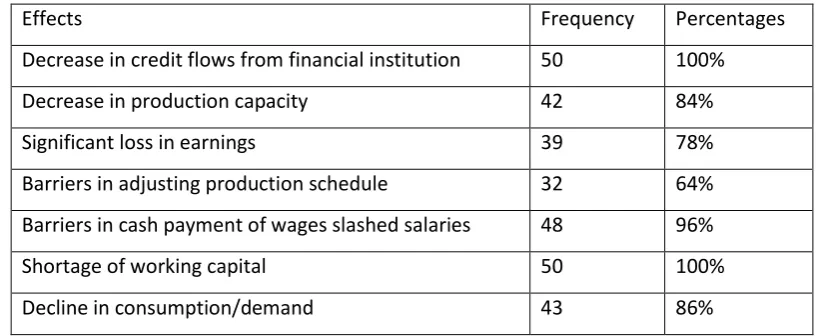
Table no. 1
Effects of demonetisation on micro-small enterprises (multiple responses)
Effects Frequency Percentages
Decrease in credit flows from financial institution 50 100%
Decrease in production capacity 42 84%
Significant loss in earnings 39 78%
Barriers in adjusting production schedule 32 64%
Barriers in cash payment of wages slashed salaries 48 96%
Shortage of working capital 50 100%
Decline in consumption/demand 43 86%
38
International Journal in Management and Social Science http://ijmr.net.in, Email: [email protected]tremendous decrease in the credit flows from banks or financial institutions stated by 100%
respondents. There was a decrease in industrial output or production capacity. Micro and small
enterprises were badly hit by the cash crisis. This sector was also hit with significant wage
implications for its casual employees, stated by 84% respondents. In the opinion of 78%
respondents due to demonetisation, the daily earnings were totally hit; and there was a terrible
setback in the production level. The demonetisation was made impossible for micro-small and the
owners to adjust their production process/function as per the schedule. Due to inadequate cash
in hand, 96% respondents had faced the problems in payments of wages or salaries to the
workers. Since majority of the transactions in this sector are cash-based, and cash liquidity crunch
had likely caused a shortage of cash in terms of working capital stated by 100% respondents. Due
to lack of working capital, their daily functions badly affected and cause slowdown in production
process. The event of demonetisation indicated different picture in terms of labour turnover
which was caused to lack of production, and slowdown of production because of low demand for
products, customers were purchased products only if it is necessarily required. Therefore, there
was a tremendous decline in the conjunction power of people stated by 100% respondents.
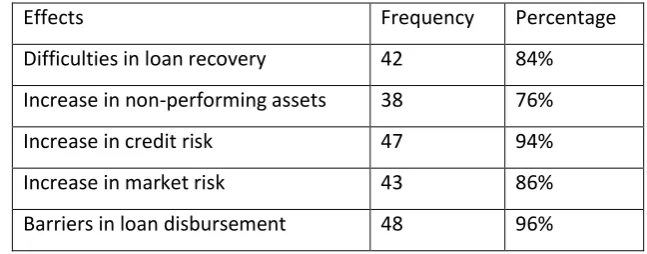
Table no. 2
Effects of demonetisation on banking sector/financial institutions (multiple responses)
Effects Frequency Percentage
Difficulties in loan recovery 42 84%
Increase in non-performing assets 38 76%
Increase in credit risk 47 94%
Increase in market risk 43 86%
Barriers in loan disbursement 48 96%
To investigate about the effects of the demonetisation over the banking sector and financial
institutions is one of the major objectives of the study. As per the information provided by the
84% respondents, there was many difficulties faced by the banks in the loan recovery process;
because, borrowers have not cash to repay the loan installments. In the opinion of 76%
respondents, there was increased in the percentage of non-performing assets. Credit risk as being
increased, stated by 94% respondents. The credit risk has increased its bank borrower or
counterparty failed to meet its obligations in accordance with agreed terms. Due to
demonetisation, the ability of borrower to repay loan is decreased because of unavailability of
cash in hand, and therefore banks faced the problem of credit risk. 86% respondents stated that,
39
International Journal in Management and Social Science http://ijmr.net.in, Email: [email protected]were faced market risks also. Fluctuation in agricultural industrial products were also a cause to
increase the market risk. In the opinion of 96% respondents, due to restrictions posed by the
Reserve Bank of India on cash payments, there were several barriers aroused in the process of
loan disbursement.
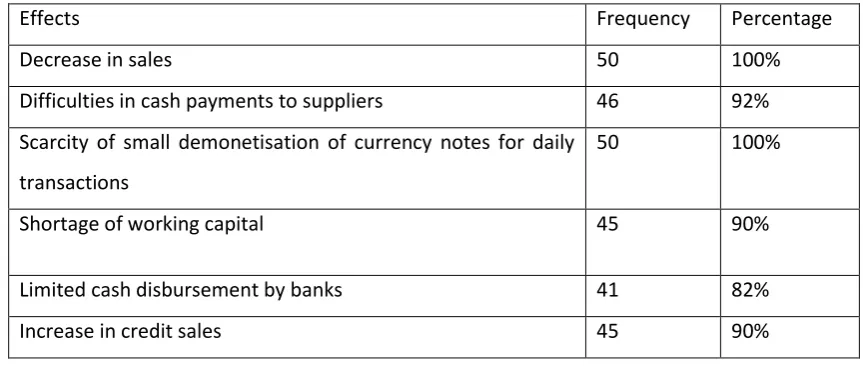
Table no. 3
Major effects of demonetisation on unorganised sector business (multiple responses)
Effects Frequency Percentage
Decrease in sales 50 100%
Difficulties in cash payments to suppliers 46 92%
Scarcity of small demonetisation of currency notes for daily
transactions
50 100%
Shortage of working capital 45 90%
Limited cash disbursement by banks 41 82%
Increase in credit sales 45 90%
There were many implications that had faced by the people who are engaged in unorganised
sector, such as grocery shop keepers, rickshaw drivers, vegetable sellers, street hawkers etc. due
to demonetisation. 100% respondents have stated that there was tremendous decrease in their
cells due to demonetisation. 92% respondents have faced many difficulties in cash payment to
suppliers, and while dealing with banks. Majority of them do not have a formal bank account.
Cash is only means of receiving and payment process. Demonetisation has created a huge
disruption on the daily activities of the people engaged in unorganised or informal sector, with
negative effects on the livelihoods. Apart from this, there was a problem of scarcity of small
demonetisation of currency notes for daily financial activities, stated by 100% respondents. Due
to inadequate small demonetisation currency notes, there is a lack of sufficient working capital
available with the 90% people working in unorganised or informal sector. 82% people faced the
problem of limited cash disbursement by banks.
9] MAJOR FINDINGS
i) On the basis of collective primary information it is found that, due to demonetisation almost
all the small and medium scale sector, financial institution and unorganised sector faced
several problems.
ii) Majority of small and micro entrepreneurs have faced the problem like- lack of working
40
International Journal in Management and Social Science http://ijmr.net.in, Email: [email protected]the suppliers. Decrease in credit for entrepreneurs from financial institutions or from banks
is one another major drawback of demonetisation.
iii) On the basis of collected primary information from the bank employees or employees of the
financial institutions, it is found that, several problems are faced by them. Barriers in loan
disbursement, increase in credit risk and market risk are the major problems raised by banks
and financial institutions. Apart from this, barriers in loan recovery, increasing NPA are some
of the major problems faced by banks in the post-demonetisation period.
iv) Through the study, it is found that, small traders, small-scale entrepreneurs or professionals
are badly affected due to the demonetisation. Due to this policy majority of small
traders/professionals engaged in unorganised sector face the major problems like decrease
in sales, scarcity of small demonetisation currency notes for their daily business activities,
lack of working capital etc.
10] CONCLUSION
The present study provides the adverse effects of demonetisation on the various sectors like
small, micro enterprises, ranking sector/financial institutions and the small traders/businessmen
engaged in unorganised sector. On the basis of collected data from the respondents it is
concluded that, government should required to undertake an action plan with proper and
appropriate facilities before adopting such policy otherwise such type of action policy will make
negative or adverse effects on all the economic sectors and economic components like growth,
livelihood, daily wage employees, marginalised peoples who are least equipped with latest
technology.
REFERENCES-
i) Abhani Dhara K, (2017)," A Study on Impact of Demonetisation over the Banking Sector:
With reference to Veraval City", International Journal of Marketing and Financial
Management, Vol. 5 No.3
ii) D.K. Parmar and S. K. Dave, (2017)," Impact of Demonetisation on Major Sectors of Indian
Economy", International Journal of Scientific Research in Engineering, Vol. 1 No. 2
iii) S. M. Hasan, (2017)," Impact of Demonetisation on SME Sector", International Journal of
Advanced Studies, Vol. 2 No. 3
iv) J. Anupama and S. R. Krishna, (2017)," Impact of Demonetisation on Banking: A
Conceptual Study", International Journal of Economics and Management Studies, Special
41
International Journal in Management and Social Science http://ijmr.net.in, Email: [email protected]v) S. M. Jayasudha and M. Thangave, (2017), "An Empirical Study on the Major Problems
faced due to Demonetisation by Small Retailers in Erode City", Journal of Humanities and
Social Science, Vol.1 No. 5
vi) K. M. Veenith, (2017), "Demonetisation Impact on Small Scale Entrepreneurs: A Srvey of
Retail Vendors in Ernakulam District", Asia-Pacific Journal, Vol.1 No.5
vii) P. Saravana K., (2017), "Demonetisation- A New Transition in Indian Economy", Journal of
Humanities and Social Science, Vol.1 No.5
viii) J. Bansal, (2017), "Impact of Demonetisation on Indian Economy", paper presented at,
International Conference on Innovative Research in Science, Technology and
Management, 22-23 January 2017
ix) P. Mahajan and A. Singla, (2017), "Effects of Demonetisation on Financial Inclusion India",
Paper presented at 6th International Conference on Recent Trends in Engineering,
Science and Management, 8th January 2017
x) R. Bhattacharya and S. N. Mehata, (2017), "Demonetisation-Worst Effected the Small
Traders", International Journal of Latest Technology in Engineering, Management and