MESURE Tool to benchmark Java Card platforms
Samia Bouzefrane1, Julien Cordry1 and Pierre Paradinas2
1
CEDRIC Laboratory, Conservatoire National des Arts et Métiers 292 rue Saint Martin, 75141, Paris Cédex 03, FRANCE
2
INRIA, Domaine de Voluceau - Rocquencourt -B.P. 105, 78153 Le Chesnay Cedex, FRANCE.
Abstract
The advent of the Java Card standard has been a major turning point in smart card technology. With the growing acceptance of this standard, understanding the performance behavior of these platforms is becoming crucial. To meet this need, we present in this paper a novel benchmarking framework to test and evaluate the performance of Java Card platforms. MESURE tool is the first framework which accuracy and effectiveness are independent from the particular Java Card platform tested and CAD used.
Key words: Java Card platforms, software testing, benchmarking, smart cards.
1. Introduction
With more than 5 billion copies in 2008 [2], smart cards are an important device of today’s information society. The development of the Java Card standard made this device even more popular as it provides a secure, vendor-independent, ubiquitous Java platforms for smart cards. It shortens the time-to-market and enables programmers to develop smart card applications for a wide variety of vendors products. In this context, understanding the performance behavior of Java Card platforms is important to the Java Card community (users, smart card manufacturers, card software providers, card users, card integrators, etc.). Currently, there is no solution on the market which makes it possible to evaluate the performance of a smart card that implements Java Card technology. In fact, the programs which realize this type of evaluations are generally proprietary and not available to the whole of the Java Card community. Hence, the only existing and published benchmarks are used within research laboratories (e.g., SCCB project from CEDRIC laboratory [5] or IBM Research [12]). However, benchmarks are important in the smart card area because they contribute in discriminating companies products,
especially when the products are standardized. In this paper, on one hand we propose a general benchmarking solution through different steps that are essential for measuring the performance of the Java Card platforms; on the other hand we validate the obtained measurements from statistical and precision CAD (Card Acceptance Device) points of view.
The remainder of this paper is organised as follows. In Section 2, we describe briefly some benchmarking attempts in the smart card area. In Section 3, an overview of the benchmarking framework is given. Section 4 analyses the obtained measurements using first a statistical approach, and then a precision reader, before concluding the paper in Section 5.
2. Java-Card Benchmarking State of the Art
of Fischer in [7] compares the performance results given by a Java Card applet with the results of the equivalent native application. Another interesting work has been carried out by the IBM BlueZ secure systems group and it was detailed in a Master thesis [12]. JCOP framework has been used to perform a series of tests to cover the communication overhead, DES performance and reading and writing operations into the card memory (RAM and EEPROM). Markantonakis in [9] presents some performance comparisons between the two most widely used terminal APIs, namely PC/SC and OCF. Comparatively to these works, our benchmarking framework not only covers the different functionalities of a Java Card platform but it also provided as a set of open source code freely accessible on-line.
3. General benchmarking framework
3.1 Introduction
Our research work falls under the MESURE project [10], a project funded by the French administration (Agence Nationale de Recherche), which aims at developing a set of open source tools to measure the performance of Java Card platforms. These benchmarking tools focus on Java Card 2.2 functionalities even if Java Card 3.0 specifications have been published since March 2008 [1], principally because until now there is no Java Card 3.0 platform in the market except for some prototypes such as the one demonstrated by Gemalto during the Java One Conference in June 2008. Since Java Card 3.0 proposes two editions: connected (web oriented) edition and classic edition, our measuring tools can be reused to benchmark Java Card 3.0 classic edition platforms.
3.2 Addressed issues
Only features related to the normal use phase of Java Card applications will be considered here. Excluded features include installing, personalizing or deleting an application since they are of lesser importance from user’s point of view and performed once.
Hence, the benchmark framework enables performance evaluation at three levels:
– The VM level: to measure the execution time of the various instructions of the virtual machine (basic instructions), as well as subjacent mechanisms of the virtual machine (e.g., reading and writing the memory).
– The API level: to evaluate the functioning of the services proposed by the libraries available in the embedded system (various methods of the API, namely those of Java Card and GlobalPlatform).
– The JCRE (Java Card Runtime Execution) level: to evaluate the non-functional services, such as the transaction management, the method invocation in the applets, etc.
We will not take care of features like the I/Os or the power consumption because their measurability raises some problems such as:
– For a given smart card, distinct card readers may provide different I/Os measurements.
– Each part of an APDU is managed differently on a smart card reader. The 5 bytes header is read first, and the following data can be transmitted in several way: 1 acknowledge for each byte or not, delay or not before noticing the status word, etc.
– The smart card driver used by the workstation generally induces more delay on the measurement than the smart card reader itself.
3.3 The benchmarking overview
The set of tests are supplied to benchmark Java Card platforms available for anybody and supported by any card reader. The various tests thus have to return accurate results, even if they are not executed on precision readers. We reach this goal by removing the potential card reader weakness (in terms of delay, variance and predictability) and by controlling the noise generated by measurement equipment (the card reader and the workstation). Removing the noise added to a specific measurement can be done with the computation of an average value extracted from multiple samples. As a consequence, it is important on the one hand to perform each test several times and to use basic statistical calculations to filter the trustworthy results. On the other hand, it is necessary to execute several times in each test the operation to be measured in order to fix a minimal duration for the tests (> 1 second) and to expect getting precise results. We defined a set of modules as part of the benchmarking framework. The benchmarks have been developed under the Eclipse environment based on JDK 1.6, with JSR268 [13] that extends Java Standard Edition with a package that defines methods within Java classes to interact with a smart card. According to the ISO 7816 standard, since a smart card has no internal clock, we are obliged to measure the time a Java Card platform takes to answer to an APDU command, and to use that measure to deduce the execution time of some operations.
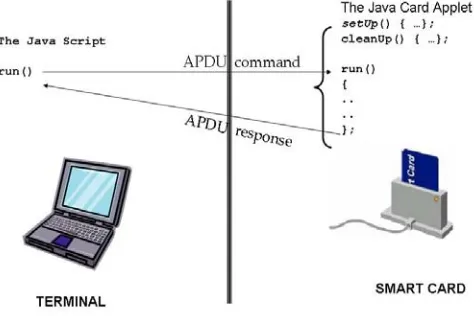
the operation type to measure, the number of loops, etc. A method run() is executed in each script to interact with the corresponding test case within the applet. Similarly, on the card is defined an abstract class that defines three methods:
– a method setUp() to perform any memory allocation needed during the lifetime test case.
– a method run() used to launch the tests corresponding to the test case of interest, and
– a method cleanUp() used after the test is done to perform any clean-up.
Fig. 1 The script part and the Applet part
3.4 Modules
In this section, we describe the general benchmark framework (see Figure 2) that has been designed to achieve the MESURE goal. The methodology consists of different steps. The objective of the first step is to find the optimal parameters used to carry out correctly the tests. The tests cover the Virtual Machine (VM) operations and the API methods. The obtained results are filtered by eliminating non-relevant measurements and values are isolated by drawing aside measurement noise. A profiler module is used to assign a mark to each benchmark type, hence allowing us to establish a performance index for each smart card profile used. In the following subsections, we detail every module composing the framework.
The bulk of the benchmark consists in performing time execution measurements when we send APDU commands from the computer through the CAD to the card. Each test (through the run method) is performed within the card a certain number of times (Y) to ensure reliability of the collected execution times, and within each run method, we perform a certain number of loops (L). L is coded on the byte P2 of the APDU commands which are sent to the on-card applications. The size of the loop performed on
the card is L = (P2)2 since L is so great to be represented with one byte.
The Calibrate Module: computes the optimal parameters
(such as the number of loops) needed to obtain measurements of a given precision.
Fig. 2 Overall Architecture
Benchmarking the various different byte-codes and API entries takes time. At the same time, it is necessary to be precise enough when it comes to measuring those execution times. Furthermore, the end user of such a benchmark should be allowed to focus on a few key elements with a higher degree of precision. It is therefore necessary to devise a tool that let us decide what are the most appropriate parameters for the measurement.
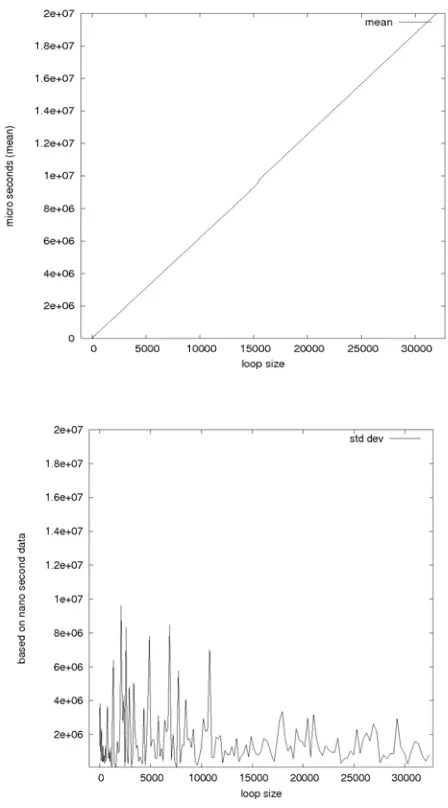
Figure 3 depicts the evolution of the raw measurement, as well as its standard deviation, as we take 30 measurements for each available loop size of a test applet. As we can see, the measured execution time of an applet grows linearly with the number of loops being performed on the card (L). On the other hand, the perceived standard deviation on the different measurements varies randomly as the loop size increases, though with less and less peaks. Since a bigger loop size means a relatively more stable standard deviation, we use both the standard deviation and the mean measured execution time as a basis to assess the precision of the measurement.
duration to perform each test. Hence, with both the ratio and the minimal accepted value, as specified by the end user, we can test and try different values for the loop size to binary search and approach the ideal value.
Fig. 3 Raw measurements and Standard deviation
The Bench Module: For a number of cycles, defined by
the calibrate module, the bench module computes the execution time for:
– The VM byte codes – The API methods
– The JCRE mechanisms (such as transactions).
The Filter Module: Experimental errors lead to noise in
the raw measurement experiments. This noise leads to imprecision in the measured values, making it difficult to
interpret the results. In the smart card context, the noise is due to crossing the platform, the CAD and the terminal (measurement tools, Operating System, hardware).
The issues become: how to interpret the varying values and how to compare platforms when there is some noise in the results. The filter module uses a statistical design to extract meaningful information from noisy data. From multiple measurements for a given operation, the filter module uses the mean value µ of the set of measurements to guess the actual value, and the standard deviation σ of the measurements to quantify the spread of the measurements around the mean. Moreover, since the measurements respect the normal Gaussian distribution, a confidence interval [µ − (n × σ), µ + (n × σ)], within which the confidence level is of 1−a, is used to help eliminate the measurements outside the confidence interval, where n and a are respectively the number of measurements and the temporal precision, and they are related by traditional statistical laws.
The Extractor Module: is used to isolate the execution
time of the features of interest among the mass of raw measurements that we gathered so far. Benchmarking byte-codes and API methods within Java Card platforms requires some subtle means in order to obtain execution results that reflect as accurately as possible the actual isolated execution time of the feature of interest. This is because there exists a significant and non-predictable elapse of time between the beginning of the measure, characterized by the starting of the timer on the computer, and the actual execution of the byte-code of interest. This is also the case the other way around. Indeed, when performing a request on the card, the execution call has to travel several software and hardware layers down to the card’s hardware and up to the card’s VM (vice versa upon response). This non-predictability is mainly dependent on hardware characteristics of the benchmark environment (such as the CAD, PC’s hardware, etc), the Operating System level interferences, services and also on the PC’s VM.
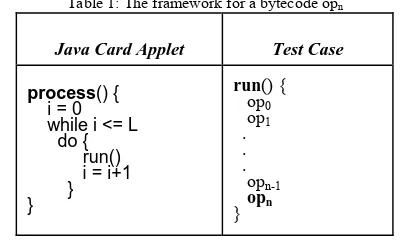
an empty loop and the execution time of the auxiliary byte-codes from that of the byte-code of interest (opn in Table 1) to obtain the isolated execution time of the byte-code. As presented in Table 1, the actual test is performed within a method run to ensure that the stack is freed after each invocation, thus guaranteeing memory availability.
Table 1: The framework for a bytecode opn
Java Card Applet Test Case
process() { i = 0 while i <= L do { run() i = i+1 } }
run() { op0 op1 . . . opn-1 opn }
In Table 1:
- L represents the chosen upper bound, - opn represents the byte-code of interest,
- opi for i ∈ [0..n-1] represents the auxiliary byte-codes
necessary to perform the byte-code opn.
To compute the mean isolated execution time of opn we need to perform the following calculation:
∑
− = −−
=
1 0 ) ( ) ()
(
)
(
n i i L Emptyloop m op mn
M
op
op
M
L n L (1)Where :
‐ M(opi)is the mean isolated execution time of the byte-code opi
‐
m
L(
op
n)
is the mean global execution time of thebyte-code opn, including interferences coming from other operations performed during the measurement, both on the card and on the computer, with respect to a loop size L. These other operations represent for example auxiliary byte-codes needed to execute the byte-code of interest, or OS and JVM specific operations. The mean is computed over a significant number of tests. It is the only value that is experimentally measured.
- Emptyloop represents the execution of a case where the run method does nothing.
The formula (1) implies that prior to computing M(opn)we
need to compute M(opi) for i ∈ [0..n-1].
The Profiler Module: In order to define performance
references, our framework provides measurements that are
specifically adapted to one of the following application domains:
– Banking applications – Transport applications, and – Identity applications.
A JCVM is instrumented in order to count the different operations performed during the execution of a script for a given application. More precisely, this virtual machine is a simulated and proprietary VM executing on a workstation. This instrumentation method is rather simple to implement compared to a static analysis based methods, and can reach a good level of precision, but it requires a detailed knowledge of the applications and of the most significant scripts.
Some features related to byte-codes and API methods appeared to be necessary and the simulator was instrumented to give useful information such as:
– for the API methods :
• the types and values of method parameters • the length of arrays passed as parameters, – for the byte-codes :
• the type and duration of arrays for array related byte-codes (load, astore, arraylength),
• the transaction status when invoking the byte-code.
A simple utility tool has been developed to parse the log files generated by the instrumented JCVM, which builds a human-readable tree of method invocations and byte-code usage. Thus, with the data obtained from the instrumented VM, we attribute for each application domain a number that represents the performance of some representative applets of the domain on the tested card. Each of these numbers is then used to compute a global performance mark. We use weighted means for each domain dependent mark. Those weights are computed by monitoring how much each Java Card feature is used within a regular use of standard applets for a given domain. For instance, if we want to test the card for a use in transport applications, we will use the statistics that we gathered with a set of representative transport applets to evaluate the impact of each feature of the card.
We are considering the measure of the feature f on a card c
for an application domain d. For a set of nM extracted
measurements M1c,f, …, MnMc,f considered as significant for the feature f, we can determine a mean
M
c,fmodelling the performance of the platform for this feature. Given nC cards for which the feature f was measured, it is
necessary to determine the reference mean execution time
Rf , which will then serve as a basis of comparison for all
subsequent test. Hence the “mark” Nc,f of a card c for a
f c
f M
R f c
N
,
,
=
(2)However, this mark is not weighted. For each pair of a feature f and an application domain d, we associate a coefficient αf,d, which models the importance of f in d. The
more a feature is used within typical applications of the domain, the bigger the coefficient:
∑
=
=
F n i id
d f
d f
1 , ,
, β
β
α
(3)where :
– βf,d is the total number of occurrence of the feature f in typical applications of the domain d.
– nF is the total number of features involved in the test.
Therefore, the coefficient αf,d represents the occurrence proportion of the feature of interest f among all the features.
Hence, given a feature f, a card c and a domain d, the “weighted mark” Wc,f,d is computed as follows :
Wc,f,d = Nc,f × αf,d (4)
The “global mark” Pc,d for a card c and for a domain d is then the sum of all weighted marks for the card. A general domain independent note for a card is computed as the mean of all the domain dependant marks.
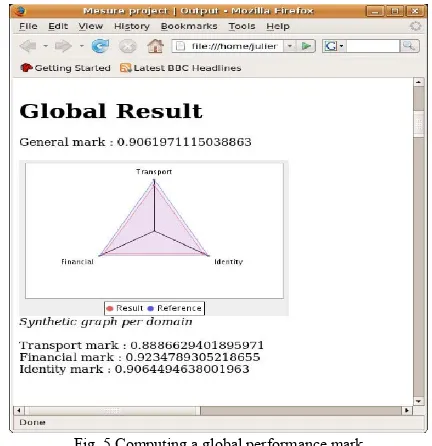
Figure 4 shows some significant byte-codes computed for a card and compared to the reference tests regarding the financial domain. Whereas, Figure 5 shows the global results obtained for a tested card. Based on the results of Figure 5, our tested card seems to be dedicated for financial use.
Fig. 4 An example of a financial-dependent mark
Fig. 5 Computing a global performance mark
4. Validation of the tests
4.1 Statistical correctness of the measurements
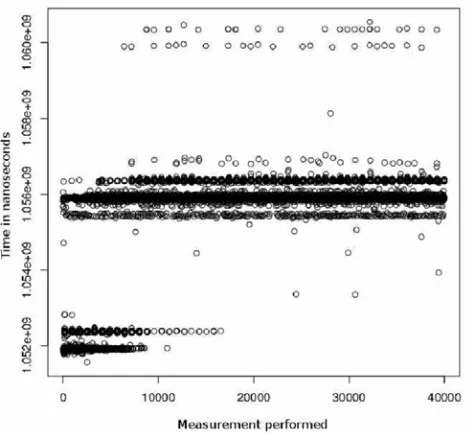
at least 30 measurements). Nevertheless, Rehioui [12] pointed out that the results obtained via methods similar to ours were not normally distributed on IBM JCOP41 cards. Erdmann [6] cited similar problems with Infineon smart cards. When we measure both the reference test and the operation test on several smart cards by different providers using different CADs on different OSs, none of the time performances had a normal distribution (see Figure 6 for a sample reference test performed on a card). The results were similar from one card to another in terms of distribution, even for different time values, and for different loop sizes. Changes in CAD, in host-side JVM, in task priority made no difference on the experimental distribution curve. Testing the cards on Linux and on Windows XP or Windows Vista, on the other side, showed differences. Indeed, the recurring factor when measuring the performances with a terminal running Linux with PC/SC Lite and a CCID driver is the gap between peaks of distribution. The peaks are often separated by 400ms and 100 ms steps which match some parts of the public code of PC/SC Lite and the CCID driver. With other CADs, the distribution shows similar steps with respect to the CAD driver source code. The peaks in the distribution from the measurements obtained on Windows are separated by 0.2 ms steps (see Figure 7). Without having access to neither the source code of the PC/SC implementation on Windows nor the driver source codes, we can deduce that there must be some similarities in the source codes between the proprietary versions and the open source versions.
In order to check the normality of the results, we isolated some of the peaks of some distribution obtained on our measurements and we used the resulting data set. The Shapiro-Wilk test is a well established statistical test used to verify the null hypothesis that a sample of data comes from a normally distributed population. The result of such a test is a number W ∈ [0, 1], with W close to 1 when the data is normally distributed. No set of value obtained by isolating a peak within a distribution gave us a satisfying W close to 1. For instance, considering the peak in Figure 8, W = 0.8442, which is the highest value for W that we observed, with other values ranging as low as W = 0.1384. We conclude that the measurements we obtain, even if we consider a peak of distribution, are not normally distributed.
4.2 Validation through a precision CAD
We used a Micropross MP300 TC1 reader to verify the accuracy of our measurements. This is a smart card test platform, that is designed specifically to give accurate results, most particularly in terms of time analysis.
The results here are seemingly unaffected by noises on the host machine. With this test platform, we can precisely monitor the polarity changes on the contact of the smart card, that mark the I/Os.
We measured the time needed by a given smart card to reply to the same APDUs that we used with a regular CAD. We then tested the measured time values using the Shapiro-Wilk test, we observed W ≥ 0.96, much closer to what we expected in the first place. So we can assume that the values are normally distributed for both the operation measurement and the reference measurement.
We subtracted each reference measurement value from each sadd operation measurement value, divided by the loop size to get a time values set that represents the time performance of an isolated sadd bytecode. Those new time values are normally distributed as well (W = 0.9522). On the resulting time value set, the arithmetic mean is 10611.57 ns and the standard deviation is 16.19524. According to [6], since we are dealing with a normal distribution, this arithmetic mean is an appropriate evaluation of the time needed to perform a sadd byte code on this smart card. Using a more traditional CAD (here, a Cardmann 4040, but we tried five different CADs) we performed 1000 measurements of the sadd operation test and 1000 measurements of the corresponding reference test. By subtracting each value obtained with the reference test from each of the values of the sadd operation test, and dividing by the loop size, we produced a new set of 1000000 time values. The new set of time values has an arithmetic mean of 10260.65 ns and a standard deviation of 52.46025.
The value we found with a regular CAD under Linux and without priority modification is just 3.42% away from the more accurate value found with the precision reader. Although this is a set of measurements that are not normally distributed (W = 0.2432), the arithmetic mean of our experimental noisy measurements seems to be a good approximation of the actual time it takes for this smart card to perform a sadd. The same test under Windows Vista gave us a mean time of 11380.83 ns with a standard deviation of 100.7473, that is 7,24% away from the accurate value.
We deduce that our data are noisy and faulty but despite a potentially very noisy test environment, our time measurements always provide a certain accuracy and a certain precision.
5. Conclusion
requirements of the different application domains. For the time being, there is no other open source benchmark solution for Java Card. The objective of our project [10] is to satisfy this need by providing a set of freely available tools, which, in the long term, will be used as a benchmark standard. In this paper, we have presented the overall benchmarking framework. Despite the noise, our framework achieves some degree of accuracy and precision. Our benchmarking framework does not need a costly reader to accurately evaluate the performance of a smart card. Java Card 3.0 is a new step forward for this community. Our framework should still be relevant to the classic edition of this platform, but we have yet to test it.
Fig. 6 Measurements of a reference test as the tests proceed under Linux, and the corresponding distribution curve L = 412
Fig. 7 Distribution of sadd operation measurements using Windows Vista, and a close up look at the distribution (L = 902)
Fig. 8 Some Distribution of the measurement of a reference test: close up look at a peak in distribution L = 412
References
[1] Java card 3.0 specification, March 2008.
[2] Pierrick Arlot. Le marché de la carte à puce ne connaît pas la crise. Technical report, Electronique international, 2008.
[3] Zhiqun Chen, Java Card Technology for Smart Cards: Architecture and Programmer’s Guide, Addison Wesley 2000.
[4] Jordy Castellà-Roca, Josep Domingo-Ferrer, Jordi Herrera-Joancomati, and Jordi Planes. A performance comparison of Java Cards for micropayment implementation. In CARDIS, pages 19–38, 2000.
[5] Jean-Michel Douin, Pierre Paradinas, and Cédric Pradel. Open Benchmark for Java Card Technology. In e-Smart Conference, September 2004.
[6] Monika Erdmannn. Benchmarking von Java Cards. Master’s thesis, Institut für Informatik der Ludwig-Maximilians-Universität München, 2004.
[7] Mario Fischer. Vergleich von Java und native-chipkarten toolchains, benchmarking, messumgebung. Master’s thesis, Institut für Informatik der Ludwig-Maximilians-Universität München, 2006.
[8] David J. Lilja. Measuring Computer Performance: A Practitioner’s Guide. Cambridge University Press, 2000.
[9] Constantinos Markantonakis. Is the performance of smart card cryptographic functions the real bottleneck? In 16th international conference on Information security: Trusted information: the new decade challenge, volume 193, pages 77 – 91. Kluwer 2001. [10] The MESURE project website. http://mesure.gforge.inria.fr. [11] Pierre Paradinas, Samia Bouzefrane, and Julien Cordry.
Performance evaluation of Java card bytecodes. In Springer, editor, Workshop in Information Security Theory and Practices (WISTP), Heraklion, Greece, 2007.
[12] Karima Rehioui. Java Card Performance Test Framework, September 2005. Université de Nice, Sophia-Antipolis, IBM Research internship.
Samia Bouzefrane is an associate professor at the CNAM (Conservatoire National des Arts et Métiers) in Paris. She received her Ph. D. in Computer Science in 1998 at the University of Poitiers (France). She joined the CEDRIC Laboratory of CNAM on September 2002 after 4 years at the University of Le Havre. After many research works on real-time systems, she is interested in smart card area. Furthermore, she is the author of two books: a French/English/Berber dictionary (1996) and a book on operating systems (2003). Currently, she is a member of the ACM-SIGOPS, France Chapter.
Julien Cordry is a PhD student from the SEMpIA team
(embedded and mobile systems towards ambient intelligence) of the CNAM in Paris. The topic of his research is the performance evaluation of Java Card platforms. He took part in the MESURE project, a collaborative work between the CNAM, the university of Lille and Trusted Labs. He gives lecturers at the CNAM, at the ECE (Ecole Centrale d'Electronique) and at the EPITA (a computer science engineering school). The MESURE project has received on September 2007 the Isabelle Attali Award from INRIA, which honors the most innovative work presented during “e-Smart” Conference.
Pierre Paradinas is currently the Technology-Development